Dryer for Pet Hair in a Rental, Using the One You Have
What a dryer for pet hair really does in a rental: loose hair goes to the lint trap, embedded hair stays [and one test load shows which].

Alfredo RamsesFounder · October 13, 2026 · 14 min read

On this page7 sections
- 1What a Dryer Can Take Off Clothes, and What It Can't
- 2The Pet Cycles, Read Closely
- 3The Lint Trap Is Where the Hair Goes, and Where It Stalls
- 4A Silicone Disc in the Drum: When It Works and When It Doesn't
- 5The Dryer You Don't Own: A Renter's Test Load and What to Check
- 6Shake First, Leave Room, Then Read the Trap
- 7Frequently Asked Questions
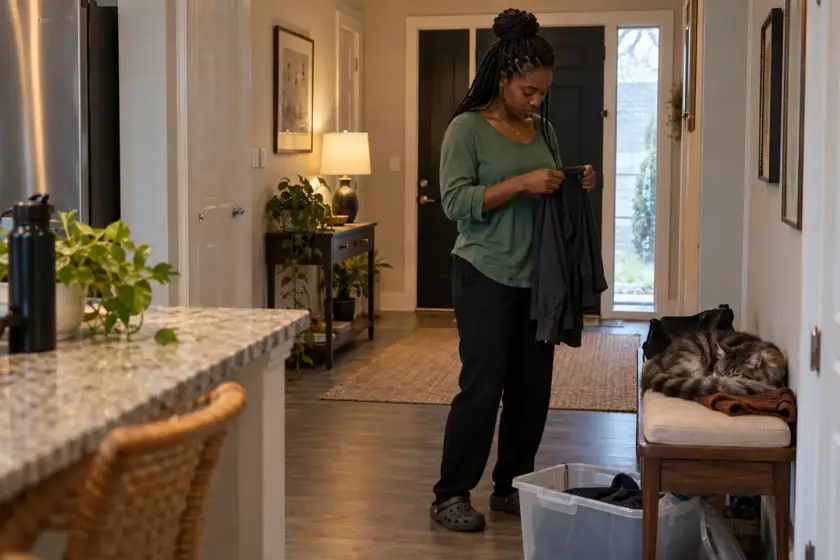
You lift the black sweater out of the dryer, warm and soft, and it still looks furred. The cat is already in the basket you set down for a second, because a basket of warm clothes is the best spot in the apartment and he found it before you did. A dryer for pet hair is an air machine, not a hair remover: it lifts what is loose and carries it to the lint trap, and it leaves behind what has been pressed into the weave. This guide covers what a dryer takes off, what the pet-cycle buttons actually claim, and what you can check on the machine your landlord picked.
Quick Answer
Mostly no. A dryer lifts loose cat hair and sends it to the lint trap, but hair pressed into knit or fleece stays put. Even the maker of a silicone drum disc says it may not clear embedded hair in one cycle, so shake loose hair off before the wash.
What a Dryer Can Take Off Clothes, and What It Can’t
The machine is not failing here, and neither is the cat. Hair reaches clothes in two states. Loose hair sits on the surface or in the top of the fabric and moves with almost no effort.
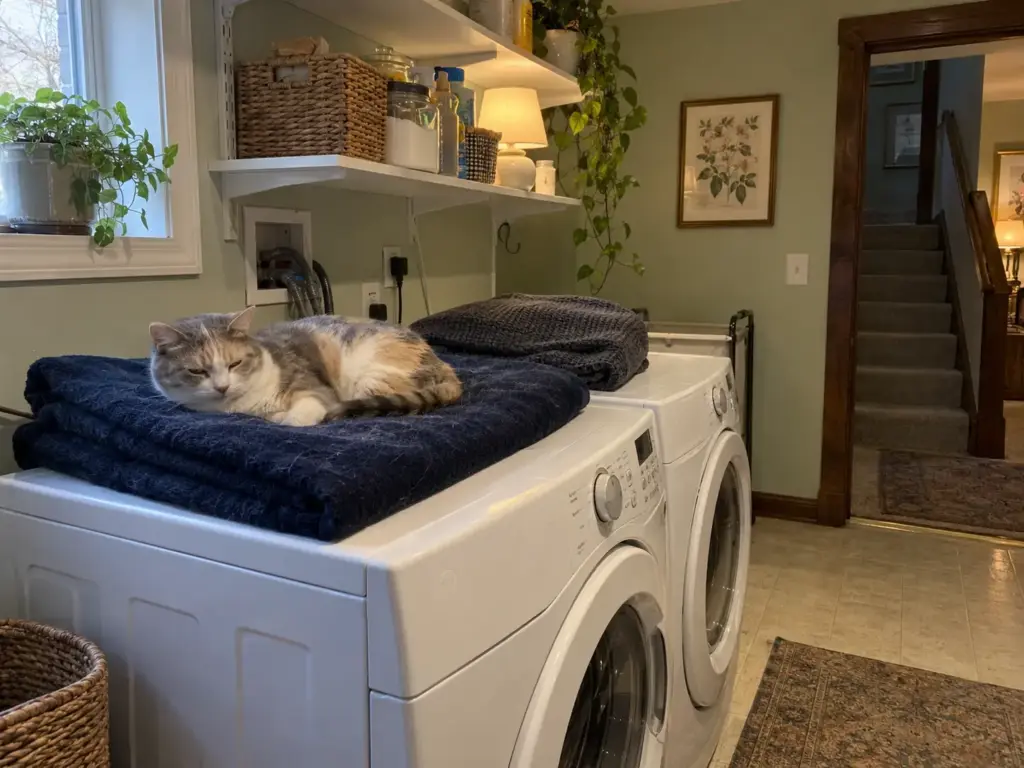
Embedded hair has been pressed down into the weave, most likely by a cat settling onto a pile of clothes that happens to be the warmest, softest spot in the apartment, which is a fair choice on his part. A dryer works on the first kind and mostly leaves the second.
The order for the house as a room-by-room job (what to run first, what to leave for last) lives in the guide on how to clear cat hair around the house without moving it, so this page looks only at the machine in the laundry corner.
What the dryer does with loose hair
Tumbling and moving air do one thing well: they lift hair that is not holding on to anything and send it wherever the air goes. In a dryer, the air goes to the lint trap. The listing for the silicone drum disc covered later in this guide says it without decoration: the product “does not permanently trap or store collected hair; loosened hair will move into the dryer lint trap.” Whatever helps that hair come loose, a disc or a pet cycle or plain tumbling, the destination is the same screen by the door.
That makes the trap a measuring stick, which is handy when the machine is not yours. What you find on it is the hair that left the clothes. What is still on the clothes is the part the machine could not move.
Why hair pressed into knit or fleece stays
Knit has loops and fleece has pile, and both are built to hold on to things. A hair pushed down between those fibers is gripped along its length, so air passing over the top has to pull it out against that grip. This part is reasoning, not a lab result, but the disc’s own listing lands in the same place: it “may not remove all embedded or heavily accumulated pet hair in one cycle.”
One Amazon reviewer put it this way: “Does not remove pet hair from my laundry. I have two small burmese cats that are shorthaired.”
A forum thread from February 2023 describes the same wall from the dog side. A golden retriever owner with a top-loader wrote that the trouble is “washing clothes with lot of embedded hair. A good shake before washing doesn’t help much.”
Different animal, same weave. Which fabric grips hardest is the same question as on the sofa, and cat hair off a rented couch, fabric by fabric goes through it for upholstery.
Free first: what to do before the load goes in
Before any machine gets involved, take the hair off by hand. Shake each piece, then run a hand along knits and fleece in one direction to gather what is loose into a clump you can drop in the trash. The disc maker asks for the same thing in its listing: for heavily furred items, “remove excess loose fur before washing.” It is the one step that the seller of a product and a person trying not to buy one agree on.
Do the shaking over a trash bag, not over the rug. Loose hair dropped on the floor lands on the spot your cat is most likely to lie down on next, and from there it finds its way back into the basket.
The Pet Cycles, Read Closely
A button labeled “pet” on a dryer panel sounds like a promise. Read closely, the two manufacturers whose pages say anything about it make different claims, and neither is a guarantee for your sweater.
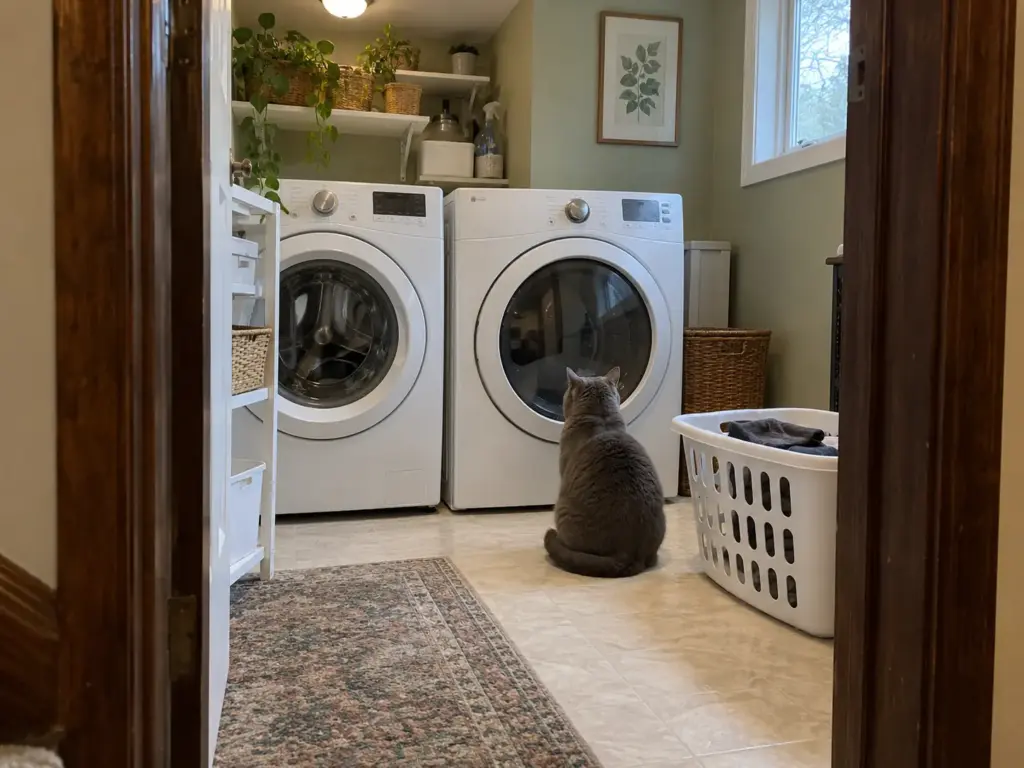
Maytag’s no-heat extended dry time
Maytag’s 2022 announcement describes its Pet Pro option for dryers as one that “uses a no-heat, extended dry time to lift pet hair from clothes and capture it in the XL lint trap.” In plain terms, the drum turns longer and without heat, so the hair rises into the air and lands in a larger trap that you empty. Expect a longer cycle, because time is what the option is built around. But a longer cycle is also the price of the feature, and a description of what a maker intended is not a test of what happens to your laundry.
What Speed Queen says (and what its page leaves out)
Speed Queen’s page for its DR7 dryer says the machine is “Designed with Exclusive Pet Plus cycles that remove pet hair before washing.” That tells you when the cycle is meant to run: ahead of the wash. It does not tell you how it works, because the page gives no mechanism, no heat setting and no running time.
So the two cannot be compared on method, only on wording: Maytag gives a method and Speed Queen gives a timing. A claim that stops at “before washing” is not something to plan a purchase around.
Why the washer’s filter does most of the catching
The same Maytag announcement credits the washer, not the dryer, with the big number: a Pet Pro filter “removing 5X more pet hair.” The footnote matters as much as the number: “Comparing Normal cycle with Pet Pro Filter and option to cycle using traditional agitator without Pet Pro Filter and option. Results will vary based on fabric and type of pet hair.”
So the 5X sets one of its own cycles against a machine without the filter. It is not a promise about the washer you have.
Even so, it points at something useful. The design intent is for a good share of the hair to be gone before the load reaches the dryer, which makes the dryer the last stop in the chain and not the first.
For a renter with a stock washer, the shaking in the first section carries more weight than I would give any panel setting.
The Lint Trap Is Where the Hair Goes, and Where It Stalls
If you empty the trap and still see hair on the clothes, the trap is not lying. What it holds is the hair that did leave. What you still see is the hair that did not.
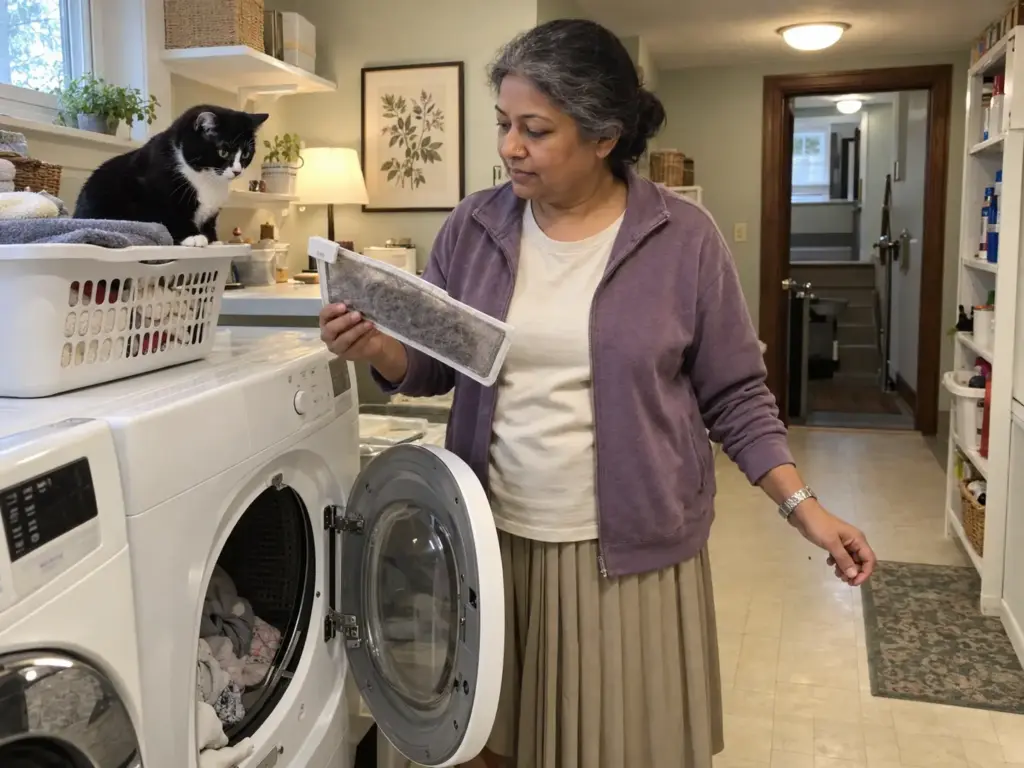
What a lint trap actually catches
A lint trap catches what the air carries to it, which is loose hair and lint. Hair pressed into a knit never leaves the fabric, so it never reaches the screen. That gap is the difference you are looking at when the trap is full and the sweater is not clean.
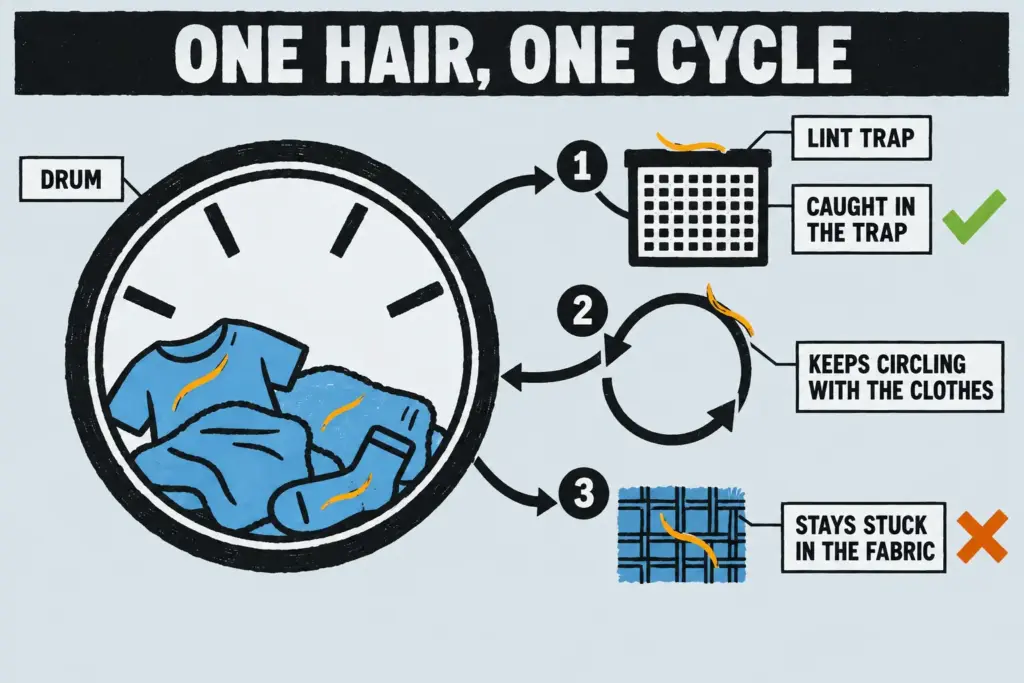
A Pittsburgh Post-Gazette test of the FurZapper disc ran three dog beds through the dryer with one in the drum. The tester found the beds had “a few remaining hairs,” then added, “But I found a lot more in the lint trap.” The review rated the disc 4 out of 5. Those were dog beds, not cat clothes, so it shows the route and not your sweater, but the route is the point: far more hair ended up in the trap than stayed on the beds.
What a full trap or a packed drum does
Take the disc listing’s logic one step further. If loose hair travels to the lint trap and the trap is already full, that hair has nowhere to go. That is my reasoning, not a measured mechanism, and no source I found tests it.
What the seller does state is a rule about the drum: “Do not overload the washer or dryer; laundry and FurZappers must move freely.” A packed drum is one where the pieces cannot slide past each other, and hair that cannot move is hair that stays.
No source gives a number for “packed”, and I will not invent one. The common habit of filling the drum to save a cycle is the advice that fails here: with hair, a load size that looks comfortably loose to you is the safer reading.
Empty the trap before each load, not after several. The same gesture shows you how much hair left the last one, which is the only free feedback the machine gives you.
A cat’s warm spot that is not the dryer
A dryer that has just finished is the warmest enclosed spot in the apartment, and the cat knows it. An open door at the end of a cycle is an invitation.
WebMD’s guide to risky hiding places gives the habit in a single line: “Keep the door tightly shut and always check inside before you use the appliance.”
A veterinary column on cats in dryers recounts a cat that “survived, but it certainly served as a cautionary tale.” That glance inside is the routine. A cat that has been in a running cycle is a call to the vet, not a laundry question. And the same look in the hamper before the wash covers the other warm hiding place.
Everything about cleaning the trap safely, plus the pass without heat, sits in the clothes guide under the no-heat pass and the lint-trap safety line, so it stays there.
A Silicone Disc in the Drum: When It Works and When It Doesn’t
Free steps come first: shake the hair off, and give the load room. Both are what the disc’s own listing asks for. If the clothes still come out furred after those, a silicone laundry disc, a kind of hair catcher for the drum, is the one drum-side item worth testing in your home, with its limit stated before you spend anything.
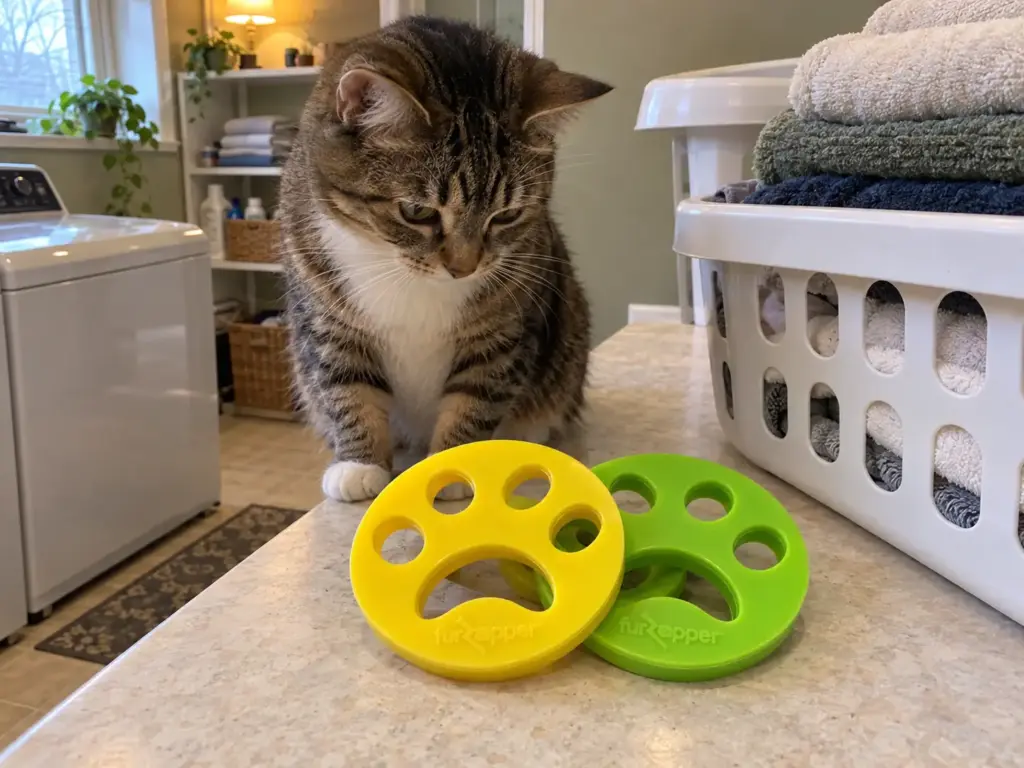
What the maker says it does
The FurZapper Pet Hair Remover for Laundry, 2 Pack is a silicone disc measuring 4 by 4 by 1 inches that tumbles with the clothes, and you can find it on Amazon. Its listing says it “does not permanently trap or store collected hair,” which makes it a mover and not a keeper. The same listing admits the limit up front: it “may not remove all embedded or heavily accumulated pet hair in one cycle.” That sentence is the disc’s flaw in the seller’s own words, and it matches the embedded hair from the first section.
The one-disc and two-disc rule
The loading rule is the only number in the listing: one disc for a small-to-medium load with light or moderate hair, two for larger loads, bedding, blankets, heavier hair or several shedding pets. That count is the seller’s rule of thumb, not a test.
My reading is to start with one on a light load, because a second disc takes up drum room, and drum room is exactly what the listing says to protect. Two discs for a duvet, one for a handful of t-shirts. The seller also says a rinse with a little dish soap lets the disc regain its tack once the surface fills up.
For a light load, one disc. Keep the second for bedding or a blanket, as the seller asks, and if two discs make the drum look full, take the load down instead.
Why the reviews split almost in half
Amazon’s own summary of the 2-pack shows 3.5 stars out of 5 from 61,640 ratings, and its “Effectiveness” tag counts 8,304 mentions: 2,957 positive and 5,347 negative. That is closer to two in three than to half, and it is Amazon’s tally of what buyers wrote, not a test.
Two reviews sit in that same listing.
One reads: “Doesn’t work . Comes out perfectly clean from the washer and with barely anything on it from the dryer. Don’t overload the washer for better results.” Another, from a household with “2 cats and a dog,” says “I use it all the time now.”
Both can be true. A disc with barely anything on it is either a load that had little left to catch or a drum too full for the disc to touch the clothes, and the review cannot tell you which.
A home with two cats, a dog and fur on everything gives the disc far more to find. The load is the variable.
The Dryer You Don’t Own: A Renter’s Test Load and What to Check
The dryer in a rental is not yours to swap, open or upgrade. What you control is the load, the order and what you do with the trap. The pet cycle is the landlord’s decision, and the test below is yours.
One test load, one look at the trap
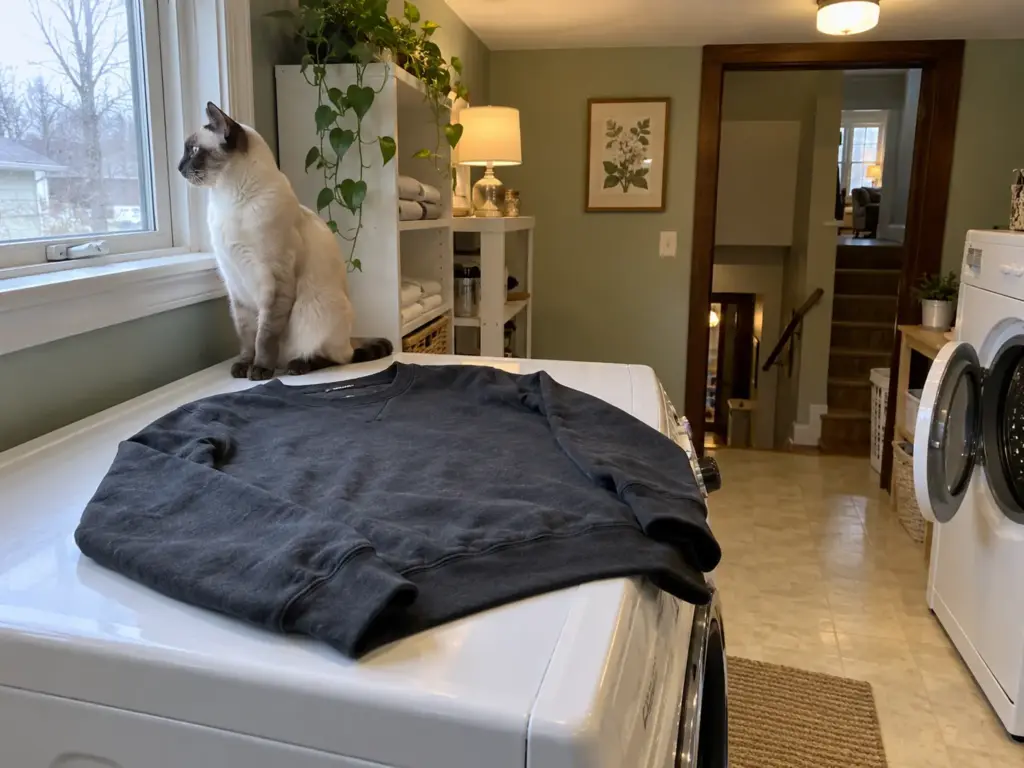
This is my suggestion, with no source behind it. Pick a small load of dark clothes, shake it, run a normal cycle, and then make two looks: first at the clothes, then inside the trap. Next time, change one thing (shake harder, load less, add a disc) and look in the same two places. One change at a time tells you which step is doing the work in your laundry corner.
After the test load, hold the dark clothes up against a window. Daylight shows the hair that a lamp at night hides, and it is where you will actually judge the result.
A shared laundry room and what the cat leaves behind
A shared machine adds two problems. You do not know what the last person left in the trap, and your cat’s hair goes into a drum that the other tenants use next. Maytag’s own 2022 survey of 2,000 dog and cat owners reported nearly 50% going to a laundromat to avoid using their machines at home. That is a seller’s survey, so read it as a mood and not as data, but it means a lot of people do this with a bag of furred clothes.
Shake the load over a bag at home so the hair stays in your apartment, empty the trap before you start, and leave it empty for the next person. A shared dryer is the one place where your cat’s tenancy becomes your neighbors’ problem.
What to look for if you ever choose the dryer
If you pick the dryer yourself, compare features and skip the brand lists. The pet option, as Maytag describes it, is a no-heat, longer cycle: ask whether the machine in front of you has something like it and what its panel calls it. The trap should be large and easy to reach, since you will empty it more than any other part.
Maytag’s own wording for its trap is “XL lint trap”, which is a feature to look for, not a size to quote. Whether it is a front load, a stacked washer dryer pair in a closet or a compact dryer, the drum capacity, listed in cubic feet on a spec sheet, tells you how much room the load you actually run leaves for hair to move.
Whatever you pick, the shaking and the loose load still do their share.
Shake First, Leave Room, Then Read the Trap
A dryer takes off loose hair and delivers it to the trap; hair pressed into knit or fleece mostly stays. The trap and the drum decide the result more than the panel does, and in a rental those are the parts you control. A silicone disc works as far as the load leaves it room to move, and its own listing says embedded hair may need more than one cycle.
Three weeks from now, run the same small dark load again and compare what the trap holds against the first time. A fuller trap and cleaner clothes mean the routine is holding. Clothes that look the same mean the next thing to change is how much goes into the drum.
Before the next load goes in, shake each piece, run a hand down the knits, and put in fewer pieces than you usually would. If the clothes come out furred week after week, the hair is landing somewhere it keeps ending up, and the piece on reducing shedding by fixing where the hair lands starts earlier in the chain than any dryer does.
Frequently Asked Questions
01What is the best dryer for pet hair?
Look for features, not a brand: a pet cycle that runs longer without heat, a large lint trap, and drum room for the load you actually run. The dryer you already have still does better with a shaken, loosely packed load.
02What can I use in a dryer for pet hair?
A silicone disc made for the drum is one option, and its own listing says it moves loose hair to the lint trap and may leave embedded hair behind. Shaking loose hair off before the wash is the free step, and it comes first.
03Does a dryer get rid of pet hair?
Loose hair, yes: the airflow lifts it toward the lint trap, while hair pressed into knit or fleece mostly stays in the fabric. Shake the loose hair off first and give the drum room to move.
04Should I check the dryer before I run it if my cat sleeps on warm laundry?
Yes, look inside the drum before you close the door and start the cycle, because cats seek out warm, enclosed spots. It is a home-safety habit, and a cat that has been hurt needs a vet.

Leave a comment