Cat Territorial Behavior With One Cat or Two, Zone by Zone
See what your cat is claiming and which zone to fix first. Cat territorial behavior with one cat or two, free moves before any purchase (+ vet line)

Alfredo RamsesFounder · November 3, 2026 · 22 min read

On this page12 sections
- 1Cat Territorial Behavior Starts as a Claim, Not a Threat
- 2When the Claim Changes Overnight, the Vet Comes First
- 3Why the Claim Starts Now: Age, a Newcomer, a Move, a Window
- 4Reading a Claim Before It Turns Into Friction
- 5The Apartment as Three Zones, and Which Fix Goes Where
- 6Sleep and Litter: the Zone a Cat Defends Hardest
- 7Food and Water: One Station per Cat, Out of Sight of the Next
- 8The Window and the Shared Rooms: Split the View Before You Buy a Perch
- 9Pheromone Diffusers: What They Settle and What They Leave Alone
- 10One Cat, No Housemate: What a Single Cat Still Claims
- 11Move One Thing Today, Then Watch Who Stops Turning Back
- 12Frequently Asked Questions
Your cat has been in the hallway doorway every evening this week, and when you step over him he looks up, then settles back in. That is cat territorial behavior in its everyday form: a claim on the one spot your home lets him hold, not a challenge to you. VCA Animal Hospitals, the ASPCA and Four Paws all describe a claim that reaches indoor cats and can stretch to the street outside the glass, so a home with a single cat is not exempt. What follows covers how the claim shows up, when it goes to the vet first, why it starts, and a three-zone map of your home with a fix for each zone, the free ones first.
Quick Answer
Cat territorial behavior is a cat claiming a spot, a route, a window or a person, even in a one-cat home. A claim is not an attack. Anything that changes overnight goes to the vet first. After that, the home sorts into three zones (sleep and litter, food and water, shared rooms and windows), each with a different fix.
Cat Territorial Behavior Starts as a Claim, Not a Threat
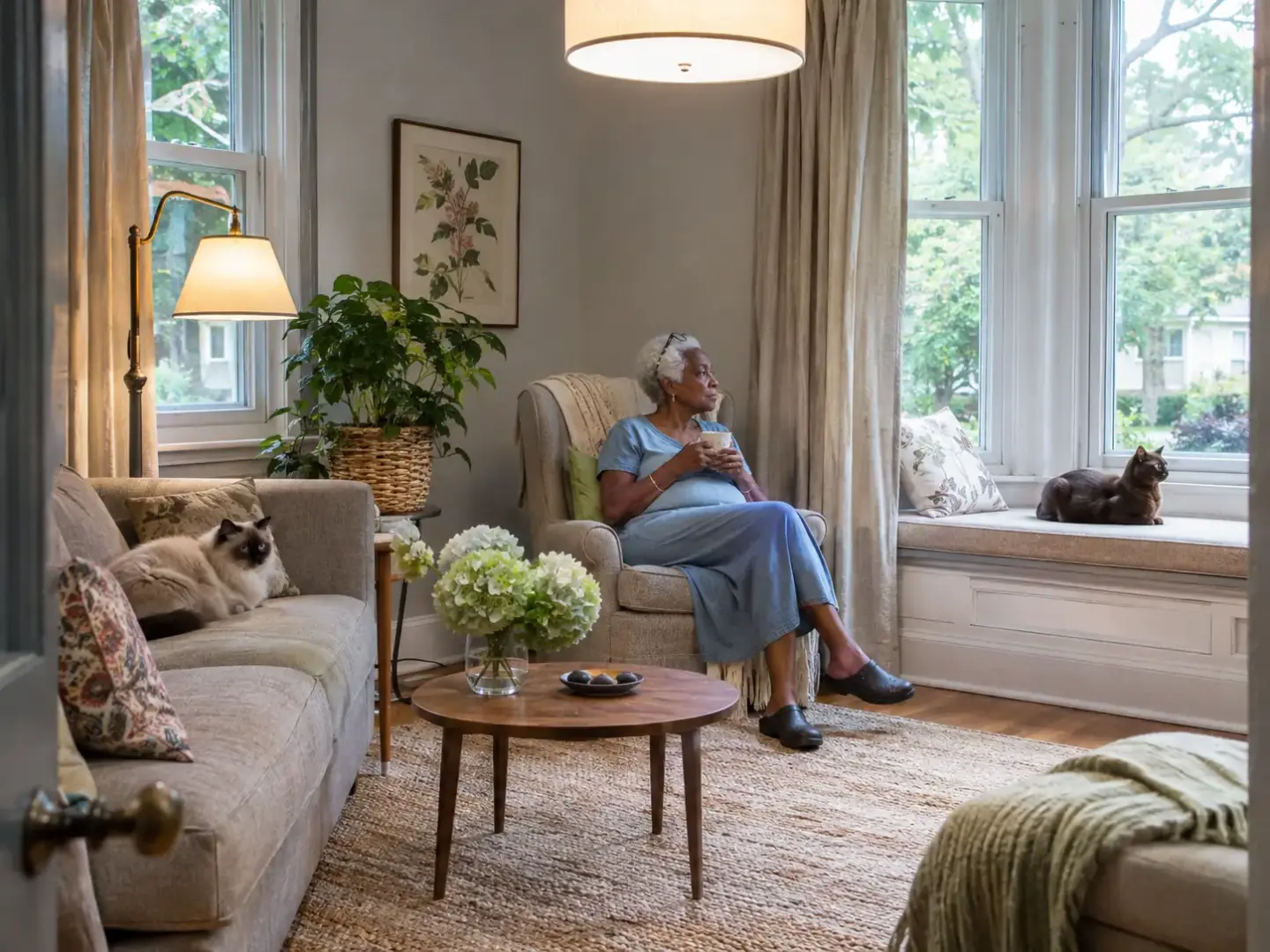
A cat who plants himself in the same place day after day is working out where in this home he can hold a spot without being moved. Cat territorial behavior is mostly that question answered without a sound: a bed he will not leave, a route he walks the same way each evening, a window he will not share.
What the Cat Is Claiming: a Spot, a Route, a Window
Territory is not the house. It is a map, with a handful of places that have an owner and a handful of routes that carry traffic.
The sleeping spot and the litter area make up his core territory, the most guarded places on the map. Food and water sit in a second zone, his hunting territory. Everything else (the windows, the living room, the hallways) is shared territory that every resident crosses.
What a cat claims is usually small and specific: the cushion at the end of the sofa, the diagonal from the bedroom door to the kitchen, the sill with the best view. A doorway is a favorite because a cat sitting in one can see two rooms and be surprised from neither. So the cat who holds a doorway is not giving orders. He is keeping the one spot where nothing reaches him unseen.
Four Paws on how cats claim territory puts one common mistake to rest: claiming territory is natural feline behavior, and indoor cats do it too. It is not a habit that only appears once a second cat moves in.
How a Cat Marks It Without a Sound
Scent marking comes in three forms: he patrols the space, he rubs his chin and cheeks on it, and now and then he marks it with urine. At home the first two look like ordinary habits. The cheek lands on the same corner of the door frame, at his own height, and the walk from the bed to the window repeats every evening at the same pace.
Cheek rubbing and patrolling make no noise, and neither does a cat lying across a threshold so that anyone passing has to step over or around. The whole set gets read as stubbornness.
Urine spraying is the exception, and it belongs to a different list. If a cat who has never done it starts, he needs a vet before anyone moves a bed.
The Claim Reaches Past the Walls
The claim does not stop at the front door. According to the ASPCA’s guide to aggression in cats, “A cat’s perceived territory could be the entire house or part of it, the yard, the block or the neighborhood.” For an indoor cat the window becomes a border: the cat on the sill is watching ground he counts as his, and any cat who crosses it is trespassing.
That has two consequences later in this guide. A cat who watches the block holds a bigger territory than your apartment, so moving furniture alone will not change what he is guarding. And the street keeps supplying outdoor cats to react to, which no door can close.
When the Claim Changes Overnight, the Vet Comes First
Everything else in this guide is about patterns tied to a place, a doorway or a window. A cat who changes overnight is a different case, and his first stop is a vet, with the furniture left alone. The ASPCA names a complete veterinary exam as the first step when a cat turns tense, and VCA Animal Hospitals on territorial tension between household cats says that when two cats have recently started fighting, both should be examined. Cats Protection, the UK charity, gives the same first step for a cat whose behavior has turned hostile: see the vet.
Call the vet when you see any of these:
- A cat marks with urine and never did before
- Any wound, bite or scratch that breaks the skin
- A cat stops using the litter box, stops eating or stops moving the way he always has
- A change of character from one day to the next, toward you or toward the other cat
This guide stops there on purpose. What sits behind those signs is for the vet to find. A clean visit sends you back to the floor plan, and the rest of this guide starts from there.
Why the Claim Starts Now: Age, a Newcomer, a Move, a Window
A cat who was easy for years and suddenly guards a hallway usually has a trigger inside the house, and the common ones are short to list: his age, a newcomer, a move, a window.
Two to Three Years Is When It Often Starts
VCA places the start of territorial behavior after a cat matures socially, typically between two and three years of age. A cat who shared the sofa without fuss at one can begin guarding the end of it at two. Nothing in the house went wrong; his idea of what belongs to him got bigger. If your cat is in that window, read the guarding as news about his map and not as a flaw in his character.
A New Cat Redraws the Map
A new cat, a kitten, a move or a rearranged living room shifts the borders, and ground that belonged to nobody suddenly has two candidates. Bringing a newcomer in well has a full walkthrough in how to introduce cats in a small apartment, stage by stage, and how long it takes depends on gates, not days, as how long an introduction should run explains.
A kitten is a smaller newcomer with different wrinkles, and adding a kitten without crowding the resident cat deals with that case. Scent is a claim too. Where a swapped item sits decides whether it calms or provokes, ground covered in why swapping scent between cats can backfire.
The Street Outside the Glass
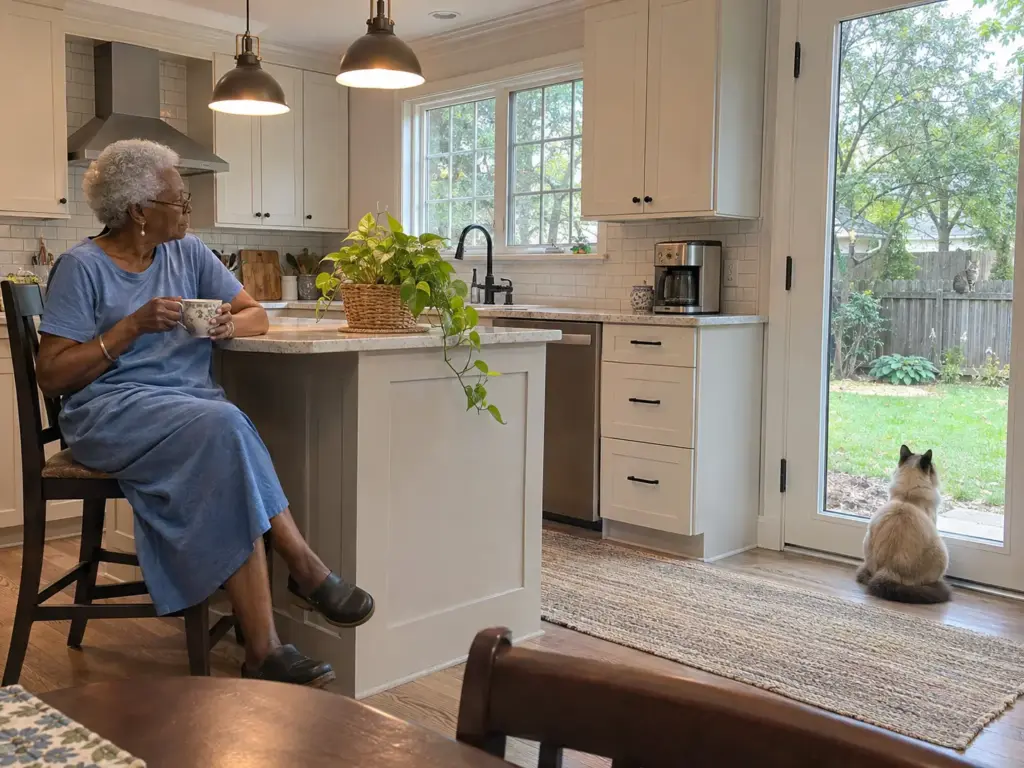
The window brings in a trigger from outside the household. A cat on the sill watches another cat cross the yard. He cannot reach it. The housemate sitting a few feet away is in range.
VCA calls the result redirected aggression: the cat inside turns on his companion because the one outside is out of reach. The street is the trigger and the housemate is the target.
The clue is timing. Tension arrives in a burst at the moment a cat appears outside, not at random hours. The window is cat TV, and it plays all day, so the fix is to cut the sightline, covered in the window section below.
Reading a Claim Before It Turns Into Friction
A cat sitting in the middle of the hallway could be comfortable, lazy or collecting a toll, and the three look alike from the kitchen.
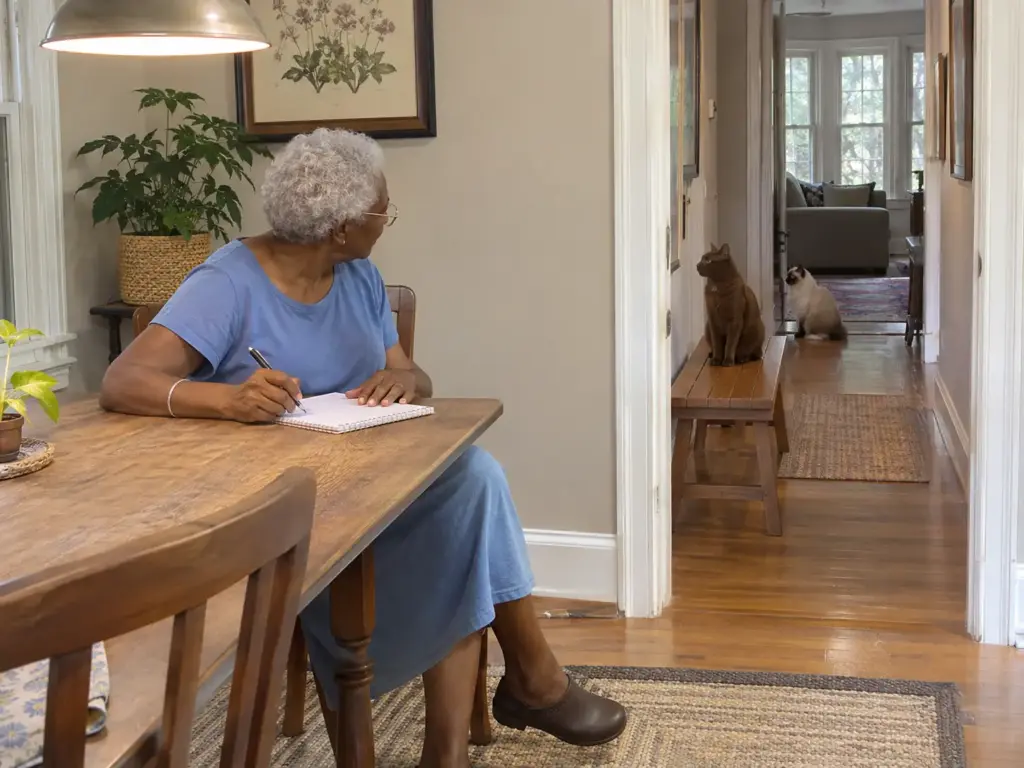
A Cat Holding a Spot Versus a Cat Blocking a Door
Holding a spot means staying put. Blocking a door means making the other cat pay to get through. The same cat on a cushion at the end of the sofa is relaxed; in the one doorway between the bedroom and the litter box he is guarding a route.
So ask what the spot controls. If it controls nothing (a corner nobody passes), it is a nap. If it controls the way to the box, the bowls or the bed, it is doorway blocking, a toll on the route.
Who Gives Way, and How Often
One hiss at a doorway is noise. The pattern that counts is who turns back. Over a few days, note which cat gives way, where, and at what hour.
A cat who always yields the same hallway has handed that part of the home to the other cat, and his routes will shrink to the rooms where the other cat is not. A cat who lives in one corner and avoids the other is not getting along. He is staying out of the way.
The warning signs in signs a cat introduction is failing were written for newcomers, but cats who have shared a home for years show the same kind of retreat, and watching for it works the same.
Keep a note on your phone for a few days: the doorway, which cat turned back and the hour. Describe the cats by coat color, not by name. A tabby who yielded the bedroom door three times says more than a general feeling that they do not get along.
Tense Posture, Calm Posture
The ASPCA and VCA describe the same two postures. A cat holding his ground sits upright and tense, with his ears forward. A cat giving way crouches with his ears flat and his pupils wide. Learn both and you can tell a claim from a cat who has just lost one.
This guide does not break up a live fight or split a home in two. When a claim turns into contact, the vet comes first and a behavior specialist after. Up to that point the question stays about place: where is each cat allowed to be? It is never about which cat is guilty.
The Apartment as Three Zones, and Which Fix Goes Where
Cat territorial behavior usually arrives as a pile of fixes with no order: more boxes, more perches, a diffuser, a second bowl. The pile works better once each item is attached to the zone it repairs. A home sorts into three.

The core territory holds the bed and the litter boxes, and it is the most guarded. The hunting territory is the food and water. The shared territory (rooms and windows) belongs to everyone and to nobody, and the three zones overlap in the hallways, where the route from bed to box crosses the route from bowl to window.
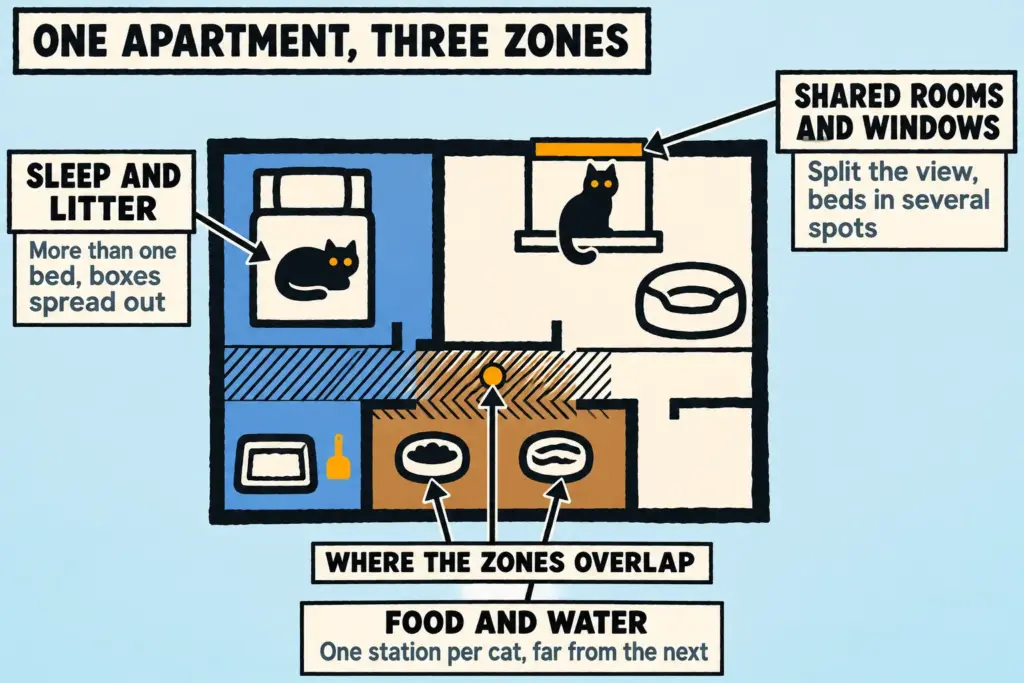
The order matters as much as the match: in every zone the cheapest move comes first. Move the bed, cover the lower glass, spread the bowls across rooms, and only then decide whether anything in a box is needed.
| Zone | What the cat guards there | Change this first | Where it goes deeper |
|---|---|---|---|
| Sleep and litter | The main bed and the boxes, the most defended spots in the home | Move a bed to another room or wall, and spread the boxes across rooms | where a litter box goes, and three places to never put one |
| Food and water | The bowls, and the line of sight to whoever is eating | One station per cat, each out of sight of the next, with water set apart | where cat bowls go, and what quietly ruins them |
| Shared rooms and windows | The seat with the best view, the doorways and the end of the sofa | Take the street out of the glass, then add seats and beds in more than one place | Covered below, with the film, the perches and the diffusers |
Sleep and Litter: the Core
This is the zone to fix first, because a cat cornered here has no retreat. What repairs it is more than one place to sleep and boxes spread across rooms.
Placement counts as much as the count. A box with one way in and out is a spot no cat wants to be caught in, and in a multi-cat home the other cat can shut it simply by sitting at the mouth of the corridor. A box in a dead end therefore fails sooner than one in a room with two exits.
Food and Water: the Hunting Ground
Eating is hunting, and a cat who eats with one eye on the other cat is not finished eating. Give each cat a feeding station with a wall or a corner between them, and set the water apart from the food in a water station of its own. Two bowls on the same wall still count as one station to a cat who is watching, however far apart on that wall you put them.
Shared Rooms and Windows: Everyone’s and No One’s
Nothing here belongs to anyone, which makes it the place where claims collide: the seat with the best view, the doorway, the end of the sofa. Split the prize. Take the street out of the glass, put seats with a view in more than one place, and give the cats beds in several spots.
A hallway sits in two zones at once, so a cat who blocks it is guarding the core and the shared ground in one move, and fixes in the other two zones loosen the hallway too.
The same zone idea shows up when a new cat is brought into a home. Here it is applied to cats who already share a home, or to one cat who has the place to himself.
Sleep and Litter: the Zone a Cat Defends Hardest
Four Paws describes the territory around a cat’s main sleeping place as the one he defends most vigorously. The bed is where a cat will stand his ground even against a housemate he likes.
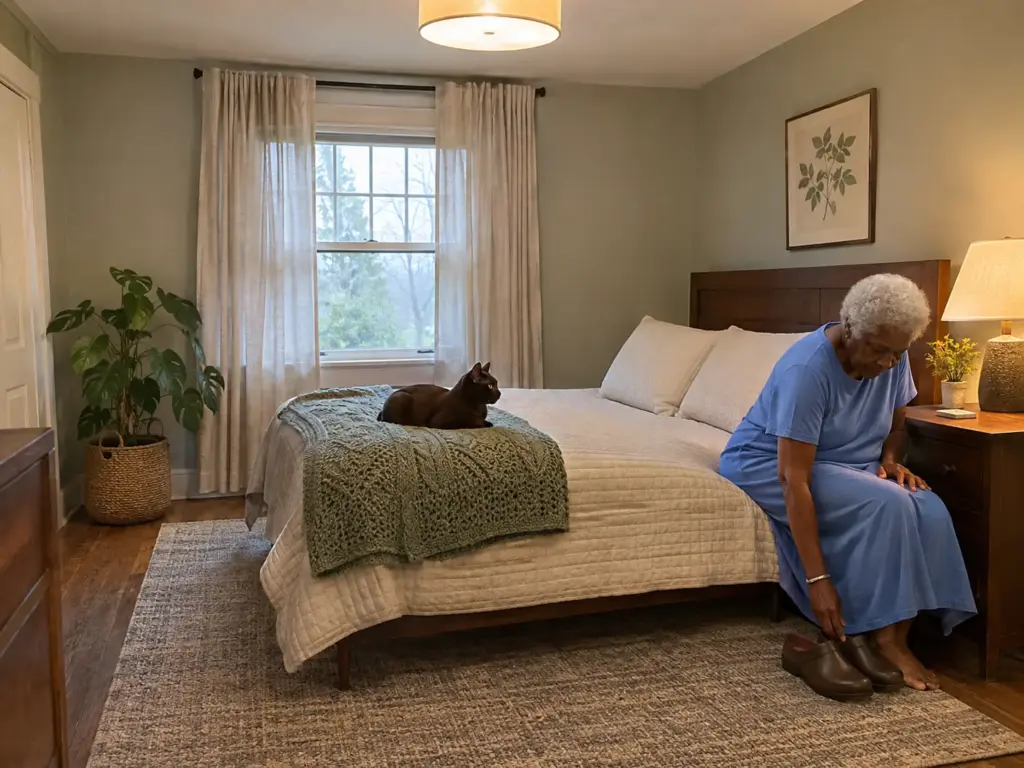
The Bed Is the Core
VCA advises beds and perches in several desirable locations so that no single spot becomes the prize. The free version comes first: move one bed to another room or another wall and watch for a few days. A second bed in the same corner of the same room is the same prize, doubled.
One Box Per Cat, Plus One, in Different Rooms
The usual rule is one per cat plus one, which means a box for each cat and a spare. It only works if the boxes sit in different places. Two boxes lined up against one wall are a single location to a cat who is guarding it, and one cat sitting in front of the row closes both. With two cats, the third box earns its place by standing in a room of its own; parked beside the first two, it adds nothing.
VCA’s advice is multiple boxes so that every cat can reach one easily. How many litter boxes two cats need works through the count, and where a litter box fits in a small apartment sorts out placement when the floor has no spare room.
Put the two boxes in different rooms, not on the same wall, and keep them out of sight of each other. If a cat can see the other box from where he is standing, he is still watching it.
When the Bed Being Claimed Is Yours
If the spot he guards is your own bed, the answer is not to evict him. His claim is a list of conditions: the height, the heat, the side with the window. A bed of his own beside yours, with the same height and the same warmth, gives him all three, and yours comes back to you. The cat is describing a restriction, and your preference is the part that can move.
Whether neutering has a part in a cat’s claim is a conversation with your vet, and this guide goes no further.
Food and Water: One Station per Cat, Out of Sight of the Next
A cat is at his most exposed with his head down over a bowl, so the bowls are where a quiet claim turns visible. Two cats and two bowls pushed together look like a tidy feeding corner and work against the zone.
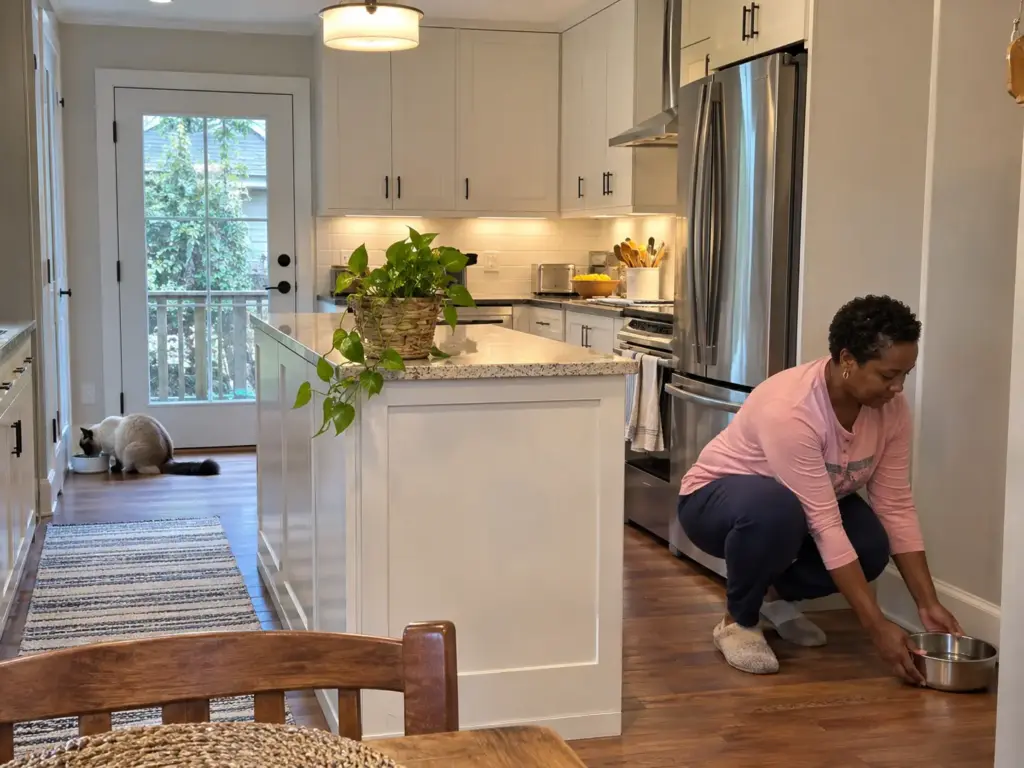
Stations Instead of a Shared Bowl
A feeding station is a place where one cat can eat with a wall at his back and no other cat in view. Two bowls on one wall are still one station. The free move is today’s: carry one bowl to another wall or another room.
Whether two cats can share one food bowl goes through why sharing fails. When the floor is small, the stations go where the layout allows: one in the hallway, one in the kitchen, a third where a door closes, as feeding two cats in a small apartment, by floor plan lays out.
Water Away From the Food
Water belongs apart from the food, and with more than one cat it needs a bowl more than the number of cats. A water station parked beside the feeding station is a single spot to guard, and a cat who is not allowed at the food ends up missing the water as well. Why food and water shouldn’t sit side by side explains the separation, and why three cats get four water bowls shows the extra bowl at work.
A Cat That Guards the Bowl
A cat who eats fast with his eyes on the doorway, or who stands between the other cat and the bowl, is no longer just eating. He is watching the spot. Treat it as territory: split the stations and put a wall between them.
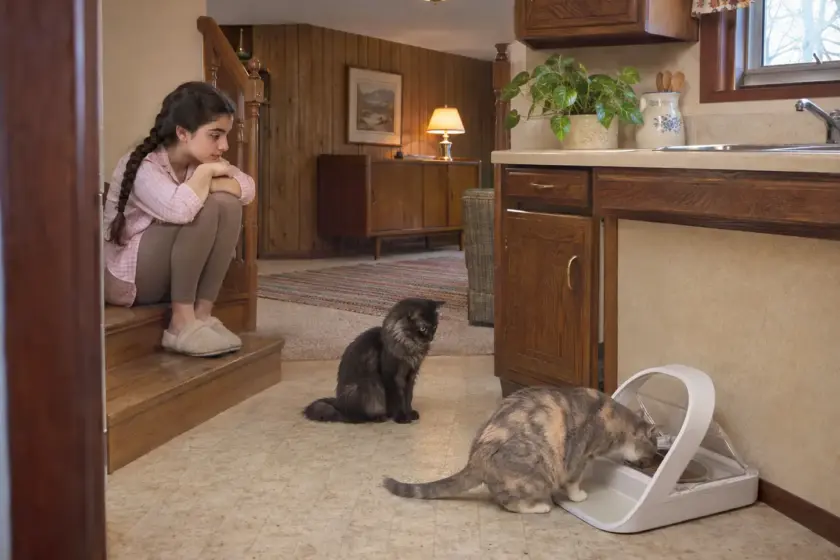
If one cat keeps finishing what the other leaves, an automatic feeder that opens only for his chip is an option, and an automatic feeder that works for several cats compares them. A cat whose appetite changes, eating much less or not at all, goes to the vet, not to a bowl swap.
The Window and the Shared Rooms: Split the View Before You Buy a Perch
The window is where the free fixes and the products meet, so the order matters. Start with the free moves: lower the blind over the bottom half of the glass, shift the furniture that gives him access to the sill, or move his bed to a different wall. If the street is still in the view after that, a film does the same job for good.
Take the Street Out of the View
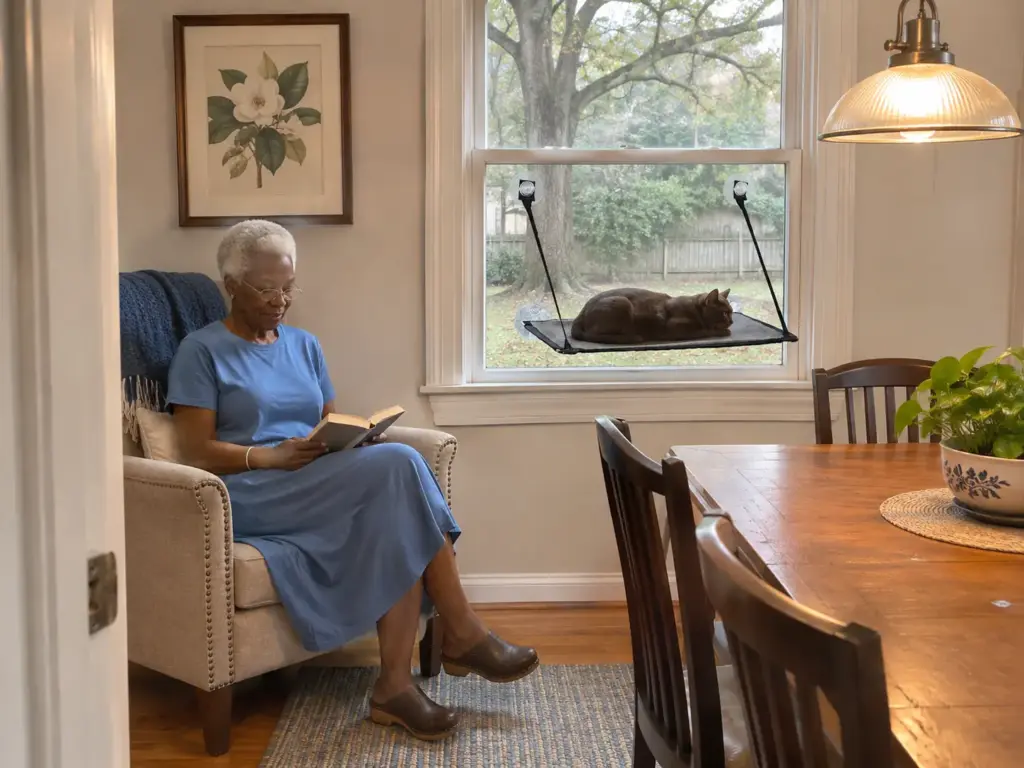
A cat reacting to the outdoor cats on the block is reacting to what he can see, and the cheapest permanent fix is to break the sightline: frost the lower pane so the street goes soft while the sky stays clear. rabbitgoo Frosted Glass Window Privacy Film is a static-cling sheet, 35.4 x 78.7 inch, with no adhesive and no drilling, which suits a lease with strict rules. Its weak point is grip: on some windows it does not hold to the glass, so press a corner on first and see whether it stays before you commit the whole sheet.
The obvious move at a window is a better seat. But if the street is what winds him up, a better seat is a better view of the problem. The film comes first and the perch second.
A Seat for One Cat, a Stack for Two
Once the view is sorted, a seat gives him a spot at the glass that is his. The K&H Cat Window Perch EZ Mount Kitty Sill measures 23 x 12 x 14 inch and hangs on suction cups, so nothing gets drilled into a rental. The cups can stop holding after a while. Press on the seat before he climbs on, and recheck it now and then.
For two cats the question changes. The K&H Multiple Cat Window Perch Triple Stack has three levels of 23 x 12 inch and stands 42 inch tall, so measure your window before you decide (a 42-inch stack in a short window is a ladder to nowhere). Some stacks work loose as the cups lose strength with time, so it earns the same recheck.
Beds in More Than One Place
VCA recommends perches and beds in several desirable locations so no single spot is the prize. Put in order, the zone comes down to three moves:
- Take the street out of the view.
- Give each cat a seat with a view, in more than one spot.
- Put beds in more than one room, never in a row.
A bed in the same corner as the first one only doubles the prize.
Pheromone Diffusers: What They Settle and What They Leave Alone
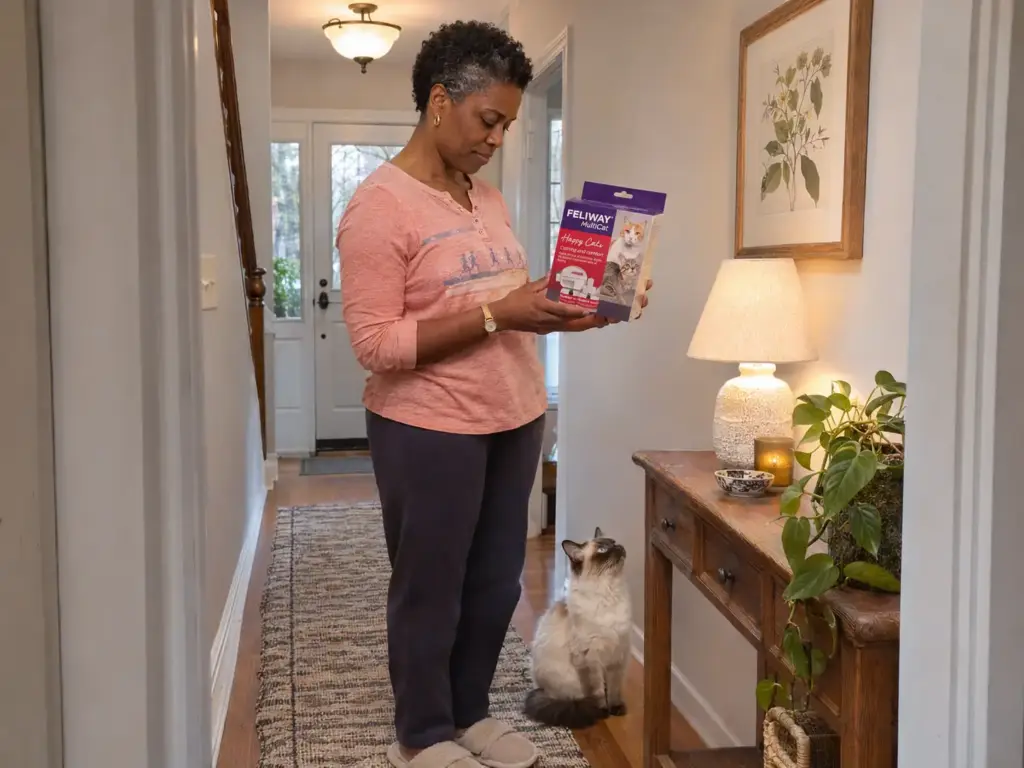
A diffuser settles tension; it does not remove what caused it. VCA names FELIWAY MultiCat and FELIWAY Optimum among the products that can go in several spots to ease it. Treat a diffuser as the last layer on top of the zones above, and as a replacement for none of them. None of these is a treatment for anything.
Where the Diffuser Goes
A diffuser works where the cat spends his hours, not where the outlet is convenient. Put it in the room he sleeps in or the one where he watches the window, and leave it there so it has time to work. Optimum’s own instructions say not to plug it in under shelves, behind curtains, near the litter box or in a hallway, which rules out the spots most people reach for first.
Plug the diffuser in where the cat actually spends his hours, not where it looks best. Check where he is for a few days first and use that room.
FELIWAY Optimum, FELIWAY MultiCat or the Budget Kit
Choosing among the three kits depends on the home, and the best pheromone diffuser for introducing cats in an apartment goes deeper into the choice when a newcomer is involved.
The FELIWAY Optimum Cat Calming Pheromone Diffuser Kit covers up to 700 sq ft per diffuser, which fits an open floor plan. Its weak spot is the hardware: units of this kind can quit early or leak oil, and it calms some cats and does nothing for others. Unplug any unit that leaks or smells scorched.
The obvious pick for two cats is FELIWAY MultiCat, a diffuser with one 48 mL refill that also covers up to 700 sq ft and is made for homes with more than one cat. It stops being the obvious pick the moment there is a bird in the house, because it carries a bird warning (see below).
The cheaper route is the Comfort Zone 30 Day Starter Kit, which covers 650 sq ft per diffuser. For some cats it does nothing, so a cheaper kit only saves money if it works on yours.
The Bird Warning
FELIWAY MultiCat is unsafe for birds, parrots and budgerigars included. A home with a bird in it skips that one. The warning is specific to the MultiCat; for a bird household, check the maker’s page for any other diffuser before plugging it in.
One Cat, No Housemate: What a Single Cat Still Claims
A cat who lives alone still keeps a map. Nobody disputes it, which changes how the claim looks, not whether it exists.
The Bed, the Route and the Window
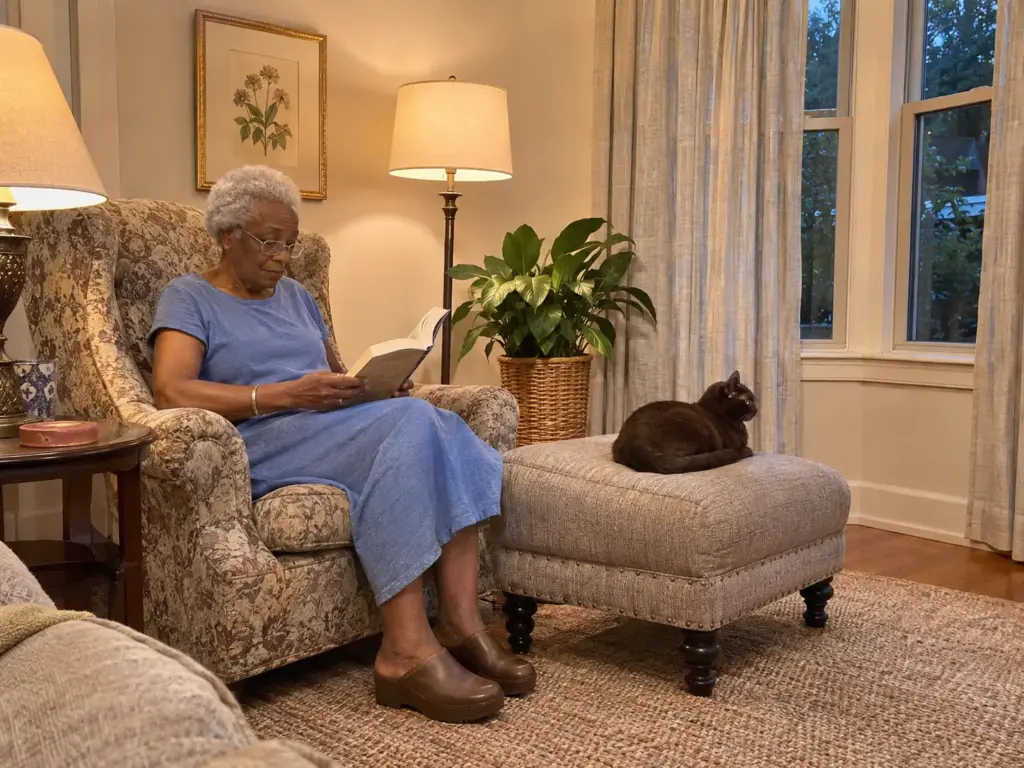
Four Paws says indoor cats claim territory, and the ASPCA says the claim can reach the block. A lone cat’s map therefore holds the bed, the route from the window to the kitchen, the armchair, and sometimes you. What is missing is a housemate who gives way.
In a two-cat home one cat eventually yields a spot, and the line moves. Alone, nobody yields, so the claim stays where it is, longer and stricter. A cat who has lain in the same armchair for years treats it as property, and rearranging the room around him asks him to give up ground that nobody ever contested.
Splitting resources between two is off the table, because there is no second; ordering what he has is the job: a bed in two places, a window view he can choose to look out of or turn his back on, and a high spot. Shift the bed a few feet first and see whether he follows it.
A one-cat home also removes the usual feedback. With two cats, the one who gives way shows where the line is; with one, the only signal is the cat’s own routine, so the routine is what to watch. Where he sleeps, which way he walks the apartment in the evening and which window he returns to are the borders. A change in any of them with nothing changed in the house is worth a note, and if it sticks, a call to the vet.
The Cheek Rub on You
Now the person. The cat who rubs his cheek on the door frame does the same on your shin, your shoe, your hand. The ASPCA lists chin rubbing among the ways a cat marks what he claims, so a reasonable reading is that you are on his map too. Take it as a reading of the behavior and not as an established rule.
What the reading changes is how you take the rub: as belonging, not as begging.
The Block Beyond the Glass
The block outside is part of a lone cat’s map as well, and the same fixes apply: film on the lower pane, and a seat of his own at the window. A single cat who sits rigid at the glass or paces beside it is holding that border. If he starts marking by the window, or drops a spot he has always used, that goes back to the vet list above.
The map is the same with one cat or several: three zones, and a fix for each.
Move One Thing Today, Then Watch Who Stops Turning Back
Territory is a map of three zones, with one cat or several. A claim is not an attack, and a claim that changes overnight, or arrives with a wound, a marking habit he never had or a change in eating or litter use, goes to the vet before any furniture moves. In each zone the free move comes first: a bed to another wall, a bowl to another room, the lower half of the window covered, the boxes in different rooms. A diffuser can settle the tension left over, but it fixes no zone.
Then look again. If the change depends on the cat accepting a new place, give it four or five days and see whether he uses it. If it depends on a routine of yours, with boxes and bowls spread across rooms, look after two weeks to see whether they have crept back into one corner.
Today, carry one bed or one bowl to a different wall, or cover the lower half of the window glass. Then notice which cat no longer turns around at the doorway.
Frequently Asked Questions
01How do I stop my cat’s territorial aggression?
Start with a vet exam if your cat has recently turned tense or pushy, because a house cannot explain a sudden change in behavior. After that, spread beds, boxes and bowls across rooms and take the street out of the window view. If the claim has become contact, add a behavior specialist.
02Which gender of cat is more territorial?
Both males and females are territorial, but the ASPCA says males may defend larger territories, and it describes the most obvious conflicts as happening between unneutered males. Whether and when to neuter is a question for your vet.
03My cat is territorial over my bed. What should I do?
The bed is the spot a cat defends hardest, so give him a bed of his own beside yours, at the same height and warmth, instead of pushing him off. Then add a second sleeping spot in another room so no single bed is the prize.
04At what age do cats become territorial?
Territorial behavior is more likely once a cat reaches social maturity, typically between two and three years of age, according to VCA Animal Hospitals. A calm one-year-old can start guarding the window or the bed at two, and that is age, not something you did.
05Can a cat be territorial if it lives alone?
Yes. Claiming territory is natural feline behavior that includes indoor cats, and the ASPCA says a cat’s perceived territory can reach the yard or the block. A lone cat typically claims the bed, the route to the window and sometimes you.
Leave a comment