How to Choose a Litter Box by Size, Sides and Entry
A 16-inch cat needs a 24-inch box (1.5x nose to tail base) + under 4-inch sides if he's older. The litter box math nobody publishes.

Alfredo RamsesFounder · August 24, 2026 · 27 min read

On this page11 sections
- 1The Box You Own Is Probably Failing on One of Five Counts
- 2Measure the Cat First, Not the Box
- 3Width Is the Measurement Everyone Forgets
- 4Side Height Is a Trade, and It Changes With the Cat's Age
- 5Entry Height for Kittens, Seniors and Heavy Cats
- 6Covered or Open, and Who Each One Is Actually For
- 7Plastic, Stainless Steel, and What Material Actually Fixes
- 8Two Cats Change the Answer, and It Isn't Just Buying Two
- 9Choosing in a Small Apartment, Where the Rules Collide
- 10Choosing the Box, in Three Numbers
- 11Frequently Asked Questions
He isn’t being difficult about the box. He’s telling you it’s the wrong shape, and there are only three measurements that decide whether he’s right. Most people shop for a litter box by label, which is how you end up owning something called “large” or “jumbo” or “high-sided” without a single number attached to any of those words.
The veterinary sizing rule that settles it has existed for years and almost nobody publishes it as arithmetic you can carry into a store. So here it is as arithmetic: size, sides, entry, in that order, because getting the first one wrong makes the other two irrelevant.
Quick Answer
Five numbers decide the whole purchase, and you can check them all with a tape measure and two minutes.
- Measure nose to the base of the tail, then multiply by 1.5 for box length
- Width should be the length figure plus 3 to 4 inches
- Keep sides under 4 inches for an old, heavy or short-legged cat
- Open beats covered in most homes, and it isn’t close with two cats
- One box per cat plus one spare, in separate rooms
The Box You Own Is Probably Failing on One of Five Counts
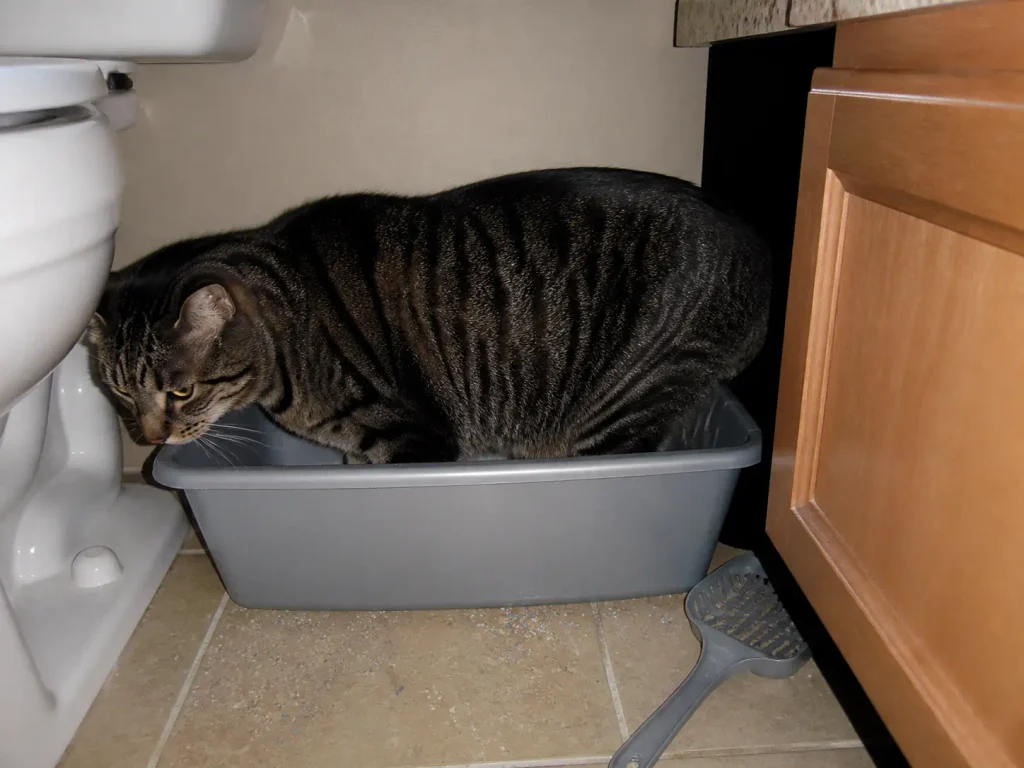
Nobody arrives here with an empty apartment. You already bought a box, it’s sitting in the corner of the bathroom, and something about it isn’t working: he’s going next to it, or the litter is halfway down the hall, or the room announces itself before you get to the door. Every other guide starts you at zero, as though the purchase you already made never happened. Start where you actually are instead.
Cats abandon boxes for five documented reasons, and they’re all mechanical: the box is too small, the sides are too high to climb, there’s a hood on it, there’s too much litter inside, or there aren’t enough boxes for the household. Those are the most common mechanical reasons cats abandon a box, and not one of them is a personality flaw. Each one is the box describing a constraint out loud. In a house where something has gone wrong with the litter box, the cat is usually the only one behaving rationally.
Check them in order: size first, then sides, then entry. Size comes first because it invalidates everything downstream. A box with a perfect 3-inch entry and a beautifully low wall is still the wrong box if he can’t turn around inside it.
Too Small Is the One That Hides
The other four failures announce themselves. A hood is visible. Litter depth is visible. Box count is a number you already know. Too small is the one that hides, because the box looks fine sitting there empty, and the failure only shows up in the two seconds a cat is actually using it.
All five get filed under litter box avoidance or house soiling, which are useful words for a search bar and useless as a diagnosis. Both name the outcome. Neither names the wall, the width or the step that produced it.
All five get filed under litter box avoidance or house soiling, which are useful words for a search bar and useless for a diagnosis. Both name the outcome. Neither names the wall, the width or the step that produced it.
The most repeated story across every sizing source runs the same way each time. Someone buys a box labeled “large,” never measures the cat, and then notices him backing up against the back wall because there’s nowhere else to be.
Or notices that the waste is always pressed right against one side. That’s not a hygiene habit. That’s an animal solving a geometry problem you handed him, and solving it the only way the floor plan allows.
If you want the arithmetic in full, with the tape-measure walkthrough and the awkward cases, the full sizing walkthrough for your cat’s measurements goes deeper than this section will. The short version is two sections down.
Before you buy anything, put a second plain open box next to the current one and leave both there for a week. If he switches, the box style was the problem and you just diagnosed it for free. If he keeps using the original, the box isn’t what’s broken and you’ve saved yourself a return.
The Wall That Solved Tracking and Then Created a Problem
High sides work. That’s the frustrating part. Somebody buys a high-sided litter box because there’s litter tracked across the bedroom every morning, the tracking drops off almost immediately, and the purchase gets filed under “solved.”
Then eighteen months go by. The cat gains a pound, or turns nine, or just gets stiffer the way everything does, and one day he starts going on the bath mat instead. The wall didn’t change. He did.
This is the second most repeated failure in litter threads and it’s the cruelest one, because the person who caused it was doing everything right at the time. A spec that’s correct today has a quiet expiry date attached to it, and nobody selling you the box mentions that.
When It Isn’t the Box at All
One boundary before the measurements start. A cat who used the same box happily for years and then stops, suddenly and without anything in the house changing, is telling you something a vet should hear before a furniture store does. That’s a phone call, not a purchase.
Everything below assumes that call has already been made and came back clear. From here it’s geometry.
Measure the Cat First, Not the Box
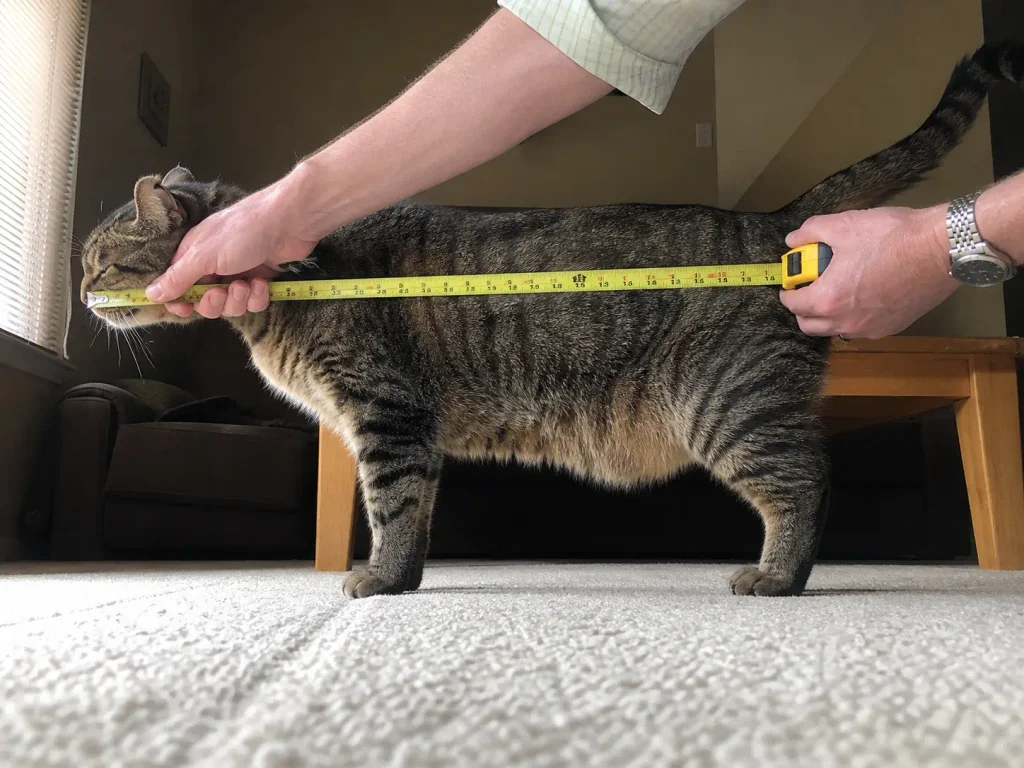
Every guide tells you to buy a box that’s “big enough.” None of them tell you what big enough means for your cat, and the difference between a 16-inch cat and an 18-inch cat is three full inches of box that no shelf label will ever mention.
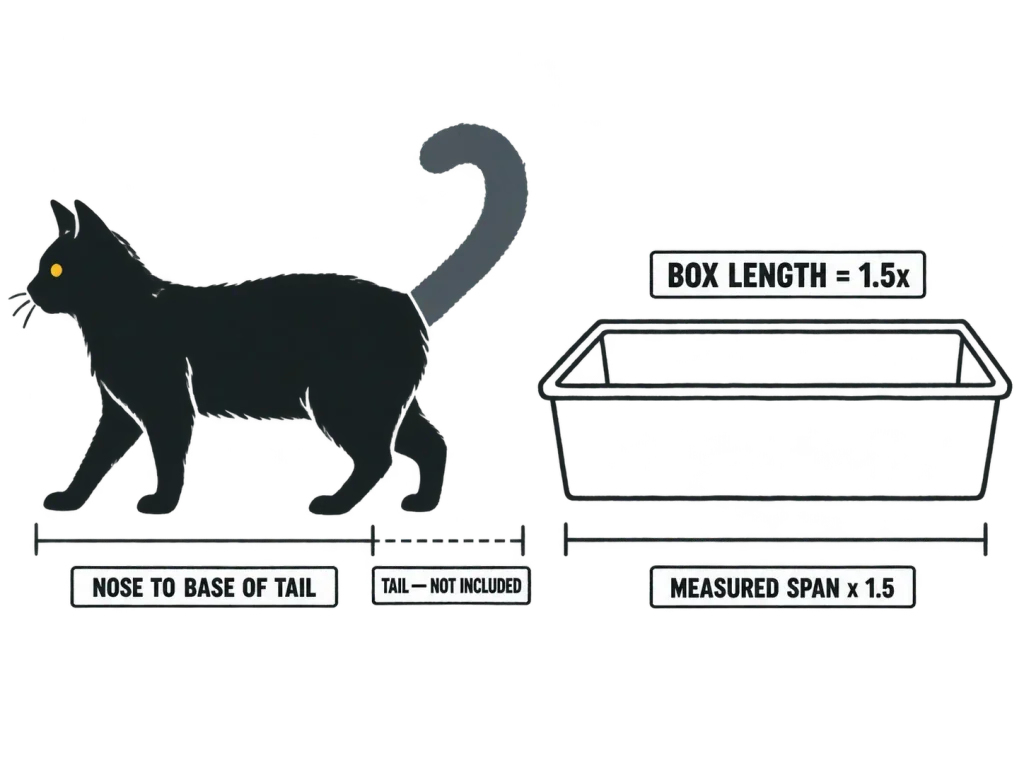
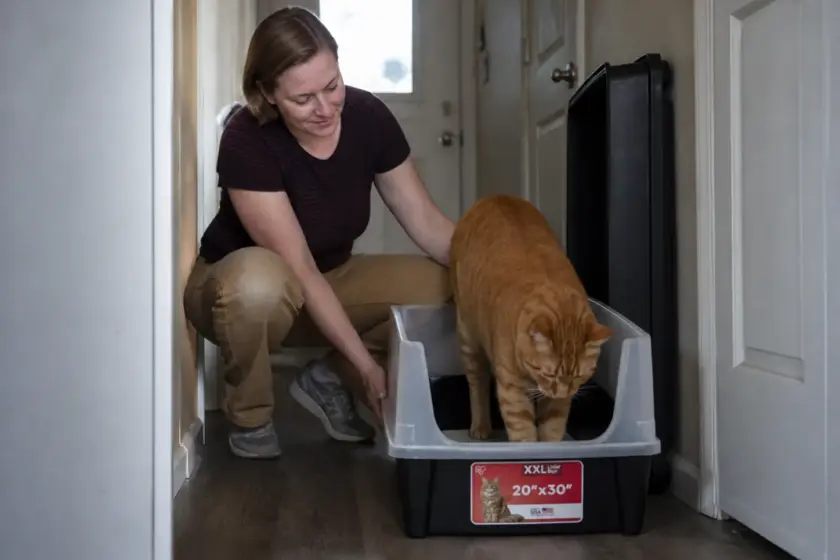
The rule comes from the AAHA-AAFP guideline of 1.5 times your cat’s body length, and it’s the closest thing this decision has to a hard floor. Box length should be at least 1.5 times the cat’s body length, measured nose to the base of the tail. The tail is not included, and that exclusion is where most people go wrong.
Do the multiplication and it stops being advice and starts being a filter: a 16-inch cat needs a 24-inch box. An 18-inch cat needs a 27-inch box. That’s it. Two sentences of arithmetic that the entire first page of Google leaves as “measure your cat” and then walks away from.
Nose to the Base of the Tail, Not the Tip
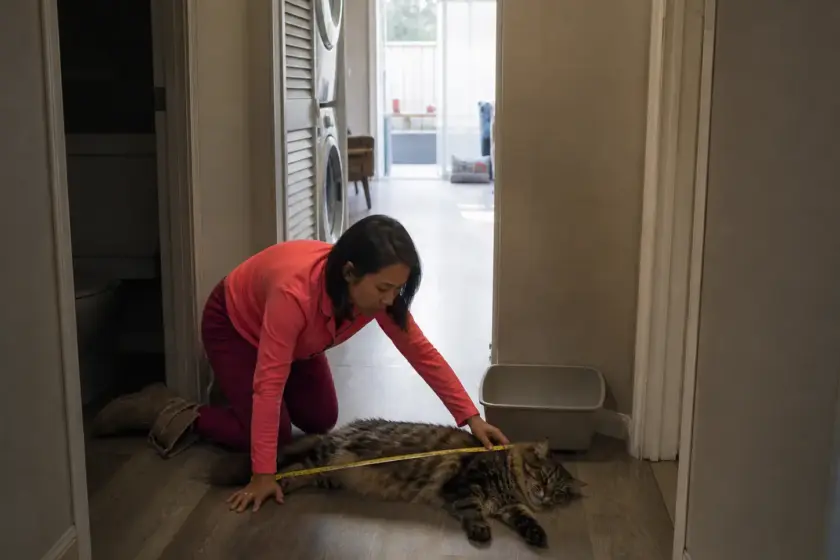
Measure him standing, not curled. A cat loafed on the sofa measures shorter than the same cat mid-stride, and the box has to work for the standing version.
The tape measure is the entire tool. Run it from the tip of his nose to the point where the tail starts and stop there. Include the tail and you’ll overshoot by six or eight inches on a long-haired cat, buy a box the size of a coffee table, and wonder why it doesn’t fit in the bathroom. Exclude it and you get a number that’s honest.
For a large Maine Coon at full length, that honest number is often past what most brands print on a box at all.
What 1.5x Looks Like in Inches
Run a few of these and the shopping problem becomes obvious. A 14-inch cat needs 21 inches. A 16-inch cat needs 24. An 18-inch cat needs 27. A genuinely large cat measuring 20 inches nose to tail base needs a 30-inch box, which is longer than most retail litter boxes are manufactured.
That last case is why storage bins keep showing up in threads about big cats. It isn’t a hack for the sake of being clever. It’s that the arithmetic points past the end of the category, and a plain uncovered bin is one of the few things sold at that footprint.
Why “Large” on the Label Means Nothing
There is no standardized inch behind the word “large.” There’s no standard behind “jumbo,” “XL,” or “giant” either. They’re comparative terms in a category that never agreed on what it was comparing itself to, which means two boxes on the same shelf, both labeled large, can differ by five inches of usable floor.
Which is the actual takeaway here: the number is yours to carry. Write it on your hand if you have to. Once you have it, the label stops mattering and the listing’s dimensions section becomes the only part of the page worth reading.
Width Is the Measurement Everyone Forgets
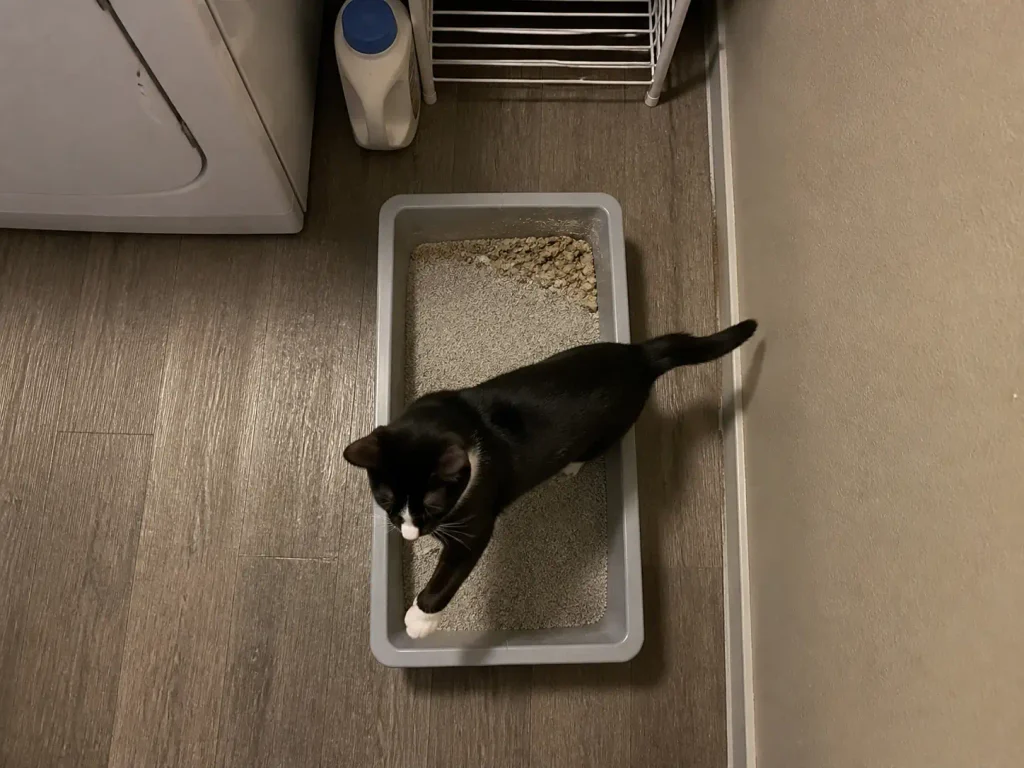
A long narrow box passes the 1.5x test and can still fail in practice, because a cat doesn’t just stand in a box. He walks in, turns, digs, positions, does his business, turns again, covers it, and then steps away from what he did. That sequence needs floor area, not length.
The working rule is straightforward: width = length plus 3 to 4 inches, and most cats need 15 to 18 inches of interior width to complete a full turning arc. A box that only permits a straight line forces him to reverse out or press against a wall, and he’ll do it, right up until the day he decides the bath mat has better clearance.
The Turning Arc, in Inches
The arc is doing three separate jobs and it’s worth naming them, because “room to turn around” undersells it. He turns to choose a spot and dig. He turns again to cover. And then he needs to step away from the covered spot rather than stand on top of it.
That third one is where narrow boxes actually break. If the waste in your box is always shoved against a side wall, that isn’t a hygiene failure and it isn’t laziness. It’s geometry reporting back: there was nowhere else to put it. The same geometry decides how the smell behaves in the room, which is a related but separate question, and how box design concentrates odor at the cat’s nose covers that side of it properly.
Interior Width Is Not What the Listing Says
The dimensions printed on a product page are almost always exterior. Litter box walls slope outward, sometimes considerably, and a box advertised at 16 inches wide can offer 14 inches of floor at the bottom where it counts.
That gap of an inch or two sounds trivial and isn’t, because it lands right at the edge of the 15-inch minimum. When a listing gives you both figures, use the interior one. When it gives you only one, assume it’s the outside and subtract an inch and a half before you decide.
And with two cats, width earns its keep twice over. Overlapping use means less recovery time between visits and more chance of one cat entering while the other’s business is still fresh. The real answer to two cats is a count problem, though, and that has its own section further down.
Side Height Is a Trade, and It Changes With the Cat’s Age
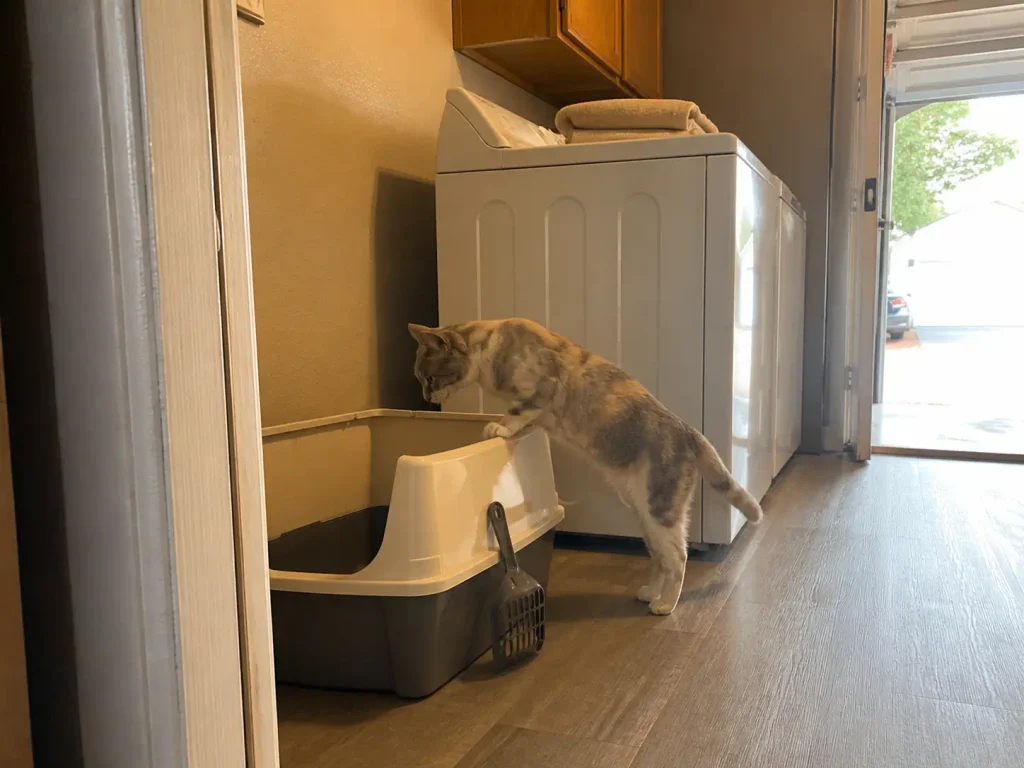
Tall walls are sold as the fix for litter on the floor, and they earn that reputation. What no listing mentions is that the same wall is a stair the cat climbs several times a day, every day, for the entire life of the box. Cats get older, heavier and stiffer. The wall stays exactly where it was.
Under 4 Inches Is the Accessible Line
“Low-sided” is a marketing phrase everywhere else. Here it’s a number: walls under 4 inches. That’s the practical industry line, and it’s the threshold that decides whether an aging or heavy cat can enter without thinking about it first.
Above that, entry becomes a small negotiation each time. Below it, the box is just a place on the floor he walks into.
For a young, healthy, average-sized cat, anything up to about 6 inches is fine and buys you real containment. For a cat with arthritis, a heavy frame, short legs, or fourteen years behind him, under 4 inches isn’t a preference. It’s the whole decision.
What Tall Walls Actually Buy You
Give tall sides their due, because they deliver. Less scatter when he digs, less litter kicked over the edge, less tracked through the apartment on paws. And for the cats who stand and aim high, tall walls are the difference between a clean floor and a wall you’re wiping weekly.
If tracking is specifically what’s driving your search, there’s wall height sorted specifically for tracking with the heights broken out by use case. For a reader who’s decided containment matters and mobility isn’t a factor yet, the plain version of that is exactly what you want: high sides, open top, no hood attached to any of it. The Amazon Basics Large Cat Litter Box with High Sides, Open Top is the budget-friendly answer to that description and the honest “if you’re not sure, start here” pick, with the obvious caveat: those same high sides are the spec that ages badly, so it’s the wrong box for a senior cat and the wrong box to buy for a cat who’ll be a senior before you replace it.
The Ramp Fix, Before You Replace Anything
Here’s the move nobody leads with, and it’s free. If the walls are the problem but the box is otherwise correct, you don’t need a new box. You need a way in. A ramp angled between 18 and 26 degrees makes a tall-walled box usable again for a cat who can’t manage the step, and you can build one from a scrap of plywood and a strip of grip tape.
This matters most in the households where the tall box is doing a job that can’t be dropped. Multi-cat homes, enthusiastic diggers, a cat who sprays high. Replacing the box trades one solved problem for one unsolved one. Adding a ramp keeps both solved.
Measure the step your cat already takes to get onto the sofa without hesitating, and treat that as his ceiling. The box wall should never ask for more than the jump he makes willingly a dozen times a day. If he pauses before the sofa now and he didn’t last year, the box wall is already too tall and you found out early.
Entry Height for Kittens, Seniors and Heavy Cats
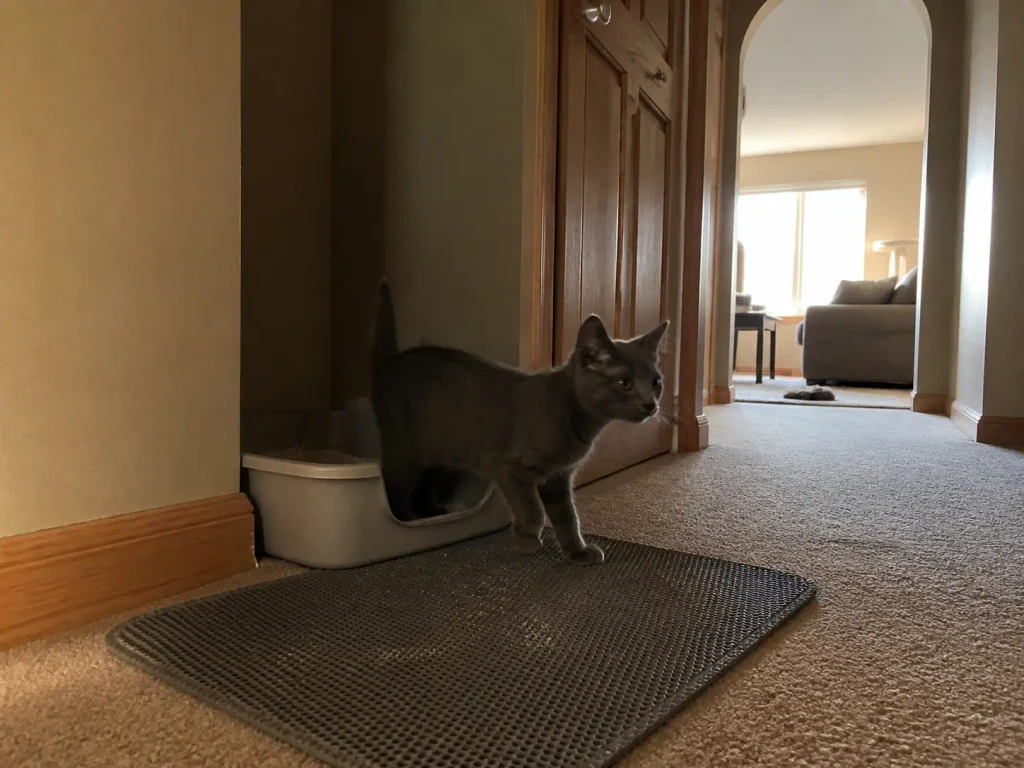
The front cutout is not the same spec as the side wall, and collapsing them into one number is where a lot of otherwise good buying advice falls apart. Entry height is the height of the lowest point he has to clear to get in. Side height is everything else. A box can have both, set differently, and that combination turns out to be the one that solves the most homes.
The cats who need a genuinely low entry sit at the two ends of the age range: the kitten who can’t climb yet, and the senior who can’t anymore. Both walk into a store and get sold the same adult box.
The Kitten Number
For kittens under 12 weeks, the front cutout should be 2 to 3 inches at most. Not as a comfort feature. As the difference between a kitten using the box and a kitten going next to it while you wonder what you did wrong.
A twelve-week-old cat is a few inches of leg attached to a lot of confidence, and a 5-inch wall is a climbing problem she’ll attempt twice before finding a floor she doesn’t have to climb. The good news is that this spec expires in the friendly direction: she outgrows it in a couple of months, and the box you bought for her becomes the spare. Which, if you’re counting ahead, is a box you were going to need anyway.
The Senior and Heavy-Cat Number
For a cat with arthritis or any of the mobility issues that arrive with age, the entry should be under 4 inches, and in more severe cases 2 to 3 inches is where it needs to land. Same range as the kitten, arrived at from the opposite direction.
Heavy cats are a separate case that lands on the same number for a different reason. It isn’t joint pain, it’s the plain effort of lifting a large frame over an edge eight or ten times a day. A heavy cat can clear a 6-inch wall perfectly well once. The question is whether he wants to at four in the morning, on the twelfth repetition, when there’s a rug nearby with no wall at all.
And the box is only half of it. If he has to cross the apartment or take a flight of stairs to reach a perfectly-sized box, you’ve moved the barrier rather than removed it, which is why why stairs between the cat and the box undo a good box is worth reading alongside this one.
One line on the boundary, and then back to inches. Stiffness, a hesitation before a jump he used to make without thinking, or a step he managed last month and can’t manage now is a conversation with a vet. We size the box. We don’t diagnose the joint.
Tall Sides With a Low Front Is a Real Option
Here’s the combination that resolves the trade instead of picking a side of it: high walls on three sides, a low cutout on the fourth. Containment where the litter flies, easy access where the cat enters.
It’s sold as a “low-entry” or “step-in” box and it’s genuinely the best answer for a household that needs both. Two things to check before you buy one, because the marketing is loose here. Confirm the cutout height in inches rather than trusting the phrase, since some “low-entry” boxes cut the front to five inches and call it done. And check that the cutout is wide enough that a large cat doesn’t have to thread himself through it.
Covered or Open, and Who Each One Is Actually For
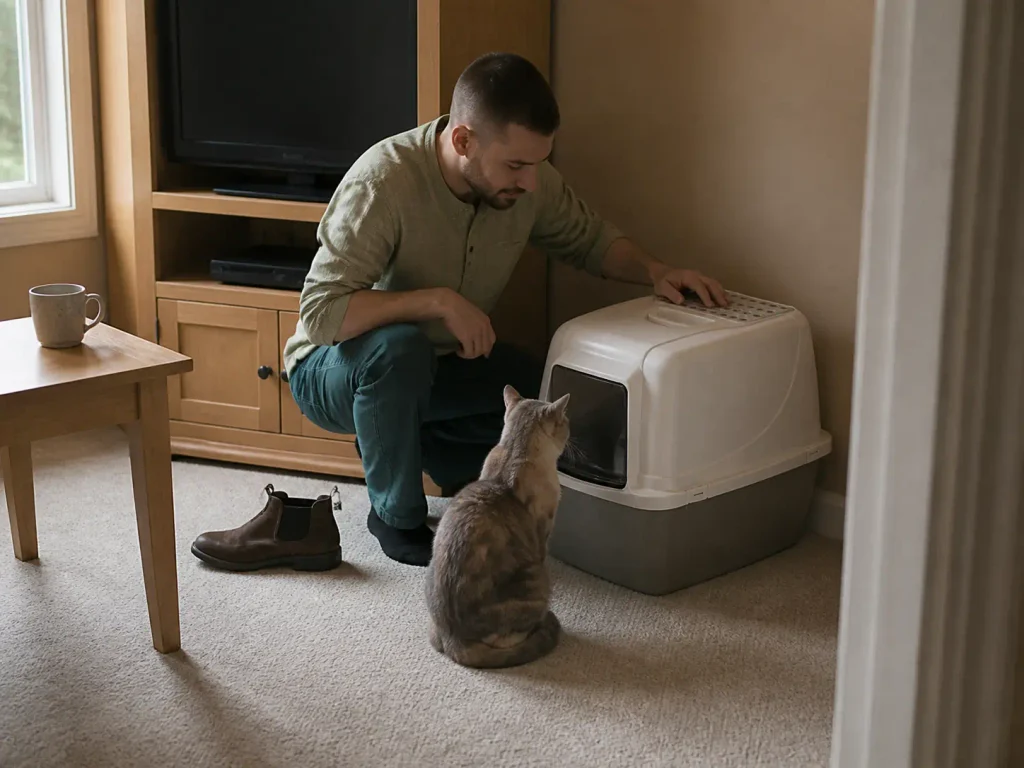
The lid is the one part of this decision where you and the cat want different things, and both of you have a point. You want the mess contained and the smell out of your sightline. He wants to see what’s coming while he’s in a vulnerable position. Both wants are legitimate. Only one of you is using the box.
What the Hood Buys the Human
Say the quiet part first, because pretending otherwise makes this section useless. Covered litter boxes are bought for the human’s benefit. A tidier sightline, contained scatter, less visible mess, and a guest who walks through the living room without doing the polite thing of not looking at it. Those are real wants and there’s nothing shameful about having them.
There’s also a practical version of that argument. A box the human resents gets moved, and it gets moved somewhere worse, usually a closet or a bathroom with the door mostly shut. A covered box in the right room beats an open box in a room the cat won’t reliably visit.
If you’ve weighed both sides and still want a lid, the one thing you can’t compromise on is size, because a hood is only defensible on a box that clears the sizing rule comfortably. The Extra-Large Covered Cat Litter Box with Door, Hooded Enclosed Litter Pan runs 21.75 by 17.75 by 18.125 inches, which clears 1.5x for a cat up to about 14 inches nose to tail base and gives real interior width underneath the hood. A covered box that also fails the sizing rule fails twice, and that’s the version that ends up on a curb. Worth knowing before you commit: the hinged flap door is the part cats object to most often, and it usually comes off.
Whichever way you go, introduce it slowly rather than swapping it in overnight. A box that appears fully formed in place of the old one gets treated as a new object in his territory rather than as the same appointment in a new outfit.
What It Costs the Cat
Two things, and they’re both structural rather than aesthetic. A hood concentrates odor at nose height inside the box, which is the one place in the room where the smell was never bothering you. You solved your problem and made his worse, which is a fair summary of most covered-box purchases.
The second is the exit. A hood reduces the way out to a single opening. For a solitary cat in a quiet apartment that costs nothing at all. In a busier house it’s the difference between a box he uses without thinking and a box he checks before entering.
Most cats prefer open. That’s the honest summary of the behavior literature and of what people actually report, and it’s why the default recommendation in this article is open. If you want the trade-off argued properly with the exceptions laid out, the full covered-versus-uncovered comparison is the one that owns this question.
The Multi-Cat Exception That Settles It
In a house with more than one cat, the single opening has a name that gets used constantly in cat forums and describes the mechanism exactly: the ambush point. One entrance means one cat can be cornered on the way out, by another cat who may only be doing it as a game. A top-entry litter box concentrates the same problem into a single hole in a lid, which is why it belongs to this conversation and not a separate one.
That’s a territory problem, not a cleanliness one, and it doesn’t announce itself. Nobody sees the ambush. What you see, weeks later, is one cat going somewhere else and no obvious reason for it. In a multi-cat home a hood is a structural risk, not a style choice, and the calculation stops being close. A plain open litter box has no exit to guard, which is the entire reason it keeps winning here.
Covered genuinely wins in a few real cases. A single-cat home with a cat who sprays high. A box that has to sit in a sightline the human would otherwise resent. A situation where the alternative is not having a box in that room at all. Outside those, open.
Plastic, Stainless Steel, and What Material Actually Fixes
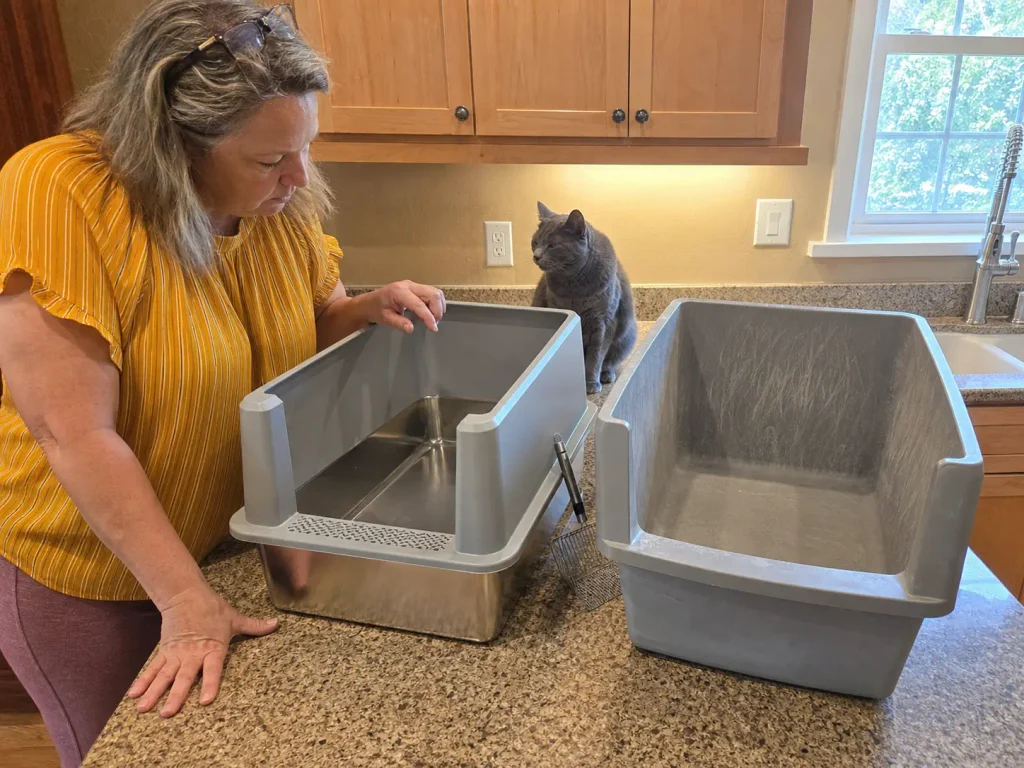
Steel boxes get recommended as the upgrade, full stop, as though material sits at the top of the decision tree. It doesn’t. Steel is better at one specific thing, and that thing has nothing to do with whether your cat fits.
What Non-Porous Actually Means Day to Day
Plastic is porous in the way that matters over years. Claws leave micro-scratches, scoops leave micro-scratches, and every one of them is somewhere for residue to sit that a wipe doesn’t reach. Do that for three years and the box smells faintly even the hour after you clean it. Stainless steel is non-porous, so the smell has nowhere to embed and the box you wash is the box you get.
The point worth holding onto: this benefit is independent of size. An undersized steel box still fails 1.5x, and steel doesn’t buy you out of doing the multiplication. If you’re a big-cat household that has decided odor retention is the actual problem, you need a box that satisfies both, and the WoofiGo XL Stainless Steel Litter Box, High Sided is sized for large cats rather than sized for a photograph, which is the reason it’s sitting in this section rather than in the sizing one. Check the interior length against your own number before ordering, and note that high-sided steel is the exact combination that ages worst for a cat heading toward his senior years.
For how much of the steel claim survives contact with a real apartment, how much of the steel odor claim holds up tests it properly rather than repeating the marketing.
When a Plastic Box Is Genuinely Done
Plastic isn’t disqualified, and the honest ranking is uncomfortable for anyone selling steel: a correctly-sized plastic box beats an undersized steel one every time. Size is the top of the tree. Material is a branch.
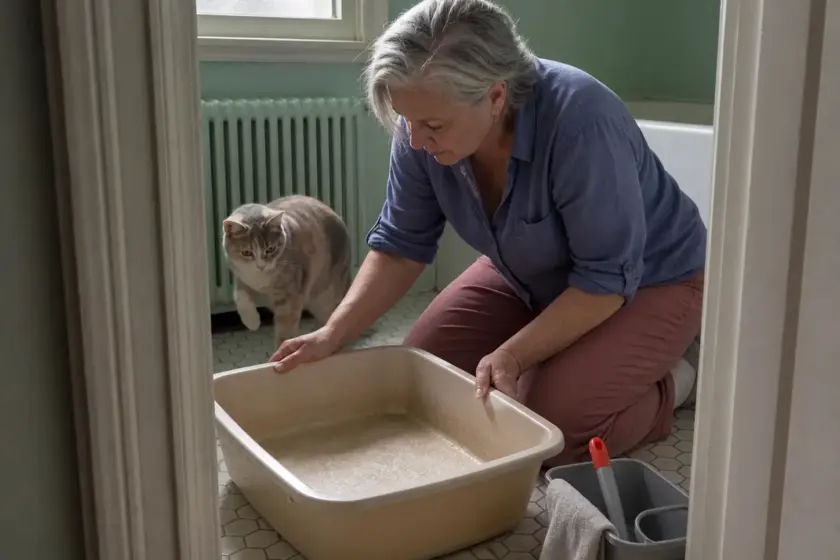
And one thing that does not solve it: a litter box liner buys you a tidier scoop and nothing else, because claws puncture it in a week and the litter ends up under the plastic anyway. The replacement trigger isn’t a calendar either. It’s the surface. Run your hand across the inside floor of your current box, and if it feels rough rather than smooth, that texture is where the smell lives now and no amount of scrubbing gets it back. That’s the signal. A plastic box in a low-traffic single-cat home can stay smooth for years. The same box under two enthusiastic diggers can be done in one.
The Trade-Offs Nobody Lists
Every recommendation carries its objection, so here are steel’s. It’s heavier, which matters when you’re carrying a full box to empty it. It’s colder underfoot in winter, and some cats notice on a tile floor in an unheated bathroom. And it’s louder: litter hitting metal is a distinctly sharper sound than litter hitting plastic, which is a genuine consideration if the box sits within earshot of where you sleep.
None of those are dealbreakers. They’re the things you’d want to know before spending several times what a plastic box costs, and they never appear in the reviews.
Two Cats Change the Answer, and It Isn’t Just Buying Two
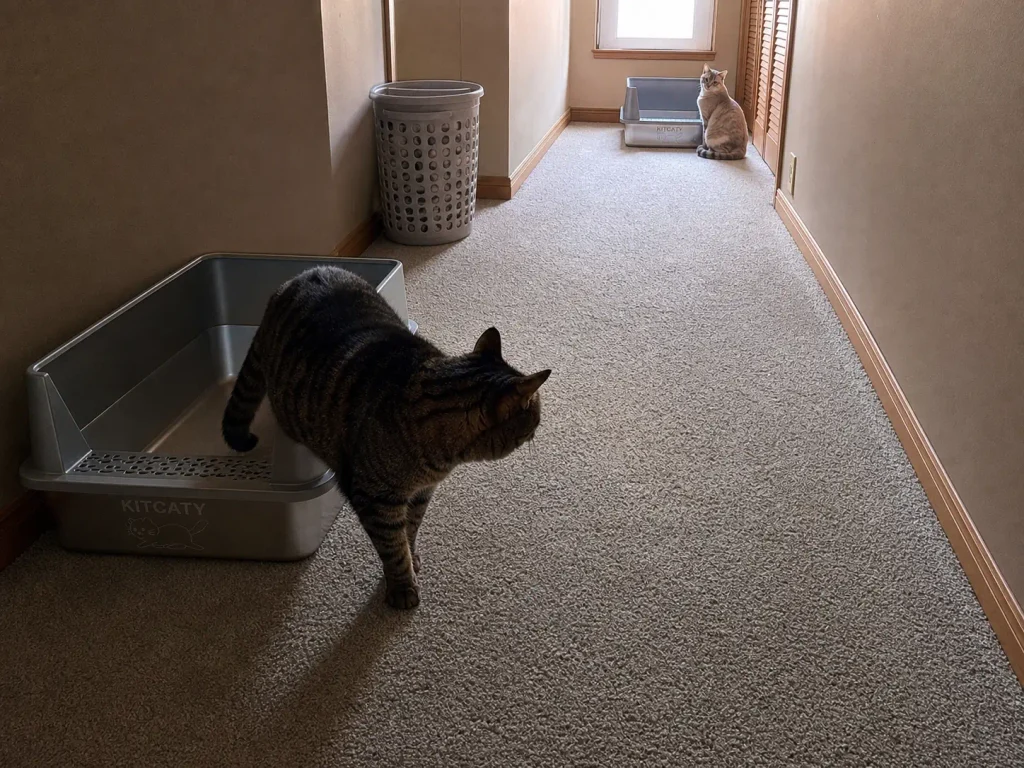
Everyone has heard “one per cat plus one.” Almost nobody says what it does to the boxes themselves, or why two identical boxes in the same corner doesn’t count as two.
Three Boxes, Not Two
The N+1 rule means two cats need three boxes. The spare isn’t about hygiene, and it isn’t about anyone running out of room. It exists so that no cat ever has to wait for a resource or defend one.
That distinction is the whole thing, and the count rule and the households where it breaks covers the exceptions, because there are households where N+1 is the wrong answer. In a standard two-cat apartment, though, three is the number.
Three Boxes in One Room Is Still One Place
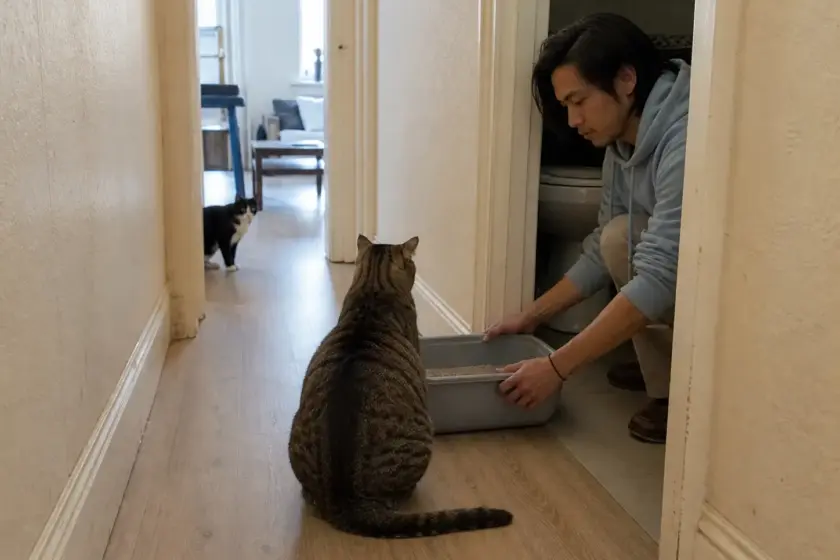
Here’s the part that gets dropped every time. Three boxes lined up along the same bathroom wall is not three resources. It’s one resource with three lids on it. A cat guarding that corner guards all three simultaneously, and the cat being guarded against gains nothing from the count.
Separation is the mechanism. The rule was never about arithmetic, it was about a cat being able to reach a box without crossing paths with the cat who has opinions about it. Two boxes in genuinely separate rooms outperform four boxes in one, and if your apartment only has so many rooms, distributing them along different walls in different parts of the space beats clustering them where the mop already lives.
I used to treat the count as the whole rule and the placement as a detail. Enough multi-cat threads follow the same arc, three boxes bought and one cat still going in the hallway, that I flipped it: the count is the easy half and the separation is the half that does the work.
What Multi-Cat Does to the Box Itself
Now the part nobody generalizes. Multi-cat doesn’t just change how many boxes you buy. It changes what kind.
Prefer open over covered, because there’s no single exit to guard and no ambush point to create. Prefer more width per box, because overlapping use means less recovery time between visits and a cat entering a box that’s still occupied territory in his estimation. And prefer matched boxes over an assortment: identical height and entry means neither cat is choosing between two different experiences, which quietly turns into a preference and then into one box doing all the work.
Before you buy anything, though, the cheap route is real. Plain uncovered storage bins are a repeated workaround in exactly these households, because retail “jumbo” so often still fails 1.5x for a big cat, and a bin gives you more square inches of floor per unit than almost anything sold as a litter box. They look like what they are. That’s the entire objection.
If you’d rather buy the proper version, buying matched is the practical form of N+1, and the 2-Pack Stainless Steel Litter Box with Lid High Sides XL is two boxes at 23.8 by 16 by 12 inches each, which clears 1.5x for a cat up to about 15 inches nose to tail base with room to spare, and lands inside the 15 to 18 inch width band. Two honest notes on it. The lids are removable and this article’s multi-cat advice is to take them off and leave them off. And at 12 inches the sides are tall, which makes it the wrong buy for a household where either cat is older or heavier, ramp or no ramp.
Choosing in a Small Apartment, Where the Rules Collide
Every guide above this one assumes a spare bathroom, a utility room or a basement. A lot of readers have one bathroom, a hallway and a landlord. The framework still holds. The compromises just have to be said out loud instead of quietly assumed away.
The Corner, Not the Closet
The compromise that gets repeated by people who actually live in small spaces is a corner in the main living area, out of the primary walking path. Not hidden in a closet.
That feels wrong the first time you read it, because the closet is the tidier idea and the corner is the one you have to look at. But a closet is a box with one exit and a door somebody closes without thinking, and a cat evaluates it the same way he evaluates a hood. Near the bathroom rather than sealed inside an unventilated one is the other half of it: you get the cleanup access without turning a small room into a smell trap. The window matters more than the wall. If you want it laid out properly with the actual floor plans, the small-apartment layout in full is the one that owns the layout question.
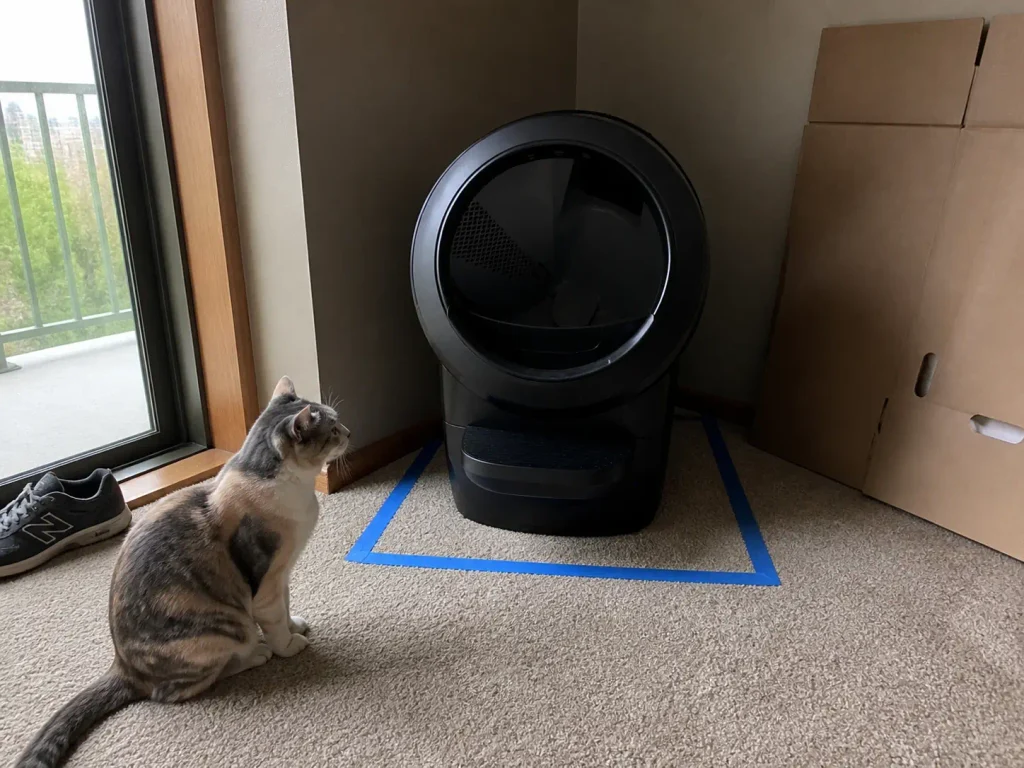
Mark the box footprint on the floor with painter’s tape and live with it for two days before buying anything. If you’re stepping over the tape, walking around it, or quietly moving it on day two, the box was never going to work there and the tape cost you nothing to find out.
Automatic Doesn’t Mean Smaller
Self-cleaning boxes get pitched to small-apartment readers as the space-efficient answer, and that’s the one claim in the category that doesn’t survive a tape measure. They solve scooping frequency. They do not win floor back.
Do the free thing first. Committing to scoop daily, twice if you can manage it, costs nothing, takes about ninety seconds, and keeps your existing footprint exactly as it is. If that’s genuinely not happening in your household, then the numbers matter. The Litter-Robot 4 with Step & Fence by Whisker needs roughly 22 by 27 inches of floor, which is more than a standard open pan of the same interior capacity, and in a studio that number decides the purchase before any feature does. It also needs a power outlet within reach, which is its own constraint in an apartment where outlets are already spoken for.
Measure the corner you actually have before you read a single feature list. And for how the category works and who genuinely benefits, how self-cleaning boxes actually work and who needs one covers it as its own subject.
What to Give Up First When It Won’t All Fit
Sometimes all three axes can’t be satisfied in the space available. Here’s the priority order when something has to go.
- Size stays. It’s the one that invalidates everything else. Give up length last.
- Open over covered comes second. A lid is the human’s feature, and it’s the first genuine preference on the list.
- Side height comes third. Tall walls are a convenience for you, and a ramp solves the access problem they cause.
- Entry height jumps to the top if the cat is a kitten, a senior, or heavy. In those households it stops being third and becomes the first thing you protect.
One thing renting mostly doesn’t forbid: your box choice. Leases restrict modifying the room, not what stands in it, which is why every option here is renter-friendly by default and none of it needs a drill, a bracket or a hole in anything. Every box in this article is free-standing and leaves with you.
Choosing the Box, in Three Numbers
Measure the cat before you look at a single listing. Nose to the base of the tail, times 1.5, and add three to four inches for width. That number is the entire filter, and everything on the shelf either clears it or it doesn’t. No label survives contact with it.
Sides and entry are two separate decisions, and the second one has an expiry date. The cat who clears a 6-inch wall today isn’t the cat who’ll be clearing it in four years, and a ramp is cheaper than admitting that later.
Open beats covered in most homes, and it isn’t close in a house with more than one cat. The lid is a human feature. Buy it knowingly if you buy it, and buy it extra-large if you do.
Then check back in three weeks, not three months. A cat accepts or rejects a new box within days, and the answer is visible in two places: where the waste ends up, and whether he turns fully around inside the box or reverses out of it. Three weeks is also about when a new scooping habit starts to slip, and that shows up in the same two places.
Measure him tonight. If the box you already own clears the number and the walls aren’t the problem, you just saved yourself the purchase, and for anyone whose cat is over a year old and recently changed his mind about the box, that’s the most likely outcome of everything above.
Amazon’s Audible — free for 30 days
Your cat won’t let you read. Let someone read to you.
Audible is Amazon’s audiobook library — thousands of titles, read out loud, on your phone. Free for a month, plus one audiobook to keep forever.
Frequently Asked Questions
01What is the golden rule for litter boxes?
One box per cat plus one spare, and each box at least 1.5 times the cat’s body length measured nose to the base of the tail. The count rule stops resource guarding; the size rule is what makes each box usable in the first place.
02Do cats prefer open or closed litter boxes?
Most cats prefer open. A hood concentrates odor at nose height and reduces the exit to a single opening, which matters most in homes with more than one cat. Closed boxes are usually bought for the human’s benefit, and that’s a legitimate reason, just not a feline preference.
03What litter box do vets recommend?
Veterinary guidance is about dimensions rather than brands: the AAHA-AAFP sizing minimum of 1.5 times body length, a low entry for cats with mobility limits, and one box per cat plus one. Any box that meets those numbers qualifies, regardless of what’s on the label.
04Why do vets not recommend closed litter boxes?
The stated concerns are odor concentration inside the hood and the single exit, which can leave a cat cornered in a multi-cat household. A covered box isn’t forbidden. It’s a worse default, and a poor choice specifically where more than one cat shares the space.
Leave a comment