How to Clear Cat Hair Around the House Without Moving It
Clear cat hair around the house without moving it ➜ what holds on floors, couch, bed and clothes, and what only sends it to the next room.

Alfredo RamsesFounder · Updated November 1, 2026 · 21 min read

On this page11 sections
- 1Why Cat Hair Around the House Comes Back After You Clear It
- 2The Couch: A Cover Holds the Hair, It Doesn't Stop It
- 3The Spot the Cat Chose, and the Bed It Shares With You
- 4Clothes and the Laundry: What the Wash Sets and the Dryer Lifts
- 5Floors: Lift the Hair Before You Move It
- 6The Air: A Purifier Handles What Floats, Not What Lands
- 7Renting With No Doors: The Common Fix Needs One
- 8What Holds and What Only Moves It, Surface by Surface
- 9When the Hair Is Coming From the Cat, Not the House
- 10Work One Surface at a Time, and Look at His Spot in Three Weeks
- 11Frequently Asked Questions
You give a Saturday morning to the cat hair around the house, sweep the hall, run the vacuum, and before the broom is back in its corner a gray tumbleweed is drifting along the baseboard again. Owners call this a cat hair purge: hours of work, then fresh clumps ten minutes later. What they describe is rarely a lack of effort. Most of the tools we reach for push hair around before they pick any of it up, so this article sorts the hair by the surface where it ends up (floor, couch, bed, clothes, air) and says, for each one, what holds and what only sends the hair to the next room, with the free moves ahead of anything you buy.
Quick Answer
Start each surface with the move that gathers hair instead of scattering it:
- Run a dry microfiber mop or a damp broom over floors before vacuuming.
- Wipe the couch with a damp hand or rubber glove before reaching for a roller.
- Put a washable layer on the cat’s own spot and wash it with the bedding.
- Tumble dirty clothes in the dryer first, with wool balls spread through the load.
- Treat a purifier as a helper for hair still floating, not for hair that landed.
Why Cat Hair Around the House Comes Back After You Clear It
The broom is the first thing most of us grab, and it is where the trouble starts. LiveToPlant, a home-cleaning site, says sweeping pet hair off hard floors feels like a never-ending task because “the fine strands cling stubbornly to the surface or scatter as you try to collect them.” Hair that fine and that prone to static does not sit still while you work. It goes where the air and the bristles send it, and the sofa, the baseboards and the next room are all on the route.
Sweeping and dry dusting lift hair instead of collecting it
Common accounts hold that sweeping sends hair up into the air and spreads it more evenly on everything, and that even vacuuming puts a lot of it into the air. That is not a measured result, but it matches the mechanism. A dry broom throws hair up before it gathers any, and what lands again lands somewhere new. The same logic covers a dry duster flicked along a shelf: anything that crosses fine hair without collecting it first tends to leave some of it on a different surface.
So the order of your tools decides whether hair moves or lifts. Three habits send it traveling:
- Sweeping dry with a broom before anything has gathered the loose hair.
- Vacuuming open floor, which still lifts a lot of hair into the air.
- Running a vacuum whose underside is loaded, since hair “stuck to the underside of my vacuum cleaner so it leaves a trail of cat hair.”
You can change the order today with tools you already own, and the floors section below gives it.
Work from the highest surface down and leave the floor for last. Hair you lift from the couch and the bed then has nowhere left to fall except onto a floor you have not cleaned yet.
The source is the cat, and brushing is a contested fix
Whatever lands on the floor came off the cat first, so brushing is the obvious place to start. Chewy, the pet retailer, says it plainly: “Regular brushing can help remove loose hair on your cat’s coat, which means less will end up on your couch and clothes.”
But owners are split on it. For some cats brushing does little, because the brush barely pulls hair and the cat objects, while for others it lets you remove loose hair in a controlled setting rather than have it fly all over your house. Both can be true: brushing puts the hair where you chose, and it is no guarantee that the couch stays clean.
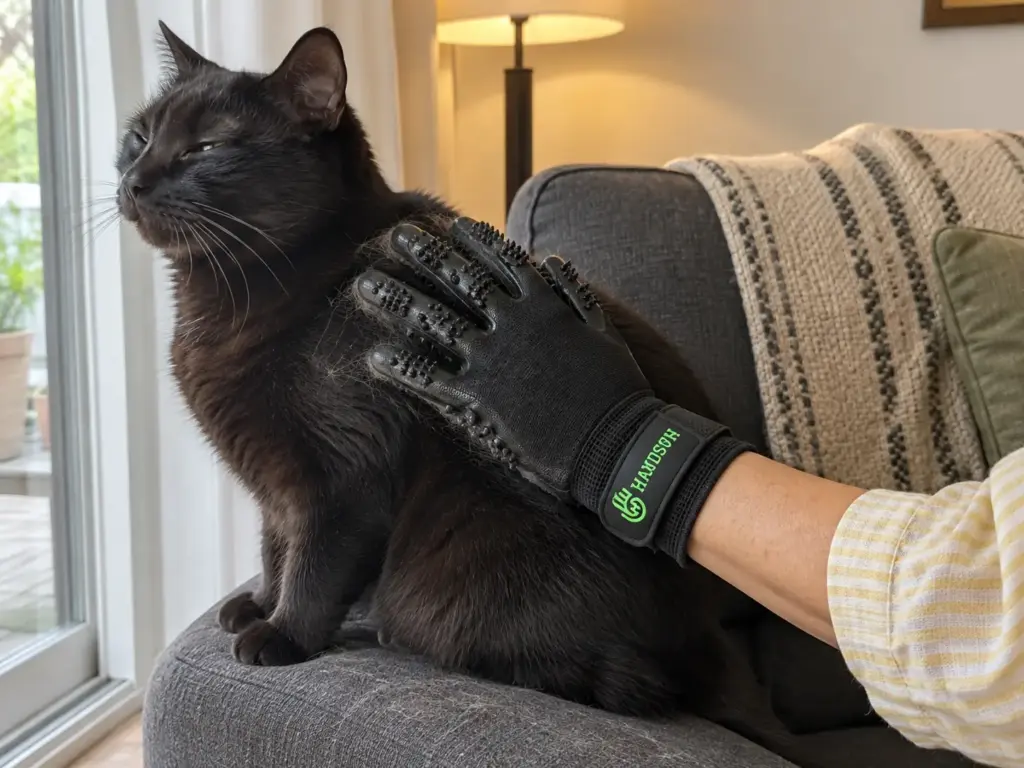
If your cat tolerates a glove better than a brush, the H HANDSON Pet Grooming Gloves (5-finger, Large, sold as one pair) are a grooming tool and nothing more: they take loose hair off the cat. They do not lift hair out of fabric, and the reviews say where they fall short. Hair does not stick to them the way it does on a silicone brush, so it keeps drifting while you brush, and the rubber nubs can come apart from the first use. Brush over a towel or a spot you can wash, and expect to replace them sooner than you would like.
How often to brush depends on the coat, and how often a cat needs brushing, by coat sets it out, while the full grooming routine covers a whole session. If your cat walks off at the first stroke, start with what a cat objects to when you brush it. A cat who leaves is describing the tool, the spot or the moment, and that is information, not defiance.
Why one big clean-up never finishes the job
Even a perfect Saturday has an expiry date, because the source never stops. A cat that sheds year round drops hair into your week every week, shedding season or not, which turns the job from an event into a load you carry. A method you can repeat in a few minutes beats an afternoon purge that the next week undoes, and that is why the rest of this article is organized by surface and not by deep clean.
The Couch: A Cover Holds the Hair, It Doesn’t Stop It
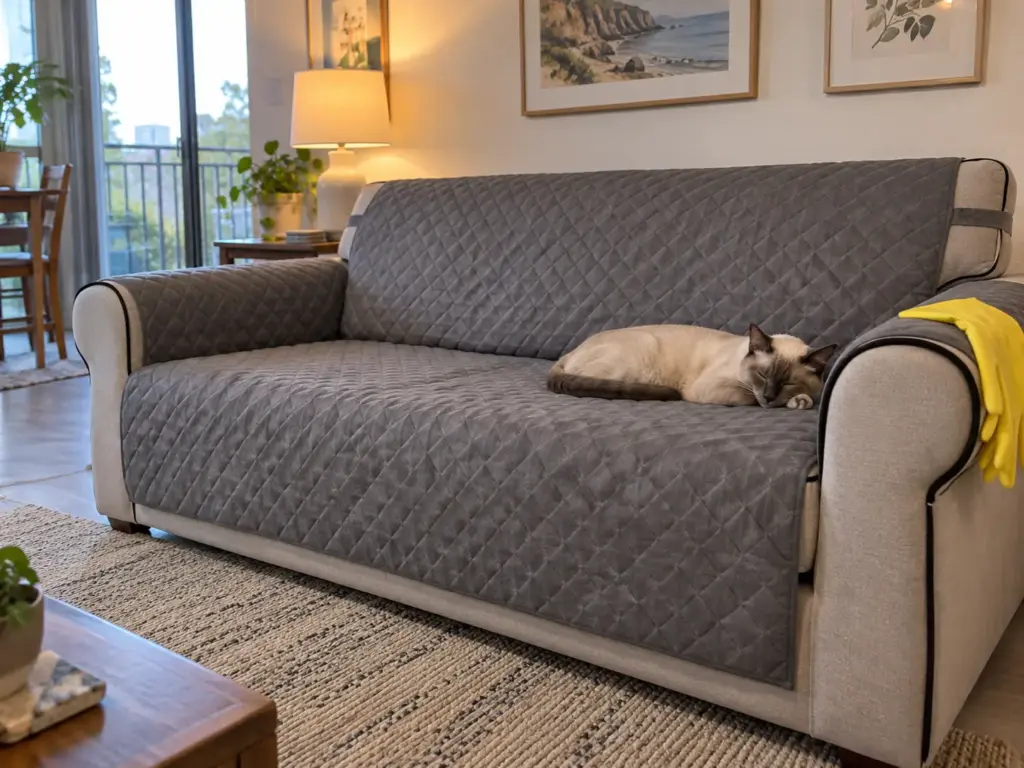
Most people buy a cover hoping the sofa will stop filling up, and nothing about the amount of hair changes. Chewy puts the limit in one sentence: “This won’t reduce your cat’s shedding, but it’s a lot easier to clean than the couch itself.” The cover is a container. A free move gets hair off the cushion today, so that comes first.
Start with a damp hand or a rubber glove
LiveToPlant’s advice is almost embarrassingly simple: “Slightly dampening your hands and running them over affected areas allows you to pick up loose fur manually.” A rubber glove, wet and shaken out, takes it one step further when rubbed over the furniture or a small rug until the hair balls up and can be picked up or vacuumed away. Both work by gathering the hair into clumps you can lift, which is the opposite of what a broom does.
- Wet your palm, shake off the excess and pull it across the cushion toward you.
- If that works, switch to a wrung-out rubber glove for the whole couch.
- Pick up the clumps by hand, and vacuum last for what is left.
Try the glove on a hidden corner of the couch first and let that patch dry before you do the cushions people can see. A fabric that darkens or stiffens when damp is better found out on the back, not the front.
What a washable cover really does
Once the cushion is clear, a washable couch cover keeps it that way for longer, which is a different job from reducing hair. The PureFit Reversible Quilted Sofa Cover in the 66 inch size is a reversible, quilted layer that goes into the washer in place of the sofa. That is its point and its limit. Hair can get embedded into the fabric even through the wash, so run the damp glove over the cover itself before it goes in.
Chewy files a sofa cover and a throw blanket under the same fix, and the throw has no straps to fail. If your cushions are sewn in, a plain throw blanket you can toss in the wash does the same containing job with nothing to slip.
Why covers keep sliding off the cushions
Two three-star reviews of that cover say the same thing in different words: “Top always falls down,” and “they do not hold well to my stitched in cushions.” Most of these reviewers have dogs, and a dog jumping on and off is probably a rougher test than a cat circling once, but the mechanism is the same. The loops that are meant to hold the cover have little to grip when the cushions are stitched to the frame. A cover that creeps leaves the cat’s chosen spot bare, and the hair lands on the fabric the cover was bought to protect.
Check whether your cushions lift out before you buy anything. If they are sewn in, assume the cover will creep and plan around that.
Tape and rollers: fine for one patch, not for the couch
For a single small patch, a strip of masking tape pressed down and pulled off gently works, and it is great for denim or furniture fabric. For a whole couch, tape and rollers are slow, and the laundry section below explains why pressing hair into fabric and then washing it can drive the hair deeper instead of out. A closer pass at cat hair off the couch, fabric by fabric, belongs on its own page; this one only decides which move comes first.
The Spot the Cat Chose, and the Bed It Shares With You
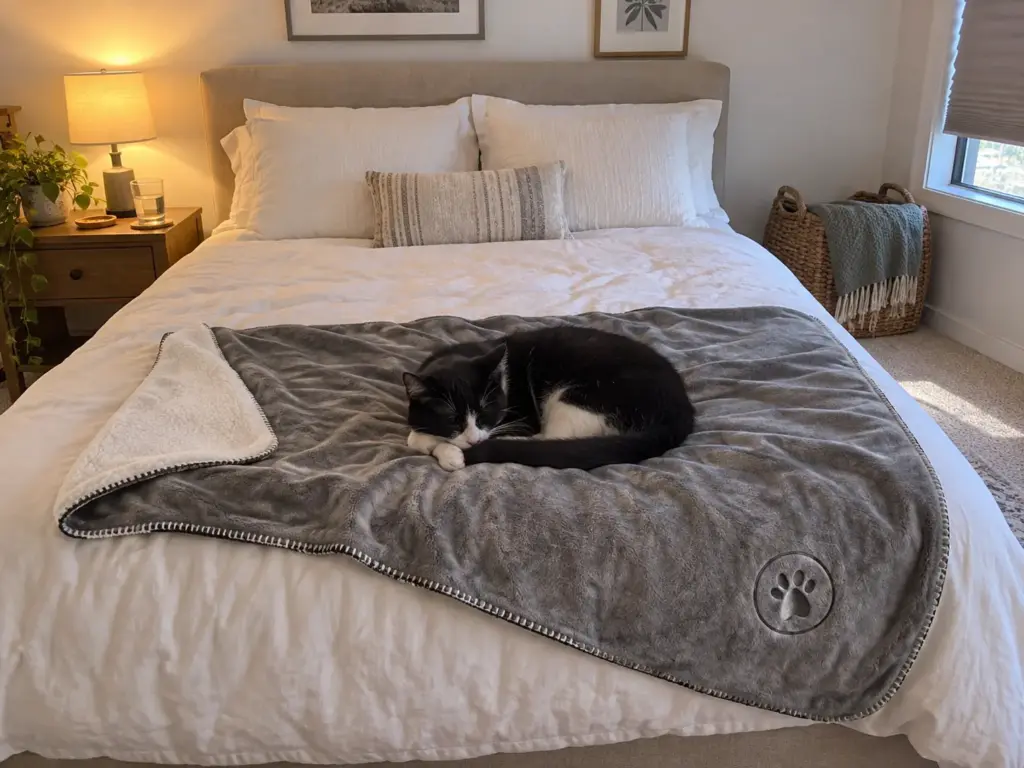
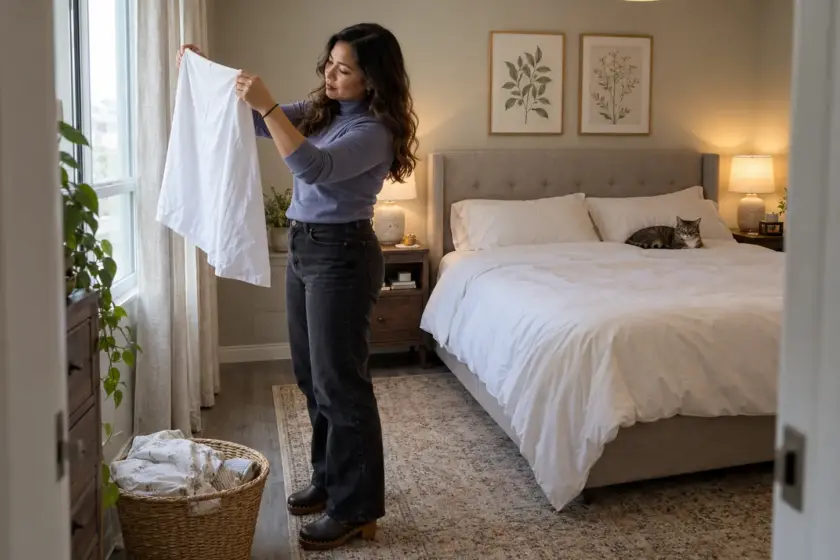
Picture a scene that anyone with a cat on the bed will know: three cats, two of them asleep in the bed, a household that cannot just skip washing the bedding, and one corner of the pillowcase that is always orange. The hair was not spread evenly. It collected where one cat slept.
The thickest hair is wherever the cat sleeps
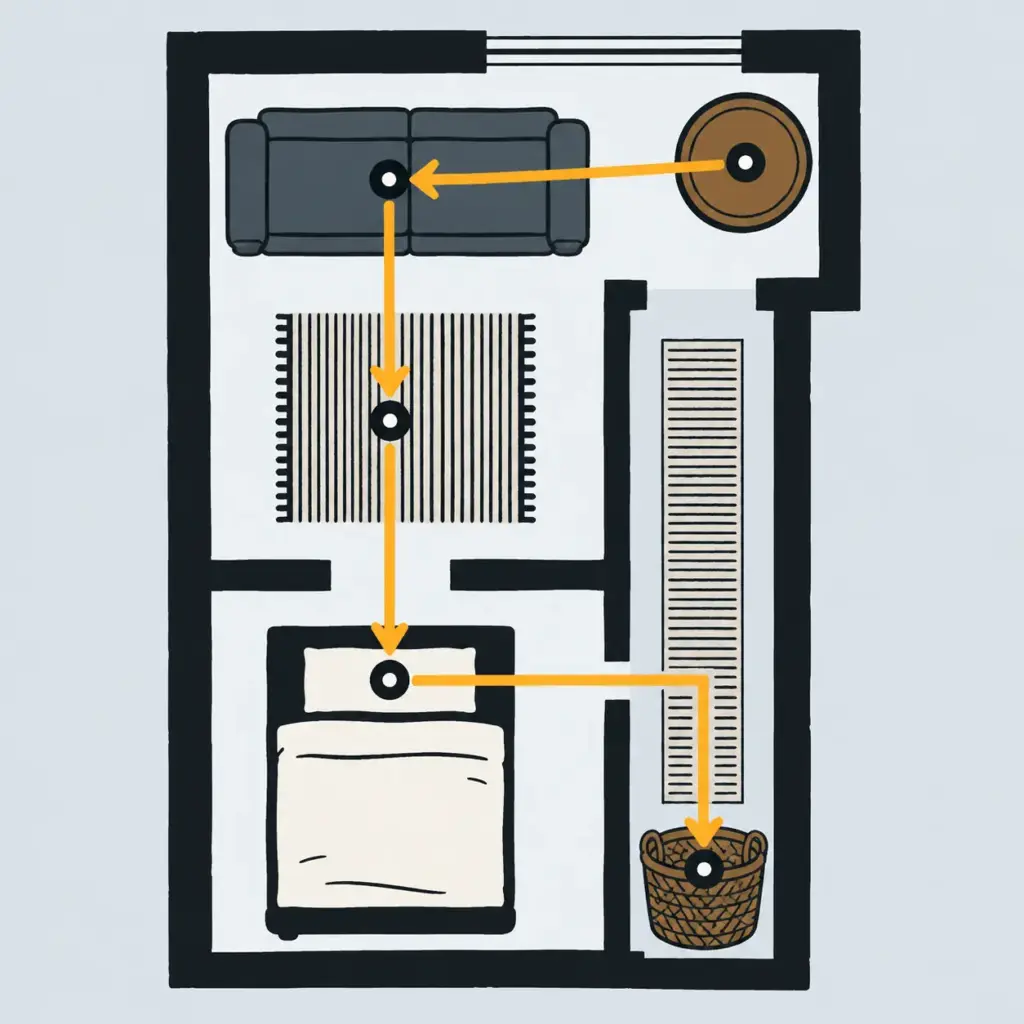
You can test this with nothing but your eyes: walk the rooms of a small apartment (or any home) and find where the hair is thickest. It is rarely random. It is the arm of the sofa, one side of the bed, the cushion by the window, which is to say the cat’s sleeping spot. That is this article’s reading of the pattern, not a measured finding, so treat it as a place to look and not a rule.
If it holds in your home, it changes what you do.
The spot is the cat’s choice, and the choice is a constraint. He decided where he sleeps, and moving him is a negotiation you can lose every night. A washable layer works because it adapts to his decision instead of arguing with it.
One cat on the bed versus two or three
In a multi-cat home, look at each cat’s spot, not just one; with a single cat, one spot is usually enough to look at. With two of the three cats sleeping in the bed on a regular basis, the third cat’s hair ends up somewhere else in the house, and one layer on one corner would cover two of them and miss the rest.
A washable layer on the cat’s spot, and where it fails
The PETMAKER Waterproof Pet Blanket in gray, 50 x 60 inches, is a waterproof layer you can set on the sofa arm or at the cat’s side of the bed. It has two weak points: the blanket can slide down and bunch up on the couch, which leaves the spot bare, and the waterproof inner layer can ball up after a trip through the dryer.
If the layer will not stay put, a softer option comes from the same community. Washable warming pads in the cat beds and on the big bed are one answer, because hair does not stick to them like it does to other fleece blankets. It comes off in the wash and balls up in the dryer, so at least it leaves the fabric.
A quilt that does not clump like a traditional comforter when washed is a softer option, and a washable duvet cover that goes in with the sheets is the same idea.
The order in which to stack the layers (his spot first, then everything else) is set out in the order for the washable layers, so it is not repeated here. A closer look at cat hair in bedding gets its own page.
Put the cat’s layer into the same wash as the bedding so it does not become a second chore you skip. Read the care label before the dryer, because the waterproof backing is the part that can ball up.
Clothes and the Laundry: What the Wash Sets and the Dryer Lifts
The laundry is where loose hair becomes stuck hair. Hair in the wash tends to ball up in the dryer, and anyone who has pulled a sweater out warm, with a gray fuzz on it that was not there at the start, knows the feeling.
The lint roller and the washer can set hair deeper
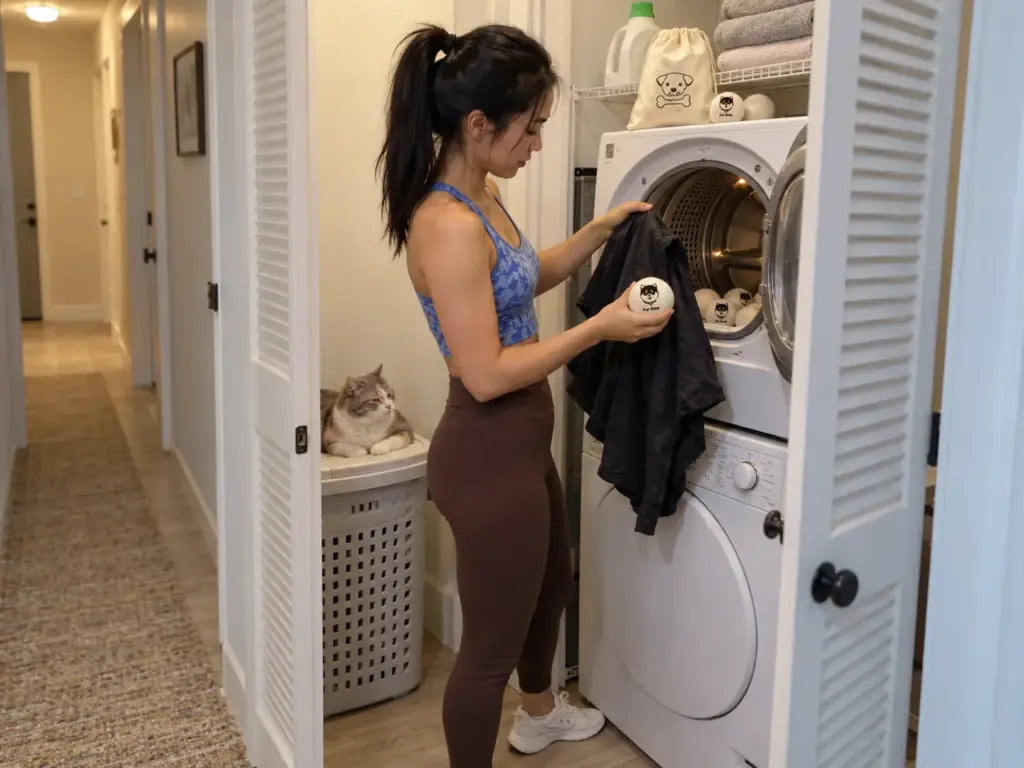
PetPlace, a pet-care site, makes a point that sounds backward: “lint rolling and washing can actually cause pet hair to embed itself further into the fabric of your clothing.” So the roller you use to get dressed and the wash you run afterward are not neutral. Hair already pressed into a sweater is harder to move than hair sitting on top, which is why the order of the steps matters more than the effort.
Run the dryer before the wash
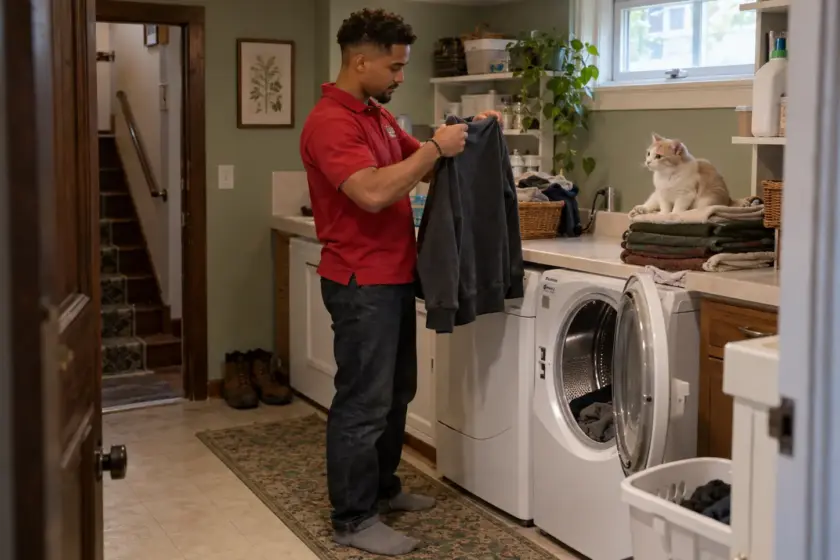
Using the dryer helps remove a lot of hair. The idea is that the dryer loosens the hair before water can set it, and the lint trap is where the loosened hair ends up.
- Tumble the clothes in the dryer first, before they touch water.
- Empty the lint trap, because that is where the loosened hair collects.
- Wash as usual.
And skip the lint roller on anything you are about to wash.
Wool dryer balls: spread them through the load
Wool balls are meant to pull hair toward the lint trap, and they only work when they have clothes to rub against. The Bienstylife Wool Dryer Balls for Pet Hair Remover arrive in a package that measures 8.19 x 5.28 x 2.72 inches and weighs 8.1 ounces (that is the package, not each ball). Two reviews are blunt about the weak side: one says “after two loads of laundry, the balls are shedding all over my clothes,” and another that “my clothes still come out with pet hair on them.”
Drop the wool balls in one at a time as you load the dryer, between the clothes, and not in a pile on top. PetPlace says to “layer them throughout your laundry rather than just placing them on top of the dryer load.”
So the balls may help, and they are no substitute for the dryer pass or for brushing the cat. Raffaelo’s XL set of six is the other set to compare before you buy.
Dark fabrics show whatever is left, and cat hair on black clothes is a topic of its own. A step-by-step on getting cat hair out of clothes, and on using the dryer for it, belongs on those pages.
Floors: Lift the Hair Before You Move It
You finish the hall, look back, and there is a thin line of hair where the machine just went. That is the floor in a nutshell: the tool that was meant to collect the hair is also the one that spreads it, and the fix starts with the order of the tools more than with the machine.
A dry microfiber mop before the broom
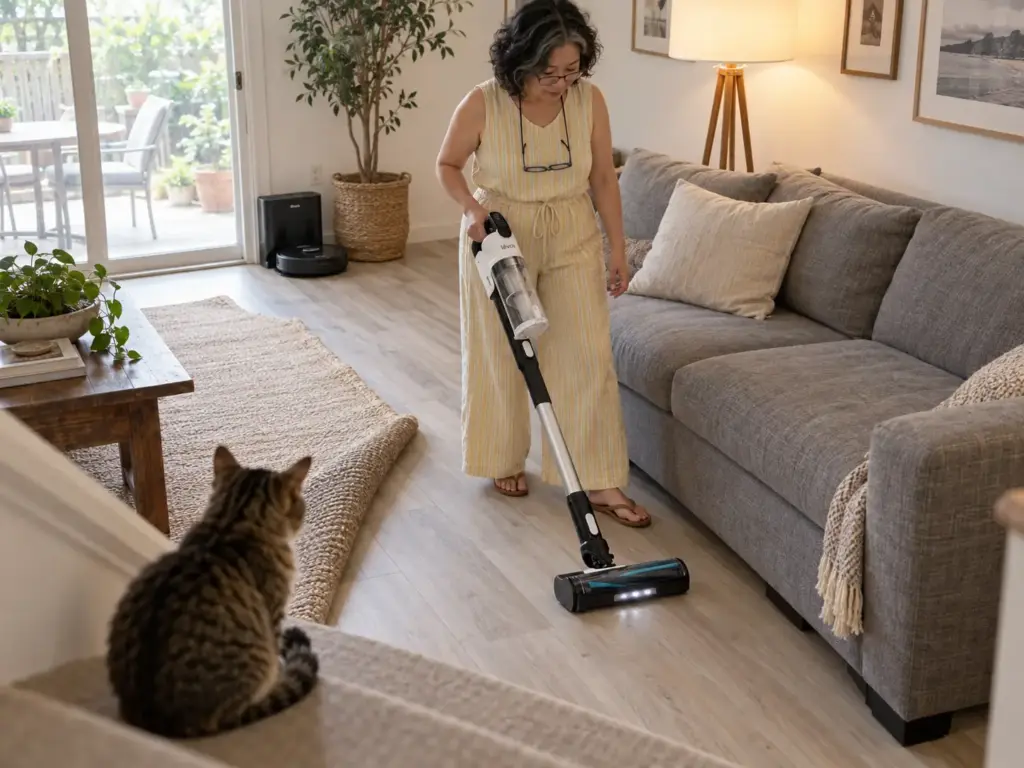
LiveToPlant says “using a microfiber dust mop before sweeping can lift loose pet hair without scattering it further.” The mop gathers the loose layer first, so the broom or the vacuum that follows has less to throw. If you own a microfiber pad already, this is the cheapest upgrade on the page, or the second cheapest, since the damp broom below needs no pad at all. Either way it is the same floor and the same pass with the steps in a different order.
A damp broom, and low humidity
Wetting a broom slightly before sweeping means less hair ends up in the air. It is an unproven claim, but it follows the same logic as the damp palm on the couch: wet hair sticks to what picks it up. Humidity matters too, because LiveToPlant warns that a dry room “can increase static buildup on some floors, causing hair to cling more tightly.” A heated apartment in winter can be that dry, so the hair may grip harder and the same pass may do less.
The vacuum that blows hair into the air
Even vacuuming still puts a lot of it into the air, which is why the vacuum follows the mop and not the other way round. The order on a hard floor is short:
- Dry microfiber mop, or a barely damp broom.
- Vacuum for what the first pass left.
- Empty the dustbin before you put it away.
How often depends on the traffic. Chewy says you may need to vacuum high-traffic areas “every one to two days,” especially in high-shed seasons, and that number is wrong for the bedroom nobody walks through. Count the rooms that carry the load and give those the schedule.
For a daily pass without a cord, the Levoit Cordless Vacuum Cleaner LVAC-200 is a stick vacuum sold as anti-tangle for pet hair. Its reviews carry two complaints. One is a battery of about 8 minutes at maximum suction, along with “fur sitting directly on the surface that the vacuum simply glides over.”
The other, from a household with two German Shepherds, is that “the hair/dander has already clogged up the internal suction area” after two uses. Dog hair is the test there, but the mechanism applies to cat hair too, so start on the lower setting and empty the bin often.
A full breakdown of vacuums for cat hair belongs to the vacuuming section of this site, which keeps this article on the mechanism.
Empty the vacuum’s bin and clear the roller before each pass. A loaded one is the one that leaves a trail, and hair can clog the suction path quickly.
A robot on a schedule, and what its app gets wrong
A robot vacuum runs when you are out and lifts nothing for you. The Shark AI Ultra Robot Vacuum (AV2511AE, black) comes with a self-emptying base that the listing calls a 60-day base, and the base needs a clear patch of floor.
What fails is the app, not the suction. The app can lose its maps, the wifi can drop out, and the robot can make a thwacking sound at night after it recharges.
So schedule it for when you are out, not for night, and treat the mop and the damp broom as the pass you do yourself. The robot only keeps the floor from getting worse between those passes.
The Air: A Purifier Handles What Floats, Not What Lands
A purifier with a HEPA filter is the purchase people expect to end the problem, and it helps to be plain about what it can do. It can only work on what reaches it, which is the fine hair and dust that is still in the air, for example after a sweep.

It does nothing for the hair already on the sofa, the bed or the floor, and that hair is the part you see. So the purifier is a helper for the air after a pass, not a replacement for the passes. Allergies are a separate subject with their own questions, and nothing here promises anything about them.
Renting With No Doors: The Common Fix Needs One
Why “keep the cat out of the bedroom” fails without a door
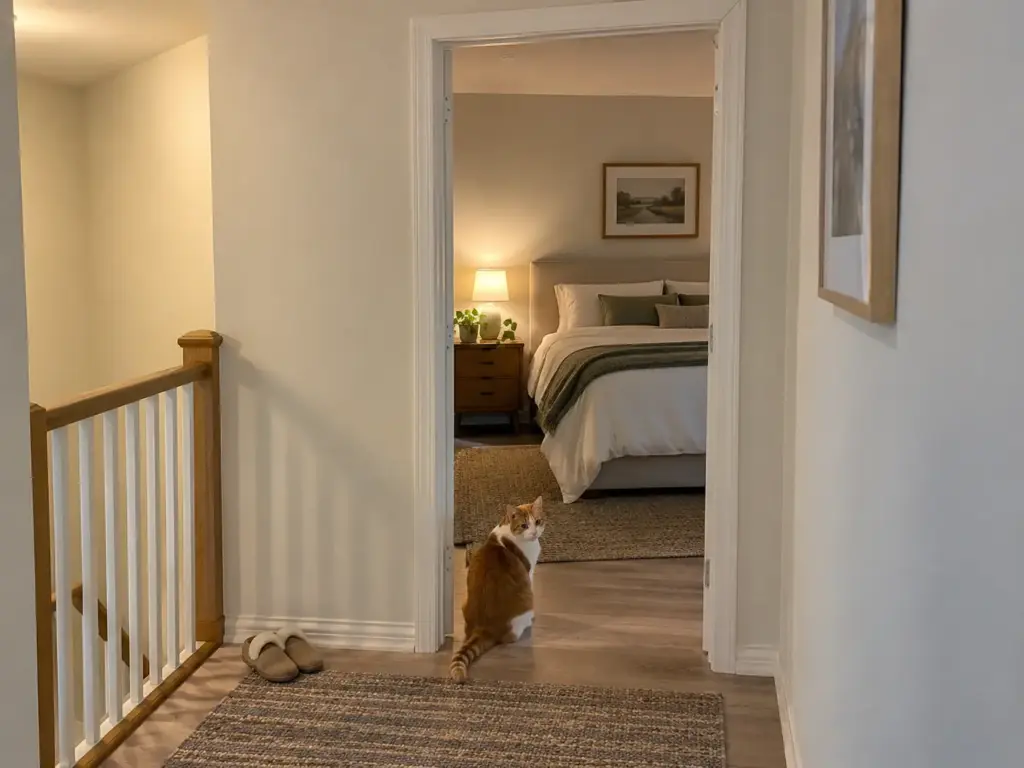
The fix people reach for is to close the bedroom door on the cat. It is a reasonable idea. A bedroom he cannot enter is a bed that stays clean, and it assumes a door.
Some rentals have no doors at all, which leaves two parts to the usual fix: locking the cats out of the bedroom and a robot vacuum scheduled to run daily. Half of that needs a door.
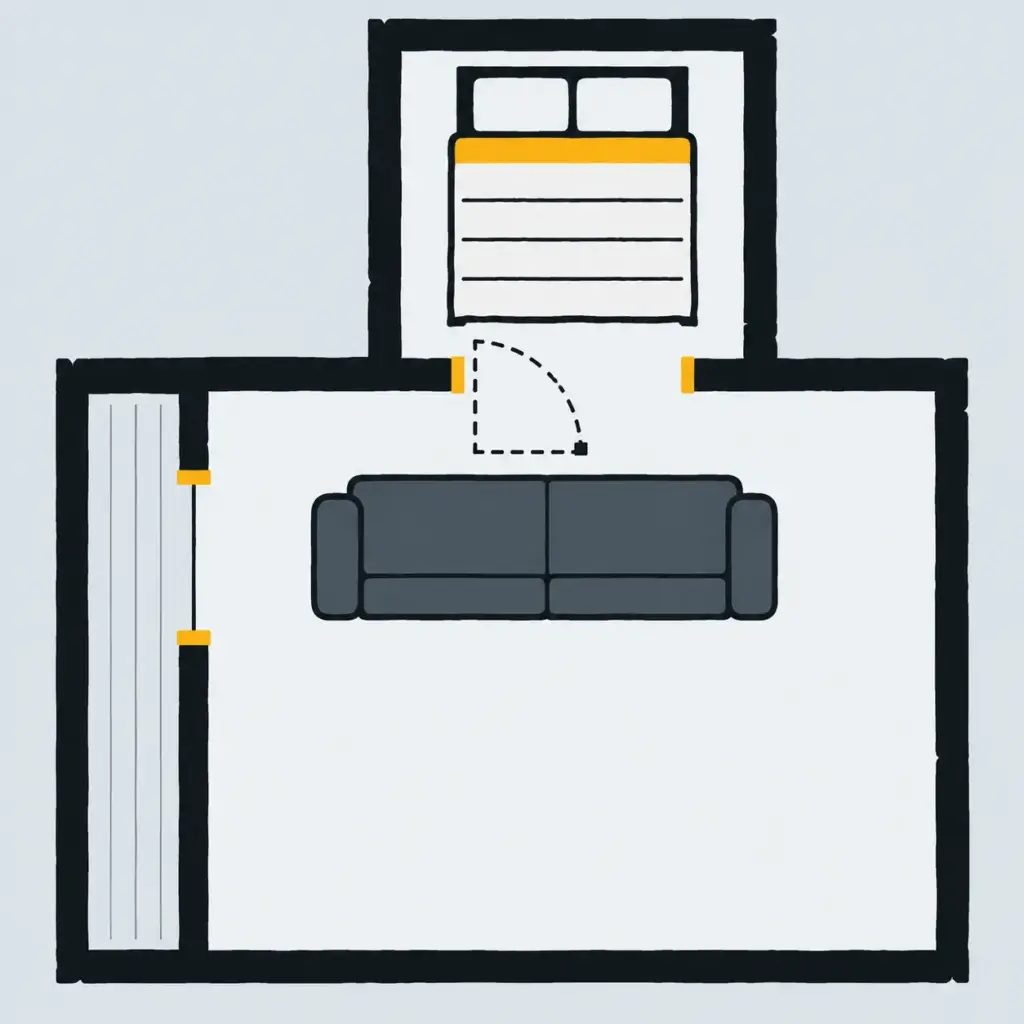
In a rental apartment with no doors, the better call is not a stricter rule for the cat, who cannot read one. It is a bed that can take the hair.
Make the bed the container, not the cat’s new rule
Put the washable layer on the bed itself, at his side. Some households cannot skip washing the bedding, so the answer is to make washing the bedding quick. Anything you add to a rental should be cloth, should not need a drill, and should not need your landlord to say yes, which a layer you launder with the sheets satisfies. If the lease is the reason you cannot do more, living with shedding in a rental is the place to look.
Before you buy a bed layer, decide whether your own machine can wash it and whether it fits next to the sheets. A layer you cannot wash at home is a layer you will leave on the bed too long.
A scheduled pass instead of a closed door
The second half of that fix, a robot vacuum on a daily schedule, does not need a door at all. It covers the floors, the layer covers the bed, and between them you have replaced what the door would have done. Run the robot while you are out, so any noise it makes is not yours to listen to.
What Holds and What Only Moves It, Surface by Surface
Here is the whole page in one table: for each surface, the move that gathers hair and the one that only sends it to another room.
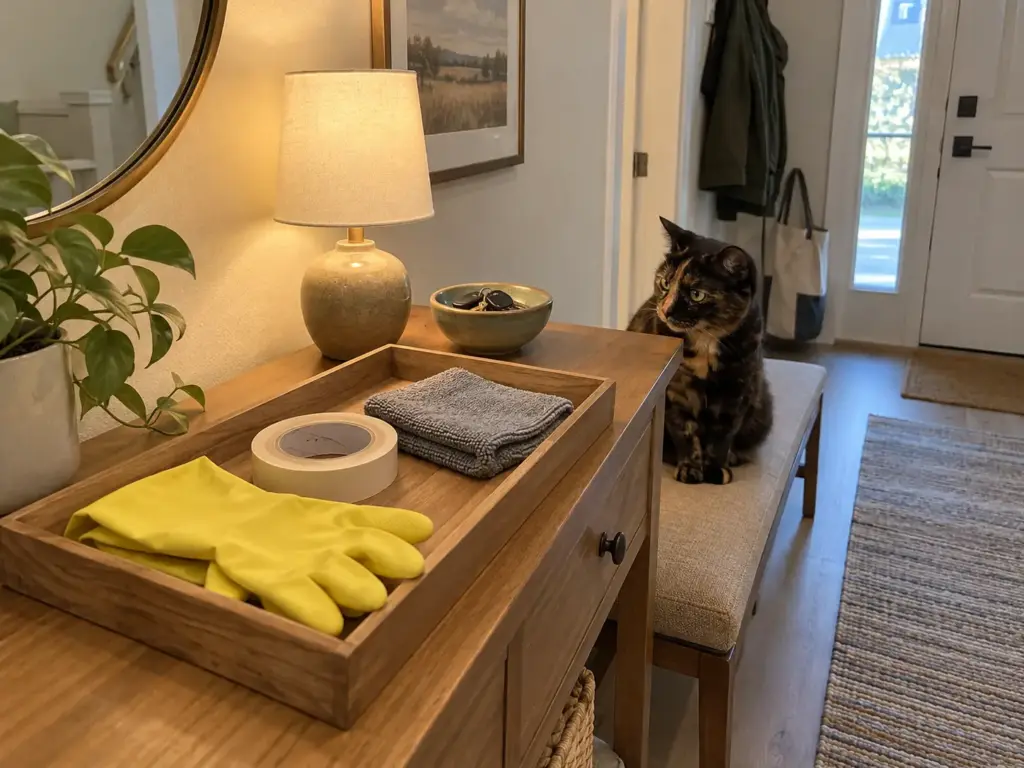
The five surfaces in one table
| Surface | What holds | What only moves the hair | The deeper read |
|---|---|---|---|
| Floors | Dry microfiber mop or damp broom first | Dry sweeping; a vacuum run over loose hair | Vacuuming for cat hair |
| Couch | Damp hand or rubber glove; a washable cover to contain it | Expecting the cover to cut shedding | Cat hair off the couch |
| Bed | Washable layer on the cat’s own spot, washed with the bedding | Locking the cat out when there is no door to lock | Cat hair in bedding |
| Clothes | Dryer before the wash; wool balls spread through the load | Lint roller and wash on the same fabric | Cat hair out of clothes; dryer for pet hair |
| Air | A purifier for hair still floating | Hoping it lifts hair that has landed | Allergies, a separate subject |
Start with the surface that bothers you most, usually the one people see, and finish with the floor. The floor is where whatever you loosened elsewhere ends up.
Why the free move comes first
The free moves (the damp palm, the dry mop, the dryer pass) change how hair is handled this week. A purchase does not change where the hair comes from, and it adds a thing that can slide, ball up or shed. Every product in this article carries a flaw on the page: the glove sheds its nubs, the cover creeps, the blanket balls up, the dryer balls shed, the stick vacuum loses its charge, and the robot loses its map. Use the free move first, and buy only after it has failed on your own surface.
Which tool belongs at the source
The cat is where the hair starts, and the right tool depends on his coat. Which tool belongs at the source is a question of coat layer: a brush for one cat and a deshedding tool for another. If you share a home with a long-coated cat and a short, dense-coated one, expect to own two tools, because the same brush rarely suits both.
When the Hair Is Coming From the Cat, Not the House
If you have done every pass above and the hair is still more than you can explain, the house is not the place to look. Chewy lists “Bald spots, areas of thinning, or an otherwise thin coat” under its own “When To See a Vet” heading. A sudden change in how much hair your cat loses, or areas of thin coat, is a question for your vet, and nothing in the house will answer it.
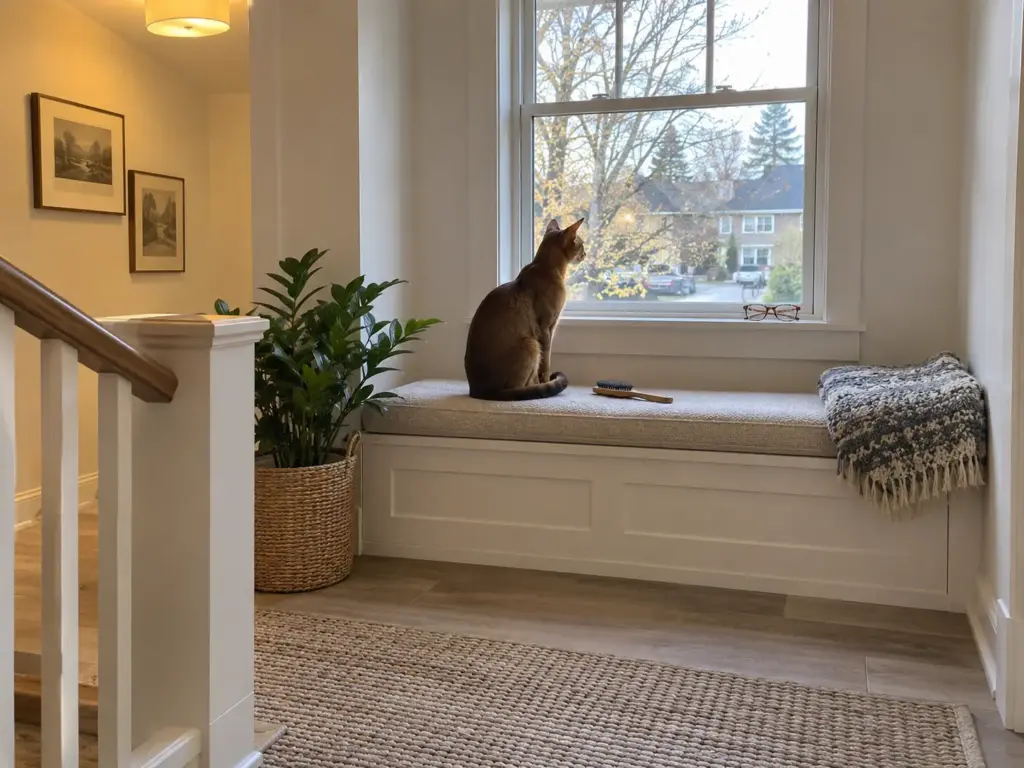
When shedding is a vet question lays out when to call. Everything else in this article is the sofa, the bed, the laundry and the floor.
Work One Surface at a Time, and Look at His Spot in Three Weeks
Three things carry the article. Sort the hair by the surface it lands on, not by the product that promises to fix everything. Gather the hair before you move it: the damp hand, the dry mop and the dryer pass all lift hair before anything else touches it. And find the spot where the cat sleeps, because that is where the hair collects, and a washable layer on his chosen spot works with his decision instead of against it.
Three weeks from now, look at that spot and the arm of the sofa once more. If the layer is where you put it and the hair on it comes out in the wash, the setup is holding; if the layer has crept or the hair has moved to a new corner, the cat has just shown you where he actually sleeps.
Today, with a damp hand or a rubber glove, pull across the part of the sofa where he sleeps and watch what balls up. That is the amount of hair a single pass lifts, and it will tell you more than another product page.
Frequently Asked Questions
01How do you deal with cat hair around the house?
Work by surface and gather hair before you move it: a dry mop on floors, a damp hand on the couch, the dryer before the wash. Dry brooms and lint rollers on fabric mostly relocate it.
02Why is cat hair so hard to remove?
Cat hair is fine and static-prone, so it clings to surfaces or scatters as you collect it, and washing or lint rolling can push it deeper into fabric. Gathering it first helps.
03Do air purifiers reduce cat hair?
A purifier can only work on hair and dust still floating in the air, so it does nothing for hair that has already landed on the couch, bed or floor. Surface hair needs a surface fix.
04How do you avoid spreading cat hair while cleaning?
Use a dry microfiber mop or a damp broom before sweeping, start with high surfaces and finish with the floor. A vacuum can lift some hair into the air, so it comes after.
05Does brushing your cat reduce the hair in the house?
Brushing removes loose hair in a spot you choose and is the only fix that works at the source. It is not a guarantee, and for some cats it did little.
Leave a comment