Why Cat Hair on Black Clothes Shows, and How to Check
Cat hair on black clothes is a contrast problem. Learn which coats show, how to check a shirt before you leave & which blacks to wear (no gear needed)

Alfredo RamsesFounder · October 13, 2026 · 13 min read


On this page7 sections
Catch yourself in the hallway mirror in a black sweater and visible cat hair is the first thing you see, so you decide the sweater must pull it in. What black does for certain is make cat hair on black clothes easy to see, strand by strand, and that is a different job. Your cat sheds where he sleeps, and a cat sleeping on clothes will pick whatever is warmest; the sweater just happened to be the best background in the house.
How much hair there is and how much you can see are two separate questions, and only the second one has anything to do with the color of your shirt. This guide covers why the dark shows it, which coats make black the hard case, the check to run before the door, homes with two coats, and the black you already own.
The quick read, by coat:
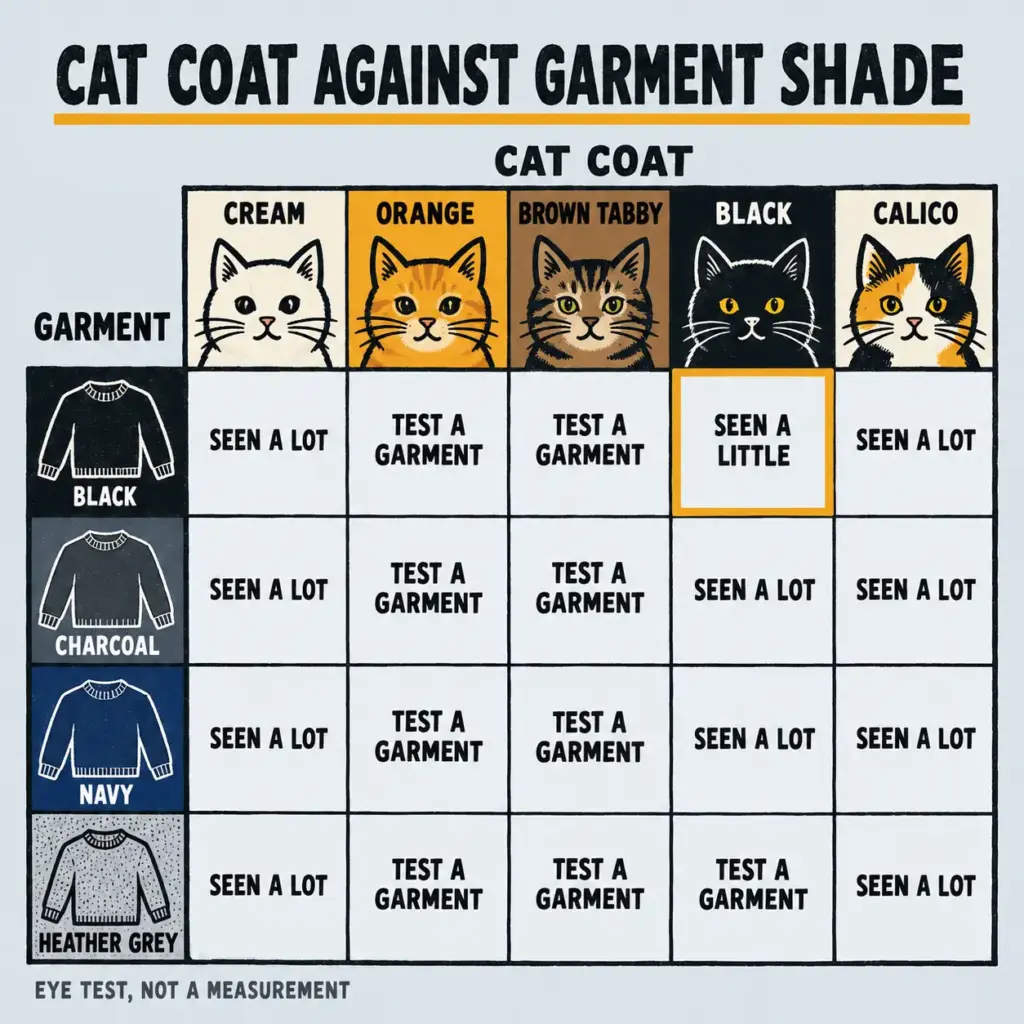
| Your cat’s coat | On a black shirt | Black is… | First move |
|---|---|---|---|
| Cream or white | Light strands against a dark ground read loudest | the hardest case | Look at the shirt from the side before you put it on |
| Orange | Clear on true black, softer on a faded one | a mixed result | Test one shirt and see where yours lands |
| Black or dark | Nearly lost on black, visible on charcoal or navy | close to invisible | Check the charcoal and navy pieces first |
| Tabby or brown | Somewhere in the middle, depending on the garment | a toss-up | Lay one strand on the shirt and step back |
| Calico or tricolor | Something shows on nearly every color | never the whole answer | Pick which color of hair to hide today |
Read the table as what the eye does, not as a measurement; one shirt of your own settles it.
Why Cat Hair on Black Clothes Is a Visibility Problem
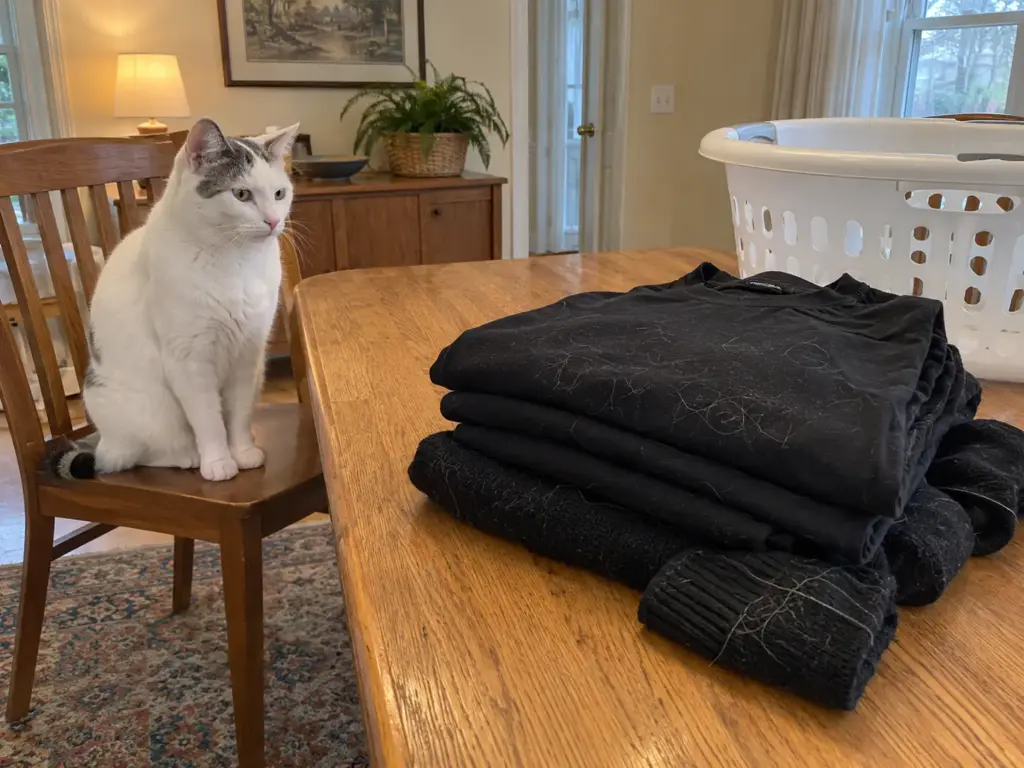
Leave a black shirt and a mid-gray one over the same chair back for one evening, and only one of them looks like it belongs to a cat. The hair on the gray one is still there. What changed is the background your eye has to find it against.
The Wash Moves Hair, It Doesn’t Hide It
The first mistake is expecting the laundry to reset a dark garment. One r/cats owner says it flatly: the hair does not go away when you wash clothes. The drum drags it around and presses it into the weave, so a black shirt can come out of the cycle looking worse than it went in.
The rest of the house is a separate job, and the Around the House guide covers clearing the rest of the house without pushing the hair around. Here the question is only what your eye can see on the garment in front of you.
What the Eye Catches Against Black
In a forum thread about light-haired cats, someone asked why the cats seemed drawn to dark clothing. The reply was short: “You just notice the hair on dark clothing more.” That is an observation about eyes, not a measurement of fabric, and it is the one this page works from.
Nothing here claims that black collects more hair. It claims that black is the cloth where every strand that lands has a clear stage to stand on.
The volume side lives in the shedding guide, including why hair count misleads. Visibility is about contrast and light. Volume is about the cat. Contrast is the part you can change before you leave this morning.
Why the Hallway Mirror Tells You Too Late
By the time you reach the mirror you are dressed, keys in hand, and the only choices left are a hurried pick-off or leaving as you are. The mirror is the worst place to learn the shirt is covered (you are already late). The check belongs before the garment goes on, and the next sections build it.
None of this means giving up black. One r/cats owner wears a lot of it anyway and says she sometimes gets “a nod of understanding” from other owners covered in fur. Black can be a choice you make with your eyes open.
Your Cat’s Coat Decides Which Black Is the Problem
One r/cats owner had only orange pets for years, and she picked furniture and clothing in colors that let the fur blend in. Then a calico arrived and the arrangement stopped working. The cat did not change the rules of the house; she changed the colors the house had to hide.
Light Coats on Black Are the Worst Pair
Cat coat color sets the contrast, and contrast sets what you see. White cat hair on black is about the widest contrast there is, and cream and pale gray strands read as bright lines against the cloth. This is reasoning about the eye, not a measured result, and it takes ten minutes to confirm. Lay a single strand of your cat’s hair across your blackest garment and across a mid-gray one, then step back to arm’s length and see which one you can still pick out.
Orange and brown tabby sit in the middle, and where they land depends on the garment. On true black they read clearly; on a black that has washed out toward charcoal they lose some of that edge. There is no rule here beyond the strand test.
Dark Coats on Black Nearly Disappear, Until the Black Turns Charcoal
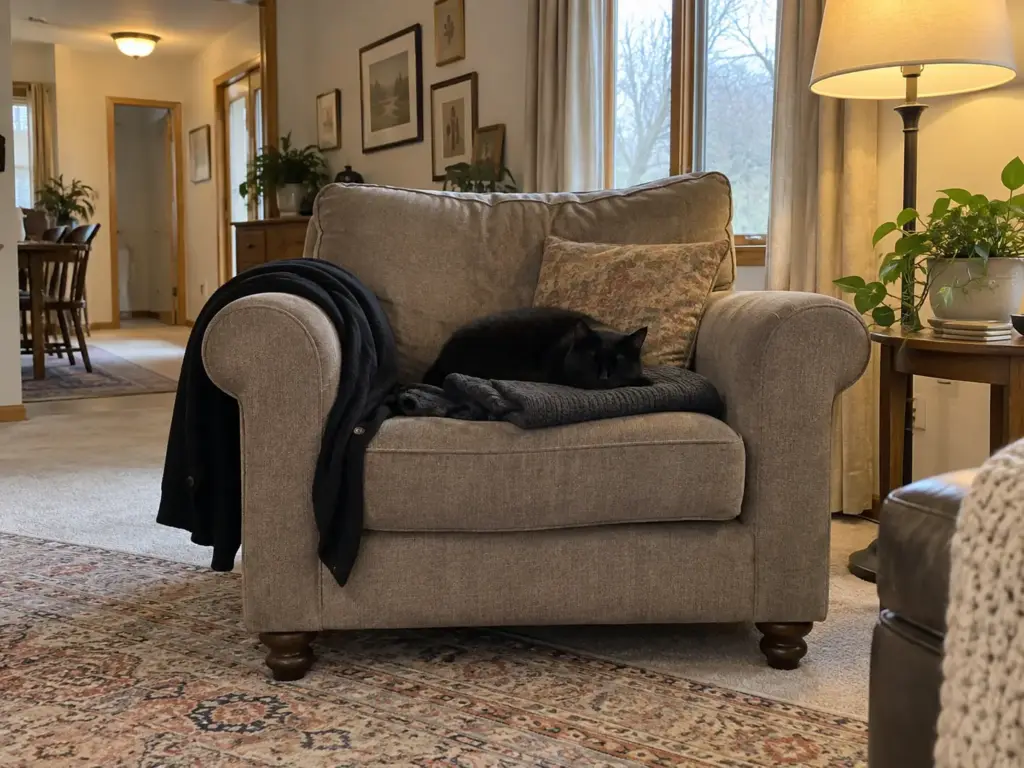
Black cat hair on a black sweater is close to a fair fight, because the strand and the cloth are nearly the same dark. That reading flips as soon as the garment stops being quite so black. Charcoal, navy, and an old black that has faded in the wash all leave a lighter ground for dark hair to show against.
The white shirt is the extreme case, and one forum voice sums up that household bluntly: “Black cat: Check. Dark trousers: Check. White shirt: Check.”
So a black cat does not make every dark piece safe, and it is worth sorting your closet by how dark each piece really is, not by what the tag calls it. Coat type changes how much comes off and how it clings, and the guide to cat breeds that shed less on a rented sofa sorts coats along that line. A short, dense coat and a long double coat can share a color and still need different checks.
Picking a Shade That Hides More Than It Shows
When the shirt is yours to choose, the easiest way to cut contrast is to move the garment toward the cat’s coat, which is all a camouflage color means for cat hair. One r/cats owner says light gray seems to be a good color in their house. That is an anecdote about one home, and it says light gray, not charcoal.
The idea behind it is simple enough to test. A mid-tone with flecks, like heathered gray, has no clean dark ground for a pale strand to sit on and no clean pale ground for a dark one, so both coats may read as part of the weave. Treat that as a hypothesis, buy nothing on its strength, and try it on a heathered piece you already own.
The rule behind a camouflage color is simple: the closer the tone of the garment to the hair, the less there is to see (the same idea runs through an r/cats thread about buying clothes the color of your cat). Hold one strand against the fabric in the same light you will wear it in before you decide, because a store’s lighting will not match your hallway.
The Check Before You Walk Out the Door
A check before leaving is only worth running if it happens before anyone else sees you, with a light that shows what a ceiling lamp hides, and with a tool that costs next to nothing. The habit matters more than the tool.
Flat Light Hides What a Side Light Shows
A lamp straight overhead lights the fabric flat, and a few loose strands sitting on top of it can go unnoticed. Side light, the raking light photographers use to bring out texture, crosses the garment sideways and throws a thin shadow beside each standing tuft, which may be what makes them show. That is a hypothesis, not an established method, so run it once on a black shirt before you trust it: hold the shirt beside a window or under a lamp held low, then look at it again under the ceiling light.
If the side light finds tufts the ceiling light missed, you have a check. If your fabric shows nothing new, drop it and keep the habit in the next section.
Put the Black On Last
Owners who live in black land on the same routine. One r/cats owner’s version: get dressed right before you walk out the door, keep sticky rollers in the car and at work, and never wear black or fleece at home. A Straight Dope forum poster describes a husband who checks for hair before he leaves for work and wears a shirt for only one day before washing it.
Both are habits, not tricks, and that is why they hold up. The cat sleeps on whatever is warmest, and the pile of clothes on the bench by the door is warm. Putting the garment on at the last second leaves the cat almost no time to add to it.
Turn the shirt so window light or a low lamp crosses it sideways, then look along the sleeves and the front panel, where a lap or a chair back would touch. Do it once on a clean shirt first, so you know what clean looks like under that light.
Tape on the Hand First, Then the Roller
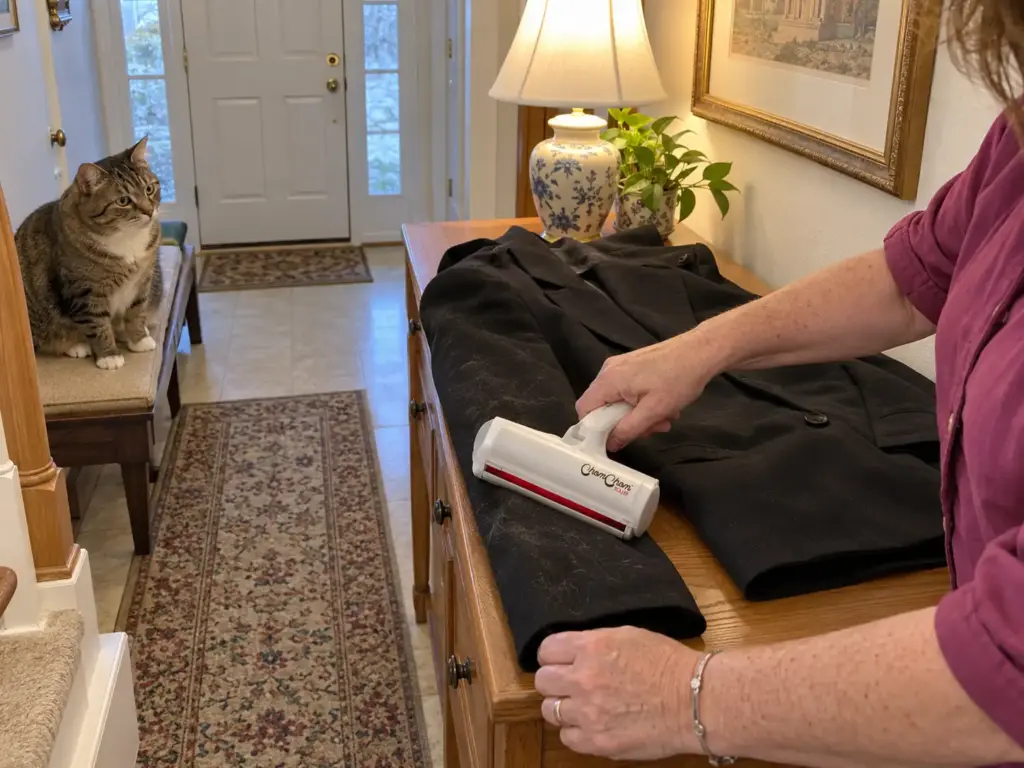
The usual reach is a roller. For a black garment, tape goes first: tape, gaffer or duct, wrapped sticky side out around your hand, as r/lifehacks commenters suggest, presses into a cuff or a seam where a roller head will not fit. It is free. And it shows you immediately how much was there.
If that is not enough, the damp-hand pass from the clothes guide is the next free step.
When the tape stops grabbing and a whole jacket is left, the ChomChom Roller (listed at 2.5 x 7.5 x 7.5 inches) is a reusable lint roller with no sheets to run out of, which matters to the r/cats renter in a renovated camper who was going through sticky rollers so fast it was “SOOO TEDIOUS.” Her verdict on this one is the honest limit: “great for furniture, but awkward for me to use on clothes.” Use it as the repass for sturdy fabric and not as the main plan.
Two Coats on One Black Shirt
Mixed coat colors turn one black shirt into two different problems at once, and neither cat is responsible for either. Each coat is a different color against the same cloth.
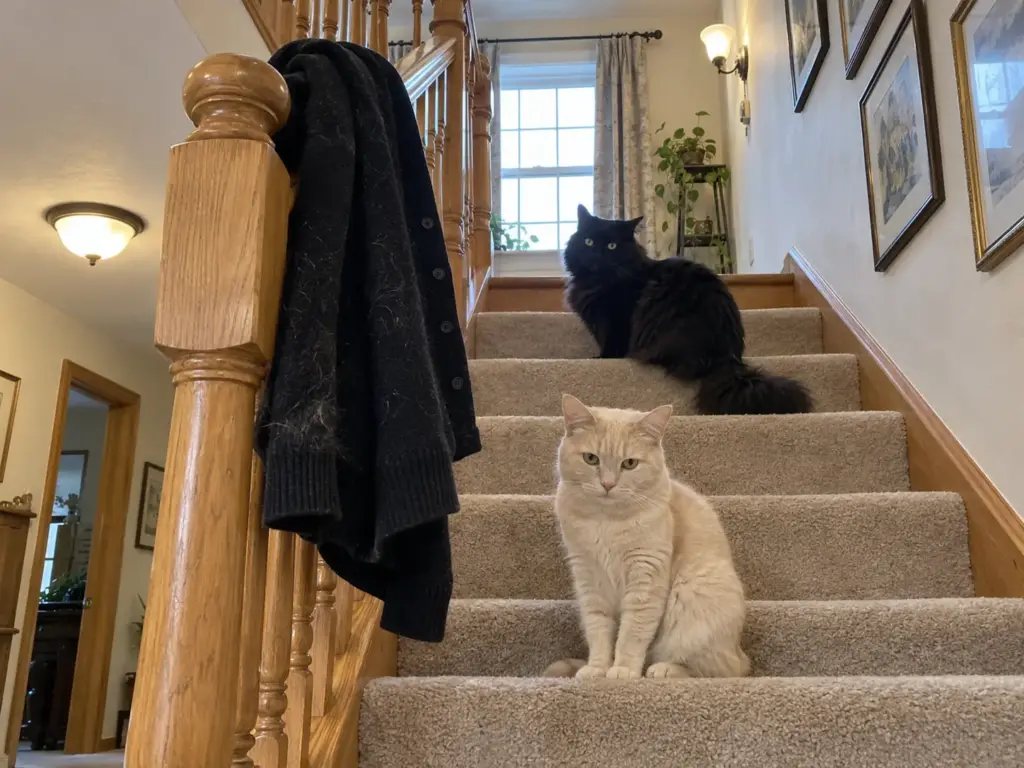
A Cream Cat and a Black Cat Make Two Kinds of Residue
The cream cat’s strands show on the black shirt; the black cat’s strands show on a pale one, and a mid-gray piece shows a little of both. There is no garment that clears you of both coats, so the question stops being which cat is the problem and becomes which coat you want to hide today. Run the check from the last section twice if you have to, once for each color, or pick the shade based on where you are going.
The sofa tells the same story, since the same two colors on the couch get handled fabric by fabric in the rented-couch guide. It is worth looking at the sofa and the shirt together; they show the same pair.
A Calico Leaves Something on Every Color
One r/cats owner put it plainly: you could tell how many cats she owned by the three different colors of fur present. Another says her calico “is like 3 different colors” and her fur shows up “on every color I wear.” Neither is a measurement, but both are a fair warning: a multicolor coat means no garment is outside the reach of at least one of its colors.
For a calico the move is to stop looking for a safe color. Choose a mid-tone, run the side-light check, and accept the tape pass at the door (some mornings that is the whole answer).
The Black You Already Own, Ranked by Weave
Some days there is no time to check anything, and the useful question is which black piece to put on. The weave decides, and the closet is the free option.

Black Denim and Woven Cotton Let Go, Knit and Fleece Hold
Woven fabrics tend to let hair go, while knits and fleece hold it by loops and static cling. Applied to black, that sorts the closet without buying a thing: black denim and a tightly woven cotton shirt on the days you cannot check, a dark knit and black fleece on the days you have time at the door. The full order, weave by weave, is in the full weave table on the clothes guide, so this page only applies it to the dark end of the rack.
A black fleece left on the bench by the door doubles as a warm bed, so hang it where the cat cannot reach.
The Dryer Disc, and What a Clean Disc Doesn’t Prove
Start with the free move: empty the lint trap before every load, because that is where a dryer pass sends the hair. Then, for a black knit or fleece that needs a dryer pass, there is the FurZapper Pet Hair Remover for Laundry two-pack, silicone discs about 4 inches across that ride in with the load. The maker’s account, as reported by the Pittsburgh Post-Gazette in 2023, is that it plucks hair off clothes and then drops it to the lint trap.
The reviews are split, and the split is the honest part. In a 2022 test by The Gadgeteer, the disc came out bare after one load and again after a load with two discs, and the reviewer wrote, “I’m gonna just write this off as a failure.”
The Post-Gazette gave it 4 out of 5 on three dog beds, but its one win was “I found a lot more in the lint trap.” An r/lifehacks poster wrote that the discs “didn’t help at all.” But treat it as optional and judge it by the trap, never the disc.
If the disc comes out bare, open the lint trap before calling it useless. By the maker’s own account the hair ends up there, and so did the best result in the tests above. A bare disc and a full trap is the pattern it is supposed to make.
Dress Last, Look From the Side, Recheck in Three Weeks
Three things to carry out of this page. Black shows the hair that is already there; it has not been shown to collect more. Your cat’s coat sets which dark pieces are the hard ones, with light hair on black the widest contrast and dark hair on black the narrowest. And the habit beats the gadget: dress last, look at the shirt from the side, and keep tape within reach of the door.
Three weeks from now, open the closet and see which black pieces you still reach for and which ones you quietly stopped wearing, and whether the door routine is still happening or slid back to the mirror. A routine that slips by the third week is the one to rebuild first. For the wider job of keeping a rented place livable with a shedding cat, see living with shedding in a rented apartment.
Today, put the black shirt on last, stand where window light crosses it from the side, and see what the ceiling light was hiding.
Frequently Asked Questions
01Does cat hair show more on black clothes?
It looks that way mostly because dark fabric is the clearest background for light hair, and nothing here shows that black collects more of it. Dark hair on black nearly disappears, so the answer depends on your cat’s coat.
02Does cat hair stay on clothes after washing?
Usually yes: the wash moves hair around and presses it into the weave instead of removing it. The order that gets it out first is on the cat hair out of clothes page.
03What dissolves pet hair on clothes?
Nothing in the wash does, so the hair has to come off before the water touches the clothes. One renter reported that rubber paws and vinegar did nothing for her.
04How do you avoid getting cat hair on clothes?
Put the clothes on last, at the door, and look at them from the side before you leave. Keep black and fleece away from the bench or chair where the cat sleeps.
05Which color of clothes hides cat hair best?
A color close to your cat’s coat hides the most, since less contrast means less for the eye to catch. That is a guess from how the eye works, so try one garment first.




Leave a comment