Cat Hair Off a Rented Couch, Fabric by Fabric
Get cat hair off a rented couch by finding your fabric, reading the care tag (W, S, WS or X) and using the one move that fits, free tools first.

Alfredo RamsesFounder · October 13, 2026 · 14 min read

On this page7 sections
- 1Before You Get Cat Hair Off the Couch, Read the Tag Under the Cushion
- 2Leather and Faux Leather: The Hair Sits on Top and Comes Off Dry
- 3Microfiber and Tight Weave: The Hair Sits Between the Fibers, So Vacuum Before You Wipe
- 4Chenille and Loops: The Hair Hooks In, So Lift It Before You Drag Anything Across
- 5Velvet and Tufts: Check the Pile Before You Wipe, Then Pick the Hair Up Dry
- 6Tag First, Then the Move, Then a Palm Test in Three Weeks
- 7Frequently Asked Questions
You vacuumed the couch and it still looks furry, because the cat sleeps on the spot he picked and the fabric keeps what he leaves there. The next thing most people grab is whatever lives under the sink, and on a rented sofa that can trade a hair problem for a water ring you pay for at move-out. To get cat hair off the couch, start with the four-code system on the care label (W, S, WS and X), because it sets what the fabric will take before any hair enters the picture. Then find which of four places your upholstery fabric holds the hair, and use the one move that fits it.
Find your fabric in the first column and read across; the sections after the table explain why each move fits.
| Fabric | Where the hair sits | First move | Hold off on |
|---|---|---|---|
| Leather and faux leather | On top of the surface | Dry soft cloth, then the crevice tool in the seams | A wet cloth pushed into a seam |
| Microfiber and tight weave | Between the fibers | Upholstery vacuum in two directions, then a nearly dry glove | Skipping the hidden-patch test |
| Chenille and loops | Hooked in the loops | Slow pass of the upholstery attachment, with the loops | Dragging a glove or squeegee across untested |
| Velvet and tufts | Down in the pile | Pile check: flat gets a barely damp cloth, tufted gets the dry vacuum | Moisture left in the folds |
| Tag says X (any fabric) | Wherever the fabric holds it | Vacuum or a soft dry brush | Anything wet: glove, cloth, squeegee |
Before You Get Cat Hair Off the Couch, Read the Tag Under the Cushion
Cat hair on couch cushions is one corner of the rest of the house, and the general moves for the whole place, the damp glove, the lint roller and the washable throw or slipcover among them, are covered there. This page stays on the couch and on the one thing that changes from sofa to sofa: what the tag allows. The damp glove is the move most people name first, and on a fabric that takes water it earns that spot. On a rental sofa whose tag says X it is the wrong place to begin, and a rental is exactly where nobody turns the cushion over to check.
Read the code on the tag (W, S, WS or X)
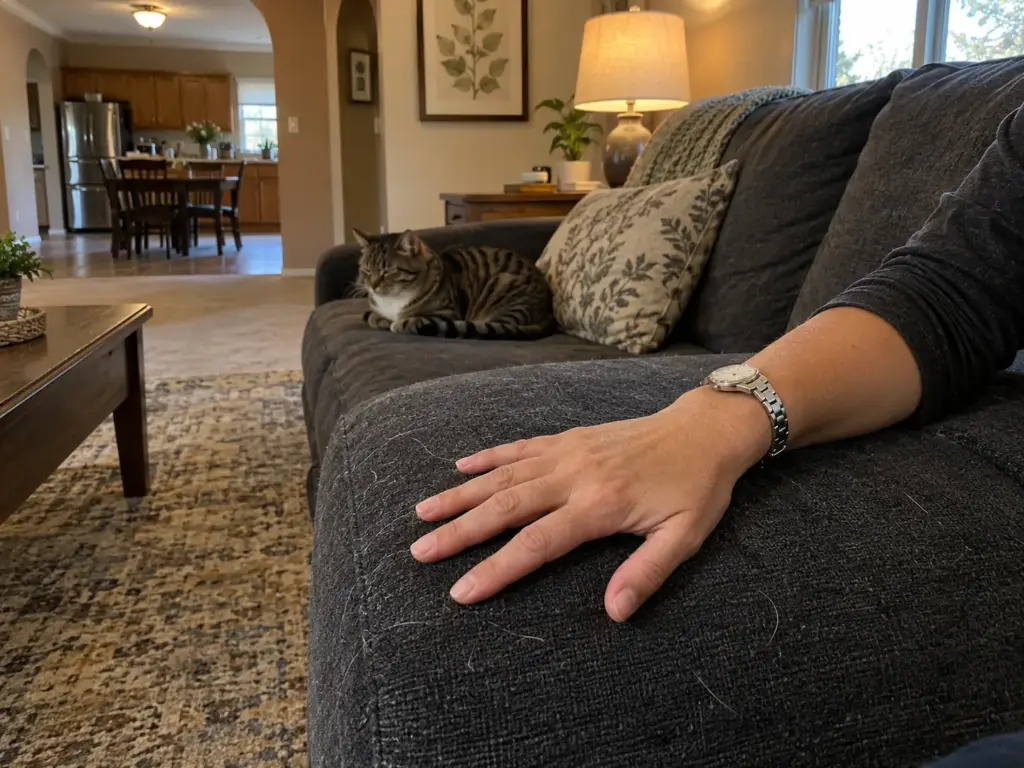
Lift a seat cushion and look for the small tag, the care label, sewn into the seam. A furniture retailer’s care guide spells out the four codes: the W code means water-based cleaner only, the S code means solvent-based cleaner only, WS accepts either, and X means no liquid at all, just a vacuum or a gentle brush. The code describes the finished piece, which makes the tag under the cushion the one that counts. The ISO symbols printed on some fabrics, the washing tub among them, are a separate system.
Two consequences follow for a renter. An X tag rules out the damp glove, the damp cloth and the squeegee, no matter how well they work on other sofas, so that couch gets the vacuum and a soft dry brush, covered further down. And a zipper on a cushion cover does not mean the cover can be washed: the same guide says to leave covers on unless the maker says otherwise, which matters a great deal when the cushion in question belongs to your landlord.
Before any damp move touches a visible cushion, try it on the back panel or under the skirt, on a spot about the size of a coin. Let it dry completely and look at it in daylight, because rings and color shifts show up as the fabric dries, not while it is wet. If the fibers fuzz or the color moves, that move is off the list for this sofa.
When the tag is gone, the feel test
Tags get cut off, worn through or tucked where nobody finds them. When yours is missing, your hand does the sorting. Slide a flat palm across the seat.
A slick surface that your hand glides over is a leather sofa or faux leather. A fine, closely woven, slightly suede-like surface with no visible loops is a microfiber couch or another tight woven fabric. Visible loops or a nubby, knotted texture mean chenille or a coarse weave. A deep plush that changes shade when you brush it against the nap, sometimes pulled into buttons or folds, is a velvet couch.
With no readable tag, take the dry route first: vacuum, then a dry cloth, and nothing wet until you know what the fabric is. The same palm doubles as a hair detector. If your cat’s coat matches the cushion, the eye misses what a hand finds, so run it across the seat in both directions and look at what gathers on your skin.
The four places a sofa holds cat hair
Cat hair ends up in one of four places, and the place picks the move. On smooth leather and faux leather it sits on top of the surface. On microfiber and other tight weaves it settles between the fibers. On chenille and coarse weaves it hooks into the loops, and on velvet and tufted pieces it works down into the pile as embedded hair.
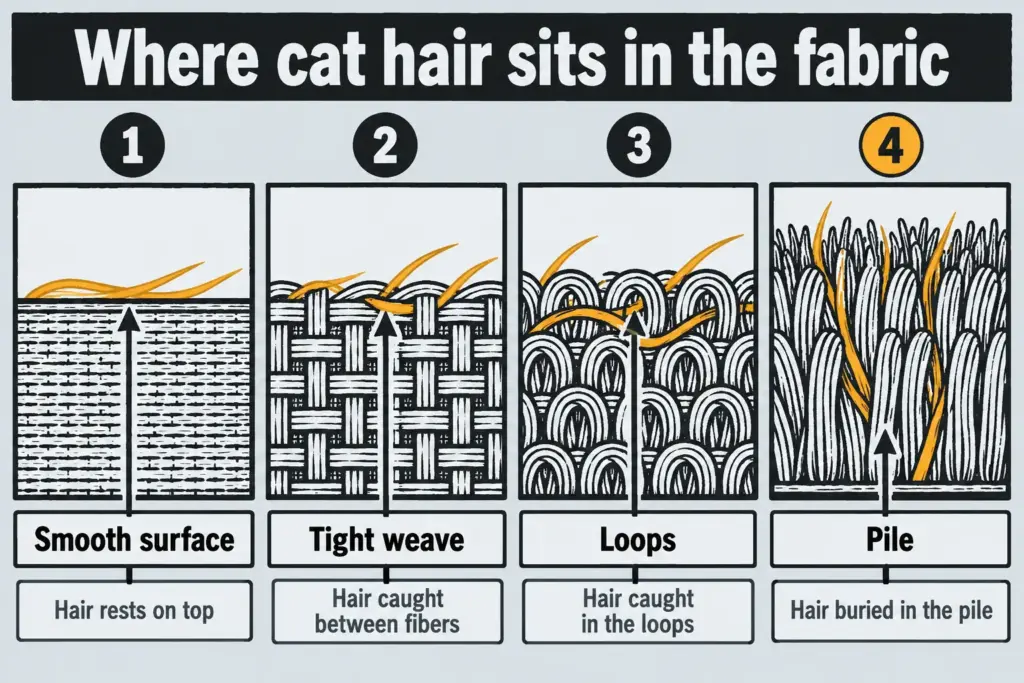
Pet hair sticks to each of them differently. A buying guide for pet owners ranks these fabrics in the same order of difficulty, with leather wiping clean at one end and velvet and chenille at the other, though a ranking like that is one retailer’s judgment and not a lab result.
That is why no single tool is right for all four. A glove that lifts hair out of a tight weave rides over the top of a loop, and a roller that clears a leather arm in one pass barely reaches the bottom of a velvet pile. The cat did not choose a difficult sofa on purpose; he chose the soft, warm one, and the fabric decided how his hair would stay behind. With one cat a regular pass keeps up; with two cats the hair arrives faster, so the passes come closer together while the method for your fabric stays the same.
Leather and Faux Leather: The Hair Sits on Top and Comes Off Dry
This is the easy case, and the free move is also the safe one. A slick surface gives hair nothing to grab, so on a leather sofa it rests on top instead of working between fibers, and a buying guide for pet owners puts leather at the head of its list for wiping clean.
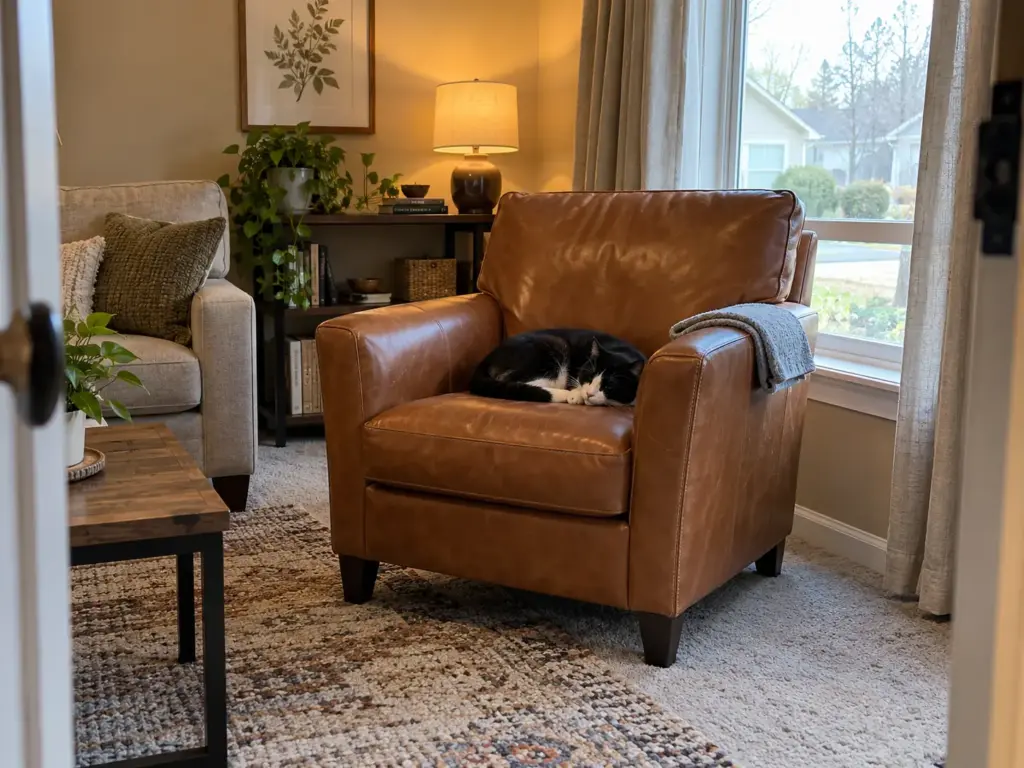
Start with a dry, soft cloth drawn across the cushion in one direction, then a second dry pass to gather what the first one loosened. If a film of fine hair is left, switch to a cloth that is barely damp (never wet) and finish dry. Leather and faux leather take moisture differently, so the tag or the maker has the last word, and a hidden spot gets the test first.
The seams are the real job. Hair collects in the gap between cushion and arm and along the cushion seams, where a cloth cannot reach, so the vacuum’s crevice tool goes down into the cushion crevices. Keep the cloth out of the seams while you are at it, since moisture pushed into a stitched gap dries slowly and leaves nothing to show for it but a damp edge.
If you are still choosing between sofas, or between cats, which breeds shed less on a rented sofa is a separate page.
Microfiber and Tight Weave: The Hair Sits Between the Fibers, So Vacuum Before You Wipe
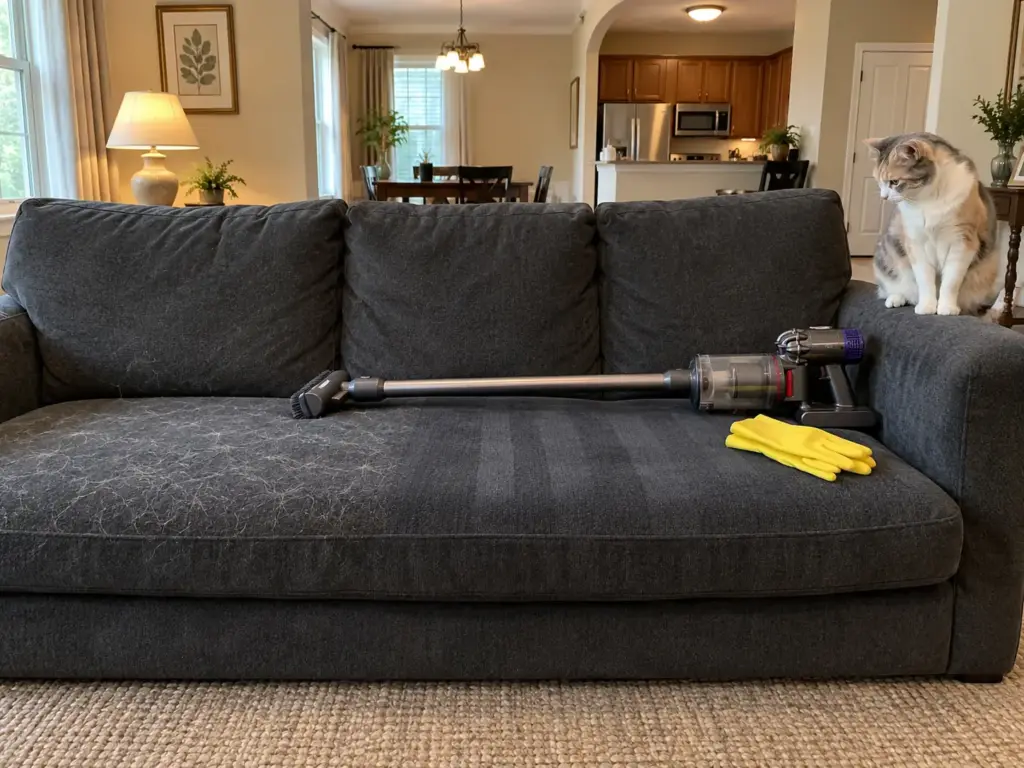
A microfiber couch is what most rented living rooms hold, and it is where the vacuum gets blamed unfairly. You run it over the cushion, the surface looks done, and a hand across the seat still comes away furry. The vacuum is not weak. It is the first of two steps: suction and bristles loosen hair that sits between the fibers, and a second move finishes what loosening leaves.
Vacuum first, in two directions
Fit the upholstery or brush attachment rather than the floor head, and make two passes over each surface, the second at right angles to the first. A cat-care site gives the same order: attachment first, two passes in alternating directions, then a roller, then gloves. You can see it working in the nap, which shows two sets of lines, and hair that lay one way gets lifted by the stroke from the other. One owner’s 2020 r/CleaningTips post about cat and dog fluff describes the failure in her own words: a sofa still “coated in black fur even after vacuuming.”
Count the vacuum as the loosening step and judge the result with the flat of your hand, not your eyes. Hair the color of the upholstery hides in plain sight, so a cushion that looks clean but drags under your palm still needs the second move.
Then the damp glove, on a hidden patch first
The glove is where this fabric gives up what the vacuum loosened. Wet a rubber dishwashing glove, wring it until it is nearly dry (the cushion should not feel wet when you lift your hand away), and rub in one direction with light pressure. In that same thread, the owner says the fur “comes right off in clumps,” ready to pick up and drop in the trash.
But one r/CleaningTips commenter warns that gloves and squeegees pill a weave over time. That is an owner’s report and not a tested result, and it is still worth acting on: it is the reason the hidden-patch test comes first, the pressure stays light, and you stop the moment the fibers start to fuzz.
When the tag says X
Skip the glove entirely. An X tag leaves two tools, the vacuum and a soft dry brush, so the finishing step has to be dry too: brush gently in one direction, as the maker allows, to gather the loosened hair, then vacuum up what it collects. The trade-off is frequency. With no wet pass to finish the job, you keep the sofa ahead of the hair with short, regular dry sessions instead of one big one.
Chenille and Loops: The Hair Hooks In, So Lift It Before You Drag Anything Across
Why loops hold hair differently
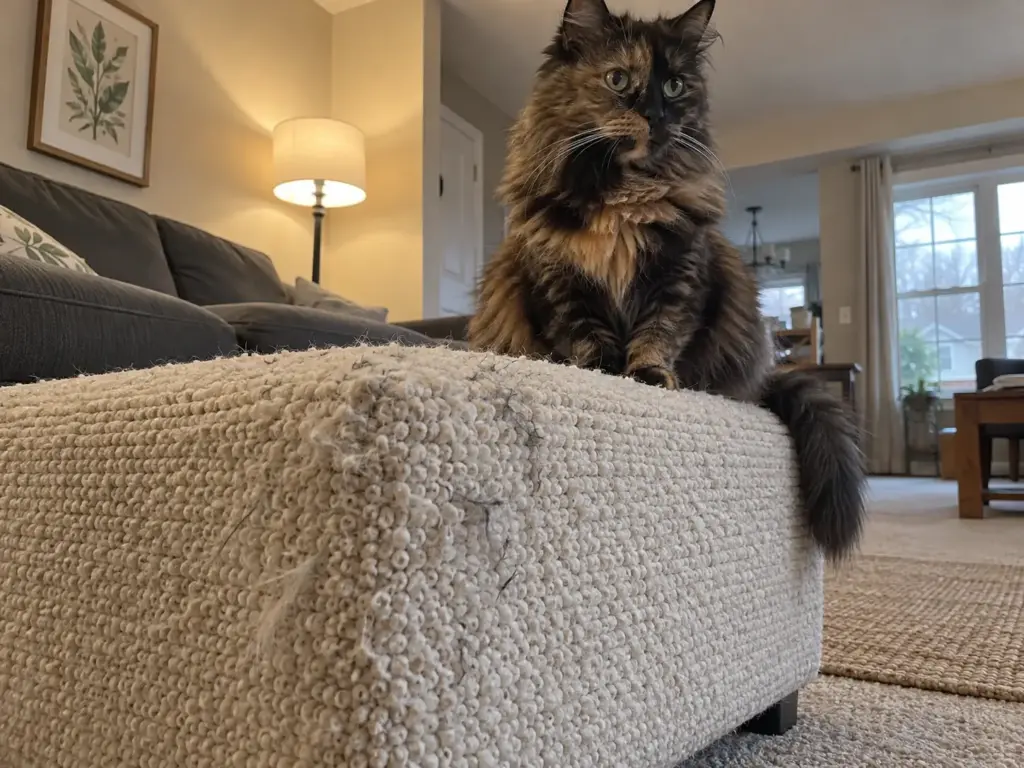
A loop stands up from the cloth like a small hook, and cat hair does not lie on a loop weave the way it lies on microfiber. It winds around the base of the loops and stays there, which is why the same buying guide rates chenille poor at letting go: the hair clings. A flat wipe passes over the tops of the loops and leaves behind the hair they are holding.
That also explains the snag. The glove that worked on the tight weave catches here, and the first thought is that you have wrecked the sofa. Stop without pulling the loop, and read the snag for what it is: the fabric telling you the tool is wrong for this weave, not a verdict on you or on the cat.
The upholstery tool first, the squeegee only after a test
Begin with the vacuum’s upholstery attachment, moved slowly and with the loops rather than against them, so suction lifts the hair out instead of packing it deeper. No wet move comes next until a hidden patch has passed. The vacuum tool already covers the job, so there is nothing to buy for this fabric.
The community’s other favorite is a squeegee or rubber blade, and it is the obvious second pick. On loops it stops being the safe one: the pilling warning from the weave section applies here too, and standing loops give a blade more to catch. If you want to try it, test the back panel, pull in one direction with light pressure, and stop at the first sign of fuzz.
One commenter’s budget alternative is a damp sheet laid over the cushion, then beaten with a rattan carpet beater. It only makes sense when the tag allows liquid, and it gets the same hidden-patch test.
Velvet and Tufts: Check the Pile Before You Wipe, Then Pick the Hair Up Dry
Velvet is the fabric people argue about. That buying guide rates it poor because the hair embeds in the pile, while other owners say a damp microfiber cloth lifts hair off a velvet cushion quickly. Both are true on different sofas, and a two-second look tells you which one you have.
Flat pile or tufted: the two-second check
Look at the surface from a low angle. A smooth, even pile with no buttons, channels or deep folds is flat velvet: if the tag allows liquid, a barely damp cloth moved along the nap, never against it, picks hair up. A tufted or buttoned seat has folds where moisture sits and dries slowly, so it gets the vacuum first, dry. And if the tag says X, the dry route applies whatever the pile looks like.
Dry pick-up for the folds
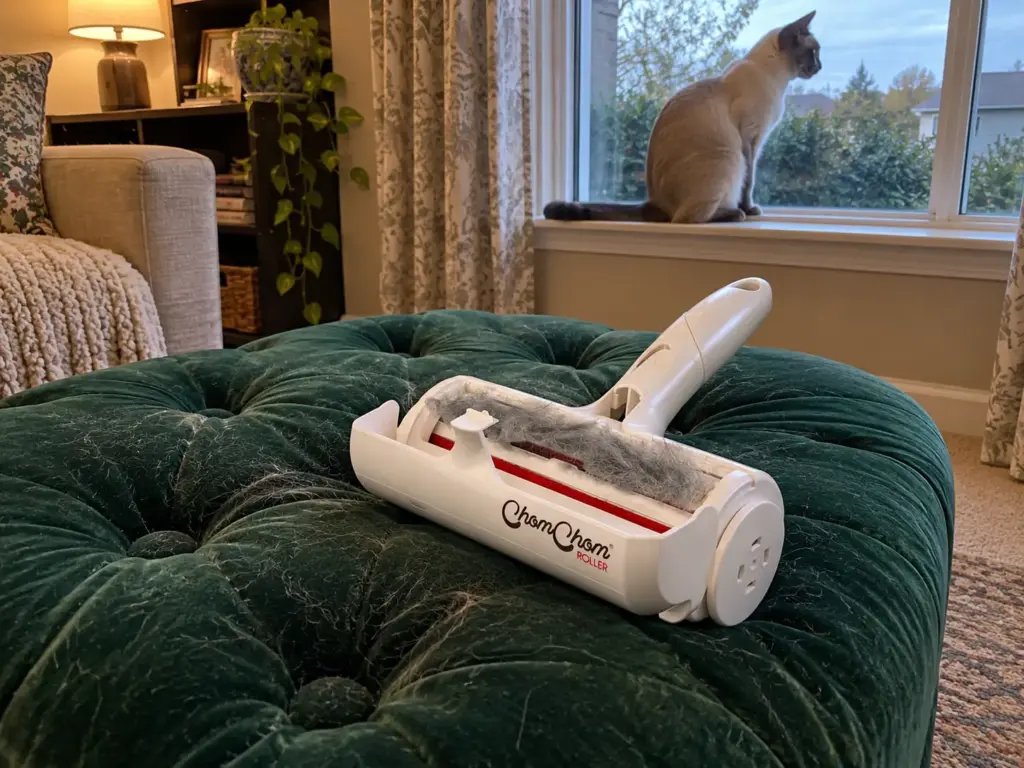
Free first: wrap a length of packing tape around your hand, sticky side out, then press and lift across the pile. It takes up what sits at the surface and wets nothing. Tape loses its grip quickly under a lot of hair, though, and in a deep tuft it only reaches what stands at the top.
A dry reusable roller fills that gap. The ChomChom Roller Pet Hair Remover is a hand roller measuring 2.5 x 7.5 x 7.5 inches, with no adhesive sheets to peel, so it lifts surface hair without wetting a fabric that holds hair deep. Its limit is built in: it will not pull hair out of a deep tuft, so use it dry, in repeated passes, and finish the folds with the vacuum’s crevice tool.
One thing no fabric fixes: when hair comes off the cat in clumps or in sudden amounts, that question belongs to his vet, and the sofa can wait until it is answered.
Do the tape pass before you buy anything. Fold the last half inch of the strip back on itself to make a tab you can peel without taping your fingers, press the strip down without rubbing, and lift it straight up along the nap. If one cushion’s worth of strips clears most of the hair, the roller can wait.
Tag First, Then the Move, Then a Palm Test in Three Weeks
Three things carry over to any sofa. Read the tag under the cushion before anything wet comes out, because X ends the conversation and W, S and WS each narrow it. Match the move to the place the hair sits: dry on top of leather, vacuum then a nearly dry glove between microfiber fibers, the upholstery tool with the loops, the pile check on velvet. And test every damp move on a hidden patch, since that spot is the one allowed to be wrong.
Less hair reaching the cushion helps all of it, and brushing the cat on a schedule that suits his coat catches it before it lands, which is the same logic as where the hair lands in the first place.
Three weeks after your first pass, run your palm across the cushion the cat sleeps on most. If the hair is back where it started, the move was right and the schedule is too slow; if the fibers feel fuzzy where a glove went, retire the glove for that sofa and stay with the dry tools.
Today, with what you already own: fit the upholstery attachment, vacuum the seat he sleeps on in two directions, then lay your palm on it. Whatever still drags under your hand tells you which of the four places your sofa holds hair, and which row of the table to follow next.
Frequently Asked Questions
01What is the best way to get cat hair off a couch?
The best way matches the fabric: a dry wipe on leather, a vacuum then a nearly dry glove on microfiber, the upholstery tool on loops, and a pile check on velvet. Read the care tag first, since an X means nothing wet.
02What material does cat hair not stick to?
Smooth leather and faux leather let go of cat hair most easily, because the hair sits on the surface instead of between fibers. Velvet and chenille hold it hardest. On a rented sofa you cannot swap the material, so the move matters more.
03What is the best couch cleaner for removing pet hair?
No spray removes hair; this is a tool question, and the upholstery attachment of your vacuum does the job on most fabrics. A tag marked X rules out anything wet anyway, so a liquid cleaner is the wrong place to start.
04Can I use a damp rubber glove on any couch?
No, a damp glove is off the table on any tag marked X, and every other fabric deserves a hidden-patch test first. Wrung nearly dry, it is a common owner fix for microfiber and tight weave, but on loops it can snag.
05Why does vacuuming not get all the cat hair off my couch?
On microfiber and velvet the hair sits between the fibers or down in the pile, so suction loosens it without releasing all of it. Follow the vacuum with the move that fits your fabric, such as a nearly dry glove or a dry roller.
Leave a comment