Why Cats Get Hairballs and Where a Vet Takes Over
Don't wait on a cat that retches and brings up nothing. Hairballs, the 3 signs to call the vet, and what brushing can change [no remedies].

Alfredo RamsesFounder · Updated November 1, 2026 · 17 min read


On this page9 sections
- 1What a Hairball Is, and Why a Tongue Built for Grooming Makes Them
- 2How Many Hairballs Is Normal, and Why the Sources Disagree
- 3Hairball, Cough or Vomit: What the Rug Can Tell You, and What It Can't
- 4When a Hairball Is a Vet Call, Not a Brushing Job
- 5What the House Can Change, and How Much Hair Goes Down
- 6The Shelf of Hairball Remedies, and Why the Vet Decides
- 7One Cat or Several: Who Left It on the Rug, and Where It Lands in a Rental
- 8Keep a Count, Brush First, and Call at the First of Three Signs
- 9Frequently Asked Questions
Something damp and cylindrical is lying on the hallway rug, the same color as your cat’s coat, and it takes a second to work out that it is fur. Hairballs are what a tongue made for combing leaves behind, so your cat did the job her tongue was built for and the rug got the leftovers. The facts below come from Cornell’s veterinary school and a peer-reviewed review in feline medicine, and the line between a house problem and a vet problem is drawn early, because it matters more than any brush. This guide covers what a hairball is, how many are usual, how to tell one from a cough or a vomit, the point where you call the vet, what the house can change, and what shifts when more than one cat lives there.
Quick Answer
A hairball is swallowed fur that comes back up as a tube, and Cornell’s vet school calls one every week or two not uncommon. A cat who turns lethargic, skips food for more than a day or two, or retches repeatedly with nothing coming up needs a vet. Brushing is the house’s part: less loose fur to swallow.
What a Hairball Is, and Why a Tongue Built for Grooming Makes Them
The first tube many owners find sends them online to ask whether it looks normal, and the more useful question is what the cat’s tongue was doing before that. Nothing in the house failed. A cat washing herself is working to design, and a hairball is the part of that work that does not leave by the usual exit.

The tongue only moves hair one way
A cat’s tongue is covered in rough, backward-pointing tongue papillae, and they work like the teeth of a comb: they catch loose hair and drag it toward the throat. This is what makes cat grooming so efficient and so hard on the hair that gets swallowed. Cornell Feline Health Center’s guide to hairballs explains the rest of the problem. Hair is made of keratin, a protein the cat cannot digest, so whatever she swallows has to travel the whole length of her digestive tract or come back up the way it went in.
A comb that can only be emptied in one direction is a poor tool for a cat who spends so much of the day washing. From her side, grooming is routine upkeep and swallowed hair is the price of a tongue she cannot change. From yours, the price lands on the carpet. She cannot grow a different tongue, which means any plan that helps has to work on the hair and leave the cat alone.
Most of it leaves in the litter box, and some stays
Shedding is the fur you can see, and the fur on the couch and the floor belongs to the guide on living with cat shedding in a rented apartment. A hairball is the fur you cannot see, the share she swallowed instead of dropping.
Martha Cannon’s review in the Journal of Feline Medicine and Surgery makes the point that cats swallow a lot of fur every day and most never bring it up regularly, because the hair travels through and ends up in the stool. A hairball is simply the part that stayed behind.
Cornell describes what stays: the hair in the stomach gathers, clumps, and comes back up. Vets have a technical name for the clump, a trichobezoar, and a hairball is the everyday word.
If it comes back through the esophagus, the narrow passage shapes it into a slender tube, usually about an inch long, sometimes as long as five inches, and about an inch thick. A lump that stays in the stomach is round. Hold the tube against her coat and the color usually matches.
Who makes more: longhaired cats and older cats
Two groups come up most. The first is the longhaired cat, with the Persian and the Maine Coon as the usual examples, and the next section puts a number on how much more often it happens.
Neither group is doing anything wrong. A Maine Coon with a long coat and a short-coated cat can live in the same apartment and sit on different baselines, and that is a fact about the coat.
Older cats are the second group people mention, and with them the grooming itself can change. Why older cats stop grooming has its own guide, and it starts at the vet, not at the brush.
How Many Hairballs Is Normal, and Why the Sources Disagree
A neighbor says one a month is normal, a thread says one a week, and your cat is somewhere between them or outside both. You can find support for each number because the sources really do disagree, and this section puts them side by side so you can see where the gap comes from.
The range Cornell gives
Cornell’s guide says it is not uncommon for a cat to regurgitate a hairball once every week or two. That is the highest ordinary rate any source here gives, and it comes from a veterinary school.
Other pet-health sites put it much lower, at once or twice a month or less. And the owner survey in Cannon’s review gives two or more a year.
Every week or two, once or twice a month and a couple of times a year can all be true of ordinary cats. So a single normal number does not exist, and I am not going to hand you one. The number worth having is your own cat’s.
The count worth keeping on a calendar
Many owners treat hairballs as ordinary cat behavior not worth a vet’s attention, a belief that Cannon’s review describes. For the occasional tube it holds up. The count is how you notice when it stops holding.
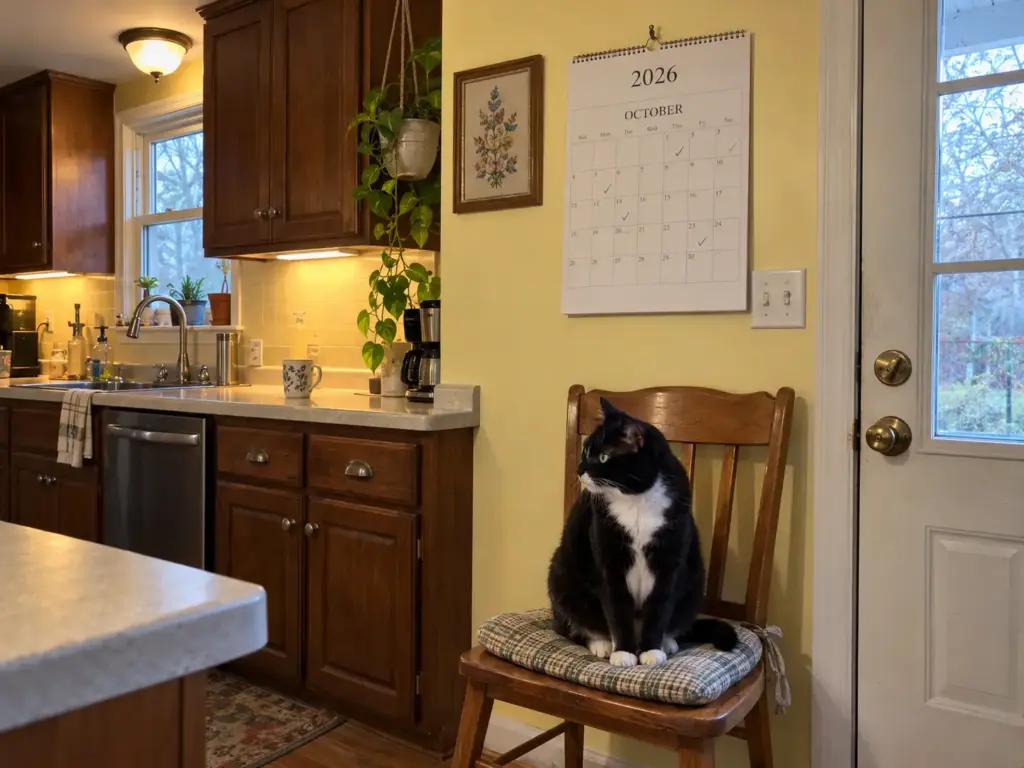
Write the date on a calendar each time one turns up, and if more than one cat lives with you, write which cat (the seventh section is about how). After a month you have a number that belongs to your cat and nobody else’s.
The number’s job is to be compared with itself. A calendar showing one every few weeks and then several in a single week is what to put in front of a vet, and this page cannot say why it changed. Take the calendar with you.
Hang the calendar where you already look every day, and write the date while you are still holding the paper towel. A tube remembered at the end of the week gets counted wrong, and with two cats a missing note is a missing name.
Why a longhaired cat sits higher
In a peer-reviewed review in the Journal of Feline Medicine and Surgery, an owner survey reported hairball vomiting about twice as often in longhaired cats as in shorthaired ones, with Persians and Maine Coons the breeds it names.
A survey of owners is a small window, so read the ratio as a direction rather than a rate. If your cat has a long coat, expect a higher count than a shorthaired neighbor reports, and do not hold the two numbers against each other. But a short coat does not mean none, either.
Hairball, Cough or Vomit: What the Rug Can Tell You, and What It Can’t
The word owners use is hairballing, and it covers a crouch that may or may not end in anything. Before you decide what you are looking at, there is a test you can run on the rug in a glance, and it answers exactly one question: is this a hairball?

A tube of matted hair is a hairball
A hairball is a slender cylinder of matted fur, damp when fresh, close to the color of your cat’s coat, and usually about an inch long. Cornell explains the shape: the lump forms on its way up a narrow passage, so it comes out as a tube and not a ball.
So the test is plain. If what is on the rug is a tube made of your own cat’s fur, it is a hairball, and the sections above are the right reading for it. If it is not, you are looking at something else, and the next heading is for that.
Owner threads show the confusion plainly. A title like cat coughing, hairballing, but no hairball belongs to someone who saw the crouch and found no tube. The test is built for that moment. No tube means the answer is not hairball, and the section on vet calls comes next.
Anything that is not a tube is a question for the vet
Everything else gets the opposite treatment, with a vet visit ahead of any guess: a puddle, a clump that is not made of fur, something that looks wrong to you for any reason. Describe it, do not decode it. Color, texture and smell are the vet’s to read, and this page will not guess.
Take a photo before you clean up. “It looked off” is hard to describe an hour later, and a photo takes a second.
Same crouch, different problems
From the doorway the crouch looks the same whichever of the three it is, whether the owner calls it hacking, gagging or dry heaving: low to the ground, neck stretched forward, the heaving. Cat vomiting looks the same from there too. Watching the posture will not tell you which one you are seeing.
A retch that ends in a tube settles it. A retch that ends in nothing is the first thing on the vet list in the next section, and it gets no explanation here, on purpose. What a cough or a wheeze means is for the vet to say.
When a Hairball Is a Vet Call, Not a Brushing Job
Owners often write that the cat still eats normally and still uses the box, and then wait. The reassurance feels solid, and a day of waiting quietly becomes three.
Three signs that end the brushing plan
The three warning signs on Cornell’s hairball page are a short list, and none of them is the hairball itself:
- Your cat turns lethargic.
- She refuses food for more than a day or two.
- She retches again and again without bringing anything up, or actually vomits.
Any one is enough, and the signs are not a score you add up. A cat can keep eating and keep using the litter box while one of the three is happening, so the signs that look fine do not cancel the one that does not. Cornell lists them as the reasons to call the vet.
The brushing plan in the next section pauses at that moment. It was written for a cat who is eating and behaving as usual.
Why a blockage is rare and still the reason for the rule
Cornell calls a hairball that reaches the small intestine and lodges there, an intestinal blockage, uncommon but very serious. Both halves matter: uncommon is why most hairballs are a rug problem, and very serious is why the list above exists and why nothing on it says wait and see.
This article cannot tell you how to recognize a blockage and will not try. That is a vet’s judgment, made on the cat in front of them, and no photo, calendar or online advice replaces it. What you control is how soon the call happens.
What this article will not answer
A few questions sit close enough to hairballs that you may expect answers here, and they will not get them: whether laxatives, gels, oils, fiber or supplements help; whether a remedy or a hairball food clears a blockage; what a cough or a wheeze means; whether frequent hairballs point to an illness; what overgrooming means; and what to do about thread or yarn your cat may have swallowed. Each of those goes to your vet.
What helps at the appointment is the calendar: dates, and which cat if there is more than one. That is the one piece of homework this page asks for.
What the House Can Change, and How Much Hair Goes Down
The house controls one thing about hairballs, and it is not the hairball itself: it is how much loose hair is left on the cat when her tongue gets to it. Brushing takes some of that off first, which does not promise zero hairballs and does not claim to.

The brush already in the drawer comes first
Use whatever brush or comb you already own before buying anything, for a few minutes a day, and let the coat set the schedule: how often to brush by coat type runs differently for a long coat than for a short one.
A brush takes off fur that would otherwise be swallowed, and that is all it does. No brush earns a bigger claim.
Brush in the stretch of the day when you already see her washing, after a meal or a nap for many cats, so the brush arrives while she is thinking about her coat anyway.
If you find knots pressed against the skin, stop brushing there. That is a different job, and handling matted cat fur is covered on its own.
A silicone brush for the cat who objects, a steel comb for the rest
A cat who refuses the brush is describing a constraint, and the guide on what a cat that won’t be brushed is objecting to is the place to find out which one.
For that cat, soft tools are the first thing to try. The Cat Brush with Soft Rubber Pins, Washable Silicone Pet Brush measures 8 by 4.5 by 2.5 inches and has rubber pins in place of wire. Soft pins suit a two-cat home where one cat makes brush time hard. How much hair it collects varies, so treat it as the gentler way to start and not the guaranteed one.
In a two-cat home the cat who accepts the brush and the cat who does not need separate plans, and the one who objects is not forced.
If the cat tolerates a comb, or the budget is the sticking point, a steel grooming comb about 7.5 inches long, with coarse and fine teeth, lifts loose hair too, and it costs less than the brush. For the cat who objects to wire, steel teeth are the wrong answer, which is why the soft pins come first and the comb second. The rest of the routine sits in the full grooming routine.
Food and water are a question for the vet, not a swap
People ask whether wet food helps with hairballs. That one goes to your vet, and nothing on this page claims that any food, wet or a hairball formula, changes the count. Water is a house question, and how much water a cat needs answers it in ounces.
If the moisture side is what you are after, what to add to cat food for hydration covers what can go in the bowl without costing her the meal. Whether any of it matters for hairballs is a question for the appointment.
The Shelf of Hairball Remedies, and Why the Vet Decides
You are in the pet aisle with a cat waiting at home, and the shelf offers gels, pastes, treats and foods that all say hairball on the label. The most useful thing this page can do for you there is tell you not to buy anything yet.

What is on the shelf and what the label does not tell you
The label tells you what the product is for. It cannot tell you whether the cat in front of you has a problem a product should be answering or one that needs a vet, and that question comes first. This page names no ingredient, no brand and no amount, because the choice is not a shopping choice.
The vet-school rule: no laxative without supervision
According to Cornell’s hairball page, “Dr. Goldstein strongly advises owners never to give their cats a laxative without the approval and supervision of a veterinarian.”
That is the only medical sentence in this article, and Cornell wrote it. Everything else here is about the house.
What to bring to the appointment
Bring the calendar from the count: dates, and which cat if there is more than one. Add the name of the food, a photo of what was on the floor, and a rough idea of how much she drinks in a day. None of that is diagnosis. A vet would otherwise have to ask you for all of it, and gathering it beforehand is quicker than recalling it in the exam room.
Buying the gel just in case and waiting three days to see do the same thing: both push the call later. The three signs in the earlier section are about the call, not the gel.
One Cat or Several: Who Left It on the Rug, and Where It Lands in a Rental
A household with two cats can find cat puke about once a week and not know which cat was behind it. Anyone with two cats knows the moment: you find it, you did not see it, and now you are guessing.

One cat: the count is yours to keep
With one cat there is no attribution problem, and the count from earlier is a list of dates. The only discipline is writing it down. A tube cleaned up and not noted is missing from the number that matters.
Several cats: you cannot count what you cannot attribute
The tube was on the rug when you came in, and it could belong to either of them. A pooled count mixes two coats and two baselines, so a rise in the total could be one cat doing more or both doing the same, and the total cannot say. Only a count kept per cat can.
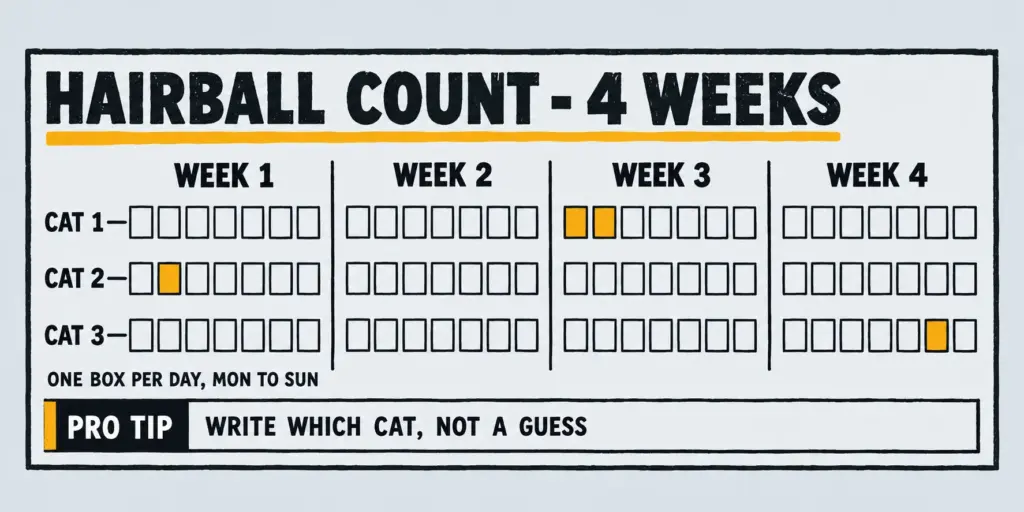
The advice to keep a count needs a correction here: a date with no name beside it stops being useful the moment a second cat arrives. The reliable version is to watch the crouch instead of the aftermath, so the cat you see arching her neck is the cat whose name goes on the calendar. If you did not see it, write unknown beside the date and leave it at that.
Write the name of the cat you saw crouching, not the cat you suspect. An honest unknown next to a date is more useful to a vet than a confident guess.
The rental floor, and where the cleanup guides pick up
The cleanup is its own job and it has its own guides. The one on clearing cat hair around the house covers the surfaces of a rental, and this page does not repeat its steps.
A vacuum is the next tool people reach for, and where vacuuming cat hair fails is mapped in its own guide.
A tube on a rental carpet is not the cat misbehaving: she washed, and the leftover landed where she stood. The rug needs a pickup. The cat needs nothing from you except the brush.
Keep a Count, Brush First, and Call at the First of Three Signs
Three things carry over. Keep your own count, with dates and the cat’s name, because the sources give different normal numbers and yours is the one that matters. Know the three signs (lethargy, no food for more than a day or two, repeated retching with nothing coming up) and treat any one of them as a call and not a wait. And use the brush already in the drawer before you buy anything, because loose hair is the only part of a hairball the house touches.
Give the calendar and the brushing three weeks. If the count has gone up by then, bring it to your vet and let them answer why, because this article cannot.
Today’s step needs no purchase: pick up the brush or comb already in the drawer, run it over your cat for a few minutes (or over the part she allows, if she objects), and write today’s date on the calendar if a tube turned up this week.
Frequently Asked Questions
01How do you get rid of hairballs in cats?
You do not get rid of them; the house can only change how much loose fur is left to swallow, and that starts with brushing. Any gel, paste or food sold for hairballs is a question for your vet before it is a purchase.
02How do I know my cat has a hairball stuck?
You cannot tell at home, so this is a question for your vet and not something to watch for another day. Cornell lists a lethargic cat, no food for more than a day or two, or repeated retching with nothing coming up. Any one is a call.
03Does wet food help with hairballs?
Whether wet food changes anything for hairballs is a question for your vet, and this article does not promise that it does. How much water your cat drinks is a house question, and the hydration guide covers it.
04How do you get rid of a hairball on the floor?
Cleaning a hairball off a floor or rug is a housekeeping job, and the guides on clearing cat hair around the house and on vacuuming cover it for a rental. If what is on the floor is not a tube of matted fur, describe it to your vet instead of guessing.
05How often is it normal for a cat to have a hairball?
Cornell says it is not uncommon for a cat to bring one up every week or two, and other sources give lower numbers, so keep your own count. Several in a week, or any retching with nothing coming up, goes to the vet.




Leave a comment