Elevated Cat Bowls Help Some Cats and Not Others
Don't buy a stand before you measure your cat. Elevated cat bowls help some cats and do nothing for others (+ the free test that settles it).

Alfredo RamsesFounder · September 7, 2026 · 20 min read

On this page9 sections
- 1What an Elevated Cat Bowl Actually Is
- 2When This Is a Vet Question and Not a Furniture Question
- 3The Measurement That Decides It
- 4Test It for Free Before You Buy Anything
- 5Two Cats Change the Answer
- 6Where the Station Goes When the Apartment Is Small
- 7What to Expect Once It Is in Place
- 8The Short Version
- 9Frequently Asked Questions
Every listing for elevated cat bowls sells height as an upgrade, the way a taller chair would be an upgrade. The honest version is narrower than that: for a healthy adult cat with no mobility trouble, raising the bowl a few inches changes nothing you will ever be able to measure.
No peer-reviewed feline study has tested the claim, and the vet-facing sources say so plainly before the product links bury it. What actually decides this is not the stand. It is one measurement taken off the cat who owns the bowl, and almost nobody tells you where to hold the tape.
Quick Answer
Height is worth changing for some cats and irrelevant for most. Where yours lands:
- It helps a cat that already struggles to crouch, usually one a vet has looked at
- It does nothing measurable for a healthy adult cat, and no study says otherwise
- The rim goes at the cat’s own elbow height, about two to four inches of lift for most adults
- Test it free with a stable stack of books for a week before you buy a thing
What an Elevated Cat Bowl Actually Is
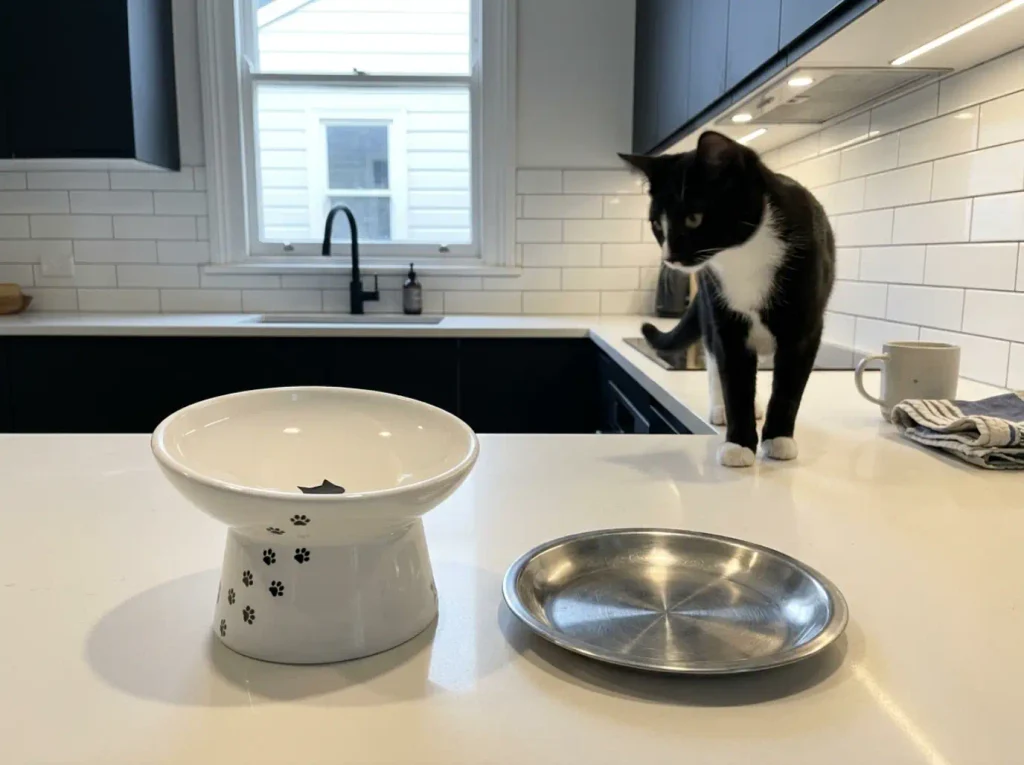
You searched one phrase and got back four different objects at four different prices, which is the first problem. Before deciding whether you want one, it helps to know which one the results are even selling you.
Three distinct things share the name. There is the single bowl sitting on short legs, the smallest and cheapest version of the idea.
There is the tilted bowl set into a stand, where the dish is angled toward the cat. And there is the two-bowl raised tray, food on one side and water on the other, which retail calls a feeding station and which can mean anything from a molded plastic base to an actual piece of furniture. That last phrase does most of the damage: it gets used so loosely across product pages that a reader can picture a sideboard and receive a tray.
The lift on a stand-style single bowl is smaller than most people picture. The Necoichi Ceramic Elevated Cat Food Bowl, 15° Tilted runs 6.1 inches wide with legs of 2.75 inches, so the whole raise is under three inches, and the dish itself is barely over an inch deep.
That is the honest scale of this category. Not a platform, not a pedestal, just enough to take the sharpest angle out of a crouch. The ceramic also means it stays where a cat pushes it, which matters more than the tilt does; the tradeoff is that a ceramic bowl is a bowl you can break in a sink.
The Tilt Is Not the Height
These two features ride on the same products and get conflated in almost every listing. An angled bowl changes how food gathers, pooling it toward the low edge so the last few pieces do not get chased around a flat base.
Height changes how far the cat lowers its head to reach any of it. A bowl can be tilted and sit flat on the floor; a bowl can be raised four inches and be perfectly level. If you are buying for a posture reason, the tilt is a convenience feature and nothing more.
Underneath both of them sits the material question, and which material the bowl itself is made of is a separate decision with its own tradeoffs around chin acne, scratches and biofilm. Plastic in particular comes with its own argument that has nothing to do with how high off the ground it sits.
One thing this category has that almost no other cat-furniture topic does: it is renter-friendly by default, with zero friction. Every elevated bowl and stand here is freestanding by design. No drill, no bracket, no conversation with a landlord about holes in a wall. For once the constraint that shapes half this blog simply does not apply.
When This Is a Vet Question and Not a Furniture Question
If your cat’s eating changed recently, no bowl is the answer to that. This section sits this early because the worst outcome of an article like this one is somebody buying a stand instead of making a phone call.
There are two situations where vets do raise elevation on a case-by-case basis, and both of them start with a diagnosis rather than a purchase. The first is arthritis-related mobility trouble, where crouching adds joint strain to a body already doing too much work, and where a senior cat is the one most often affected without anybody noticing. The second is megaesophagus, where gravity is being recruited to help move food down.
In both, as one vet-reviewed overview puts it, elevation is a case-by-case call for cats with arthritis or megaesophagus, not a blanket upgrade. The order matters and it is not negotiable: the vet names the condition, and then the bowl height becomes a reasonable thing to adjust. Never the reverse.
The Signs That Mean Stop Shopping
A recent change in how a cat eats is the line. Pausing partway into a crouch.
A few bites, walking away, coming back a minute later to do it again. Eating from the side of the bowl instead of square to it, when that is new. Those are worth an appointment, not a purchase.
What makes this one hard is that the change is gradual and it does not look like a symptom from across the room. One of the most repeated versions of this story in cat communities is an owner describing months of a cat “getting picky,” rethinking the food, buying a different flavor, and only connecting it to discomfort later. Nothing about it read as urgent, because nothing about it looked dramatic.
That is the whole trap. A cat that has changed how it eats is telling you something, and this article is not qualified to interpret it. Behavior, furniture, placement and smell are ours. What a body is doing belongs to a vet.
The Bloat Warning Does Not Transfer
You will run into this one, usually from someone who read it on a dog forum. Raised bowls and bloat, or gastric dilatation-volvulus, have a genuine and unresolved argument attached to them in dogs, where current suspicion runs toward raised bowls increasing risk rather than reducing it. It does not carry over.
GDV is real in cats but rare enough that most of the data is extrapolated from dogs, and unlike in dogs, there’s no evidence linking bowl height to bloat risk in cats at all. There is nothing here to avoid, and nothing elevation is proven to prevent. It is simply not a factor in this species, in either direction.
Before the appointment, write down what changed and roughly when it started. “He pauses before he settles into the bowl, started maybe three weeks ago” is worth more to a vet than “he’s been off lately.” A date beats an adjective every time, and you will not remember it accurately in the waiting room.
The Measurement That Decides It
The listings say four to six inches, and they print that number for an average cat who does not live in anyone’s house. Six inches of raised cat bowl under a compact eleven-pound shorthair is not an upgrade. It is the same problem upside down.
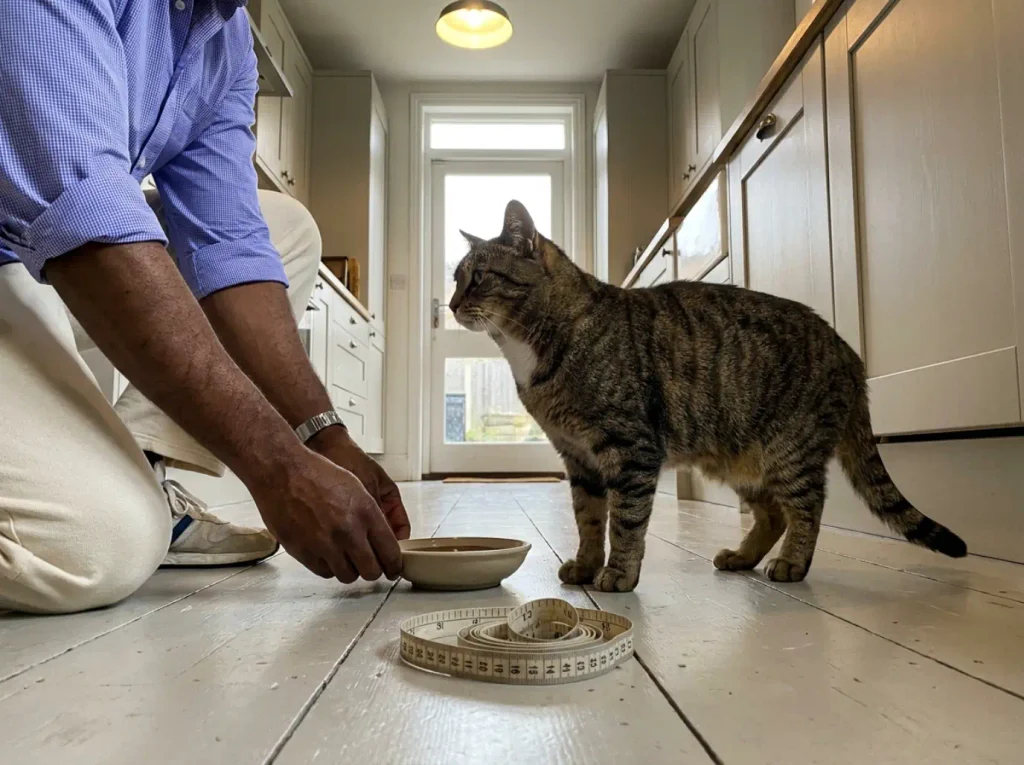
Here is the method, and it takes about twenty seconds. Stand the cat up naturally, not stretched and not posed, just standing the way it stands. Measure from the floor to the bottom of the chest, right where the elbow sits.
That is chest height, and it is not the same as shoulder height, which is the number people reach for because it is easier to see. That line is where the bowl rim goes. Not the top of the stand, not the base: the rim, the edge the cat’s chin clears. It is the one number in this entire topic that comes off your cat instead of off a box, and it is the reason two people can buy the same well-reviewed stand and get opposite results.
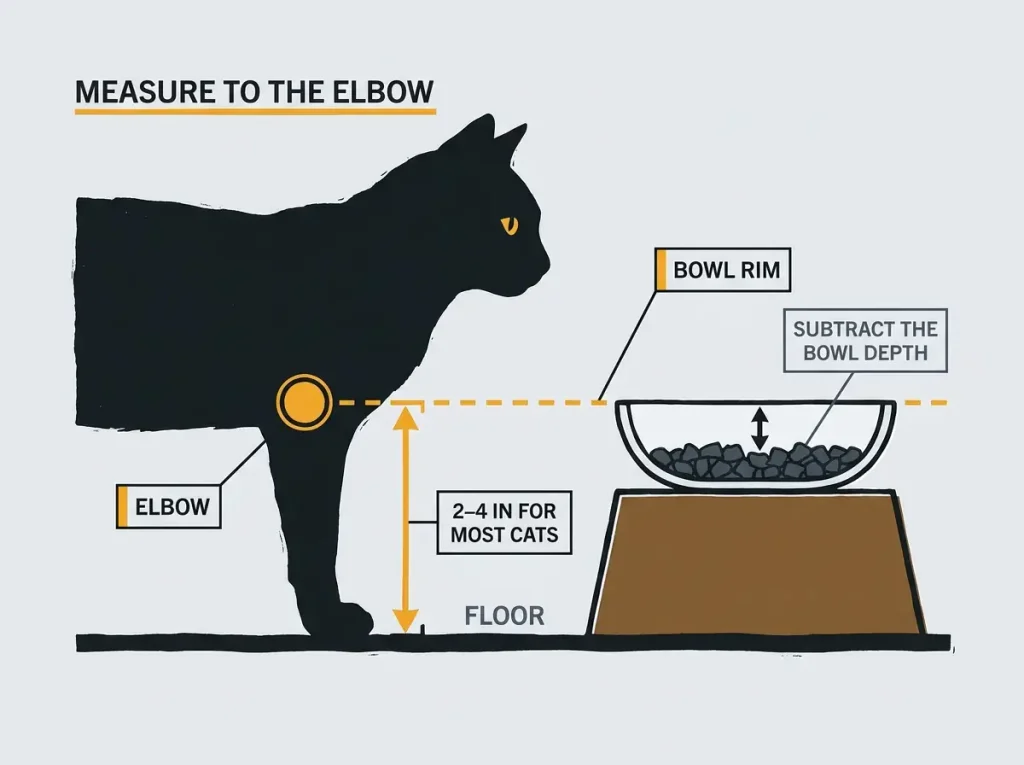
For most adult cats that measurement lands somewhere around two to four inches of lift. Long-bodied and large cats sit at the top of that range, small and young cats at the bottom or off it entirely.
This is where body type does more work than age does, and where the generic range quietly falls apart. A large Maine Coon at full stretch has a completely different floor-eating angle than a compact British Shorthair with short legs and a heavy frame, and a single stand cannot be right for both. Buy for the average and you have bought for neither.
Too Tall Is a Real Failure, and Nobody Warns You
Everyone frames this as “how much lift do I need,” as though the only risk is not enough. The recurring caveat across the vet-facing sources is the opposite one, and it is the most common way this purchase backfires: a stand that is too tall makes the cat reach and extend its neck upward to get into the bowl, trading a crouch for neck strain. You have not removed the awkward angle. You have inverted it, and now the cat is doing something new and uncomfortable instead of something old and uncomfortable.
That is why the elbow line matters more than the inch range. It is not a target to beat, it is a level to match. Somewhere near it is fine. Well above it is a fresh problem you paid for.
One more thing that eats the number, and it is the piece people skip: bowl depth. If you measure to your elbow line and then buy a stand that height, you have forgotten that the dish sits inside the stand and the food sits at the bottom of the dish. A deep bowl on a correctly measured stand puts the food back down where it started. The rim is what you measure to, and the depth comes off the total.
A wide shallow dish costs you almost nothing here; a deep one can eat the entire lift. This is the same species of error as the same logic applied to the width of his face rather than the height of his chest, where people measure the cat correctly and then buy a bowl whose sides undo the measurement. Measuring the animal is only half of it. The other half is measuring what you are about to put in front of him.
Measure at the elbow, then subtract the inside depth of the bowl you already own. The lift you actually need is almost always smaller than the number you first wrote down, and that is how a two-inch stand ends up being the right answer for a cat you were about to buy a five-inch one for.
Test It for Free Before You Buy Anything
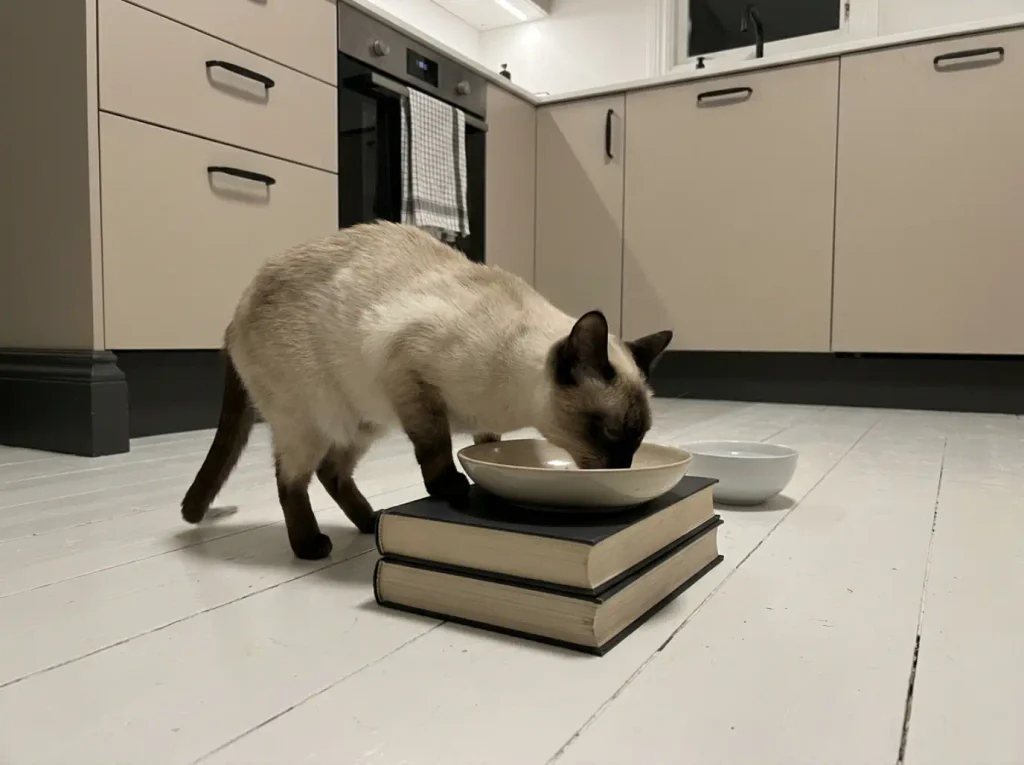
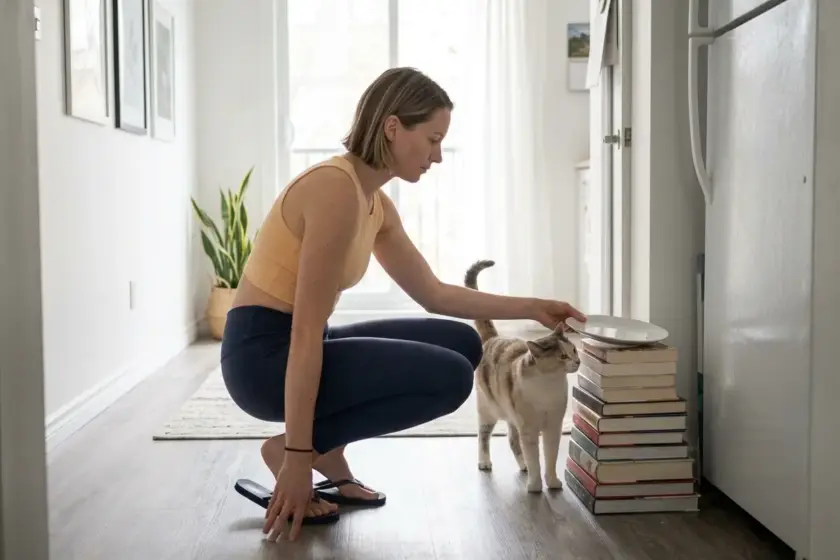
You do not need to buy a stand to find out whether your cat wants one. You need something stable, roughly the right height, and a week.
Put the bowl you already own on top of a couple of hardcover books, or a shallow sturdy box, at about the height you measured. That is the whole experiment. And stable is the part that decides whether it works, not tidy: a platform that shifts even slightly under a paw teaches the cat to distrust the entire arrangement, and then you have learned nothing except that your cat dislikes wobbling, which was already true. If the stack rocks when you press a corner of it, you will read the resulting avoidance as an opinion about height.
What You Are Actually Watching For
Posture, not enthusiasm. This distinction is the one that ruins most home experiments, because people expect a reaction and cats do not give them one. The question is narrow: does the crouch get easier?
Does he stand more square to the bowl instead of folding down into it? Does the pause before he commits go away? Nobody is going to seem pleased. A cat who finds eating slightly less awkward looks exactly like a cat eating.
Give it about a week. That is long enough for a cat who was going to notice to have noticed, and short enough that you have not rearranged your kitchen around a guess. I used to think a couple of days was plenty here. It is not, because the first day or two is a cat reacting to change, not to height, and if you judge it on day two you are reading novelty.
Now the honest part. The most likely outcome is that nothing changes at all.
In community threads about this, the phrase that comes back over and over is some version of “doesn’t seem to care either way,” and for a healthy adult cat with no mobility trouble that is not a failed experiment. That is the correct result, arriving for free, and it means you just saved the cost of a feeding station by stacking two books. The absence of a reaction is data.
And if it does help, you now know the exact height that worked, which is a far better brief for shopping than any listing description you will find. You stop buying a category and start buying a number.
Two Cats Change the Answer
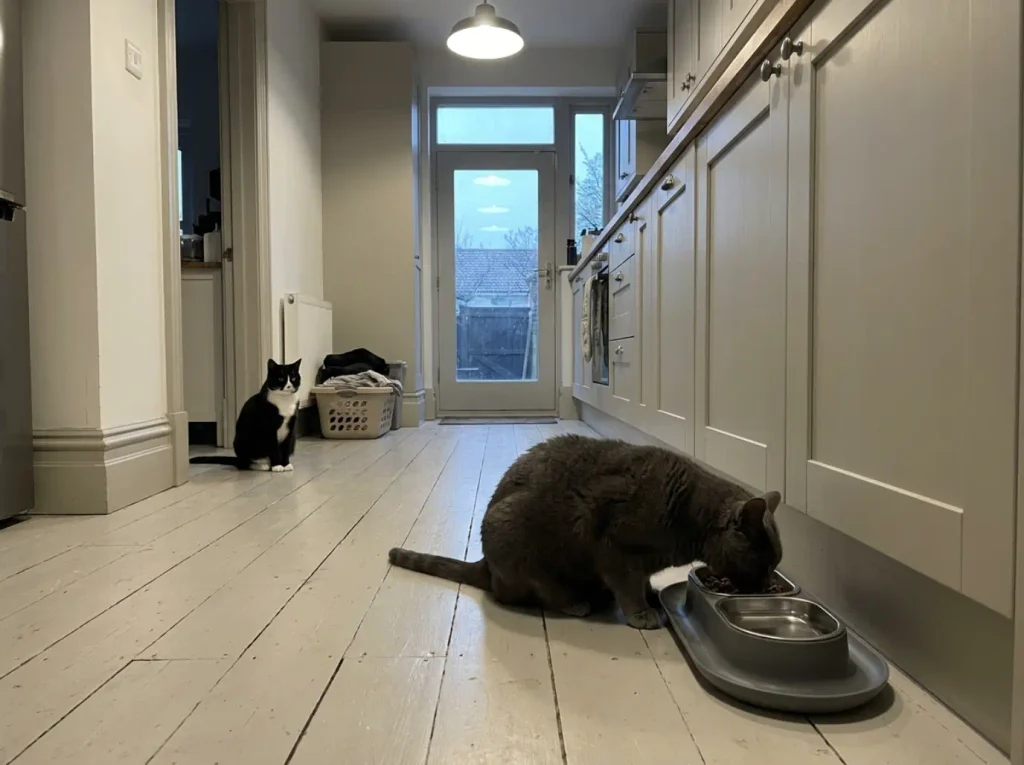
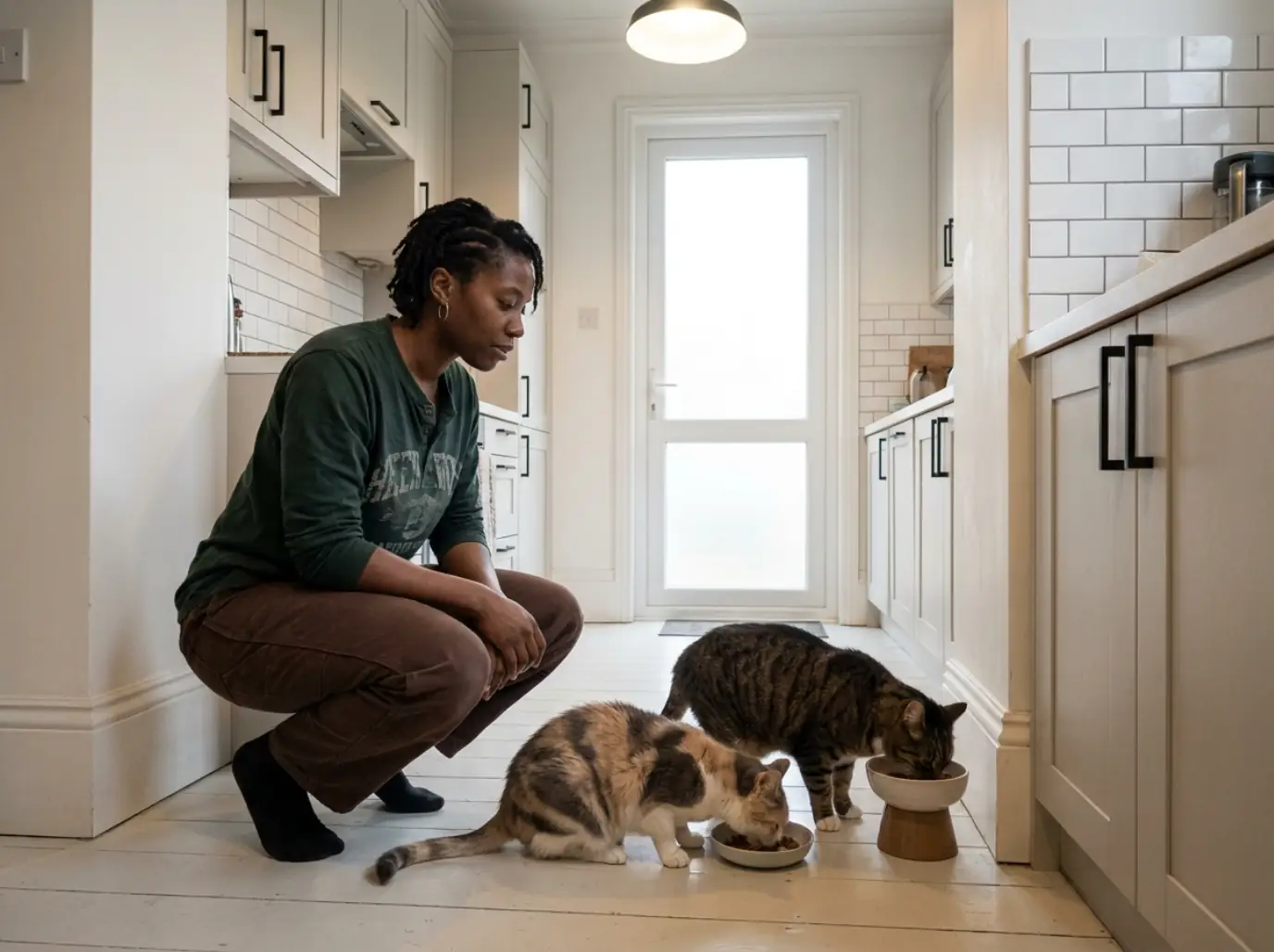
You bought one nice station and the confident cat claimed it. The other one is eating when nobody is looking, and you have not noticed yet, because nothing about it looks wrong.
The rule here comes from the AAFP and ISFM’s feline environmental needs guidelines, which call for each cat to have its own separate feeding station, physically separated from the other cat’s. That last part is doing all the work, and it is the part that gets read past. Resource guarding in a multi-cat household almost never looks like a fight; it looks like an arrangement everybody has agreed to.
Separate does not mean a second bowl beside the first. Two bowls touching each other read to a cat as one location, guardable from a single spot by a single animal who only has to stand in one place to control both. You bought two dishes and installed one chokepoint.
A raised station makes this specifically worse rather than better, which is the opposite of how it gets sold. Down on the floor, a bowl is a spot on the ground with fuzzy edges. Up on a tray, it is one distinct, defensible object with an obvious approach and an obvious owner.
The Hepper NomNom Spill-Proof Elevated Cat Bowls show the shape clearly: two stainless bowls in a single raised tray, compact enough for a small kitchen and easy to wipe under. That is a food-and-water setup for one cat. It is not a two-cat solution, no matter that it has two bowls in it, and the tray is exactly why. Whether two cats can share a bowl at all is its own question, and the short version is that sharing is something the humans decided.
Separate Levels, Which Nobody Mentions
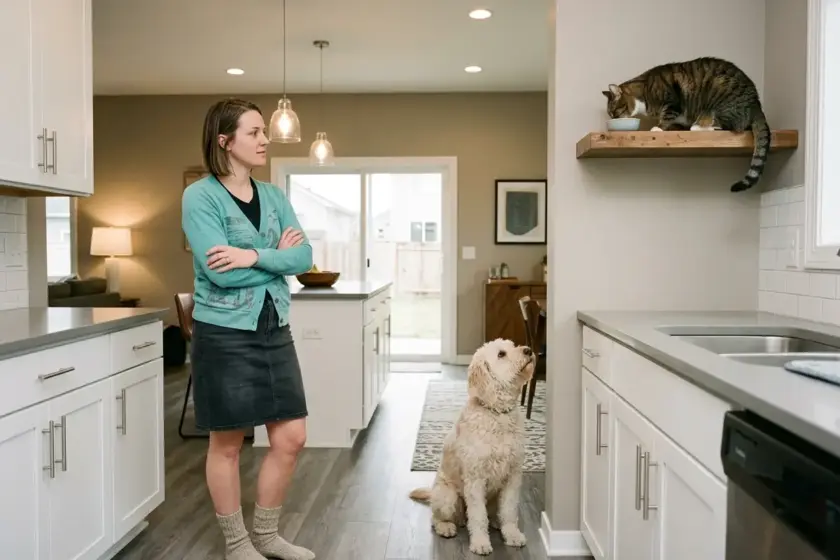
Here is the move that does not appear anywhere in the search results for this topic, and it costs nothing. Feed the cats at different heights. One on a raised surface, one at floor level, in the same room but not in the same plane.
It works because a cat avoiding a confrontation does not need distance so much as it needs an out that is not a face-to-face negotiation. Two bowls on the floor, four feet apart, still puts two cats eye to eye across an open stretch of floor.
One up and one down breaks the sightline geometry entirely, and the timid cat gets to eat without asking permission. If you already own one elevated station and one floor bowl, you have the setup. You just have to stop thinking of the raised one as the good one.
The failure mode this prevents is quiet, which is why it runs for months. The shier cat waits. Eats late, eats less, eats in the gaps.
Nothing looks wrong from across the room, because nothing is wrong in any visible sense: there is food, there are two dishes, nobody is fighting. Related signals are easy to misread too, and a cat that drags its food away from the bowl is saying something about the location, not the food. The cat is solving a problem you gave him with the only tool he has, which is moving.
One last constraint on where the station goes: it needs more than one way out. A dead-end corner turns a meal into a place where a cat can be cornered by another cat simply walking up, and a cat who has been cornered once at dinner remembers the spot, not the incident.
Feed them in the same room but out of each other’s sightline for a week, and watch which cat finishes first. The order tells you more about who owns the room than any bowl arrangement does, and it is usually not the order you expected.
Where the Station Goes When the Apartment Is Small
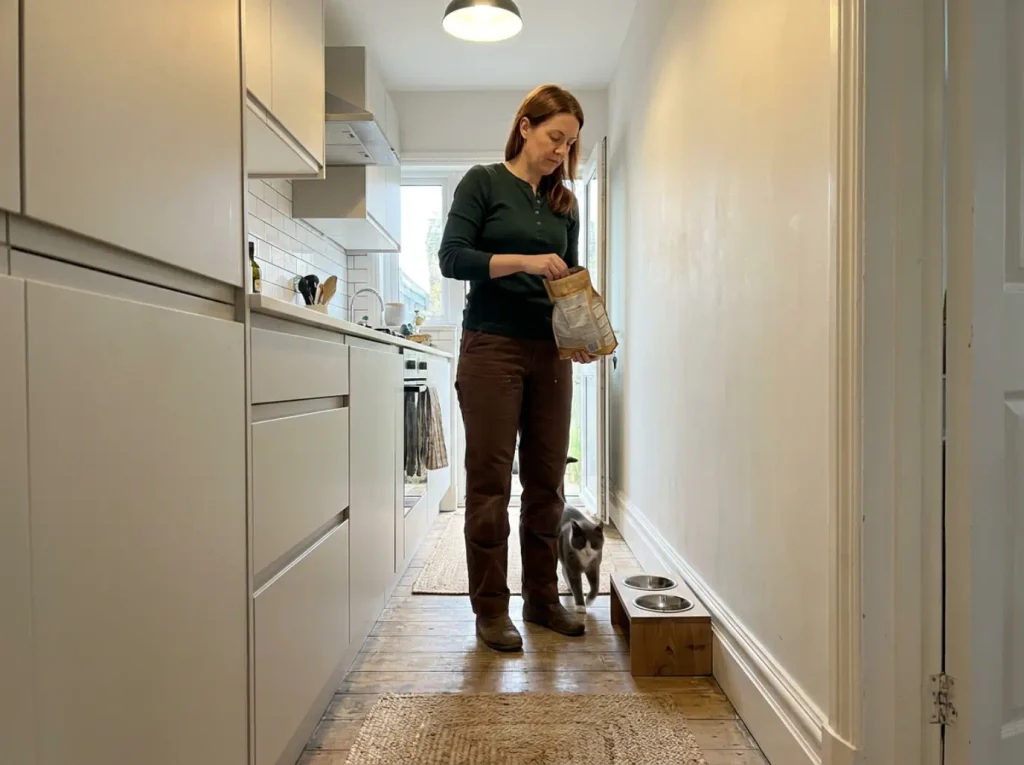
In a studio there are maybe two places this can go, and one of them is next to the litter box. That is not a hypothetical constraint, it is the actual floor plan a lot of people are working with, and it decides the question before any product does.
Food and water stay physically away from the litter area. The AAFP guidance is explicit about it, and in a small apartment it is the rule that deletes most of your options before you have started choosing. It is also the rule that pushes both decisions into the same conversation, because where the litter box ends up in a small apartment is the other half of the same square footage problem. Solve one badly and you have already decided the other one badly.
The Corner Problem
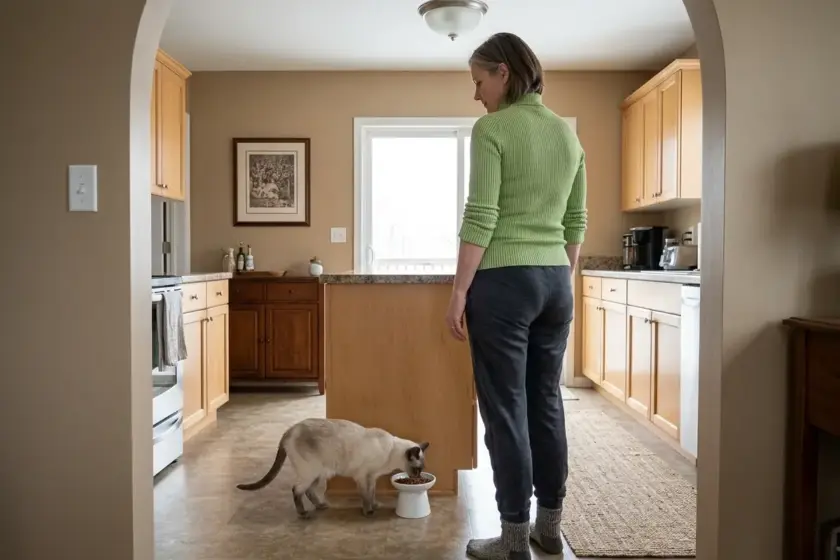
The corner is the default answer in a tight floor plan. It is out of the walkway, it looks tidy, and it is the one place a stand does not stick into the room. It is also a dead end, which is the single thing a feeding spot should not be.
An open stretch along a wall with two ways out beats the tidy corner, even though it looks worse to you. This is the recurring split on this blog between what the cat is describing and what the human prefers: you are describing an aesthetic, and he is describing an escape route. His constraint is not negotiable and yours is.
There is a genuine argument for a raised station in a small kitchen, and it is about footprint. A stand takes up less floor than a mat with two bowls spread out on it, because it stacks the same function into a smaller square.
But it is a taller obstacle in a walkway, so it trades a floor problem for a shin problem. The same small-apartment math applies to a fountain, with a plug added, and a cord across a walkway is its own decision. Honestly, in the tightest apartments, a low profile beats a small profile.
Traffic matters more than aesthetics, which is the summary of this whole section. A cat interrupted partway through a meal walks away from the bowl and may not come back to it, and a hallway is interruption by definition. The quietest spot that still has two exits is the right answer, even when it is the ugliest one. Put it there.
What to Expect Once It Is in Place
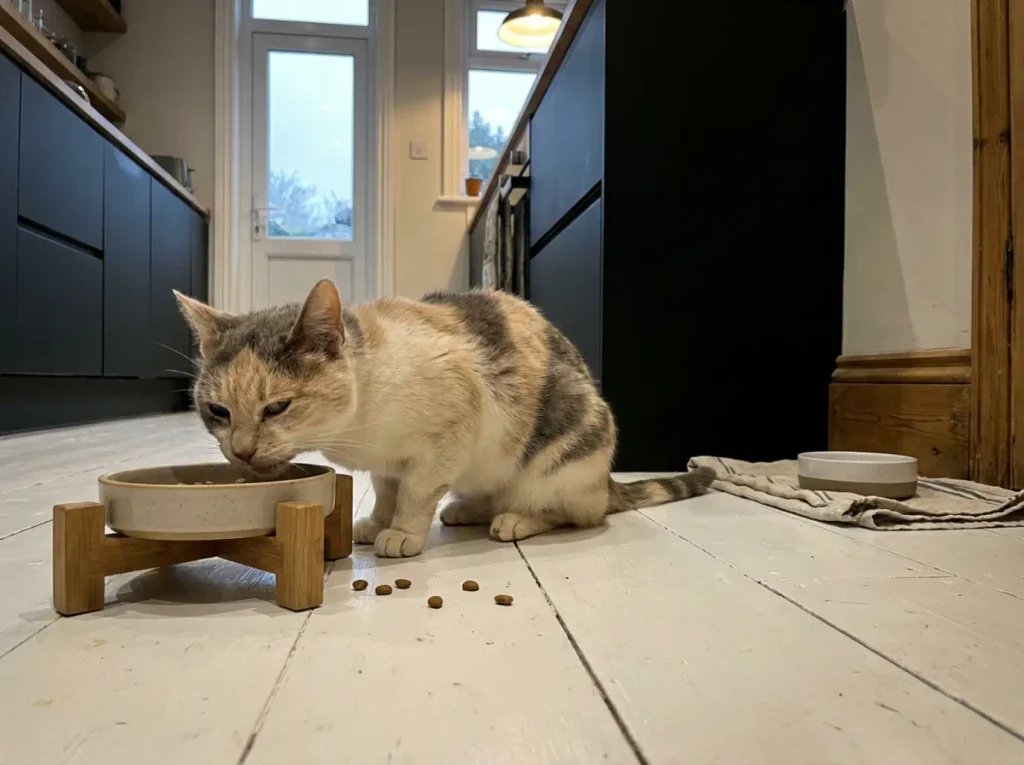
Nobody tells you what “working” looks like, so people either declare victory on day one or put the stand in a cabinet by week three. Both of those are the same mistake, which is judging a slow change on a fast timeline.
Move the bowl to the new height and leave everything else identical. The transition period is short, but it only works if the height is the only thing that changed. Same bowl, same spot, same food, same times.
This sounds obvious and it is broken constantly, usually because the new stand arrives with a new dish in it and the new dish is a different width and depth. Now two variables moved and you have no idea which one the cat is responding to. Height is one of two measurements people confuse; the other is the width of the bowl against his face, and that one has its own guide because it answers a genuinely different question.
Working looks like this: the cat eats standing more square, without the pause before it commits, and it stops being a thing you notice. It does not look like enthusiasm, and if you are waiting for enthusiasm you will conclude it failed.
Not-working looks like reaching upward, eating from the side rather than head-on, or eating less than before. Any of those means the height is wrong, and too high is far more common than too low. Take an inch off before you conclude the idea was bad.
The Benefit Nobody Lists
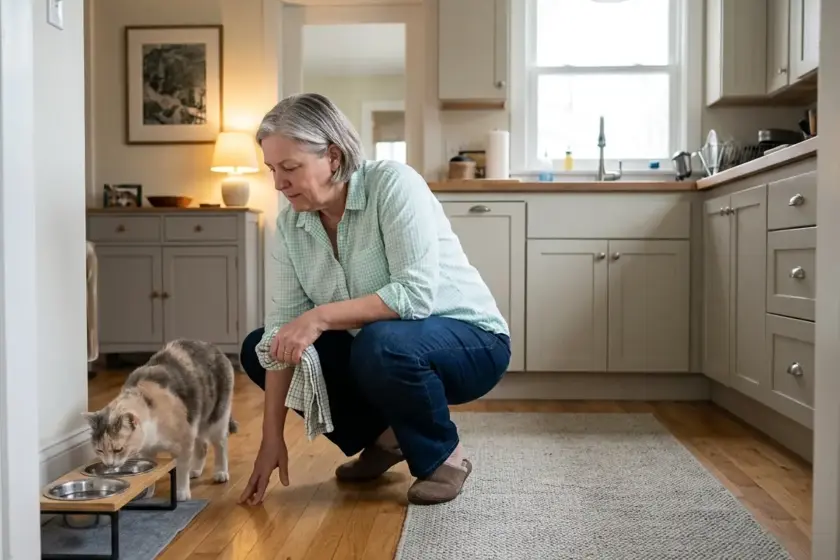
Cleaning gets easier, and this is genuinely underrated because it is the one benefit that accrues to you rather than the cat. A raised bowl keeps the rim off the floor, so the ring of dried food and water that normally welds itself to the tile stays reachable. You can get a cloth under it without moving anything. Whatever the cat thinks of the height, the human notices this within a week, and it is the reason plenty of people keep a stand that made no difference to the cat at all.
And if nothing changed after a few weeks, nothing is wrong. A healthy adult cat with no mobility trouble is exactly the population the evidence says has nothing to gain here, and getting no result from that cat is the system working correctly. The same “plausible mechanism, no proof” structure shows up next door in whether whisker fatigue is real, and it is worth getting comfortable with the shape of that answer, because this niche is full of it. If you have decided yes and now want the buying detail rather than the decision, that is the next step, along with what size the dish itself should be once the height is settled.
Change one thing at a time. A new height and a new bowl in the same week means you learn nothing from either one, and if it goes badly you will not know whether to lower the stand or return the dish.
The Short Version
The measurement comes from your cat, not from the listing. Floor to the elbow with him standing normally, and the rim goes on that line, minus however deep the dish is.
Test it with what you already own before you spend anything. A stable stack of books answers the question in a week, and the most likely answer is that your cat does not need this, which is worth knowing for free.
A second cat does not need a second bowl on the same tray. It needs its own station somewhere else in the room, ideally at a different height, because two dishes an inch apart are one place as far as a cat is concerned.
Come back to it in three weeks. That is long enough for the cat to have accepted the new height or rejected it, and it is also roughly when your own attention to a new setup starts to slip. If he is eating square and unhurried, you are done. If he is reaching up, or eating less, drop it an inch and give it another week.
Tonight, stack two books under the bowl. If nothing changes by next weekend, you have your answer and it cost nothing.
Amazon’s Audible — free for 30 days
Your cat won’t let you read. Let someone read to you.
Audible is Amazon’s audiobook library — thousands of titles, read out loud, on your phone. Free for a month, plus one audiobook to keep forever.
Frequently Asked Questions
01Are elevated bowls actually better for cats?
For a cat that already struggles to crouch, usually one with arthritis a vet has named, raising the bowl takes work off a joint that is doing too much of it. For a healthy adult cat, no study has shown a measurable benefit and most owners report no visible change.
02Do cats prefer deep or shallow bowls?
Shallow, wide and low-sided, so the sides stay clear of the face during a meal. That is a separate measurement from height and the two get confused constantly. The width question is answered in its own guide.
03Should a cat food bowl be elevated?
Only if the measurement says so. Stand the cat up normally and measure floor to elbow. If the bowl you already own sits near that line, elevation has nothing left to fix and you can stop here.
04How high should an elevated cat bowl be?
At the cat’s own elbow height, which for most adults works out to about two to four inches of lift. Bigger, longer-bodied cats sit at the top of that range and smaller cats at the bottom. A stand that is too tall causes the same strain in the opposite direction.
05Do elevated bowls help with vomiting or reflux?
That is a vet question and this article will not answer it. If a cat is bringing food back up, book the appointment. The height of the bowl is not the variable to be adjusting first, and adjusting it costs you time you may not want to spend.
Leave a comment