How Many Cats Should I Have? Count Stations, Not Square Feet
How many cats should I have? Count 4 of each resource for 3 cats, 1.5x box length, 1 to 3 m of distance + the lease, city and carrier caps.

Alfredo RamsesFounder · November 10, 2026 · 23 min read

On this page11 sections
- 1How Many Cats Should I Have? What the Vet Number Counts
- 2When the Count Turns Into a Vet Question
- 3Why Square Feet Mislead and a Walk Doesn't
- 4The One-Plus-One Count for Boxes, Bowls and Beds
- 5The Three-Minute Audit: What Each Cat Did in the Last 24 Hours
- 6What a Third Cat Costs in Time and Money
- 7The Three Caps to Check Before You Say Yes
- 8The One-Pair-of-Hands Ceiling
- 9Before You Add a Cat: Move a Station and Watch for a Week
- 10Your Number Is the Smallest Cap, and Tonight Is Enough to Find It
- 11Frequently Asked Questions
The carrier is on the shelter bench, the third cat is looking out through the mesh, and back home your two residents are about to find out. They have no opinion about a headcount; what they have is a map of where each of them eats, drinks, uses the box and sleeps, and who can see them doing it. Ask yourself how many cats should I have and the answer arrives in stations, not in a number: the figure vets quote is a ceiling for a whole household, not a reading of your floor plan, and in a rental the lease almost always caps you first. What follows swaps the single number for tests you can run in your own rooms: what the vet figure counts and when a change in a cat is a call to the clinic, a walk that counts stations, a 24-hour audit for tonight, what a third cat costs in time and money, the caps to check before you say yes, the carrier limit, and a first move that costs nothing.
Quick Answer
No single number fits every home. Your limit is the smallest of four: what the lease allows, how many cats you can still account for day by day, how many stations each cat reaches unseen, and how many carriers you can lift at once. Vets’ four to five is a household ceiling, not your apartment’s.
How Many Cats Should I Have? What the Vet Number Counts
Every conversation about too many cats ends at the same figure, so it helps to know what the figure measures before you hold your apartment up against it. It measures less than it seems to.
Four to Five, and a Hard Cutoff of Six
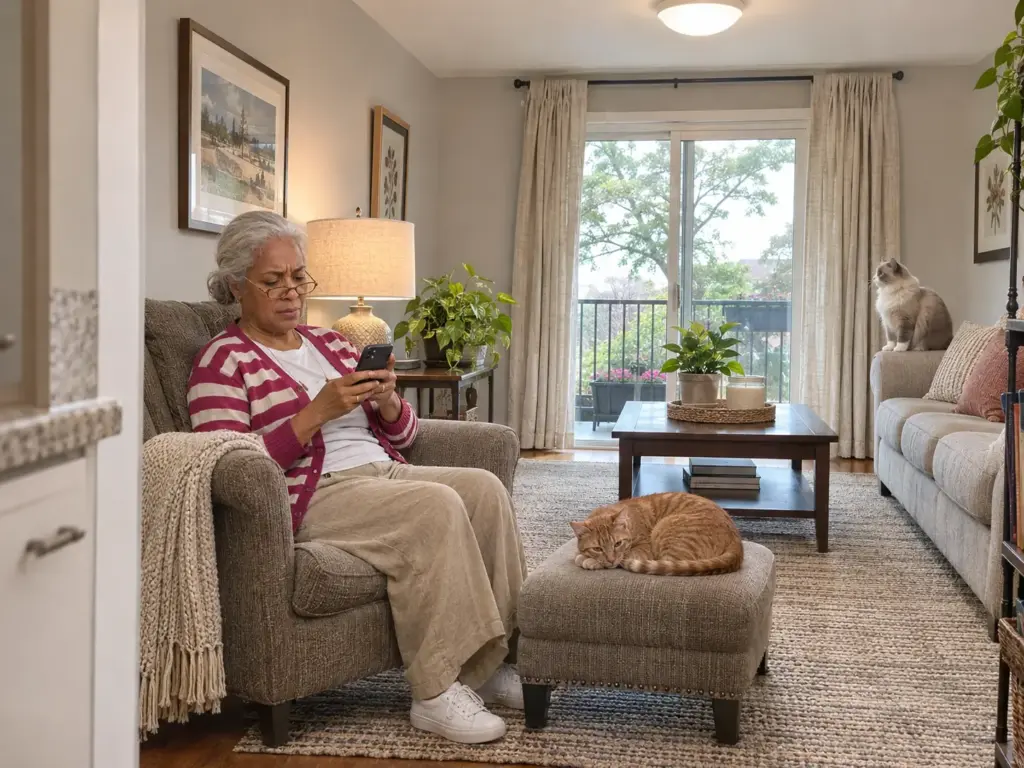
Veterinary advice puts the working limit at no more than four to five cats in a home, with six as the cut-off. Dr. Justine Lee, a veterinarian who has put that number in writing, lands there, on the reasoning that medical and behavioral problems become more common past five. It is a statement about the household as a unit: how much care one home can give before something gets missed.
It does not shift with square footage, and nobody calibrated it to 500 square feet or to 1,500. Read it as a welfare guideline drawn from clinical experience, not as a published standard. Vets themselves disagree about where the line sits, and ten of them would give you ten numbers.
A Ceiling Is Not a Target
A ceiling marks where trouble starts, which makes it a poor place to aim. The vet figure is also the wrong number to plan around in most rentals, because your own number comes out lower once stations, hours and a lease are counted. Two cats can already be past their limit when every box, bowl and bed sits in one corner, and six cats in a house with six working stations are not a bigger version of that problem but a different one.
Households that end up at six rarely chose six. They got there one cat at a time over years, each addition reasonable on the day it happened, which is how a ceiling gets crossed without anyone deciding to cross it.
Why Two Homes Never Get the Same Answer
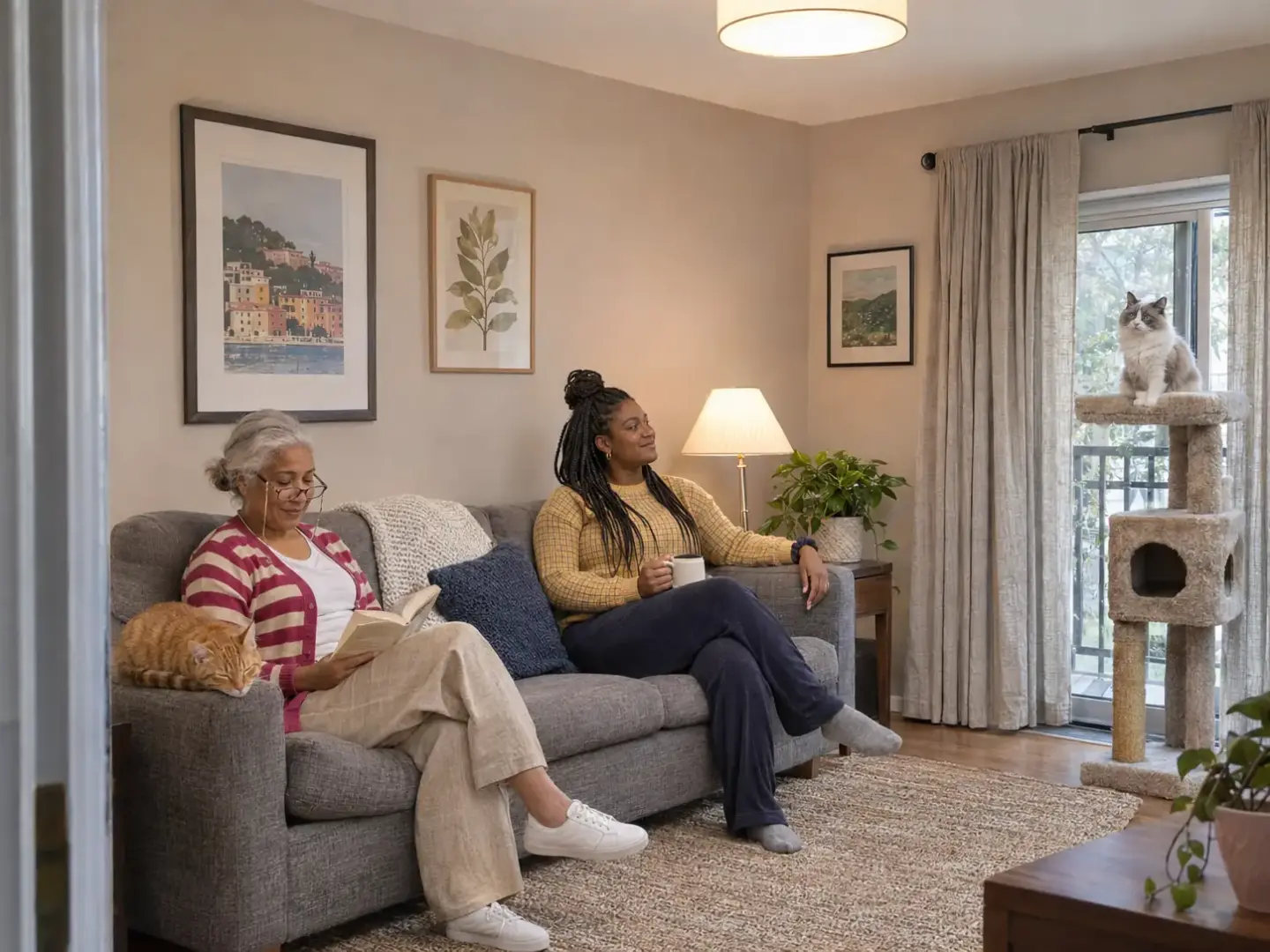
Take two apartments of the same size. In the first, a hallway, a bedroom door that stays open and a kitchen with two usable corners give three cats six places to eat, drink and use a box without meeting. In the second, one bathroom holds every box and the only water bowl sits at a crossing point. The vet ceiling reads both identically; the cats read them as opposites.
What the ceiling can’t see is how a cat’s territory splits up zone by zone, and the unit that does see it is the resource, so the AAHA/AAFP feline life stage guidelines count boxes per cat and never rugs.
Heads are not the only thing that fills stations. A dog, a kitten still growing into its jumping and climbing, or a foster who is only staying a few weeks all use the same bowls and corners, and a cat and a dog sharing a small home shows how quickly that arithmetic changes. A rule like “three is my limit,” held without a reason, is usually a statement about time and stations that hasn’t found its words yet.
When the Count Turns Into a Vet Question
Some of what looks like a crowding problem isn’t one, and the only way to tell is to split what the house explains from what a clinic explains. The clinic goes first.
Overnight Change Is a Vet Call, Not a Count
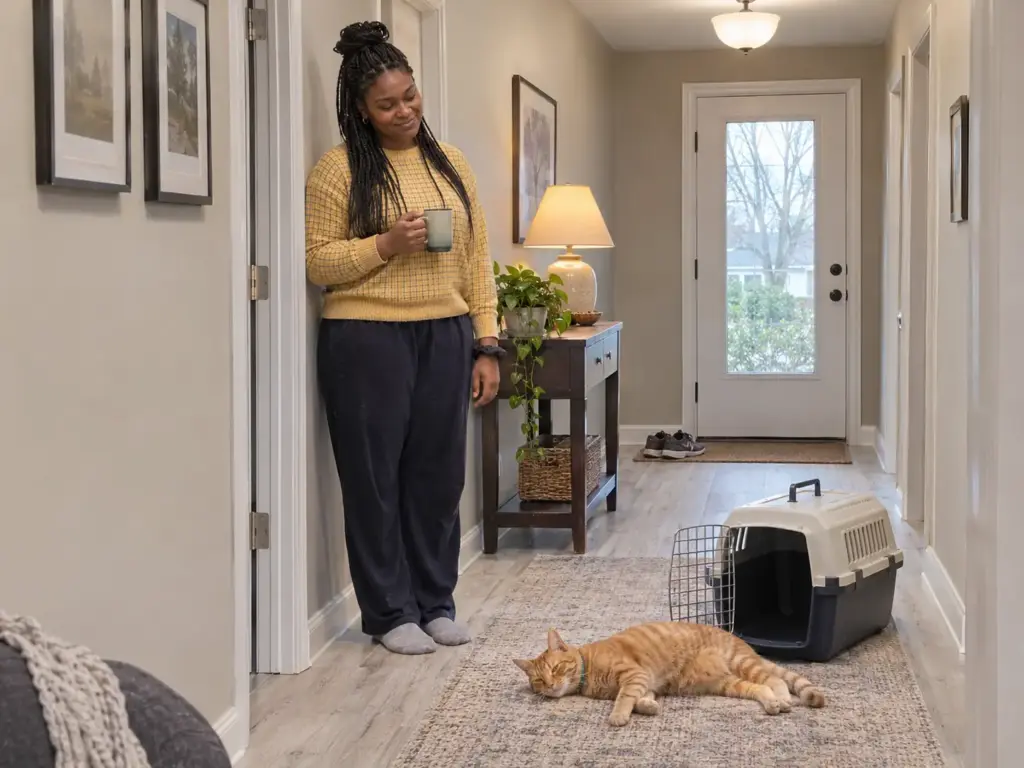
A cat who stops eating, drinks noticeably more or less than usual, starts peeing outside the litter box, hides for days or shows weight loss has changed a habit from one day to the next. That goes to the vet that day, before anyone moves a bowl or recounts the boxes.
The AAHA and AAFP guidance draws the same line on litter box problems and says to get veterinary help promptly. This article doesn’t say what any of those changes means or what causes them, and no headcount can. Everything else here covers routes, stations and rooms, which is the part a person can adjust at home.
The Rooms a Cat Stops Entering
What the house does explain is a cat who gives up a room. He stops walking into the room where the other one sleeps, eats only after the other has left, or watches a doorway before crossing it.
None of that is a symptom. Those are routes, and a room with one entrance, watched from the sofa by another cat, is a room he has no safe way to use. Giving it up is a sound decision with the resources he has.
That is what a home over its number looks like first, and it is rarely a fight. International Cat Care’s guide to multi-cat households notes that when resources are limited, cats avoid each other or hold back normal behavior.
A room the victim of a bully stops visiting is the clearest case, and it is a count problem before it is a character problem. When a settled pair starts clashing more, look at what changed in the home over the last six weeks before deciding anyone has to leave. And after a new arrival, what you watch between meetings is covered in the signs that a new cat is not settling in.
Write down which cat sleeps and eats in which room this week, then repeat the list two weeks later. A room that empties points at the house. A habit that changed points at the clinic, and that call doesn’t wait for the second list.
Where Many Cats Ends and Hoarding Begins
No number decides where animal hoarding starts. Twenty cats in a well-run sanctuary and six in a one-bedroom where nobody can say who is eating are different situations, and what separates them is whether every animal gets food, water, a clean box and veterinary care. That is a welfare and mental-health matter. When a home can’t supply those four things, the conversation belongs with a veterinarian or local animal welfare, held without judgment, and this article can’t tell any reader which side of that line they stand on.
Being the person with the cats is not the problem. Not looking is.
Why Square Feet Mislead and a Walk Doesn’t
Home-size tables pair a floor area with a cat count: under 600 square feet, one or two cats; 600 to 1,000, two or three; over 1,000, three or four, with 18 square feet per cat as the usual add-on. They are easy to read and they count the rug.
The Home-Size Table Counts the Rug
A big apartment can have exactly one working station, with every box in the same corner and a single water bowl on the way to the kitchen. A 600-square-foot one can hold two cats comfortably and three only if the walls get used.
Area is a poor stand-in for what a cat needs, which is to reach a litter box, water, food and a place to sleep without crossing the gaze of another cat. The table tells you how much floor you have. It says nothing about how many places on that floor a nervous cat can use.
The Walk: Can Each Cat Reach Each Station Unseen?
Walk the apartment as the shyest cat would. Start at the bed, go to the box, then the water, then the food, then back, and at each step ask whether you crossed a sightline to somewhere another cat could be lying. Then ask two more things: does each high place have two ways down, one of them not past anybody, and is the spare station in a different corner or room, or just beside the first? A station in plain view of another cat doesn’t count, however many of them the arithmetic says you have.
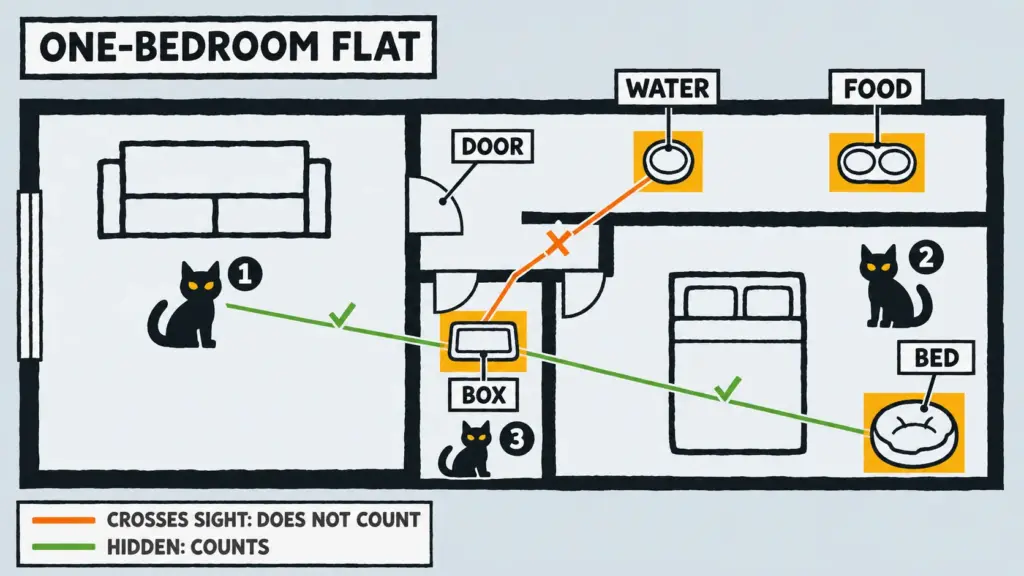
Distance matters at room scale too. Herron and Buffington’s review of indoor cat enrichment puts social distance at 1 to 3 meters (roughly 3 to 10 feet), horizontally and vertically, when cats share a room. Three meters is about two sofas, and in a studio that gap exists only when one cat is up and the other is down, so a perch counts as real separation there. The same counting works in exits, and territory in a small apartment, counted in exits walks through it for a one-bedroom.
Count how many times you cross another cat’s line of sight on the way from bed to box to water. More than once and that station doesn’t count, even if it sits on a different wall.
Water Is a Station Too
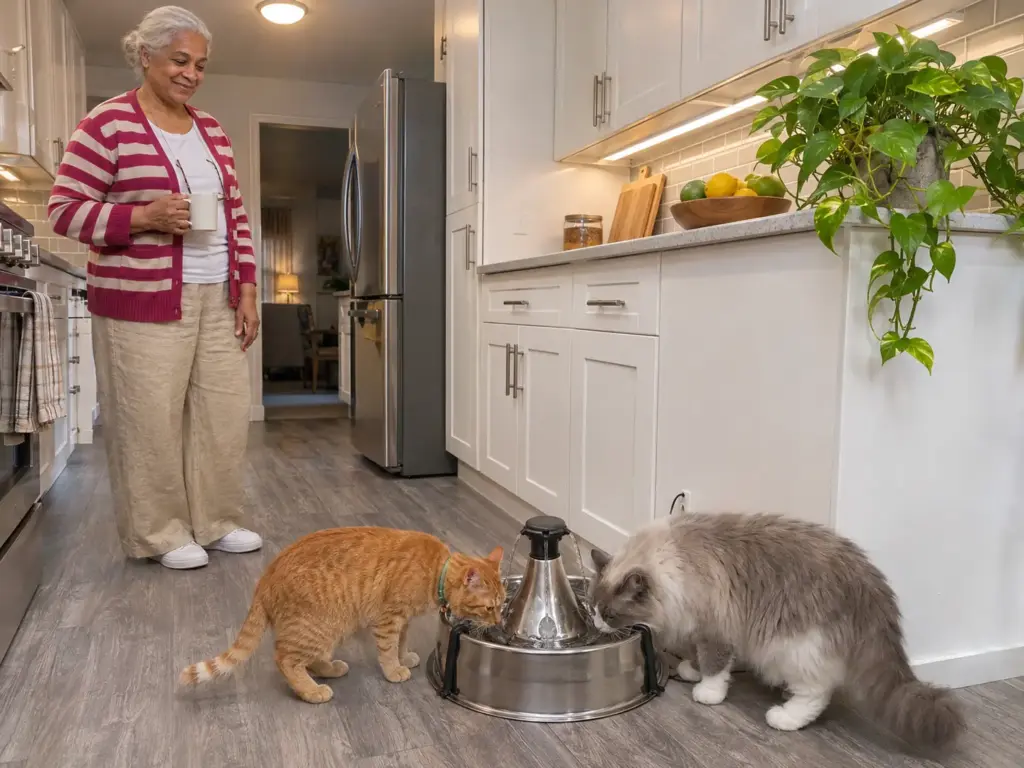
Water gets forgotten because it never looks crowded. One bowl in the kitchen is one station, and a cat who has to cross another cat’s gaze to reach it will find water somewhere else, usually a place you didn’t plan for.
Water is one of the resources a trio needs four of, and how many water bowls three cats need sets out the full count. Free first: move the bowl you already have to a second corner, away from the food, and watch for a week. The move tells you whether the first station was the problem.
If you are buying, the obvious pick for three cats is the biggest fountain you can find, and the PetSafe Drinkwell Stainless 360 Multi-Pet Fountain is a good version of that: 128 oz (3.8 L), a 360-degree bowl so two cats drink at once without a queue, and one to five streams. Cleaning is where it costs you, since it comes apart into several pieces and has a spout tower that needs scrubbing.
But one big fountain adds volume, not a station. A second water spot in another corner adds a station, and for that job I’d put the Veken Stainless Steel Cat Water Fountain there: 108 oz (3.2 L), 8.3 x 8.3 x 4.9 inches, all stainless, with a small footprint and a need for an outlet. The pump is the part that gives out, and in some units it does so within two months, so keep your original bowl as the backup.
What Walls Can Do in a Studio
Walls are what a studio lacks, so you build substitutes. A tall shelf adds vertical space and a route up, a cat tree turns one corner into two levels, a window perch gives the cat who needs distance a lookout of his own, and in a one-bedroom, a pet gate with a cat door for a rental doorway can split the apartment into two territories without touching the wall. None of these needs a drill, and each one is a station you can test for a week before deciding the answer is a bigger place.
The One-Plus-One Count for Boxes, Bowls and Beds
The rule everyone quotes, the 1+1 rule (also written n+1), covers litter boxes. It really covers everything a cat needs, and it fails in one particular way: the arithmetic passes while the layout doesn’t.
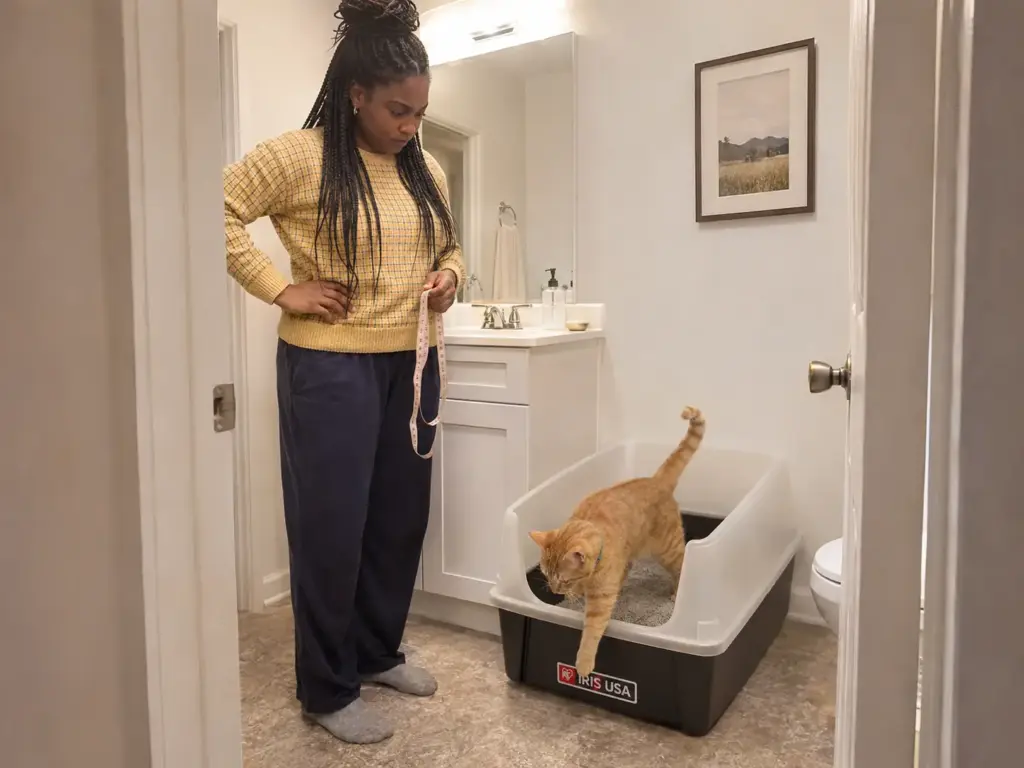
Four Boxes by One Wall Is One Box
According to the AAHA/AAFP feline life stage guidelines, “The rule of thumb is one litter box for each cat plus one additional box.” That is one litter box per cat plus one, and the advice breaks in a one-bathroom apartment, where the plus-one lands next to the first box and the cat who watches that wall holds both. The American Veterinary Society of Animal Behavior on separated resources asks for the boxes to be spread out, ideally with several feet between them, and International Cat Care treats boxes grouped in one place as a single resource.
That changes the numbers.
Three cats that aren’t a close social group need four of every resource: litter boxes, water, food, scratching posts, beds, high places and toys. A bonded pair, two cats who sleep touching and groom each other, can share a station, but a third who isn’t part of that bond needs his own. Four pans pushed against one wall are one resource station with four trays, and why a spare resource fails when it sits beside the first explains what goes wrong when they sit together. For the litter half alone, how many litter boxes two cats need shows the same math one cat earlier.
Put one box behind a door that closes and another at the far end of the apartment, not both on the same wall. The cat who guards one wall can’t guard two.
The Box That Clears One and a Half Cat Lengths
The same guidelines ask for a box at least 1.5 times the cat’s length, nose to tip of tail, and note that most manufactured boxes fall short. A 16-inch cat needs about 24 inches of floor, and the “large” box on the shelf is often closer to 19, which is why a cat ends up with his back half over the edge. The box is simply too short for him.
Measure him with a soft tape before opening a product page, multiply by 1.5 and compare that to the inside floor of the box you own. If you do buy, the IRIS USA XX-Large High Sided Cat Litter Box is the largest open pan I’d point a big cat at: 30 x 20 x 14 inches with a 6.5-inch entrance, which on the listed dimensions clears the 1.5x rule for a cat up to about 20 inches. Open and high-sided, it lets you see what each cat left without taking anything apart, which the 24-hour audit depends on. The cost is floor, 30 by 20 inches per station, and in a small apartment that rectangle is the real price.
Steel holds odor less stubbornly than a scratched plastic pan, and the KITCATY XXL Stainless Steel Litter Box is the steel option with enough floor: 28 x 20 x 12 inches and about 60 liters of litter, enough for a cat up to roughly 18 inches. The bottom scratches with use. Whichever you pick, a self-cleaning litter box doesn’t replace counting, and where an automatic box breaks with three cats covers the limits.
Bowls and Beds Count the Same Way
The second bowl is the point, not a spare. Two stations in one order is what the WROSWT 2-Pack 304 Stainless Steel Cat Food Bowls deliver: each is 5.98 inches across, 1.22 inches deep and holds 13 oz. A bowl that size is built for one cat’s meal, so a big eater finishes and lifts his head looking for more. Three cats means four bowls in four different places, not a row along the wall.
Beds, scratchers and high places follow the rule too, and all of them can be moved for free before anything is bought. A cardboard box on its side counts as a bed. If the numbers say you’re a station short, redistribute what you have across two rooms before you order the fourth of anything.
The Three-Minute Audit: What Each Cat Did in the Last 24 Hours
The ceiling that matters most is the one you can test tonight, with a pencil and a sheet of paper.
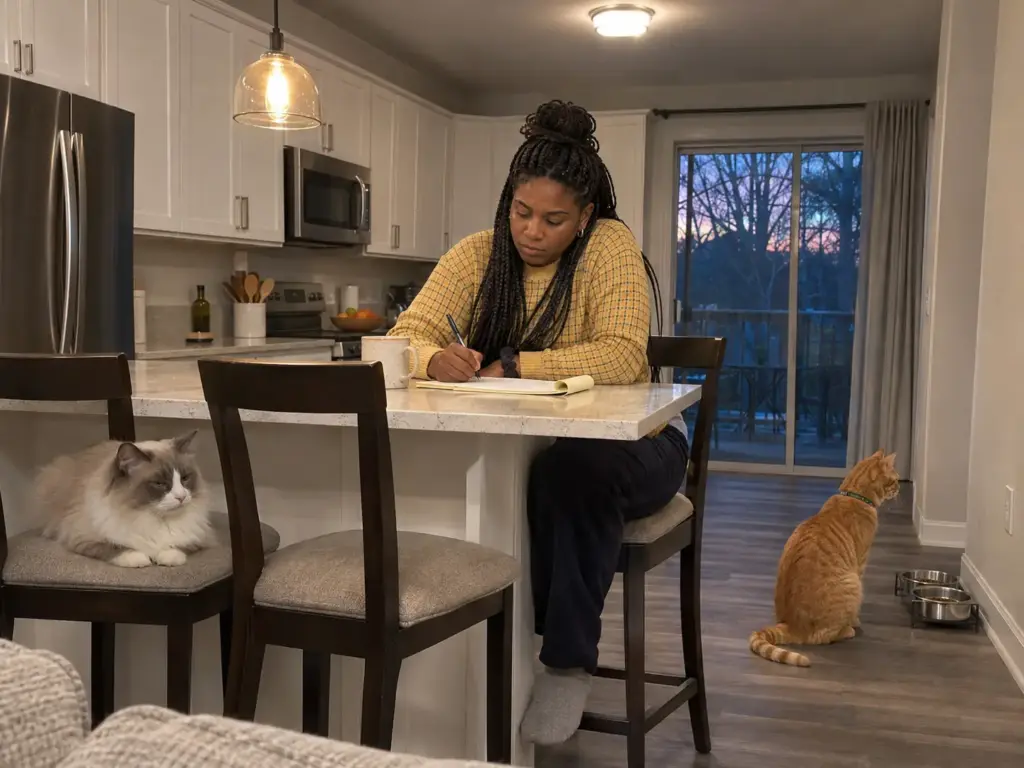
Run It Tonight
Draw one column per cat. For each, write what it ate, what it drank and what it left in the box, and where, over the last 24 hours. It takes three minutes.
If every column fills in, your household is inside its limit whatever the count says. If two cats share two boxes and one bowl, the record is already blank, because nobody can say whose anything was. That blank is the ceiling.
Where you put the stations decides how much of the sheet you can fill, and a feeding map for two cats in a small apartment gives a layout you can copy as a renter. Dr. Lee puts the same limit in a vet’s terms: monitoring health gets harder with the count, and spotting that one cat has a urinary tract problem is harder among six cats than among two. Tracking gives out before space does.
Fill the sheet in pencil and tape it to the refrigerator for a week. A box that stays empty for three days is the station you’re missing.
Why Shared Boxes Break the Record
A shared box is a blank in the log. Two cats using one pan means every entry carries two names, and a shared bowl hides the same thing on the food side; why a shared bowl hides what each cat eats covers it. A shared bowl isn’t a bad sign by itself; it is just an empty cell on your sheet. A cat guarding a bowl, which is resource guarding, turns it into a worse problem, and what one cat guarding a bowl costs the others is the cost nobody puts on the sheet.
What makes the record attributable is the same formula applied twice. International Cat Care’s guide to multi-cat households describes it as one resource per cat plus one extra, positioned in separate locations, and the review by Herron and Buffington adds that boxes should be out of sight of each other. Put that onto the two resources that answer “did he drink, did he go” and the sheet starts to fill.
When the Audit Fails, Add a Station Before a Cat
A column that stays empty doesn’t mean you have to rehome a cat. It means add a station, move one, or split the count before adding another head, and then repeat the sheet. If food is the blank, there is a paid route: a feeder that opens only for the cat it recognizes makes each cat’s meals attributable. It doesn’t replace the sheet; it makes the food column possible to fill.
What a Third Cat Costs in Time and Money
The jump from two cats to three gets paid in attention and cleaning before it gets paid in food.
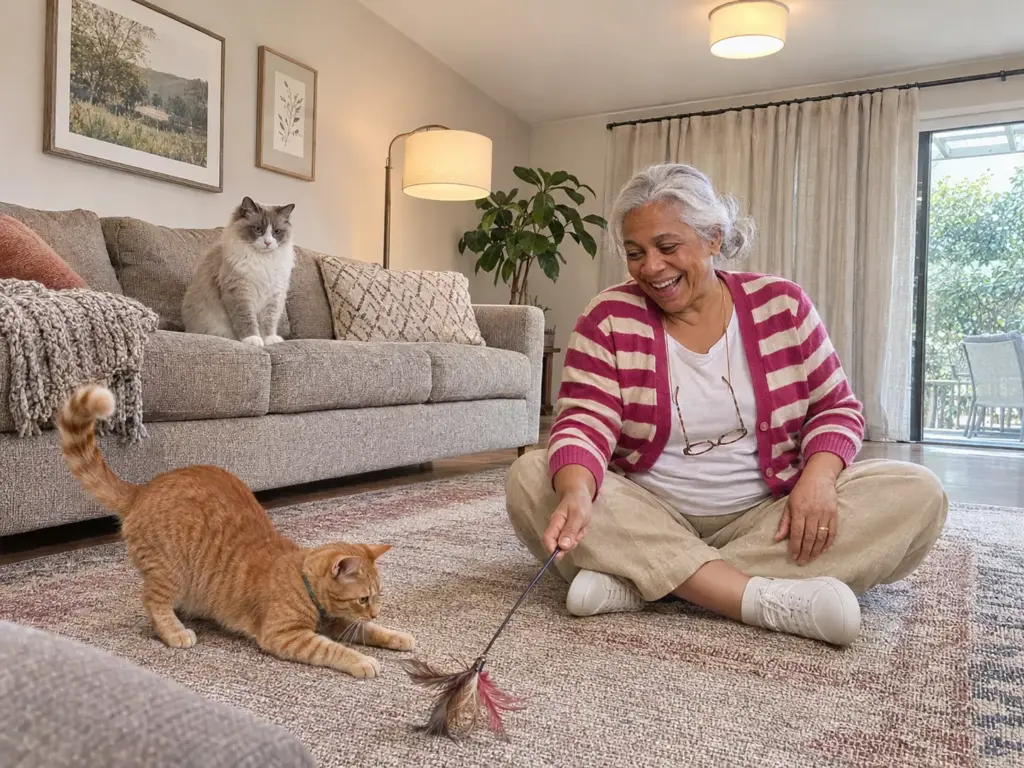
The Jump From Two to Three Is Time
Play has to happen one cat at a time with three, because they steal each other’s toy, and a closed door gets complained about until somebody opens it. Brushing, if your cats need it, grows with every head. The limit that bites at three is usually time, not space. Count the actual hours last week spent on play, brushing and scooping before deciding, and judge the answer by what is left after work, not by what feels possible on a good day.
Scooping and the Litter You Step On
In a small apartment the third cat shows up as housework before it shows up as conflict. That means two more boxes, furniture moved to make room for them, three times the scooping, and litter underfoot even after you sweep. Cleaning multiplies faster than any behavior problem does, and it falls on the same person every day.
The Vet Year, Quietly Budgeted
Each cat is its own line in the budget: a routine visit, food, litter. Keep a separate cushion for one cat’s bad year, because illness doesn’t wait its turn. What to do when one of three gets sick is the vet’s call, not a budgeting question. Write each cat’s routine visit, food and litter down as its own line before the third one comes home, so the total isn’t a surprise.
The Three Caps to Check Before You Say Yes
The cap that bites first is almost never the vet’s number. For a renter it is one of three others, and most people check none of them until the third cat is already in the carrier.
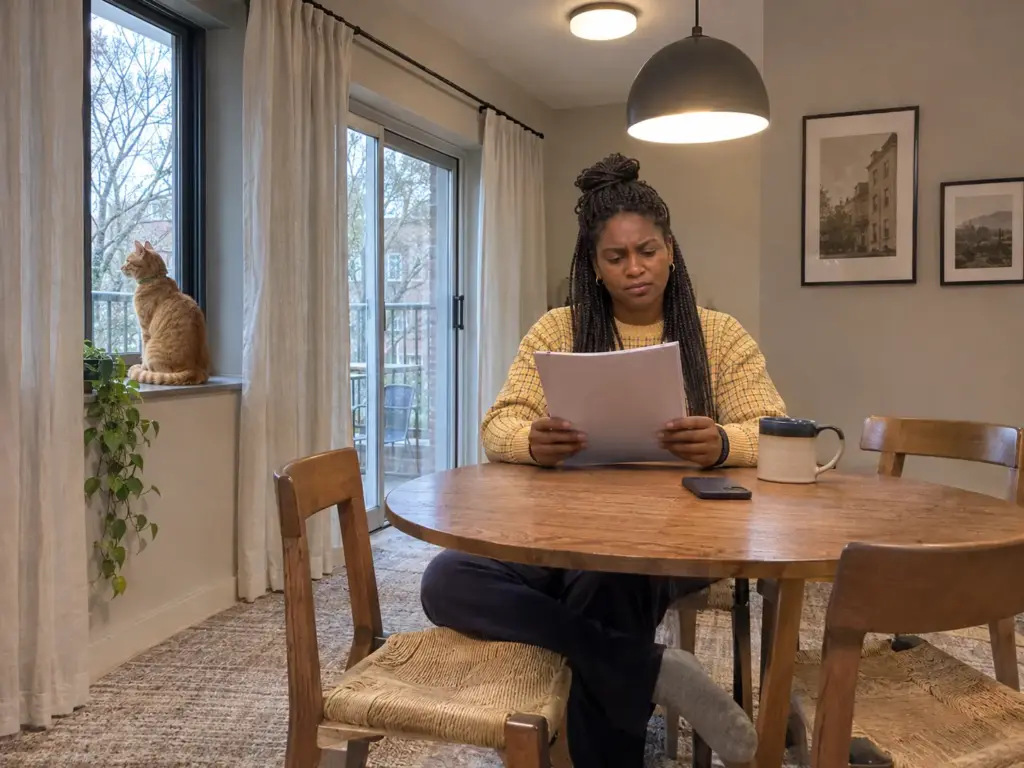
The Lease and the Pet Addendum
The lease is the only cap that can end with the cat leaving the building, so it goes first. A landlord can set a stricter limit than the city does, and a city permit doesn’t oblige a landlord to accept the animals; many property managers cap pets at one or two per unit. Ask for the pet addendum in writing before the third cat comes home, even if you already have two. A cat kept off the books is a risk to you and to the cat, and the conversation goes better before the cat is in the apartment than after.
The City or County Limit
A local ordinance varies widely and changes. Los Angeles allows five cats, with conditions above three (indoor-only, spay and neuter proof, microchipped and registered), and moved up from three in 2021.
Dallas allows four dogs or cats in an apartment and six in a house on less than half an acre. Calgary allows six. Use those to see how wide the range is, then look up yours: the figure for your city or county is the one that counts.
The Building’s Own Rules
Homeowner association and co-op rules apply even when the city allows more, and they are the cap people forget because nothing in daily life reminds them. Read your lease and your city’s page. This article doesn’t interpret either one, and a rule you haven’t read is a rule you haven’t passed.
Keep the reply email from your landlord with your lease, and save your city’s pet-limit page as a PDF with the date you read it. When the rules change, the dated copy tells you which version you were living under.
The One-Pair-of-Hands Ceiling
Every other cap here can be argued with, bought around or put on a calendar. This one is physical: how many cats you can get into carriers and out of the building in one trip.
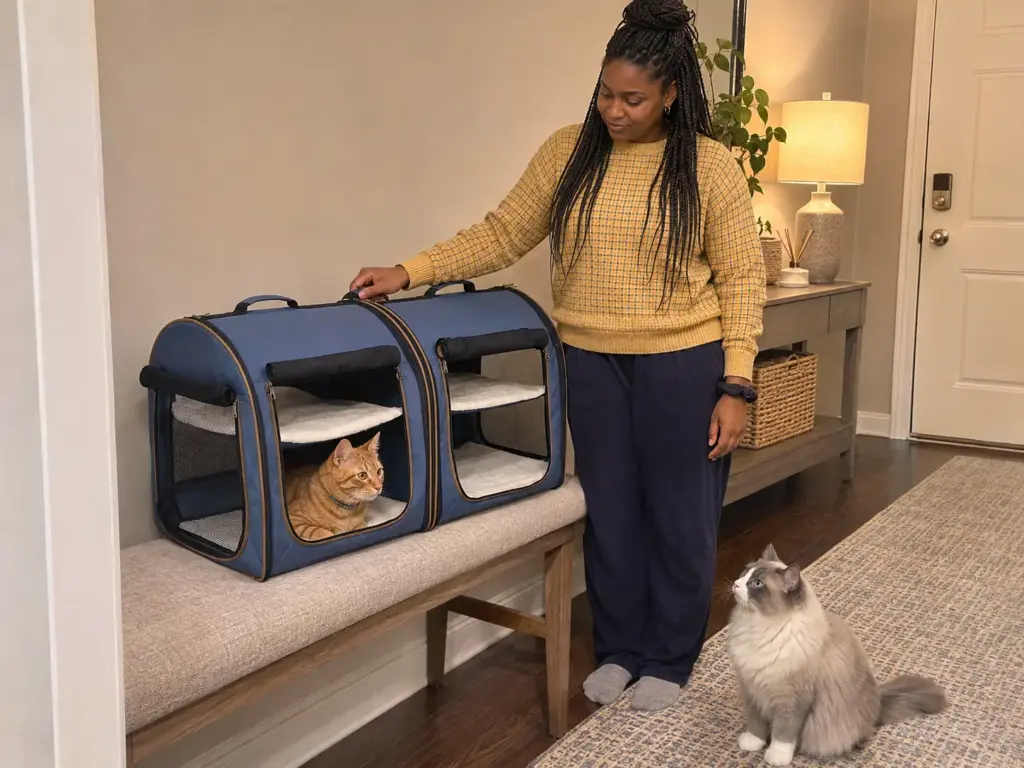
Carriers by the Door
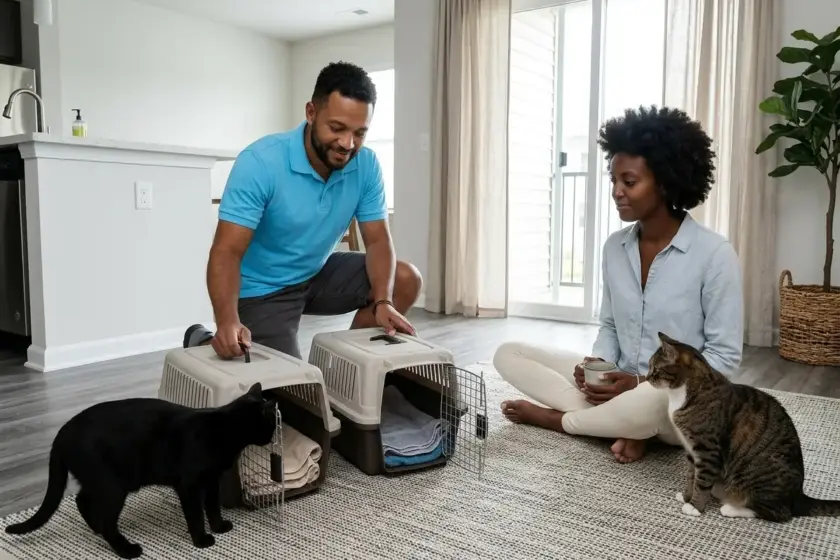
The working rule is one cat per free hand, which gives two for someone living alone and four for a couple. It isn’t a law. It’s a mirror: how many carriers can you carry to the lobby, or to the car, without leaving one cat behind? Keep carriers open by the door with a treat inside, so they belong to the apartment rather than to the closet at the back, and so the emergency you’ve never had doesn’t have to start with an argument over a carrier.
Single hard-sided carriers are the standard pick, and with two people in the house I’d still choose them.
For one person lifting two cats, a double changes the math. The PawHut 39 in Portable Soft-Sided Cat Carrier with two compartments measures 39 x 20 x 20 inches overall, 19.5 inches per side, and is rated for 44 lb total. The zipper joining the two halves is the weak point and can open under load. It also takes 39 x 20 inches of floor when open, so it needs a storage spot.
A Morning With Two Vet Visits
Picture two cats with appointments on the same morning. A double carrier takes both through the door in a single lift, and at the clinic it separates into two crates so each cat gets his own space. That is what makes three cats realistic for one person at all, and no amount of money fixes more cats than hands: it is an evacuation problem as much as a logistics one, in a storm or a building emergency.
Free first: practice the route once with the carriers open and empty, before you need it.
Before You Add a Cat: Move a Station and Watch for a Week
You’ve done the counting and still aren’t sure whether to say yes. Before anything is bought, one free experiment tells you more than another hour of arithmetic.
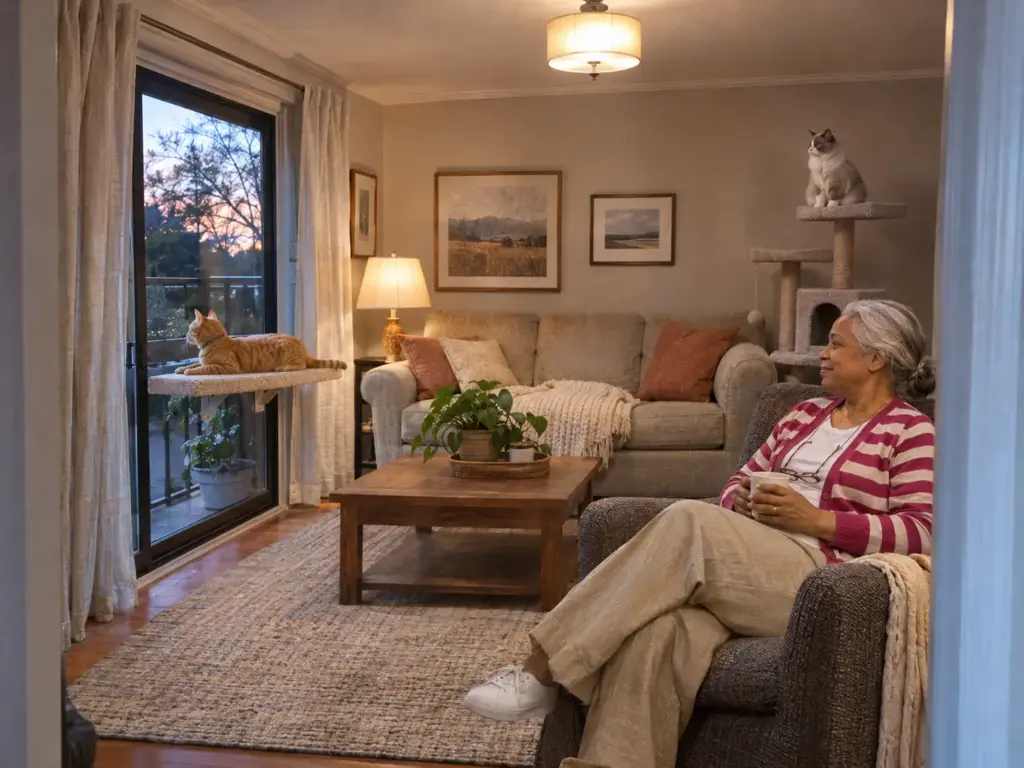
The Free Move Comes First
The cat is describing a constraint and the person a preference: a third cat, a tidy corner.
Before you buy another box, move one you already own into a different room and watch for a week. Write down which cat uses it, which cat stops walking down the hallway, and which station ends up unused. A cat who takes the long way round to avoid a doorway has told you where the house fails him. If he’s right, and he usually is, the house changes, not the cat.
The Order to Decide In
Lease and city go first, because they are the only caps that can end with a cat outside your door. The 24-hour sheet follows, then the walk through your stations, then the carriers and hands. Only after all four does it make sense to think about introducing a new cat, which is a separate topic with its own timing.
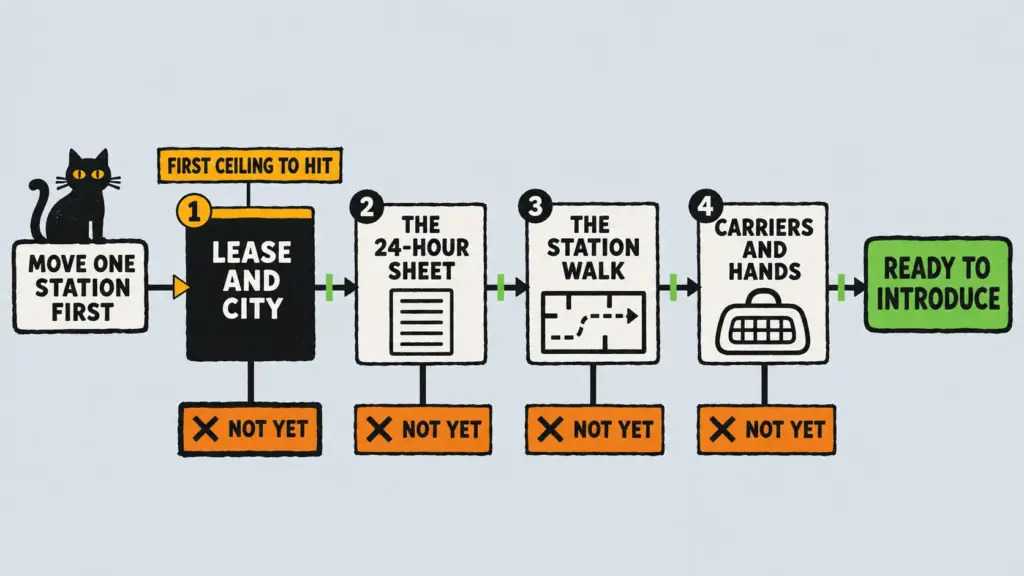
Questions like which carrier suits two cats, or how a pair copes with a workday alone, come after this count, not before it. Leave them until the order above has been walked.
Put the date you moved the station into your phone and watch an entire week before changing anything else. If no cat has changed route by the end, the house absorbed the move and you can try the next one.
If the Answer Is Not Yet
Not yet is a real answer. Repeat the 24-hour sheet after a week and again after a month, move one more station, and set no deadline for deciding. If the lease says no, the answer is no, and the free alternative is taking in a foster cat for a shelter, where your contract allows it.
When the answer is yes, how to introduce cats in a small apartment, stage by stage is the next page, and how long to wait before the first meeting sets the calendar for closed doors. If the new arrival is a kitten, adding a kitten without crowding the cat who lives there covers what the resident is owed.
Your Number Is the Smallest Cap, and Tonight Is Enough to Find It
The vet figure of four to five, with a hard stop at six, is the ceiling for a household as a unit and not a measurement of your apartment. Your number is the smallest of four limits: the lease and the city, the cats you can still name day by day, the stations each of them reaches unseen, and the carriers you can lift at once. A cat who changes a habit overnight goes to the vet before anything else, and a home that can’t give each animal food, water, a clean box and care is a conversation for a veterinarian or local animal welfare, not for a tally.
Check the sheet again after a week, and once more after a month, or after any station moves. If one box stays empty for three days running, change something instead of waiting for it to sort itself out. Today, the only step that costs nothing is an email to your landlord asking for the pet addendum in writing, so that when the carrier is on the bench you already know what the building says.
Frequently Asked Questions
01Is 3 cats in a house too much?
Three cats are not too many by count alone, but they need four of each resource spread through the home and enough hours and hands to track each one. A lease that says two settles it before the cat does.
02Is 4 indoor cats too many?
Four sits inside the four-to-five range vets quote, but that range is a ceiling for a household, not a verdict on one apartment. The test is whether you can still say what each cat did in the last 24 hours. A cat whose habits change overnight is a vet call first.
03What is the 3-3-3 cat rule?
The 3-3-3 rule is shorthand for how a newly adopted cat settles in: three days to decompress, three weeks to learn the routine and three months to feel at home. It says nothing about how many cats fit in your home.
04Is 20 cats considered hoarding?
No number decides it. Hoarding is about whether each animal gets food, water, a clean box and a vet, which is a welfare and mental-health matter, not a count. A home that can’t give those is a conversation for a veterinarian or local animal welfare, without judgment.
05How many cats can I have in an apartment?
As many as your lease, your city and your building allow, and then as many as you can walk, audit and carry. Check the three caps first: the lease almost always bites before the vet’s number does.
Leave a comment