How Much Water a Cat Needs, in Ounces
Cat hydration in numbers: 4 oz per 5 lb of body weight daily, wet food at 80% water, one station per cat +1, and five feet of clearance from the litter box.

Alfredo RamsesFounder · September 21, 2026 · 20 min read

On this page9 sections
- 1What a Cat's Daily Water Actually Adds Up To
- 2When This Stops Being a Bowl Problem
- 3The Food Is Doing More of the Work Than the Bowl Is
- 4How Many Water Stations, and Where They Go
- 5Where a Cat Will Actually Drink in a Small Apartment
- 6The Bowl and the Fountain, and Which One Is Actually Your Problem
- 7What This Looks Like Three Weeks From Now
- 8The Short Version
- 9Frequently Asked Questions
You have stood over a full bowl at ten at night, tilted your head, and tried to work out whether the level has moved since morning. It hasn’t, obviously. Or it has by about a fingernail, which feels like the same thing.
Here is the part the entire first page of search results skips: before you ask how to make him drink more, you have to ask whether he is drinking too little at all, and for a cat eating wet food the honest answer is usually no. Cat hydration is a total, not a bowl reading, and the number that settles it comes from Cornell. This article gives you that number, tells you exactly where the line is between a furniture problem and a phone call, and then covers what to change in the apartment.
Quick Answer
A cat’s daily water is a total across food and bowl, not a bowl reading.
- Count about 4 oz of water per 5 lb of body weight, daily.
- Subtract the food first: wet food runs up to 80% water.
- Set one water station per cat, plus one, in different rooms.
- Keep every station about five feet clear of a litter box.
- Call the vet if drinking stops, or suddenly climbs.
What a Cat’s Daily Water Actually Adds Up To
If you have already read three articles about this, you have three different ratios in your head and no answer. One says an ounce per pound. One says three and a half to four and a half ounces per five pounds. A third gives you a cup and leaves it there.
They are all roughly in the same neighborhood and none of them are the same number, which is exactly the kind of thing that makes a reasonable person close the tab.
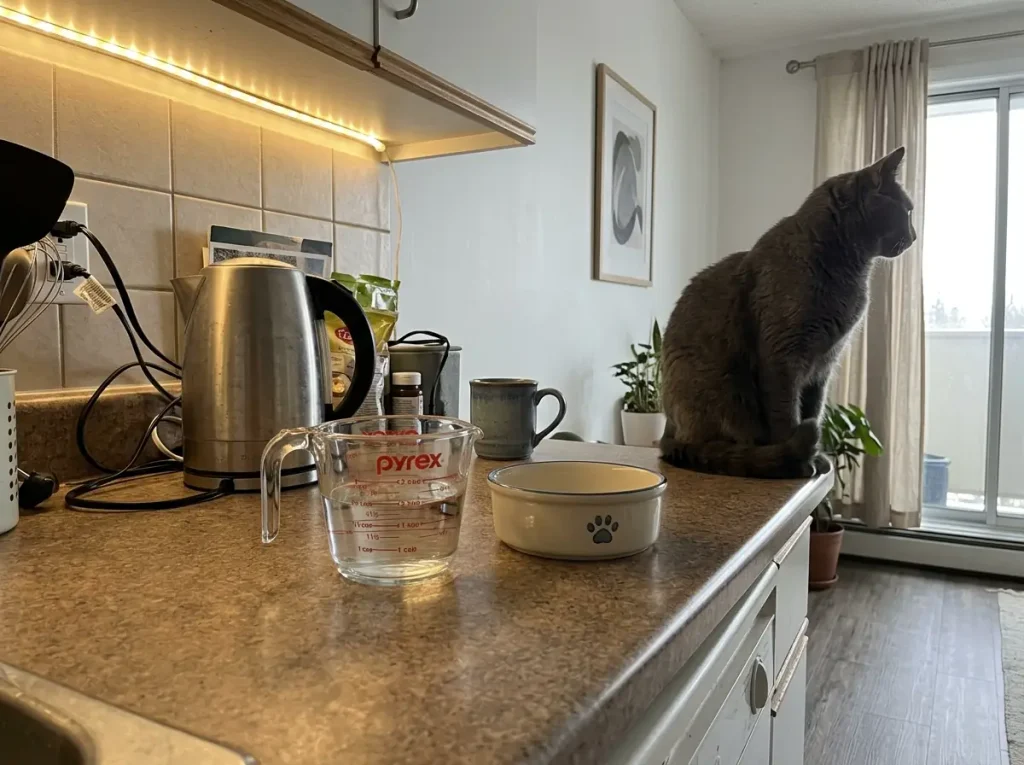
So take one figure and build on it. According to the Cornell Feline Health Center, “Cats need to consume about 4 ounces of water per five pounds of lean body weight per day.” A ten-pound cat lands near a cup a day, and you can hold a cup of water in a coffee mug without either hand shaking. That is the whole daily requirement for an adult cat, and Cornell’s feline hydration guidance is where the figure comes from.
Now the part that reconciles the other numbers. Cornell’s figure is total intake, everything the cat takes in from any source. Some of the competing ratios count only what leaves the bowl.
Same cat, same day, two wildly different targets, because one of them quietly assumes a cat eating dry food that has to drink every drop it needs. The gap between “about a cup” and “a cup and a half” stops looking like a rounding error the moment you notice one of those numbers has already subtracted dinner and the other hasn’t.
The low thirst drive underneath all of this is not a design flaw in your cat. Cats descend from desert animals built to extract most of their water from prey, which is to say from food. A cat drinking little from a bowl is behaving exactly as built. The trouble is that we put a bag of dry kibble in front of that animal and then stand around being surprised at the bowl.
Which brings up the other reason your reading is unreliable: you are judging a wide shallow dish by eye, in the evening, from standing height. A quarter inch of level change across a six-inch bowl is a lot of water and looks like nothing. A cat can hit its entire daily bowl quota and leave you convinced it drank nothing, and if the bowl is the wrong shape entirely, what the bowl itself is doing to the reading is a separate problem sitting on top of this one.
Stop judging by eye. Fill the bowl to a mark you can see from above, a scratch on the rim or the seam in the steel, and check it at the same hour for three days running. Same bowl, same spot, same time. Three days of one honest comparison beats three weeks of squinting, and it costs nothing.
When This Stops Being a Bowl Problem
Everything below this heading assumes you have a cat that is drinking somewhat less than you pictured. That is a different animal from a cat that has stopped, and the difference decides whether you spend tonight moving a bowl or on the phone.
Here is the binary, and it is worth being blunt about it because every other article on this topic buries a vague “consult your veterinarian” in the closing paragraph. Drinks less than you expected is usually the food, usually normal, and the rest of this article is for you. Stopped drinking, or suddenly drinking far more than usual, is a call to your vet today.
Not a rearrangement, not a new bowl, not a week of watching. A call.
The second one is the one people sit on, because a cat suddenly emptying the bowl looks like a win. You did the work, you moved the station, and now he’s drinking. A sudden climb in thirst is a recognized reason to have a cat looked at, and it is the signal most likely to get filed as good news for a month. If the level started dropping fast and you didn’t change anything to cause it, that is information for a vet, not a result to enjoy.
You will also be pointed at the skin-tenting test, so it is worth knowing what it is and what it isn’t. You lift the loose skin over the shoulders and let go; in a well-hydrated cat it drops back almost at once.
What almost nobody passes on is the caveat that comes with it. In Cornell’s note on the skin test in older cats, geriatric cats may show decreased skin turgor even when they are normally hydrated. A slow snap-back on a fourteen-year-old proves nothing on its own.
It fools the other end of the scale too, in the opposite direction. A very heavy cat can give you a fast, reassuring snap-back that means nothing, and a very thin one can look tented while being fine.
A test that reads wrong in both directions depending on the shape of the cat is a screening tool. It tells you whether to hurry. It does not tell you what is happening.
The same goes for the other signs you will see listed, dry gums and sunken eyes among them. They are worth knowing so you can describe what you are seeing when you call. They are not a checklist you work through at home to decide whether the call is necessary.
And the honest version of how this actually goes: somebody does the pinch once, doesn’t like what they see, and spends the next two hours reading forums instead of dialing the phone. The test is not there to replace the call. It is there to tell you how fast to make it.
So, plainly, what this article does not do. It does not diagnose, it does not treat a cat that is already dehydrated, and it will not tell you how to give fluids at home. That is veterinary work and it stays there. What follows is furniture, food and placement, which is the part you can fix yourself.
The Food Is Doing More of the Work Than the Bowl Is
Half the people convinced their cat has a water problem have a cat that already drank most of its water at dinner. They are watching the wrong container.
Wet food runs up to 80% water by weight. Dry food is nowhere close.
That single fact is the biggest lever on the number in the section above, and it is already sitting in your cabinet. A cat eating canned food can cover most of its daily total before it walks anywhere near a bowl, which is why a wet food cat can ignore water for a day and be completely fine. A dry-fed cat has to make up every ounce by drinking, which is why dry-fed cats visibly drink more and why the bowl tells you so much more about them.
Reframe the whole worry that way and it shrinks. For most cats the bowl is a supplement to the food, not the source. Watching the bowl on its own is measuring the smaller half and then drawing conclusions about the whole.
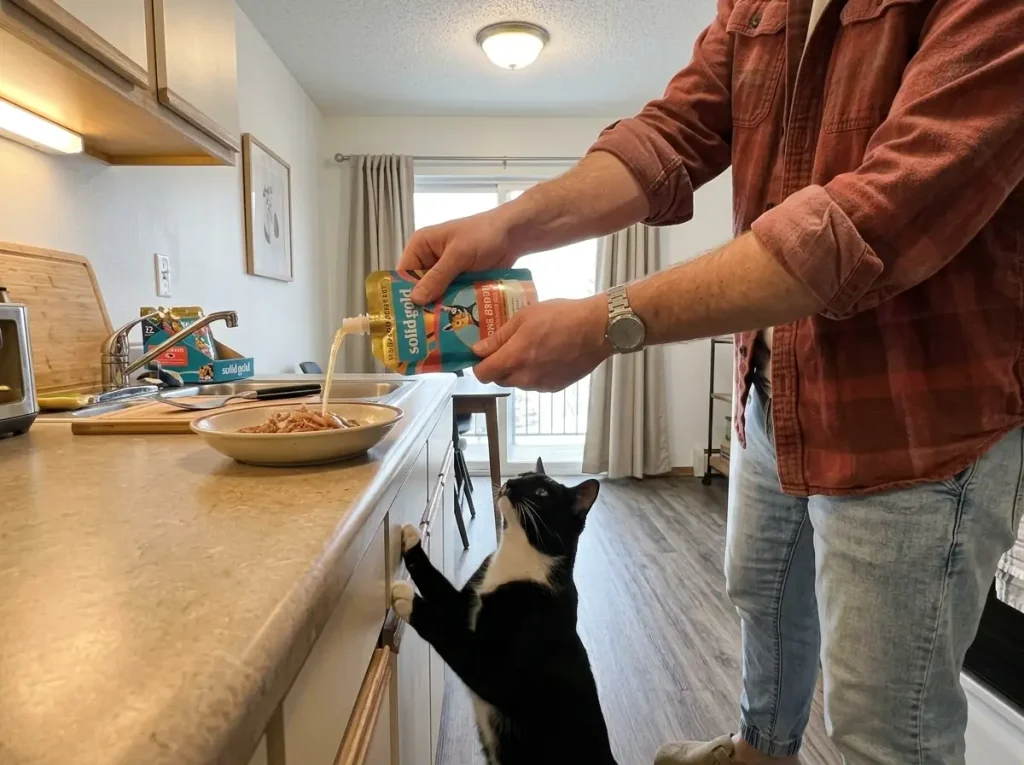
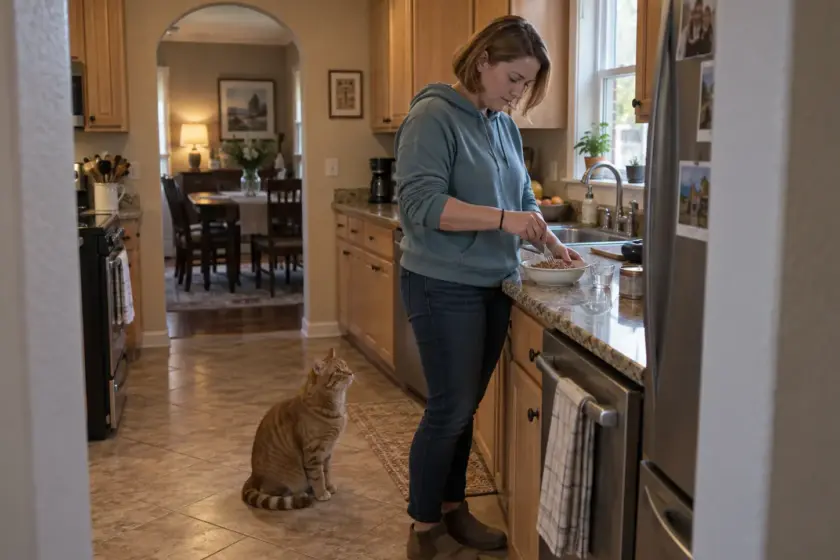
The free move comes before any purchase, and it is the one to do tonight: add a splash of water to the food he already eats. Not a new food, not a transition, just water stirred into what is already in the dish. It costs nothing and it moves the number that actually matters. If you go the wet-food route more seriously, the trade-off is that a can can’t sit out all day, and how long wet food can safely sit out is the constraint that decides whether it works with your schedule.
The second free lever is flavor. Save the water a can of tuna sat in and pour a little into the bowl, or use plain unsalted chicken broth.
This is not a folk remedy, and Cornell on flavoring water to raise intake lists it as a recognized way to get a cat to take more in. It has a ceiling, though. It is a nudge, not a meal, and a bowl of permanently flavored water is a bowl the cat may start refusing when it goes back to being plain.
If tuna isn’t something you keep in the house, the shelf-stable version of the same idea is a broth pouch. The Solid Gold Bone Broth Cat Food Topper comes in twelve lickable pouches, which is roughly a two-week run at one every other day, and it does the same job as tuna water without a can in the fridge going over. The caveat is the same as above: it’s a topper, so it adds moisture to a meal rather than replacing one, and the honest comparison is that the free tuna water works just as well if you already open tuna.
Flavor the water in one station, never in all of them. Keep at least one bowl plain, so you always have a clean read on whether he drinks water as water. If every bowl tastes of tuna, you have swapped a hydration question for a preference you now have to maintain forever.
How Many Water Stations, and Where They Go
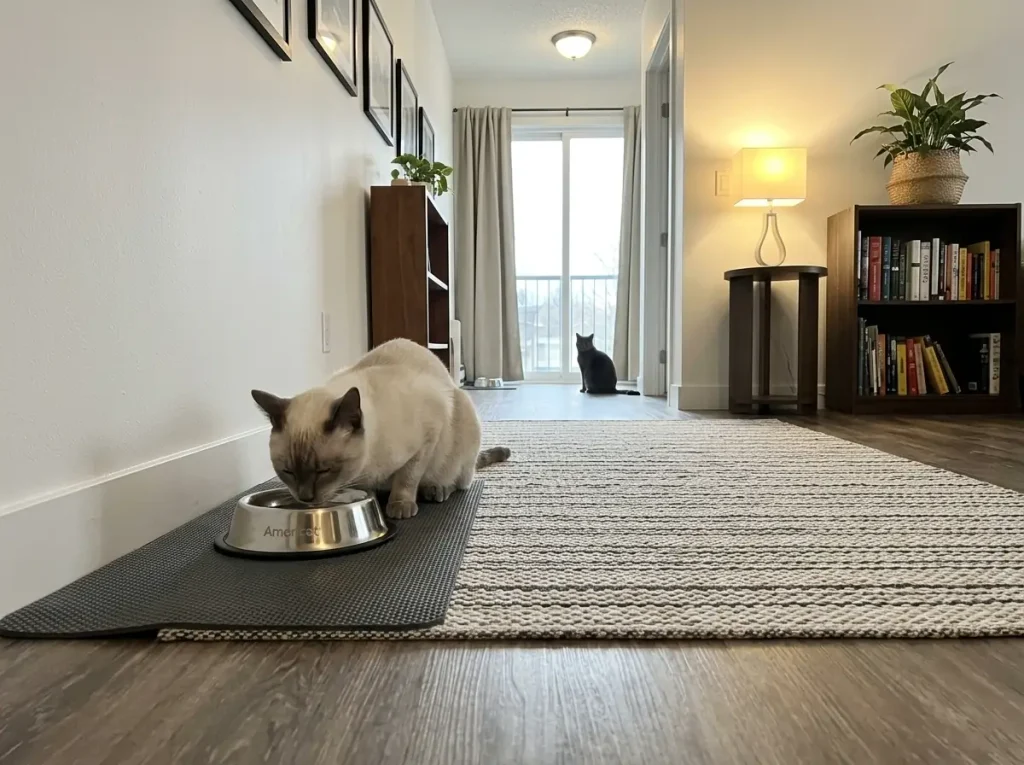
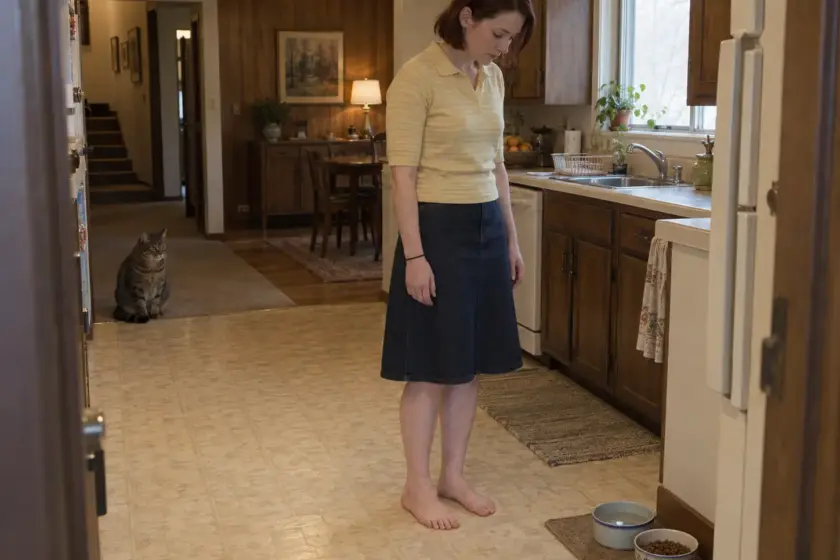
Two bowls in the same kitchen corner feel like two bowls. To the cat they are one. Same approach, same escape route, same sightline, and in a house with more than one cat that distinction is the entire problem.
The rule is borrowed from the American Association of Feline Practitioners environmental needs guidelines, and it is the same arithmetic this site already uses for litter. Call it the 1+1 rule: one station per cat, plus one. Two cats, three stations.
If it sounds familiar, it is the same rule, applied to litter boxes, and the logic transfers intact because it was never about hygiene. It is about not being cornered.
Which means the count only works if the stations are genuinely separate. Different rooms, or at minimum different sightlines. Two dishes three feet apart on the same kitchen floor are a single resource with two rims, and one cat standing between them controls both without doing anything a human would recognize as guarding.
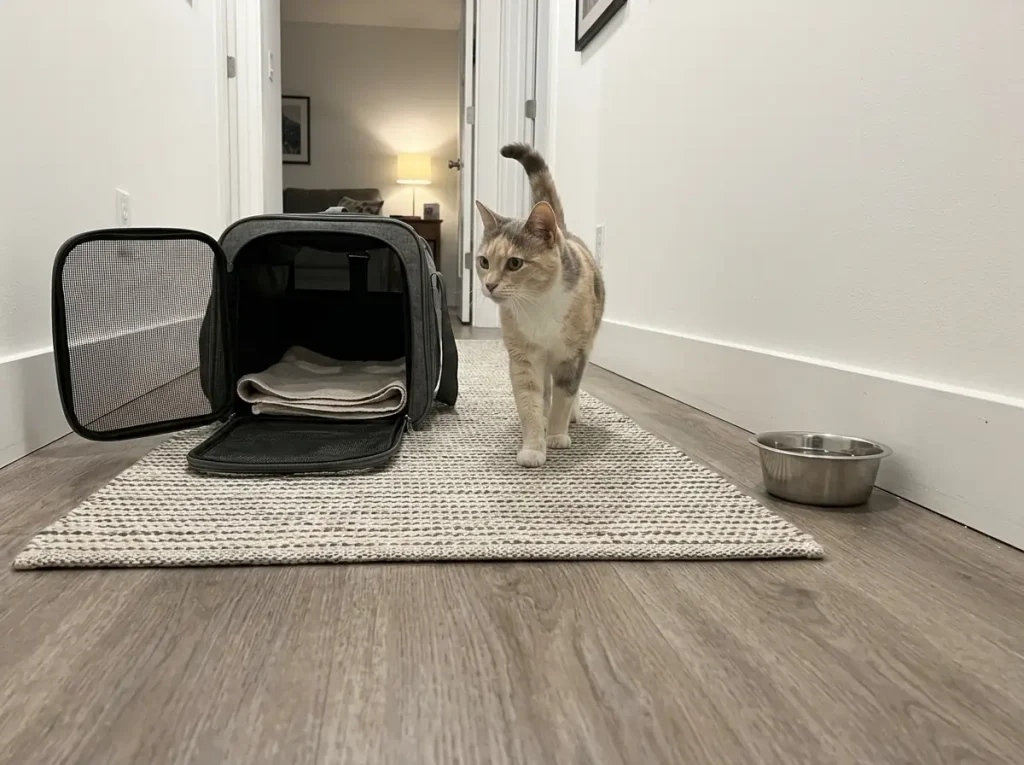
Then the distance almost nobody publishes: keep water roughly five feet clear of any litter box. Not “a different corner of the same room.” About five feet, or a body-length-and-a-half of separation. Cats do not drink where they eliminate, and a bowl parked next to a box is a bowl that gets used out of necessity and abandoned as soon as anything better exists.
And while you are moving things, take at least one station off the feeding station entirely. The matching food-and-water set sold as a pair is a human convenience, and a cat that walks to a separate dish for water will often drink more than one standing over its dinner.
Corners are the other default that quietly fails. A bowl wedged into a corner forces the cat to turn its back on the room to drink, and a cat drinking has its head down and its ears busy.
That is why the elegant little water nook you set up gets ignored while the ugly bowl in the hallway gets emptied. It isn’t the bowl. It is the direction he has to face.
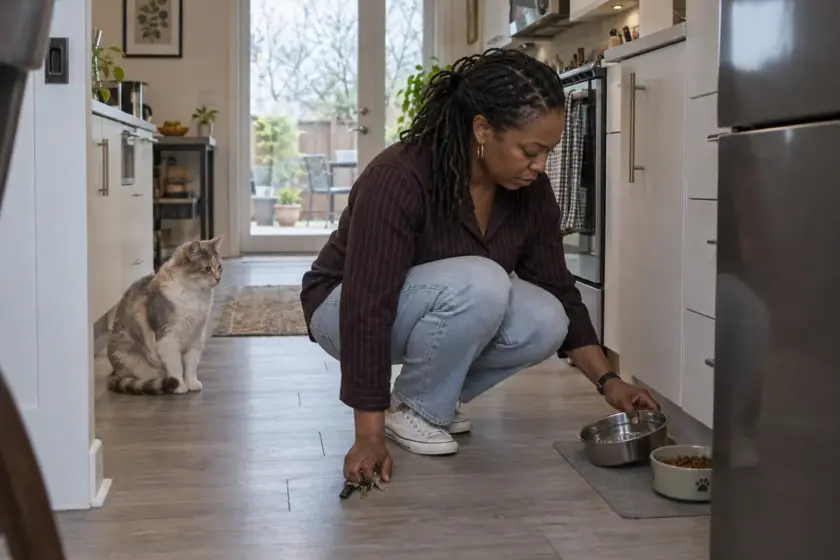
- One cat: two stations, different rooms. The second one is your insurance against the first being in a spot you got wrong.
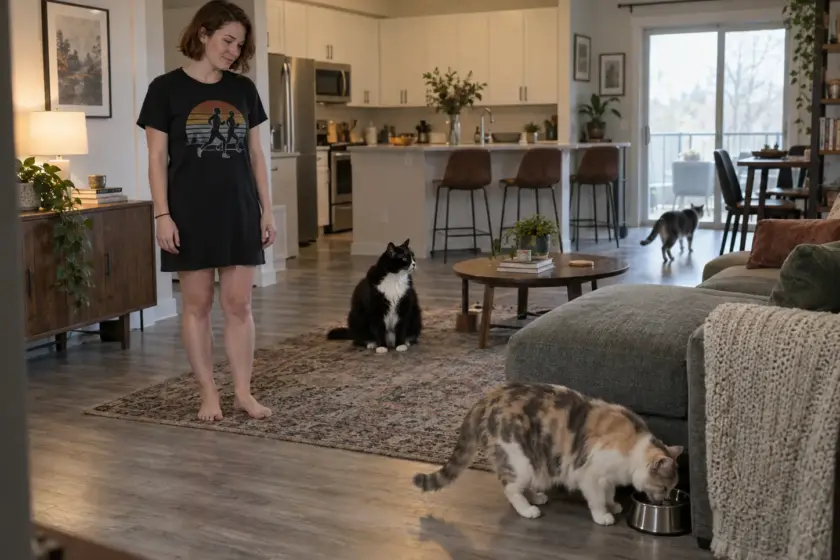
- Two cats: three stations, and no two of them visible from each other. This is where most apartments are actually set up for one.
- Three cats: four stations, and at this point you are planning rooms, not corners.
The multi-cat version of this problem is almost never loud. Nobody fights. There is no hissing and no incident to witness. One cat simply doesn’t walk to the bowl while the other one is in the room, and since that only happens when it happens, you never see it.
What you see is one cat who “doesn’t drink much,” which is a conclusion about the wrong animal. Cornell has a phrase for what is really going on, and it is that a cat can effectively be banned from the water bowl by a housemate. If that sounds like your house, two cats and one bowl is the same dynamic examined up close.
Where a Cat Will Actually Drink in a Small Apartment
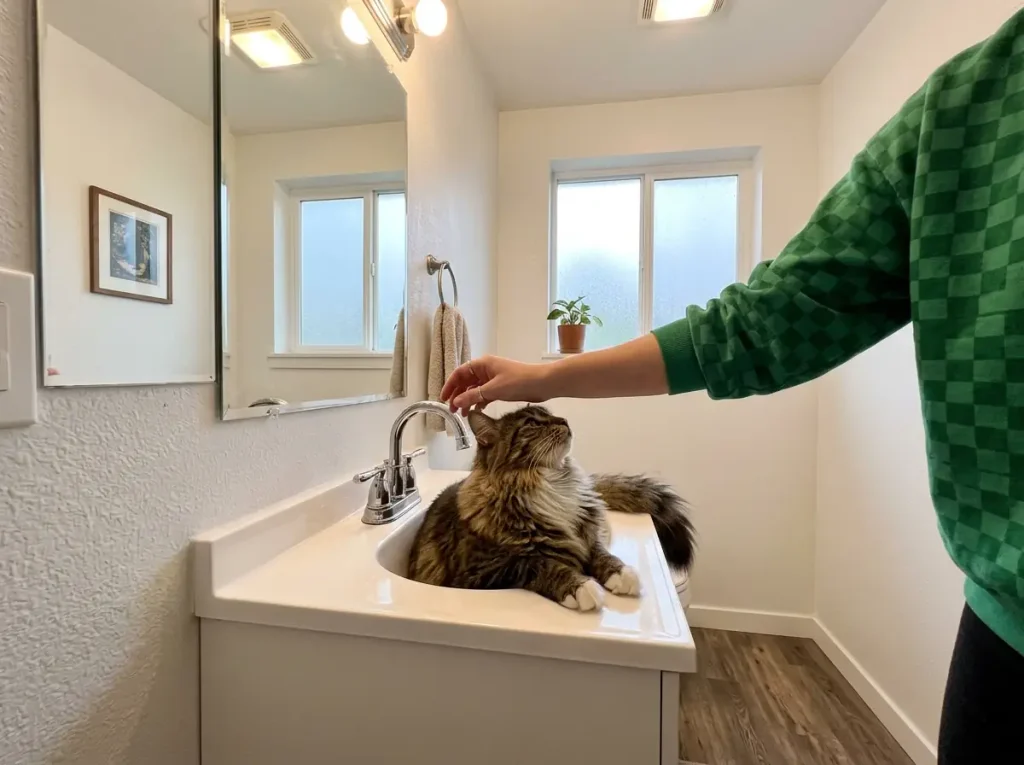
“Put the water in a quiet, low-traffic area away from the litter box” is easy advice to write in a house with four bedrooms. In a one-bedroom or a studio apartment it is a shopping list of things you do not have.
So do the real count. In a typical one-bedroom the candidate spots are the kitchen floor, the hallway or the strip by the bedroom door, and the bathroom. That is three.
The bathroom usually holds the litter box, which takes it off the list and leaves you two spots for the three stations a two-cat household is supposed to have. That is the actual constraint, and it’s the one the whole first page of results acts like nobody has.
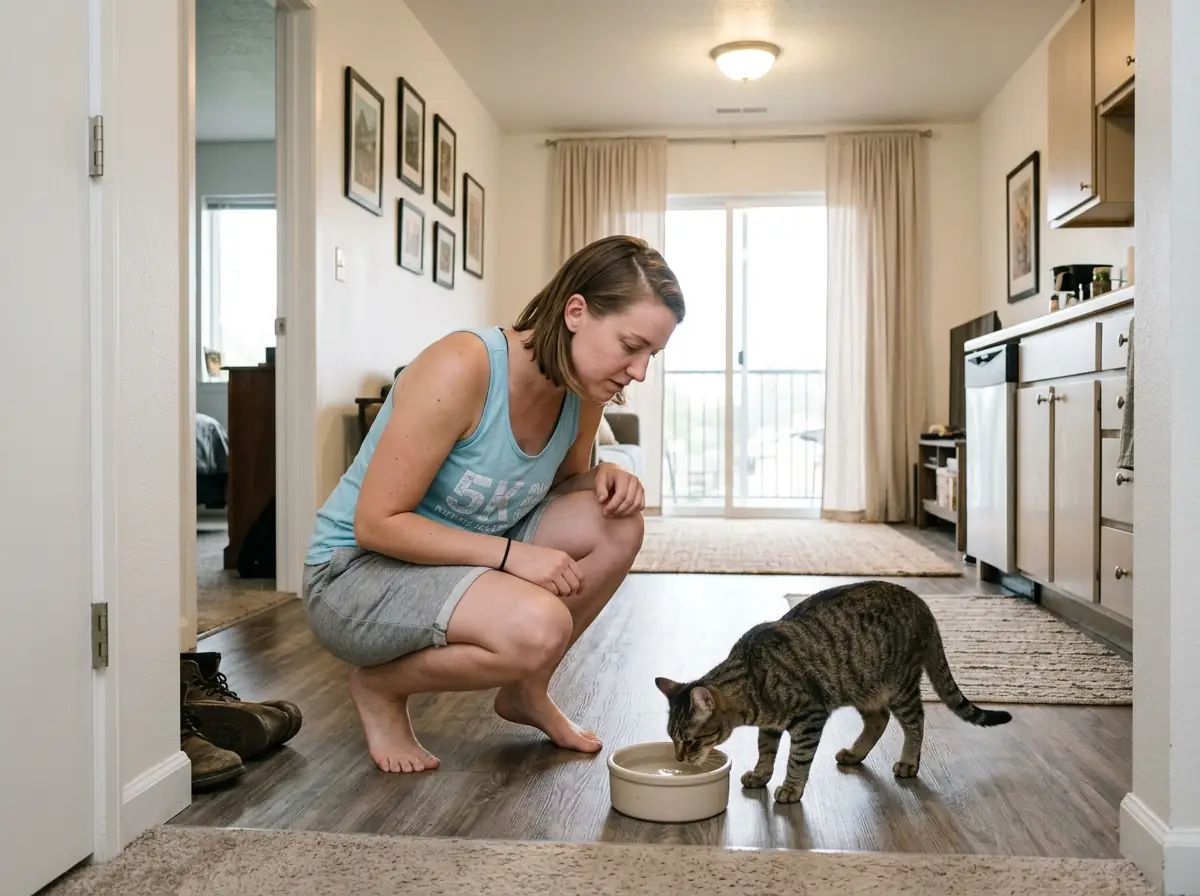
Every fix in this section is renter-friendly, which is the other half of the constraint: none of it needs a drill, a landlord’s permission or a single hole in a wall. When five feet of clearance simply is not available, substitute the thing the distance was buying you. The rule exists so the cat is not drinking where it eliminates, and a doorway, a cabinet edge or the corner of a couch breaks the association nearly as well as floor space does. Water on one side of a door frame and a box on the other is not five feet apart, but it is two rooms as far as the cat is concerned, and two rooms is what the rule was really asking for.
None of this needs a landlord’s permission. Nothing here involves drilling, mounting, or changing anything you’d have to put back. Moving a bowl is free, reversible, and takes about four seconds, which makes it the cheapest experiment in the whole topic. And honestly, it is the step most people skip on the way to buying something.
Height is the lever small apartments forget. A station does not have to sit on the floor, and floor area is the thing you are short of. A wide shallow dish on a shelf the cat already uses, or on a windowsill he sits on anyway, is a full station that costs you zero square footage.
The only requirement is that the surface is one he already goes to on his own. A new bowl on a new shelf is two changes at once, and one of them is going to fail without telling you which.
Then there are the sink drinkers. A cat that sits by the faucet and waits for you is not being difficult, and he is not weird. He has told you two specific things: where he wants his water, and that he wants it moving.
The cheap answer is to take the hint and stop serving it. Put a station in that bathroom, at that height, and stop turning the tap on for him. The move that gets reported as working, repeatedly, is exactly that combination, because as long as the premium option is available on demand, no bowl is going to compete with it. If the answer you land on is moving water, running a fountain in a small apartment covers the noise and outlet side of that decision.
Crouch down to bowl height and look. If you can see the litter box from where the water is, the cat can too, and the five feet on your tape measure is not doing what you think. A closed door, a cabinet or the back of a couch buys you the same separation that floor space would, in an apartment that has no floor space to give.
The Bowl and the Fountain, and Which One Is Actually Your Problem
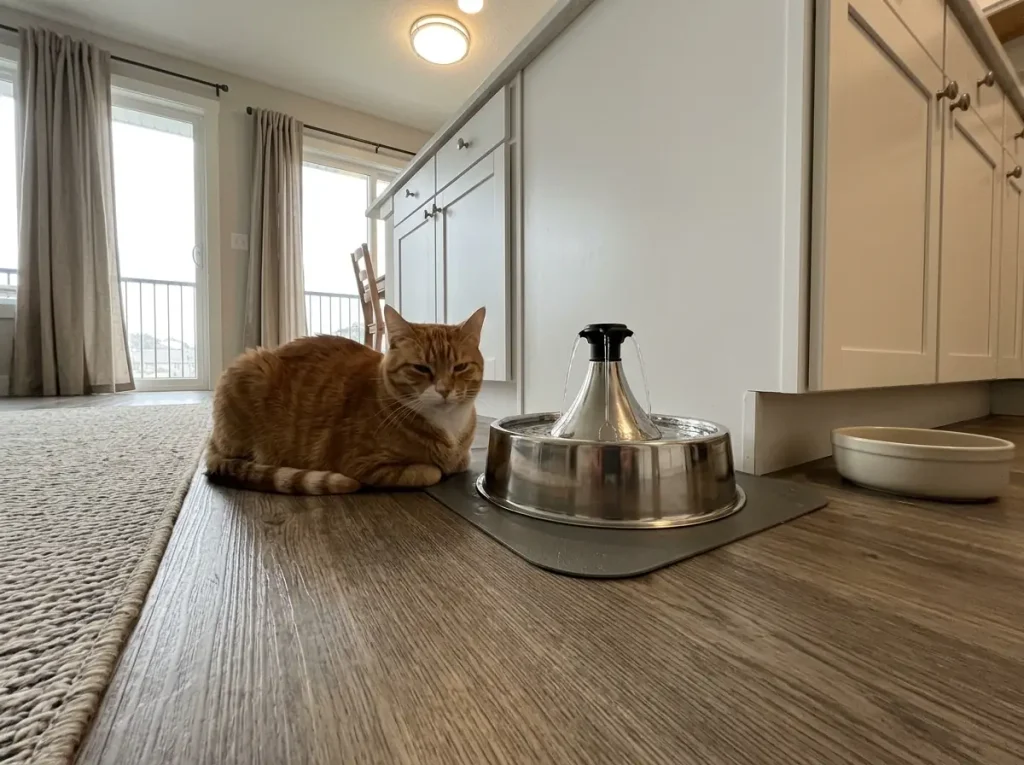
Most people buy a fountain first and think about the bowl never. It is usually the other way around, and the bowl is cheaper to be wrong about.
Start with material, because it is one decision and then it’s done. Stainless steel and ceramic are the safe defaults; plastic is the one with a case against it, and that case belongs to the room that owns it rather than being re-argued here. For someone setting up the extra stations from the section above, the Americat Stainless Steel Cat Bowls come as a two-pack in 18/8 304-grade steel, which is the plain version of getting this right, and a two-pack happens to be exactly the shortfall most one-cat households are working with. The limitation is real though: they are light, and a light steel bowl on a hard floor is a bowl that travels across the kitchen while the cat drinks.
Shape matters more than material, and it is the thing people get wrong while buying carefully. Wide and shallow, so the cat is not pushing its face into a well and its whiskers into the walls on every lap. A deep narrow dish is a dish a cat drinks from in short bursts and then leaves. The full argument about whisker contact at the sides of the bowl lives in its own room, but the shopping version is one line: if it looks like a mug, put it back.
Now fountains, and the honest version is worth more than a recommendation. Fountains work for some cats. Not most, not all, some.
A cat that already drinks fine from a bowl gains very little from one, and what you have definitely bought is a pump to maintain and a filter on a schedule. I used to treat a fountain as the default first purchase for any low-intake cat. After enough threads where the fountain arrived, got sniffed, and became a decorative appliance in the corner, I moved it down the list behind station count and placement, which are free. The fountain question in full is its own decision, and it deserves to be made deliberately rather than by default.
If your house has already established that a fountain is worth having, size it for the household instead of the cat. The PetSafe Drinkwell Stainless 360 holds 128 ounces with a stainless tray, and 128 ounces is roughly a week for a two-cat house before you are refilling. That volume is also its drawback: a big reservoir makes it easy to leave the water sitting longer than you should, and the filter schedule doesn’t care how full it looks.
One genuine exception, and it is specific. Raising the water bowl helps an older cat with stiff joints, because the problem is crouching and not thirst. It does essentially nothing for a healthy young cat, so this is a fix for a particular animal rather than an upgrade for everyone.
If that is your cat, the Necoichi Ceramic Elevated Bowl is a one-cup ceramic dish on a raised base, wide enough at the top to keep whiskers clear, and the one-cup size means you are refilling it daily rather than topping it up, which is not a bad habit anyway. Raised water tips more easily than raised food does, and whether the water bowl specifically should be raised is worth reading before you commit to it as a permanent station.
Fountain threads all land in the same place, by the way. Some cats never touch it, some drink nothing else, and nobody can tell you which one you have until the box is open and unreturnable. Plan the purchase knowing that, not hoping otherwise.
What This Looks Like Three Weeks From Now
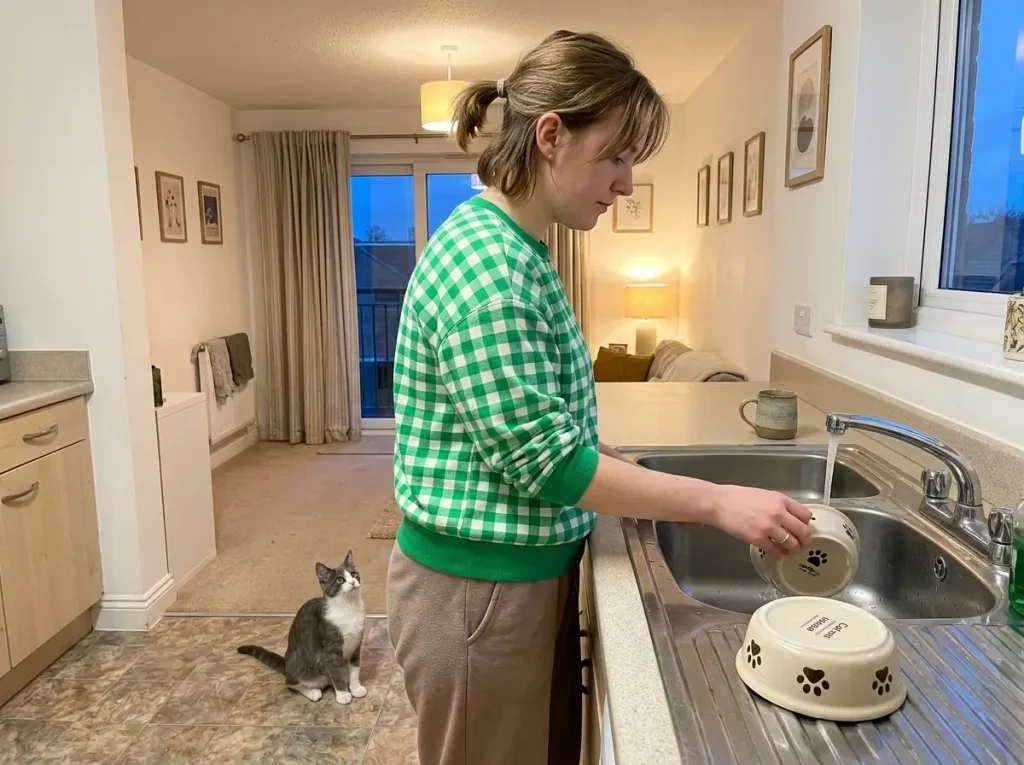
Everybody sets up three water stations on a Sunday. The question is which of them still has clean water in it on a Wednesday three weeks later.
Standing water goes stale, and a station nobody refills is a station the cat wrote off days before you noticed. For a plain bowl, refilling is the entire maintenance job, which sounds trivial until it is the third bowl in a room you don’t walk through. A fountain is not less work, it is different work: a pump that needs rinsing and a filter on a schedule. Choosing a fountain is choosing that chore, and how often the fountain water actually needs changing is the schedule you are signing up for.
Here is the failure mode nobody warns you about, and it is fine. Of your three stations, one gets used constantly, one gets refilled out of pure habit, and one becomes furniture. That third bowl is not a mistake. It is data.
The station nobody drinks from is telling you where water does not belong in your apartment, and the right response is to move it rather than to keep topping it up out of obligation.
And the thing that slips at three weeks is you, not the cat. The cat made its decision about each station within about two days. The human routine is what loosens: the far bowl gets refilled every other day, then twice a week, then it is a dish with a ring in it. Build the plan expecting that, and put the stations where you already walk.
At three weeks, do one audit and make it a real one. Fill every station to the same mark on the same morning and leave them alone for a day. The one whose level actually dropped is your real station. The others are candidates for relocation, not evidence that your cat is stubborn.
The Short Version
Count the food before you count the bowl. A cat on wet food that ignores water all day has usually already drunk its dinner, and the mug-sized daily total was met before you ever looked.
Stations are about count and separation, not about the bowl being nicer. One per cat plus one, in different rooms or at least different sightlines, every one of them well clear of a litter box. That is the fix that works in an apartment, and it is free.
A change in drinking, in either direction, is a call to your vet rather than a furniture project. Less than you expected is usually the food. Stopped, or suddenly much more, is a phone call today.
Set a reminder for three weeks out, because this is a habit topic and habits are what slip. When it comes around, check which station’s level actually dropped and whether the one you were most confident about is the one being used. It usually isn’t.
Before you buy anything at all, move one bowl out of the corner and into the room you actually sit in. Ten seconds, no money, and it works often enough to be worth doing first.
Amazon’s Audible — free for 30 days
Your cat won’t let you read. Let someone read to you.
Audible is Amazon’s audiobook library — thousands of titles, read out loud, on your phone. Free for a month, plus one audiobook to keep forever.
Frequently Asked Questions
01How do you rehydrate a cat?
A cat that is genuinely dehydrated needs a veterinarian, not a home remedy. That is a same-day call, and fluids are not something to attempt yourself. What you can do at home is prevention: more water stations, more wet food, and water stirred into meals.
02What can I give my cat to hydrate them?
Water, and food that already contains it. Wet food runs up to 80% water, and a splash of tuna-can water or unsalted broth in the bowl is a recognized way to raise intake. None of that treats a cat that has stopped drinking.
03How do I increase my cat’s hydration?
Add stations before you add products: one per cat plus one, in different rooms, none of them near a litter box. Then move the wet-food ratio up if the cat eats mostly dry. The bowl is the smaller half of the total.
04How does a cat act when it’s dehydrated?
The signs people are told to watch for are slow skin snap-back, tacky gums, sunken eyes and low energy. Those are screening signs, not a diagnosis, and Cornell notes the skin test is unreliable in older cats. Any of them means calling the vet rather than working it out at home.
Leave a comment