How to Handle Matted Cat Fur, Sorted by Reach
Don't pick up the scissors. Matted cat fur sorts by reach: what fingers and a comb loosen, what a groomer takes, and when it's a vet (3 spots to check)

Alfredo RamsesFounder · Updated October 31, 2026 · 19 min read

On this page11 sections
- 1Why Matted Cat Fur Starts Where the Tongue Can't Reach
- 2The Signs That Hand the Job to a Groomer or a Vet Before You Touch a Comb
- 3Feel Under the Tangle Before You Pull Anything
- 4A Loose Tangle Comes Apart With Fingers First, Then a Comb
- 5Scissors, Clippers and the Bath Are Where the House Stops
- 6Where to Do a Mat Session in a Small Apartment
- 7Why the Same Spot Mats Again in Three Weeks
- 8One Cat or Several, Long Coat or Short
- 9When an Older Cat Stops Grooming Itself
- 10Three Spots to Touch Today and a Date to Touch Them Again
- 11Frequently Asked Questions
Your hand goes down her back for the weekly brushing, the coat feels smooth, and then your fingertips stop on a hard, felted lump behind one ear or tucked into the armpit. That is the usual way matted cat fur gets found: her self-grooming covers everything her tongue can reach, you have been brushing everything you can see, and the mat sits in the gap between the two. Veterinary hospitals and the people who swap these stories in cat communities name the same few spots again and again. This guide sorts matted cat fur by reach and by hands: what fingers and a comb can loosen at home, what belongs with a groomer, and what is a vet’s call.
Quick Answer
Let your fingertips decide who handles the mat, before any tool comes out.
- Feel under the tangle: does it slide over the skin, or drag it along?
- Split a loose, small tangle with your fingers, then a wide comb, and stop early.
- Hand tight, large or protested mats to a groomer or vet.
- Keep scissors out of the room.
Why Matted Cat Fur Starts Where the Tongue Can’t Reach
A brush follows your eyes. A mat follows the cat’s reach, and the two overlap less than you would think. Her tongue and front paws cover a lot of coat, but not the strip along her spine and not the far end of a long coat. Whatever sits outside that range is left to whoever holds the brush, and that person is usually working the part that was already smooth.
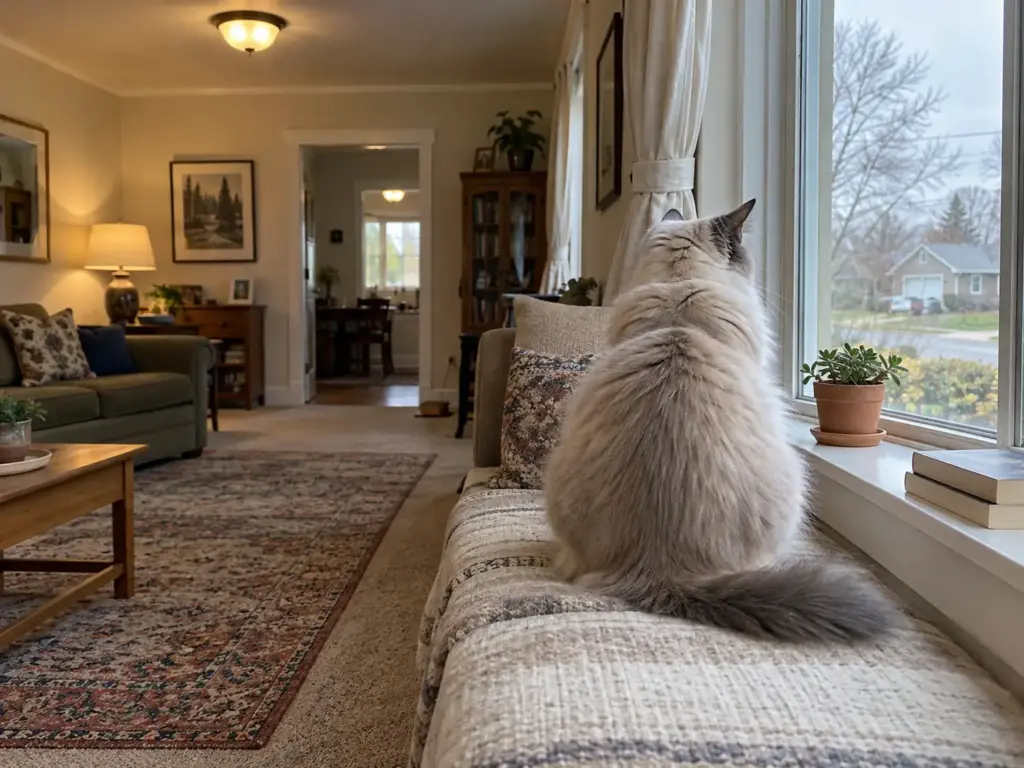
The spots a cat’s own tongue never gets to
VCA Animal Hospitals says mats tend to form where there is a lot of movement and where a long-haired cat cannot reach while she grooms. PetMD’s veterinary guidance adds the friction points: behind the ears, under the legs and around the armpits, around a collar or harness, and around the base of the tail and the hindquarters. Put those two lists on one cat and you get a route you can walk with your hands, including the stretch of back between the shoulder blades that no tongue touches.
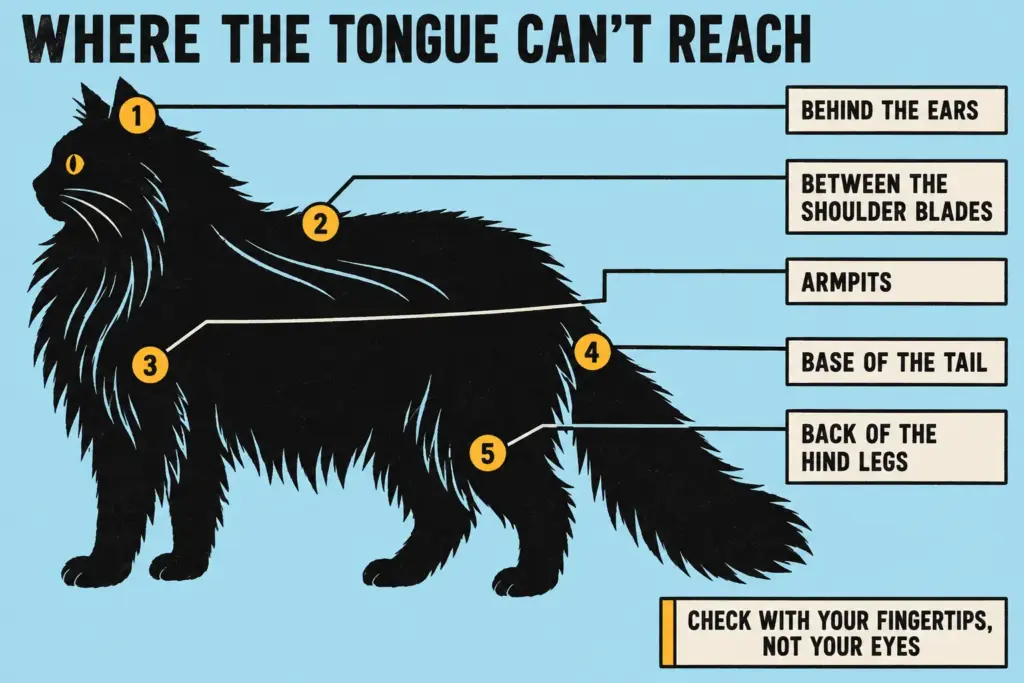
Five spots, and the reason each one gets missed:
- Behind the ears: the head turns and rubs against everything, and you cannot see the spot without tipping her chin.
- Along the back, between the shoulder blades: past what a tongue can reach, and the one stretch you can see but never think to part the coat on.
- Armpits and under the front legs: coat moving against coat with every step.
- Under a collar or harness: the same strip of fur gets rubbed in the same direction every day.
- The base of the tail and the hindquarters: the far end of a long coat, as far from her tongue as it gets.
A big, heavy, long-coated cat has the longest list, since every extra inch of coat sits another inch from her tongue, which is why Maine Coon mats and Persian mats are the classic cases. An older, heavier cat who kept matting had a bit of trouble reaching that area, and once those mats were separated and that spot got brushed, none came back. What changed was where the brush went. The brush-and-comb schedule for the rest of the coat lives in the full grooming routine, so this page stays with the spots a routine can miss.
If five spots is too many for one sitting, start with three: behind the ears, the armpits and the base of the tail. Slide the pads of your fingers through the coat there. A mat is much easier to feel than to see, and a smooth top layer will hide it from your eyes every time.
Tangle, mat and pelted coat are three different jobs
In the mats vs tangles question, a tangle is tangled cat fur that moves freely: you can slide it along the hair and it follows your fingers. A mat is a dense mass that has stopped moving, with the hair locked together at its base. A pelted coat is a felted sheet lying flat against the skin over a wide area. PetMD points to loose undercoat trapped in the outer coat as what builds a mat in the first place.
Each one is a different job. A tangle yields to fingers on the arm of a sofa. A mat is a judgment call, and the section on feeling under the tangle turns that call into a test. A pelted coat is not a home project at all.
Not the litter-mat kind
Cat mats can also mean the rubber and fabric mats that sit under a litter box, which is a different subject, covered in litter mats. Everything below is about fur.
The Signs That Hand the Job to a Groomer or a Vet Before You Touch a Comb
Settle this before the cat is in your lap. Once your fingers are already in a knot, one more try always feels reasonable, and the cat is the one who pays for it. The signs below are written to be read once, in advance.
Tight to the skin, large, or a cat who objects
PetMD’s veterinary guidance puts a mat on the hand-over list when it:
- is tight against the skin
- covers a large part of her coat
- will not loosen with gentle brushing
- makes her cry, snap or pull away when you handle it
That last one is the cat telling you where the session ends, and on that point she is right. VCA Animal Hospitals’ guide to removing mats at home draws the line in the same place: when you worry about injuring your cat, or “the mats are large and/or widespread, visit your veterinarian or a groomer.”
Pick your stop signs while she is asleep next to you, not once she is in your lap with a knot already between your fingers. Tight to the skin, large, or she objects. Decide in advance, because halfway through is exactly when “one more try” starts to sound sensible.
Near the eyes, ears, genitals or anus
The same PetMD list puts any mat near the eyes, ears, genitals or anus on the hand-over side, whatever its size. A small knot in those places is still a groomer’s or a vet’s job from the first touch.
Red, raw, moist or sore skin around it
You do not need to work out what you are looking at. PetMD says it plainly: “Matting is considered an emergency if the mat is causing pain or the underlying skin is red, raw, moist, or broken.” Redness, swelling, a smell or wetness around a mat means a vet visit, and the comb stays in the drawer. A cat who suddenly stops grooming herself belongs in the same category, a question for the vet before it is a question for your house, and when shedding is a vet question sets out the same hand-off for a coat that changes overnight.
Why a groomer and a vet are not the same call
A groomer’s work is the coat, on a cat who is not hurting. A vet is the call when the mat hurts or the skin looks damaged, and if sedation comes up at all, that decision belongs to whoever examines the cat.
Groomers charge for this work, and the price of de-matting an older Persian is the reason people try it at home first. The bill is real. It does not move the line.
Feel Under the Tangle Before You Pull Anything
Eyes cannot settle whether a mat is loose, so hands have to.
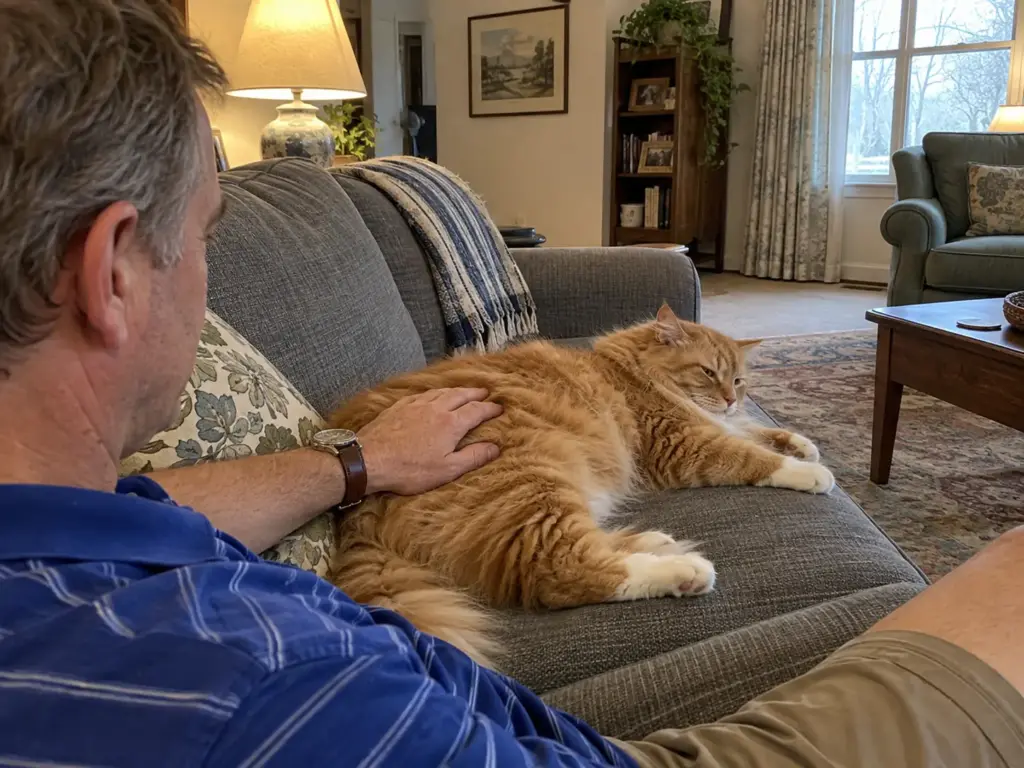
The skin hides inside a mat
PetMD notes that a mat can sit so close to the skin that you cannot tell where the hair ends and the skin begins. From the outside it looks like a lump of hair. Underneath, a skin fold can be gathered up into it, which is why pulling a mat pulls the cat, and why a blade near one can find skin before you have seen it.
There is no safe distance in inches to quote here, because the skin cannot be seen. What you can do is test by touch.
The two-finger check
Do it while she is calm, before any tool is in your hand:
- Wait until her weight is settled and her muscles are loose, not braced.
- Hold the coat flat beside the mat with the thumb and first finger of one hand.
- Nudge the mat from side to side with the other hand, a fraction of an inch at a time.
- Watch two things: whether the skin stays put under your fingers, and what she does.
A mat that slides over still skin is loose. If the skin moves with it, or she flinches, twitches her skin, turns her head or tries to leave, you have your answer without needing a second test.
Run the check when she is drowsy after a meal, on a lap or a sofa arm she already likes. A cat on alert reads any hand near her as restraint, and a flinch from a wary cat tells you much less than a flinch from a relaxed one.
What the answer sorts
Three outcomes, three destinations. A mat that slides freely over the skin goes to the next section. One that drags the skin, or earns a protest, is a groomer’s or a vet’s, and the stop list above applies.
And if you are not sure, that goes in the groomer column too: you have just learned that this skin is hard for your fingers to read, which was the point of checking. The part of the cat your hands can check is the part she cannot reach, so the hand is the right tool for the job.
A Loose Tangle Comes Apart With Fingers First, Then a Comb
This is the one job the house keeps, and it covers only a tangle that moves.
Fingers first, then the wide comb
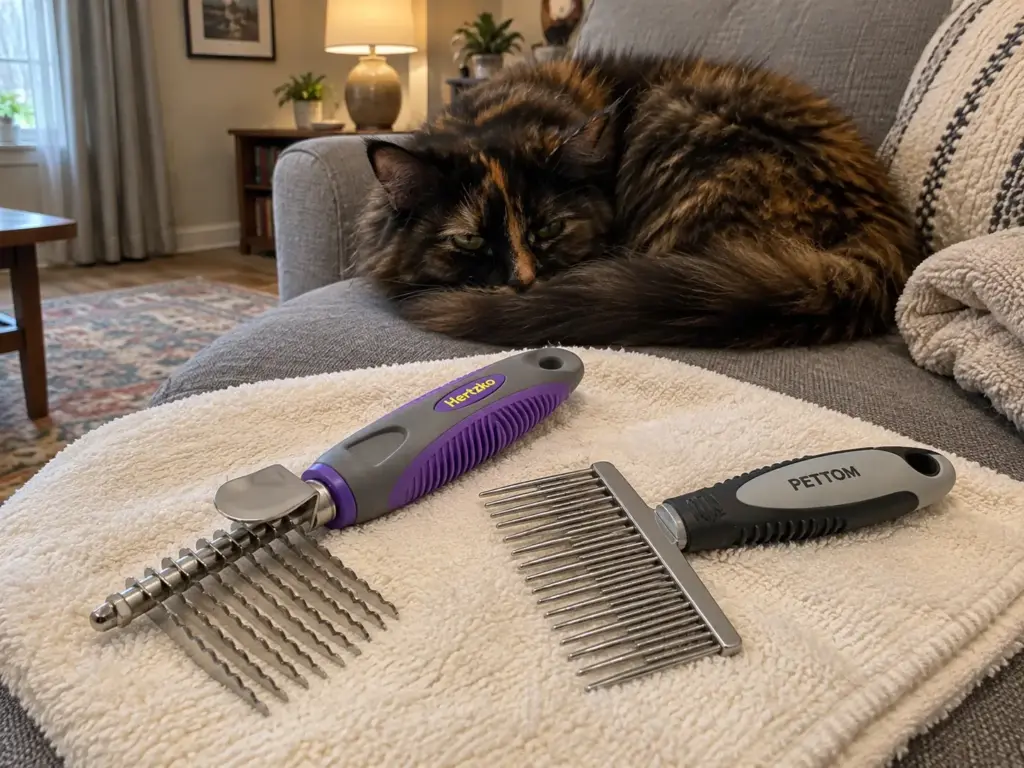
Start with what you already own. For a loose tangle, work with your fingertips first and bring a comb (or a slicker brush) in second, going from the outer edge of the mat toward the skin in short, gentle strokes, as PetMD describes it. Cat communities have a phrase for the first half: split the mat, don’t pull it, and stop pulling the moment the skin moves with the hair. Pull the fur on either side of the mat apart without pulling on the skin, then finger pick the rest a little at a time.
- Hold the coat at the base of the tangle with one hand, so nothing tugs the skin.
- With the fingers of the other hand, pull the fur on either side apart, a few strands at a time.
- Once the tangle has opened, comb from its outer tip toward the skin, in short strokes.
Some people work through a set of mats with the point of a metal nail file, picking a little at a time and going with the grain of the hair. That uses what is already in a drawer, and it comes before any purchase here.
The tools that fit a loose tangle
A dematting tool sounds like the obvious pick for a mat. But a wide comb after fingers is the better first pick for a tangle that moves, because it works from the surface and lets you stop at any moment.
For the comb step, a PETTOM Steel Grooming Comb is the budget pick: 7.5 by 2 by 2 inches, with rounded steel teeth, one coarse side and one fine, which suits a small tangle once your fingers have opened it. Buyers mention teeth that bend after a few uses, and some doubt the metal is the stainless steel the title claims, so expect it to wear out.
A Hertzko Grooming Dematting Comb (9 by 3 by 1 inches, double-sided blades) comes in when a small knot is too tight for the wide comb, and only along the direction the hair grows. It is not for a felted plate across the back, and not for any mat where you cannot find the skin. Customers report the handle breaking off after about three months, and one reviewer’s warning is blunt: “Be careful of the sharpness.” If you cannot tell where the skin is, leave it in the drawer.
Stop early, and finish tomorrow
The session ends when the cat says so, and a few minutes counts as a full session. A cat that allows only a couple at a time can still get them all out, which is how this job usually goes: several short sessions beat one long one that leaves her hiding when she sees the comb. Ten minutes is a reasonable ceiling, and for a cat who walks away after two, two is the session. If she keeps leaving early, what a cat objects to in a brushing session breaks down what she is reacting to.
Work one zone per session. Open one tangle, give her a break, and leave the others for the next day. A cat who ends the session on her own terms is the one who sits down for the next one.
The undercoat tool is the wrong one here
A deshedding tool pulls loose undercoat out through the coat. It has no way to open a knot, only to drag on it. The tool can be a no go for an older cat who has arthritis in the spine and hips, and the same reasoning holds for any cat who dislikes being pulled. Which tool matches which layer of the coat sorts the tools by what each one is built to reach.
Scissors, Clippers and the Bath Are Where the House Stops
Tangles that move belong to the house. Everything below is a way of pretending a mat is a tangle, and each one has a cat on the receiving end.
Scissors never go near a mat
VCA and PetMD agree on this one: never cut a mat off with scissors. A mat sits against the skin, the skin can fold up inside it, and a cat who moves mid-cut gets nicked with no warning. Cutting the big ones off is a common impulse, and the problem is what happens next: the cat moves. A blade at her skin is the moment a twitch is the right response.
A clipper is a tool for loose coat, not for a mat on the skin
VCA’s note on clipping near the skin is to be careful not to nick it and to watch the clipper for overheating. Both are reasons to keep a clipper on the surface of the coat and away from a mat that touches the skin, which is a groomer’s or a vet’s job. Whether to shave a matted cat is a decision of its own, and the piece on whether to shave a matted cat takes it up.
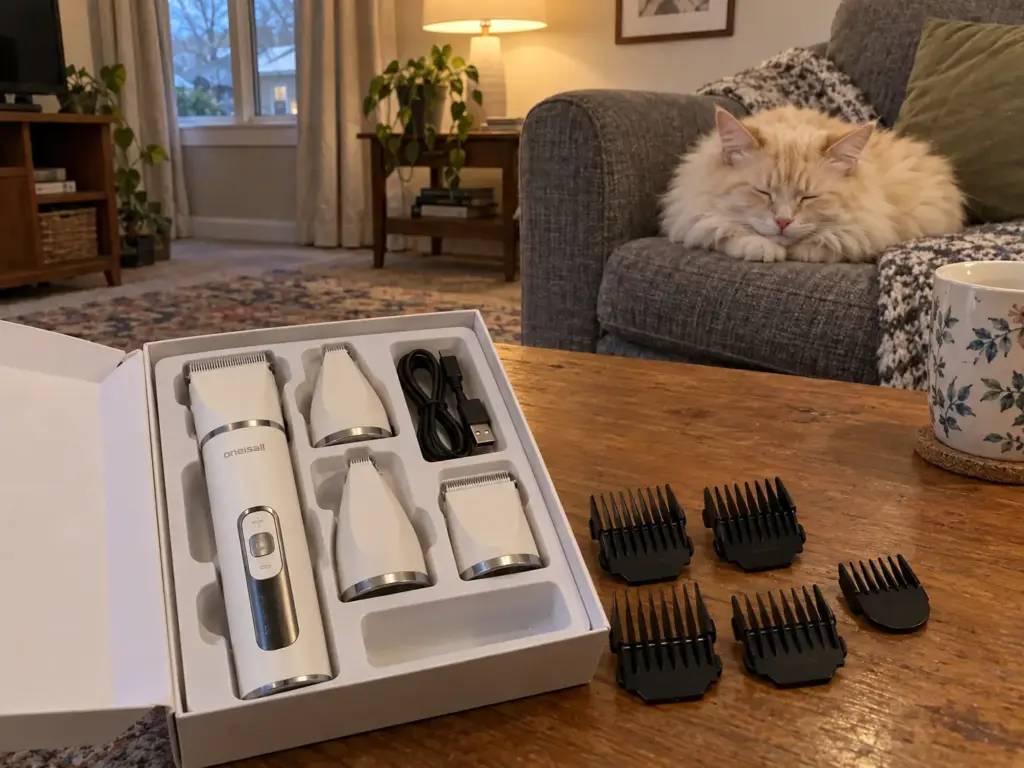
On the surface, a oneisall Quiet Cat Clippers for Matted Hair kit (3 in 1, cordless, 6.6 by 1.5 by 1.5 inches, with guide combs) does a job for coat that is loose at the surface, such as trimming a ragged patch around a collar line. Its limits are in the reviews. Buyers with long-haired cats say it will not shave anything off regardless of the blade, and that an earlier model fell short on heavy matting. If you are weighing where a clipper fits at all, which pieces earn a place in a grooming kit covers that decision.
Switch a clipper on a few feet from her before it touches anything, and let her walk away if she wants to. The sound is part of what she is agreeing to, and she gets a vote on it.
Wet makes a tangle tighter
PetMD’s advice is to brush tangles out before a bath whenever possible, because water tightens them. Comb the loose ones dry first. A knot that is not loose enough to comb dry will not be fixed by a bath, only locked tighter.
Nothing goes on the skin under a mat
Skip anything you have read about rubbing something onto a knot or the skin beneath it. A cat licks what is on her coat, and the skin under a mat is for whoever examines her to look at, not for anything from a kitchen cabinet.
Where to Do a Mat Session in a Small Apartment
A mat session needs a small amount of room and a cat who is willing to stay in it. In an apartment that is a decision about furniture, noise and floor.
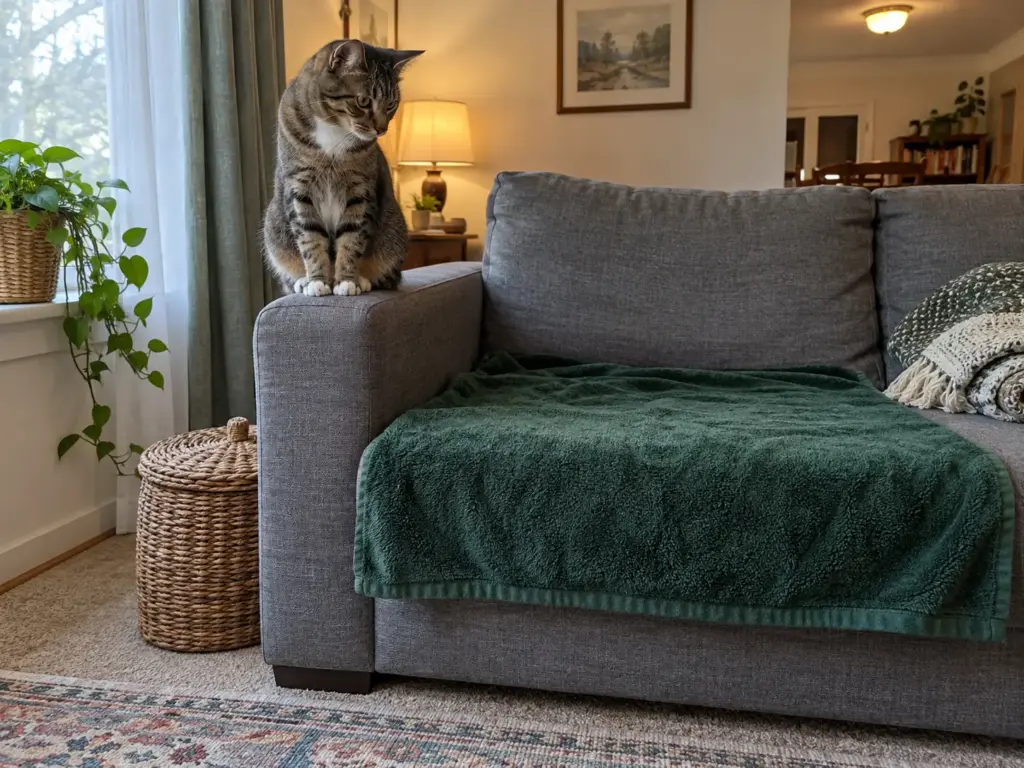
A towel on the sofa end, or the bathroom with the door shut
My pick for a short session on a loose tangle is the end of the sofa or couch she already naps on, with a towel folded under her. She stays where she is comfortable, the session is three minutes long, and the hair lands on the towel. The bathroom with the door shut is the usual suggestion, and in a one-bathroom apartment it can be the wrong room: if the litter box lives in there, the cat has a reason to bolt, and a bathroom floor with the door closed makes her feel cornered. Use it when the sofa fails, not first.
What a clipper sounds like through a thin wall
In a small apartment the sound has nowhere to go. The cat hears it at full volume from every corner, and the neighbor hears it through the wall.
Quiet clippers are sold on a decibel figure, and that figure comes from the seller, so the real test is the cat. Run the clipper a few feet from the sofa arm, off the coat, and watch whether she stays where she is, flattens her ears or leaves. That tells you more than the number on the box.
Fold the towel’s edges up around her like a tray. Hair that leaves the coat lands on it, and the whole session goes in the wash or gets shaken out outside in one move.
Where the hair ends up afterwards
Most of it is on the towel. The rest is on your clothes and the floor around the sofa, and one pass with whatever you already use for cat hair gets it. In a rental that is the same job as the rest of the apartment’s hair, covered in living with cat hair in a rental.
Why the Same Spot Mats Again in Three Weeks
When a mat comes back in the same place, the coat is rarely the problem. The place is.
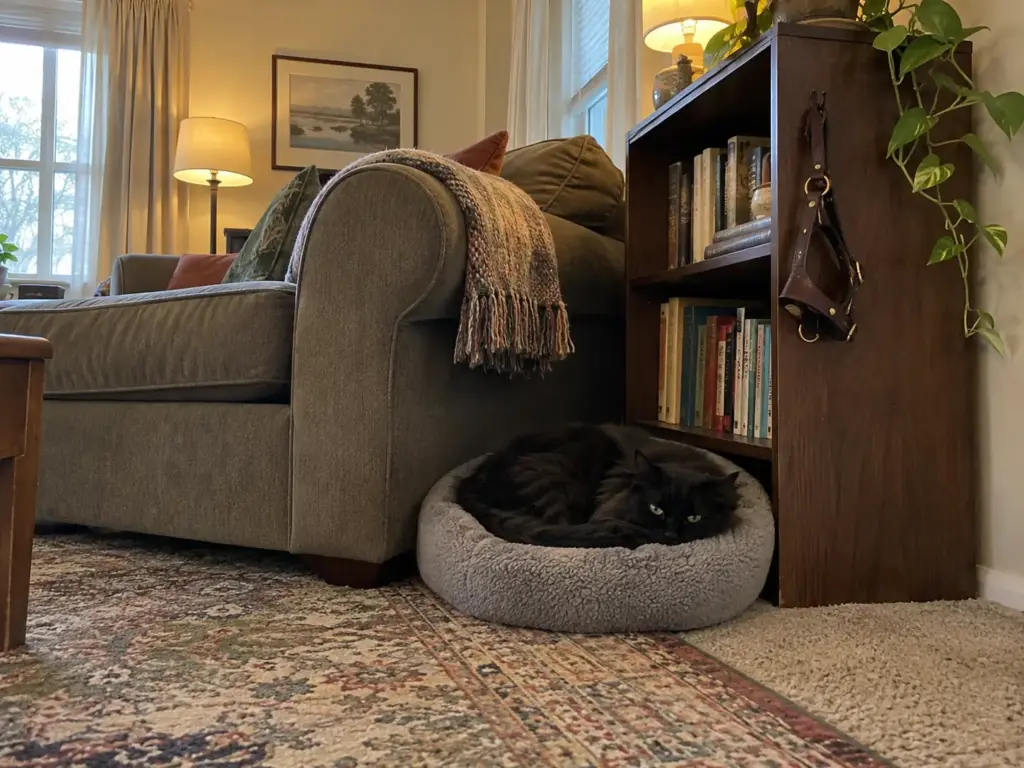
The collar, the harness and the favorite corner
Friction is the first cause: PetMD names the collar or harness, the armpits and the tail as the places that rub. A strap that sits snug in one spot rubs the same patch every day, in the same direction. The favorite corner of the sofa does the same job for a cat who lies on the same side.
If a mat returns in the same patch, look at what touches that patch daily. See whether the collar or harness can shift without dragging the fur, and where she lies when she naps.
Loose undercoat is the fuel
PetMD describes loose undercoat getting trapped in the outer coat. Clearing one mat while leaving the loose hair around it leaves the fuel in place. That is why the area around a cleared mat needs a gentle pass with a comb in the days after, not only the knot itself.
Brush the spot she can’t reach, not the coat she can
The usual advice is to brush the whole coat more often. For a cat whose patience runs out in minutes, that spends the minutes on the easy back and leaves the hard spot with whatever tolerance is left.
Start the session at the spot. The older cat with trouble reaching one area stopped getting mats back once that area was separated and brushed through, which points the routine at a place and not at the look of the coat. How often each coat needs full brushing is a separate question, covered in how often each coat needs brushing.
Feel the usual spots when she is awake and unhurried, not while she is stretched out asleep. A cat lying on her mat-prone side hides the mat under her own weight.
One Cat or Several, Long Coat or Short
The routine shifts with the coat and with who else lives in the apartment.
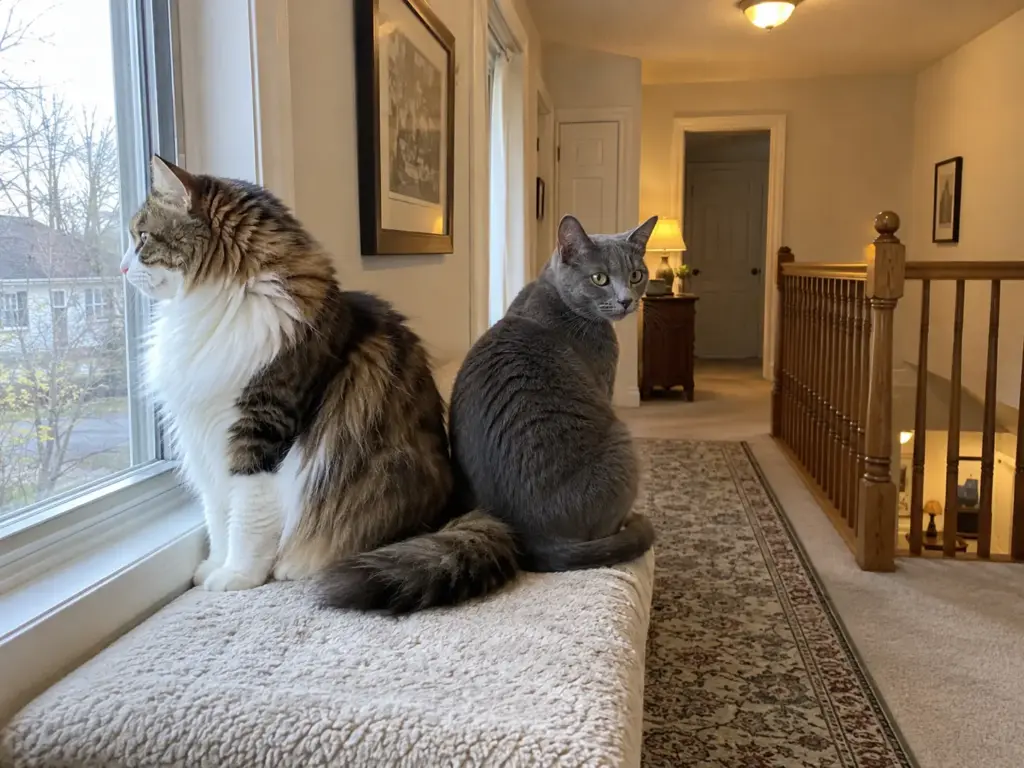
A long coat needs the reach map weekly
A long coat puts more hair further from the tongue, and the full reach map is a weekly job, not a monthly one. But weekly is only the starting point, and the number depends on the cat. If the same spot is knotted again at that pace, the answer is more frequent touches of that spot, not more brushing of the whole coat. What a long coat costs spells out the price of the breeds that carry one.
A dense short coat mats less and hides it longer
A short, dense coat gives a mat less to catch on, and covers it when it forms. The lump sits under the thick top layer, and only fingers find it. The same brush also does not suit both coats, so a house with a big long-coated Maine Coon and a compact, dense-coated British Shorthair needs two tools and two routines.
Two cats: one lies by the other and the spot changes
Cats that share a sofa may groom each other around the head and neck, which are places neither can reach alone. That can hide mats there and leave them in other places. Check both cats, not just the one who looks worse.
When an Older Cat Stops Grooming Itself
A cat who used to keep her coat tidy and now has an unattended back is showing a change, and the change is the signal. That is a vet’s question before it is a house question. Meanwhile, a senior cat can be combed gently every few days with any mats finger-picked apart. Older cat grooming, and why some cats stop altogether, gets a guide of its own in this series.
Three Spots to Touch Today and a Date to Touch Them Again
Three things carry most of this page. The mat is found by fingertips, in the spots her tongue cannot reach: behind the ears, the armpits and the base of the tail. Your hands make the call on who solves it: a tangle that slides over still skin is yours, and a mat that drags the skin, covers a wide patch or earns a protest goes to a groomer or a vet. And the cat ends the session, so a few minutes counts.
Three weeks from now, put your fingertips on those same three spots again. Smooth coat means the routine is aimed right, and a fresh knot in one of them tells you where the next session starts.
Today, before you buy anything, wait for a calm moment and run the pads of your fingers through those spots. Notice which of three things you feel: smooth coat, a small knot that gives, or a firm patch that does not. That decides your next move.
Frequently Asked Questions
01How do you get rid of matted hair on a cat?
Only a loose, small tangle is resolved at home: split it with your fingers, then work a wide comb from the outer edge toward the skin in short strokes. A mat tight to the skin is a groomer’s or a vet’s job.
02How can I treat matted fur on my cat?
You do not treat matted fur so much as work it apart: for a loose tangle, use your fingers and then a wide comb. Anything on the skin, or the skin underneath the mat, is for a vet to examine.
03Is matted fur painful for cats?
It can be, and what you can see is a cat who cries, snaps or pulls away when the mat is touched. Red, raw or wet skin around it means a vet visit, not another try with the comb.
04Will a cat’s matted fur grow out?
A mat does not release on its own, and one that will not loosen with gentle brushing needs a groomer or a vet. Left alone, it tends to sit tighter against the skin over time.
05What happens if you leave matted fur on a cat?
A mat tends to pull tighter against the skin, which is why the stop list matters more than the calendar. Once it sits tight, spreads, or she objects to a touch, it is no longer a home job.


Leave a comment