7 Cat Litter Types and Who Each One Is Actually For
7 cat litter types, ranked by what a landlord walkthrough actually checks + the box-count rule shelters repeat before any brand change.

Alfredo RamsesFounder · August 23, 2026 · 22 min read

On this page12 sections
- 1Litter Is Only Doing Two Jobs, and Every Material Trades One for the Other
- 2Clay, the Default Nobody Chose
- 3Crystal, the Low-Dust Option With a Texture Problem
- 4Tofu, the Flushable One With a Storage Condition
- 5Pine, the Pellet That Stays in the Box
- 6Walnut, the Dark One With a Hidden Cost
- 7Corn, the One With a Pest Problem
- 8Paper Pellets, the One You Buy for a Reason
- 9One Cat, Three Cats, and a Kitten Change the Answer
- 10The Apartment Filter, and What a Landlord Actually Checks
- 11Conclusion
- 12Frequently Asked Questions
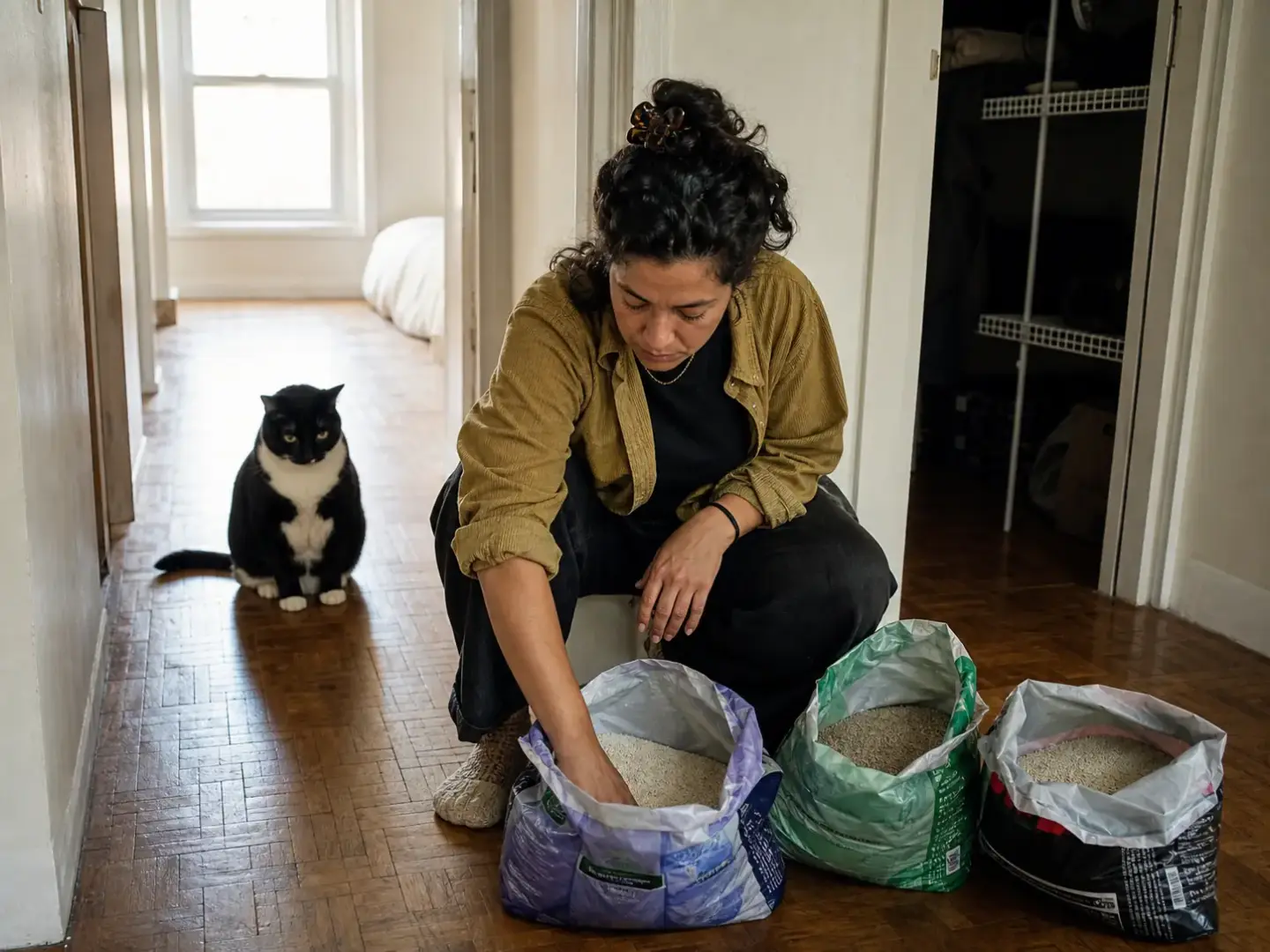
The bag in your hallway closet was chosen by whoever stocked the shelf that day, not by you. Almost nobody sets out to pick a litter. You grab a brand once, it works well enough, and you re-buy it for four years without thinking about it, right up until it stops working or you move somewhere with hard floors and thin walls and the same bag becomes a problem.
There are seven cat litter types sold in any real quantity in the US, and they fail in completely different directions. What follows is the map of all seven: what each material is physically doing in the box, and which household it fits. It is not a ranking, because there is no universal winner.
Here are all seven in one pass.
| Material | Clumps? | Dust | Odor control | Tracking | Best fit |
|---|---|---|---|---|---|
| Clay | Yes (clumping type) | High | Best of the seven | High | Multi-cat households that scoop daily and have somewhere to put a heavy bag |
| Crystal (silica) | No, it absorbs | Low | Very good | Low to moderate | One cat, a dust-sensitive household, and a cat who will stand on beads |
| Tofu | Yes | Low | Fades by day three | Moderate | A third-floor walk-up where the bag has to be carried and the clump gets flushed |
| Pine | No, it crumbles | Low | Good, and scented by nature | Lowest of the seven | A renter with hard floors and neighbors below |
| Walnut | Yes | Moderate | Very good for a plant material | Moderate | A busy household that wants clay performance at half the carry |
| Corn | Yes, closest to clay | Low | Good | Moderate to high | A clay user going plant-based who still has two or three cats to serve |
| Paper pellets | No | Lowest there is | Weakest of the seven | Very low | A cat recovering from surgery, or any house where dust is the one thing that has to go |
Litter Is Only Doing Two Jobs, and Every Material Trades One for the Other
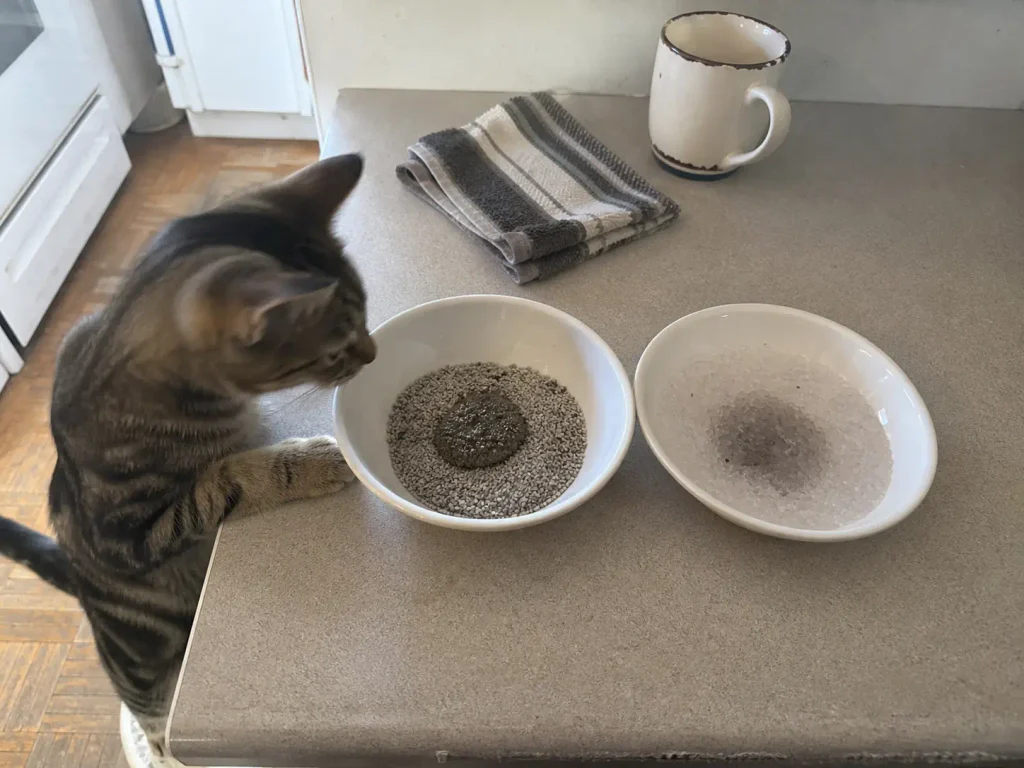
People shop for litter as if one were simply better, then get frustrated when the highly rated bag disappoints at home. Every material is a bet on which failure you would rather live with: a little dust, or a heavier sack up the stairs; a clump you lift out in one piece, or a bed you dump entirely every week.
Absorb, Then Contain: What the Bag Is Actually Being Asked to Do
Strip the marketing off and litter does two things: it absorbs liquid, and it traps the smell of what is sitting in it. Everything else on the bag is how a material goes about those two jobs. That tells you where to look when something fails. A box that smells within hours is failing at containment; wet patches on the bottom mean it is failing at absorption, usually because how much litter you use was never enough to begin with.
Clumping Is a Behavior, Not a Category
Half the confusion in the litter aisle comes from treating clumping as a type of litter. It isn’t. It is a behavior some materials have and others don’t: clay, tofu, walnut and corn clump, while crystal, pine and paper don’t.
What it changes is your maintenance. Clumping is scoop-and-top-up: lift out the solid piece, add a bit back, and the bed lasts. Non-clumping is dump-and-replace: scoop solids daily, then swap the whole saturated bed on a schedule. Neither is lazier, and when clumping is worth the trade and when it isn’t is worth reading before committing on that basis alone.
The Two Costs That Land on You, Not on Him
Dust and tracking are the two properties the cat does not care about. He is not the one vacuuming grit out of the hallway at seven in the morning. Yet they decide whether a litter survives in an apartment. And here is where labels stop helping: a bag marketed 99% dust-free that visibly clouds within days of the switch is one of the most repeated complaints in litter reviews. Dust-free is a marketing claim, not a specification.
What the cat does care about never makes the comparison charts: he has roughly double the olfactory cells you do. The box that smells fine to you at standing height is not the box he is standing in. When he hovers at the entrance instead of stepping in, he is not being fussy. He is reporting from four inches away.
Clay, the Default Nobody Chose
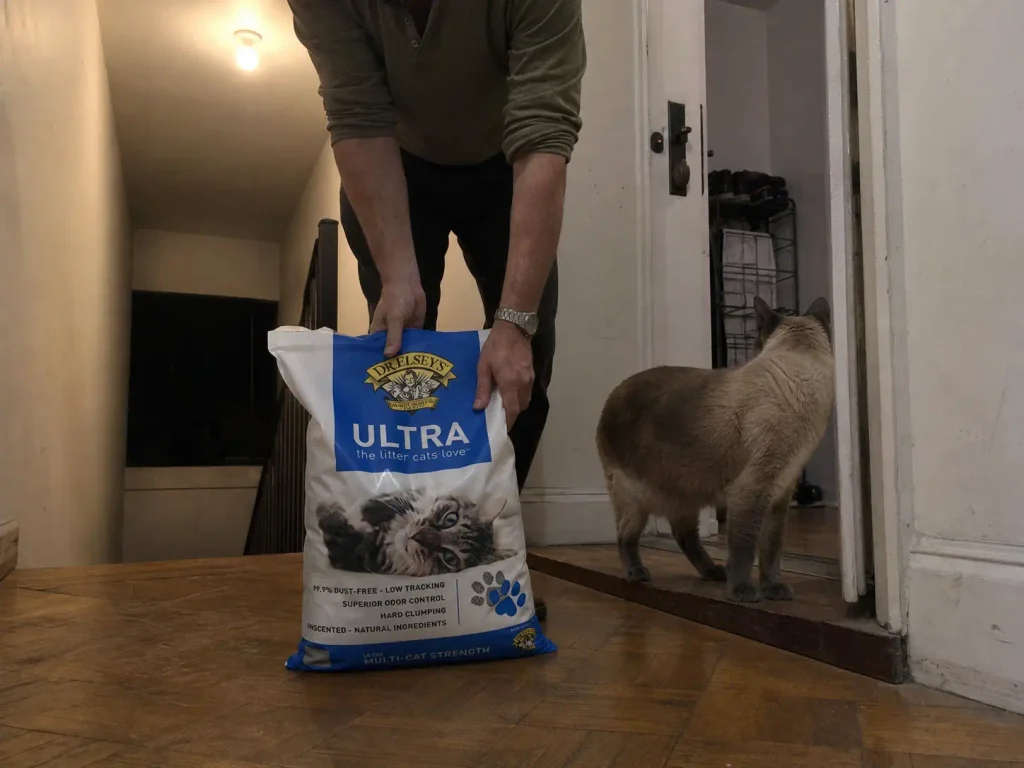
This is almost certainly what is in the box right now. It got there because it was on the shelf and it worked well enough, and for a great many households it is still the right answer.
What Sodium Bentonite Is Actually Doing in There
Sodium bentonite is the mineral that makes clumping clay litter work. It expands to roughly 15 times its dry volume when it absorbs moisture, which is why urine turns into a solid brick you lift out whole instead of soaking into the bed. That single mechanism explains both why clay outperforms on odor and where its one safety caveat comes from.
Before replacing a bag that is basically working, try the free move. If the clay is fine and the only complaint is smell, scooping twice a day fixes more clay complaints than a brand change does, and you will know inside three days whether the material was ever the problem.
Clumping Clay vs Non-Clumping Clay, in One Paragraph
Non-clumping clay is a different animal wearing the same word. It absorbs rather than binds, so nothing lifts out in one piece: you replace the entire bed instead of scooping it, and smell builds between changes because the urine stays in the material the whole time. Cheaper sack, more smell, more labor.
The Kitten Caveat, and the Rule It Creates for the Whole House
That 15x expansion is also the whole safety caveat, because the same swelling happens in a warm, wet stomach. Kittens explore litter with their mouths and swallow some of it while grooming, which is why there are veterinarians who recommend non-clumping litter for kittens under twelve weeks, and why clumping clay is commonly advised against for kittens under about four months. That is the fact, and this article stops there.
The practical version is that litter ingestion risk is what makes a material kitten-safe or not. The depth belongs to the piece on how much litter to use and why depth beats volume.
What does belong here is the household rule that falls out of it, because it is the part everyone misses: the youngest cat in the house sets the material, not the average cat. One kitten in a home with three adults means the whole house is off clumping clay for a few months. Not the kitten’s box. The house.
Crystal, the Low-Dust Option With a Texture Problem
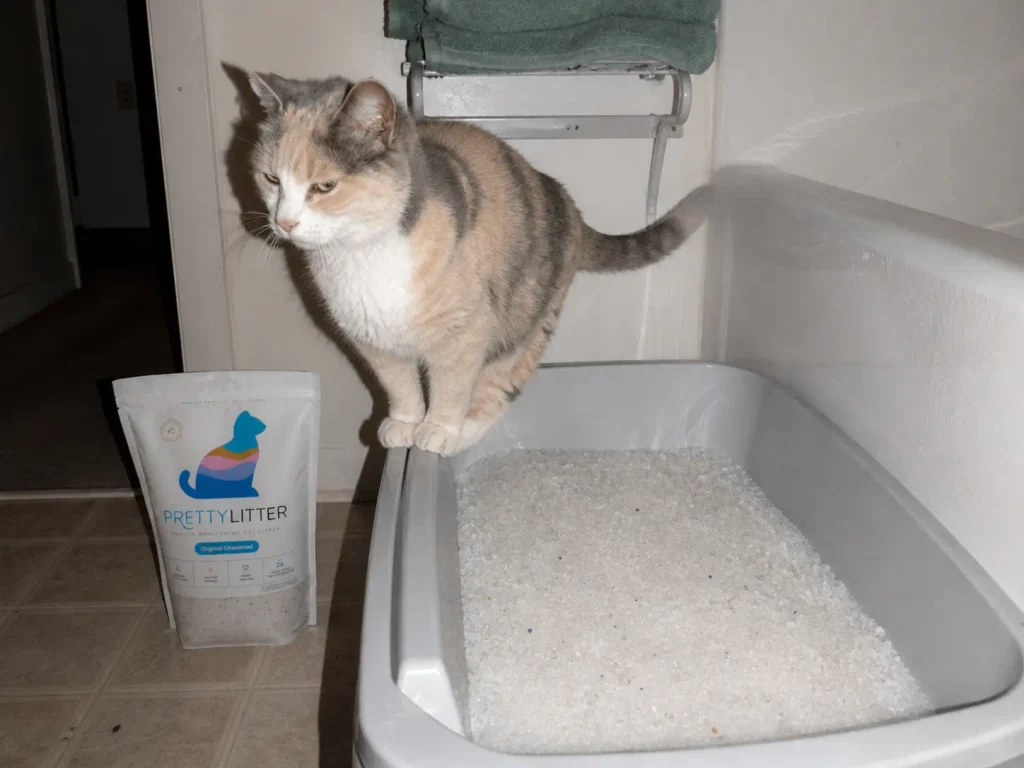
Crystal is where people go when the dust finally gets to them, usually after a winter of closed windows. And then a fair share of cats refuse to stand on it, which is the part the bag does not prepare you for.
Absorption, Not Clumping, and Why That Changes Your Week
Silica gel beads absorb urine and let the water evaporate back off, holding the solids and the smell in the bead. Nothing binds, nothing lifts out as a brick, so you scoop solids daily and swap the bed on a schedule. The weight argument nobody makes loudly enough: the PrettyLitter Health Monitoring Cat Litter fills the same box from a 6 lb bag that clay needs 40 lb to fill. The catch is that a bed left past its point saturates and starts smelling all at once.
Amorphous vs Crystalline Silica, Since the Internet Mixes Them Up
The respiratory warning that circulates about silica litter describes the wrong silica. Crystalline silica is fine dust and a known inhalation hazard, sometimes present in clay. The gel beads in crystal litter are amorphous silica, chemically distinct and classified as safe for normal use. Two words apart on a label, two different substances, and the vet-reviewed distinction between amorphous silica gel and crystalline silica dust is worth reading if you have avoided the category on that basis.
Crystal still does not automatically mean low-dust. Bead quality varies between brands, and owners call out specific crystal products for dusting despite the claim on the front. If dust is why you are switching at all, know what a low-dust claim is actually worth on a bag first.
The Paws Problem Nobody Mentions on the Bag
Beads are hard and loud underfoot in a quiet apartment. A cat with sensitive paws, whether from arthritis, a declaw history, or a strong opinion about texture, will stand on the rim with two feet in and two out rather than dig. He is not being dramatic. You asked him to walk on gravel.
Put a crystal box next to the current box for a week before you switch anything. A cat who won’t stand on beads tells you within two days, and you’ve lost nothing but a week and one small bag. Switching the whole setup first and finding out afterwards costs you a full bag and a boycott.
Tofu, the Flushable One With a Storage Condition
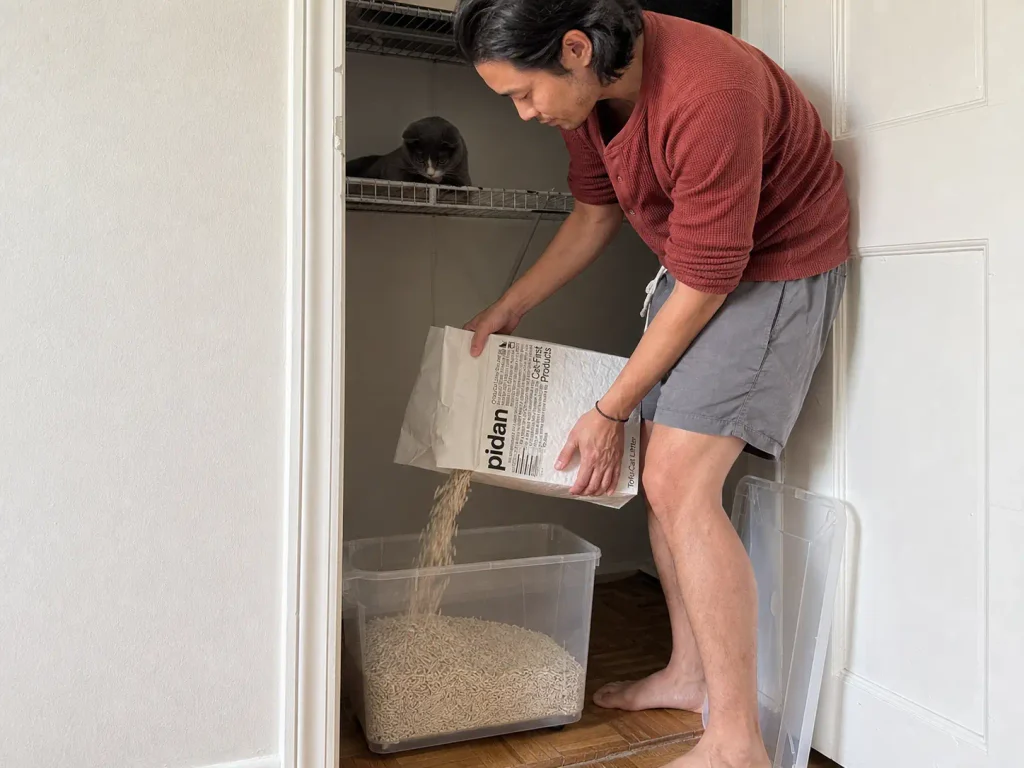
For a small apartment with no back door and trash pickup twice a week, flushing a clump is a genuinely useful property rather than a green talking point. It is also the one thing the bag oversells.
Light Enough to Carry Up Three Flights
Tofu litter is soybean fiber. It clumps close to the way clay does at roughly a third the weight for the same filled box, which is why it has spread through apartments faster than anything else here. A pidan Tofu Cat Litter bag is 5.3 lb: the same box, a fraction of the carry. The trade is softer clumps than clay’s, which break if you are careless with the scoop.
Flushable, With the Conditions the Bag Leaves Off
Flushable has conditions and the bag prints the claim without them. One clump at a time, never the whole box, and not at all if the plumbing is old or the household is on septic. The long version, including which buildings this quietly ruins, lives in what flushable actually means on a litter bag.
Odor is where tofu asks for honesty. Good on day one, mediocre by day three, because plant fiber does not hold ammonia the way bentonite does. In a single-cat home with daily scooping you will never notice. Add a second cat and you will.
The Mold Problem, and the Sealed Bin That Solves It
The eco pitch quietly assumes you have a dry closet. Tofu is vulnerable to mold in damp storage, and the split is geographic rather than random: owners in humid and coastal climates report mold problems that owners in arid states do not have. An open paper sack in a steamy apartment bathroom is the worst place to keep it, and it is exactly where people keep it, because that is where the box is.
The fix comes from the people who hit the problem and it is the cheapest thing in this article: decant the bag into a sealed bin. Paper sacks breathe, that is the whole mold mechanism.
Decant any plant-based litter into a lidded bin the day you open it, not the day you notice a problem. Paper bags breathe, and in a humid apartment that is the entire mold story in one sentence.
Pine, the Pellet That Stays in the Box
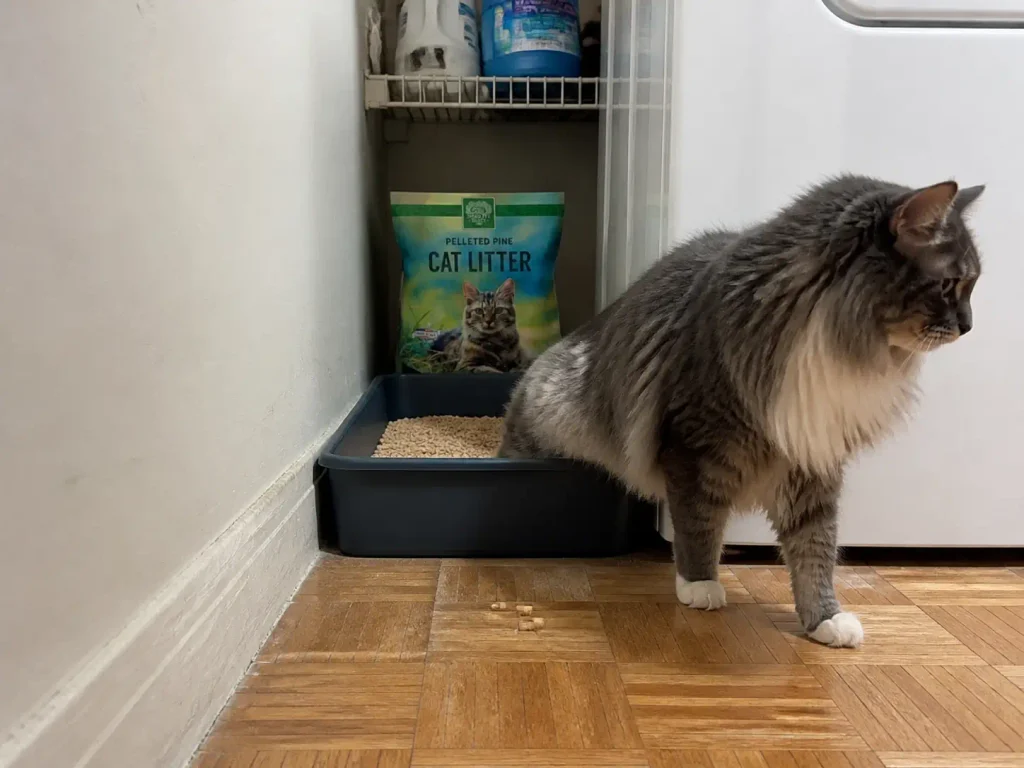
If tracking is what is quietly driving you out of your mind, grit in the hallway, grit in the bed, grit underfoot at six in the morning, pellets are the structural answer. Another mat is a patch. Changing the granule size is a fix.
Why a Pellet Doesn’t Ride Out of the Box on a Paw
A pellet is too big and too heavy to wedge between toes and get carried down the hall. That is not a marketing claim, it is geometry, and it is the whole reason pine litter is the default low-tracking recommendation. For the ranking rather than the principle, how granule size decides how far litter travels sorts materials by exactly that.
Sawdust Is the Point, Not the Failure
Pine pellets break down into sawdust as they absorb. People treat this as the product failing. It is the product working, and understanding that is the whole difference between pine being excellent and pine being miserable.
In a sifting box the sawdust falls through to a tray you empty; in a regular box it settles at the bottom and you swap that layer. Either way you scoop solids daily and deal with sawdust weekly. Honestly, less work per day than people expect and slightly more per week.
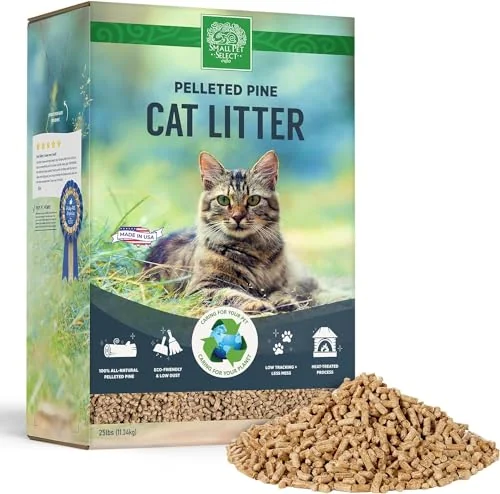
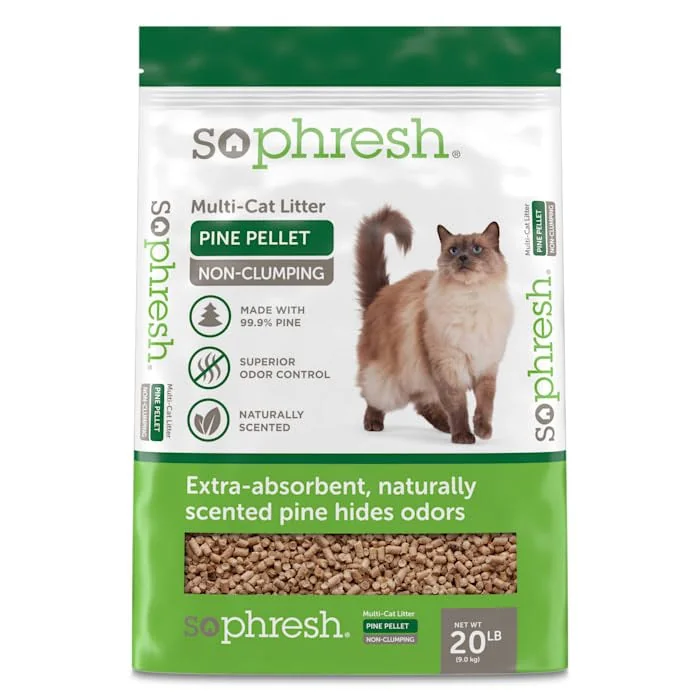
The Scent, and Who It Bothers
The pine smell is real and it divides people. It masks ammonia better than any unscented mineral, and in a small bathroom it fills the room whether you wanted that or not. Some cats object to a strongly scented box on principle, and one who objects will tell you by using the floor beside it.
There is a renter angle too, and it is why pine keeps winning in buildings: less grit in the shared hallway is one fewer conversation with the building.
Walnut, the Dark One With a Hidden Cost
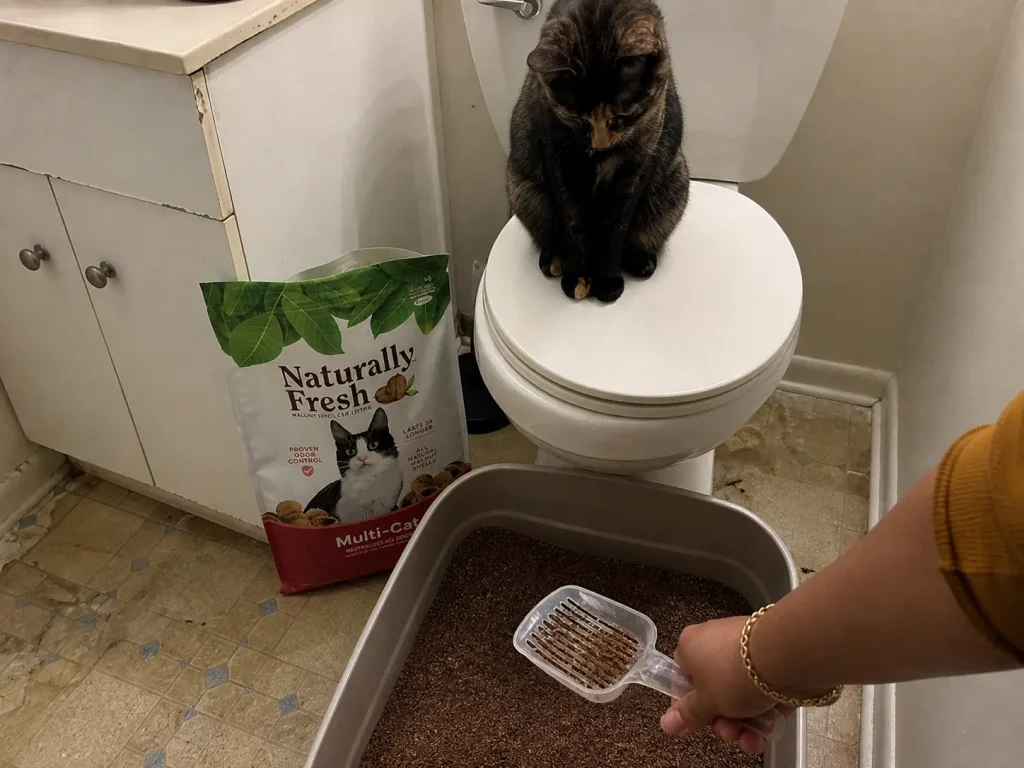
Walnut is the material people recommend enthusiastically in forums and the one with a downside you only notice months in.
Light, Clumping, and Genuinely Good on Smell
Crushed walnut shell clumps, weighs noticeably less than clay, and controls odor unusually well for a plant material. It is the closest a plant gets to clay performance without the sack weight. It also shares the mold-and-humidity weakness with tofu and corn; clay and crystal don’t have it.
What a Dark Litter Bed Hides
Now the cost nobody publishes. Walnut is dark brown, and a dark bed makes it hard to spot blood or unusual coloring while you scoop. Anyone running it as their only litter loses a passive check they were getting free from lighter clay or crystal, and that is a diagnostic cost rather than an aesthetic one.
And it stops right there. Noticing something in the box is a call to a vet, not something this article interprets. I used to file this under aesthetics, and after enough forum threads where someone only caught a change because their litter happened to be pale, I stopped.
Paws, Nut Allergies and the Grooming Question
Walnut shells do not break down in stomach acid and have sharp edges, so a cat who routinely grooms litter off his paws is a reason to pick something else. Some cats are also allergic to tree nuts, which makes walnut litter the one material here with a genuine allergen question attached.
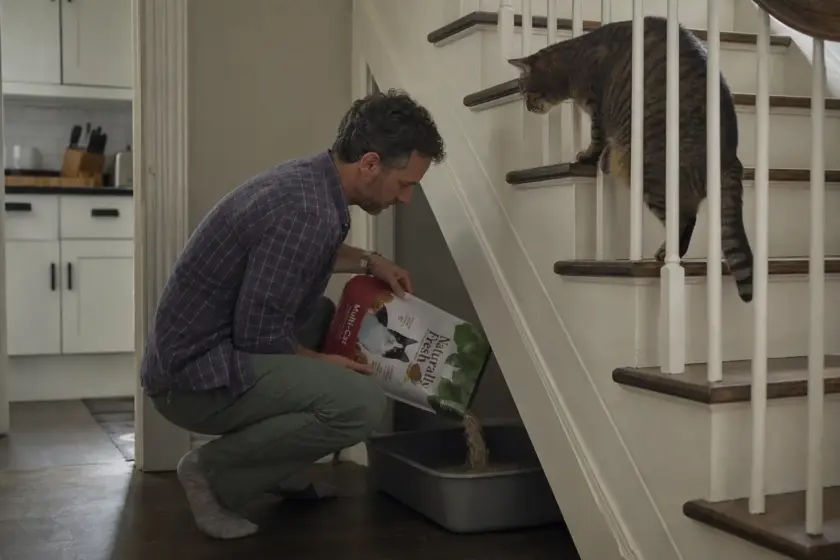
The Naturally Fresh Cat Litter Made from Walnut Shells in unscented multi-cat is the one to look at, where multi-cat labeling means a denser fill that clumps faster. Worth saying plainly: walnut is effectively a single-brand category on Amazon right now, so know the shelf is thin before building a routine on it.
Corn, the One With a Pest Problem
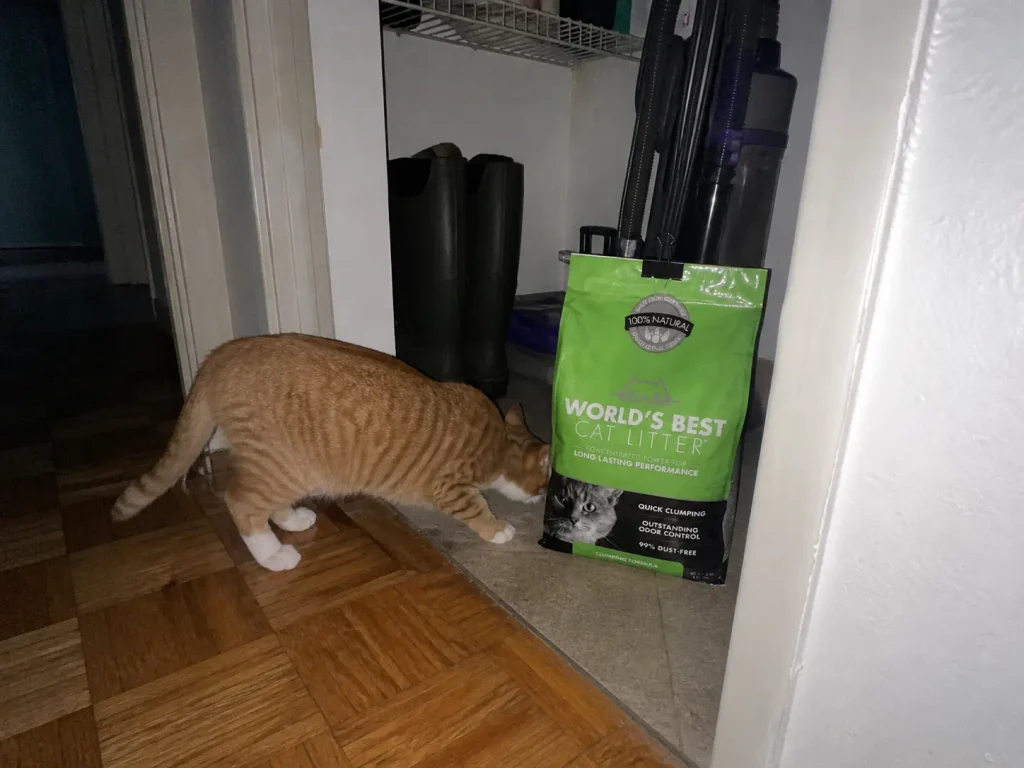
Corn is what most people try first when they go plant-based, because the brand is on every shelf. It is also the one most likely to surprise you in August.
The Plant Material That Clumps Like Clay
Corn clumps closer to clay than any other plant material, which is why it converts clay users where pine and paper do not: somebody leaving clay wants to keep the scoop-and-top-up rhythm they already have. It is biodegradable and flushable-feeling, with the same conditional asterisk tofu carries.
Mold, Pests, and the August Problem
Corn carries a documented mold and pantry-pest discussion in owner and vet-adjacent forums, and it belongs here as a real recurring complaint rather than a minor con. The concern is mold growth in humid storage or a box left too long, not the corn itself, which makes it a storage-and-cadence problem with both ends yours to control.
The fix is the one tofu needs: sealed container, cool spot, and don’t buy three months at a time in a humid climate just because the big bag was better value. Smell returning sooner than expected usually has less to do with material than cadence, which is the mechanism behind why the smell comes back even after a full clean.
How It Holds Up With Three Cats
Corn clumps hold up under three cats better than pine or paper, which is why it survives in busy households where other plant materials quietly get abandoned after a month. Going plant-based with more than one cat, corn and walnut take the load.
Paper Pellets, the One You Buy for a Reason
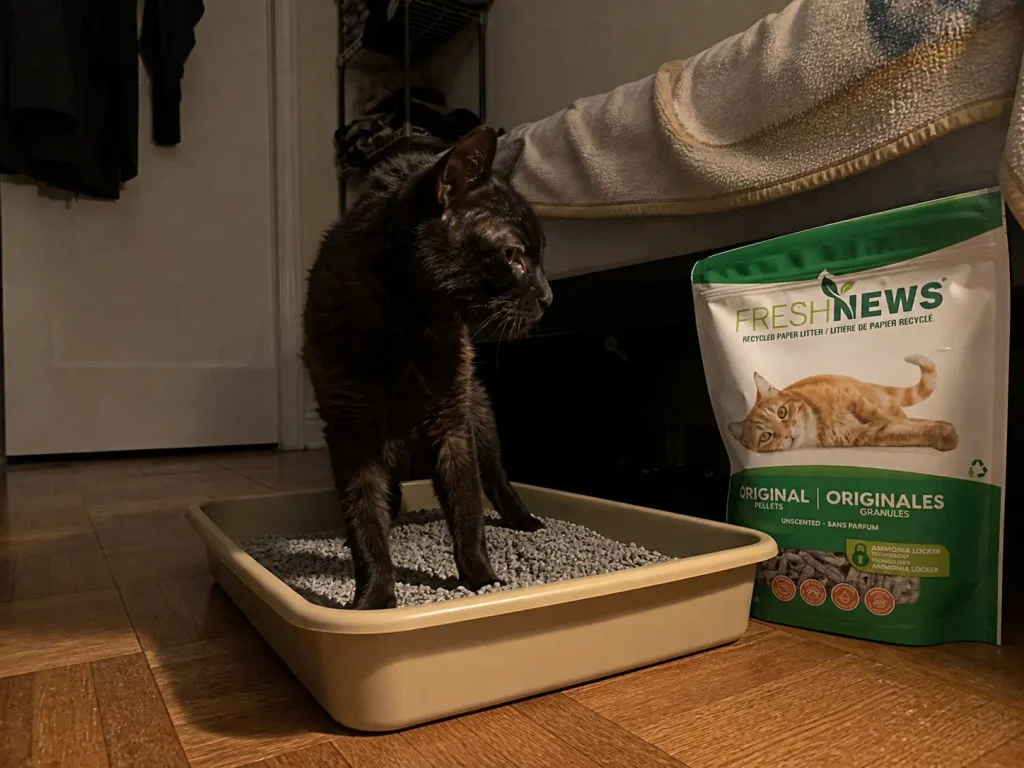
Nobody chooses paper because they love it. They choose it because a vet said no dust for two weeks and the whole calculation changed overnight.
The Lowest-Dust Material There Is, and Why That Matters Sometimes
Recycled paper pellet litter is the lowest-dust material sold, full stop. The use cases are specific: recovery after surgery, respiratory sensitivity, and cats who genuinely cannot tolerate particulate. If a vet has specified a litter, that instruction wins over anything in this article.
For that job, Fresh Pellet Non-Clumping Paper Cat Litter in the 12 lb bag is what the low-dust case points to, and being light and cheap also makes it the sensible emergency bag to keep in the closet.
What You Give Up on Odor
Odor control is the weakest of the seven. Paper absorbs and then stops working: no clumping, no chemistry holding ammonia down, which makes it a scoop-often, change-often material and realistically the highest-maintenance option here. Fair price for the one property it is unbeatable at, but don’t buy it expecting a general-purpose litter.
One Cat, Three Cats, and a Kitten Change the Answer
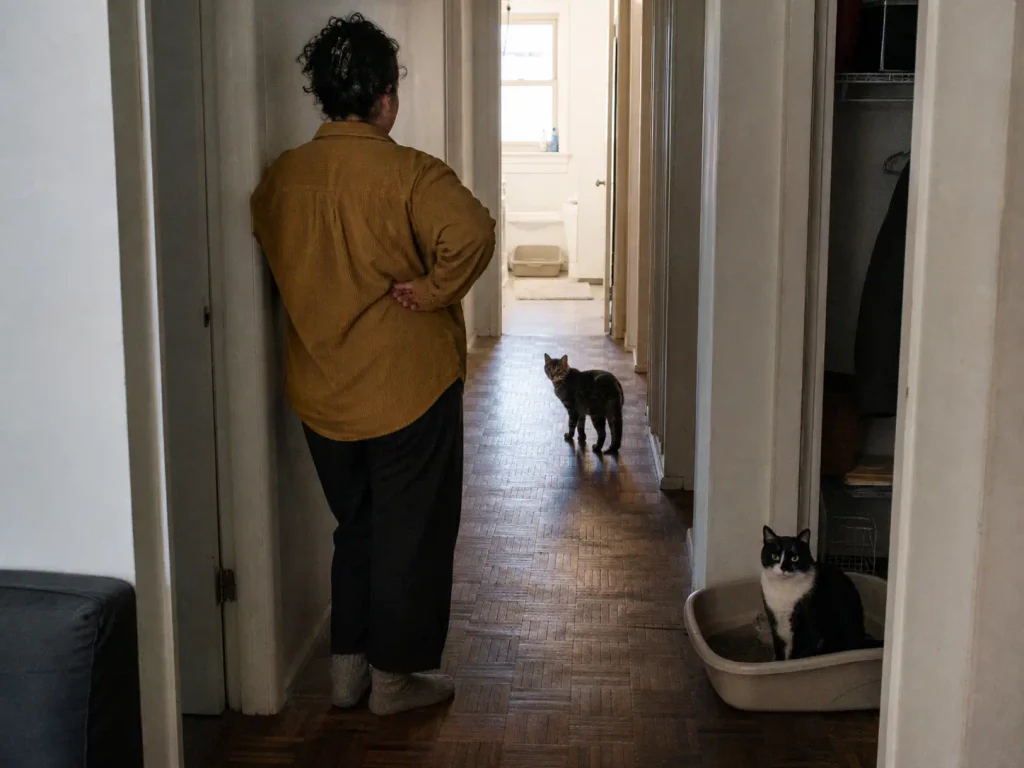
Almost every litter article answers for one adult cat in a house with a spare bathroom. Most readers have neither, and the number of cats changes the material answer more than any property on the bag does.
Count the Boxes Before You Change the Bag
The box count comes before the material, and it is not close. The guideline is one box per cat plus one, so two cats means three boxes rather than two, and the AAFP-endorsed one-box-per-cat-plus-one guideline is worth seeing stated by a veterinary association rather than as blog consensus.
Under-provisioning gets misdiagnosed as a litter problem constantly. Households run one or two boxes for three or more cats, conclude the litter is failing, and switch material three or four times chasing an avoidance issue that was a box-count issue the whole time. The material never had a chance. Two cats sharing one box also builds ammonia far faster, which is how fast ammonia builds in a box that’s serving too many cats.
So the free move goes first here too: add a box you already own, or move one to a second room.
Before switching material to fix an avoidance problem, add a box. It costs less than a bag of litter, it takes an afternoon, and it resolves a surprising share of he-won’t-use-it complaints on its own. If the second box fixes it, you just saved yourself a year of brand-hopping.
What Three Cats Do to a Material That Works Fine for One
Load tolerance is the property no comparison chart lists. Multi-cat traffic favors materials that clump firmly and hold odor between scoops: clay, corn and walnut. It punishes paper and pine, which saturate faster and need the bed swapped days earlier than the label suggested.
That is the honest version of why a litter that was perfect for one cat falls apart when a second arrives. Nothing changed about the material. You tripled the daily volume it absorbs and doubled the interval it has to hold a smell.
The Youngest Cat Sets the Rules
A kitten in a four-cat house puts the whole house off clumping clay until he is older, or you run two separate setups the adults will have opinions about. That is the household rule stated plainly.
And here is the friction nobody names: in a mixed-age house the adults’ texture preference and the kitten’s safety requirement genuinely conflict. There isn’t a clean answer, only a compromise, and knowing that going in stops you hunting for a perfect material that satisfies both. Senior cats bend it a third way: soft texture and low dust, though for an older cat a low-sided box matters more than which of the seven goes in it.
The Apartment Filter, and What a Landlord Actually Checks
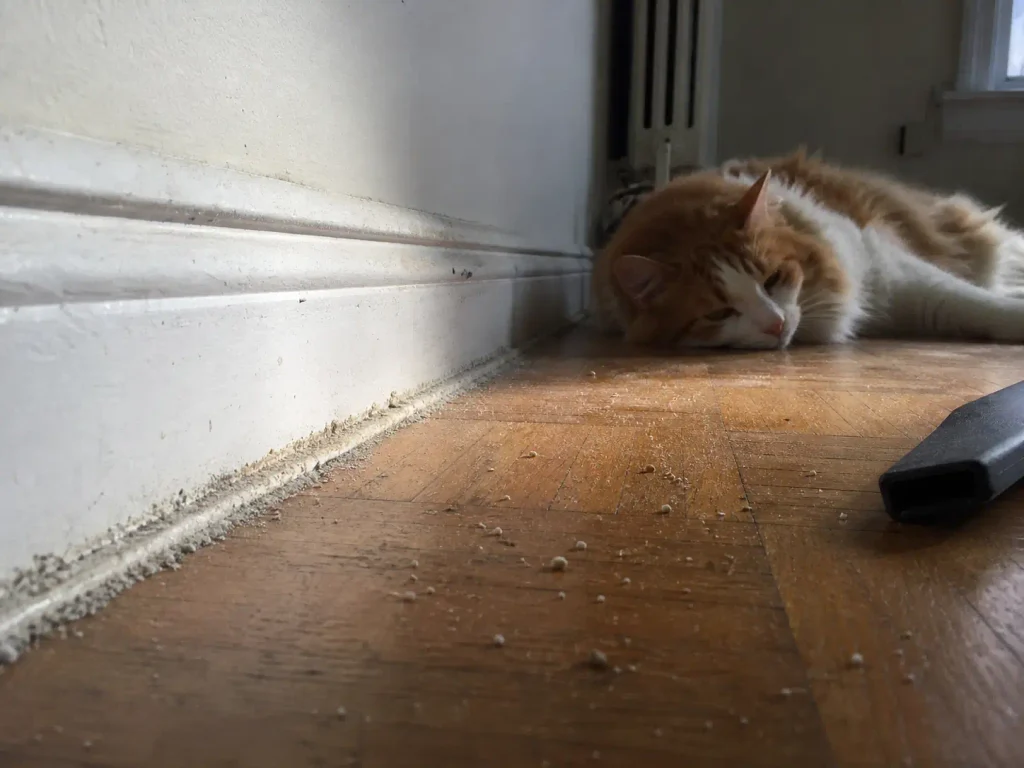
In a rental, litter stops being about the cat’s comfort and starts being about your deposit. Nobody writes that sentence down, and for a lot of readers it is the one that decides the bag.
What They Check, and in What Order
A walkthrough targets carpeted high-traffic areas, under furniture, and closets, checked for lingering ammonia or a sour smell. Some landlords ask neighbors whether odor crosses into a shared hallway. That is a standard you cannot judge yourself, because you are nose-blind to your own place and have been since a week after you moved in. Material is also only half the lever: the box design half of the same problem covers the rest.
Ask someone who doesn’t live there to walk in and tell you honestly what they smell. You stopped being able to judge your own apartment about a week after you moved in, and this is the only free test that gives you the landlord’s nose instead of yours.
Hard Floors, Carpet, and Two Different Failures
Hard floors and carpet fail in opposite directions, and the same litter can be right for one and wrong for the other. Fine-particle litter on vinyl or laminate is visible across the room, audible underfoot, and works into the seams between planks. That is a deposit conversation, not a housekeeping one.
Carpet fails the other way. Dust settles into a carpet you do not own and does not vacuum back out, so a material’s dust rating matters far more in a carpeted rental than in a house with tile. Shared walls push the same direction: heavier pelletized materials don’t drift as far when a cat kicks.
Stairs, Weight and the Bag You’ll Actually Keep Buying
Weight is a constraint, not a preference. A 40 lb bag is a different purchase in a third-floor walk-up than in a house with a garage, and the material you can keep buying beats the one that scores better on a chart. That is the quiet reason heavy clay gets abandoned after a move: the apartment changed around it, not the litter.
For what it’s worth, the renter’s move that works is switching to a lower-dust material a few weeks before an inspection rather than the week of. You address what gets checked and give the cat time to accept it, which is the part people skip.
Conclusion
There is no best litter. There is the material whose failure you can live with, so pick which of dust, weight, smell or tracking you are least willing to tolerate and the list of seven gets short fast.
If more than one cat lives there, count the boxes before you change the bag, because the n+1 rule fixes more litter problems than any material swap does. And if a kitten lives there, the youngest cat picks the material for the whole house, not just for his own corner of it.
Give it three weeks and look again, because this is about a cat accepting a material and you keeping a routine, not an object wearing out. Check whether he is covering properly and whether you are still scooping on the schedule you set. If either slipped, the material was never the problem. Whatever you land on, switch it gradually, or he’ll tell you what he thinks of it in the least convenient spot he can find.
Before you buy a different bag, add a box and scoop twice a day for a week. If that fixes it, you just learned the litter was never the issue.
Amazon’s Audible — free for 30 days
Your cat won’t let you read. Let someone read to you.
Audible is Amazon’s audiobook library — thousands of titles, read out loud, on your phone. Free for a month, plus one audiobook to keep forever.
Frequently Asked Questions
01Which type of litter is best for cats?
There isn’t one, and any article naming a winner is answering a different question than the one you’re asking. Clumping clay controls odor best, crystal produces the least dust of the mineral options, and paper pellets are the lowest-dust material sold. Which one wins depends on how many cats use it, what your floors are, and how much weight you’re willing to carry.
02What are the three types of litter?
The three-way split people usually mean is clay, crystal, and plant-based, with plant-based covering tofu, pine, walnut, corn and paper. It’s a useful shorthand for how they’re made, but it hides the split that actually matters day to day, which is clumping versus non-clumping.
03What is the healthiest type of litter for your cat?
For most adult cats it’s whichever low-dust material they’ll reliably use, since dust is the one property with a documented respiratory cost. For kittens under about four months, vets commonly advise against clumping clay because of the swelling risk if it’s swallowed during grooming. If your cat has a diagnosed condition or has just had surgery, follow what the vet specified rather than a general recommendation.
04What cat litter should you stay away from?
Heavily scented litters are the most common regret, because the perfume is for you and a cat with roughly double your olfactory cells is standing in it. Beyond that, avoid clumping clay in a house with a kitten, and avoid storing any plant-based litter in an open bag somewhere humid, which is how tofu and corn end up with mold.
Leave a comment