Where to Put a Litter Box, and Three Places to Never
Never put a litter box in these 3 spots — and the clear-floor rule nobody gives you. Where to put a litter box, measured in inches, not rooms.

Alfredo RamsesFounder · August 25, 2026 · 25 min read

On this page10 sections
- 1The Spot Is Not the Room, It Is the Floor Around the Box
- 2Why a Spot That Passes Every Checklist Still Gets Rejected
- 3What the Cat Needs at the Door, and What Goes on the Floor
- 4Air, Not Just Quiet — the Criterion People Forget
- 5The Three Places a Litter Box Never Goes
- 6The Move That Costs Nothing
- 7Renting, and the Spot You're Allowed to Have
- 8Two Cats, an Old Cat, and Keeping the Spot Working
- 9Conclusion
- 10Frequently Asked Questions
You did everything the checklists said. Quiet corner, away from the food bowls, out of the way where nobody trips over it. And he went right beside it anyway.
He is not being difficult, and he is not making a point: the spot fails on an axis none of those checklists measure, and knowing where to put a litter box starts with the number almost nobody publishes. That number is about the floor, not the box. What follows is what makes any spot pass, the three that never pass no matter how the apartment is laid out, and what to do when the only spot you have is one of the bad ones.
Quick Answer
A litter box spot has to clear four things at once, and a spot that misses one gets retired by the cat no matter how well it does on the other three.
- Predictable quiet, not quiet most of the time
- Air that moves, not a sealed closet
- Well away from the food and water bowls
- Reachable at any hour, real 24/7 access with no door that can swing shut
The Spot Is Not the Room, It Is the Floor Around the Box
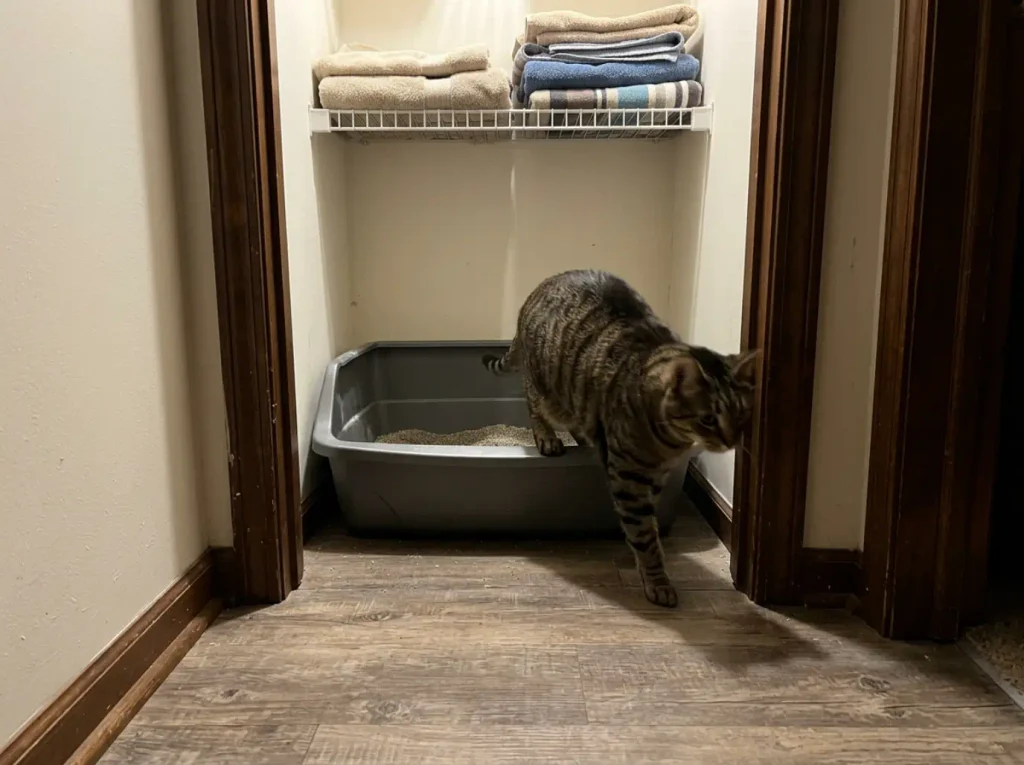
Everyone asks which room. The question that decides it is how much clear floor sits around the box once it’s in there, and that question has an answer in inches.
Measure the Cat, Then Measure the Floor
Start where every guide starts, because the baseline is right: a box’s interior should run about 1.5 times your cat’s body length, nose to the base of the tail. For most adults that lands at 18 inches minimum and 20 to 22 is noticeably better, which is where you find out that the box itself has a size rule, and it starts with measuring the cat, and most boxes sold as large are not. Fine. You already knew to measure the box.
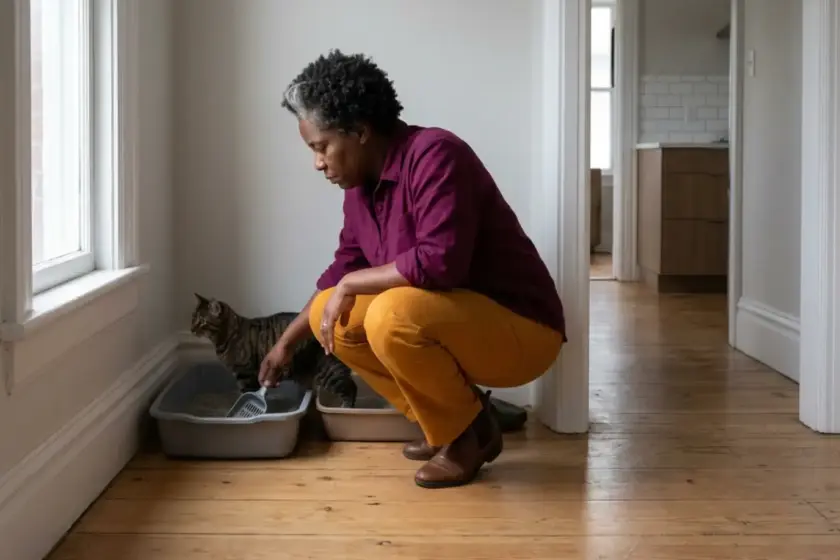
Now measure the floor, because that is where every guide to litter box location stops and the actual problem starts. A cat does not simply stand in a box.
He walks in, turns around at least once, digs, turns again, covers, and leaves, and none of that arc respects the plastic wall. He needs roughly 15 to 18 inches of interior width just to complete the turn without his tail dragging the side. Whatever he does on the way in and the way out happens on your floor.
That accessibility isn’t a preference you’re indulging. The AAFP and ISFM’s feline environmental needs guidelines put litter boxes in the same category as food, water and resting places: resources that have to be easy to reach, in more than one spot, or the cat quietly stops treating them as available.
The Clear-Floor Rule, in Inches
Here is the working number, and it is the one no competitor gives you: box length, plus at least one box-width of clear floor on the open side. In front of that, leave roughly 24 inches so there’s an approach and so you can scoop without kneeling on top of the thing.
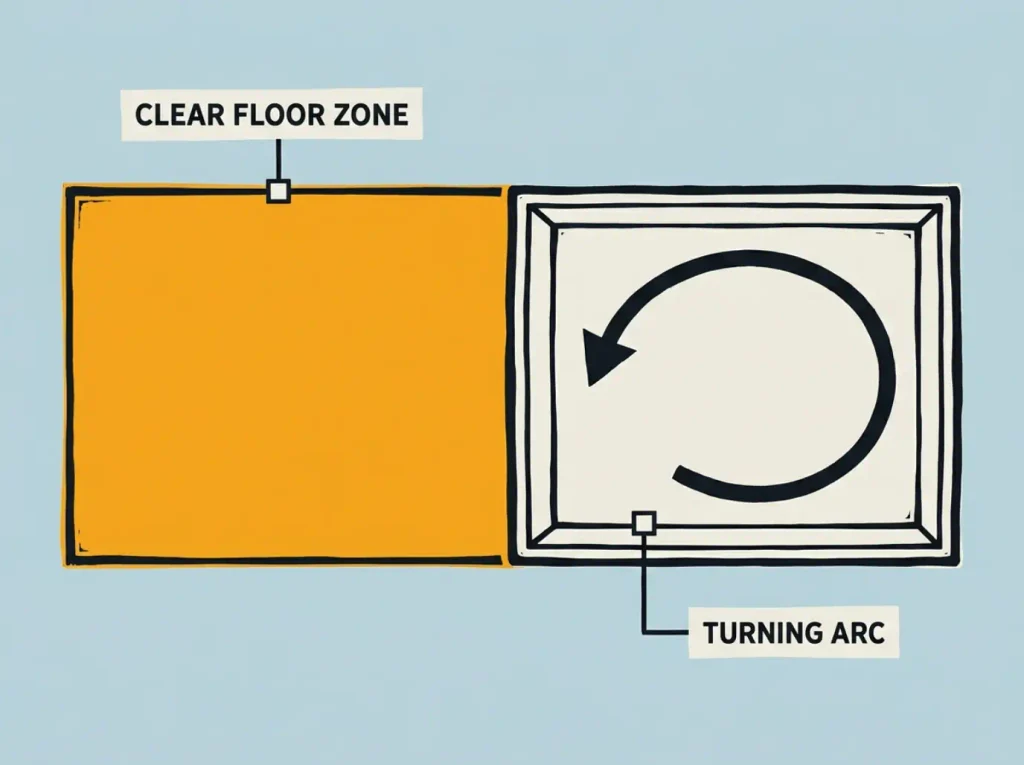
That’s not a comfort margin, it’s the working area. Miss it and the failure looks like this: the cat gets in, starts digging, and his back end meets a wall or a laundry basket. He can’t finish the motion.
He does it once or twice more, decides the arrangement doesn’t work, and goes to the rug two feet away, which has none of these problems. From your side that reads as him rejecting the box. From his side he already told you the box was fine and the room wasn’t.
Put the box where you plan to put it, then stand a shoebox on its end at the open side. If you can’t walk past both without turning sideways, neither can a cat that just got startled.
Why a Corner Is Smaller Than It Looks
Corners get chosen for the same reason every time. The box tucks in neatly, it stops looking like the largest object in the room, and it feels like you’re giving him somewhere private. Two of those three are about you.
A corner takes two of the box’s four sides out of play. The clear floor you measured a minute ago now exists on one side only, and the approach and the exit share it.
And the box wedged into a tight corner for privacy is the most repeated self-inflicted failure in litter threads, always described the same way: perfect spot, cat won’t use it. He isn’t confused. He is doing geometry with the space you handed him and coming up short.
If the box only works when the floor around it happens to be clear, that isn’t a spot, it’s an arrangement, and it lasts until the first time a suitcase or a box of something ends up there for a week. Pick a place that survives an ordinary bad Tuesday. And when the apartment doesn’t have that floor to give, the layout has to do the work instead, and that’s a different problem with its own answers.
Why a Spot That Passes Every Checklist Still Gets Rejected
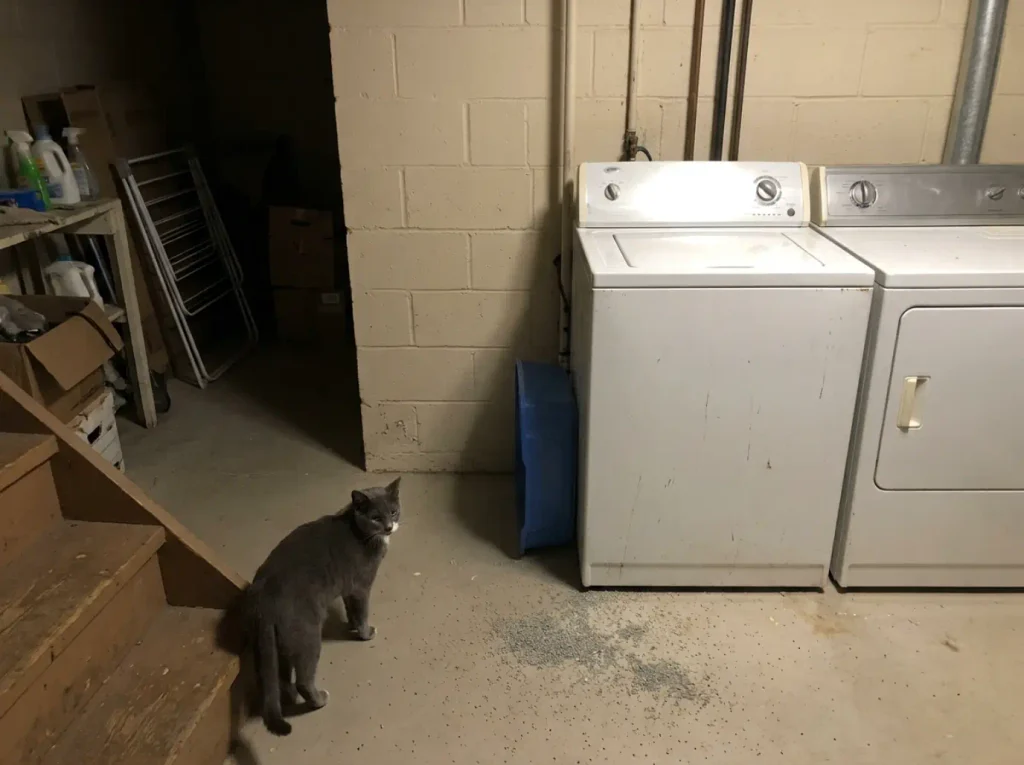
The laundry room is quiet. It is quiet ninety percent of the day. The other ten percent is a dryer buzzer going off two feet from a cat mid-squat, and that is the ten percent he keeps.
Predictable Noise and Unpredictable Noise Are Not the Same Problem
Every guide gives you criteria as a list, so you grade the spot one line at a time. Quiet, check. Ventilated, check.
Away from food, check. It passes. Cats don’t grade in columns. They experience the spot all at once, over time, including the parts that only happen sometimes.
Constant noise is survivable, and this is the part that surprises people. A cat living beside a busy street adapts to traffic in about a week, because the noise carries no information: it happens whether he’s in the box or not, so it stops meaning anything. Unpredictable noise never becomes background. A washer hitting spin cycle, a dryer buzzer, a furnace kicking on, an ice maker dropping a tray at two in the afternoon — these arrive with no warning, at full volume, and they arrive while he is in the most defenseless posture of his day.
And one event is enough. He does not run a fresh assessment next week when it turns out the buzzer only goes twice a day. The spot is filed as somewhere that ambushed him once, and it is done.
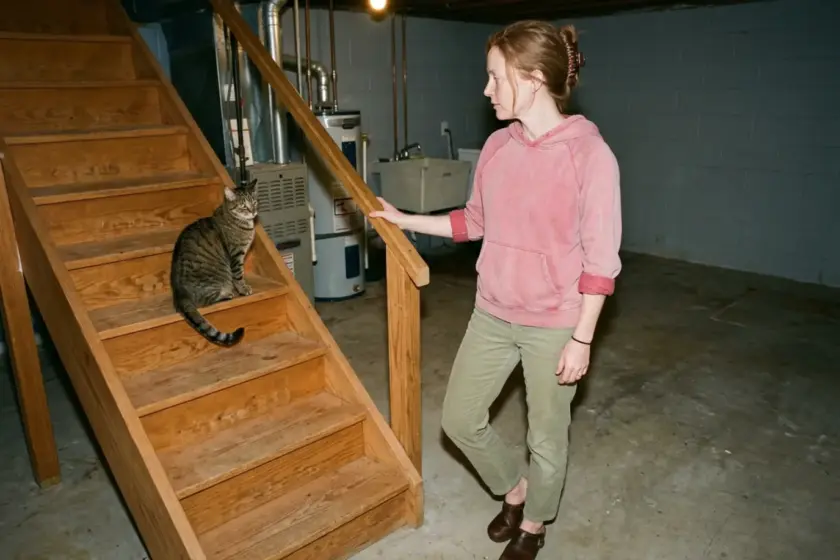
This is why people report a cat who won’t return to a laundry-room box months later, describing the room as quiet the whole time, because to them it genuinely is. The basement fails this test in a specific way, and it’s worth its own look, between the furnace, the stairs and the temperature.
Stand where the box is and wait through one full cycle of whatever machine shares that room. Whatever startles you at that distance startles a cat that cannot leave quickly.
Privacy With One Exit Is Not Privacy
The other half of the same failure is a low-traffic area with one way in and one way out, and it’s harder to see because privacy and a dead end look identical on a floor plan. A narrow closet, an alcove behind a door, the far end of a galley kitchen, the gap between the toilet and the tub.
All of them are quiet. All of them are private. All of them are also somewhere a cat can be cornered by a toddler, a vacuum, another cat, or a person walking in at the wrong second.
What he wants is a spot where he can see what’s coming and leave in more than one direction. The recurring pattern in cat forums is a box moved out of a nook and into a corner of a room with two open approaches, and the cat starts using it within a day or two, which tells you the box was never the problem.
I used to treat one-way spots as a multi-cat concern only, on the theory that a single cat has nobody to get cornered by. What changed my mind is how often the same complaint shows up in single-cat homes with a hallway or a closet involved. The instinct doesn’t check the household headcount first.
Auditing the Spot You Already Have
Go stand in the current spot and count. How many ways out are there for something with short legs and limited mobility?
What appliance noise shares this room or the wall behind it? At what hours does this room get used, and does that overlap with when he goes? Can the door to this room ever be shut by wind, a draft, or someone being tidy?
The last one is the sneaky one, and it accounts for a stack of overnight accidents that get blamed on the cat. A bathroom door that closes at eleven when someone goes to bed converts a good spot into no spot for eight hours, and nobody in the house notices, because the person doing the noticing is asleep.
Machines are worth a second look here for a different reason. An automatic box inherits every placement problem, at full price. It doesn’t fix a bad location, it adds a motor cycling in the same room. A spot that already had one unpredictable noise now has two.
What the Cat Needs at the Door, and What Goes on the Floor
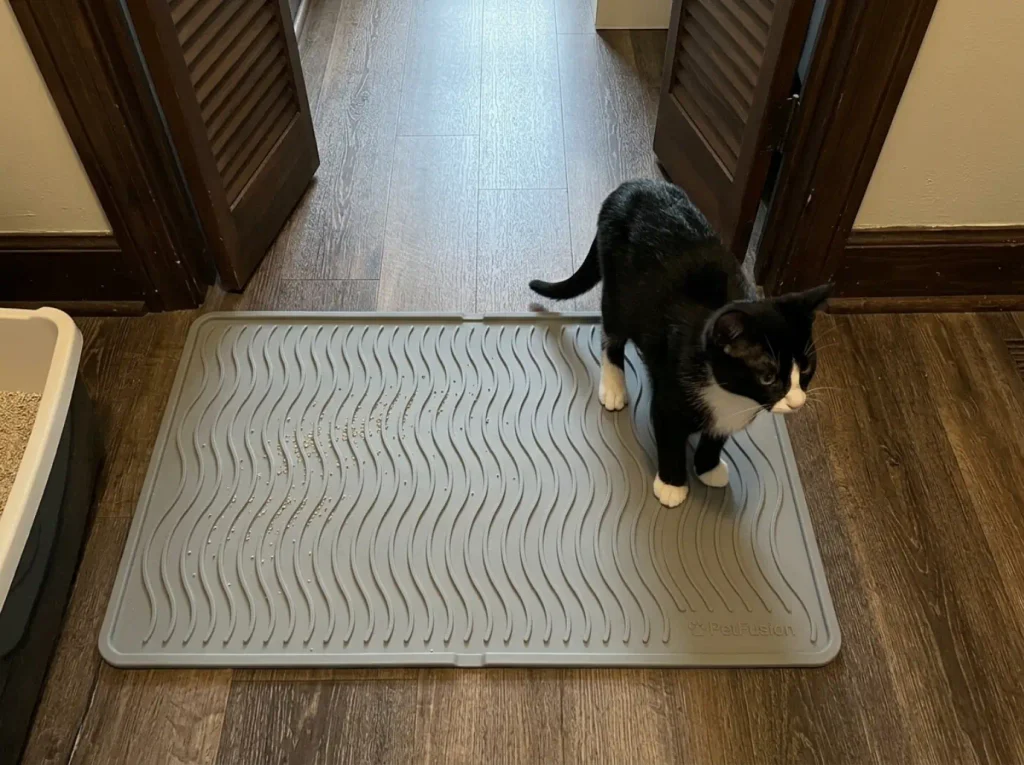
The clear floor you measured out isn’t wasted space, and it isn’t a courtesy. It is where the cat lands, turns, shakes off and walks away, and it is the origin point of every grain of litter you find in the hallway.
The Exit Zone, and What Happens in It
Three jobs happen in that strip of floor, and they happen in about four seconds. The approach, where he decides whether to commit. The turning room, which is the part that keeps his back end off the wall mid-dig. And the landing, where he steps out with litter in his toes and takes the first two or three steps that decide whether it stays in this room or goes on tour.
That third job is the one that gets ignored, and it’s the reason the tracking problem and the placement problem are the same problem. Litter travels in the first two steps. Everything after that is just distribution.
Hard Floor, Carpet, and What Goes on Top
Hard flooring beats carpet in this zone, and the reason isn’t that it’s easier to wipe. Carpet holds odor at floor level, right where the cat’s nose does its evaluating, and it also hands him a second acceptable digging surface directly beside the box. You have effectively installed an alternative and then asked him not to use it.
Put a mat in that zone, not under the box. Under the box it catches nothing, because nothing lands there. The litter tracking starts two steps out, past the plastic.
This is small enough to sound like a detail and it isn’t: where the mat goes decides whether it does anything, and the two-steps-from-the-exit position is where it earns its keep. For the mat itself, the PetFusion ToughGrip Waterproof Cat Litter Mat in Large is the shape that suits this: it wants to be wider than the box’s open side so the landing lands on it, and the silicone doesn’t curl at the edges the way the softer mats do. The caveat is texture — some cats dislike walking on the grooved surface, and a cat who steps around the mat has told you to try a different one rather than a different spot.
What Not to Put in That Zone
Whatever else you were about to store there. The laundry basket, the recycling, the vacuum, the box of things that hasn’t been unpacked. Anything that sits in the exit zone converts your measured spot back into a corner, and it does it silently, weeks after you set everything up correctly.
Also on the list: the food and water bowls, which get their own veto below, and the second litter box, which gets its own veto too. That leaves the mat and nothing else. That’s it.
Air, Not Just Quiet — the Criterion People Forget
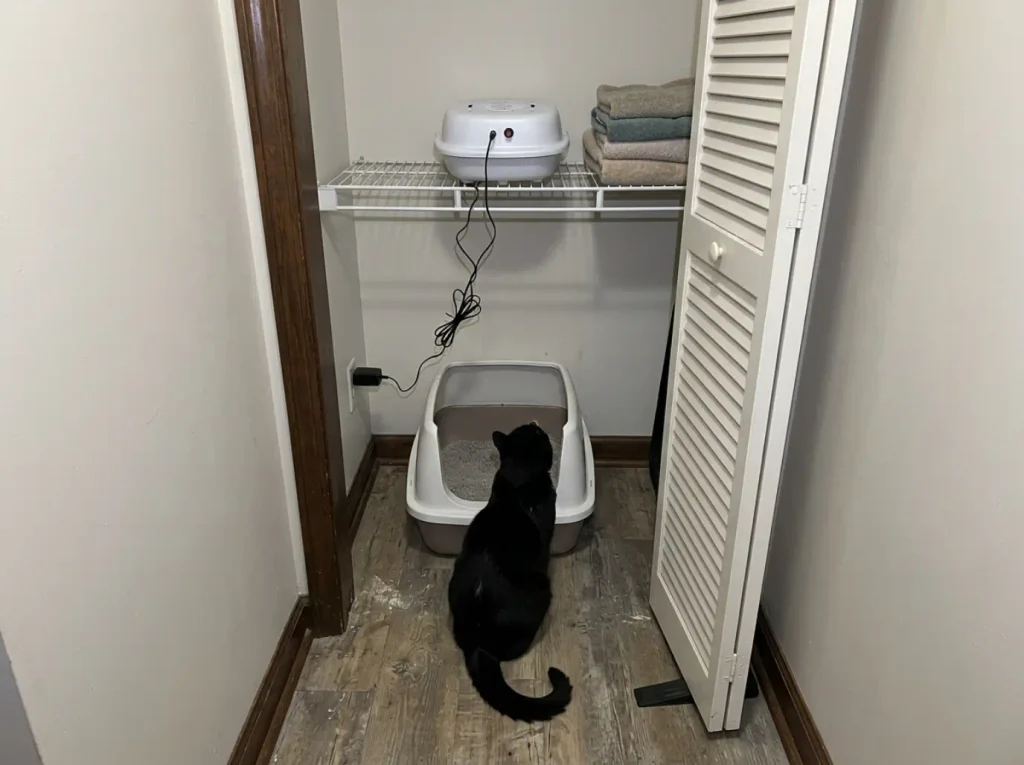
People pick a spot for silence and then wonder why the whole hallway smells by six. The box didn’t get worse. The air stopped moving.
What Ventilated Actually Means at Cat Height
Odor doesn’t hang evenly in a room. In still air it concentrates low and stays there, which puts the strongest concentration at roughly the height of a cat standing in the box, deciding whether this is somewhere he wants to be for the next ninety seconds. You’re evaluating the room from five and a half feet up. He is evaluating it from eight inches.
Which means several spots that pass the quiet test fail badly here: a closet with the door shut, a windowless half-bath, a cabinet with no cut-out in the back, a box tucked under a stairwell with no cross-draft. All silent, all sealed, all worse at cat height than they seem from where you’re standing.
The Free Fixes, in Order
Before you buy anything for this, do the three things that cost nothing, in this order.
Leave the door ajar and hold it there with a wedge or a stop, so it can’t be pushed shut by a draft or a passing person. Pull the box six to twelve inches off the wall, which sounds trivial and gives the air behind it somewhere to go instead of pooling. Then crack a window in that room two fingers’ width, even in winter, even if it’s only for a few hours a day. That last one changes small apartments more than any product does, and the reason is unglamorous: the same box, the same litter and the same cat produce a much stronger room in 400 square feet than in 900, because there’s simply less air to dilute into.
A door held open a hand’s width with a wedge does more for a closet box than any filter, and you can undo it when you move.
When the Room Can’t Be Ventilated
Sometimes the honest answer is that the room has no air path and can’t be given one. An interior closet with no vent, a bathroom whose extractor was painted over in 2004, a unit where the window in that room doesn’t open. The free fixes have run out.
That’s the point where a small carbon unit at the box is a reasonable piece of odor control rather than a lazy one, and the placement rule for it is the same rule as everything else here: it belongs near the box, not across the room, because it can only work on air that reaches it. The Purrified Air Litter Box Air Purifier is the compact version of this, activated carbon plus zeolite, around 53 CFM, which is the right scale for a closet or a small bathroom and the wrong scale for an open-plan living room. Its real limitation is maintenance: carbon saturates, and a unit nobody refreshes turns into a fan.
And it doesn’t outrank scooping. Nothing does. If you want the fuller picture of what belongs near the box for smell, and what makes it worse, some of the popular additions actively backfire.
Worth saying plainly: placement is one of the reasons odor comes back after you clean, and it’s the one people never suspect, because the smell returning has four or five different causes and only some of them are about the litter.
The Three Places a Litter Box Never Goes
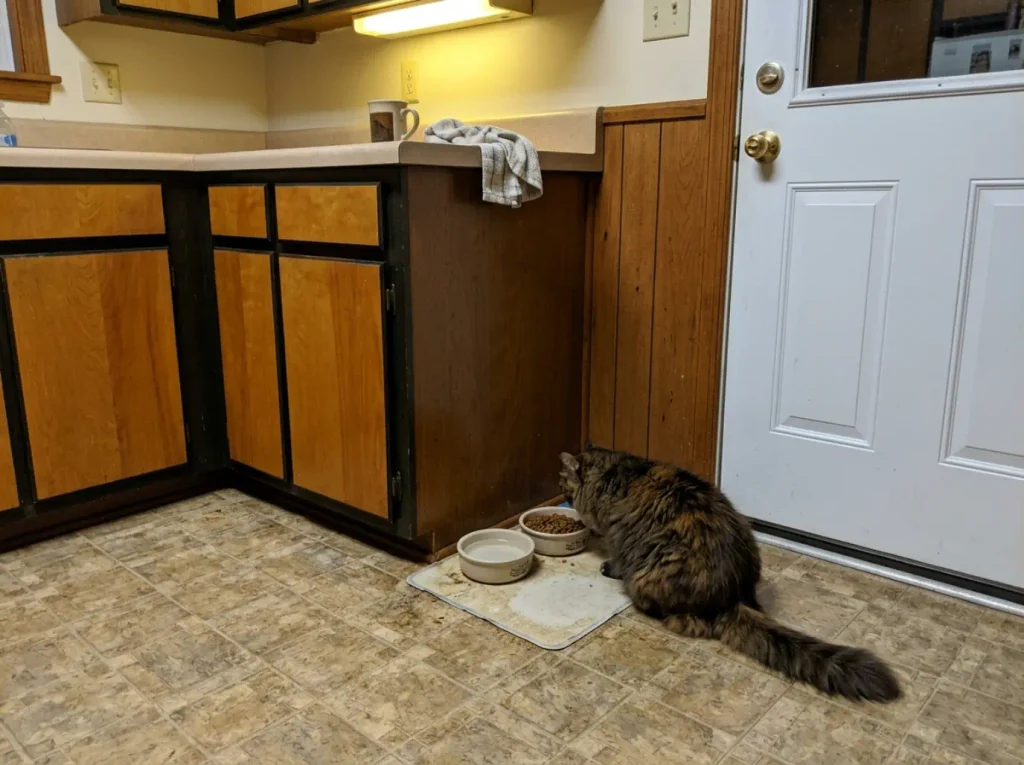
Three, not ten. A list of ten don’ts gets skimmed and forgotten by the time you’re actually holding the box. These three account for most of the failures, and each one fails for a different reason.
Beside the Bowls
Cats don’t eliminate where they eat. That is not fastidiousness. It is the oldest, most consistent preference in the species.
Put the two together and you’ve handed him a choice between two needs he shouldn’t have to trade off, and the way he resolves it is by moving one of them himself. Usually the box. Usually to somewhere you’d rather he didn’t.
The kitchen is the same rule at room scale, which is why it’s an honorable mention here rather than a fourth veto: it’s the food room, all of it, and the same goes for a dining area, including the corner by the fridge that seems far enough from the bowls. It isn’t. And this is the veto people break most in a studio apartment or any small space, for a genuinely sympathetic reason: the bowls and the box both get pushed into whichever corner is left over, because there’s exactly one corner left over. The fix is usually vertical or diagonal rather than distant: different room if you have one, opposite ends of a room if you don’t, and never in each other’s line of sight.
On the Route Everyone Walks
The hallway box and the entryway box fail for a reason that isn’t volume. They fail because they have no dead time. Every other spot in the house has hours where nothing happens in it; a high-traffic area is defined by things passing through, at intervals nobody can predict, and it’s the only room in the house whose entire purpose is traffic.
The front door is the worst version, because it stacks three problems into one location. Noise, strangers arriving without warning, and a route the cat cannot avoid using himself. He now has to walk past his own box to reach anywhere, which turns every trip into a small negotiation, and he’ll settle it with box avoidance.
Next to the Other Box
This is the one that catches careful people, because they’ve already done the hard part. They counted right, they bought the second box, and then they put them side by side, which is where a good decision quietly becomes no decision.
Two boxes touching are one box to a cat. Same smell, same location, same escape route, same everything he was evaluating, so nothing was actually added. And in a multi-cat home it’s worse than neutral: two adjacent boxes are a single position one cat can stand next to, which means a cat with an opinion about the other cat now controls both.
That is resource guarding, and it does not look like fighting. This is the whole reason AAHA and AAFP’s joint life-stage guidelines on litter box placement specify different locations rather than just a number of boxes, and it’s the half of the rule that gets dropped in transmission. Get the count right first, because how many boxes two cats actually need is usually three, not two. Then spread them, because the count is the input and the placement is the actual answer.
All three of these feel reasonable when the apartment is small. That’s precisely why they keep happening.
The Move That Costs Nothing
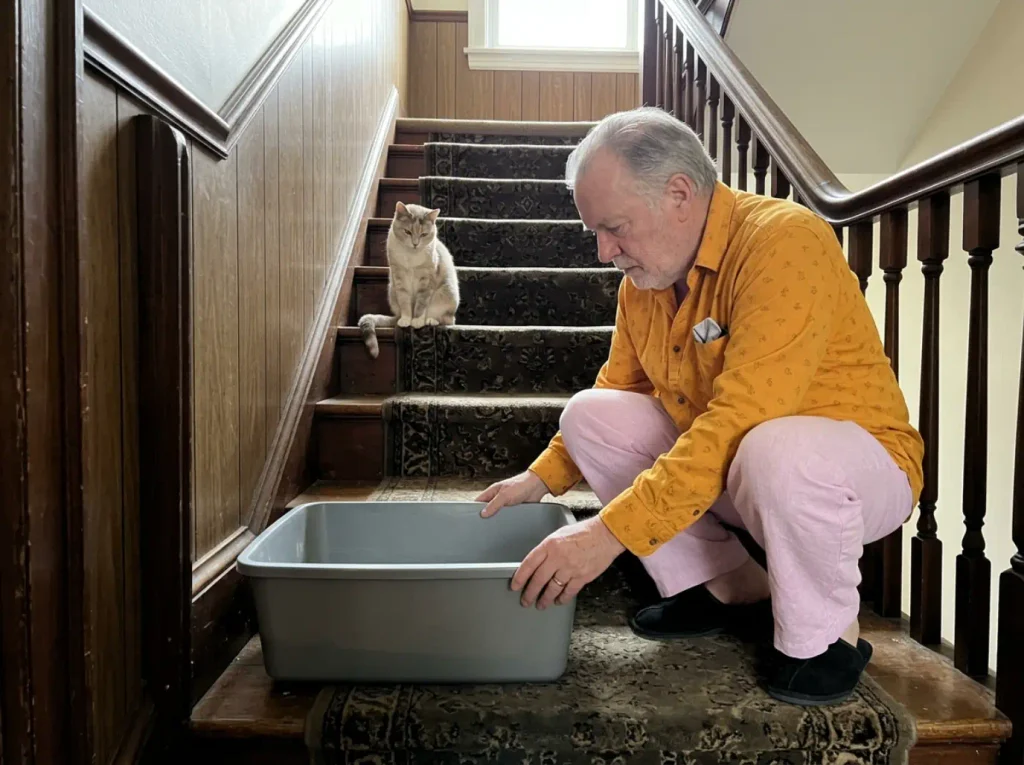
Before you buy a single thing, there’s a good chance you already have a better spot and just can’t get the box there without a week of accidents. Nobody tells you how, so here it is.
Move the Box, Not the Cat’s Mind
Most placement fixes are a relocation. And relocation done wrong produces a specific, confusing failure: the cat goes in the old spot, on the floor, where the box used to be.
That looks like rejection of the new location. It isn’t. He is still using the old location, correctly, according to a map you changed without telling him.
Cats navigate to a remembered place first and check what’s there second. Move the box eight feet overnight and you haven’t relocated the toilet, you’ve removed it and installed a new unrelated one somewhere he wasn’t looking. The gradual method solves this by never asking him to learn anything: the box stays continuously in view, moving slowly enough that each day’s position is within the tolerance of yesterday’s memory.
If the original spot was one he picked, beside the box or in one specific corner of the bedroom, start the box directly over that spot. Not near it.
Over it. Then walk it from there. The bathroom is the most common destination for this move, and it has its own rules around humidity and doors that shut, so check those before you commit to the trip.
Inches per Day, and When to Slow Down
Gradual relocation means a few inches to a couple of feet per day, and the length of tenure sets the pace. A box that’s been in the same corner for three years moves slower than one you set up last month, because three years of habit is three years of a route walked without thinking. Across one room, expect a week. Across an apartment, expect two or three, and take the extra week rather than the accidents.
Pace it by his behavior, not by the calendar. Two clean days at the new position means move again. Any hesitation, sniffing around where the box was yesterday, or a near-miss at the edge means hold where you are. The whole method is free, it requires nothing but patience and a floor, and it is almost always the entire fix.
If accidents start mid-move, you moved too fast. Put the box back to where it was two days ago, not back to the start, and hold there a week.
Renting, and the Spot You’re Allowed to Have
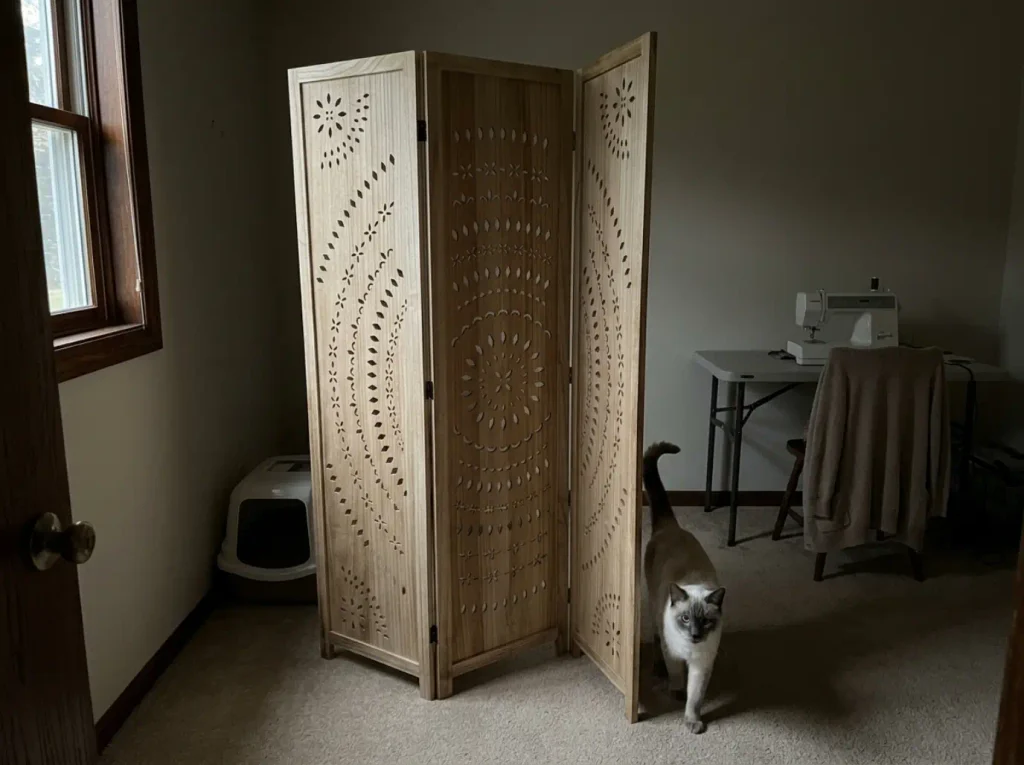
Half the placement advice online assumes you own the walls. Cutting a small cat door into a closet is a genuinely good idea, right up until the closet belongs to somebody who will inspect it in June.
What You Can’t Do, and What That Rules Out
In a rental the off-limits list is short and it’s absolute: no cut doors, no built-in nooks, no mounted fixtures, no ventilation added to a room that didn’t have it, nothing that leaves a hole or a patch. That knocks out most of what the furniture-first guides recommend as their best ideas, and it knocks out the two fixes that would otherwise solve a sealed-closet spot outright.
What it does not knock out is the thing that actually matters, which is that you can still move a box. Every rule in this article so far is about position, clearance and air, and none of them requires a drill.
The Spots That Survive the Filter
Four renter-friendly spots keep coming up, and they hold up against the criteria above. The linen or hallway closet floor, which works well because it’s usually hard-surfaced and the door frame gives a natural exit line, with the door wedged open, per the airflow section.
A guest bedroom or home office, which is the best-scoring spot most apartments have and the most commonly wasted one. Under a console table or open shelving, which gives a visual break without enclosing anything. And a laundry area, with the caveat from earlier: away from the machines themselves, not just in the same room as them.
Notice what all four have in common. They’re existing spaces used differently, they cost nothing, and every one of them comes with you when the lease ends.
Hiding It — Whose Requirement Is That?
Here’s the tension nobody names, and it runs underneath most of the litter box furniture on the market. The cat wants privacy and an exit. You want it out of sight when someone comes over. Those two overlap enough that the industry sells them as the same request, and they aren’t. Privacy means not being watched or ambushed while he’s vulnerable.
Concealment means not being seen by your guests. His version is a constraint. Yours is a preference — a completely legitimate one, it’s your apartment, but a preference, and when they conflict the constraint wins.
The cheapest honest way to serve your version without touching his is a visual break that doesn’t enclose anything. A 5.6-foot folding room divider with three panels does exactly that: it blocks the sightline from the sofa, it is genuinely no-drill, requiring no assembly and no wall, and it folds flat into the next apartment. The limitation is that it’s a screen, not a wall. It does nothing for smell, so the airflow section still applies in full, and a determined cat will eventually knock a lightweight one over if he treats it as a climbing surface.
If you want actual furniture, that’s a legitimate route and it just carries stricter rules. The Hzuaneri Cat Litter Box Enclosure publishes its interior dimensions, 20.7 by 18.3 by 18.7 inches, which is the only spec that matters and the one most cabinets hide.
Run it against this article’s two rules before you buy: does a properly sized box still leave clear floor inside for the turn, and does air have any path out? For a large cat the honest answer is often no, and a Maine Coon at full stretch rules out most enclosures on the interior number alone. An enclosure has its own placement rules, and they are stricter than a bare box’s, and where the cabinet goes matters more, not less. If you’re shopping, the furniture that fits a small apartment is a narrower list than it looks.
Two Cats, an Old Cat, and Keeping the Spot Working
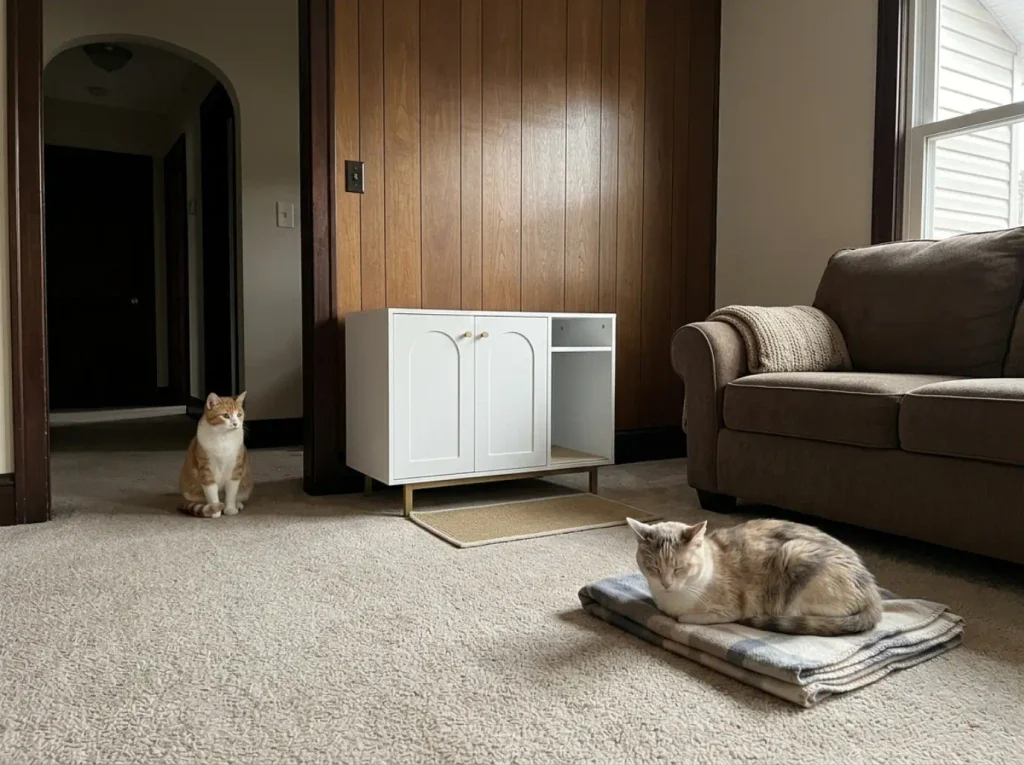
A placement that works today is a placement for the cat you have today. Two cats change the geometry, and a twelve-year-old cat changes the distance.
Two Cats, Two Rooms
In a multi-cat household the count is one box per cat plus one, and that part is well covered everywhere. The placement half is harder and gets skipped. Those boxes belong in different rooms, or on different floors, positioned so no single cat can see all of them from one place.
The reason is that a cat who can watch every box at once controls every box at once, and he doesn’t need to do anything dramatic about it. No fighting, no hissing, nothing you’d notice.
He just happens to be lying in the doorway. The other cat reads the room correctly and finds somewhere else, and you find out three weeks later when you’re cleaning the rug behind the sofa. Distributed boxes make that territorial position impossible, which is the whole mechanism: it isn’t about hygiene or about having enough, it’s about not being able to be intercepted.
The Old Cat and the Distance
For a senior cat, distance and stairs become the limiting factor before anything else does, and they do it gradually enough that nobody clocks the change. The box downstairs was fine for nine years. It’s still the same box in the same good spot. What changed is that the trip now costs him something, and at some point the cost of the trip exceeds the cost of going somewhere closer.
The fix is environmental and it’s cheap. Add a second box near where he sleeps, so the worst-case trip is short. Put a night light near it, which the AAFP and ISFM guidance specifically recommends for older cats, because failing night vision turns a familiar route into a hesitant one.
Kittens have the identical problem from the other end: small legs, no speed, no judgment about distance. The same answer works. Put a box where they already are.
What to Watch in the First Three Weeks
Placement acceptance shows up fast, which is the good news. A cat who is going to reject a new spot rejects it early, usually in the first several days, and a cat still using it comfortably at three weeks has accepted it. Watch for the small tells rather than the obvious one: going in and coming straight back out, standing beside the box before committing, scratching the floor outside instead of the litter, or using it only at night when the room is empty. Any of those means the spot is doing something he hasn’t fully forgiven.
One line that belongs here and stops there: a cat who has used a well-placed box for years and suddenly stops is not handing you a furniture problem, and that is a vet visit first — the room comes second, after he’s been cleared.
Everything else in that three-week window is routine, and routine is what keeps a good spot good. How often the box needs scooping turns out to be the single biggest variable in whether the spot holds, and how often it needs a full clean is a separate schedule with a different answer. If daily scooping is the part that keeps slipping, the tool is usually why. A scoop that doesn’t bend makes a difference out of proportion to what it costs.
Conclusion
Measure the floor, not just the box. Box length plus one box-width of clear floor on the open side, roughly 24 inches in front, and a spot that still passes when the laundry basket comes back.
Three places never work: beside the bowls, on the route everyone walks, and next to the other box. Everything else in your apartment is negotiable, including the spots you assumed were off the table.
If the spot is wrong, move the box a few inches a day rather than buying your way out. The relocation is free, it takes a week or two of nothing but patience, and it is almost always the entire fix.
Give a new spot three weeks. A cat who is going to reject it rejects it well inside that; a cat still using it at three weeks has accepted it, and you can stop watching.
Start tonight with the version that costs nothing: move the box eighteen inches off the wall and wedge the door open a hand’s width. If that fixes it, you just saved yourself the price of a cabinet.
Amazon’s Audible — free for 30 days
Your cat won’t let you read. Let someone read to you.
Audible is Amazon’s audiobook library — thousands of titles, read out loud, on your phone. Free for a month, plus one audiobook to keep forever.
Frequently Asked Questions
01Where should you not put a cat litter box?
Beside the food and water bowls, in a hallway or entryway everyone walks through, and directly next to another litter box. Each fails for a different reason: competing needs, unpredictable traffic, and two boxes reading as one resource. All three are common in small apartments, because the leftover corner tends to collect everything at once.
02Where do most people keep a cat litter box?
The bathroom, the laundry room and a spare bedroom are the three most common spots, in roughly that order. Common is not the same as correct. The laundry room in particular passes on quiet and fails on unpredictable noise, which is why so many boxes there quietly stop being used.
03Is it okay to keep my cat’s litter box in my bedroom?
Yes, and for a lot of apartments it is the best available spot: quiet, low-traffic at the hours the cat uses it, and the door usually stays open. Get two things right. Ventilation, since bedrooms are often the most closed-up room in the home, and distance from where the cat eats or sleeps.
04Will my cat remember where the litter box is if I move it?
He will find it, but that is not the same as using it. Cats navigate to a remembered location first, so an abrupt move often produces accidents in the old spot for days. Moving the box a few inches to a couple of feet per day avoids that, because he is never asked to remember anything new.
05What is the golden rule for litter boxes?
One box per cat plus one extra, but the count is only half of it. Those boxes have to sit in different rooms or on different levels, because two boxes side by side function as a single box, and in a multi-cat home a single box is something one cat can stand next to.
Leave a comment