Cat Water Fountains, and the Cat They Actually Work For
Don't buy one until you run the two-bowl test (it's free). The 2018 study found no average gain, but 3 of 14 cats had a clear favorite.

Alfredo RamsesFounder · August 26, 2026 · 22 min read

On this page9 sections
- 1What a Water Fountain Actually Changes
- 2Why the Bowl You Already Have Is Failing
- 3The Four Kinds of Fountain, and Who Each One Is For
- 4Stainless, Plastic, and What the Box Does Not Tell You
- 5One Cat, Three Cats, and the Number Nobody Gives
- 6Where It Goes When You Rent and the Outlet Is Wrong
- 7The Weekly Job You Are Signing Up For
- 8The Short Version
- 9Frequently Asked Questions
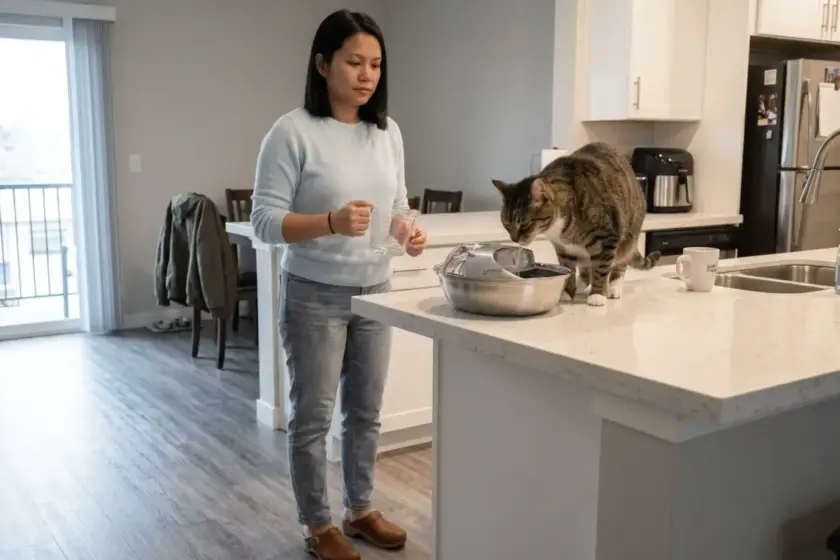
A woman in a fountain thread found out her pump had died because her cat started drinking out of the toilet. Not the low-water indicator, not an auto shut-off, not a noise, not the empty top tier she walked past twice a day. The cat. He wasn’t being gross, and he wasn’t broken: he went and found the only moving, cool water left in the house, which is exactly what the fountain had been selling him for a year.
The whole category is sold on one idea: cats have a weak thirst drive, so more water in means less risk of chronic dehydration, and dehydration is the thread that runs through urinary tract infection and kidney disease in older cats. That part is established and not in dispute.
What is in dispute is whether a fountain is what delivers it. There is a controlled study on cat water fountains, and its headline result is not the one printed on the box. Here is what a fountain actually changes, which cat it changes it for, and what it costs you every single week.
Quick Answer
On average, a fountain does not make cats drink measurably more than a clean bowl does. Individual cats disagree strongly, and about one in five has a clear favorite. Get one if your cat is that one, if you have several cats, or if the bowl keeps going stale. It comes with a weekly cleaning job a bowl does not.
What a Water Fountain Actually Changes
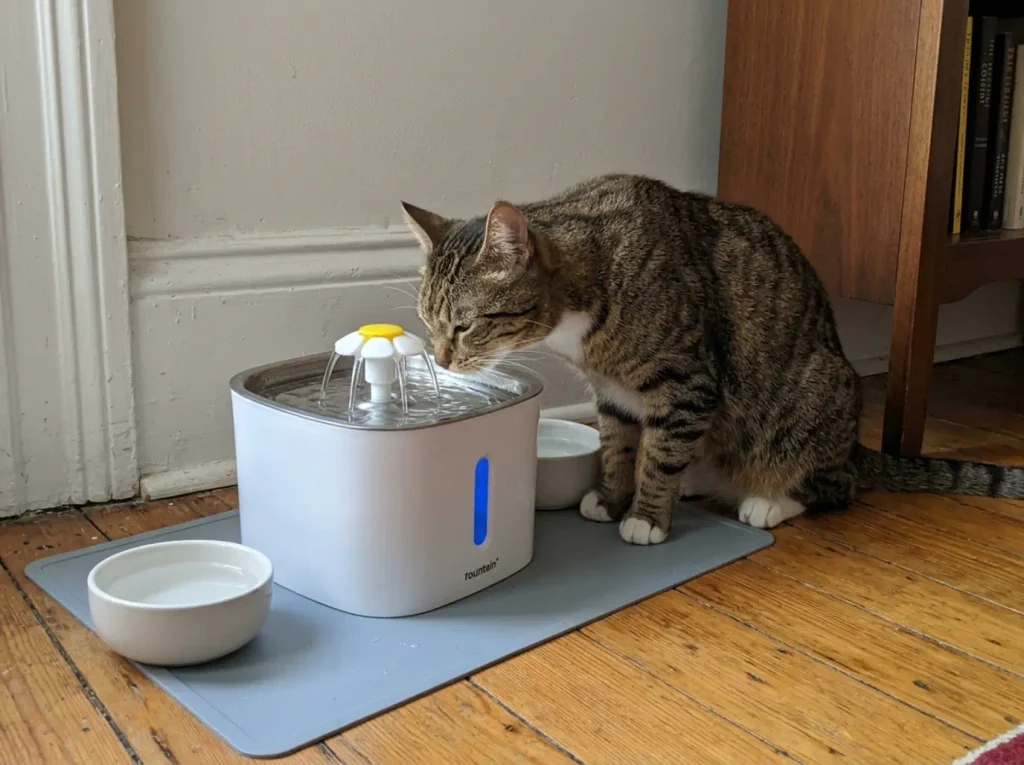
The whole category rests on one sentence: cats prefer moving water. It gets repeated on every box, in every listing, and in about four of the five results above this one. It has been tested, and the result is more interesting than the slogan.
What the study measured, and what it found
In 2018, Robbins and Cline ran fourteen healthy cats through three drinking setups, two weeks on each: a still steel bowl, a circulating plastic bowl, and a free-falling fountain. They measured water intake, urine output and urine concentration, which between them are a reasonable proxy for whether a cat is actually drinking more. All three came out statistically the same. There is a veterinary summary of the 2018 intake study if you want the numbers rather than my paraphrase of them.
So the fountain did not win. It also did not lose. Fourteen cats moved from a plain bowl to a piece of running-water technology and the group drank the same amount, which is a result nobody selling fountains has any reason to bring up.
The three cats that disagreed
Here is the part that never gets quoted, and it is the part that decides your purchase. Three of those fourteen cats showed a strong, consistent individual preference.
Not a mild lean over two weeks: a clear favorite. And each of the three preferred a different setup. One of them preferred still water.
Read that again, because it flips the marketing on its head without making it a lie. “Cats prefer running water” is wrong about cats. It might be entirely right about your cat.
Roughly one in five in that sample had an opinion, and there is no way to know from the outside which fifth yours is in. That is not a shrug, it is a testable question, and the test is free.
Before you buy anything, run the two-bowl test. Put a second plain bowl somewhere your cat already walks past, leave the original where it is, and watch for two weeks which one drops faster. That answers the same question the fountain is asking, for free, and it tells you where the water should live either way.
What changes for certain, study or not
Two things do change, and neither of them is hydration. A fountain keeps water in circulation, so it never becomes stagnant water sitting still for two days picking up whatever the kitchen smells like that week. And it holds a lot more than a bowl, which turns “refill twice a day” into “refill twice a month.”
That is a refill-frequency benefit and a freshness benefit. Real ones. Just not the miracle on the packaging.
The honest counterweight comes from owners themselves. There is a recurring story in these threads about someone who bought a second fountain for another floor and swears the cats now drink twice as much. I’m not going to pretend that person is imagining it, and the study doesn’t say they are.
It says the average cat won’t. Those two things sit together fine, and if you want the mechanism pulled apart properly, what actually changes when a fountain replaces a bowl is a longer conversation than this page can have.
Why the Bowl You Already Have Is Failing
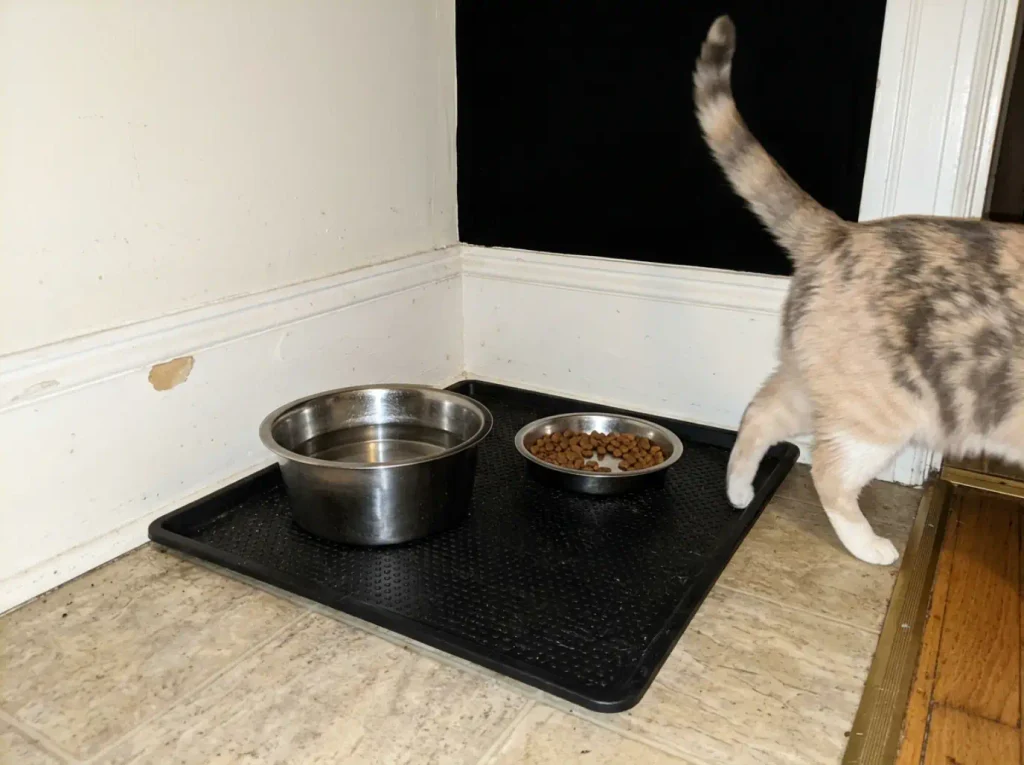
Half the people reading this don’t need a fountain. They need the bowl moved. Nobody in the search results says that, because there is nothing to sell at the end of it, so it goes here instead, before anything with a plug.
The bowl shape, and where the whiskers land
Pick up your cat’s water bowl and look at it side-on. If it is deep and narrow, the kind that came in a two-pack with the food bowl, the sides are touching his whiskers on every single drink. Whiskers are wired in and they report back constantly; pressing them against ceramic forty times a day is a low-grade irritation that a cat solves the only way he can, by drinking somewhere else.
Whisker fatigue, or whisker stress, is the term you’ll see, and the fix is embarrassingly cheap: a wide, shallow dish where nothing touches the sides. Your cat is not fussy. The bowl is the wrong shape and he has been saying so.
Water next to food is water that gets ignored
The default setup in almost every home is a food bowl and a water bowl, side by side, on the same mat. It is tidy for you and it is the arrangement cats walk away from most reliably. The usual explanation is an old instinct about not drinking next to where prey was eaten, and whether or not you find that convincing, the behavior is easy enough to observe: put water in a second room and watch which one goes down.
Then there’s staleness, which is quieter. A bowl left two days grows a faint surface film and takes on the smell of whatever is cooking near it. You will not notice. He noticed yesterday.
The toilet, by the way, is cool, moving, and nowhere near the food, which makes it a completely rational choice and a fairly pointed piece of feedback about the bowl. Food and water separation is the free half of this fix, and almost nobody does it.
The free version of this fix
Do this before you spend anything:
- Move the water bowl away from the food. Different side of the room is a start, different room is better.
- Add a second bowl somewhere he already walks past. Hallway, bedroom, next to the window he sits in.
- Swap deep and narrow for wide and shallow, so nothing touches his whiskers while he drinks.
Give that two weeks. It works often enough that it should always come first, and if it works you have your answer and your money. If the water still goes untouched, or if you have several cats and the real problem is that the bowls are empty by six, then a fountain starts to make sense, and it is worth reading the safety questions worth asking before you plug anything in before you pick one.
The Four Kinds of Fountain, and Who Each One Is For
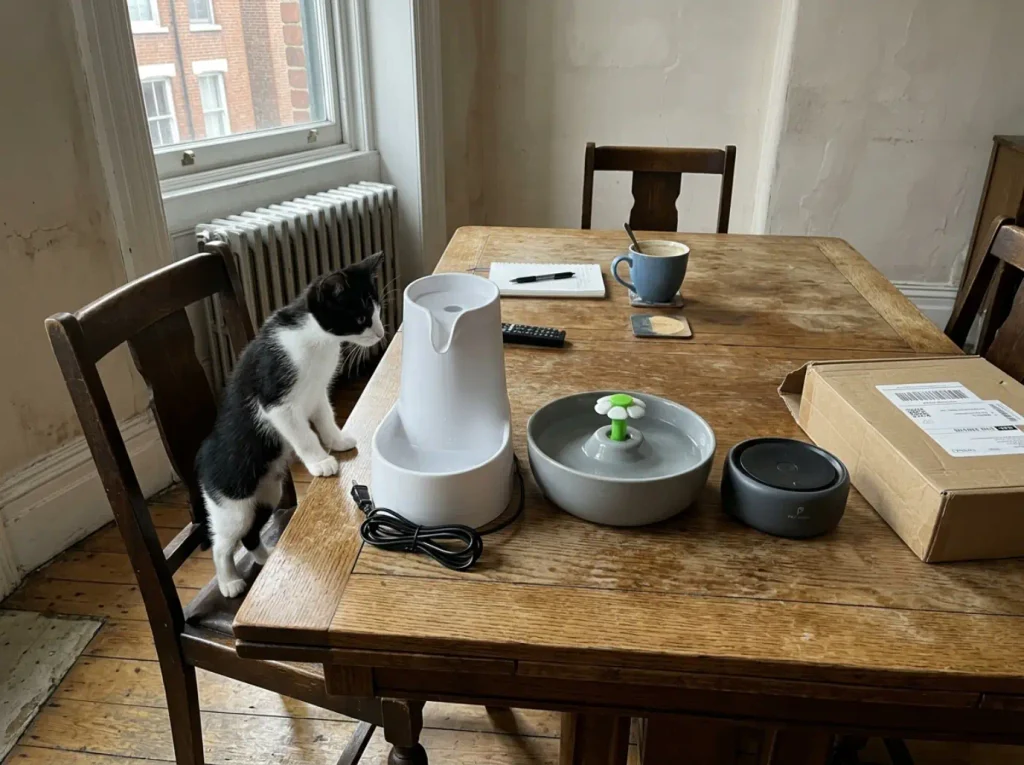
Fountains get sorted by looks in most roundups, which is useless. Sorted by the problem each one solves, there are four, and the differences between them matter more than the brand names on top of them.
Free-falling and cascading types
The free-falling type drops a visible stream from a spout into the basin. It is the loudest kind by design, because the noise and the movement are the point: this is the one for a cat who has to see the water to care about it. The flower and cascading-dish shapes run water over a wide, shallow surface instead. People buy those for the shape and get something better than they paid for, because a wide open surface means no whisker contact, which is a geometry benefit that has nothing to do with the flower.
The quiet ones
Submerged designs move the water without a visible stream. The surface stirs, the water stays in circulation, and the room stays silent. This is the category for two situations: the cat who dislikes the splashing, and the apartment where the fountain has to live somewhere you sleep. In a studio, everything lives somewhere you sleep.
I used to treat the noise level as a spec-sheet footnote, the decibel number at the bottom of the listing nobody reads. Enough returns threads later where the complaint is not the pump failing but the pump working, at 3 a.m., ten feet from a pillow, and I moved it near the top of the list. If that’s your room, which quiet fountain is actually quiet enough for a bedroom is the comparison to read next.
Cordless, and what it removes
Battery-operated and radar induction units are the newest category and the only one that changes what is physically possible in a rental. A magnetic rotor pump does the work of a conventional submersible pump with no cable crossing the floor and no dependency on where the previous tenant decided outlets should go. Most are motion-activated, so they only run when a cat approaches, and that flow mode is what makes a battery last months instead of days. Runtimes have gotten long enough that this stopped being a compromise, which is its own section further down.
Capacity ranges across all four types from a small single-cat tank up to a multi-cat reservoir. Sizing is a real calculation and it gets its own section, so ignore the liter number for now and pick the type that matches your room.
| Type | How the water moves | Who it suits |
|---|---|---|
| Free-falling stream | Faucet-style spout or bubbler, visible drop into the basin | The cat who has to see it moving |
| Flower / cascading dish | Runs over a wide, shallow surface | Whisker-sensitive cats; audible splash |
| Submerged / quiet flow | Surface stirs, no visible stream | Bedrooms, studios, noise-shy cats |
| Cordless / induction | Battery or magnetic pump, no cable | Rentals with no outlet nearby; needs charging |
Stainless, Plastic, and What the Box Does Not Tell You
“Stainless steel” reads like a settled upgrade, the grown-up choice, the end of the material conversation. It is not one material, and the part that decides whether yours ages well is usually not printed anywhere on the listing.
Two grades of “stainless”
SUS304 is food-grade steel. It is chemically stable in permanent water contact, which is the specific job a fountain basin has, twenty-four hours a day, for years. SUS201 contains less nickel and forms a less stable oxide layer, and under tap-water chlorine plus the salts a cat leaves behind, it can pick up surface corrosion over about a year. Neither one is acutely unsafe. One of them still looks like the product photo after eighteen months.
Here is the checkable detail nobody publishes: if the listing does not name the grade, assume 201. Manufacturers using 304 say so, because it costs more and it is the only spec in the category worth advertising. Silence in a spec sheet is an answer.
What scratches do to plastic over a year
BPA-free ABS plastic is not automatically a bad buy, and I’d rather someone bought a plastic fountain they’ll actually clean than a steel one they resent. What plastic does is micro-scratch. Every wipe with the rough side of a sponge, every time a cat’s claw catches the rim, leaves grooves too small to see and deep enough to hold biofilm that a cloth passes straight over. That slow bacteria buildup is a problem you meet in year two, not on day one, and it is why an older plastic basin can smell faintly of pond while looking spotless.
Ceramic sits between the two. Heavier, does not scratch the way plastic does, and when it fails it chips rather than dents.
One owner in a fountain thread described a cat with ongoing stomach upset that stopped after they retired a plastic fountain. One report is not a study, and I’m not going to dress it up as one. Recurring digestive trouble is a vet visit, not a shopping decision, and that is the end of that thread here. What the story does line up with is the scratch-and-biofilm mechanism above, which is the whole reason the material question is worth asking at all.
The same fountain in two materials
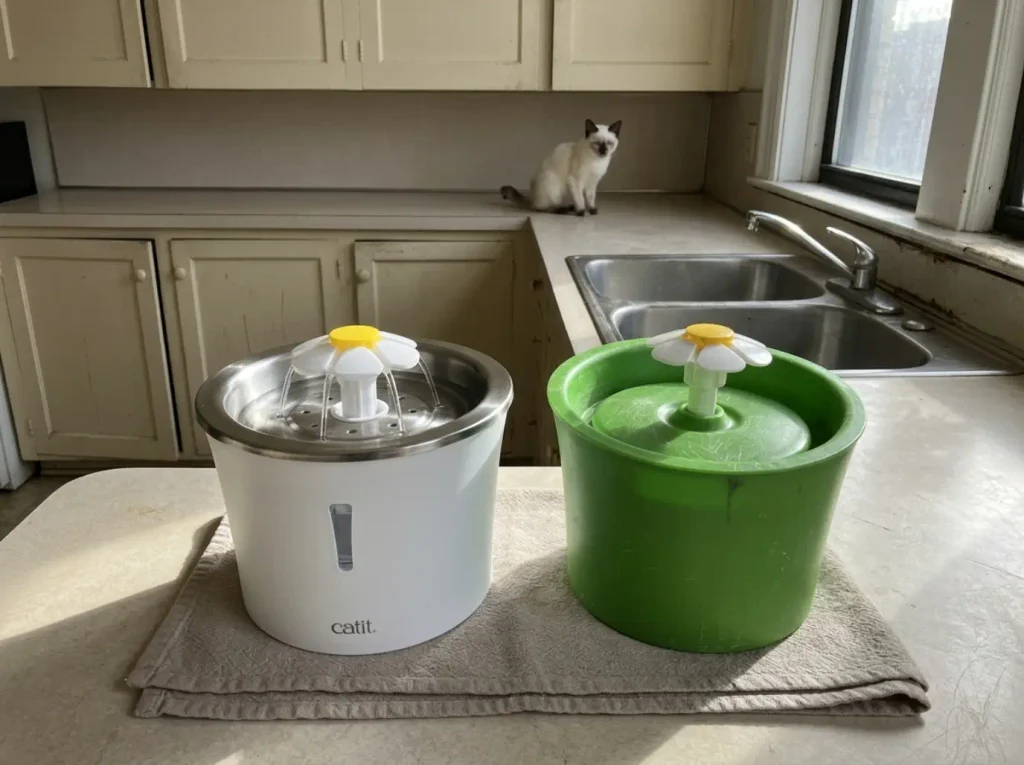
The cleanest way to see the trade is a product family that sells both. The Catit Stainless Steel Flower Fountain holds 3 liters and runs the same triple-action filter as its plastic sibling, so the basin is genuinely the only variable between them. Its limitation is the one every flower fountain has: the wide open surface that is so good for whiskers is also more surface to wipe down every few days.
The Catit Flower Fountain in green plastic is the same 3 liters, the same filter, the same shape, for noticeably less. That is the honest cheaper option and it deserves to be stated as a trade rather than a warning: cheaper today, against micro-scratching that shows up somewhere in year two. If money is the deciding factor, buy the plastic one and put the difference toward replacement filters. A well-maintained plastic fountain beats a neglected steel one every time.
One Cat, Three Cats, and the Number Nobody Gives
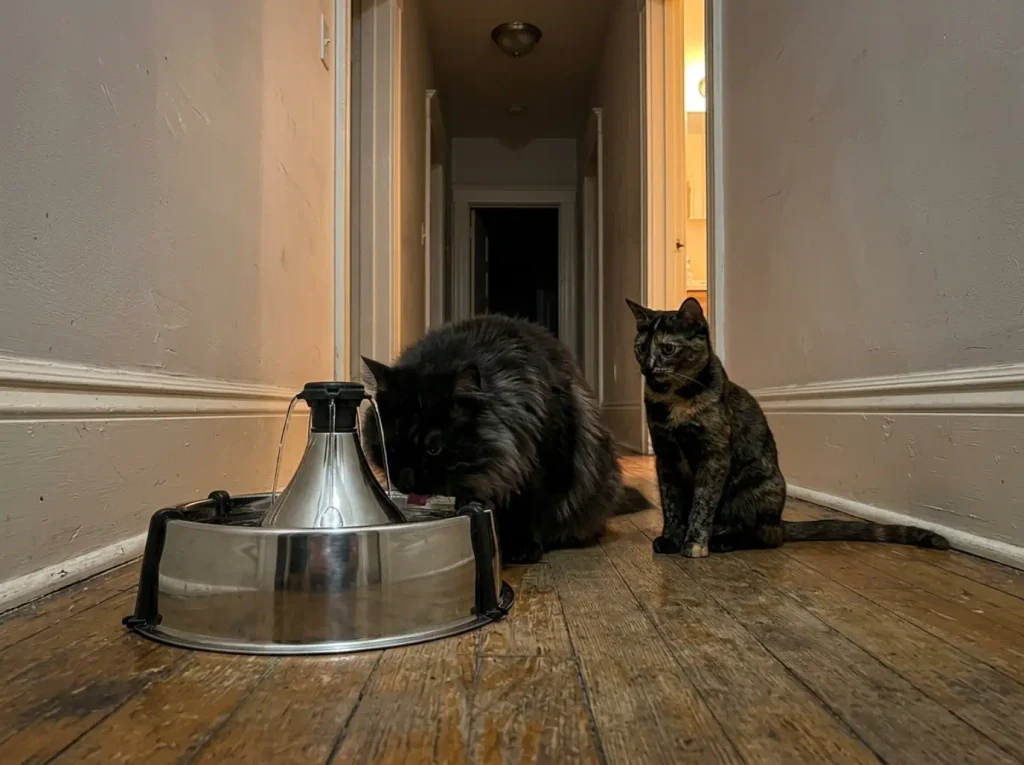
Every roundup on the first page names one model “best for multi-pet” and leaves it there, as though a multi-pet home were a single setting rather than a sizing problem. Not one of them says how many cats that means, or for how many days. That number exists and it is not hard to work out.
A cat drinks somewhere around 200 to 400 ml a day, and diet moves it more than anything else. A cat on wet food is getting a large share of that from the food itself and may barely touch a bowl. A cat on dry food is drinking all of it, and that difference alone can double what your fountain has to supply.
Run the arithmetic and the sizing rule falls out. A large reservoir around 5 liters runs roughly two weeks for one cat. That same tank covers a two-cat household for about seven to ten days. A mid-size 3-liter fountain with three cats on it is a two-to-five-day proposition, and four or more cats means a refill every day or two, or a second unit somewhere else in the house.
But those are run-dry numbers, and run-dry is the wrong thing to plan around. The interval that actually matters is when it should be emptied, and for a full empty-and-refill, three or four days is the honest real-world figure regardless of how much is left in the tank. Standing water in a reservoir runs on the biofilm clock, not the water level, and topping up a two-week tank every few days just means the water at the bottom is two weeks old. That distinction is worth more than any capacity spec, and how often the water actually needs changing goes through the schedule properly.
The other rule that transfers straight over from litter boxes is one resource per cat plus one, in separate places. It applies to water as much as it applies to boxes, and it is the reason a second fountain is usually the wrong answer for a two-cat home. A fountain plus two plain bowls in other rooms is the right one: more places to drink, more escape routes, a fraction of the cleaning.
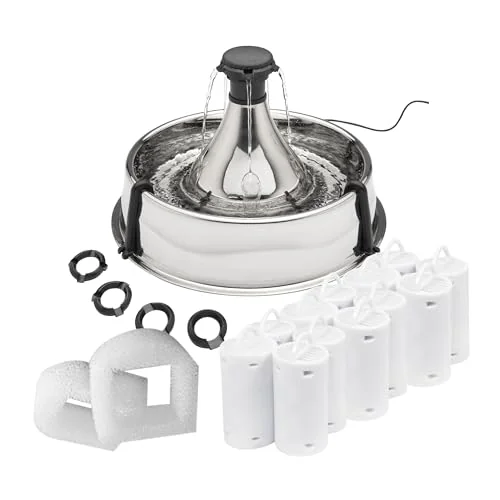
There is one more habit worth stealing from experienced owners, and it has nothing to do with capacity. A lot of them keep a plain backup bowl beside the fountain permanently. Not for a picky cat. For the failure mode at the top of this article: a pump dies without a sound, the water level looks fine because the reservoir is still full, and nobody notices until the cat starts drinking somewhere strange.
Keep one plain bowl next to the fountain for good. A pump that dies at 2 a.m. is completely silent and the tank still looks full, so the bowl is what covers the gap until you notice. It costs nothing and you already own one.
Where It Goes When You Rent and the Outlet Is Wrong
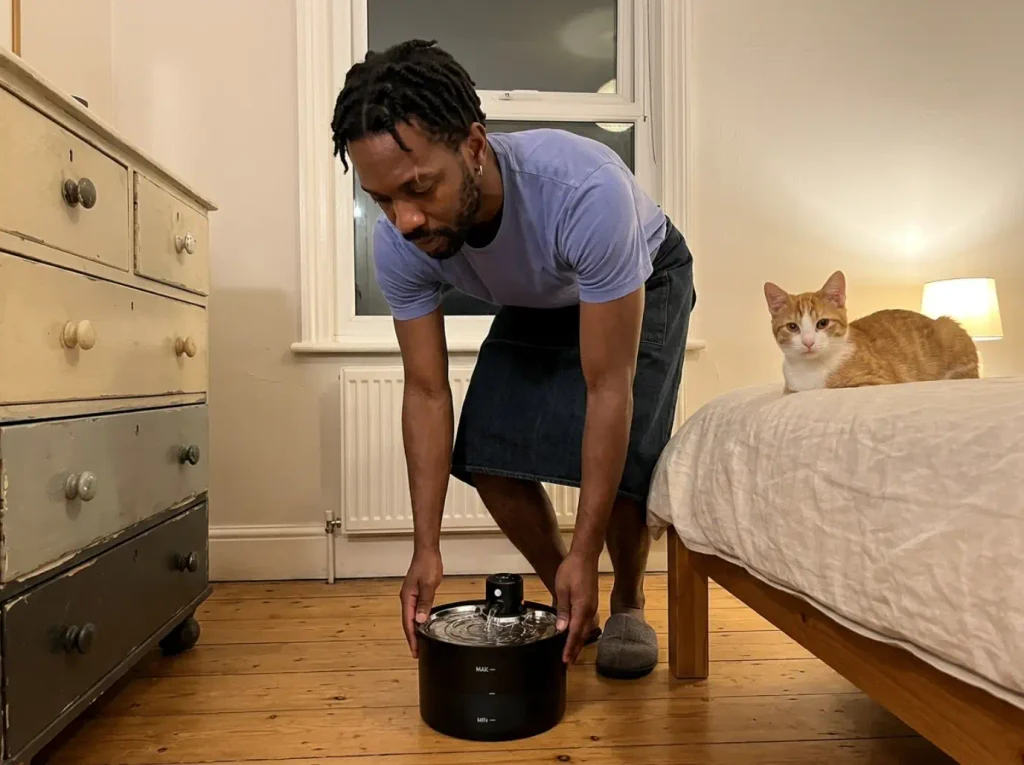
Every article on this subject says to put the fountain away from the food, and every one of them assumes you can put it anywhere. In a one-bedroom rental you have maybe three viable spots, two of them are already occupied by furniture you can’t move, and the only free outlet is in the wrong room entirely.
The placement rule itself is sound: water away from food, away from the litter box, somewhere the cat already passes. A corded fountain then has to negotiate all of that against a floor plan somebody else designed in 1974. That negotiation is the actual problem, and here is how it goes.
A GFCI adapter plug is the cheapest safety upgrade in this entire category. It goes between the fountain and the outlet, it trips the instant it senses a ground fault, it requires no electrical work, no landlord permission, and no explaining yourself, and it comes out of the wall with you at move-out.
What it is not is a reason to reach for an extension cord instead, which adds a second run of cable across the floor for a cat to find.
US kitchens and bathrooms already have GFCI outlets built in. Bedrooms and living rooms almost never do, which is exactly where a fountain ends up in a small apartment. Outlet placement, not floor space, is the constraint that actually decides the room. Buy the adapter.
Then there’s the cord itself, which has to survive a deposit inspection:
- Run it along the baseboard inside a clip-on raceway or a fabric cable sleeve. Both peel off clean.
- Skip adhesive anchors and anything that drills. Adhesive takes paint with it, and paint is what deposits are made of.
- Route it behind a furniture leg rather than across open floor, so the cord is boring instead of interesting.
Worth being precise about what the electrical risk actually is, because it is not the one people picture. The water is not going to be electrified: 12V transformer-isolated pumps and USB 5V pumps both keep mains voltage on the other side of a barrier, and that is the standard architecture across the category. The real risk is a cat chewing a cord down to bare copper. A cordless unit removes that category entirely, which is a different kind of fix from routing the cord better.
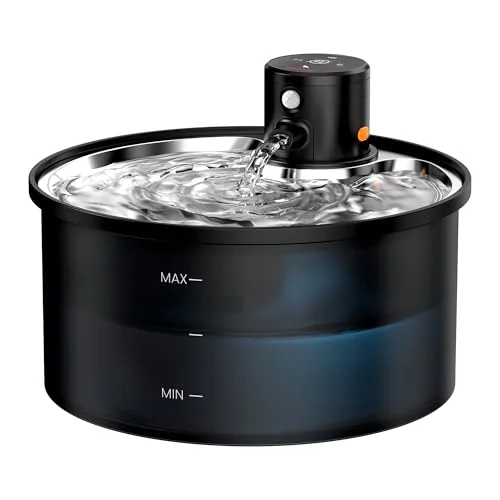
Runtimes are the reason this stopped being a compromise. A large battery unit now goes a couple of months between charges, which puts recharging in the same mental category as replacing a filter rather than a nightly chore. And if your two constraints are the two hardest ones stacked on top of each other, several cats and no outlet in the right room, the APD APETDOLA Wireless Stainless Steel fountain is the one unit that answers both at once: 135 fl oz, a stainless basin, and 60 to 100 days per charge. It sits at the top of the price range for a fountain, which is the honest catch, and it is also the only thing on this page that solves the multi-cat sizing problem from the previous section without needing a wall socket to do it.
The Weekly Job You Are Signing Up For
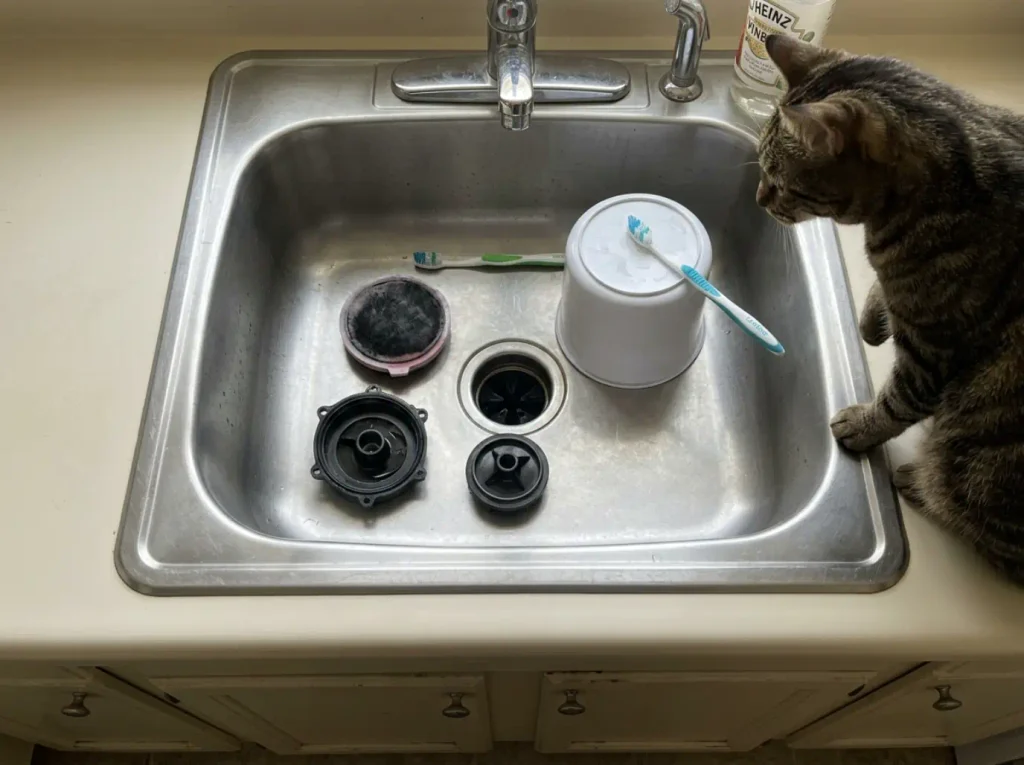
A bowl gets rinsed. A fountain has a chore attached, and the chore is the real trade you are making. Anyone who tells you otherwise has not run one for a year.
The actual schedule
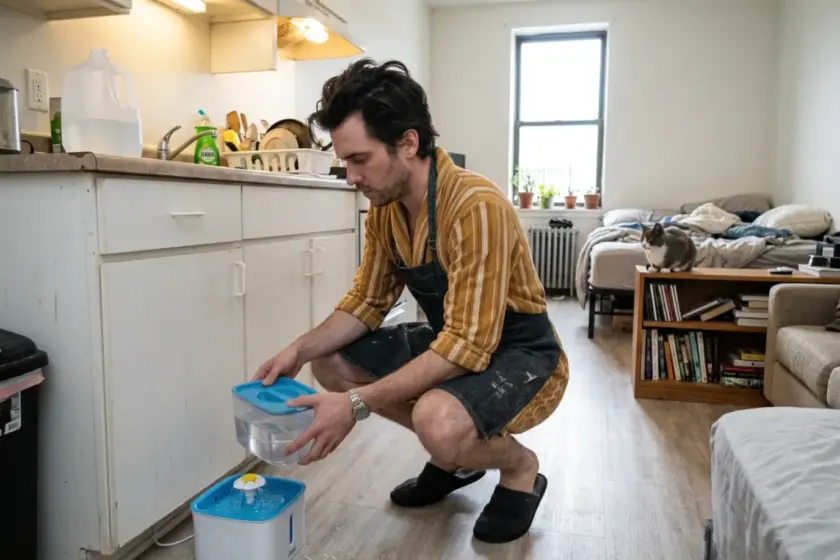
Rinse and top up daily, at the same time you scoop the box, because a chore attached to an existing chore is one that survives. Wash the parts the water touches every two or three days. Take the pump apart and deep-clean it weekly, which means the impeller and the housing, not just the outside.
A dishwasher-safe steel basin saves you one of those jobs; the pump is never dishwasher-safe and never will be. Replace the carbon filter every two to four weeks, though some higher-capacity models stretch that to one to three months and say so on the box.
That’s four separate rhythms. Nobody keeps all four in their head, which is why the fountain that gets abandoned is almost never the one that broke. The full method for each of them, the full cleaning routine, filter included, is its own article, because it deserves more room than this one has.
What “filtered” means on the box
The carbon filter is doing a taste job, not a hygiene job. Activated carbon adsorbs chlorine, chloramine and the organic compounds that make tap water taste and smell like tap water, and that is the whole of its function.
It does not sterilize. It does not remove bacteria. “Filtered” on the packaging is a flavor claim wearing a lab coat.
A foam prefilter, where the model has one, catches hair and grit before it reaches the carbon and is the part most people forget exists.
Worse, and this is the part that catches people: a saturated filter stops being neutral. Once the carbon is loaded, its enormous surface area becomes somewhere bacteria colonize, and the thing installed to keep the water clean is now the dirtiest object in the tank. One owner described exactly this, a purple growth that came from the filters and stained the pump, and gave up on filters entirely rather than change them. Half of that decision was right.
Set the filter change on a repeating phone reminder rather than judging it by eye. A saturated filter looks exactly like a fresh one right up until it stains the pump, and by then it has been the problem for a fortnight.
The pink slime, and what it really is
The pink or purple film in the corner of the reservoir is not dirt and it is not mineral scale. It is a colony, usually Serratia marcescens (bacterial, pink) or Fusarium solani (fungal, purple-pink), both opportunists that love a warm wet pump housing and a filter that has been in place too long. Green algae is a different and much less common problem, and it only shows up if the fountain sits in direct sun. That is why “it still looks clean” and “it is clean” are two different statements: biofilm is transparent until the population gets big enough to show its color, and by the time you can see pink, you are looking at the late stage.
The deep clean that works is a white vinegar soak, diluted about half and half with water, fifteen minutes, then scrub and rinse. Vinegar breaks the polymer matrix holding the colony to the surface, which is what a plain wipe fails to do, and it leaves nothing behind that a cat shouldn’t drink. Bleach and household cleaners do leave residue. That’s the entire reason to skip them here, and it is a good enough reason.
One last failure mode, and it is a different one: hard-water scale. Mineral deposits build up on the pump over months and eventually seize it, which is the real story behind most fountains that simply stop working after a year. Vinegar handles that too, on the same schedule, which is a rare piece of good news. It is also a maintenance load that tracks directly with material and build quality, and if that’s the deciding factor for you, the steel models worth the extra money is where that argument gets made properly.
The Short Version
Run the two-bowl test before you spend anything. A second plain dish in a room your cat already uses answers the same question the fountain is asking, for free, and for a good share of people it ends the problem right there.
If you do buy, buy for the constraint you actually have.
Several cats means capacity and separate stations. A rental with bad outlets means cordless. A bedroom means quiet. The type follows the constraint, not the review score.
And the fountain is not the purchase. The weekly clean is. A fountain nobody deep-cleans is a worse bowl than the bowl it replaced, which is a strange thing to spend money on.
Check back in three weeks, not three months. This depends on the cat accepting something new and on you keeping a routine, and both of those declare themselves fast. At three weeks, look at two things: is the fountain the water they actually use, and is the cleaning still happening on a schedule or has it quietly become “when I remember”?
Start with the free version. Move the bowl away from the food, add a second one down the hall, and give it two weeks. If drinking picks up, you just answered the question and kept the money.
Amazon’s Audible — free for 30 days
Your cat won’t let you read. Let someone read to you.
Audible is Amazon’s audiobook library — thousands of titles, read out loud, on your phone. Free for a month, plus one audiobook to keep forever.
Frequently Asked Questions
01Do vets recommend water fountains for cats?
Some do and some don’t, and the reason is that the controlled evidence is thin: the one intake study found no population-level difference against a clean bowl. Where vets agree is the goal, which is more water intake, especially on dry food. A fountain is one route there and a second bowl in another room is another.
02Are water fountains worth it for cats?
They’re worth it for the cat who prefers one, for a multi-cat household where the refill interval is the real problem, and for anyone whose bowl keeps going stale before someone changes it. They aren’t worth it if the fountain will sit unwashed, because an unwashed fountain is a worse bowl.
03What are the cons of cat water fountains?
The weekly cleaning, the filter replacement cost, pump noise in a quiet room, and the failure nobody expects: a pump that dies silently and leaves the cat with no moving water until someone notices. Keeping one plain bowl alongside it covers that last one for free.
04Can I leave my cat’s water fountain on all the time?
Yes. They’re built to run continuously and the pump depends on staying submerged. What matters far more than switching it off is that the reservoir gets fully emptied and refilled on schedule rather than just topped up, since topping up keeps the oldest water in the tank indefinitely.
05Is a cat water fountain safe to plug in near water?
The common designs keep mains voltage away from the water: 12V transformer-isolated and USB 5V pumps both isolate it, and cordless units have no cord crossing the boundary at all. A GFCI adapter plug adds outlet-level protection with no electrical work, worth doing in any room that doesn’t already have one.
Leave a comment