Cat Allergies Take 4 to 6 Months to Clear From a Home
Carpets hold 13x more cat allergen than smooth floors, a bath fades in a week, and a home needs 4 to 6 months to clear [numbers from Ohio State & PMC].

Alfredo RamsesFounder · Updated October 30, 2026 · 16 min read


On this page9 sections
- 1What Cat Allergies Are Really About, and It Isn't the Hair
- 2Who to Call: the Doctor for You, the Vet for the Cat
- 3How Long a Home Keeps Cat Allergen After the Cat Is Gone
- 4Where the Allergen Sits in the Apartment: Floors, Fabric and Air
- 5What a Bath Buys, and the Week It Doesn’t
- 6Keeping the Cat Out of the Bedroom, and What That Costs the Cat
- 7One Cat or Several: Why the Count Changes the Answer
- 8Start With a Damp Cloth and Give the House Months, Not Days
- 9Frequently Asked Questions
You vacuum the sofa, empty the brush into the trash, and the room feels no different an hour later. The hair was never the center of cat allergies, and the cat did nothing wrong by making it: grooming himself is what every cat does, and the protein that travels with that habit sits on his skin and in his saliva. Ohio State’s veterinary school and a 2021 veterinary review agree on this, and between them they give a number most pages leave out, which is how long a home holds on to that protein after the cat is gone. This guide goes in the order you will need it: what the allergen is, who to call, how long the clock runs, where it sits in an apartment, what a bath buys, what the bedroom rule costs the cat, and what changes when there is more than one.
Quick Answer
Cat allergies come from a protein on the cat’s skin and in his saliva that travels on dander, not from the hair. After a cat leaves, a home can take 4 to 6 months or more to return to no-cat levels. Cleaning helps. Whether you can live with the cat is a question for your doctor.
What Cat Allergies Are Really About, and It Isn’t the Hair
The protein sits on the skin and in the saliva
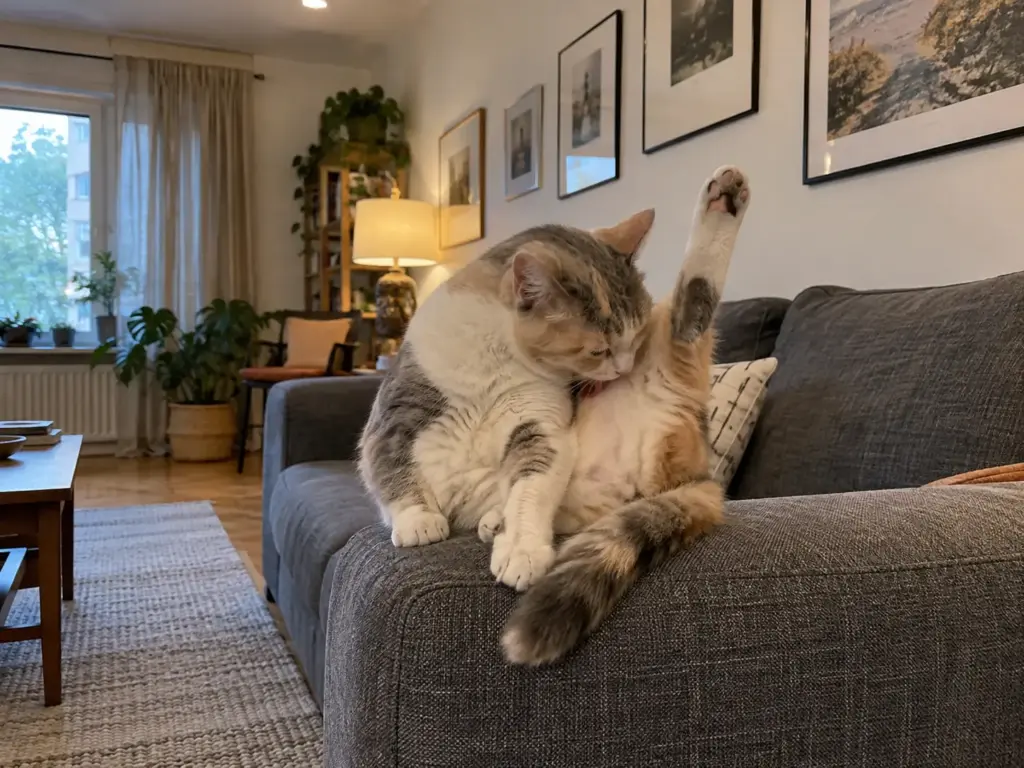
Ohio State’s veterinary public health guide to allergic reactions to cats puts the cause in one sentence: allergies to cats come mainly from a single protein found on the skin and in the saliva. It is usually called Fel d 1. The cat spreads it by grooming, because cat saliva dries on the skin and the coat, and flakes of skin (pet dander) carry the protein off. Dander is light, so it rides the air and settles into whatever is soft.
None of that is the cat’s fault. Washing himself is how he stays clean and calm, and the allergen comes along whether anyone wants it or not. What you can change is the house, and that is where the rest of this guide spends its time.
Why the hair gets blamed
Hair is what you can see. It collects on the sofa, in the brush, on dark clothes, so it takes the blame for whatever you notice in the room. Hair does carry some dander and dried saliva along with it, which is why lifting it off the sofa still makes sense.
But an empty lint roller is not a clean room, because the thing you are trying to remove is too small to see and too light to stay where it lands. The hair that falls has its own guide, on living with cat shedding in a rented apartment. This one covers what the hair doesn’t explain.
Why no cat is allergen-free
A cat that sheds less hair does not make less allergen, so the usual shortcut of choosing a short-coated cat gets you less hair on the sofa and the same protein in the air. Ohio State’s guide says outright that hypoallergenic cats, meaning low-allergen producers, and allergen-free cats do not exist, because every cat makes at least one allergen. The list of cat breeds that shed less is a list about hair, and it reads best that way.
Who to Call: the Doctor for You, the Vet for the Cat
For you, the doctor
Whether you are allergic to your cat is not something a page about floors and furniture can tell you, and a page that claims to is guessing. Ohio State’s guide says to see your doctor to be certain, and that is the right order: the doctor first, the house second. Tests, medicines and anything else aimed at you rather than at the home belong to that conversation, along with the question of whether keeping the cat is workable for you.
One line is not a house question at all. If breathing is hard, that is a same-day medical visit or urgent care, and no cleaning routine in this guide stands in for it.
For the cat, the veterinarian
A second mix-up turns up all the time. Being allergic to a cat and a cat being allergic to something are two different problems with two different professionals. If your own cat is scratching, itching or has skin trouble, VCA’s allergy guide for cat owners says he needs a full diagnostic evaluation to rule out other causes of itching, skin problems and other allergy signs. This guide goes no further than naming that visit.
The same goes for any change in the cat’s coat or skin: it belongs to the veterinarian before it belongs to the housekeeping, and when cat shedding is a problem draws that line for the hair itself. Everything from here on is about the house.
How Long a Home Keeps Cat Allergen After the Cat Is Gone
Take a household that had lost its cat and planned to steam-clean the carpet, the tile and the upholstery before relatives who react to cats came to visit. More than two months had passed, and earlier guests had still “opted to not stay with me.” She was asking whether the cleaning would be enough. The clock she was working against is longer than two months, and it has an actual number.
What the first two weeks look like
In a UK study of cat allergen in British homes, published in Thorax, researchers took the cat out of the living room and kept measuring the air. The small particles stayed largely unchanged on days 1, 2 and 4, and had slowly dropped to 33 percent of their starting level by day 14. The total in the air fell 61.7 percent by day 2, but most of that was large particles, which leave the air quickly and were never the lingering part.
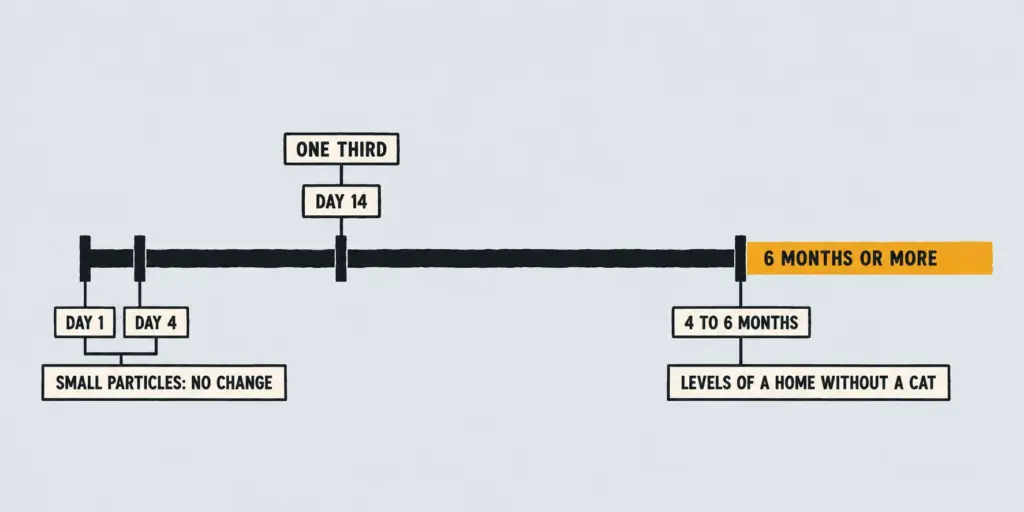
That is why the first days fool you. The drop on day 2 looks like progress while the small particles have not moved. And these are readings of the air in two rooms, not of the sofa, the rug or the curtains, which are where the allergen settles.
Why it takes months, not weeks
For the whole house the figure is much longer. According to a 2021 veterinary review of human cat allergy by Andrew Sparkes, “it may take 4-6 months or more to achieve levels seen in homes without cats.” The same review says thorough cleaning, including washing or removing carpets, may speed that up.
Mount Sinai’s guidance on bathing a cat for allergies is a second source with the same message: after a pet is removed, the allergen stays in the house for 6 months or more. Two sources, two phrasings, one answer, which is to count in months. (The rug is the slowest piece, and in a rental it is often not yours to pull up, so the months are the number to plan around, not the carpet.)
What “clear” means for a home
Clear, in these studies, is a benchmark and not a feeling: the levels you would find in a home that never had a cat. That is why the number is so long. It describes the whole house, and a house is mostly fabric and floor.
An air reading drops faster than the reservoir does. The air of one room can look much better by day 14 while the sofa, the curtains and the rug still hold what they hold, and they give it back whenever something disturbs them.
The 4 to 6 months is a number for the whole house, not for the air in one room, so a room that seems finished is no reason to stop. Keep the routine going until the months are up, and read a good week as the routine working, not as permission to drop it.
Where the Allergen Sits in the Apartment: Floors, Fabric and Air
The rug holds more than the floor
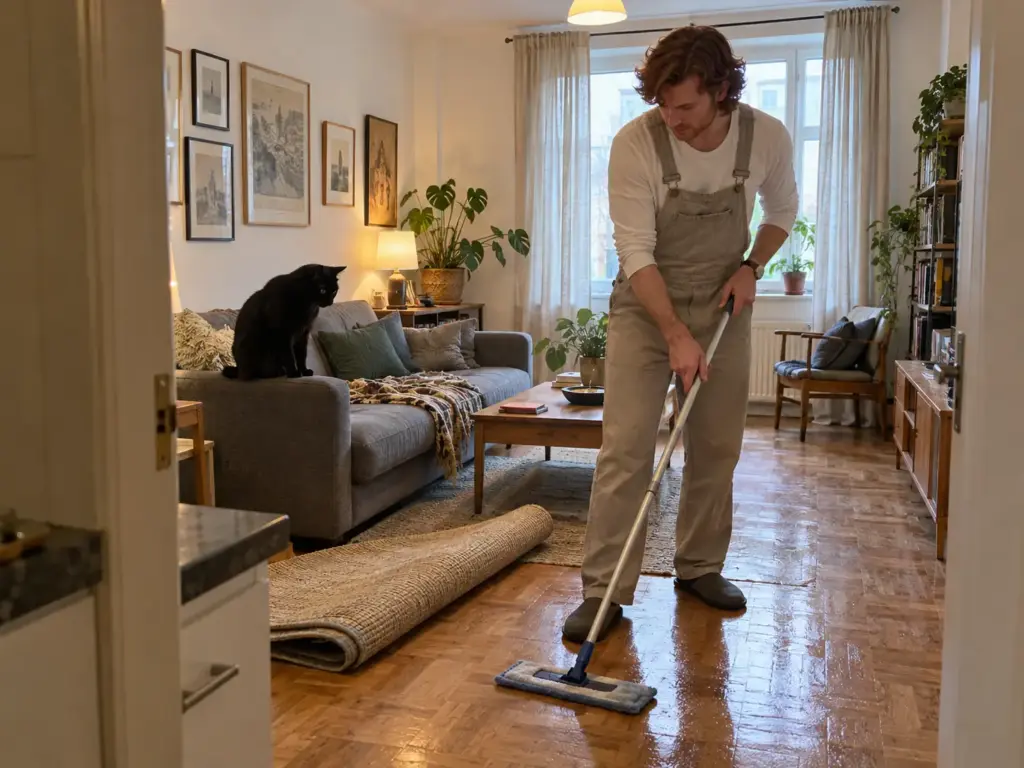
Start with what you walk on. Ohio State’s list of household controls carries the number that changes how a room gets cleaned: “Carpets can contain 13 times more cat allergens than smooth floors.”
The standard advice is carpet removal: swap it for hard flooring. In a rental that advice stops at the lease, because the carpet is the building’s and replacing it is rarely your call. So 13 times is a number to know, not a purchase to make. It tells you which part of the apartment will hold the allergen longest, and where cleaning pays back most: the rug under the sofa, the runner by the door, the stretch of carpet next to wherever the cat sleeps.
Wet cloth first, then the vacuum
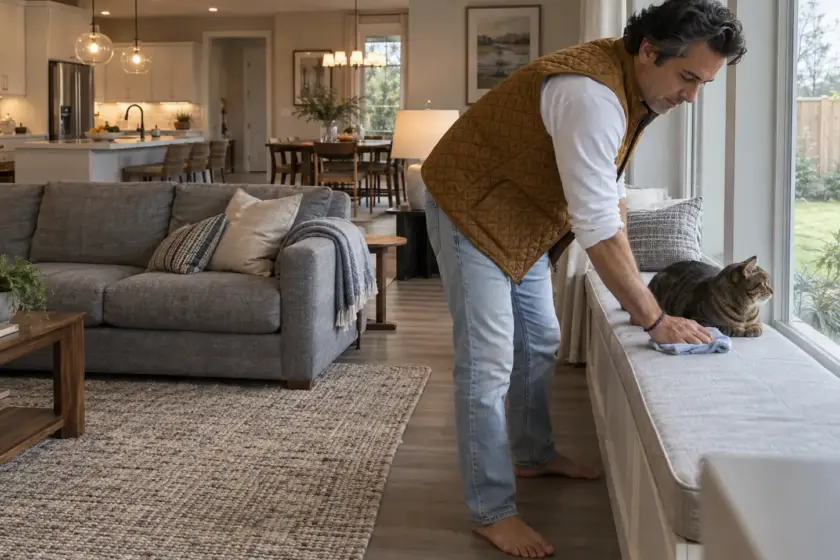
Free comes first. A dry broom lifts the allergen into the air, where it hangs and resettles. A damp cloth or damp mop picks it up and keeps it. The guide to clearing cat hair around the house without moving it rests on the same principle for hair, and it holds for the part you can’t see.
- A damp cloth or damp mop in place of dry sweeping. It collects what a broom would throw back into the air.
- A hot wash for the fabrics where the cat settles. Bedding and washable covers go in hot, since they are what everyone sinks into.
- A vacuum with a closed filter. One that holds what it picks up instead of blowing part of it back out.
A bedding wash is the place where results can disappoint: the blanket comes out clean and still carries hair. Cat hair in bedding after a wash deals with the hair that survives a wash. For the allergen itself, the hot water is what matters.
A vacuum without a closed filter sends part of what it collects out through the exhaust, which makes it a poor trade for this problem. Where vacuuming cat hair fails lists the three places a vacuum goes wrong. For allergen, Ohio State asks for a good vacuum with a HEPA filter, used at least once a week.
HEPA is a category here and not a recommendation of any one machine. Which one to buy is a separate question, and what to look for in a cat hair vacuum works through it for a rented apartment. Mind the order, though: the cloth and the hot wash cost nothing, and the vacuum comes after them.
The air in the room where the cat spends its day
An air purifier with a HEPA filter is the last thing to add and not the first. Ohio State says one in the room where the cat spends most of its time can cut the allergen in the air by up to five to seven times. In the UK trial from the first-two-weeks study, a HEPA cleaner reduced airborne allergen significantly in seven homes with cats. Two sources, same direction.
What it cleans is the air of that room. It does nothing for the sofa or the rug, which is why it sits after the cloth, the wash and the vacuum in this order. No model is named here: the category is the point.
Put the purifier in the room where the cat actually spends the day, and size it for that room’s floor area, not for the whole apartment. It cleans air it can reach, and one in a room the cat never enters is cleaning the wrong air.
What a Bath Buys, and the Week It Doesn’t
The three-hour number
A bath works, and it has a clock. The 2021 veterinary review reports that airborne allergen dropped 79 percent three hours after a bath in plain water.
Ohio State’s guide gives a bigger figure: bathing a cat weekly, if possible, can decrease the allergen by up to 84 percent. Put the two side by side and the difference is the clock. One is a reading taken at three hours, the other an upper limit for a weekly routine.
The one-week number
The same 2021 veterinary review reports what happened next: a week later, concentrations had returned to the levels from before the bath, even with weekly bathing. So both figures are on the record, with hours next to one and a week next to the other. Weekly bathing is the advice that gets repeated, and it is the one that holds up worst against the clock.
A bath buys hours, not a week. And for the cat, a weekly bath is a deal he never asked for. Whether he should be bathed at all, how often and how is a veterinarian’s decision about the cat in front of them, not something this page can settle.
Bathing and brushing are separate jobs, and the cat grooming guide covers brushing between baths.
Between baths: wipes, and what their label claims
Between baths, the first move is still the house: a damp cloth on the surfaces he lies on does more than anything done to him. For the cat himself, wipes are the common answer, and they come with a label that deserves to be read as a label.
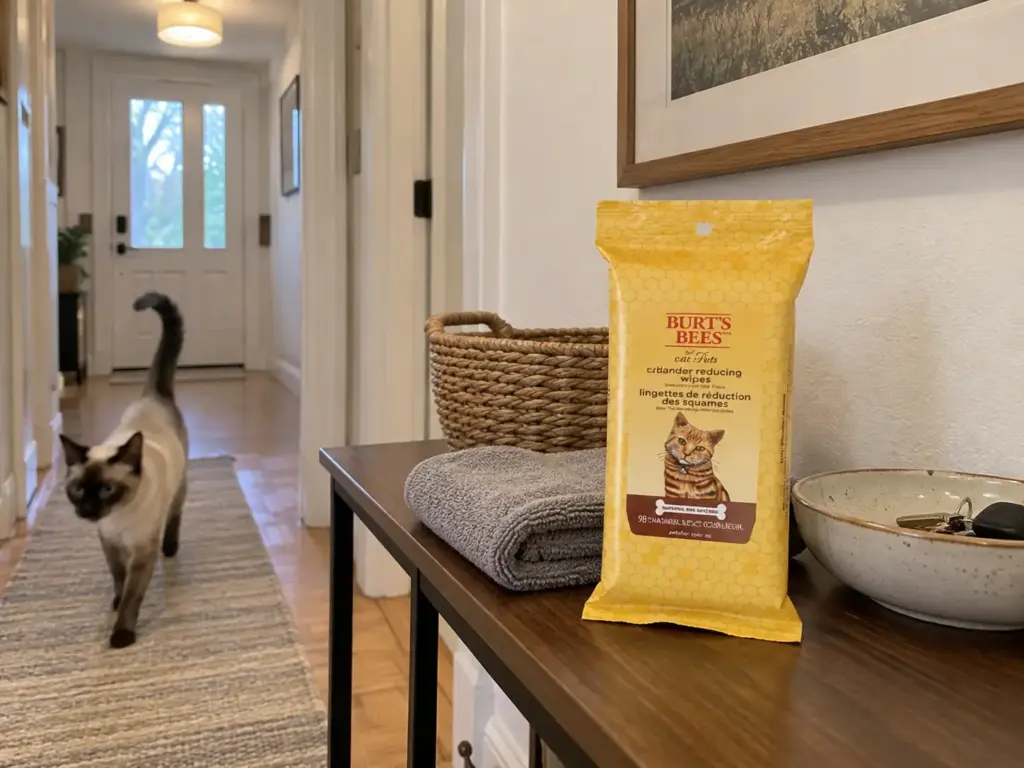
The one in this guide is Burt’s Bees for Pets Cat Dander Remover Wipes, unscented, 50 to a pack (the listing is for three packs). The maker says they reduce dander. That is the manufacturer’s claim, and no independent test of these wipes backs it up that this page can point to. So they go here as a habit for the hours between baths, not as a fix, and before adding anything new to a cat’s skin routine it is worth asking the veterinarian.
Decide with the three-hour number, not the one-week number. If a bath lasts hours, plan by hours: it belongs in the stretch before the room matters, such as the time before a visitor arrives, and not on a weekly schedule the clock outlasts.
Keeping the Cat Out of the Bedroom, and What That Costs the Cat
Why a closed door is not enough
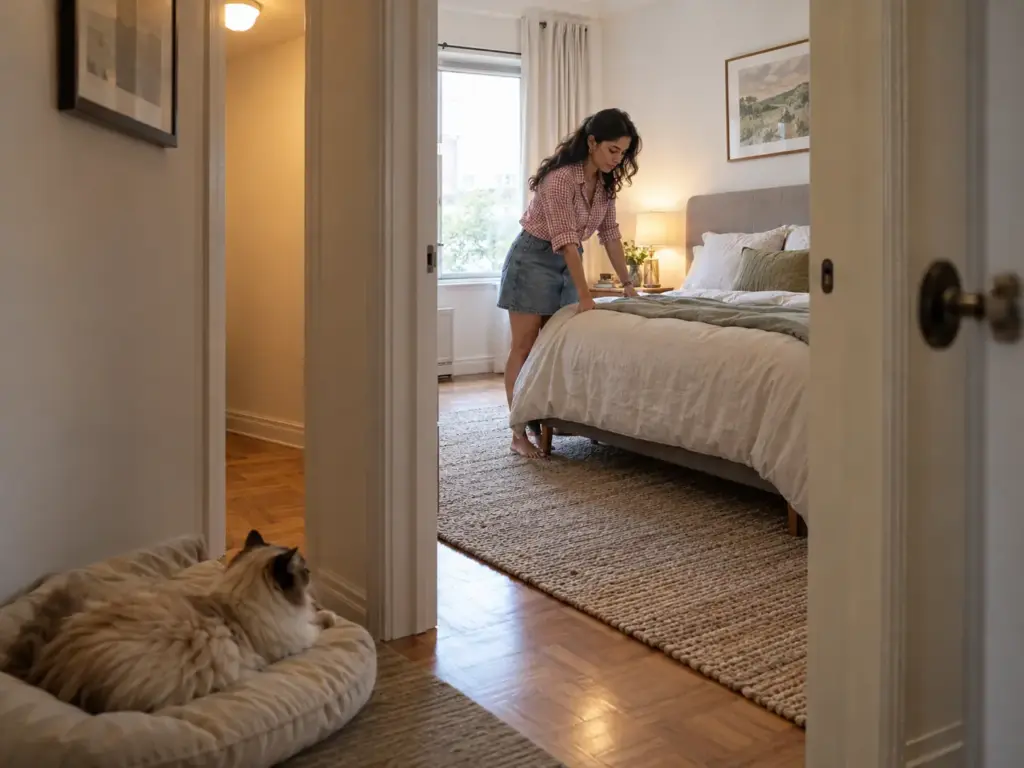
The bedroom is the first room most households close to the cat, and the reasoning is sound: it is where you spend the longest unbroken stretch. But dander is light, and the 2021 review says that because of its physical characteristics, keeping the cat out of a room is unlikely to be enough on its own. A bedroom door stops a cat. It does not stop the protein, which travels on air and fabric.
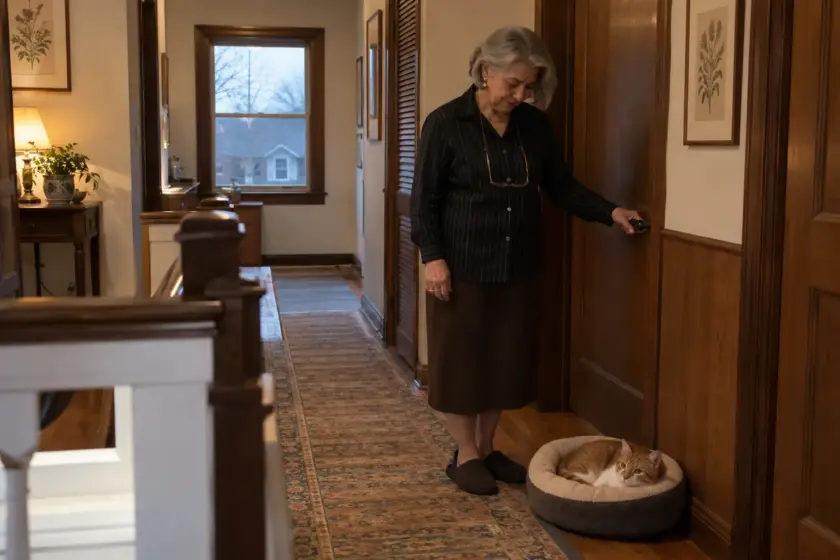
Another household kept bedrooms off limits from the day the family moved in, for relatives who react to cats. Starting early is the easier way to keep a rule, since nobody has to undo a habit later. It still needs the rest of the house to carry its share.
What the rule costs the cat
The cost lands on someone who never asked for the rule. The review’s section on keeping cats out of rooms says that restricting a cat’s space might have important welfare implications for cats: frustration and behavior problems and, in the review’s own account, a risk that the cat ends up given away.
The review also cites an online survey of more than 2,000 owners in the US, in which 84 percent said they would ignore advice to give up their cat. That tells you which rule most households will actually choose, and it makes the cat’s side of the bargain worth building properly. The rule is made for you. The cat pays for it.
A closed door works for the cat only when the other side is a better place. Put his best bed in the room where the household spends the evening, so the door takes away one spot and leaves him the company.
Where the vet comes in
The review closes the point with a recommendation: involve a veterinarian when such measures are being contemplated. That is worth acting on, most of all for a cat who has slept on the bed for years, because the veterinarian knows that cat and a closed door changes his whole day. Talk it over before the door shuts, not after.
One Cat or Several: Why the Count Changes the Answer

More cats, more allergen
Ohio State’s guide states it directly: the more cats present, the higher the concentration of allergens in the household. It gives no figure per cat, and a rule such as two cats meaning double would be a guess.
Everything in the clock section was measured around one cat leaving. In a multi-cat home there is no published figure, so the single-cat months are not a promise to borrow. A small apartment matters too: fewer rooms mean fewer places to keep cats and fabric apart. Small space, more cats, longer wait.
Neutered and intact males: a question for the vet
Ohio State also notes that intact male cats produce more allergen than neutered ones, and that the levels decrease after neutering. Whether that applies to your cat, and what the surgery involves, is the veterinarian’s call. It is a fact about cats, not a prescription.
If you are weighing a second cat, talk to your doctor first. Another cat is more allergen in the house, and what that means for you is a medical question.
Start With a Damp Cloth and Give the House Months, Not Days
Three things carry over from everything above. The cause is a protein on the skin and in the saliva, carried on dander, so removing hair alone does not touch it. The clock is counted in months and measured across the whole house, not in the air of one room on a good day. And what happens to your health is for your doctor to decide, while what happens to the cat’s skin or coat is for the veterinarian.
Put a date three weeks from now in your phone, and look at the routine, not the room. Is the damp cloth still replacing the broom, is the hot wash still on the calendar, and has the vacuuming rhythm held? A new human routine slips by the third week, and that is where this one usually breaks.
How often to vacuum with a cat sets the schedule by spot and by floor. The allergen will not be gone by then, and it is not supposed to be.
Today, wipe the floor and the shelf nearest the cat’s favorite spot with a damp cloth instead of sweeping, and start the wash for whatever he sleeps on. Look at the cloth afterward: that is what a broom would have thrown back into the air.
Frequently Asked Questions
01Can you live with cats if you’re allergic?
Whether you can live with a cat while allergic is a decision for your doctor, because it depends on you more than on the house. The allergen stays in a home for months, and household measures help without promising to be enough.
02How can I reduce my cat allergies?
Most of what you can change sits in the house: a damp cloth instead of dry sweeping, hot washes for fabrics, a vacuum with a HEPA filter and, in the room where the cat spends the day, a HEPA air purifier. Anything aimed at you is a question for your doctor.
03What are the signs of being allergic to your cat?
Working out whether what you notice comes from your cat is your doctor’s job, and a page cannot do it for you. If breathing is hard, do not wait on cleaning advice: that is a same-day medical visit or urgent care.
04Can cats be allergic to cats?
A cat can itch or develop skin trouble for many reasons, and telling them apart is the veterinarian’s job. If yours is scratching, he needs a full evaluation, and that appointment is the answer.
05Are there hypoallergenic cats?
No cat is truly hypoallergenic: Ohio State’s veterinary guide says low-allergen and allergen-free cats do not exist, whatever the breed. A cat that sheds less hair does not make less allergen, because the protein is on the skin and in the saliva.
Leave a comment