How to Tell Bonded Cats From Roommates in One Apartment
Bonded cats rest within about 3 feet across rooms [not just at one bowl]. A 5-day notebook count + 3 boxes for 2 cats settles bonded vs. tolerant.

Alfredo RamsesFounder · November 17, 2026 · 19 min read


On this page10 sections
- 1What Makes Two Cats a Bonded Pair, and What Does Not
- 2The Signs You Can See, and What Each One Proves
- 3A Five-Day Count That Settles Whether Yours Are Bonded
- 4Bonded or Just Tolerant, and What Neither Changes
- 5When a Bonded Pair Is Split, and When It Is a Vet Call
- 6What the Bond Does Change in a Small Apartment
- 7The First Weeks of an Adopted Pair in One Room
- 8Adding a Third Cat to a Bonded Pair
- 9Start With a Notebook and the Boxes You Have
- 10Frequently Asked Questions
You have watched your two cats share a sofa for months, one at each end with a cushion of air between them, and every list of bonded cats signs still leaves you unable to say which kind of pair you have. The cat on the far cushion may simply be answering with a distance he prefers, and a distance can be measured. Researchers who study cat behavior define a bond by where two cats are found, not by how sweet the pair looks, and that yardstick works in a living room. Below you get what a bonded pair is, what each familiar sign proves and what it leaves open, a five-day count that answers “are mine bonded?”, what a bond changes in a small apartment and what it leaves exactly as it was, and the point where a split pair stops being a furniture problem.
Quick Answer
Bonded cats choose each other again and again, resting within about three feet even when nothing is there to compete over. Sharing a bed with a gap of air between them is tolerance. A bond does not cut the litter boxes, and a cat who stops eating after a split needs a call to the vet.
What Makes Two Cats a Bonded Pair, and What Does Not
The label gets handed out far more freely than the behavior it describes. A pair called inseparable can turn out never to touch, while a pair nobody labeled is found within arm’s reach of each other in every room of the apartment. A definition you can check beats a label, so start there.

Why Siblings Are Not the Only Pairs
VCA’s page on adopting bonded pairs, written by veterinary behaviorists, says bonded pairs are often siblings but that unrelated cats who have spent time together can also develop a tight bond. Growing up as littermates is a common route to a bonded pair, not a requirement. Two adults who ended up together as a foster pair, a shelter pair or a household that merged get there too, and a mother and her grown kitten face the same distance test as anyone else.
A Bond Is a Distance the Cats Choose
Crowell-Davis, Curtis and Knowles, in their review of cat social life in the Journal of Feline Medicine and Surgery, call two cats preferred associates when they are found within about a meter (roughly three feet) of each other more often than either is found near any other cat in the group, across different contexts and locations. Across contexts is the working phrase: two cats at the same bowl at dinnertime do not qualify. That is the measured version of “they’re bonded,” and the five-day count below borrows it. In plain terms, bonded cats keep seeking each other out, in different rooms and at different hours, and the distance is only the part you can measure.
The same review notes that resting in contact continues even in extreme heat, so two cats pressed together in July are not sharing warmth. The spot they chose is the other cat.
The Pair That Met as Adults
Bonds are not reserved for cats who grew up in one litter. A bond formed as adults is possible too, although no study puts a number of weeks on it, so any timeline you read is a guess and the pair sets the real one. If yours are still in the getting-to-know-you stage, how two adult cats are introduced in a small apartment, stage by stage lays out the calendar.
One pattern is worth carrying into the signs: a bond is often lopsided, with one cat attached and the other putting up with it. That asymmetry comes back in the section on splitting a pair.
The Signs You Can See, and What Each One Proves
If you are working out how to tell if cats are bonded, most of the signs read like proof and carry less than they appear to. These are the ones that show up in a home, with a verdict on each:
- Resting in contact is the strongest sign you can see, but only when no gap sits between them; a cushion of air means roommates.
- Allogrooming, the social grooming of one cat by another, is the rarest sign here, and it also happens when a pair is tense, so posture decides what it means.
- Head bunting, face rubbing, tail twining and following each other from room to room are easy to spot and unmeasured, so they count as hints.
- Social play without tension is a good sign, and play chasing gets easier to read once you know telling a chase that ends in a nap from one that does not.
- Eating or playing at the same hour proves nothing about the bond.
Sleeping in Contact, and the Gap That Means Roommates
The 2024 AAFP guidelines on tension between cats describe bonded pairs as often seen sleeping huddled or intertwined. Cats that share a piece of furniture without touching, at opposite ends or facing away from each other, are described as tolerating one another without a social bond. So the signal is the gap, not the sofa. The American Veterinary Society of Animal Behavior’s guide to reading cat friendships adds that cats who get along often snuggle when they rest.

Contact is information, not a guarantee. In a cattery study of 25 pairs, Bradshaw and Hall found littermates in physical contact in 46 percent of hourly counts and unrelated pairs in 18 percent, and 6 of 11 unrelated pairs that had lived together for a year were never seen touching once. Not touching is ordinary.
Grooming Is the Rarest Sign, and Posture Decides
In that same cattery, 6 of 14 littermate pairs groomed each other and 0 of 11 unrelated pairs did. A lick between your two is something uncommon, and it looks like the proof everyone wants, which makes it the sign least able to carry the weight.
A 2026 video study of 53 pairs found grooming in two settings: affection, with long contact, huddling, matched posture and play afterward, and tension, with one cat leaning over the other, ears turned back, lip-licking and sometimes a swat. The tongue does not give the answer. The posture does.
Take a quick phone photo of any grooming bout and look at it afterward. Ears and posture are far easier to read in a still frame than in the moment, and a pair that looks matched in the photo is giving you a better answer than the lick itself.
Eating or Playing at the Same Time Proves Nothing
What the ethology puts at the center is closeness across different situations, and it says plainly that two cats showing up at the same resource at the same hour of the day is not a bond. A pair that eats together at one bowl shows that they share a bowl. Often the feeding schedule is doing the synchronizing, not the cats.
A Five-Day Count That Settles Whether Yours Are Bonded
One afternoon tells you nothing. Two cats parked at opposite ends of the apartment today may share a cushion tomorrow, so the answer is a pattern over days, and a notebook is all it takes.

What Counts as Contact, and What Counts as Close
Contact means touching. Close means within about three feet (one meter), the same yardstick Crowell-Davis, Curtis and Knowles use for how cats choose their companions, and far means anything beyond that. You do not need a camera: a few glances a day, at the same moments, is enough.
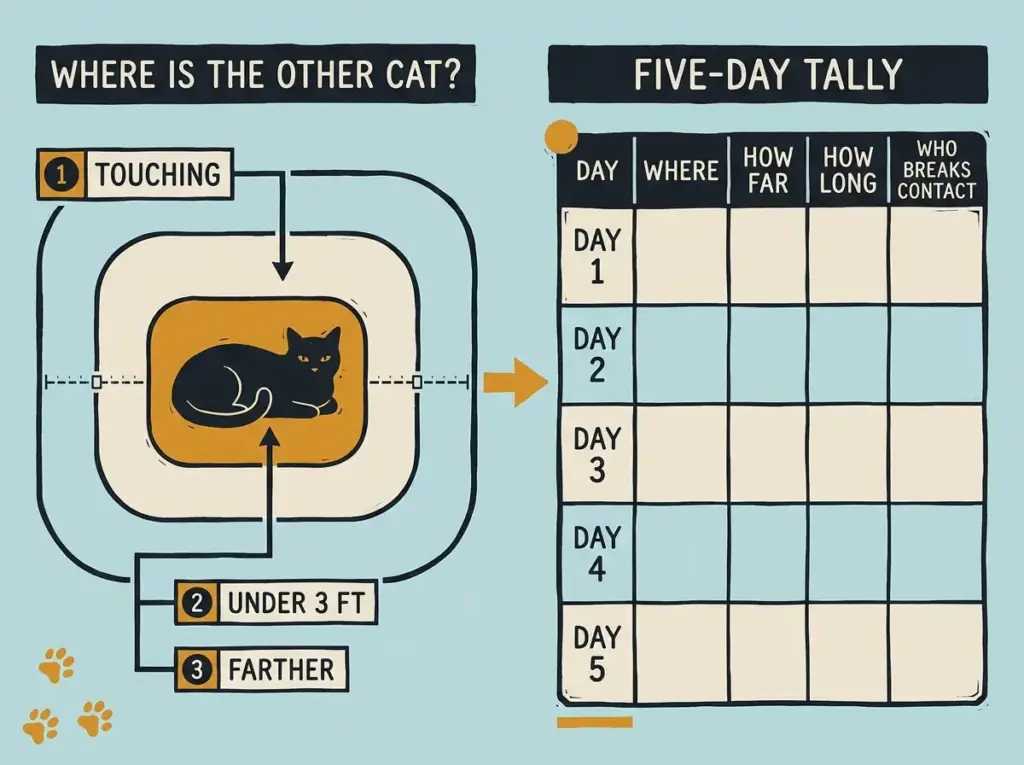
Write Down Four Things for Five Days
Each time you look, note these:
- Where each cat is resting.
- How far apart they are: touching, within about three feet, or farther.
- How long they hold it, in minutes if you can tell, or still there at the next glance.
- Who breaks the contact first.
For a reference point, a study of free-living cats found them sleeping alone in 31.7 percent of counts and in bodily contact with one or more cats in 16 percent, and one individual was alone in 70.9 percent. Even in a colony, most rest is apart, so a snapshot of your pair apart means little. What a bonded pair’s numbers for each other should show is a figure clearly above that colony 16 percent, and it should be the same two cats day after day. Who leaves first is data too: when the same cat always gets up, the pair is probably lopsided, one attached and one tolerant.
Check at the same two moments each day and keep the notebook out of the room where they rest, so the count shows what they choose and not what they do for an audience.
Give Them an Empty Room and Watch What They Pick
Set up a room with two or three comfortable spots and nothing to fight over: no food, no sunny window, no you. If the same two cats skip the other spots and settle within about three feet of each other, that is the closest thing to proof a home can produce. If each takes a far end, that is tolerance, and it is a legitimate answer, not a failure. The cat who leaves the room when the other walks in is asking for more distance.
The AAFP guidelines add a limit to all of this: cats who fight are unlikely to show friendly behavior toward each other at other times. If nothing friendly happens all week, the bond is what is missing, and what to do when two cats in one apartment stop being friendly is covered separately.
Bonded or Just Tolerant, and What Neither Changes
A bond does not trim the shopping list or the floor plan. Sharing a bed is not sharing a resource, and the cats’ own behavior shows the gap better than any rule.
Roommates Are Not a Failure
The AAFP treats toleration as a normal state: tolerance between cats that share space without a social bond, with no fight and nothing wrong. They are managed with resources spread out, so nobody has to pass the other to eat or to go. A pair that sleeps in a heap needs exactly the same spread, and the word bonded tempts people to skip it.
A Pair That Sleeps in a Heap Still Guards a Doorway
Two cats who sleep touching look like they would share everything. They do not. The more confident cat can hold a doorway or one end of a hallway while the other waits or detours without a sound, a mild form of resource guarding, and the AAFP lists blocking a passage as a sign of tension.
Where each cat claims its space across one apartment, zone by zone helps you map those spots. Watch the doorways in your count, not just the bed.
Three Boxes in Three Places, and Two Stations
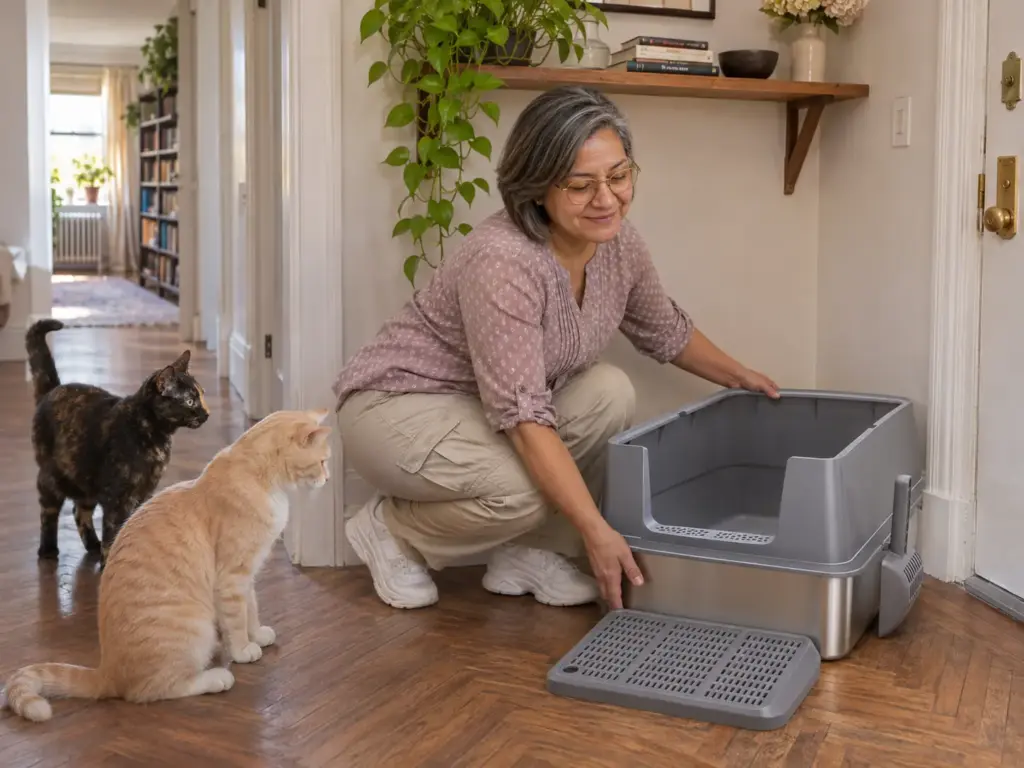
Start with the gear already in the apartment. If two boxes sit in the same corner, the cats read them as one resource, and International Cat Care’s guidance on multi-cat households puts the rule this way: “a commonly used formula is one resource per cat plus one extra, positioned in different locations.” That is the litter box n+1 rule, and for two cats it means three boxes for two cats, in at least two zones, and two separate feeding points, not one bowl with two sides. Keep the feeding distance wide enough that neither cat walks past the other to eat.
Why a spare resource fails when it sits next to the first one explains why moving a box beats adding one, the box count for two cats and the exception people ask about gives the number, and whether two cats can eat from one bowl covers the feeding side.
In a pair that is getting tense, the box goes first and the bowl second: a stressed cat will still pick at food but stops using the box. (A cat who abruptly skips every box needs a vet to look first, before anyone moves furniture.)
Pull the boxes you have apart first: one to the far end of the apartment, one into a different room. Then let the next stretch of your count show whether the traffic changes.
If the third box has to be bought, one sized right beats three small ones. The KITCATY XXL Stainless Steel Litter Box measures 28 x 20 x 12 inches, which clears the one-and-a-half-times-length rule for an average adult, and steel does not hold smell the way a scratched plastic pan does. Its limit is the 12-inch wall for a cat with sore joints, and the box ships with a pedal meant to ease the step.
A box shorter than the cat is the one that gets skipped. The plastic Amazon Basics Large High Sides is the cheaper route, but at 19 x 15 inches it runs short for an average adult, the lid will not stay put and the scoop is awkward.
When a Bonded Pair Is Split, and When It Is a Vet Call
A pair can be split for an afternoon (a clinic visit for one cat) or for good (a move, a household that divides, a cat passing away). Anything that hurts a cat belongs to a vet, so this section covers what the first hours look like, what the apartment can do, and where the answer leaves the apartment.
What a Split Looks Like in the First Hours
International Cat Care’s page on how cats grieve describes two stages of what looks like separation distress: first calling when separated, then pacing and searching the house, looking out of windows and sniffing from room to room, then a withdrawn phase with less sleeping and playing. It adds that cats have no set period for grieving. That is what can be seen from the couch, and it is as far as this page goes.
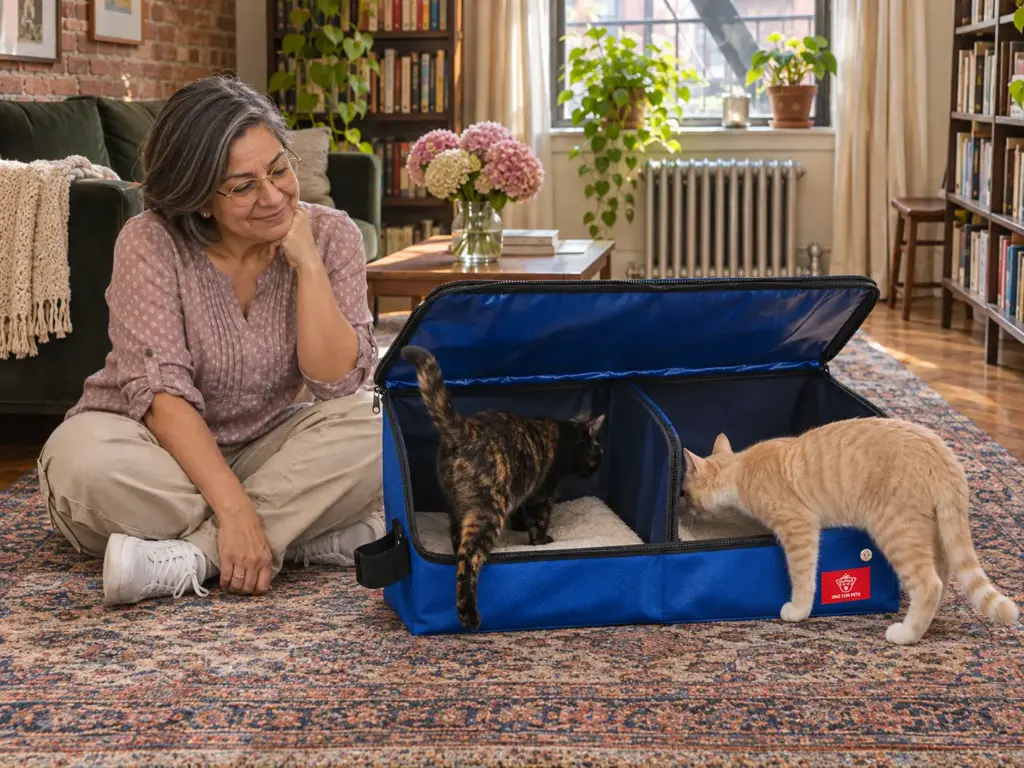
If the split is a clinic visit for one cat, the free arrangement is two rigid carriers, one per cat, so each keeps its own space and scent. When the pair has to travel as one, the One for Pets Portable 2-in-1 Double Pet Kennel (39 x 20 x 20 inches) zips apart into two halves of about 19 inches of floor each: one half can go into the building while the other waits in the car with a person. Its flaw is the zippers, which can come undone. Two-cat carriers compared by how they hold up and whether they unzip covers the rest, and a divided carrier such as the SturdiBag Divided Large (18 x 12 x 12 inches) is the cabin-size alternative for a flight.
Tension after a trip is its own pattern: when a pair that got along starts fighting after a move or a trip follows the weeks afterward.
Keep the Routine and Keep the Bedding
At home the work is small. Keep meals and your hours as they were. Do not wash the absent cat’s bedding yet: the fading scent is often what tells the surviving cat or the one waiting at home that the other is not coming back, and it is the same bedding a pair is reunited with after a clinic stay.
How to use a cat’s bedding without washing the scent away explains where the item goes. Spread boxes around the apartment, and hold off on a new cat: International Cat Care points out that swapping a settled, predictable companion for a boisterous kitten is not usually a fair substitute.
The Point Where This Is a Call to the Vet
The line is short and it is not ours to move. International Cat Care says: “If your cat has stopped eating, or is showing any signs of illness, contact your veterinary team as soon as possible.” That applies to either cat, including a surviving cat after a loss. Because a bond is often lopsided, one cat can carry on eating as usual while the other stops, and appetite loss in the one who stops is the reason to phone.
What the Bond Does Change in a Small Apartment
A bond changes less than people expect, and what it changes is small and practical: where the pair sleeps, who warms whom, and how a move goes.

One Bed or Two, and the Free Way to Find Out
Spend five days looking at where the pair already chose to rest (a sofa corner, a cushion, a blanket) and put any new spot next to it, not in a corner they never use.
The usual advice is one roomy bed for a bonded pair, and it fails the pair that touches only sometimes, who end up with one cat on the bed and the other on the floor beside it. If they already sleep in a heap, one bed with a high rim gives each head somewhere to rest, and a jumbo cat bed wide enough for two does the same job. A clamshell bed, hooded with one way in, suits a pair less well, because the cat inside can block the other at the opening. If they touch only now and then, two beds within sight of each other respect the distance and work as well.
For the heap pair, the Nisrada 27 inch Calming Round Cat Bed measures 27 x 27 x 8 inches, and its 8-inch wall is the part a pair in a heap uses, with nothing to drill and nothing on the wall, which suits a rental. The size divides opinion, with some finding it roomy enough for several cats and others too small, and durability is mixed too. Two 20-inch donut beds, one per cat and in sight of each other, are the cheaper way to get the same result.
Company While You Are Out, Within Reason
Company is not supervision. A bonded pair warms a shared spot and starts play that organizes itself. Those are things that happen in a home with a pair, not benefits with a number on them. They do not replace the stations: two feeding points still stand, and laying out two feeding stations in a one-room apartment shows how that fits.
A Move Is Easier With a Companion
A pair that moves arrives with a familiar cat at hand, and a new room smells less strange with the other cat in it. Nobody has measured it, so treat it as what tends to happen, with no timeline. Keep the pair together in transit, and in the new place the spread of resources from earlier applies unchanged.
The First Weeks of an Adopted Pair in One Room
A bonded pair adoption puts the 3-3-3 clock on two cats instead of one, and adoption settling usually happens inside one room at first. It gives you something a single cat does not: a way to watch how the two cope with the same overwhelm.

The First Three Days: Hiding Together or Apart
VCA’s description of the 3-3-3 adoption rule sets three days of overwhelm (hiding, avoiding food, testing boundaries), three weeks of settling and three months of feeling at home, and calls it not a strict timeline. For a pair, the first observable is whether they hide together or apart. Hiding together is worth writing in the notebook; so is hiding apart. The free move is a closed door and one safe room with every resource doubled.
Hold judgment through the first week. A pair that wedges into one hiding place and a pair that takes two are both giving you a data point, and neither is a verdict yet.
If tension rises in spite of that, a diffuser is the add-on.
The FELIWAY MultiCat Diffuser Kit (4.5 x 2.5 x 5 inches, with a 48 mL refill) plugs into the room where the pair spends the day, not the hallway, and wants about four feet of open space around it. The effect is uneven, a refill may not last the full 30 days, and the trial behind the product was small, scored by owners and paid for by the maker. It supports a settling cat and treats nothing. The Comfort Zone Multi Cat Bonus Kit is cheaper per refill, though it does not say which type of pheromone it carries, and which pheromone diffusers cover a multi-cat home with the doors closed compares the options.
Three Weeks, Three Months
For a pair that formed as adults, the calendar is the introductions one, and how long to wait before two cats meet in a new home sets it out; the 3-3-3 count starts the day they arrive. The same clock is used for other arrivals, and how the same 3-3-3 clock is used when a baby arrives shows it in a different household.
In one room, resources get duplicated, not enlarged: International Cat Care’s one-per-cat-plus-one formula still applies, so two small stations at opposite walls do more than one wide one, and the box count does not fall because the cats are close.
How Long Are You Out Each Day
The hours you are gone decide what gets doubled first. If you are out most of the day, the boxes and the water come before the toys. The hours two cats can be left alone, and what runs out first walks through the arithmetic.
Adding a Third Cat to a Bonded Pair
Adding a cat to a bonded pair does not add to a bond. It changes it, because the pair already has its distance and the newcomer finds it finished. The count climbs to four boxes and three stations in different places, as how many cats a home can serve, counted in stations rather than square feet explains, and the newcomer arrives on the introductions calendar, not before the pair is calm. When a third cat strains the pair, another purchase is not the answer; recount the resources, and see why three cats in an apartment work until one pair does not.

Start With a Notebook and the Boxes You Have
The five-day count and the empty room answer “are mine bonded?” better than any list of signs, and either answer is fine. A pair that tolerates each other is not a failure, and a pair that bonded still needs three boxes in separate places and two feeding stations. If either cat stops eating, that is a phone call to the vet and not a project for the apartment.
Repeat the count after anything that moves the pair, whether a move, a clinic stay or a new cat, and again after a few weeks in the new setup, because what changes is the distance each cat chooses and that shows up in days. Today, with nothing to buy, pick two moments a day and start the notebook, and pull apart any boxes sitting in the same corner.
Frequently Asked Questions
01What makes cats a bonded pair?
Two cats are bonded when they seek each other out and stay within about three feet of each other more often than near any other cat, across different situations. They often rest in contact, and being related is not required.
02Do bonded cats have to be siblings?
No, bonded cats do not have to be siblings, because unrelated cats that have spent time together can also form a tight bond, according to VCA Animal Hospitals. How long a bond takes depends on the pair, so there is no number of weeks to count on.
03If my cats never groom each other, are they still bonded?
Yes, they can still be bonded, because grooming is the rarest sign on the list and it also shows up when a pair is tense. In one cattery, 6 of 14 littermate pairs groomed and 0 of 11 unrelated pairs did. Watch how close they rest and for how long.
04Do shelters make you adopt a bonded pair together?
Sometimes, because some shelters insist that a bonded pair stay together while others only recommend it, according to VCA Animal Hospitals. Policies differ, so ask the shelter you are adopting from whether it wants you to adopt both.
05What is the 3-3-3 rule for two cats?
The 3-3-3 rule gives a new cat three days to feel overwhelmed, three weeks to settle and three months to feel at home. It is not a strict timeline. With two cats, watch whether they hide together or apart, and double the resources in the room.


Leave a comment