How to Live With Cat Shedding in a Rented Apartment
A four-point weekly brush test for cat shedding in a rented apartment, tools by coat type, and free fixes before any brush (+ when to call the vet).

Alfredo RamsesFounder · Updated November 1, 2026 · 23 min read


On this page11 sections
- 1Cat Shedding Has No Official "Normal", So Build Your Own Baseline
- 2Where Housekeeping Ends and the Vet Begins
- 3Why an Indoor Cat Sheds All Year, and What the Seasons Still Do
- 4Coat Type Sets the Load Before Any Routine Does
- 5One Cat or Several, Find Out Who Is Shedding the Most
- 6Where the Hair Lands in a Small Apartment
- 7The Free Fixes Come Before the Brush You Buy
- 8Matching the Brush to the Coat, and the Size Problem With Big Cats
- 9Getting Hair Off Fabric When You Can't Replace the Sofa
- 10Your Cat Against Last Week, Not Against Anyone's Sofa
- 11Frequently Asked Questions
Run a hand along the arm of the sofa, or over the throw your cat claims every afternoon, and your palm comes away with a soft layer of hair that was not there yesterday. You may have spent months wondering whether that is too much, and getting nowhere, because no official figure for normal cat shedding exists. Your cat is doing exactly what a coat does inside a heated apartment: dropping hair at a low, steady rate all year and leaving most of it where he sleeps.
What is missing is a yardstick of your own and a home set up to absorb the load, and the main facts below come from the grooming guidance of a veterinary hospital network and a university feline health center rather than from opinion. You will get the measure, the signs that belong to a vet, what the seasons, the coat and the number of cats change, where the hair actually lands, and what to do about it, free things first.
Quick Answer
Indoor cats shed a steady amount all year, with bumps in spring and fall. No official number for normal exists, so measure your own cat with one weekly brush session and compare week to week. Bald patches, visible or red skin, or a sudden jump go to the vet. Start free: brush, wash his spot, match your fabrics.
Cat Shedding Has No Official “Normal”, So Build Your Own Baseline
Comparing your sofa with a friend’s tells you almost nothing. Her cat may have a different coat, a cooler apartment, a favorite spot on the bed instead of the couch, or a person who brushes him every night.
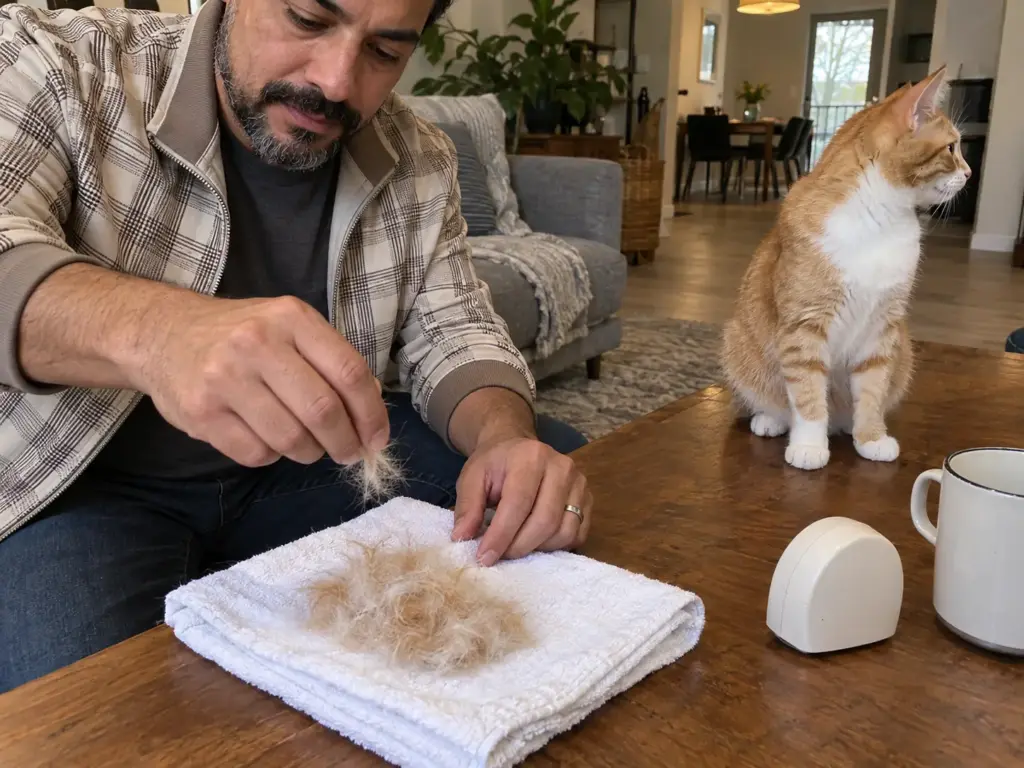
Purina’s pet expert team says there is no formal standard for how much cats shed, and adds: “Every feline is different.” So the only comparison worth making between normal shedding and excessive shedding is your cat against himself, a week earlier.
What shedding is, and why a cat does it
Shedding is the coat replacing itself. Dead or damaged hair comes out to make room for new growth, and the same process spreads natural oils across the skin (both points come from Purina’s explainer). A healthy cat is always somewhere in that cycle, which is why there is never a week with zero hair. Most cats wear two layers, a smooth outer coat of guard hairs over a fine undercoat, and the undercoat is the fluff that rolls across a hard floor and gathers under the radiator.
None of this is aimed at your furniture. It is maintenance, and he handles a good part of it himself with his tongue, which matters later, when we get to where the hair goes.
The weekly brush test, step by step
Petplan, a UK pet insurer, suggests paying attention to how much loose hair collects in the brush each time you groom your cat. That is the seed. The measured version below is our own design, not a veterinary protocol, and it works because it holds everything constant except the cat. Once a week, set him on a light-colored towel and keep four things fixed:
- The same brush every time, so the tool never becomes the variable.
- The same zone of the coat, for example his back from the shoulders to the base of the tail.
- The same number of minutes, short enough that he stays relaxed (three or four is plenty to see a difference).
- The same light towel underneath, so the hair that drifts off during the session gets counted too.
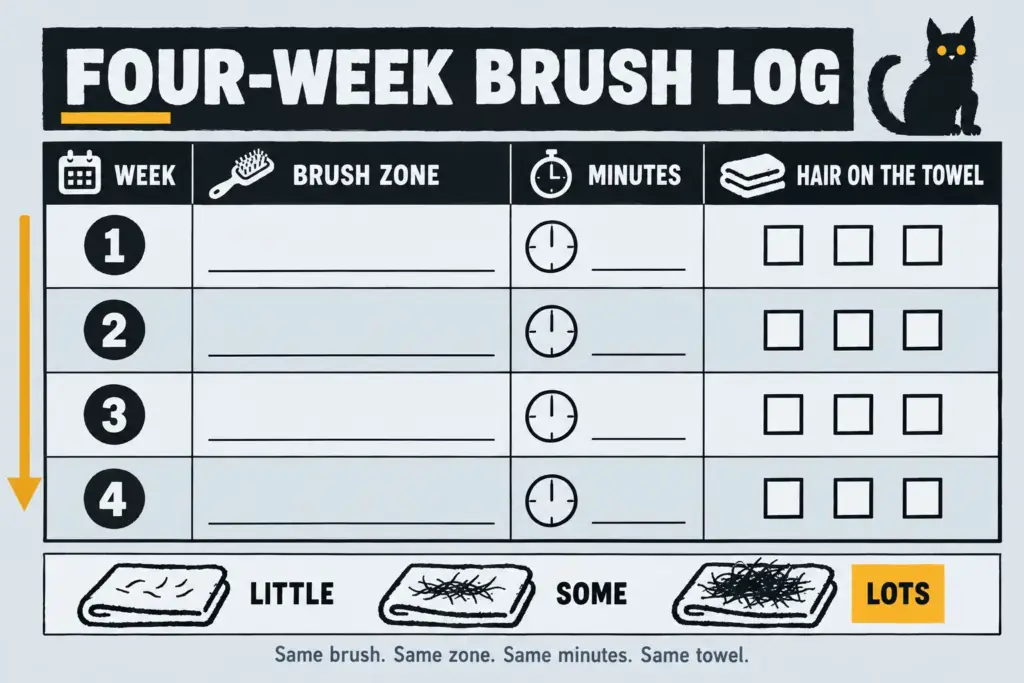
Afterward, pull the hair out of the brush, add it to whatever landed on the towel, and look at the pile. You are not weighing it and you are not counting hairs. You grade it the way your eye already does: a little, a medium tuft, a lot. Write the grade down next to the date and fold the towel away for next time.
Daily would seem more thorough. But weekly works better: a single day’s pile swings with his mood, the heating and whether he just napped on the bed, and seven days smooth most of that out.
Run the test on the same sofa cushion, by the same window, in the same daylight, and take a phone photo of the towel before you shake it out. Your memory of last week’s pile will flatter or exaggerate it; two photos side by side will not.
What to do with the number once you have two or three
One grade means nothing on its own. Two start a line, and three show you a direction. If the pile stays in the same range week after week, that is your cat’s normal, however it looks on the couch, and your job becomes handling that load in the apartment. If it climbs gradually as spring or fall arrives, that is the season, which the section on indoor cats explains.
What deserves attention is a break in the pattern: a pile that jumps from one week to the next with nothing in the house having changed, or hair that stops coming out evenly. That is where the next section takes over. And the notebook you just started is what turns a vague feeling that he is losing more into something concrete you can hand to a vet.
Where Housekeeping Ends and the Vet Begins
Hair on the sofa is housekeeping. A few changes are not, and they belong to a vet rather than to a better brush:
- Bald or thin patches, or skin you can see through the coat
- Redness, scabs or flaking on the skin
- A sudden jump in how much hair comes out, with nothing in the home to explain it
- A cat who stops grooming himself, or the opposite, overgrooming one area until it thins
- Any of these arriving together with a change in appetite or mood

Hair that comes away evenly from all over, with intact skin underneath, is what ordinary shedding looks like. An older cat who grooms less can leave more hair around simply because he is no longer clearing the dead coat himself, and if his grooming habits have changed, tell the vet. Why a particular cat is losing hair, and what to give him for it, are questions for that appointment, so this page stops there. Bring your weekly grades along, then come back to the furniture, which is the part you can handle at home.
Why an Indoor Cat Sheds All Year, and What the Seasons Still Do
Plenty of people expect the hair to ease off once the weather warms up, and it never quite does. Others brace for fall and find it barely different from August. Both are reading a calendar that an apartment mostly erases.

The two bumps, spring and fall
Outdoors, the coat follows the weather. In spring the thick winter coat comes out and lighter hair replaces it; in fall the summer coat gives way to a heavier one, the same two shedding seasons Purina describes. Each is a coat change, a stretch where the hair cycle runs faster than usual.
Inside a home the pattern softens. According to VCA Animal Hospitals’ grooming guide, “Cats that share our homes often shed their undercoat and guard hairs at low levels all year round.” The two heavy cycles mostly belong to cats that spend real time outside in cooler climates.
How a heated apartment blurs them
Two claims about indoor cats sound like they contradict each other: that they shed less, and that they shed all year. Both hold, and the useful way to keep them together is that the season blurs without vanishing.
Temperatures in an apartment barely move between January and July, and Purina points to exactly that: mild, consistent indoor temperatures, where an outdoor cat gets big swings in temperature and daylight. The cues that switch a coat over reach an indoor cat muted. What you get is a year-round shedding background every week, plus peaks that are lower and harder to put a date on.
Whether cats shed more in summer, how long cat shedding lasts once a heavy stretch begins, and why indoor cats shed year round each deserve a fuller answer than an overview can give. The point for your apartment is simpler: plan for a steady load, not for a season you can wait out.
What the heavy weeks look like on the sofa
VCA notes that during a strong cycle the undercoat tends to come out in clumps. On the sofa that looks different from the ordinary background: tufts on the sleeping spot, a soft drift collecting along the baseboard, fluff that lifts into the air when you shake out the throw. The weekly grade jumps a notch and sits there for a while. A gradual rise across several weeks reads very differently from a one-week leap, and the brush test is how you tell them apart.
Tufts are normal. Patches are not.
Coat Type Sets the Load Before Any Routine Does
A brush with thousands of glowing reviews can pull almost nothing out of your cat, and the reason is usually the coat. The reviews were written by people with other cats. Before choosing a tool or a cadence, look at what is actually growing on the animal in front of you.

Short and dense coats
A short, dense coat, the plush kind a British Shorthair wears, sheds fine hairs that weave into fabric and cling to dark clothes. These cats can look like light shedders because there are no tufts, yet the hair works its way into the couch weave and the knit of a sweater and stays put. VCA’s guidance is that short coats usually need less brushing than long ones, so a quick pass that lifts loose hair from the surface covers most days. The trouble with this coat is volume, not tangles: lots of small hairs that end up embedded where a vacuum barely reaches.
Long, large coats
Long coats drop longer hairs, often in tufts that roll into little tumbleweeds on a hard floor. VCA recommends daily brushing for long, silky or curly coats and a daily look at the armpits, the groin and the area behind the ears, where tangles start. Size multiplies all of it. A very large long-haired cat simply has more coat to replace, and every session takes longer on him, which is exactly where a tool with a small head starts to feel like a punishment for both of you.
In this house a big long-haired cat and a compact one with a short, dense coat live under the same roof, and no single brush handles both of them well. One leaves the short coat untouched; the other skims the long coat and misses the undercoat entirely.
The usual mistake runs in a predictable order. You buy the tool that suited the coat in the reviews, it lifts very little from yours, you decide brushing does nothing, and you stop. From then on the hair lands on the sofa instead of in the brush.
Why a breed list is a tendency, not a promise
Breed groupings help for a rough idea and fail as a guarantee. Purina’s version sorts them like this: the Sphynx and the Peterbald, hairless or close to it, are not known to shed; the Cornish Rex, Devon Rex and LaPerm shed minimally; the American Shorthair and its American cousins shed little; the Bengal, Chartreux, Maine Coon and Ragdoll sit in the moderate middle; the Persian sheds heavily and needs daily brushing. VCA, for its part, names the Sphynx and the Rex breeds among cats that shed very little and the Maine Coon among those that shed a lot.
Same breed, two different shelves. Purina itself adds that variation shows up even inside each group, and the same breed can produce very different coats in one house. The question of which cat breeds shed less matters to someone choosing a cat. Once you already share an apartment with one, the coat you can feel outranks whatever the breed label predicts.
One Cat or Several, Find Out Who Is Shedding the Most
With two or three cats, “the cat” gets blamed for all the hair, and usually nobody knows which one is responsible. That is unfair to all of them and useless for you, because you cannot pick a routine for a household.
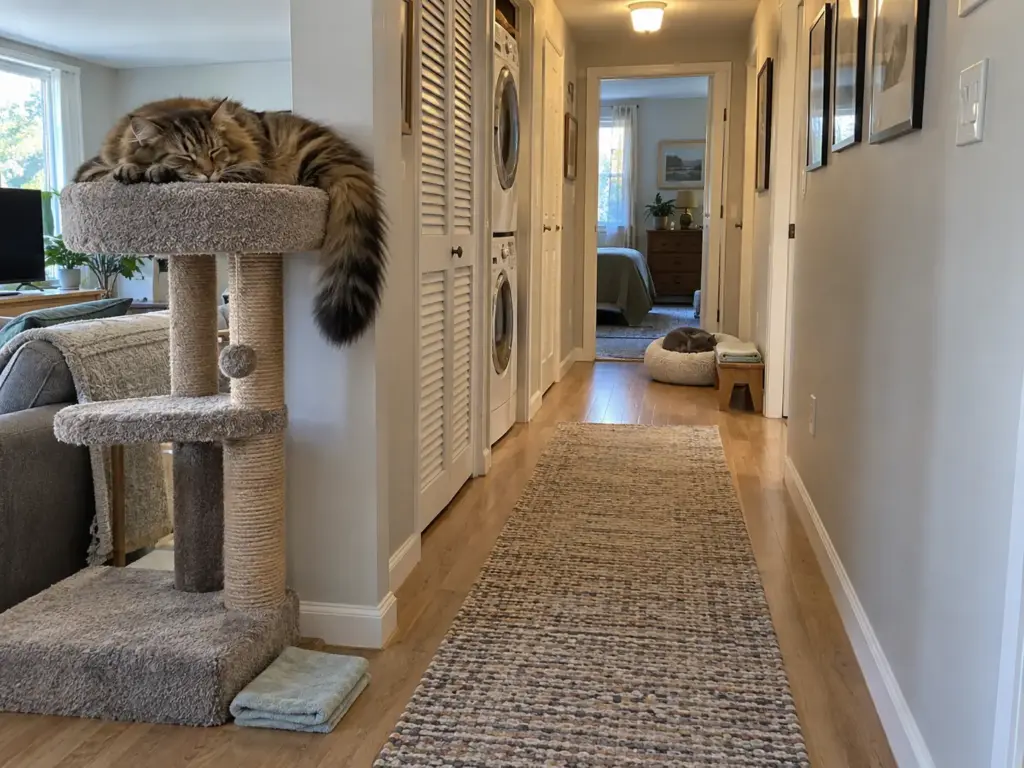
The same brush test, one cat at a time
This part is method rather than a measured finding. With one cat, the hair on the couch is his. With several, the load adds up, and a single household habit (one vacuum pass a week, say) cannot tell you whose hair you are fighting. Run the brush test for each cat separately, with its own towel and its own line in the notebook, for the same reason each cat gets one station per cat at mealtimes.
Some cats will only accept the brush on their cheeks and forehead. Fine. Brush what he allows, in the same spot every week, and the grade still works, because the test compares him with himself.
Give each cat a towel of a different pale color and never swap them. When you lay two weeks of photos side by side, you will know whose pile is whose without reading a label, and a dark cat’s hair shows best on cream, a light cat’s on pale gray.
Reading the sleeping spots
Hair collects where a cat sleeps, so separate sleeping spots make the heavy shedder visible without a single brush session. If one cat owns the end of the bed and the other the armchair, leave both uncleaned for three days and compare. The difference is often easy to see, and the cat who looks fluffier may not be the one leaving more behind.
Thinking in zones, the way you would plan meals for two cats in one small apartment, helps here as well: each cat’s spot is its own area, and each area gets its own washable layer.
When one household needs more than one routine
You will hear one weekly vacuum quoted as enough. For a single short-haired cat it may be. Put a long-haired cat and a short-haired one in a studio together, though, and the right number is set by the heavier shedder, not by an average of the two.
So in a multi-cat home, give each cat the brushing routine its coat asks for: daily for the long coat, less often for the short one, and a different tool for each if the coats are that different. It is the same reasoning as the n+1 count for litter boxes, where you count by cat rather than by household. The Maine Coon owner with three cats arrived at three routines for exactly that reason.
Where the Hair Lands in a Small Apartment
Vacuuming the floor every day and finding the same drift in the same corner by evening is a sign that the floor was never the source. Hair follows a map, and in a small apartment that map is short and predictable.
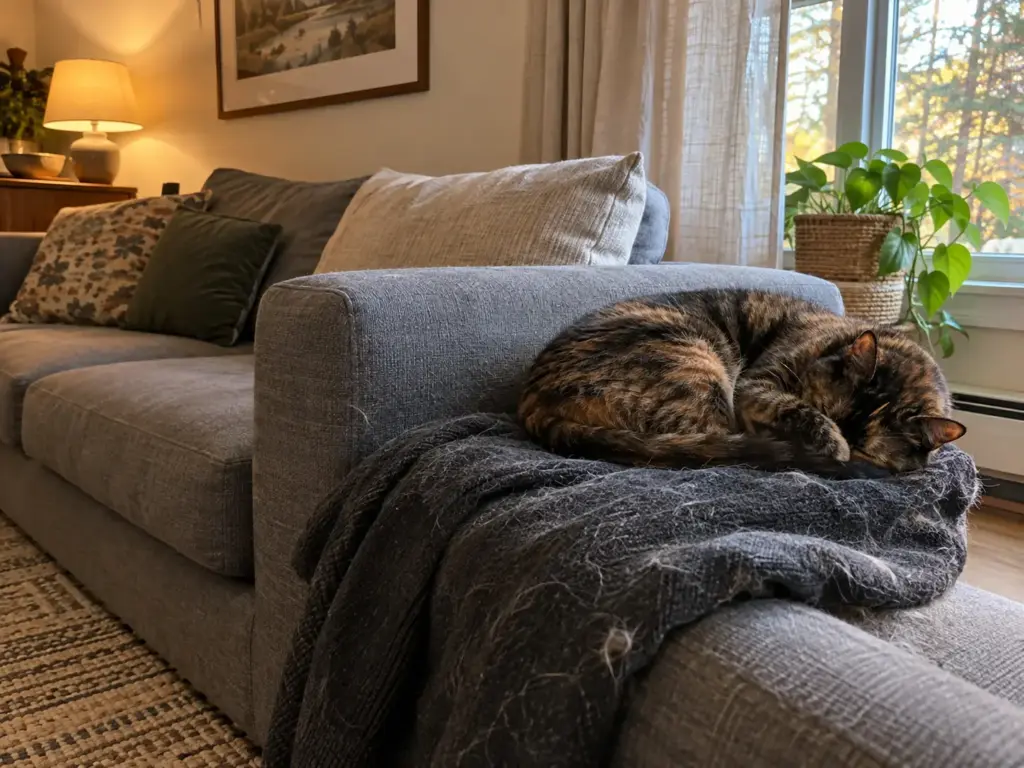
The cat’s own spot is the collection zone
Start with where things land in a one-room layout: in a small apartment almost everything a cat does happens a few steps from everything you do, and hair travels the same short routes. When a one-year-old cat starts slipping into the bedroom and seems to shed a TON, the answer that holds up is simple. The hair concentrates where the cat sleeps, because that room is warm. A sunny windowsill, the duvet, the end of the sofa where the radiator heat pools: each becomes a depot, and the floor only collects what drifts off them.
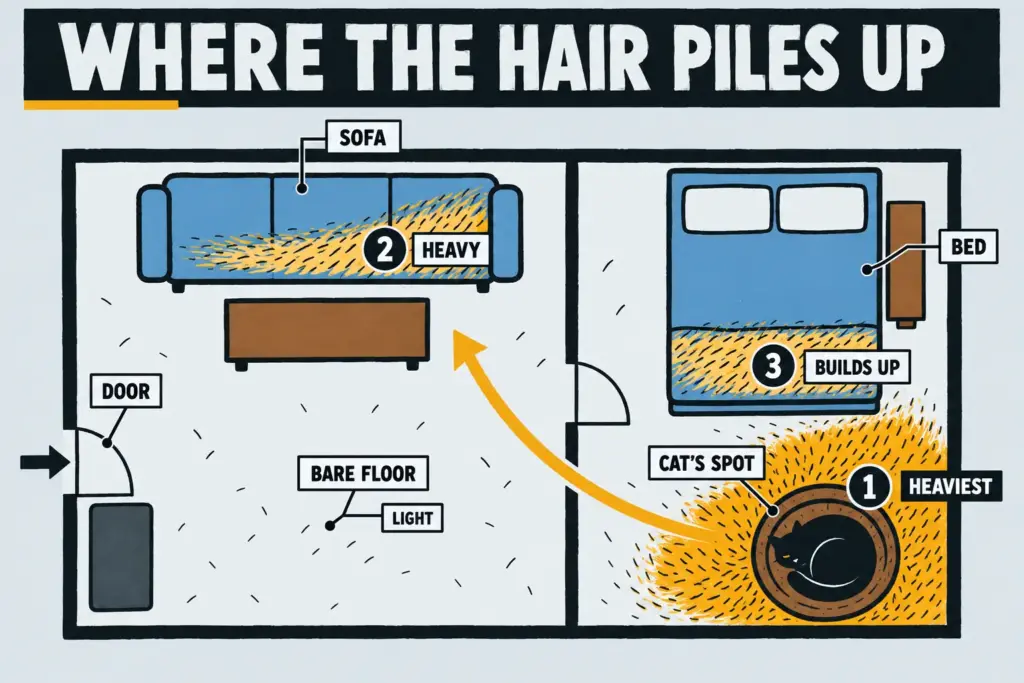
So the order matters. Wash or brush down the depot first, then do the floor. Chasing hair across the apartment before dealing with the spot he sleeps on means cleaning the same hair two or three times as it migrates from cushion to rug to hallway.
The cat chose that spot for good reasons: warmth, a view, your smell on the fabric. Moving him rarely works and is not necessary. Covering the spot with something you can lift off and wash does the same job without asking him to give anything up.
Hair that travels on clothes and into the kitchen
Hair leaves the apartment on you. Hair travels: it is possible to feel it in your nose and mouth at the gym, nowhere near the plush gray cat, in a home that is mostly hardwood. Clothes pick it up from the sofa and the bed and carry it everywhere, including the kitchen, where it settles on counters and around the feeding corner. Food bowls with seams and textured surfaces hold onto it, which is where bowls that don’t trap hair make cleanup shorter.
The laundry gives you a second reading of the load. Check the dryer’s lint screen after a load of sweaters and dark pants: the fine hair in it is hair that rode around on you before it reached the machine.
How much never lands at all
Part of the hair never reaches your floor. According to the Cornell Feline Health Center, cats spend 30 to 50 percent of their day grooming themselves, and a lot of what comes loose during those hours is licked off and swallowed rather than dropped. What you see on the sofa is only a share of what the coat sheds.
That has a practical side. Every bit of hair you lift out with a brush is hair he does not have to deal with himself, and hair that never reaches the couch. Vacuuming routines and keeping hair under control around the house are bigger subjects of their own, but for the map one rule is enough: the floor is the last stop, not the first.
The Free Fixes Come Before the Brush You Buy
People who have lived with heavy shedders for years tend to credit two unglamorous things: the color of their fabrics and a vacuum they do not dread getting out. Neither involves a new purchase, and both work often enough to try before you buy anything:
- Brush with what you already own, a few minutes at a time, on the cat’s terms.
- Wash the one spot the cat sleeps on, instead of chasing his hair room by room.
- Match the fabrics he uses to his coat, so the hair you miss does not show.
Brushing is the biggest free lever
Hair that comes out on the brush is hair that never reaches the sofa. According to VCA, daily brushing “will also dramatically reduce the amount of loose hair and cat dander floating around the home.” You do not need the right tool to start. An old brush works, and so does a damp household rubber glove (the free version of a grooming glove) run along the coat in the direction the hair grows.
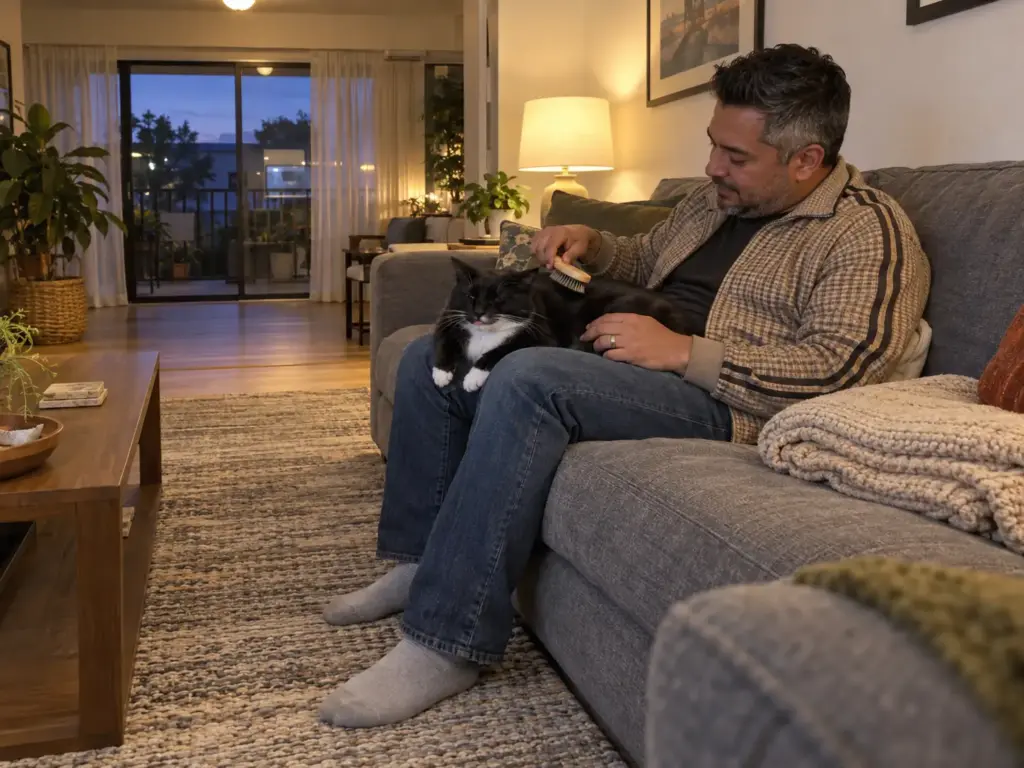
Keep the sessions short and stop before he decides he has had enough. A cat who walks away after two calm minutes will come back tomorrow; one held down for ten will hide when he sees the brush.
Make the hair less visible, then make it washable
Matching the house to the cats helps: a black cat and black clothes, a dark gray cat and dark gray furniture. “I still have to vacuum every day or every other day, but it has definitely made hair less noticeable.” Another said they deliberately choose furniture, blankets and rugs that hide their pets’ hair. You cannot repaint a rented sofa, but a throw in the cat’s color over his end of it gets you most of the way.
Then make that washable throw the thing you wash. A cat usually owns one or two spots, and if each has a washable layer, the bulk of the hair goes into the machine once a week instead of into the weave of the couch. (The throw will be covered in hair again within a day. That is the point: it collects so the sofa does not.)
One tip that circulates, running a sticky lint roller over the cat himself, leaves an open question about residue on coat and skin, and nobody discussing it had evidence either way. Skip it.
Keep the vacuum where you can reach it
A lightweight vacuum is easier to whip out. The vacuum you own already works better stored in the hallway, charged or plugged in, than tucked behind the coats in the closet, because a two-minute pass you actually do beats a thorough clean you keep postponing. How to reduce cat shedding in the broader sense is its own long list; for a rental, these three habits carry most of the weight.
Make one free change today and buy nothing until you have three weekly grades in the notebook. If the pile on the towel grows while the pile on the sofa shrinks, the routine is working, and you will know which tool is worth adding because you will know what the current one leaves behind.
Matching the Brush to the Coat, and the Size Problem With Big Cats
You bought the famous tool, ran it over him, and almost nothing came out. Sometimes nothing comes out of the cat’s fur, and the owner goes back to the old glove. The tool was probably fine. It was the wrong shape for that coat.
VCA sorts grooming tools into three groups, and each matches a coat:
- Short coats or a sparse undercoat: a brush with stiff bristles, or a rubber brush (Purina suggests rubber for shorthaired cats).
- Medium and long coats: long-toothed metal combs and brushes that reach through the outer layer (Purina adds the slicker brush for longhaired cats).
- Heavy seasonal shedding: an undercoat comb or deshedding brush, used gently and never dragged through tangles.
A rubber brush for the short, dense coat
The damp glove from the free fixes already does part of this job. When you want something made for it, the Cat Brush with Soft Rubber Pins is about 8 by 4.5 inches of soft silicone pins that lift loose hair from a short coat in a gentle evening pass, and it rinses clean under running water. Most cats tolerate it well, which matters more than any spec.
It loosens hair but does not hold onto it, and buyers note that the loose fur ends up on the bed and the couch. Use it with the cat on his towel, or right before you vacuum, so the hair it frees has somewhere to go besides the cushions.
An undercoat comb for the heavy weeks
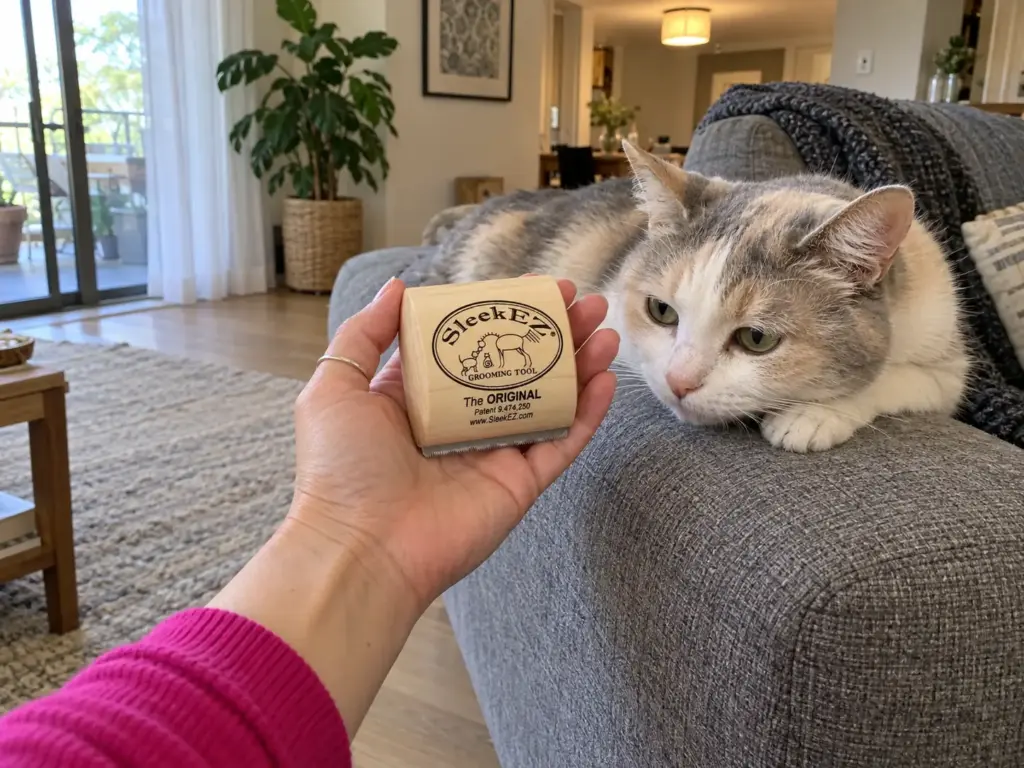
When the weekly grade jumps a notch in spring or fall, the undercoat is what is coming out, and a surface brush only skims it. The SleekEZ Cat Brush for Shedding is about 5.5 by 3 inches with a compact blade, easy to hold and well suited to pulling loose undercoat during those weeks. Go slowly and follow the direction of the coat; VCA’s advice to be gentle and avoid pulling on tangles applies to every tool in this section.
The blade is small, and reviewers with big long-haired cats describe needing pass after pass to cover the coat. On a compact cat the small blade matters less. On a very large one, keep it for the heavy weeks and the spots that need it most rather than the whole cat.
The long-coat, big-cat gap, and what to look for by shape
The obvious move is one famous de-shedding tool for every cat. For a large long-haired cat, that pick stops being obvious fast. Buyers with large cats say the combing surface is too small to be worth the time, and buyers with short coats call rival tools too harsh. Both complaints point at the same thing: the tool was built for a different coat or a smaller cat.
There is no single long-coat comb for big cats that we would name here as both easy to buy and reliable, so look for the shape instead. A wider head comes to mind first. Tooth length matters more, though: long metal teeth that reach through the outer coat to the undercoat do the work, and VCA’s description of long-toothed combs with offset tines for medium and long coats is the right picture. A wide head with short teeth only grooms the top layer.
If a long coat is already matted down to the skin, that is a job for a groomer or the vet, and whether a cat needs shaving or sedation is their call. The broader comparison of a de-shedding tool against a regular brush is a topic of its own; for most homes, the coat decides before the brand does.
Getting Hair Off Fabric When You Can’t Replace the Sofa
A lease rarely lets you rip out the carpet, and the sofa came with the apartment or cost too much to replace over cat hair. This section is practical reasoning rather than research: what you can wash, what you can roll, and what you can leave alone.
Match the fabric to the cat, and keep one washable layer
Start with the layers you control. Throws, cushion covers and the blanket at the foot of the bed can all be chosen in a shade close to your cat’s coat, and all of them come off for the wash. A washable couch cover over his end of the sofa protects the upholstery you cannot clean easily and turns the weekly hair problem into a laundry load.
For rugs, smooth low-pile ones release hair to a vacuum far more easily than shaggy ones, and a small washable runner along the route he takes from the bed to the sofa catches a lot before it reaches the carpet. All of it is renter-friendly: none of it touches the lease.
A reusable roller for sofas, bedding and the coat on its way out the door
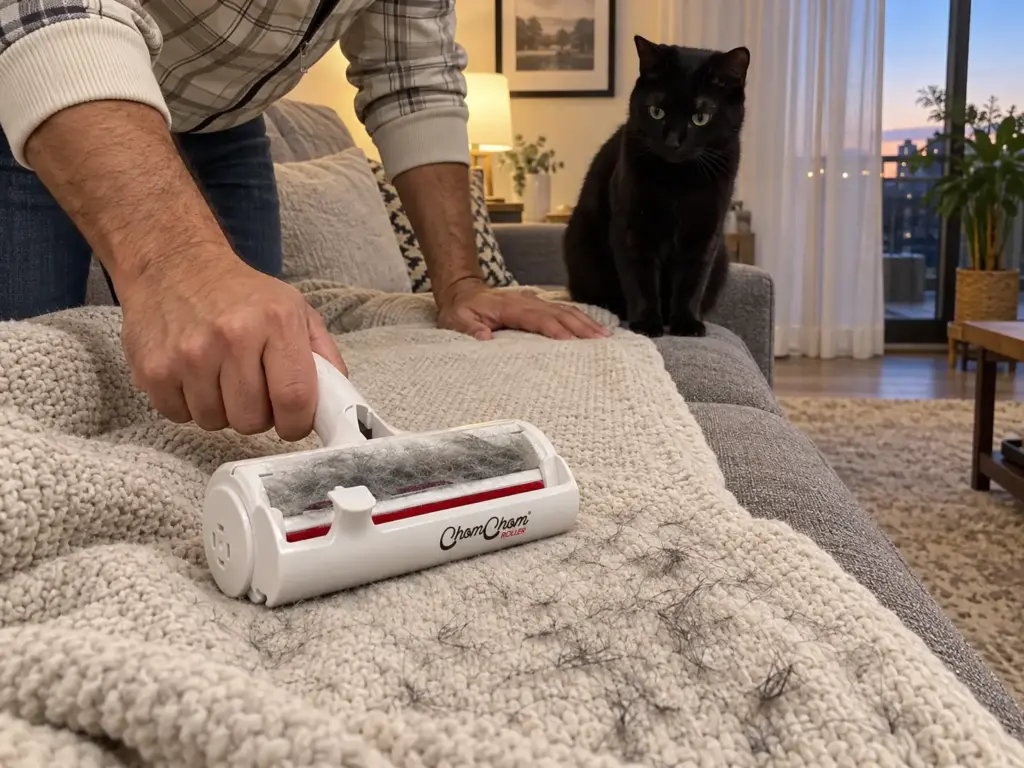
Before buying anything, try what you have: the damp rubber glove pulls hair off upholstery in rolls, and an ordinary sticky lint roller handles clothes. When those stop keeping up, the ChomChom Roller Pet Hair Remover is a reusable roller, about 2.5 by 7.5 by 7.5 inches, with no tape refills and a built-in bin. Plenty of owners say it is quicker to grab than the vacuum when they want to defur the sofa before guests arrive.
Not everyone is convinced. Some buyers say they had to roll it excessively to pick up the hair and that it feels cheaply made. On blankets, the washing machine still wins.
Keep a roller on a hook or shelf right by the front door and give your coat and pants one pass before you leave. Hair that would have ridden to work, the car and the gym stays home, and you will notice the difference first on dark clothes.
What to leave alone in a rental
Leave the carpet and the flooring alone, and skip anything that needs adhesive on the walls or the furniture. If one route through the apartment is taking most of the hair, the same no-drill approach that works to cover the one route without drilling for litter works for fur: a washable runner or mat on that path, lifted and shaken out with the rest of the laundry.
Leave the cat’s coat alone too, beyond brushing. No sticky rollers on him and no home trims to cut down the shedding. Keeping hair under control around the house and choosing a vacuum for a small apartment both deserve their own space; the rental version comes down to washing what lifts off and brushing what grows.
Your Cat Against Last Week, Not Against Anyone’s Sofa
Measure your own cat before comparing him with anyone else’s. A weekly brush session on a light towel, with the same brush, zone and minutes, gives you a baseline that no breed chart or friend’s couch can.
Do the free things first. Brush on his terms, wash the one spot he sleeps on, and match your fabrics to his coat, then add a tool chosen for the coat he actually has.
Treat a change in the pattern as the vet’s business. Patches, visible or red skin, a sudden jump, or a cat who stops grooming leave the housekeeping behind; everything else is a load the apartment can be set up to absorb.
Three weeks from now, put the photo of your first towel next to the photo of your third: if the piles look alike and the sofa looks lighter, the routine is holding. Today, pull the throw off his favorite spot and put it in the wash, lay a clean light towel on the sofa, and give him his first three minutes with the brush.
Frequently Asked Questions
01Why is my cat shedding so much?
In most homes it is ordinary shedding: indoor cats drop hair all year in a heated apartment, with heavier stretches in spring and fall. Your own weekly baseline tells you whether this is his normal. Bald patches, visible skin or a sudden jump are for the vet.
02How much shedding is too much for a cat?
No official number exists, so the useful measure is your own cat compared with himself, using the same brush, zone and minutes once a week. If the pattern suddenly changes, take those weekly grades to the vet and let them decide.
03Can you stop a cat from shedding?
No, a healthy coat always sheds, but you can cut down how much of that hair lands on your sofa, bed and clothes. Brush regularly, wash the spot he sleeps on, and choose fabrics close to his coat color so what you miss stays out of sight.
04What can I give my cat to reduce shedding?
Anything you give a cat for his coat is a question for your vet, and we leave it with them. What is fully in your hands is brushing on his terms and keeping the spot where he sleeps clean.
05Which cats shed the least?
The Sphynx and the Rex breeds shed very little, according to VCA, while long-coated breeds such as the Maine Coon shed a lot. Beyond those extremes, the individual cat matters more than the breed, and even cats of one breed vary.



Leave a comment