Where Cat Bowls Go, and What Quietly Ruins Them
Don't blame your discipline for the bowl you never wash. The spot you picked (not your habits) decides it, plus what actually breaks the film.

Alfredo RamsesFounder · September 28, 2026 · 23 min read

On this page9 sections
- 1The Spot You Picked Is Deciding How Often You Clean
- 2Where the Bowls Actually Go in an Apartment
- 3How Far the Bowls Have to Be From the Litter Box
- 4Food and Water, Together or Apart
- 5One Cat, Two Cats, and How Many Bowls That Means
- 6Material and Shape, and Why Plastic Loses
- 7The Cleaning Routine, and What Actually Breaks the Film
- 8The One Move That Makes the Rest Stick
- 9Frequently Asked Questions
Nobody chose that corner. The bowls went there because the trash can took one wall and the litter box took the other, and the corner was what was left over. The cat eats there, walks past the water, and drinks out of the bathroom sink instead. And by Thursday the water bowl has a slick on the inside that a rinse under the faucet does not touch.
He is not being fussy about any of it. He is reading a room you set up by process of elimination, and every complaint he has is about something real. The CDC puts cleaning pet bowls on the same list as washing your hands before you handle pet food, which tells you what kind of chore this actually is. Cat bowl care is one system with two halves, and this is the guide for both: where the bowls go, why the spot decides whether they ever get cleaned, and what breaks that film instead of moving it around the bowl.
Quick Answer
Bowl placement and bowl cleaning are the same job, and these five rules cover both.
- Put the bowls somewhere quiet, off the walking line, and nowhere near the litter box.
- Split the food from the water; most cats drink more once they are apart.
- One full set per cat, plus one, spread out rather than stacked in a corner.
- Use stainless steel or glazed ceramic; plastic scratches, and the scratches hold the film.
- Wash daily with soap and friction, deep clean weekly, and dry completely every time.
The Spot You Picked Is Deciding How Often You Clean
Search around and you will find two entirely separate conversations about cat bowls. One is about where to put them. The other is about how often to wash them. Nobody puts them in the same article, and that split is why the advice keeps failing in real apartments.
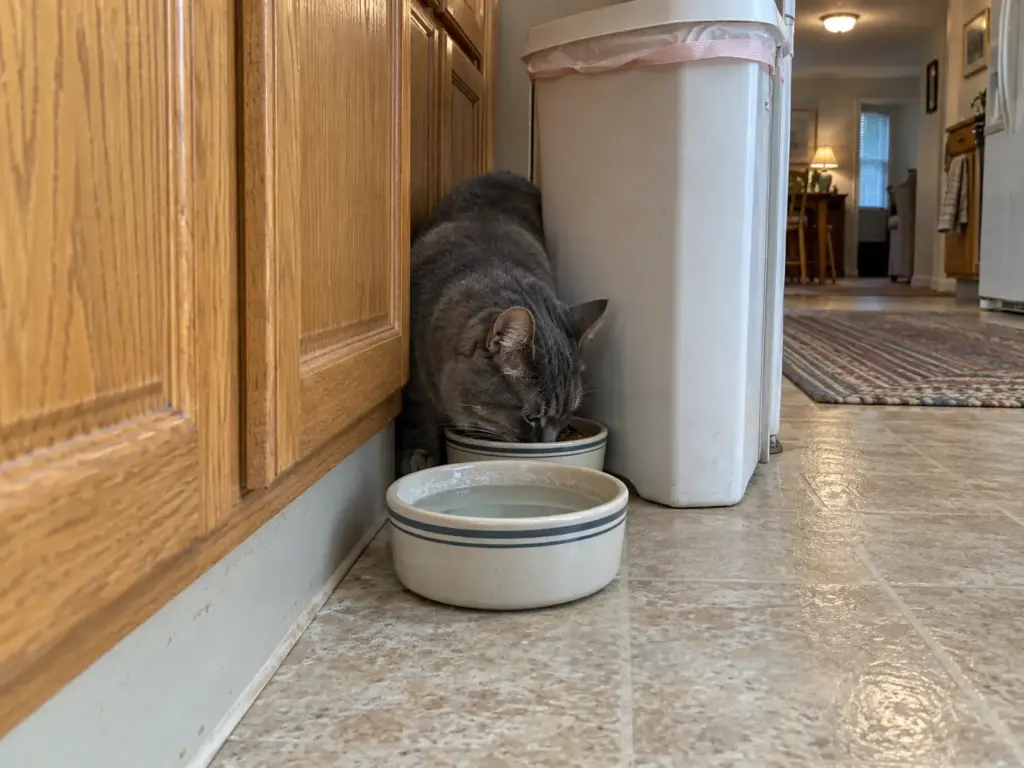
They are one failure, running in one direction. A bowl in an awkward spot does not get washed. It gets topped up.
Watch the actual sequence in your own kitchen. The water is low, you are holding a bag of groceries, and the bowl is wedged behind the trash can on the floor. Washing it means setting the bag down, moving the can, lifting the bowl over the mat without sloshing it, carrying it to the sink, and then doing all of that in reverse.
Topping it up means tipping a glass. You will top it up. So will everyone.
That is the whole mechanism, and it compounds, because fresh water poured onto a filmed bowl does not dilute the film. It feeds it. The slick layer stays put on the sides, picks up whatever the new water brings with it, and by day three the bowl feels slippery under a finger even though the water in it looks clean.
The CDC’s guidance on pet food safety is worth reading precisely because of how unglamorous it is: clean the bowls, the scoops, the mats, frequently. No conditions. The organisms it has in mind are the ordinary ones that move between a pet bowl and a kitchen, salmonella and E. coli among them, which is why the advice sits in the same paragraph as washing your hands.
But frequency is not decided by how much you agree with the CDC. It is decided by how many moves it takes to get the bowl to a sink, which is a layout problem that no hygiene article treats as one. You can read the CDC’s guidance on pet food safety and still fail at this, on a technicality of furniture.
The conventional advice is to build a better habit. In practice, the habit is not the variable. Cut the trip to three seconds and the washing happens on its own, and it keeps happening in week six when the motivation is gone.
So here is the audit, and it takes thirty seconds. Go and pick up the water bowl right now, carry it to the sink, and put it back. Count what you had to move. If the answer is anything above zero, the spot is what is broken, not your discipline.
And if you are shopping for new bowls off the back of all this, that decision has its own guide and it is a separate question from where the thing ends up living.
Do the trip before you read any further. Carry the water bowl to the sink and back, and notice whether your first reaction was a small sigh. That sigh is the whole diagnosis. A spot that makes you sigh at two in the afternoon on a good day will lose every single time you are tired.
Where the Bowls Actually Go in an Apartment
Every guide says the same four words: a quiet, low-traffic area. In a one-bedroom where the hallway is the kitchen, that sentence means nothing at all. You have three or four viable surfaces in the entire place, and two of them have a dishwasher under them.
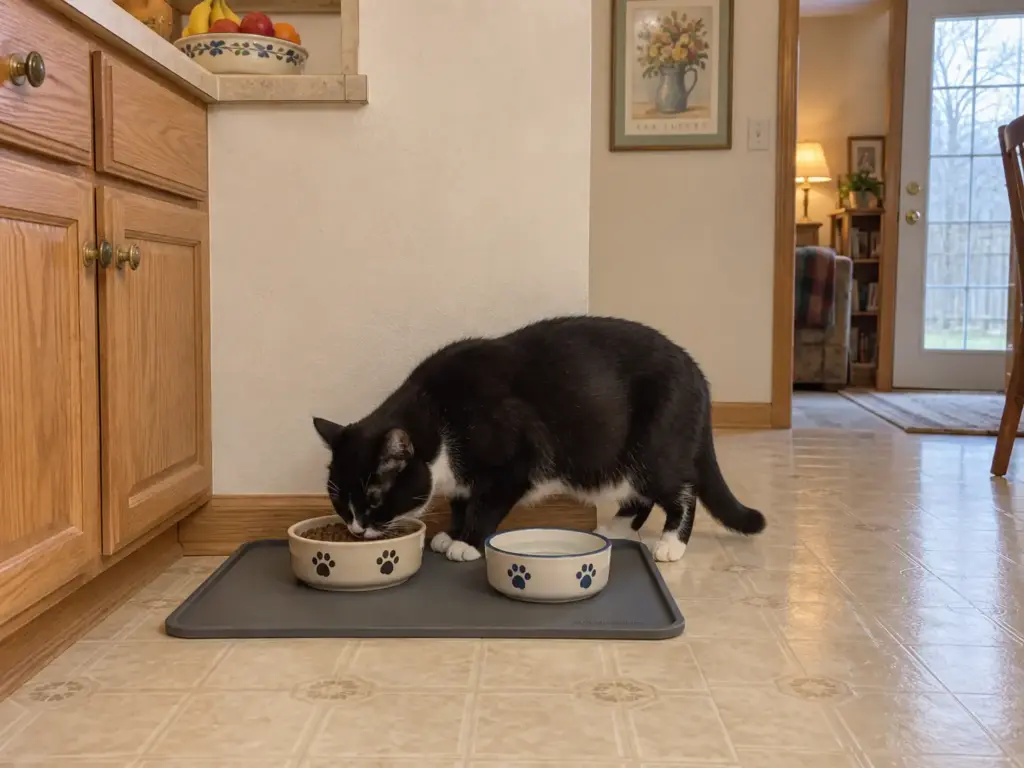
So here is the apartment version, in the order the constraints actually bite.
Off the walking line first. Not the strip of floor between the front door, the fridge and the sofa, because that is the one route everybody takes at speed while carrying something. A cat with his head down in a bowl in that strip is getting stepped over several times a meal, and he will start eating in short interrupted bursts and leaving food behind.
The pattern gets read as a picky eater. It is a cat who cannot get through a meal without traffic.
Then the appliances. A dishwasher that starts its cycle, a fridge compressor that kicks in, a washing machine mid-spin: all of them fire without warning, and all of them fire while the cat’s face is in a bowl with his hearing pointed at the floor. One startle in that position is enough to put a cat off a spot for weeks, and he will not connect it back to the machine for you. If the only counter space you have is next to the washer, the bowls go on the far end of it, not the near end.
When a cat quietly stops drinking, placement is the first thing to audit, well before anybody starts shopping for a fountain.
Now the wall. Put the bowls against something solid with a view of the rest of the room, not facing into a corner. A cat eating with his back to an open doorway spends the meal checking over his shoulder. This is not nerves, it is the default setting of an animal that eats in the open, and giving him the wall costs you nothing but a rotation of ninety degrees.
Last, the surface. Hard floor beats carpet, and it is not close. Carpet under a water bowl holds every drip, the pile stays damp between washes, and the smell that develops down there is not coming from the bowl at all. A mat on top of a hard floor does two jobs at once: it catches the spill, and it draws a visible border that turns a random patch of tile into a place where meals happen.
Before you buy a mat, move the bowls. The free version of everything above is to pick a different corner of the room you already have, and it fixes about half of these cases outright. Do that first and give it a few days.
If the spill is still the problem after the move, the mat is the small purchase that earns its place. The Amazon Basics Waterproof Non-Slip Silicone Pet Feeding Mat has raised edges, which is the only feature that matters here, because a flat mat just relocates the puddle to its own edge. One caveat worth knowing: silicone grips the floor and it also grips dust and kibble crumbs, so the mat itself joins the washing rotation. A mat nobody cleans is a bowl problem with a bigger footprint.
The rental workaround people land on, over and over, is not a separate room. It is diagonal corners of the same room. Two opposite ends of one kitchen give you real distance without spending a room you do not have, and in a small apartment that is the whole game.
How Far the Bowls Have to Be From the Litter Box
This one gets passed along as though it were etiquette. Cats are clean animals, they do not like eating near the bathroom, and so on. That framing makes it sound optional, like a preference you could reasonably overrule when space is tight.
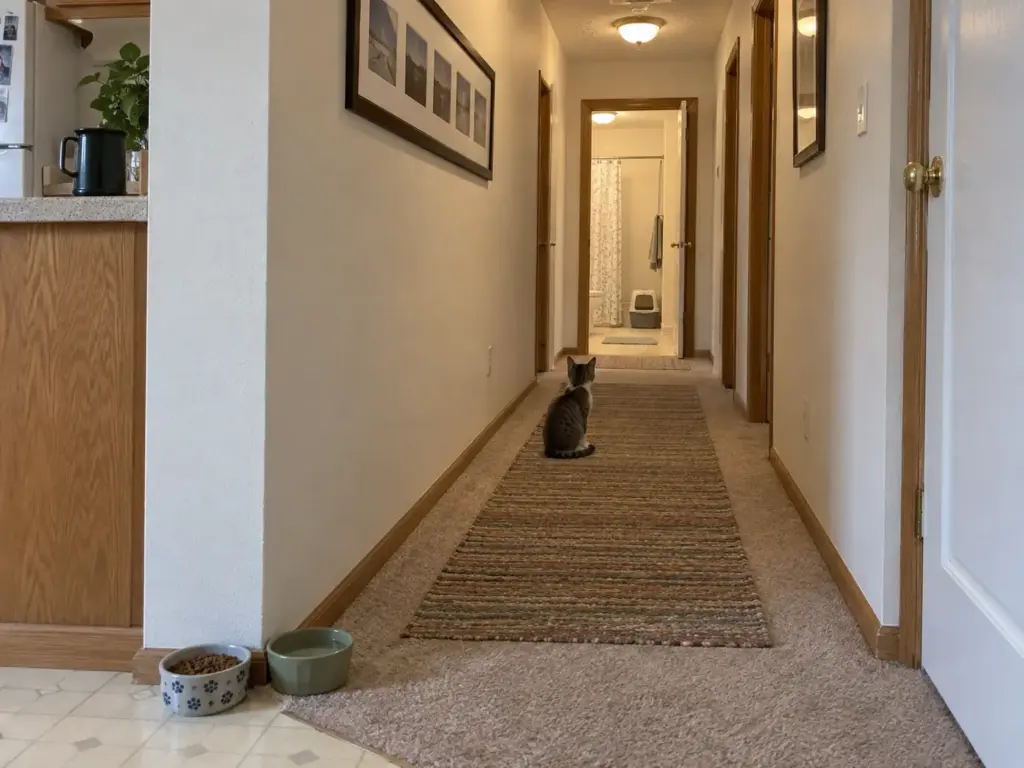
It is not a preference. It is airborne litter dust landing in an open dish of water.
Think about what a cat does in a box. He digs, he turns, he covers, and then he jumps out and shakes. Every one of those movements throws fine particles up into the room, and fine particles do not fall straight down. They drift, and then they settle on the nearest horizontal surface, and the nearest horizontal surface is a bowl of still water with a huge open face.
Water takes it worst. Kibble sits in a mound in a bowl and mostly sheds what lands on it; water catches everything and holds it at the surface, where the cat’s nose arrives first. Put a bowl a couple of feet from a box on the same counter and you can see it inside a day: a faint gray scum on the surface, visible when the light comes in sideways.
A cat who walks up, sniffs and walks away is not being difficult. He is telling you about the water, accurately.
The forum consensus on this is unusually blunt for a cat forum, and the reason people give is never aesthetics. It is contamination. The distance they land on through trial and error is a good deal further than the six inches that a kitchen layout usually allows.
Which brings up the part that no guide written for a house will tell you. In a one-bedroom with a single bathroom, the recommended distance does not exist. You cannot conjure fifteen feet of separation in a place where the longest straight line is the hallway.
So change the variable you can move. A broken sightline beats raw distance, and it beats it by a lot. A cabinet corner, a wall, a turn in the hallway, the side of a bookcase: anything that means the cat cannot see one from the other does more work than two extra feet of open floor, because it also blocks the direct path that dust travels. Distance plus a clear line of sight is worse than a short distance around a corner.
And if the bathroom is genuinely the only place the box can go, the answer is that the bowls leave the bathroom, not that the box moves out of it. The box has fewer viable locations than the bowls do, always. Move the thing with more options. There is more on what belongs near a litter box, and what has to stay away from it if the box end of this is the half you are still fighting.
If the bowls and the box have to share a room, break the sightline before you worry about the distance. Put a cabinet, a wall or a door frame between them and you have done more than two extra feet of floor would have. Then check the water at eye level in daylight, not from standing height, because the film on the surface is only visible when the light comes across it.
Food and Water, Together or Apart
Walk into any pet aisle and the default product is two bowls welded to one plastic base. That object was designed for the person carrying it, and it solves a problem the human has. It does not solve one the cat has, and it creates two.
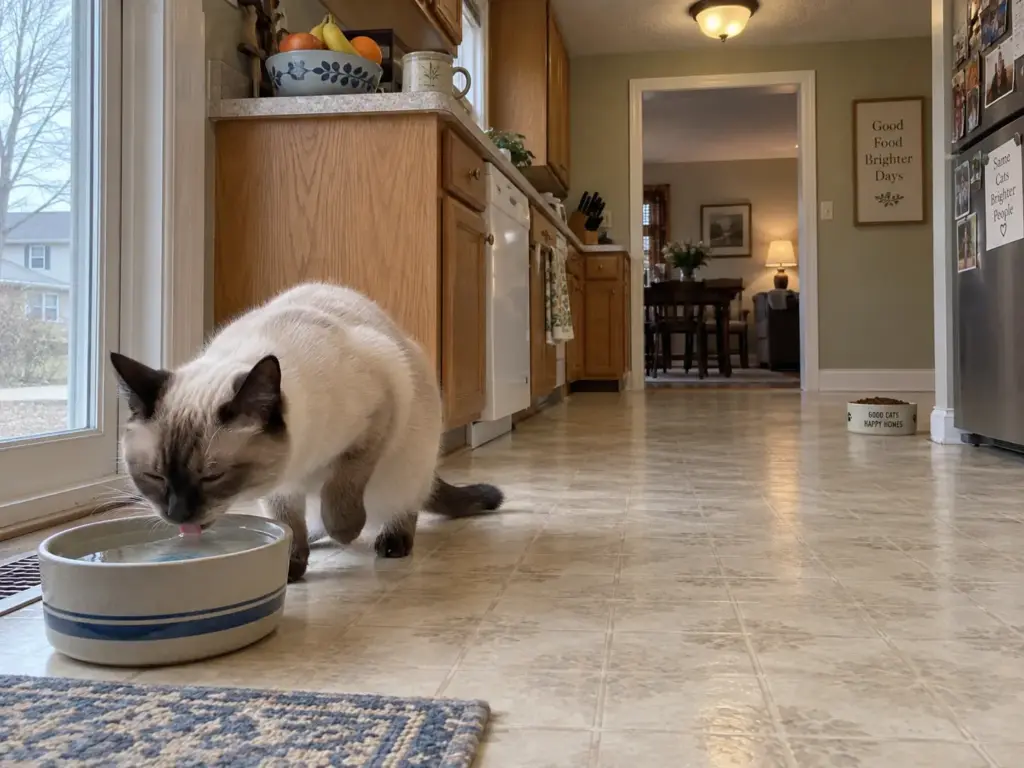
The first is instinct, and it is old. A cat is built around not drinking where it eats, because in the version of the world this animal was designed for, water next to food meant water next to whatever the food used to be. That wiring did not get updated when we started buying kibble in bags. A cat who walks away from a full bowl at his elbow and drinks from the shower tray is not being contrary; he is doing the correct thing for a slightly different century.
The second is mechanical and you can watch it happen. A water bowl six inches from a food bowl collects kibble dust, crumbs off the whiskers and a slick of grease off wet food, and it does it within a day. Grease on the surface of water is what makes a cat sniff and leave. So the bowl stays full, and the fullness gets read as a cat who does not drink much, and then somebody buys a fountain to solve a problem that was six inches of countertop.
The fix does not need rooms. It needs a couple of yards and, ideally, a break in the sightline. Water at the far end of the counter, or in the hallway, or on the other side of the doorway. In a studio, diagonal corners.
That is enough for most cats, and the whole reason a cat walks away from the food to drink is worth reading if you want the long version of the instinct.
Now the number, because the panic about all this usually comes from not having one. According to the Cornell Feline Health Center, “Cats need to consume about 4 ounces of water per five pounds of lean body weight per day.” A ten-pound cat is looking at roughly a cup a day, which is a coffee mug, and Cornell’s Feline Health Center notes on hydration is where that figure comes from.
Here is the part that changes how you read your own bowl: that is a total, from everything. Wet food is up to eighty percent water, so a cat eating wet twice a day has already covered a large share of his daily intake before he goes near a dish. A barely-touched water bowl in a wet-food house is the expected result, not a warning. The same barely-touched bowl in a dry-food house is a question worth asking.
Which is why moving the water is the cheap experiment. Shift it ten feet, change nothing else, and look at the level on Friday. You have either learned that your cat drinks fine and always did, or you have learned that six inches of counter was the entire problem.
One Cat, Two Cats, and How Many Bowls That Means
Almost nobody writes these as two different articles, and they are two different articles. Add a second cat and the answers above do not scale up; several of them invert.
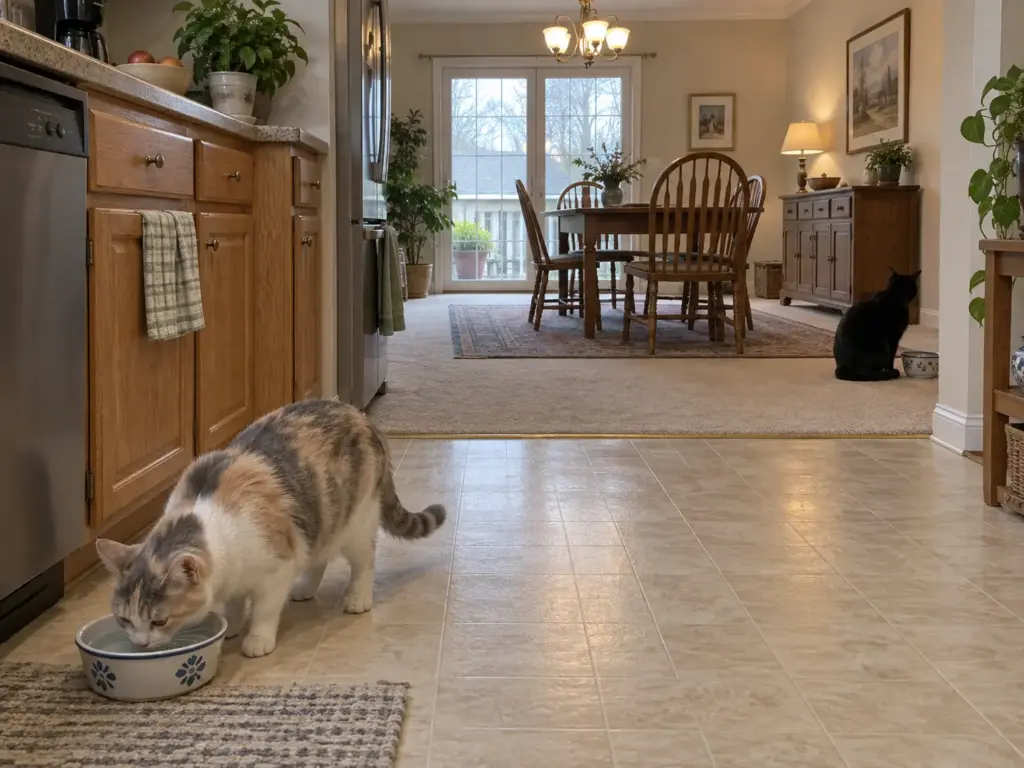
The rule is one bowl per cat, plus one, counted as full sets. Two cats means three water stations and three food spots. But the count is the easy half, and the half everybody gets wrong is what comes next: they have to be spread out.
Three bowls lined up along one wall is not three feeding stations. It is one station with more dishes to wash, and it solves nothing, because the thing being shared was never the bowl. It was the spot.
Cornell’s own framing on this is the useful one: a more dominant cat can effectively ban another from a shared resource, and it happens without anything you would recognize as a fight. Resource guarding between cats is quiet by default. No hissing, no scrap, nothing to walk in on. It is done with posture and position, usually by sitting somewhere that makes the approach feel expensive, and the cat being banned just quietly stops going.
That is what makes the water bowl such a liar in a two-cat house. The level tells you the household drank. It does not tell you which cat drank, and a full-looking bowl can mean one cat is fine and the other has been drinking out of the toilet for two weeks.
The community name for this is being banned from the bowl, and the giveaway is usually not at the bowl at all. It is a cat who has taken up drinking from the faucet, the shower floor, or the glass on your nightstand.
The other multi-cat tax is cleaning, and it is not linear. A shared food bowl gets two sets of saliva and twice the crumbs in the same twenty-four hours, and the film builds visibly faster. If you have two cats on one dish, you are on a stricter washing schedule than a single-cat house, not the same one.
Separate bowls also let you see who is eating what, which you lose entirely with a shared dish. Whether cats will share a food bowl at all has a longer answer, and so does how the count works once there are three of them, where the geometry of an apartment starts fighting back.
One line before the furniture talk resumes. A cat who suddenly goes off food or off water is a vet call, not a bowl problem — dehydration is not something to manage with a better bowl — and none of the above applies until that has been ruled out.
Material and Shape, and Why Plastic Loses
The dirtiest bowl in most apartments is the one that looks completely fine. It is plastic, it is a few years old, it goes through the dishwasher, and you would eat off it. Scrubbing it harder will not help, because what is wrong with it is not on the surface you can see.
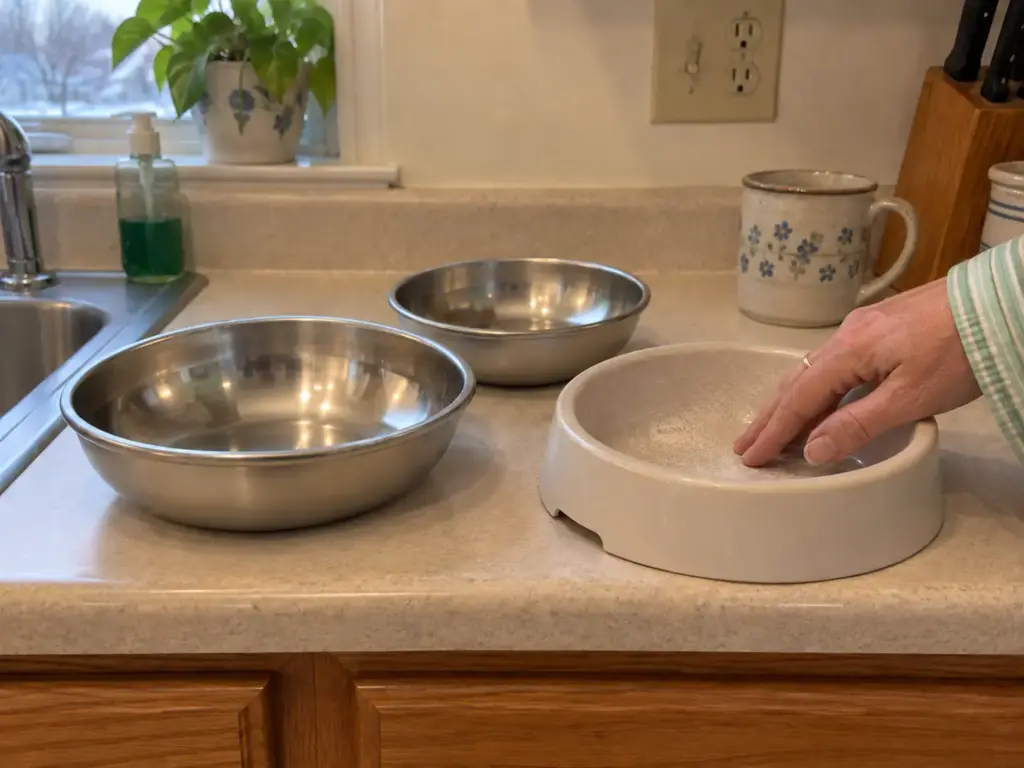
Plastic scratches. Not dramatically, just steadily, from claws and kibble and the scouring side of a sponge, and every scratch is a trench that a cloth cannot get into. Film settles into those trenches and stays there through a wash, seeding the next batch. The bowl gets microscopically worse every month while looking exactly the same, which is why people are genuinely shocked when they finally feel the difference against a new one.
Stainless steel does not do this, and neither does properly glazed ceramic. Both are non-porous and hard enough that ordinary use does not open them up, so when you wash them they are actually clean rather than clean-looking. The Americat Company Stainless Steel Cat Bowls come as a pair in 18/8 304-grade steel, which is the specification worth knowing, since plenty of cheap steel bowls do not publish a grade at all and some of them pit within a year.
The catch with any steel bowl is weight: they are light, they slide, and an enthusiastic eater will push one across the kitchen. That is a mat problem rather than a bowl problem.
Ceramic is fine right up until it is not. A glaze in one piece is as good as steel. A glaze with a chip or a hairline crack in it has a seam running through it that cannot be scrubbed or disinfected, and cosmetic damage is not cosmetic here.
This is where a lot of people go wrong on cost: the expensive ceramic bowl with a chipped rim is dirtier than the cheap steel one, and the chip is the only fact that matters. The full case against plastic bowls covers the rest of the material argument.
So use the finger test, which takes two seconds and settles it. Wash the bowl, then run a fingertip slowly around the inside and the rim. Smooth and squeaky means clean.
Any snag, any slickness that survived the wash, any catch on the rim, and that bowl is finished. Not due for a harder scrub. Finished. A cracked bowl is the clearest version of this, because a crack in a glaze is a seam no brush can get into, but the scratched plastic one fails the same test for the same reason.
Shape matters almost as much as material, in both directions. Wide and shallow beats deep and narrow, because a wide bowl lets you get a whole hand and a brush to every part of the inside, while a tall narrow one has a bottom corner that nothing reaches properly. The same shape happens to keep a cat’s whiskers clear of the sides, which is a real consideration and a separate rabbit hole if you want to know whether whisker fatigue is a real thing. And if the actual complaint in your house is food ending up on the floor around the bowl, the mess around the bowl is its own shape problem with its own answer.
The Cleaning Routine, and What Actually Breaks the Film
Here is the sentence that undoes most cleaning routines: rinsing does essentially nothing to biofilm. Running water over a slick bowl moves water past it. The film is a structure, stuck down and layered, and studies on biofilm resistance put it at up to a thousand times harder to clear with disinfectant than the same bacteria floating loose.
You are not fighting dirt. You are fighting something with a grip.
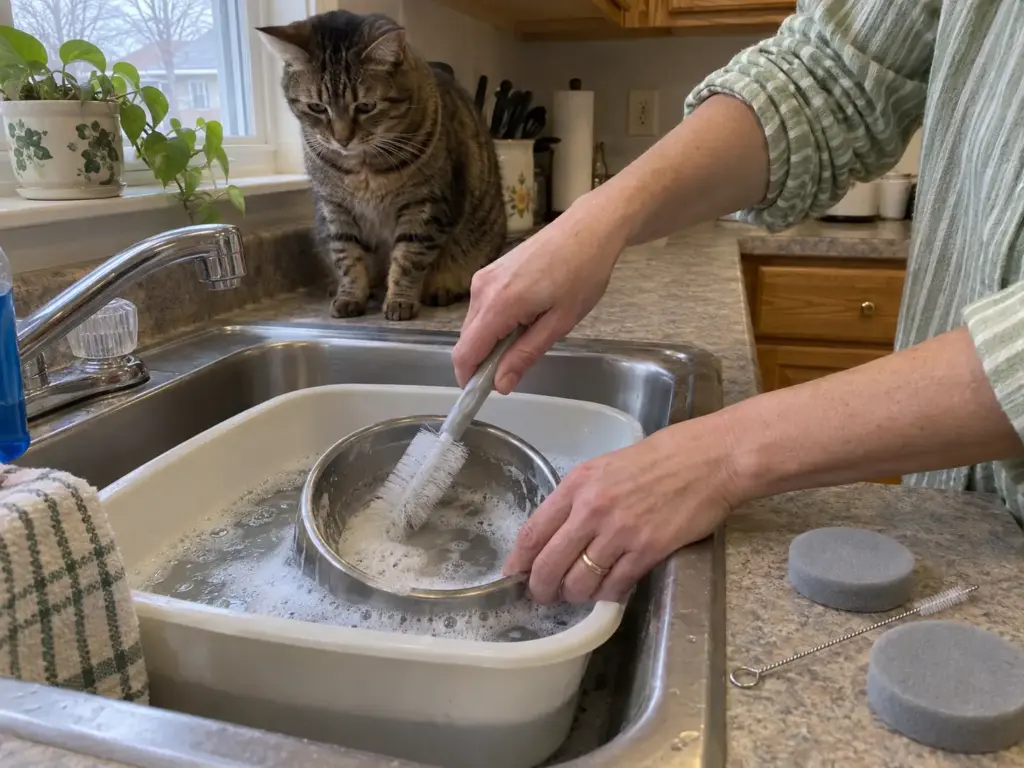
Which means the active ingredient in this entire section is friction. Not soap, not heat, not a soak: something physically dragging across the surface. Soap and hot water help the dragging work, but nothing replaces it.
The routine underneath that is short. Every day, a full wash with soap and a scrub, not a rinse, for water bowls and dry food bowls alike, and after every meal for wet food. Once a week, a deeper pass: a soak in diluted vinegar or in very dilute bleach, then scrub, then rinse thoroughly. Never mix those two, ever, and if you only remember one rule from this paragraph, make it that one.
Then dry the bowl completely, and treat that as a step rather than as putting it away. A bowl left wet in the rack has water sitting in it, and water sitting in it is where the film starts again before your cat has even walked over. Drying is what resets the clock.
The tool question is where this gets practical, because a flat sponge cannot reach the places that need friction most: the bottom corner of a deep bowl, the seam around a rim, the join where a bowl meets its stand. A long handle is what solves that. It is not a refinement. It is the difference between scrubbing the parts you can see and scrubbing the parts that hold film.
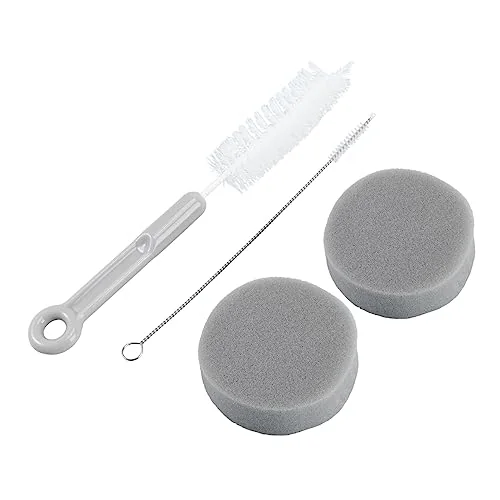
For the daily wash itself, plain dish soap and hot water is the answer, and it has been the whole time. The popular question about whether ordinary dish soap is safe has a boring answer: it is, as long as you rinse it off properly. Where a dedicated pet-safe detergent earns a place is scent. Perfumed dish soap leaves a trace that you stop noticing after a minute and a cat does not, and a bowl that smells faintly of lemon is a bowl some cats will not drink from.
The Furrtripsy Pet Bowl Cleaner Mousse is pH-balanced and fragrance-free, which is the reason to pick one of these over another, not the foam. It still does not scrub for you. Nothing does.
If your bowls are wide and shallow with nothing to reach into, skip the long handles entirely and get something with bristles you can push around with your hand.
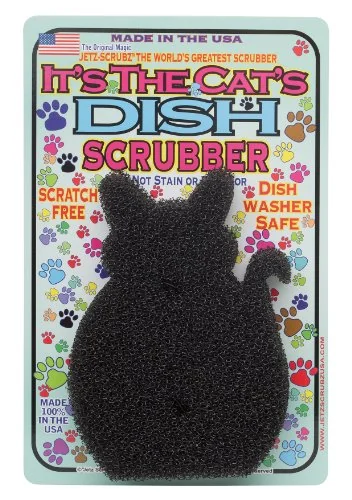
And before any of the three: the soap already under your sink plus thirty seconds of actual scrubbing covers the daily wash completely. The products above exist for the places your hand does not reach and the scent you do not want. They are not the routine.
Now the part written for houses that gets quietly skipped by everybody renting. The CDC also advises against washing pet bowls in the sink where human food is prepared, which is straightforward guidance in a place with a utility sink and a punchline in a studio apartment with exactly one.
The answer is not to give up on the wash. It is a dedicated plastic basin that lives under the sink, gets the bowls washed in it, and gets rinsed out and dried afterward. It costs almost nothing and it is the only version of this rule that survives contact with a one-bedroom.
A word on dishwashers, since three of the top results treat one as the solution. If you have one, steel and intact ceramic go in it happily on a hot cycle and it is a genuinely good weekly deep clean. Keep plastic out, because the heat works the scratches open. And if you do not have one, you have lost nothing that matters: the dishwasher is a convenience, and friction plus drying was always the part doing the work.
Finally, the thing that nobody mentions. Wash the mat too. People wash the bowl religiously and leave it on a mat that has been collecting spilled water and crumbs for a month, which means the clean bowl goes back down into the exact thing you just removed from it.
If you own a fountain instead of bowls, none of this goes away either, it just changes shape. A fountain changes the maintenance job rather than removing it, and both cleaning a fountain filter and how often the water itself has to change run on their own clocks, separate from the bowl’s.
Drying is not the optional last step, it is the step. Keep a dedicated towel for the bowls on the same hook as the washing basin, dry the inside properly before it goes back down, and you have reset the clock. A bowl that goes back wet has already started the film again before the cat gets to it.
The One Move That Makes the Rest Stick
Move the bowls before you buy anything. The spot decides whether the washing routine survives past week two, and everything else in this guide is downstream of a trip to the sink being easy or annoying.
Split the water from the food, and keep both out of the litter box’s airspace. A couple of yards and a broken sightline does the job in an apartment, and it costs nothing but a rearrangement.
Wash daily with friction, deep clean weekly, and dry the bowl completely every single time. The soap is not what breaks the film. The scrubbing and the drying are.
Put a reminder three weeks out, because three weeks is when the human end of this loosens, not the cat end. He will have made his decision about the new spot within a couple of days.
You are the variable. When the reminder lands, ask two honest questions: are you still washing daily, or has topping up crept back in? And has the water level been dropping faster since you separated it from the food?
Tonight, move the water bowl to the other side of the room and leave everything else exactly as it is. Look at the level on Friday. If it has dropped faster than it used to, you have just solved it for free.
Amazon’s Audible — free for 30 days
Your cat won’t let you read. Let someone read to you.
Audible is Amazon’s audiobook library — thousands of titles, read out loud, on your phone. Free for a month, plus one audiobook to keep forever.
Frequently Asked Questions
01How often should cat water bowls be washed?
Every day, with soap and actual scrubbing, not just a rinse under the faucet. Once a week, add a deeper pass with a vinegar or dilute bleach soak to handle what the daily wash leaves behind, and dry the bowl completely afterward.
02Can I use Dawn dish soap on cat bowls?
Yes. Ordinary dish soap is fine as long as you rinse it off properly and dry the bowl. What matters more than the brand is that something physically scrubs the surface, and that any strong fragrance gets rinsed away completely.
03Do cats like their food and water together?
Most do not. Cats drink better when the water sits away from the food, and a bowl right beside the plate picks up kibble dust and grease that put them off it within a day. The dual-bowl stand suits the person carrying it, not the cat using it.
04How far apart should the food and water bowls be?
Far enough that they are not in the same line of sight, which usually means a couple of yards or a piece of furniture between them. In a one-bedroom, breaking the sightline matters more than the exact distance, and diagonal corners of one room work.
05Can cat bowls go in the dishwasher?
Stainless steel and intact glazed ceramic usually can, on a normal hot cycle, and it makes a good weekly deep clean. Plastic is the one to keep out, since the heat works open the scratches that hold the film in the first place.

Leave a comment