Cat Hair in Bedding After a Wash? Check the Basket First
Find out why cat hair is back on your sheets after the wash, and which step to change (transfer or static) [pillowcase test + schedule by piece].

Alfredo RamsesFounder · October 13, 2026 · 16 min read


On this page8 sections
- 1Cat Hair in Bedding Starts at the Pillowcase
- 2What Can Share the Drum With the Bedding
- 3Transfer or Static: The Test That Says Which Step Failed
- 4Drying So the Hair Doesn't Cling Back
- 5Which Bedding Fabric Lets the Hair Go
- 6The Comforter and the Top Sheet: What to Wash and How Often
- 7Wash the Bed Alone, Dry It Cooler, and Read the Basket
- 8Frequently Asked Questions
You lift the sheets out of the dryer, give them one shake, and the window light catches a gray fuzz along the hem; or they sit clean in the basket and by the time the bed is made the fuzz is back. Either way, cat hair in bedding is usually not a sign that your cat is shedding more, because he is sleeping on the warmest, highest, softest surface in the apartment, which is the same list you would write for yourself. Hair gets into a bed through two different doors, the wash load and the dryer, and a lot of washing is aimed at the wrong one. Below is the sequence for getting cat hair off bedding: what to do before the wash, what can share the drum, a one-look test at the basket, drying, fabric, and a schedule by piece.
Quick Answer
Treat the bed as its own load and run it in this order.
- Shake it outside, then run a damp rubber glove over it, pillowcases first.
- Wash the bedding alone, with a hand’s width of empty drum above it.
- Check the sheet in the basket: hairy means the load, clean means static.
- Dry on low or no heat, pull it out warm, and empty the lint filter.
Cat Hair in Bedding Starts at the Pillowcase
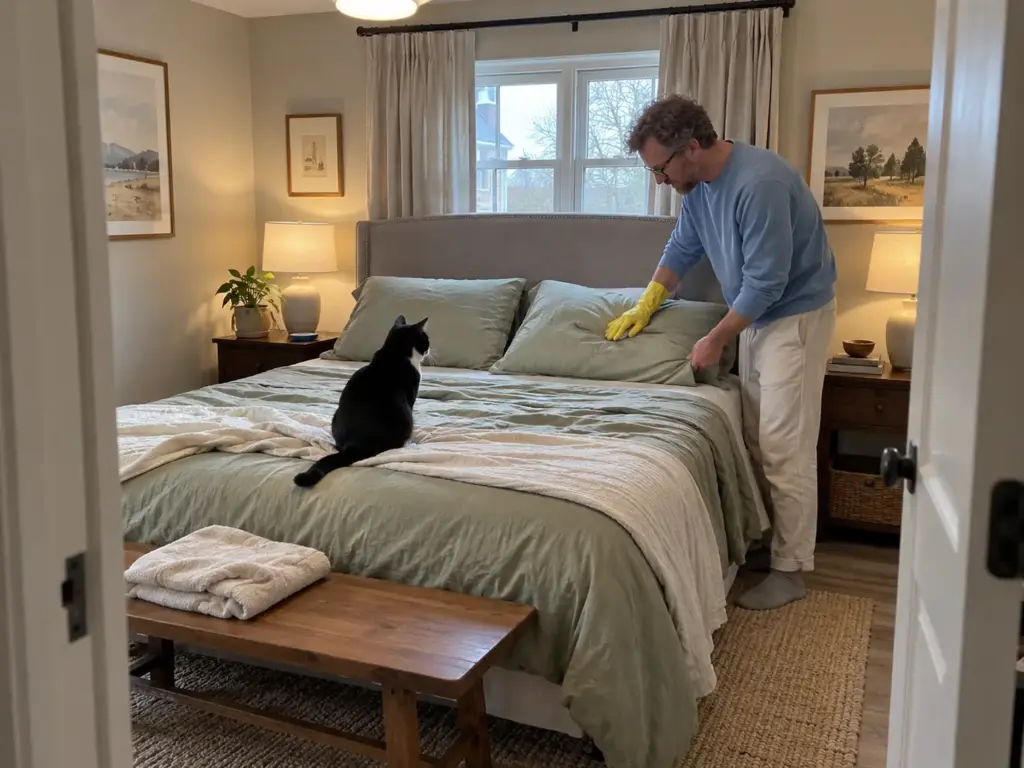
Strip a bed that a cat shares and the pillowcase gives the game away first. It sits at eye level, it takes the most contact, and it is the one piece you look at every morning. Whatever you do for the rest of the bed, start here, and start before anything gets wet.
Why the Pillowcase Shows It First
Woods Fine Linens, a bedding seller, points out that pillowcases get the most contact with the cat and with skin oils, and that they sit at eye level, so the hair shows there before it shows anywhere else. The cat chose that pillow for good reasons: it is the highest, warmest, softest spot on the bed, and nothing in your laundry routine changes that. The bed is also only one surface in a home full of them, and clearing the rest of the house without moving the hair has its own page, so this one stays with the sheets. If you want to keep the pillow in play, one commenter in r/Catownerhacks wraps it in a bath towel and keeps turning it to a fresh surface, which gives the cat a pillow and the pillowcase a rest.
A Shake and a Damp Rubber Glove
Take the bedding outside and shake it for about two minutes before it goes near the machine, the pre-wash step Woods Fine Linens recommends.
Then reach for the one pre-wash tool that does not push hair around. According to Consumer Reports, “Put on a rubber glove, dampen it with water, and run your hand over the sheet or blanket.” The hair clings to the damp rubber instead of the fabric, you rinse the glove, and you go again. Work through the pillowcases first, then the top sheet, then whatever the cat actually sleeps on.
Wring the glove out until it is damp rather than wet, and pull it across the fabric in one direction. A dripping glove soaks the sheet, and back-and-forth strokes push hair around instead of gathering it. The damp glove is Consumer Reports’ method; the wringing and the single direction are what keep it tidy.
Why a Lint Roller Before the Wash Backfires
The roller is the tool most people reach for first, and before the wash it is the one to put down. PetPlace warns that rolling and then washing can press the hair further into the fabric, and water makes the problem worse: Consumer Reports notes that wet hair clumps and sticks to both the fabric and the drum. Keep the roller for after.
The clothes page lays out the whole order, including why the roller comes after the wash, not before. One owner who has lived with this chore for years gave the verdict as “Give up. Vacuum it sometimes. It never ends :)”, which reads as permission to stop rolling the pillowcase every morning.
What Can Share the Drum With the Bedding
A washing machine is a shared room, and whatever goes in together trades fibers. The bed gets a load of its own because sheets and pillowcases are the one thing in the apartment that has to come out nearly hair-free, and every other fabric in the drum is a chance for lint to move in.

Towels and Fleece Leave Their Own Fluff
Woods Fine Linens is blunt about it: towels and fleece shed lint and fibers into whatever they are washed with, so the bedding goes in with the bedding. The load that saves a cycle by adding the bath towels hands the sheets a second kind of fuzz, and you end up chasing two problems that look identical on a pillowcase. If the machine belongs to the building and you cannot choose the load, the advice holds. A lighter load of bedding alone still beats a full one with towels.
The Hand Test for a Packed Drum
Load the bedding dry, then lay one flat hand on top of it. If your hand sits comfortably, the load has room to move and the water can carry hair out. If it feels tight, split the load. That is the hand test, again from Woods, and it adjusts to any drum because the hand is the measuring tool.
A packed drum load cannot rinse, and Consumer Reports adds that wet pet hair forms clumps that stick to fabric and drum and can clog a drain pump. Tight means splitting the drum load in two. This is where a comforter turns from a chore into a constraint, since a bulky comforter can fill most of the drum by itself and leave no hand’s width above it.
Wipe the Drum, and Check the Manual Before the Vinegar
Hair that stays in the drum rides into the next load. After the wash, wipe the drum, the door and the gasket with a damp cloth, as Consumer Reports advises, and if you have a front-loader, run the cloth into the fold of the rubber seal. Woods adds one more wipe right before the next wash.
Vinegar is the awkward one. Woods suggests half a cup in the rinse to loosen hair, while Consumer Reports warns that repeated use can damage a machine and that some manufacturers advise against it. So read your manual before you pour, and in a rental machine that is not yours, treat that as a rule rather than a suggestion.
Transfer or Static: The Test That Says Which Step Failed
You have washed the bed three times and the cat hair on the sheets is still there, so it seems pet hair on sheets after washing simply never comes out. Almost always one step failed, not all of them, and the sheet will tell you which if you look at the right moment: coming out of the machine, not after it is on the mattress. The cat is not producing extra hair for you. The bed is what changed.
Read the Sheet at the Basket
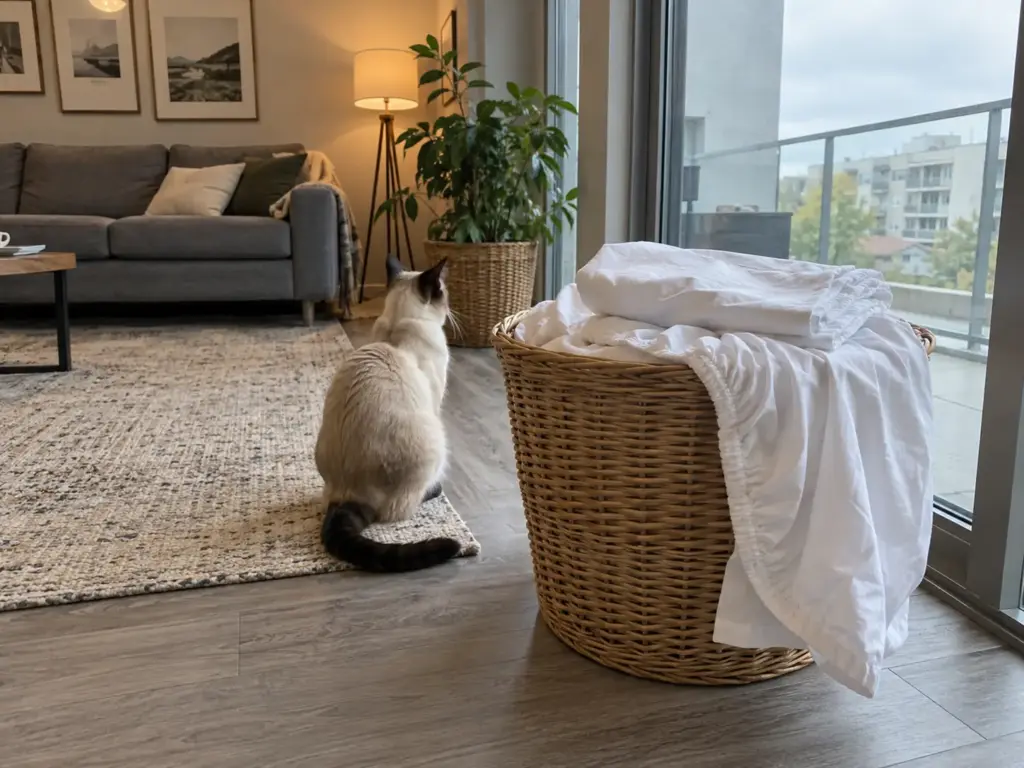
The rule has two halves, both from Woods Fine Linens. If the sheet is already hairy when it comes out of the dryer and lands in the basket, the hair came from the load. That is transfer, and the fix lives in the pre-wash sweep and the drum, covered above. If it sits clean in the basket and turns furry once it is on the bed, that is static, and the fix lives in the drying, covered next.
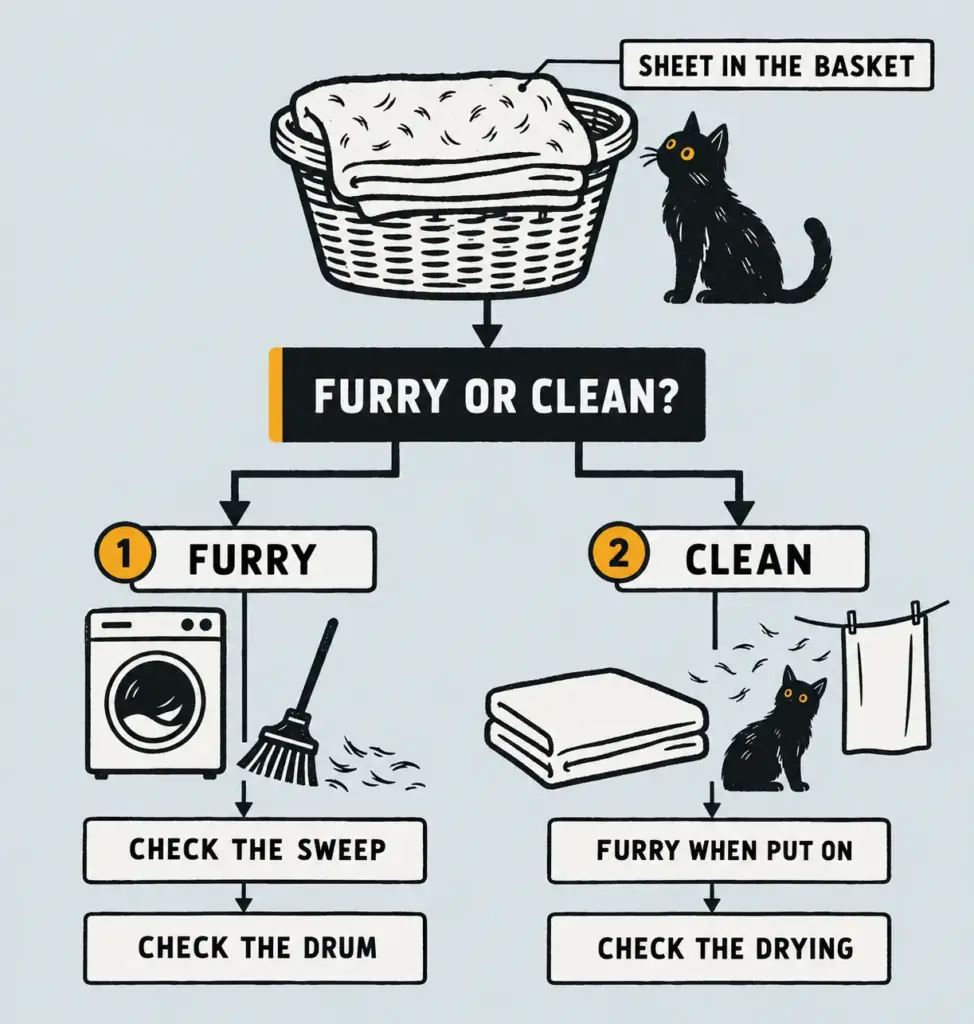
Run it on one piece, the pillowcase, and run it once. Pull it out, carry it to the window, and look along the hem and the seams in daylight. Decide hairy or clean. Change one step only, wash it again, and look again.
This is not a lab measurement. It is reading what is in front of you, and it works because you change one thing at a time.
Keep a scrap of paper on the dryer with two columns, hairy and clean, and put a tally under one of them after each wash. Three washes in, the pattern is plain, and you can see which step you changed on the wash where the result flipped. The two-cause test itself comes from Woods Fine Linens.
Hairy at the Basket Means the Load Carried It
If the pillowcase is hairy at the basket, ask what went into the drum with it. Hair that was on the sheet before the wash, lint that rode in on towels, and hair left behind from the last load all end up in the same place. One commenter described the loop exactly: “I know some people say the hair doesn’t come off when washing so like it continues to build up.”
A sheet that never comes out clean is not a cat problem. It is a sweep-and-drum problem, and the four things to change, one per wash, are the pre-wash shake and glove, the bedding-alone load, the hand’s width of room, and the wiped drum.
If the amount of hair jumps sharply from one week to the next, with far more coming off the cat than his usual season brings, that is a conversation for your vet. The test here is for ordinary shedding.
Clean at the Basket, Furry on the Bed Means Static
A sheet that is clean in the basket and furry by evening has had hair pulled back onto it, and static cling is the usual reason. Drying past dry is one cause, covered in the next section. The fabric is the other. One owner who sleeps under polyester and fleece blankets reports that they turn static in summer and winter, so “the hairs would cling to it like crazy.”
Smooth, dark pillowcases also show what a textured weave hides, and how weave and color decide what you see is worked out on the black-clothes page; the same logic applies to your pillow. If the basket test says static, do not wash it again. Wash it the same way and change the dry.
Drying So the Hair Doesn’t Cling Back
The instinct on laundry day is to finish the job: high heat, longest cycle, bone dry. For a bed a cat sleeps on, that is the setting that undoes the wash. A sheet dried to the last degree carries more static, and static is what pulls the hair you just removed back onto the fabric.
Low or No Heat, and Out While Still Warm
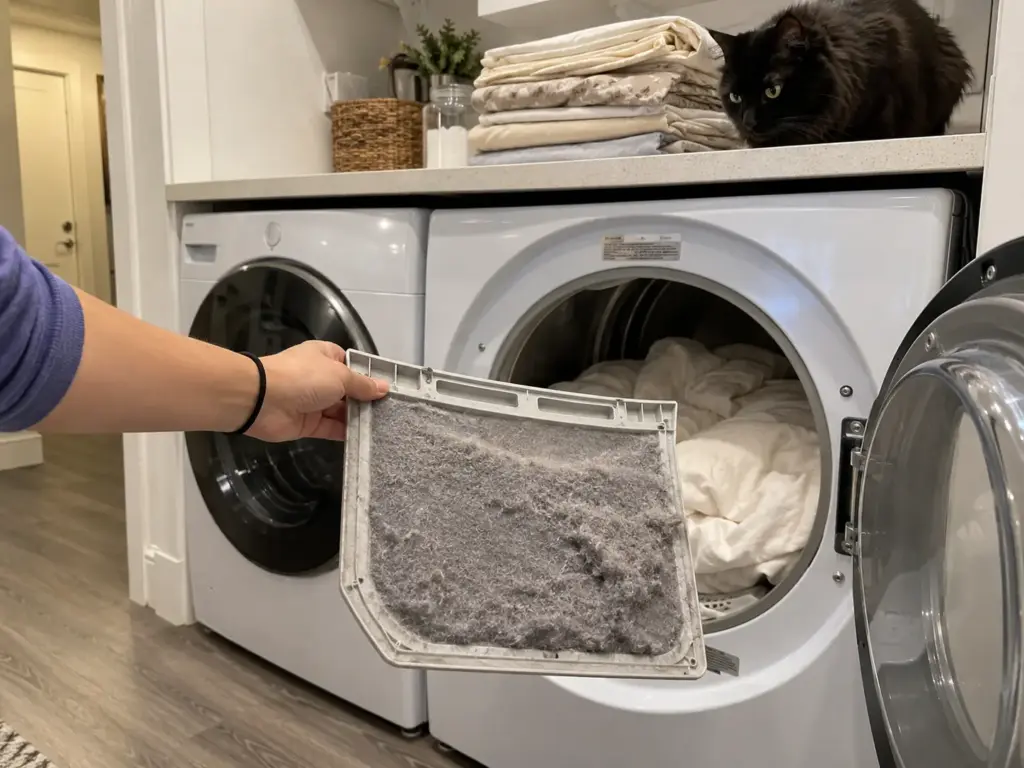
Woods Fine Linens recommends low heat or none, and taking the bedding out while it is still slightly warm. Shake it once, then put it on the bed or fold it straight away; overdrying increases static. In practice that means stopping the dryer a few minutes before it would stop itself, and treating a warm sheet as a finished sheet. Warm, not dry.
Set a timer for a few minutes before the cycle ends, so stopping early is a thing your phone does rather than a thing you have to remember. Woods Fine Linens is the source for pulling bedding out while it is still slightly warm.
Ten Minutes of Air Before the Wash, Filter Cleaned Every Load
Before the wash, run the dry bedding through ten minutes on a no-heat cycle, which Consumer Reports describes as an air fluff. It loosens the hair so the lint trap catches it instead of the drum, and a shake afterward sends out the rest. The order matters: air before the wash, not after.
Then clean the lint filter every load, as both Woods and Consumer Reports say. A full filter has nowhere to put the next batch of hair, so the hair goes back onto the laundry.
Wool Balls, Sheets and Softener: What Each One Does
Two wool dryer balls in the load are what Woods Fine Linens suggests for bedding, and one owner states the habit simply: “I use wool dryer balls not dryer sheets.” Treat that as one person’s practice, not a rule. Dryer sheets are optional, and nothing in this sequence depends on them.
Fabric softener cuts static, but Woods, a bedding seller, notes that it leaves a film that traps particles, so use very little or give the bedding an extra rinse. Discs and pet cycles are a different question, and what the silicone discs and the pet cycles do in a rental dryer is worked out on the dryer page.
Which Bedding Fabric Lets the Hair Go
What follows comes from owners, not from a lab: it is what people who sleep with cats say lets go and what holds on. Take it as direction, not measurement, and let the basket test from earlier overrule any of it.

What Owners Report About Cotton and Microfiber
Owners in r/Catownerhacks lean one way. One reply says 100% cotton sheets and duvet covers keep fur off and clean up more easily than polyester blends, and another puts it flatly: “Fur doesn’t stick to cotton sateen much.” The same threads report that polyester and mixed fabrics collect it.
Microfiber sheets got a one-word answer and a crying face when someone asked what material the sheets were, which is data of a kind and also not a rule. The common thread is a smooth, tight cotton weave, and the exception is whatever your cat has already claimed.
Velvet: The Cat Picks It, the Hair Comes Off
Velvet is where two true statements collide. Owners say cats are drawn to it, so it ends up under the cat whether you planned that or not. And an owner who bought velvet bedding says “the cat hair doesn’t stick to it so it’s easy to clean.”
The cat chooses it, and the hair comes off. Those measure different things, so there is no contradiction to resolve.
If a cat is going to claim a surface at the foot of the bed regardless, velvet is the one where the claim costs the least cleanup. The same fabric turns up on the couch, and how microfiber and velvet behave on the couch gets its own page.
Fleece and Polyester Throws Cling
Fleece and polyester throws are the clearest case for the static half of the basket test. The fabric that feels warmest to the cat is the one most likely to read as clean in the basket and furry on the bed. If your bed has one, dry it low, take it out warm, and keep it out of the towel load. And if it is still the throw that fills with fur, make it the washable throw that goes in the wash most often, because cat hair on blankets is hair that would otherwise be in your sheets.
The Comforter and the Top Sheet: What to Wash and How Often
A bed is a stack, and the cat touches the layers unevenly. The piece you wash often should be the piece he lies on, not the heaviest piece you own. That is a system, not a reproach: the cat keeps the bed, and you keep a layer that comes off.

A Thin Top Layer Does the Work
Owners who share a bed with cats keep landing on the same arrangement, a thin layer on top that takes the hair and comes off easily. One commenter’s best solution has been to “use an old king sized sheet over my entire comforter,” washed every week. Another keeps “a top layer that is thin and easily washed and swapped out.”
A third washes only the duvet cover often, so the rest of the bedding stays put. This runs against the pull of the weekly full-comforter wash that cat hair on the comforter seems to demand.
In a one-machine rental that plan fails: the comforter alone can fill the drum, fails the hand test from earlier, and brings the clump problem with it. The thin layer fits in an ordinary load, and the sheet swap takes about as long as making the bed.
A Schedule by Piece, as Owners Run It
No test sits behind a wash schedule for cat bedding; these are routines owners describe, not rules. The duvet cover or thin top layer goes in weekly, and with two cats on the bed that becomes once or twice a week. One owner washes the top blanket twice a week in summer, when the cats shed more, “to keep up with the hair.”
The fitted sheet and the flat sheet run weekly or every other week in a home with one long-haired cat and one short-haired cat. The full comforter, in these routines, is washed rarely.
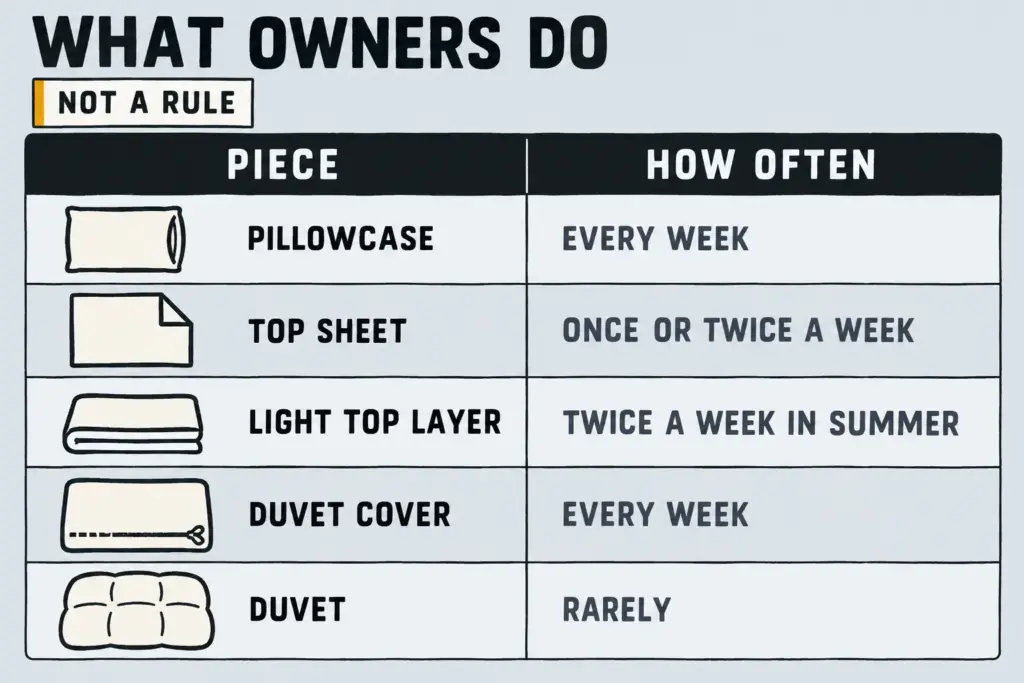
The one rule that shows up across those routines is visible rather than numerical: “if your sheets are furry it’s time to wash them.” Brushing the cat before he settles in lowers what reaches the bed at all, and how often to brush before the bed depends on his coat.
If the thin layer is the piece you wash often, lay it the same way every time, with the fold in the same place and the cat’s usual side covered. When the layer always goes on the same way, the swap becomes a routine instead of a decision.
One Cat or Several: What Changes the Count
More cats on the bed push the count up, because the hair arrives faster. The owner with two cats washing the top layer once or twice a week is running the same system at a higher rate. Coat matters as well: a long coat and a short dense coat leave hair that behaves differently, so a home with both is better off watching the sheet than the calendar.
The washable layer on his sleeping spot is the other half of the system, and the order for the washable layers on the cat’s own spot is laid out on the shedding page. None of this ends the hair.
As one commenter put it, “The hair is there to stay.” The job is the schedule, not a cure.
Wash the Bed Alone, Dry It Cooler, and Read the Basket
Three things carry out of this. The bed is one load with two doors for hair, the wash and the dryer, so wash it alone with a hand’s width of drum above it. The basket tells you which door was open: hairy there means change the sweep or the drum, clean there and furry later means change the drying, and you change one step at a time. And the pillowcase and the thin top layer are what get washed often, while the comforter mostly stays put.
Three weeks from now, pull the same pillowcase out of the dryer and see whether it still comes out clean with the step you changed, and whether the weekly top-layer swap is still happening or has slid to every third week. A new laundry routine tends to fail at that point, not in the first week.
Today’s step needs no purchase: wash the bed alone with that hand’s width of room, then look at the pillowcase in the window light before you do anything else with it.
Frequently Asked Questions
01How do I get cat hair off my bedding?
Remove what you can by hand before the wash, with a shake outside and a damp rubber glove run over each piece. Then wash the bedding alone, with a hand’s width of empty drum above the load.
02Why is there still cat hair on my sheets after washing?
Look at the sheet as it comes out of the dryer: if it is hairy there, the load carried it; if it is clean there, static put it back. Hairy means fix the pre-wash sweep and the drum. Clean means fix the drying.
03What kind of bedding does cat hair not stick to?
Owners report that 100% cotton lets hair go and that polyester, fleece and microfiber hold on to it, though it is owner experience, not a test. Velvet is the odd one: cats pick it, and owners say the hair comes off easily.
04How often should I wash bedding if a cat sleeps on the bed?
Owners wash the top layer or duvet cover weekly, more often with two cats or in summer, and the full comforter rarely. That is owner practice, not a tested rule.
05How do I protect my bed from cat hair?
Put a thin, washable layer over the comforter and wash that layer often, so the cat’s favorite surface is the one that comes off the bed. Brushing him before bed also lowers what reaches it.
Leave a comment