Cat Grooming Guide, Ten Minutes a Session at Most
A cat grooming guide with short coats weekly, long coats daily, a ten-minute cap & nails by signs, not a calendar, plus where the hair lands.

Alfredo RamsesFounder · Updated October 31, 2026 · 25 min read

On this page11 sections
- 1A Week of Cat Grooming Is Four Jobs, and Most Routines Skip the Order
- 2Where Grooming Ends and the Vet Begins
- 3Coat Type Decides the Routine Before You Pick Up a Brush
- 4The Cat Sets How Long the Session Lasts
- 5Finding the Tool This Cat Will Actually Allow
- 6Bathing Is the Exception, and the Damp Cloth Comes First
- 7Nails Follow Signs, Not a Calendar
- 8Where to Groom in an Apartment, and Where the Hair Ends Up
- 9One Cat or Several Changes the Routine
- 10The Routine That Survives the Third Week
- 11Frequently Asked Questions
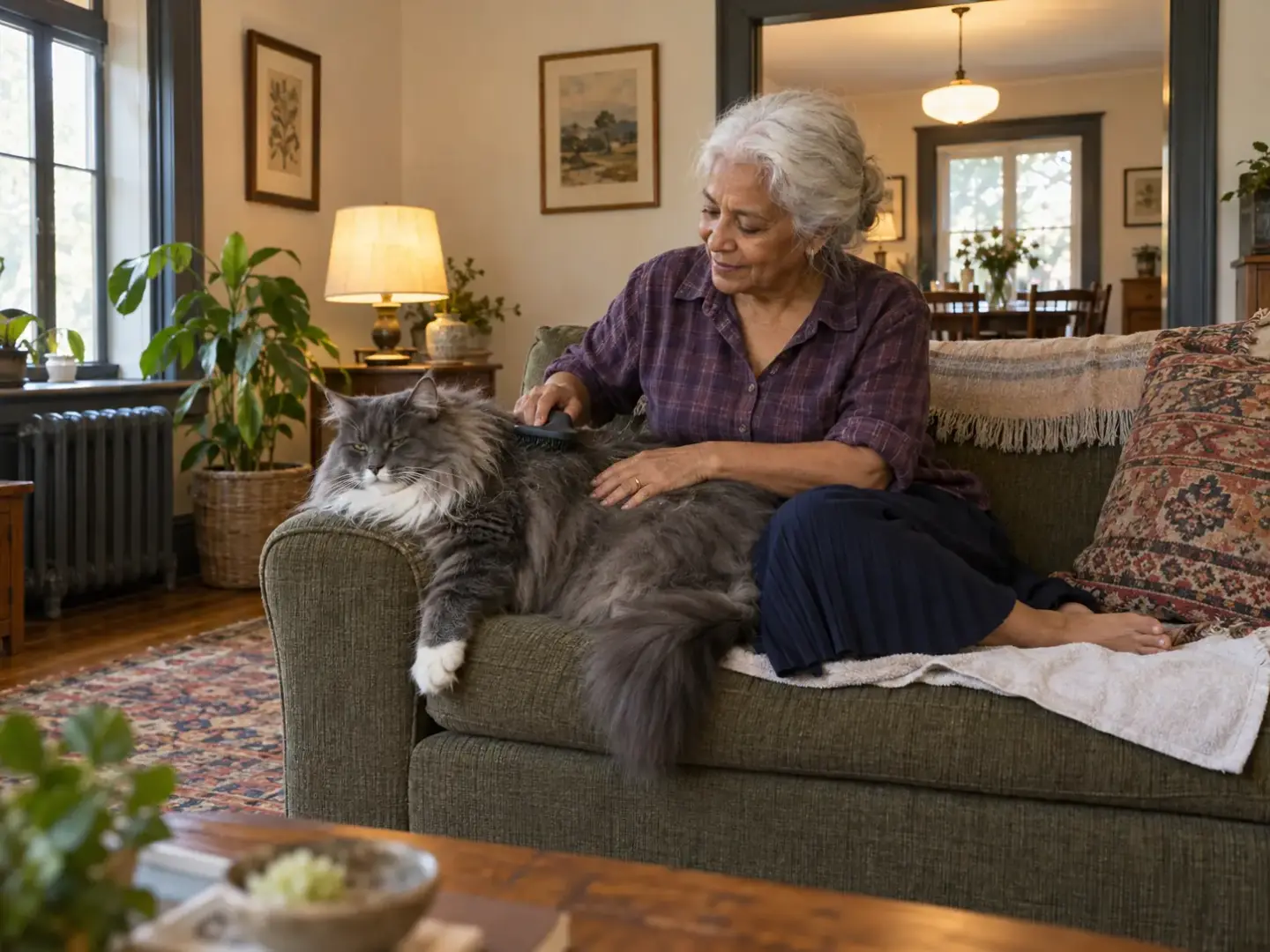
You bought the brush everyone recommends, settled on the floor with your cat across your knees, and got four strokes in before he twisted loose and left the room with his tail flicking. It is easy to conclude that he cannot stand being brushed, but look at it from his side: he was held, the session ran on your schedule, and the tool was new to him, so he used the only exit he had. Most cat grooming trouble at home starts there, and owner threads keep landing on the same fix: swap the tool and let the cat leave whenever he wants. What follows is the order a session runs in, how the coat sets the work, why ten minutes is the most one session should ask, where the hair goes in an apartment, and where grooming stops being a job for home.
Quick Answer
Grooming a cat at home is a few small jobs, each with its own pace (frequencies from International Cat Care):
- Brush a short coat at least weekly, a long coat at least daily.
- Work comb first, then brush, then a damp glove.
- Cap each session at ten minutes; the cat may end it sooner.
- Skip the bath for a healthy cat; a damp warm cloth covers most messes.
- Trim claws when they snag fabric or tap the floor, not by calendar.
- Take bald patches, sore skin, skin-tight mats or grooming changes to a vet.
A Week of Cat Grooming Is Four Jobs, and Most Routines Skip the Order
When a short-haired cat won’t tolerate brushing, the owner has often already tried a slicker and a pet comb, watched the cat bolt from both, and decided the cat simply dislikes being groomed. Taken apart one tool at a time, that usually sounds less like a cat problem than a routine with no order, run with whatever brush was to hand.
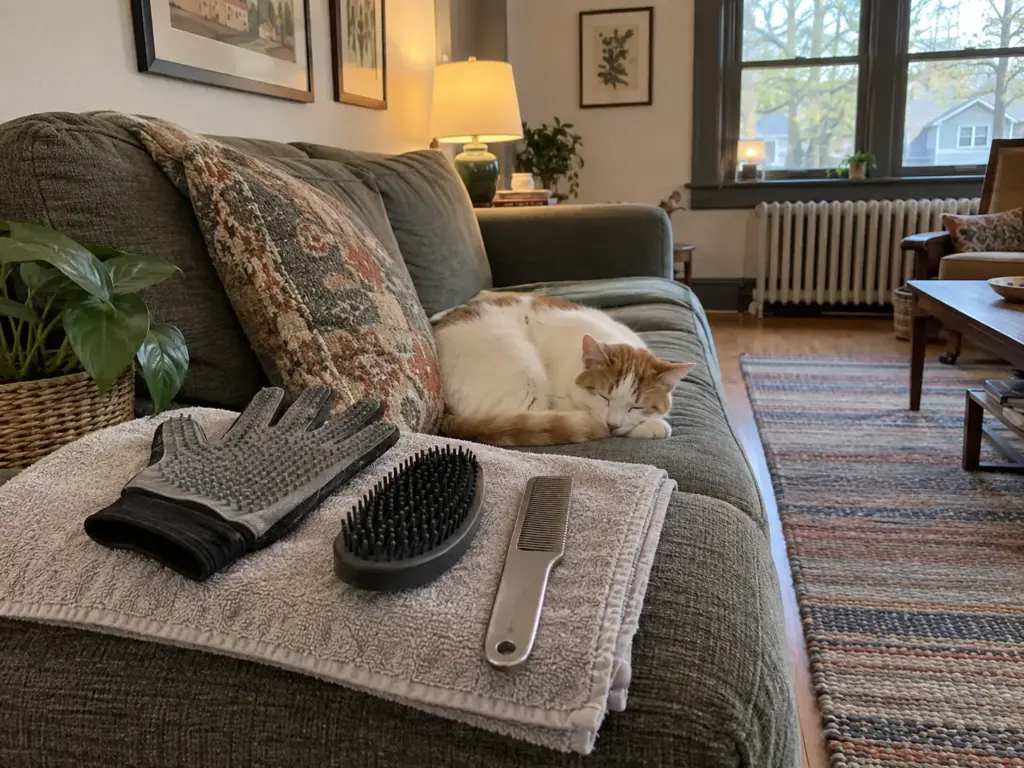
The four jobs, and what is not one of them
Strip the subject down and a week of grooming at home covers four jobs, and only four:
- Brushing and combing, which is most of the work and the only job that runs every week.
- Wiping, with a damp cloth for the occasional mess. A bath sits at the far end of this job and rarely gets reached.
- Claws, which get attention when they show the signs, not on a fixed date.
- A look as you go: while your hands are in the coat, you notice what is new and pass it on rather than work on it.
That last job is deliberately small. Ears, eyes, teeth and skin are tempting to add to the list, but what you do about anything you find there belongs to a vet, and the next section draws that line.
The first job runs weekly because indoor cats shed all year: a heated apartment flattens the seasons, so the coat drops a steady trickle of hair in January as well as in May, which is the subject of a separate piece on why indoor cats shed year round. Grooming is a weekly habit, and a spring event leaves most of the year’s hair on the sofa.
The order that keeps a session short
The order matters more than the brush. For a short coat, the sequence goes: a fine-toothed flea comb first (which doubles as a check for flea dirt), then a pass with your fingers against the grain to loosen dead hair, a bristle brush with the grain, a rubber pad from head to tail, and a damp cotton or rubber glove to lift the last loose hairs, ending on a treat. A long coat starts with a wide-toothed comb from head to tail, moves to the rubber pad, finishes with the damp glove, and only goes back to the comb if the cat is still enjoying himself. That sequence comes straight from International Cat Care’s grooming guide, which also sets the minimum pace at least once a week for a short coat and at least daily for a long one.
The logic is easy to follow once you watch a cat through it. The comb does the slow, fiddly work while he is fresh and patient, and the rubber pad and the damp glove feel closer to petting than grooming, so the session closes on the part he likes. Run it backward and you finish on the comb working through a tangle.
Then the clock. Five to ten minutes is the common advice, and ten is the ceiling this article works to. Either way the cap is a cap, not a target: International Cat Care puts the length of a session at whatever the cat is comfortable with, and the cat decides that well before any timer would.
The number also depends on the coat. Ten minutes once a week is generous for a short, compact coat. For a long coat that wants attention every day, ten minutes daily is a real commitment, so most days the time goes to the spots that tangle rather than to the whole cat.
Why routines die by the third week
Grooming routines rarely fail on day one. They fail around the third week, and nearly always for one of three reasons: the brush is wrong for the coat, the session runs past the point where the cat wanted out, or the spot is uncomfortable for one of you. Each of those gets its own section below.
The pattern under all three is the same. A short session that ends while the cat is still relaxed is one he will sit through again next week. A long one that ends with him squirming free teaches him that the brush means being held, and the next time he sees it come out of the drawer he is already under the bed. Every session either makes the next one easier or harder (there is no neutral one), and the loose hair you do not remove ends up woven into the throw and the rug, the part of cat shedding in a rented apartment that grooming is supposed to shrink.
Where Grooming Ends and the Vet Begins
This section comes early because it decides what the rest of the article is allowed to do. Brushing, wiping and a towel on the sofa are housekeeping. A handful of changes in the coat, the skin or the way a cat grooms himself are not, and no tool on this page is the answer to them.
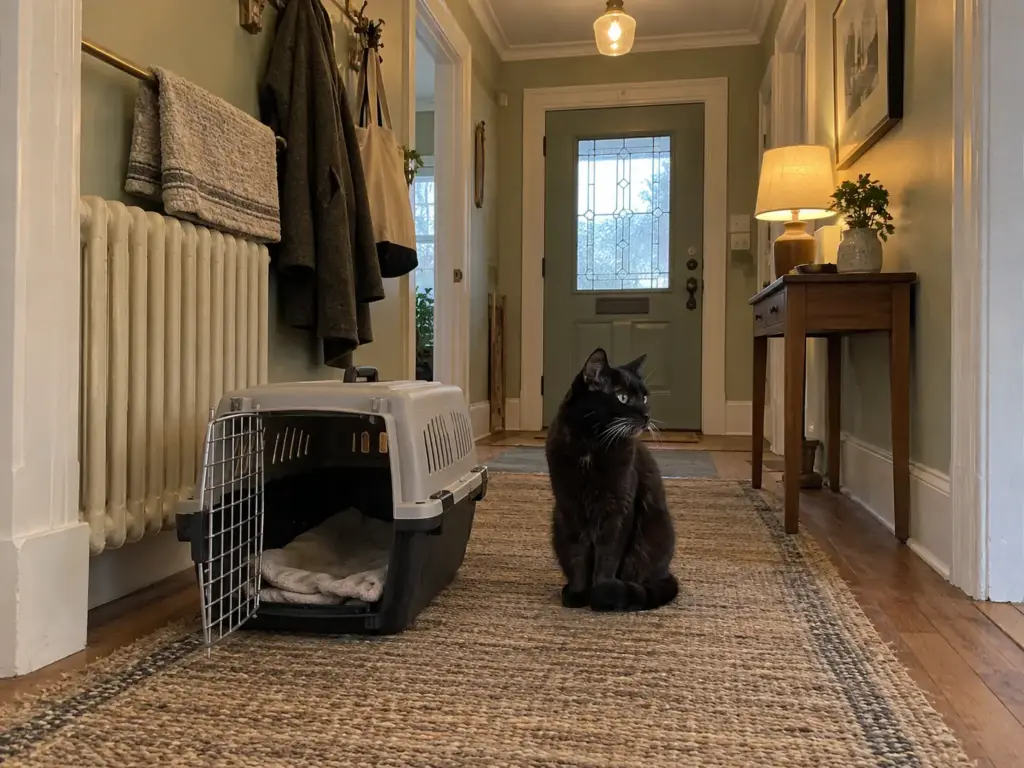
What a brush and a towel can handle
The home side of the line is wider than it sounds. Loose hair, the steady shed of a healthy coat, a small tangle at the tips that your fingers can tease apart from the root outward, dust and litter caught in the long fur of the paws, and a sticky patch on the back end after a messy litter box visit: all of that is routine, and all of it is covered later in the article.
The test is whether the thing in front of you is ordinary loose hair or a change in the cat. Ordinary loose hair is housekeeping; a change in the cat is a question for the vet. If you are unsure which side of that line your cat’s shedding falls on, the companion piece on when cat shedding is a problem walks the same border from the hair’s side.
The changes that go straight to a vet visit
These go to a vet, and this article does not try to explain them:
- Grooming that has turned into hair loss or sore skin. International Cat Care’s page on over-grooming sets that as the point to call.
- A cat who has stopped grooming himself, or a coat that looks different from the coat he had a month ago.
- Bald or thin patches, or skin you can see through the fur.
- Repeated retching that brings nothing up, or more than a day of low energy and not eating. Those thresholds come from the Cornell Feline Health Center on hairballs, which calls one hairball every week or two ordinary.
Nothing on that list gets a brush, a wipe, a product or a home remedy from this article. It gets a phone call, and the brushing schedule waits until the vet has seen him.
Mats at the skin and what a groomer or a vet team does
Mats sit right on the line, so they get their own rule. A loose tangle near the tips of the fur is home work: work it apart with your fingers, starting at the root, a little at a time.
A mat that sits tight against the skin is not. International Cat Care is blunt about scissors: you cannot see where the skin ends inside a mat, so you do not cut one out at home. Severe matting is usually shaved by the vet team, often with the cat sedated, and the fur stays short until it grows back.
A working rule for the apartment: if the mat sits against the skin and you cannot slide a comb between it and the skin, it goes to a groomer or the vet. Owners of long-haired cats also talk about the sanitary shave, a trim of the fur around the rear and the paw tufts, and the all-over lion cut. Both are groomer jobs, at least the first time, and neither belongs on a kitchen counter with household scissors.
Coat Type Decides the Routine Before You Pick Up a Brush
Before choosing a brush, look at what you are brushing. A long, dense coat and a compact short coat are two different jobs, and the breakdown of cat coat types by shedding shows how wide the range is. The house this site is written from has one of each, a very large long-haired Maine Coon and a compact short-coated British Shorthair, and the same tool rarely suits both.
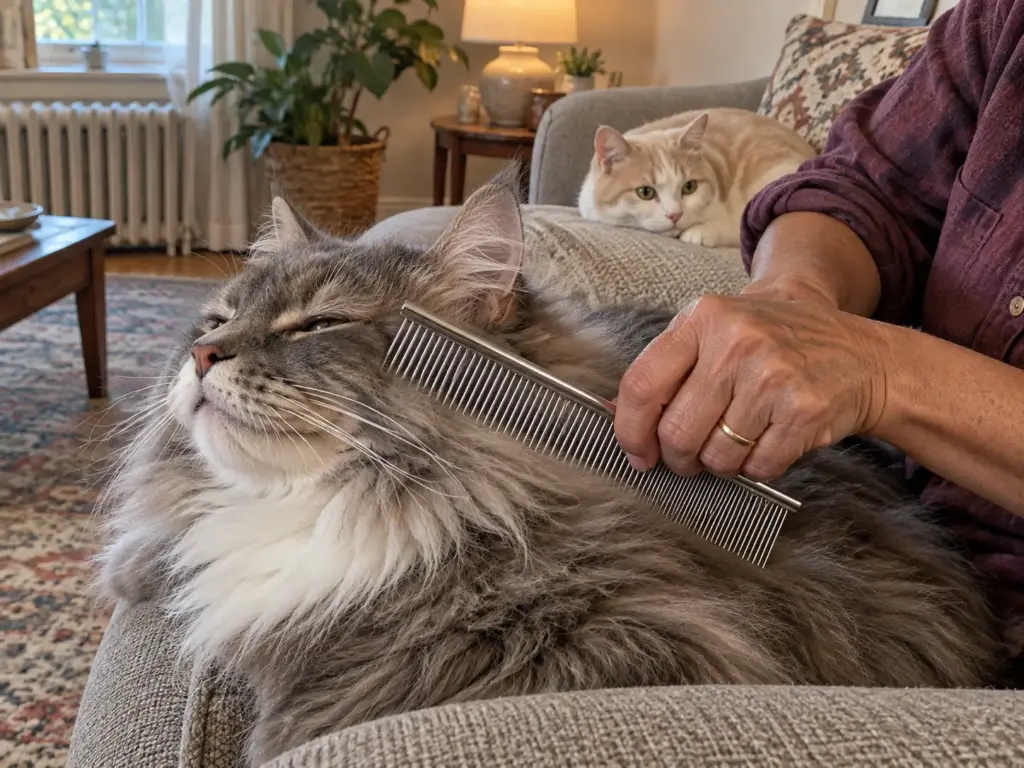
A long, dense coat: daily, and the comb goes first
A long coat wants at least a daily pass, by International Cat Care’s count, and the comb goes in before anything else. The reason is depth. A brush can skim the top layer and leave the undercoat untouched, so the knots keep forming below while the surface looks smooth. A wide-toothed comb run from head to tail, down to the skin, finds them while they are still small enough to tease apart.
International Cat Care describes the coat as three hair types, down hair, awn hair and guard hair, and those are the layers a comb has to get through on a long coat.
The PETTOM Steel Grooming Comb covers this step with its coarse end. It runs 7.5 inches, with widely spaced teeth at one end and fine teeth at the other, so one comb does the long-coat pass and the short-coat flea-comb pass. See the PETTOM comb on Amazon. Some buyers report that the teeth bend after a handful of uses, and several found it larger than they expected, which is worth knowing before you work it near a cat’s armpit.
On a long coat, the comb tells you whether you are done, not the brush. If the comb slides from skin to tip along the back, the flanks and behind the legs without catching, the brush is only finishing work. If it catches anywhere, that spot gets the next session’s first two minutes.
Long coats also collect the house. Litter, dust and the occasional bit of waste get caught in the paw tufts and the long fur around the rear, which owners of long-haired cats call butt fluff, and that hair then carries litter across the floor. Keeping the paw fur combed out is part of the answer to litter tracking, not just a grooming detail. Cornell’s feline health center also notes that long-haired breeds such as the Persian and the Maine Coon are at greater risk of hairballs, which is one more reason to take loose hair off with a comb first.
A compact short coat: weekly, flea comb first
A short coat needs far less: at least once a week, again by International Cat Care’s count, and the ASPCA lands on one or two brushings a week. The sequence for this coat is the one laid out above, flea comb, fingers, bristle brush, rubber pad, damp glove, and the order International Cat Care gives for a shorthaired coat is worth keeping exactly as written. Each tool lifts what the one before it loosened.
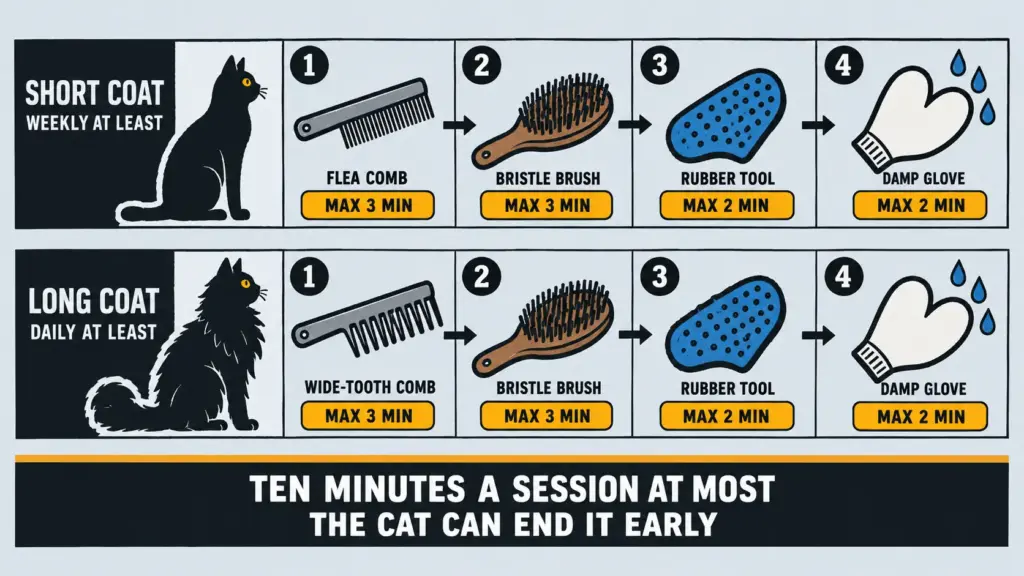
The fine end of the same PETTOM comb is the flea comb here, so a two-cat house with one long coat and one short one can get by with a single comb. The brushes are where the two coats part ways.
A short, dense coat like the British Shorthair type is thick rather than long. It knots less but still sheds, and a tool that only skims the top leaves loose hair behind, which is where the rubber pad earns its place in the sequence.
The three places knots start
Knots do not form evenly. International Cat Care names the spots to watch on a long coat: under the front legs, in what owners call the armpits; between the hind legs; and between the toes and around the pads. The first two are friction zones where the legs rub with every step, and the skin there is thin and sensitive, which is why International Cat Care says to take extra care in those spots.
That combination shapes the session: go slowly in those zones and watch for the stop signs described in the next section, because the skin there is thin. Tangles caught small, while the comb can still slide through, never turn into the mats from the previous section.
The Cat Sets How Long the Session Lasts
The ten-minute cap in this article’s title is the outside limit. The real end of a session comes from the cat, and he announces it well before he leaves. Reading that announcement, and stopping on it, is what keeps the brush from turning into the thing he hides from.
The signals that say stop
International Cat Care’s list of stress signals is specific: skin that ripples or twitches along the back, tail swishing or thumping, a sharp turn of the head toward your hand or the brush, a cat who suddenly goes still, ears rotating back, lip licking or swallowing, head shaking, a quick burst of grooming himself, and finally a growl or a hiss. The rule that goes with the list is just as plain: “If your cat shows any of these signs, stop grooming them and see if they’ll tolerate it another day.”
The early signs are the ones that matter, because by the time he growls the quieter ones have already gone by. A tail that starts to swish while the rest of him is relaxed is one to stop on, mid-stroke if needed, and stopping there is what keeps a calm session possible next week.
Watch the tail tip, not the brush. Put the tool down at the first flick, give the treat anyway, and finish the missed patch tomorrow. A session that ends two minutes early costs you two minutes; one that ends in a scramble costs you the next session.
Why holding a cat still backfires
The reflex, when the cat squirms, is to hold on: a hand on the scruff, a towel wrapped around him, a firmer grip. Veterinary handling guidance points the other way. According to the 2026 AAFP and FelineVMA handling statement, “A cat’s ability to have choice and a sense of control during interactions minimizes distress and protective behavioral responses.” The statement rules out scruffing and tight restraint, and it explicitly covers handling at home, not just in a clinic.
Owners arrive at the same place from the other direction. Holding the cat in place is a last resort for a real tangle, and best avoided even then, because it makes the next session harder. Every hold teaches the cat that the brush comes with being trapped, and a trapped cat does the sensible thing and leaves at the first chance.
So the cat stays free. He sits on the sofa arm, on your lap, or on the counter, wherever he chose, and he can step off whenever he likes. If a cat who used to tolerate brushing suddenly cannot bear being touched in one spot, that change is a question for the vet; otherwise, the door stays open and the session stays short.
Start with one stroke as the cat walks past
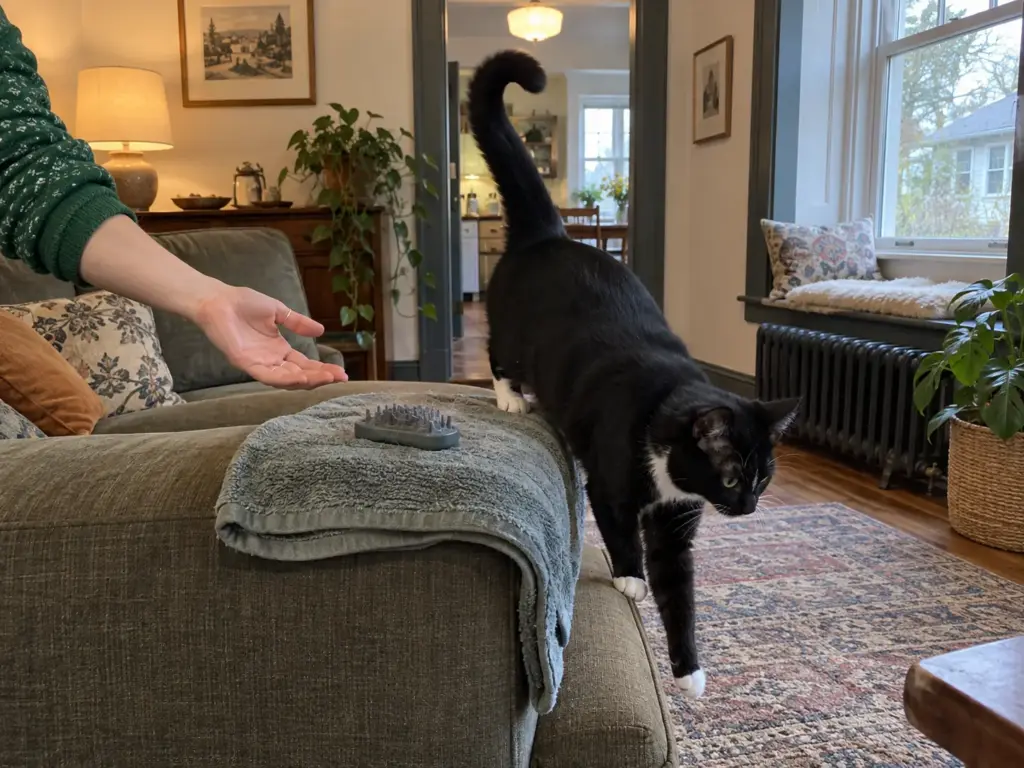
For a cat who has already learned to run from the brush, the session has to shrink before it can grow. Owners call it the drive-by comb: one stroke along the back as the cat walks past, no holding, no follow-up, nothing. Then two strokes another day. Then a few seconds while he is eating or dozing on the sofa.
Some cats accept exactly one brush, such as a pink detangling brush made for human hair, and nothing else. That cat found the one tool that does not bother him, and his owner had the sense to keep using it. Build from whatever the cat already allows, even if it is a single stroke, and let him decide when it becomes a session.
Finding the Tool This Cat Will Actually Allow
When a cat refuses a brush, the brush is usually the problem, and the tool that finally works is often one never sold for cats. Try what you already own first.
Free first: damp hands and a lint roller
Slightly damp hands are the gentlest grooming tool there is. One owner runs barely damp palms over the cat between brushings, and he takes it as petting: the loose fur balls up in their hands and he never sees a tool.
A lint roller works on some cats for the same reason: no pins, no pull. Neither does the work of a comb, but both are worth a try before you buy anything.
The rubber brush, because it feels like petting
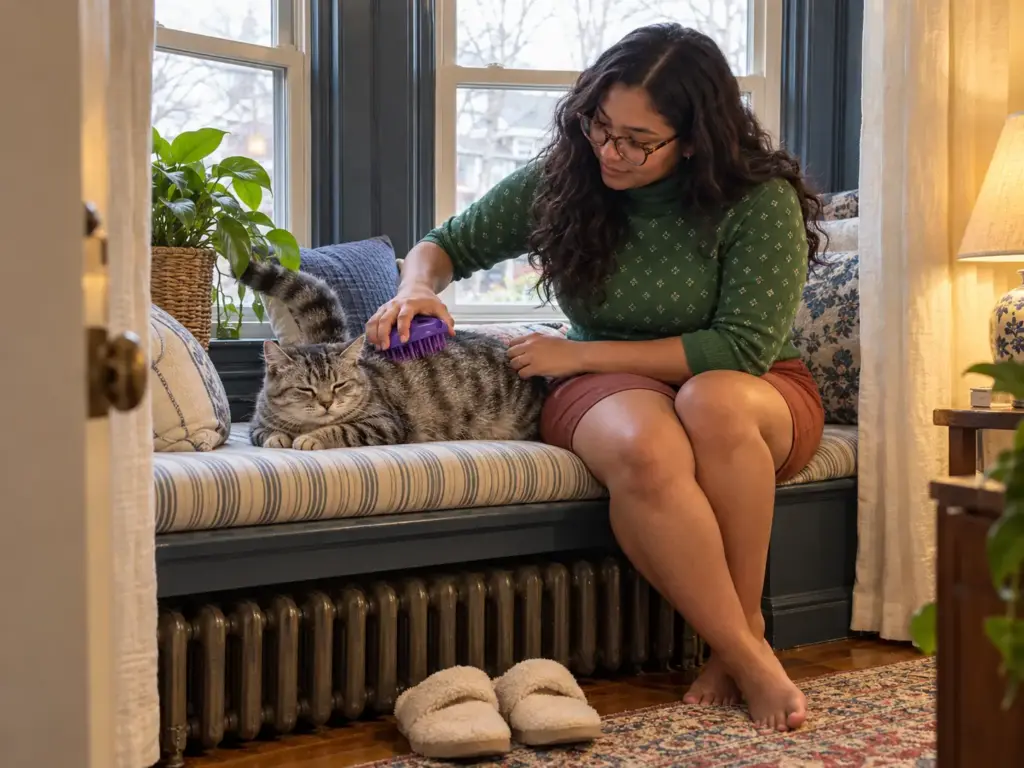
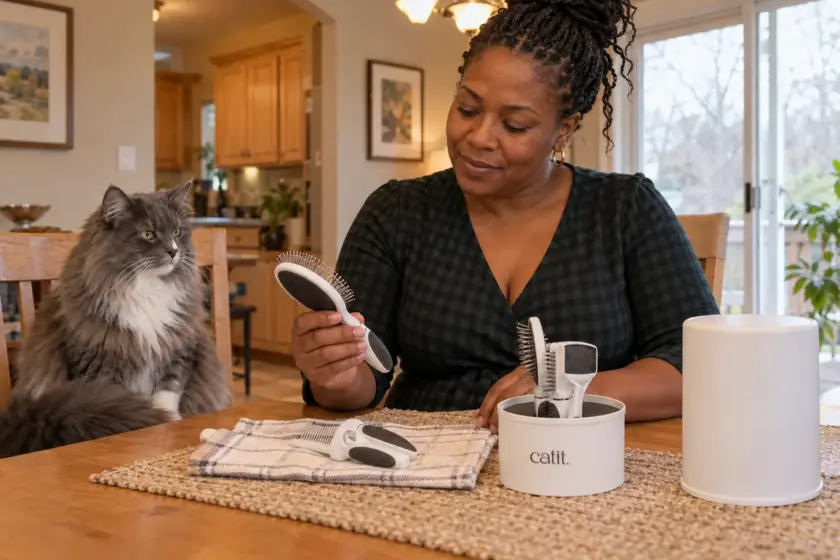
When you do buy something, a rubber brush is the safest first purchase. It is the rubber pad step of the sequence (some owners call it a rubber grooming mitt), and soft pins feel closer to a hand than a tool.
The Cat Brush with Soft Rubber Pins is a washable silicone brush measuring 8 x 4.5 inches, and it does the rubber pad’s work with no metal near the skin. Check the rubber pin brush on Amazon. It loosens hair better than it collects it, so some of what it lifts ends up on the bed and the sofa unless the session happens over a towel. For more on matching the brushing to the coat to cut down what lands on the furniture, see how to reduce cat shedding.
Introduce any new tool on the neck and the top of the back, the places most cats like being touched, for a few strokes only. If he leans into it, work outward from there over the next sessions. If he pulls away even there, that tool is wrong for this cat.
The slicker, only for a long coat and after the comb
The slicker brush is the tool most people reach for first, and for a long coat it does earn its place: the usual routine for long coats has two steps, a metal comb down to the skin first, then a slicker over the top to finish. The Coastal Pet Safari Self Cleaning Slicker Brush measures about 2 x 5 x 8.75 inches and is sold as self-cleaning. Find the Safari slicker on Amazon. Buyers do not report a recurring problem with it, but the pins are stiff, and owners warn that some cats find them uncomfortable.
On a short coat, skip it. The stiff pins reach skin almost at once, and metal combs can hurt short-haired cats; the rubber brush does that coat’s work without the scraping. A de-shedding tool is a different category again, and owners caution that it can strip out more undercoat than they meant to remove, so it is worth reading up on before buying one.
Bathing Is the Exception, and the Damp Cloth Comes First
Many people assume grooming means bathing, and the cat’s reaction to a bath is perfectly reasonable: water, a slippery tub, someone holding on, and a long wait to dry. For a healthy cat, the bath is the exception.
Why a healthy cat does not need a bath
International Cat Care’s position is that a healthy cat has no reason to be bathed and that most cats do not tolerate it well. ASPCA’s grooming tips keep the bath for a cat who is very dirty or who has gotten into something sticky or smelly. A cat spends a large part of his day grooming himself, and a weekly brushing removes the loose hair he cannot manage. Between the two, there is very little left for water to do.
A damp warm cloth first, a wipe second
The everyday mess is almost always local: a sticky patch on the back end, a dusty paw, something the cat walked through. Cats generally do not need bathing, and a damp, warm cloth handles a dirty rear. A wet paper towel does the same job in a pinch. Nothing to buy.
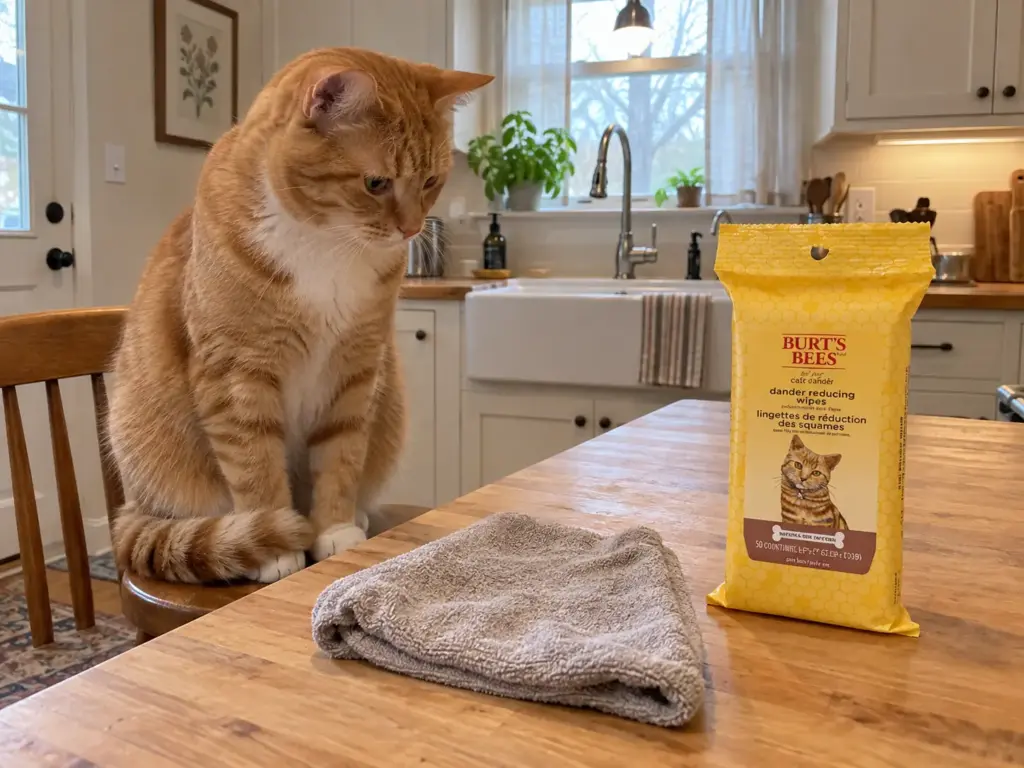
When a cloth is not enough, or you want something waterless for the paws after the litter box, a pet wipe is the next step up. The Burt’s Bees for Pets Cat Dander Remover Wipes come unscented in tubs of 50, sold as a three-pack. See the Burt’s Bees wipes on Amazon. They are optional: some buyers notice a wet-wipe smell, and others call them an expense they did not need, which is fair if the warm cloth already works in your house.
Nails Follow Signs, Not a Calendar
Claws are the grooming job most people want a number for, and the sources do not give the same one. The rule that holds up is to watch for signs and stop counting days.
The three signs a trim is due
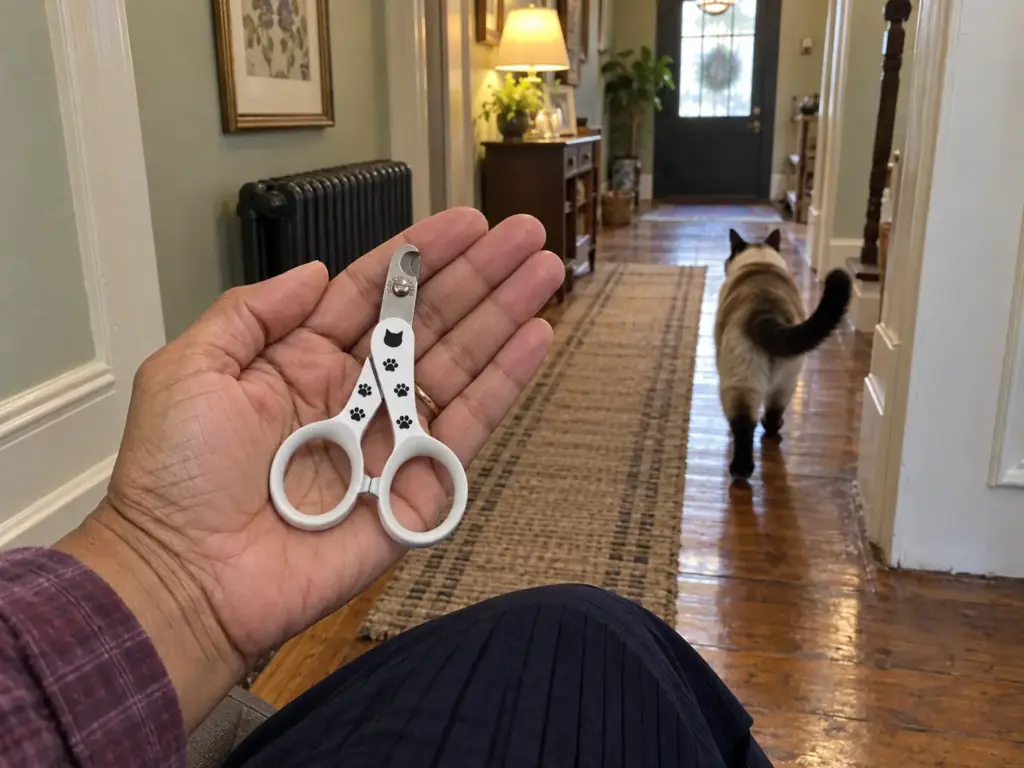
According to International Cat Care’s page on claws, most cats keep their claws at a workable length by scratching, and three signs tell you a particular cat needs help: claws that catch on blankets, furniture or carpet; a tapping sound when he walks across tile or laminate; and claw tips that stay visible while he is relaxed. International Cat Care also flags older or less mobile cats as the ones who may need help.
In a rental, the first sign is usually the sofa throw. If claws catch the weave as he jumps down, that snag is the cue, well before anything gets torn.
When a trim is due, scissor-style clippers are the common choice. The Necoichi Purrcision Stainless Steel Cat Nail Clipper is a small scissor type, about 2.3 x 3.8 inches, and buyers say its thin blades make it easier to see what you are cutting. View the Necoichi clipper on Amazon. The handles are small, so people with big hands may find them harder to use.
For a lower-cost option in the same style, there is a simpler angled design. The BOSHEL Cat Nail Clipper in the small, angled size has a curved stainless blade. Check the BOSHEL clipper on Amazon. Durability is uneven: some buyers report that it split and tore their cat’s claws instead of cutting cleanly.
This guide only covers when to trim; how to do it, step by step, is a separate subject.
Why the sources do not agree on a calendar
VCA’s nail-trimming guide recommends trimming an indoor cat’s nails regularly, every two to four weeks, mainly to limit damage to the home. International Cat Care takes the opposite view and says routine trimming is not advisable for most cats, because scratching keeps the claws in shape. Both are reputable, and they disagree.
One way to square the two: a young cat with a good scratching post and a tile floor may never need a trim, while a senior cat who barely scratches may need regular help, and VCA’s two-to-four-week interval fits that second cat.
For everyone else, listen to the floor. If his walk across the kitchen starts to click, he has given you the date.
Where to Groom in an Apartment, and Where the Hair Ends Up
In a small apartment, every grooming session leaves hair somewhere, and the place you groom decides where. Choosing one fixed spot, set up to catch hair, does more for the furniture than any brush.
One spot with a washable surface
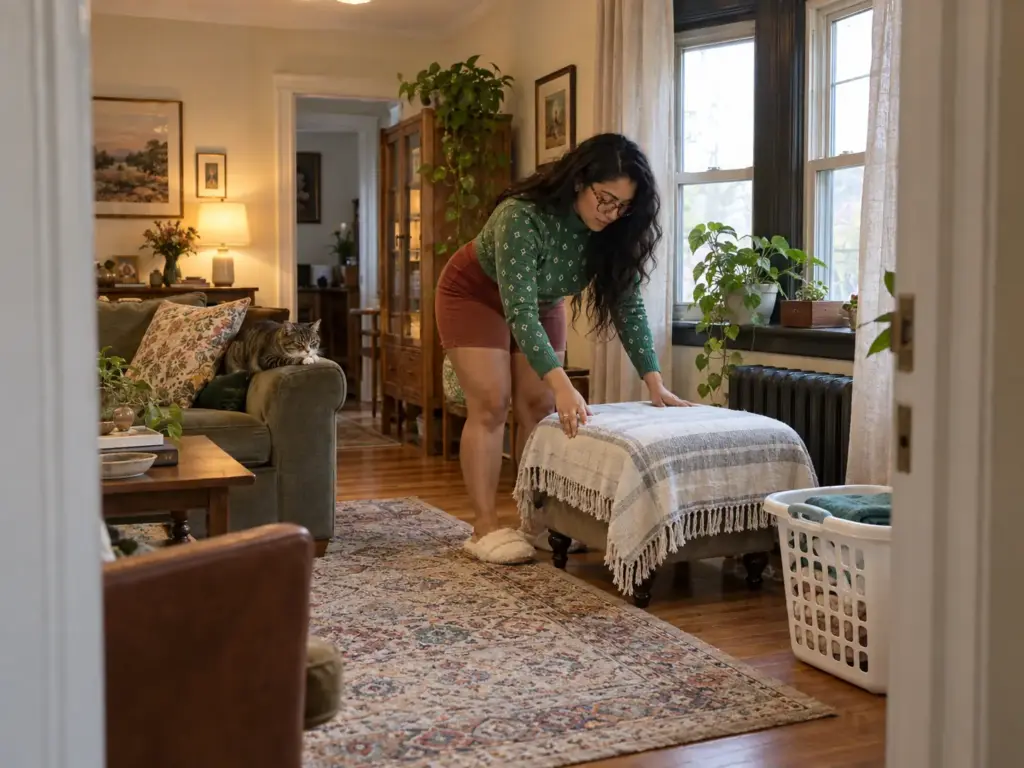
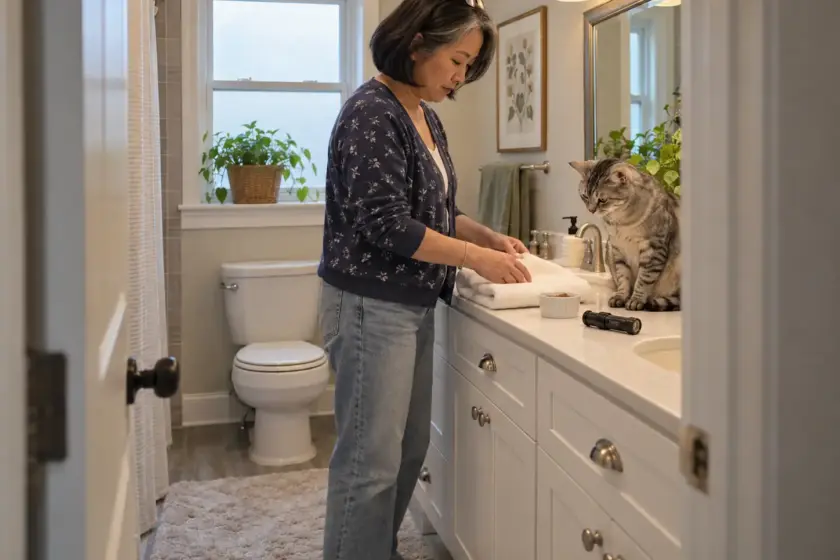
The best grooming spot is the one the cat already likes, covered with something you can wash. A few spots work: a towel over the arm of the sofa where he naps, the kitchen counter with a treat, or the balcony if you have one. A bathroom with the door shut is the other option, since loose hair stays on a surface that wipes clean. Keep grooming off the bed: hair worked loose there goes straight into the sheets, and a struggle on the bed teaches him that the place you both sleep is the place he gets held.
The spot matters as much for the cat as for the furniture. Grooming in the same place at roughly the same time makes the session predictable, and a predictable session is one he can choose to join. Pick a spot that is awkward for you, crouched on the floor or bent over the tub, and the routine dies in the third week, because you stop wanting to do it.
Where the hair lands afterward
Hair that is not removed does not disappear. International Cat Care points out that loose hair a cat swallows while grooming himself either passes through the digestive system or comes back up as a hairball. Every bit you lift with a comb is hair that does not end up on the rug or inside the cat.
How much comes off in a session varies through the year, and the week-by-week look at how long cat shedding lasts gives you a way to track it with a brush and a towel. And the towel is what makes that tracking easy. Hair that falls during the session lands on fabric you can carry away instead of drifting under the radiator or into the sofa cushions, and a washable layer that goes into the laundry every week takes whatever the brush missed with it.
Spread the towel before the cat arrives, not after he settles. When the session ends, fold it inward from the corners and shake it out over the trash can, outside the room if you can. Shaking it in place puts the hair right back into the air you just cleaned.
The rental version: nothing new to buy
A rental limits what you can change. You cannot replace the sofa, drill shelves or rip out the carpet. You do not need to: a towel, a lint roller and one fixed spot cover the whole setup, and everything leaves with you when the lease ends.
The towel catches hair during the session; the roller does a quick pass over the sofa arm and your clothes afterward; and the fixed spot keeps all of it in one corner of the apartment instead of spread across every room. The only adjustment worth planning is seasonal. During shedding season, the weeks when the hair moves the most, the towel goes into the wash more often.
One Cat or Several Changes the Routine
With one cat, grooming is a conversation between two of you. In a multi-cat home it becomes a schedule, and the cat waiting his turn has opinions about it too.
One at a time, and who goes first
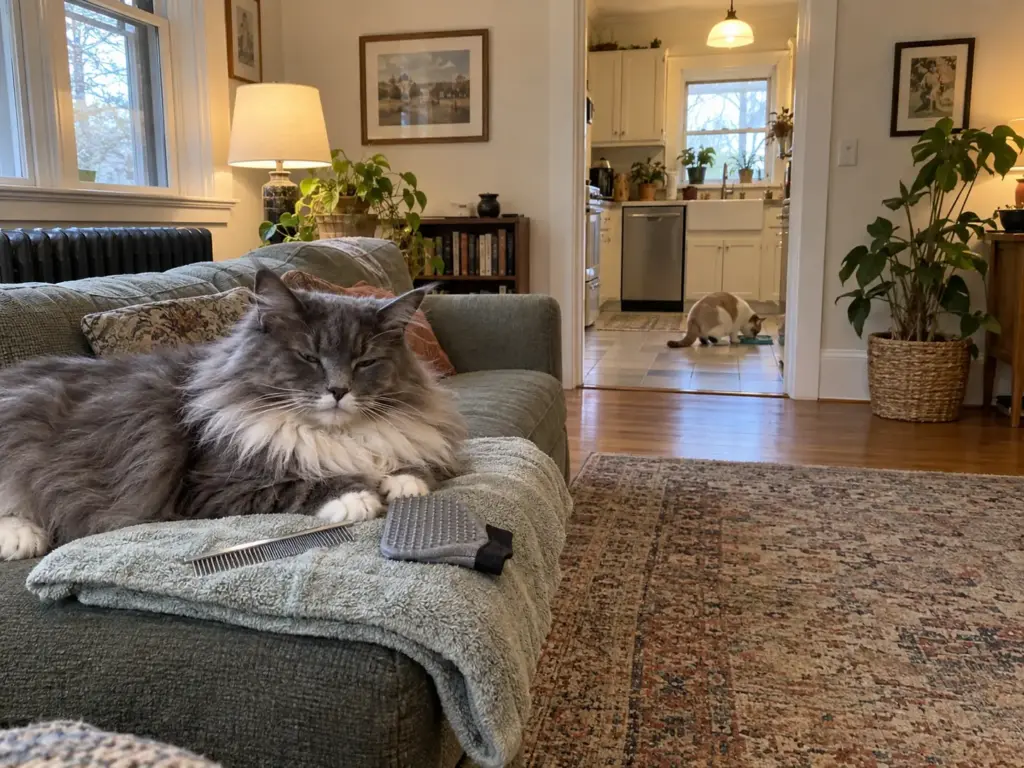
Owners with several cats tend to arrive at the same practice: one cat at a time, with something good to eat. One approach is to take the cats out to the balcony one by one, spread soft food on a lick mat, and brush each cat while he is busy with the treat, with the others staying inside. That is owner practice, not veterinary guidance, and nothing authoritative says which cat should go first.
The cat waiting is part of the session too. Some cats turn up whenever the other is being combed and praised.
Starting with the cat who tolerates it best is a reasonable default: you are fresh, he sets an easy tone, and the harder cat gets a calmer room. Keep the waiting cat in another room with a treat rather than watching from the doorway. In a one-bedroom apartment that usually means the bedroom, a treat and a closed door, while the session happens in the bathroom or on the balcony.
Two coats, two schedules
Two cats in the same apartment rarely have the same coat, and they should not share a schedule. Two siblings can have opposite coats: one needs only the fur on his neck brushed, while his sister, with much thicker fur, needs brushing far more often, or the owner deals with the consequences. Same house, same food, two completely different routines.
The tools split the same way. A long, dense coat gets the comb and the slicker; a compact short coat gets the flea comb and the rubber brush. Keep them separate and label them if that helps. Start the second cat’s session with a clean brush and a fresh towel, so he is not asked to sit on a towel that smells like the other cat.
Why mutual grooming does not replace the brush
Cats who get along often groom each other, and International Cat Care lists that mutual grooming as one of the ways cats keep strong social bonds. That is its job: social, not maintenance.
So two cats who groom each other still each need their own short weekly session. With two cats, that means two separate sessions of a few minutes each, in two places or at two times, rather than one long session with both cats in the room.
The Routine That Survives the Third Week
Three things decide whether cat grooming at home becomes a habit or a weekly fight:
- Four jobs, one order. Brushing, wiping, claws on signs and a look as you go, with the comb first and the damp glove last, and the session ends when the cat says so, never later than ten minutes.
- The coat sets the schedule. A short coat at least weekly, a long coat at least daily, and the tool this cat accepts is worth more than the one with the best reviews.
- The vet owns the changes. Hair loss, sore skin, a cat who stops grooming himself or a mat stuck to the skin goes to a vet or a groomer, and the brush waits.
Three weeks from now, notice two things: whether the sessions are still happening, and whether the cat walks toward the towel when you spread it or leaves the room. The first tells you the routine fits your week; the second tells you it fits him.
Tonight, before buying anything, dampen your hands, wait until he walks past, and run one palm down his back. Then stop. If he comes back for another, you have your first session.
Frequently Asked Questions
01How do you groom a cat for beginners?
Start with one short session a week in a fixed spot: comb first, then a brush, then a damp glove, and stop at the first sign the cat wants out. Spread a washable towel underneath, keep him free to leave, and end on a treat so the next session starts easier.
02What are common cat grooming mistakes?
The most common mistakes are holding the cat still, running a session longer than he wants, and using one brush on two very different coats. Grooming on the bed and skipping the comb on a long coat follow close behind.
03Do indoor cats need to be groomed?
Yes, because indoor cats shed all year, so International Cat Care recommends brushing a short coat at least weekly and a long coat at least daily. Self-grooming handles the rest, but swallowed loose hair is hair you could have caught on a towel.
04Should I bathe my cat?
Rarely, since International Cat Care says a healthy cat has no reason to be bathed and the ASPCA keeps baths for a cat who is very dirty or sticky. For most messes, a damp warm cloth on the affected spot is enough.
05How do I groom a cat that won’t tolerate brushing?
Change the tool before blaming the cat: start with damp hands or a soft rubber brush, give one stroke as he walks past, and stop at the first stop sign. If the refusal is new and sudden, ask a vet before anything else.

Leave a comment