Cat Bowls — Ceramic, Steel or Plastic, and What Fails
Cat bowls need ~6 inches across & 1.5 deep, in 18/8 steel or intact glaze. The three-check test for the bowl you own + why plastic fails on a delay.

Alfredo RamsesFounder · August 31, 2026 · 18 min read

On this page8 sections
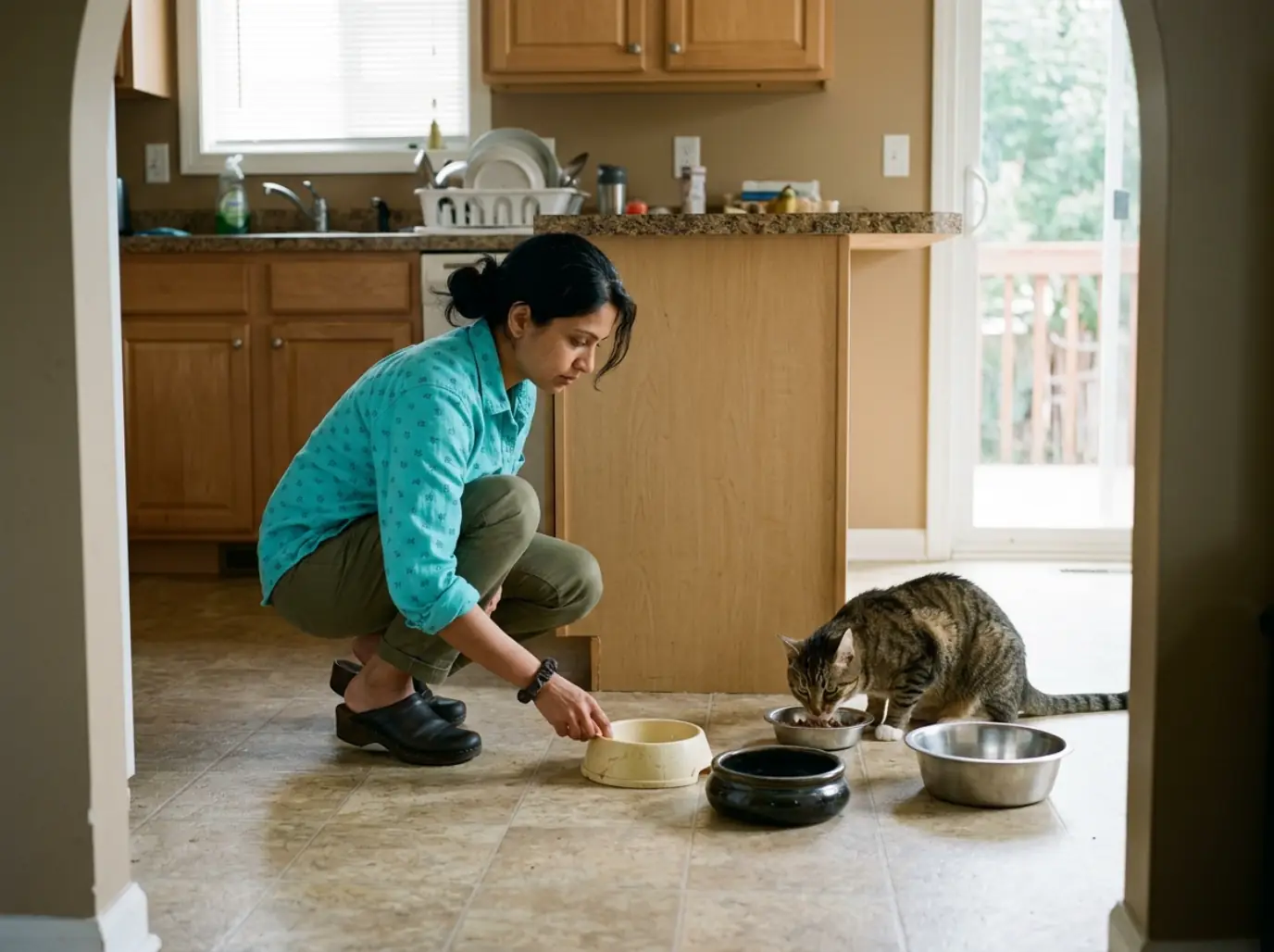
There is a bowl on your kitchen floor right now, and nobody ever chose it. It came in a set, or it came with the cat, or it matched a canister you liked. What separates cat bowls made of ceramic, stainless steel and plastic is not taste, and it is not brand: it is porosity, how easily a surface gets scratched, and which of the three has actually been sent to a lab by anyone. Your cat has been filing a report about that bowl for months. Here is what each material really does, how to check the one you already own before you spend anything, and what changes the moment there are two cats in the apartment.
Start with the shape of the decision:
| Material | What decides it | Verdict |
|---|---|---|
| Stainless steel (18/8, 304) | No pores, survives years of careless washing, light enough to skid | Safe default |
| Ceramic | Inert while the glaze is whole; heavy, so it stays put | Good until it crazes |
| Plastic | Scratches with normal use, and every scratch hides residue | Retire it |
| Glass | Non-porous like steel, but breaks on a tile floor | Fine, if it survives |
What Each Bowl Material Actually Does
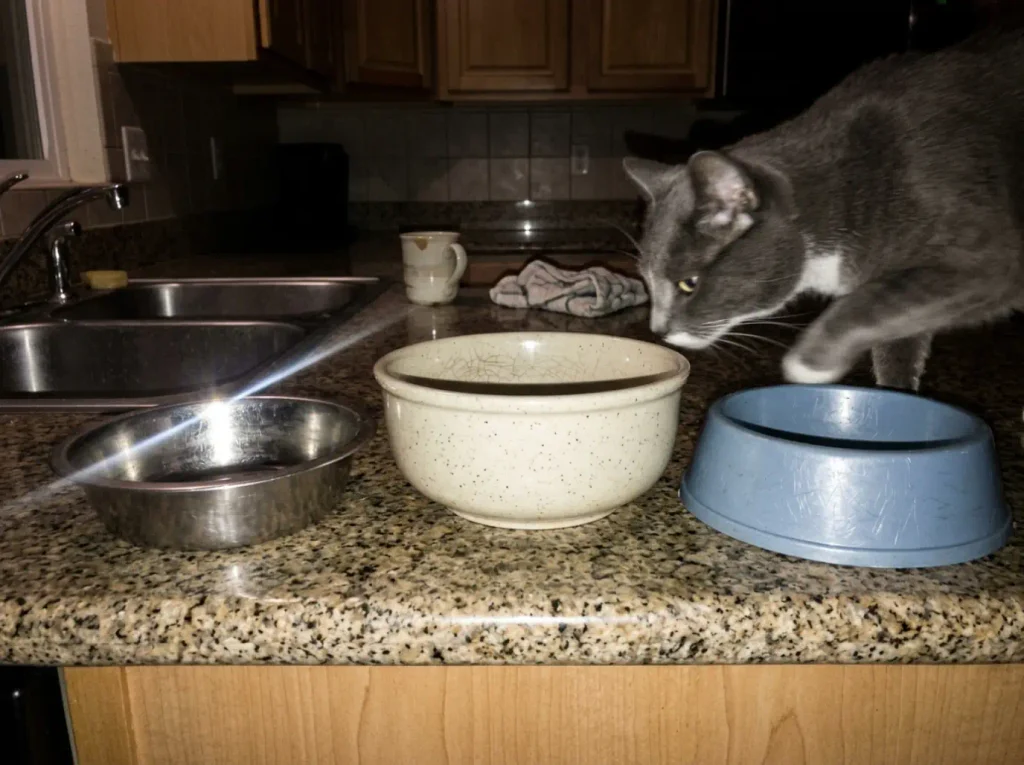
Everyone already knows stainless steel wins. Almost nobody explains why, which means nobody knows when it stops mattering, and people keep buying the same bowl for a reason they could not defend if you asked them.
Steel Has No Pores, and That Is the Whole Mechanism
Steel wins because it has no pores. Food residue, saliva and the film they leave behind need somewhere to lodge, and a smooth non-porous surface does not give them one. Rinse it and it is genuinely gone, not pushed into a texture you cannot see.
That is also why the grade matters more than the finish: 18/8 stainless, also sold as 304-grade, is the food-grade spec worth knowing. Below it, “stainless” is a word on a listing rather than a number on a mill certificate, and some cheap imported steel has carried lead the same way cheap ceramic does. It is also the grade sitting behind every cadmium-free and mercury-free claim worth reading, and the one that gets made in the USA often enough to be checkable. The same porosity argument, incidentally, is the one that decides a water fountain too.
The Glaze Is the Product, Not the Clay
Ceramic is inert, and that sentence needs a condition attached to it: it is inert while the glaze is intact. The glaze is the product. The clay underneath is porous and always was; the fired glass layer on top is the part doing the work of being safe and cleanable. A food-grade glaze is what that layer is called when someone actually specified it, and a lead glaze is what it is called when nobody did.
As long as it is unbroken, a ceramic bowl is a genuinely good surface, and it has one advantage steel does not: it is heavy. A cat who shoves a steel bowl three feet across the tile at every meal will not move a ceramic one an inch.
Plastic Does Not Arrive Unsafe, It Gets There
Plastic fails on a slower timeline and that is exactly what makes it sneaky. It does not arrive unsafe. It scratches, from the spoon, from the sponge, from a claw, from the dishwasher’s heat cycle, and each scratch is a channel a rinse cannot reach into. Six months of normal use and the feeding surface is a grid of tiny trenches holding a thin layer of yesterday, which is also where a biofilm gets its foothold: not a smear you can wipe, a colony anchored in a texture. Most modern pet bowls are BPA-free and often phthalate-free too, and neither label touches the scratching problem, which is the one that actually decides this material. And plastic is also the only one of the three with a documented contact problem: there are owner reports of an itchy rash on the chin that cleared once the bowl came out of the rotation entirely.
Why the bacteria studies disagree with each other
You will find bacterial count figures quoted everywhere as if they settled the argument, and they do not. The comparative bacterial testing across bowl materials genuinely disagrees with itself depending on which day someone swabbed: one comparison put steel highest at day seven and plastic highest at day fourteen, another had plastic and ceramic both out-testing steel by day fourteen. Trust the mechanism, not the leaderboard.
Porous and scratched surfaces trap residue. Smooth ones do not. That finding holds in every study; the day-by-day winner does not.
The Bowl You Already Own, Tested in Two Minutes
Every article you have opened about this wants to sell you a bowl. This one starts somewhere cheaper: the bowl on the floor might be fine, and there are three checks that tell you, and all three are free.
Check One, Hold the Ceramic Up to a Window
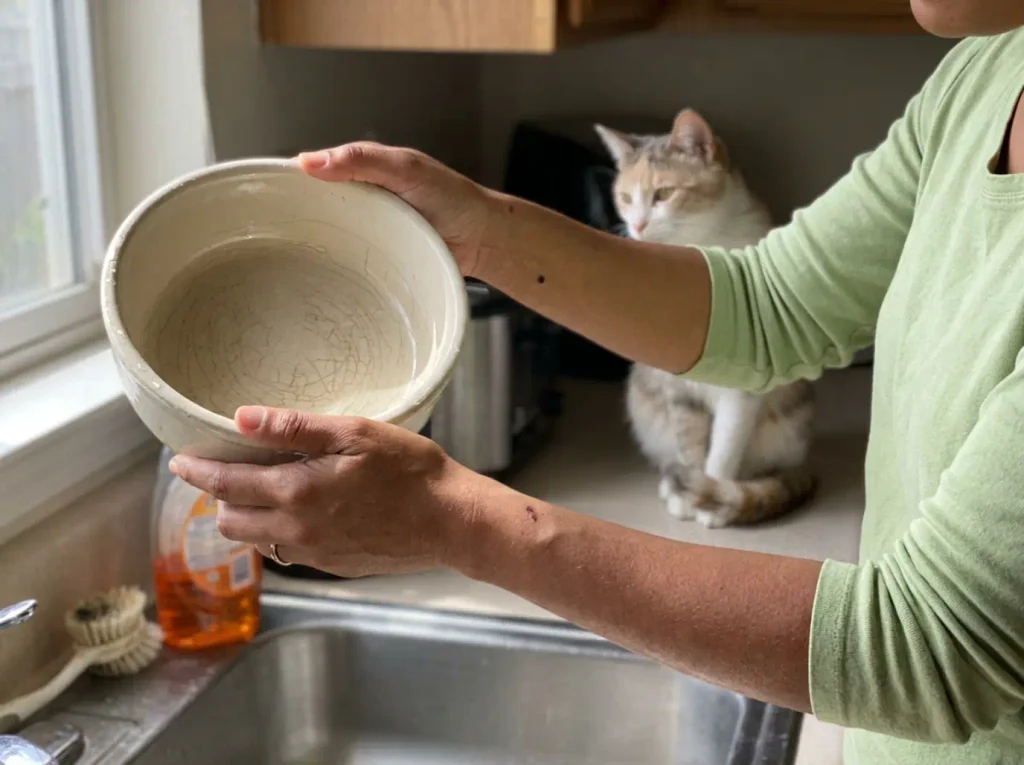
The first is crazing, and it is the one almost nobody knows to look for. Take the ceramic bowl to a window and turn it in the light. What you are hunting for is a spiderweb of hairline cracks across the glaze, so fine that it looks more like a texture than damage. A cracked glaze is the same failure once it is obvious without hunting for it.
That pattern is the moment a low-risk bowl becomes a real-risk one, and it does two things at once: it gives bacteria somewhere to live below the surface, and it opens the path for lead and cadmium in the glaze to migrate out. Independent lab testing of pet bowls for lead and PFAS makes the second half of that worse, because leaching accelerates with anything acidic, and wet food sits in a bowl far longer than most people picture. If you see the spiderweb, that bowl is done. No amount of scrubbing puts a glaze back together.
Do the crazing check before you spend a cent, and do it under a window rather than under a kitchen light. Hairline glaze cracks are almost invisible in warm overhead lighting and obvious in daylight held at an angle. Two minutes decides whether this is a shopping problem or a washing-up problem.
Check Two, Run a Thumbnail Across the Plastic
Second, the scratch check, for plastic. Run a thumbnail slowly across the part of the surface the food actually touches, not the rim. If it catches anywhere, the rinse is not reaching everything, and it has not been for a while. This is the check that turns “should I replace plastic on principle” into a yes or a no you can see.
Check Three, Hold the Bowl Against the Cat’s Face
Third, the width check, and it takes five seconds. Pick the bowl up and hold it beside your cat’s face at the cheeks. If the bowl is narrower than the widest point of that face, it is too small, and the word “large” on the packaging has no vote. The whiskers, properly called vibrissae, are dragging the rim at every bite in a bowl that fails this, and the cat’s response to that is usually not a protest you would recognize as one. It looks like food left in a ring around the edge, or food flicked onto the floor, or a cat who eats in short bursts and walks away.
Where this stops being a bowl question
One more thing belongs in this section, and then it stops. A material swap is the cheap first move when chin acne shows up on a cat who eats from plastic or from an old ceramic bowl, and there are owner reports of it clearing after switching to steel. That is where this article’s competence ends. A rash on the chin that does not clear is a vet visit, not a bowl decision, and nothing below assumes otherwise. Back to the bowl.
Where “Lead-Free” Is a Claim and Where It Is a Certification
Every listing says food-safe. The reader assumes somebody checked. Mostly nobody did, and the gap is bigger than it looks.
What the label is actually promising
There is no binding federal lead or cadmium limit in the United States for the glaze on a pet ceramic bowl. The CPSC’s 0.1% phthalate rule that people sometimes cite covers children’s products, and a cat bowl is not one. The result is that “lead-free” printed on the bottom of an imported ceramic bowl is a manufacturer’s sentence about itself, and imported ceramic ware marketed that way has still tested over FDA action levels for leachable lead when someone bothered to check. The label is not lying, necessarily.
It is just unverified, which is a different thing, and it is the least-checked of the three materials for exactly that reason.
What a real certification names
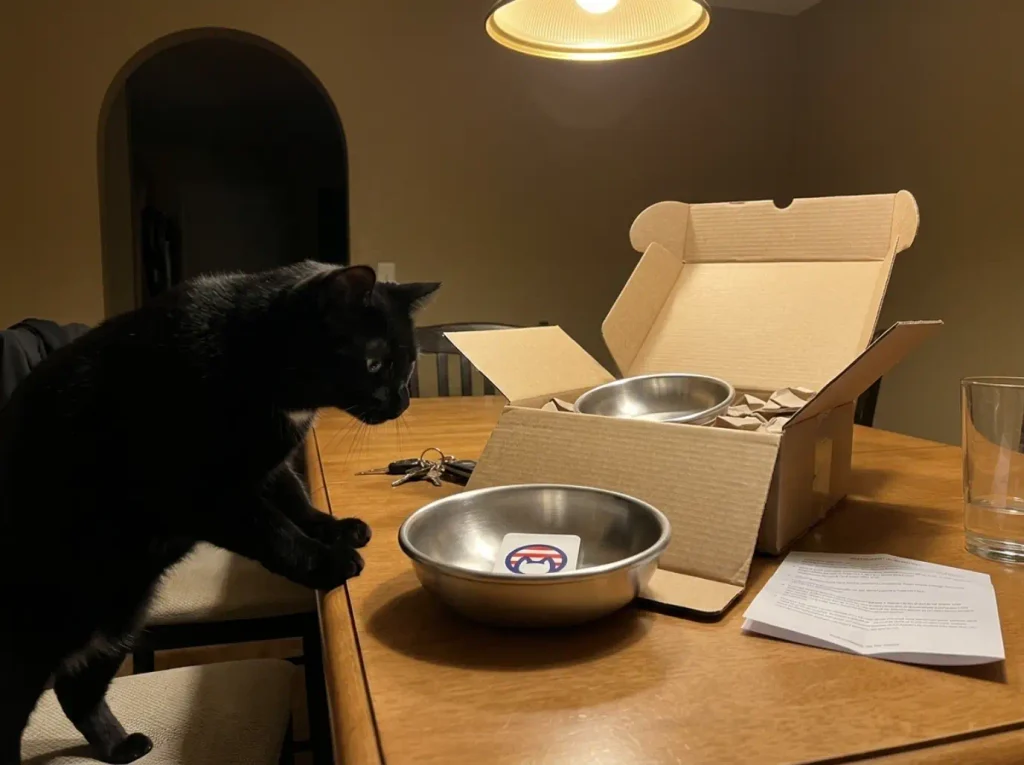
So what does a real food safe certification look like? It names three things the claim does not: a lab, the specific metals tested, and a result. “Third-party tested, lead-free” with nothing after it is the claim again in a better outfit.
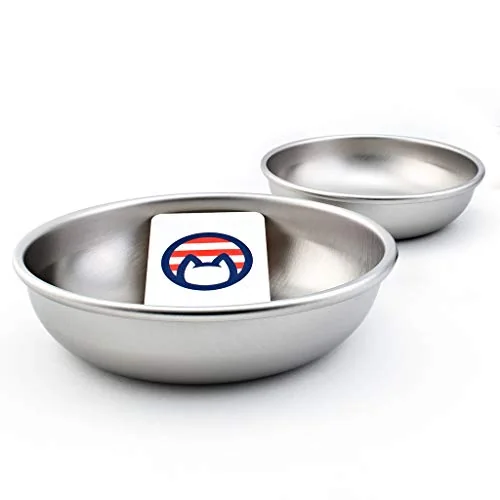
A brand publishing a stainless bowl tested and certified free of lead, cadmium and mercury is making a different kind of statement, because every noun in it can be checked and someone would be liable if it were false. Ask for the metals. If a brand has done the work, it publishes the list, because the list is the entire point of having done it.
Cheap steel carries a version of the same problem, and here the grade is the tell. A listing that says 304 or 18/8 is committing to something. A listing that says “premium stainless” is committing to nothing at all.
The free move comes first, though, and it is worth saying plainly because the section above reads like an argument for shopping. An intact, uncrazed ceramic bowl already in your house does not need replacing because a label on a different bowl is better worded. Check the glaze. If it is sound, you own a fine bowl.
Shape Decides More Than Material Does
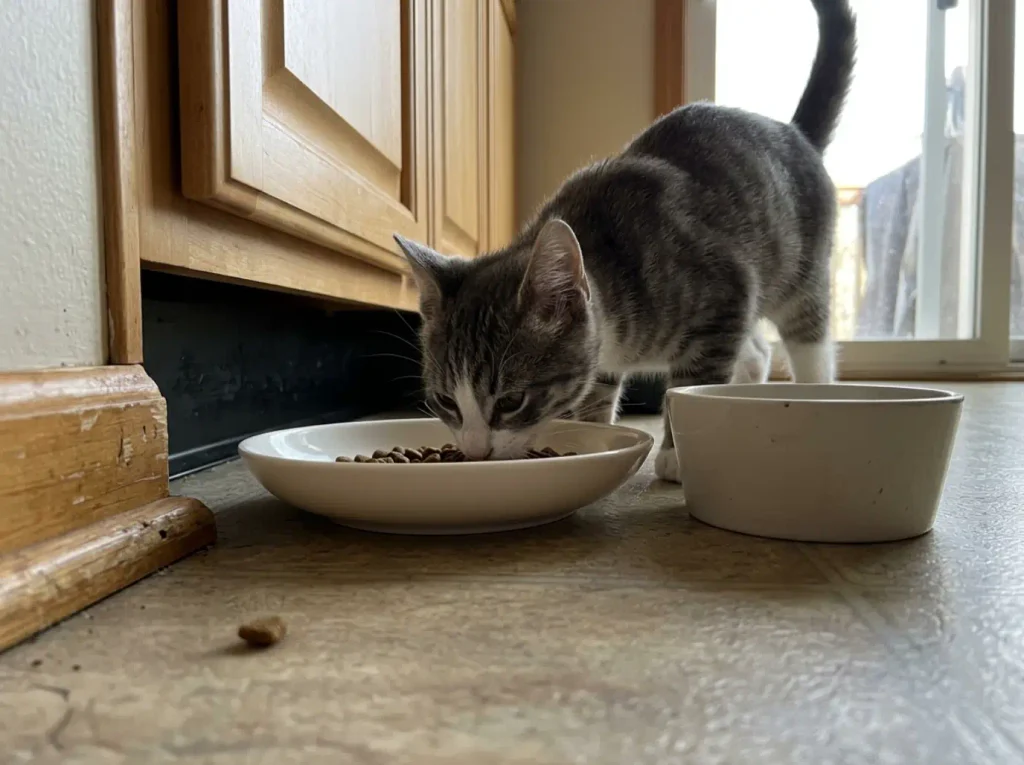
Here is the sequence that plays out constantly. Reader buys the stainless bowl everyone recommends. Cat still leaves a ring of food around the rim, still flicks kibble onto the floor, still walks off mid-meal. Reader concludes the cat is fussy.
The cat is not fussy. The bowl is the wrong shape, and steel does not fix shape.
The number nobody publishes
Standard bowls run deep, roughly 3 to 5 inches, because that is the shape a bowl has been in human kitchens for a few thousand years. The wide-and-shallow ones cluster somewhere around 5.8 to 6.2 inches across and 1 to 1.5 inches deep, which is a completely different object wearing the same name. Every competitor tells you to buy “wide and shallow” and not one of them attaches a number to it, so here is the rule this article will stand behind: at least as wide as the cat’s face measured cheek to cheek, and shallow enough that the food sits within about an inch and a half of the rim. Both halves matter. A wide bowl that is still four inches deep just moves the problem down.
Buy by the listed diameter, not by the photo and not by the word large. Take the cheek-to-cheek measurement once, write the number on your phone, and shop against it. Roughly six inches across and an inch and a half deep clears an average adult cat, and it is a number you will use again for the water bowl.
Ceramic can hit the number too
Ceramic can hit that shape without any trouble at all, which is the part that quietly undoes the whole material argument. A food-grade ceramic set built at 5.8 inches across and 1 inch deep lands inside the rule with room to spare, and it comes as a four-pack, which is how you end up with a spare in the cabinet and one in the dishwasher at the same time. The shape is a design choice, not a property of the clay. The caveat is the ceramic caveat from earlier and it does not go away because the shape is right: check these for crazing every few months, the same as any glazed bowl, and retire the one that develops it.
Flat Faces, Raised Bowls, and What Belongs Elsewhere
The cheek-to-cheek measurement gets tighter for brachycephalic, flat-faced breeds. A Persian, a Himalayan, a Burmese or a Scottish Fold has whiskers and nose sitting closer to the food than an average cat’s do, so those four want the generous end of the range: closer to six inches across and nearer an inch deep. Whisker clearance is being used here purely as a shape criterion for picking a bowl. Whether whisker fatigue is a real diagnosed condition is a contested question with its own room on this site, and I am not going to settle it in a paragraph. A dedicated guide on what size bowl fits which cat is coming to this room too.
A tilted bowl or an elevated feeder changes the angle the cat eats at, not the width of what they eat from. Useful, separate question, its own room. Get the width right first.
Two Cats Change the Answer
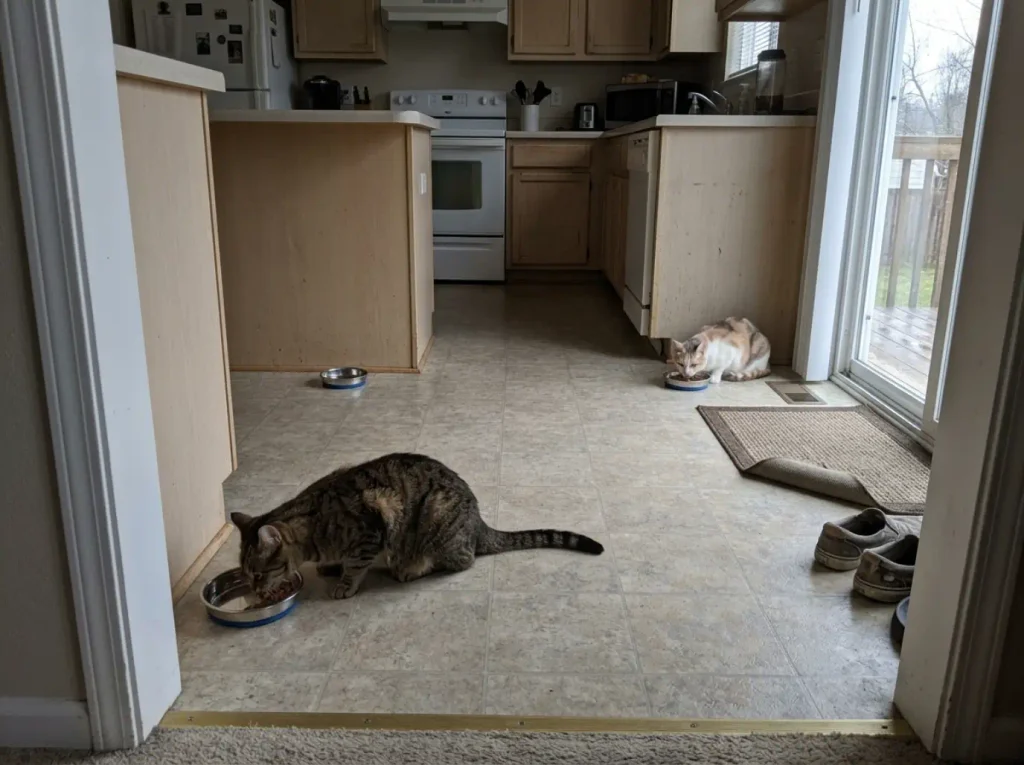
Two bowls side by side looks like a solved problem. To the cats it can read as one resource with a queue, and the smaller or more cautious of the two is the one who waits, then eats fast, then eats less.
One bowl per cat, and why distance beats count
The baseline is one bowl per cat, and the reason is not hygiene. It is resource competition. Multi-cat feeding goes wrong for a reason that has nothing to do with the bowls themselves. Cats time-share space rather than sharing it simultaneously, and a feeding spot where one animal has to stand within a whisker of another while both heads are down is a spot where one of them will start showing up late on purpose.
Distance does more work than count here: two bowls pushed together is functionally closer to one bowl than to two. The same instinct that sets the litter box distance rule sets this one. Move them apart, ideally out of each other’s sightline, and the same two bowls behave completely differently. The same multi-cat math applies to water stations, and whether a fountain is safe in a small apartment runs into the same distribution problem in a place with no spare square footage.
More bowls also means more washing, and that is the part that actually decays. Not the bowls, the routine. Two cats fed wet food twice a day is four bowls a day plus water, and week three is where the sink starts winning.
The bowl that travels across the floor
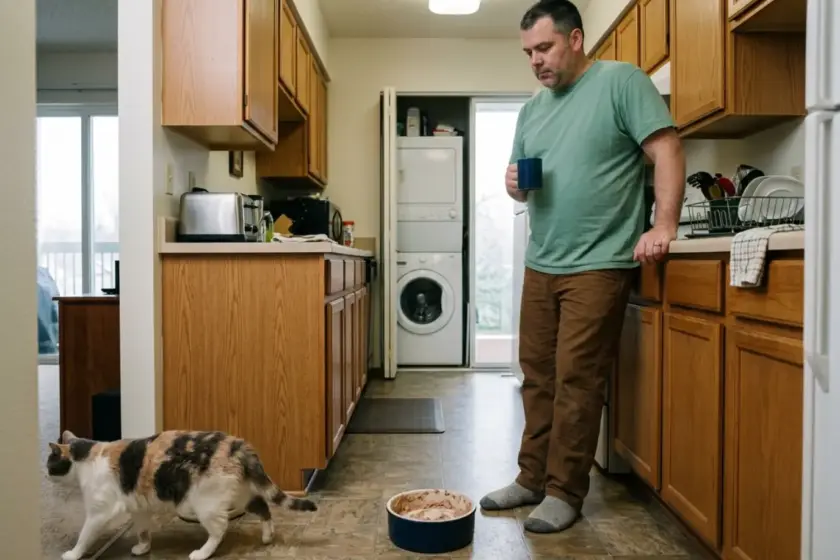
Then there is the bowl that travels. A cat who shoves the dish across the tile at every meal is describing a grip problem, not a material problem, and the free fix comes first: put a folded dish towel or a cheap silicone mat under the bowl you already own, or move the whole station off tile onto something with friction. That solves it often enough to be worth ten seconds.
If it does not, the built-in answer is a bonded base rather than a whole new feeding setup, and the OurPets DuraPet non-slip bowl has a non-slip base, a rubber ring permanently bonded to the underside, which makes it tip-resistant and stops the skid at the same time. The catch is capacity: it holds up to a cup, which is fine for a normal portion and tight if you are feeding a large cat a full can of wet food in one sitting. Also, that ring is bonded for a reason. The stick-on rubber feet on cheaper bowls come off in the dishwasher and then you have a slippery bowl and three loose rubber discs.
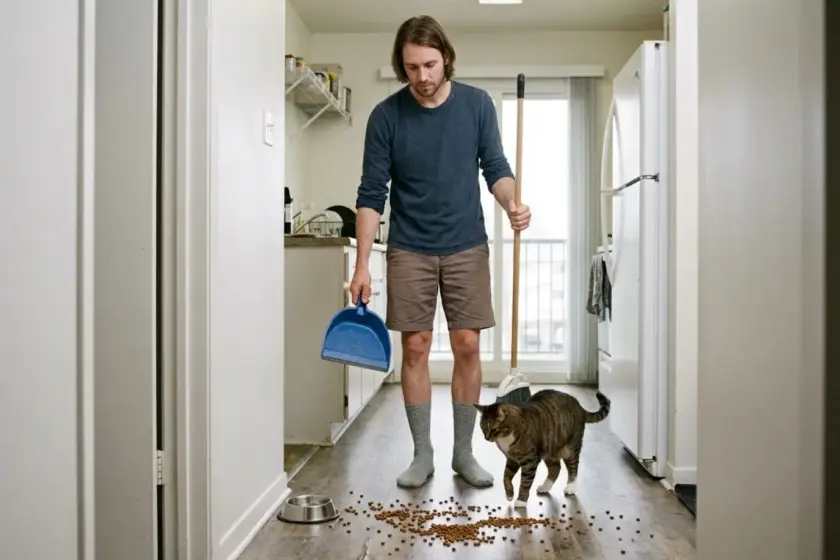
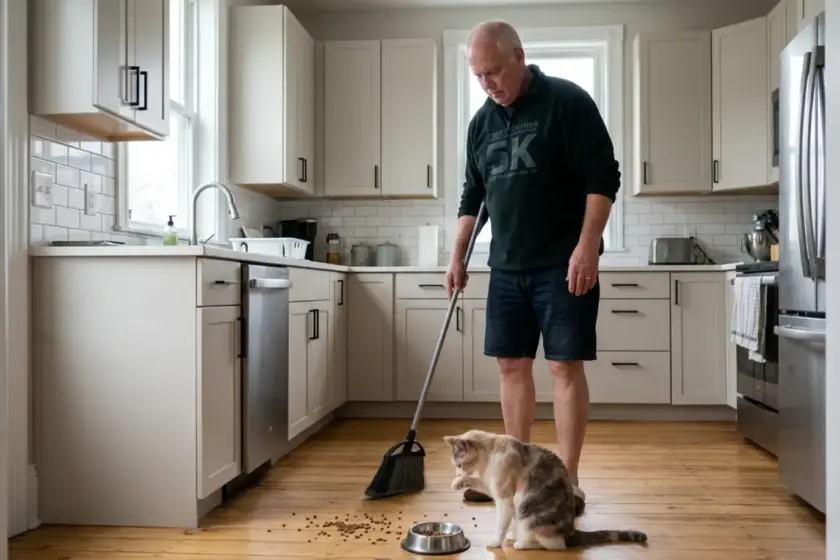
A moving bowl gets written off as a sign of a vigorous eater and nothing more, which is how it keeps getting separated from the complaint it usually arrives with. In the threads where someone mentions the sliding dish, a cat eating in short bursts and walking away turns up in the same paragraph often enough to stop being a coincidence: a bowl that slides forces the cat to chase it, and chasing your dinner across a kitchen floor is a reason to stop halfway. Two sibling guides are coming to this room on exactly that: whether cats can share a bowl at all, and what to do about the one who moves it. A third is coming on the messy eater who redecorates the floor at every meal, and a fourth on the feeding station as a whole rather than the dish in the middle of it.
The Cleaning Routine That Survives Week Three
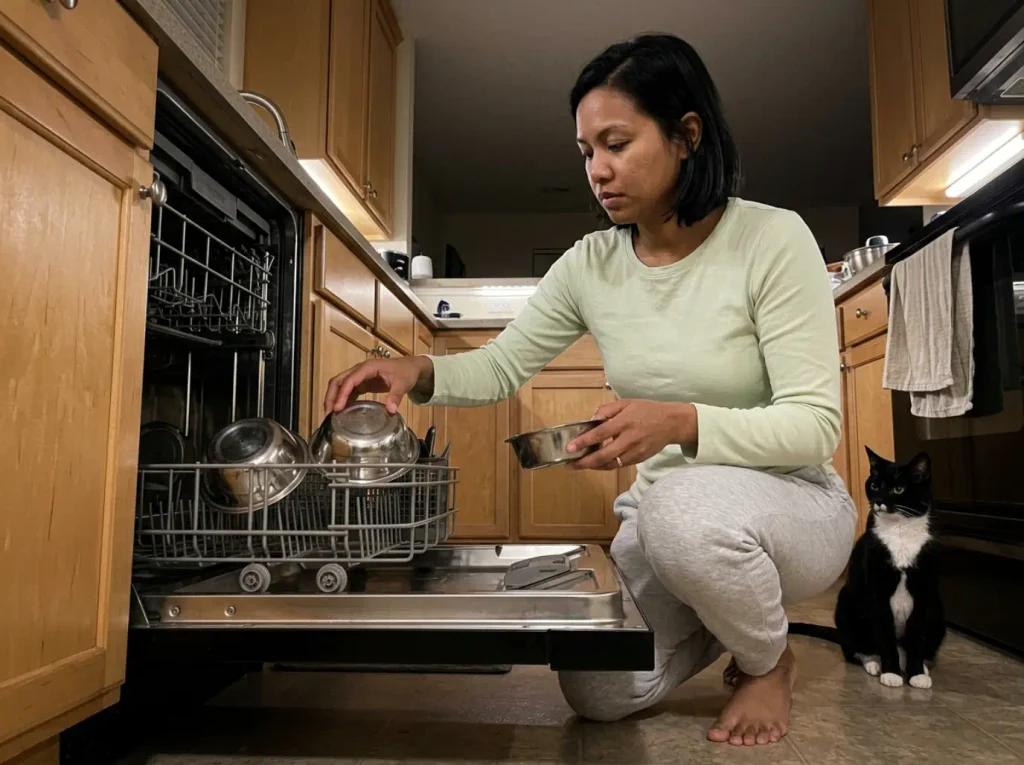
The material argument is settled in ten minutes. The washing-up is forever, and that is what decides whether any of the above held.
The daily job, and why the dishwasher wins
Wash after wet food, every time, not when it looks dirty. Residue is invisible for a long stretch before it is visible, and the bowl that looks fine at hour six is the one growing a film in the corners of the rim. Dry food is more forgiving but not exempt. The oil in kibble goes rancid on a surface, which is why an unwashed dry-food bowl eventually smells faintly wrong even though nothing was ever wet in it. A hot water rinse is not a wash, and that substitution is what quietly undoes the routine. Hot water and soap, or the dishwasher, which runs hotter than your hands can stand and is genuinely better at this than a careful hand wash.
- After every wet meal: hot water and soap, rim included.
- Daily for dry food: a proper wash, not a rinse and a wipe.
- Weekly: the whole feeding area, mat and floor underneath.
- Every few months: the glaze check on ceramic, the thumbnail check on plastic.
Steel and most ceramic go in the dishwasher without complaint. Plastic is the one that does not, and this is where its slow failure speeds up: the heat cycle warps thin plastic and roughens the surface, so the appliance that makes the other two cleaner is actively making that one harder to clean.
Why steel wins the week you are not paying attention
Which points at the real reason steel wins in a busy house, and it is not the safety argument everybody leads with. It is that steel survives being washed carelessly for years. It does not chip when it lands in the sink under a saucepan, it does not craze, it does not scratch from a scourer used in a hurry, and it comes out of a hot cycle exactly as it went in. The same logic is why an all-steel fountain follows the same cleaning rules and why the plastic-reservoir ones get returned. A material that tolerates your worst week is worth more than a material that is marginally better on your best one.
Own two sets and rotate them. One set is in use, the other is in the dishwasher, and the sink schedule stops being the thing that decides whether the cat eats off a clean surface. It is the cheapest fix in this entire article and it is the one that makes a daily routine survive a bad week, which is the only week that ever tests it.
Set the look-back at three weeks, not three months. The bowl will not have worn out by then. The routine might have, and the routine is what you are actually testing.
Conclusion
Steel is the safe default, and the reason is porosity rather than the brand or the price tag. Nothing lodges in a surface with no pores, which is why it forgives careless washing in a way the other two do not.
A good material in the wrong shape still fails. Width first, then material. Six inches across and an inch and a half deep clears most adult cats, and no amount of 304-grade steel rescues a bowl the cat’s face does not fit into.
And the bowl on the floor right now might already be fine. Hold the ceramic one up to the window and look for the spiderweb. Run a thumbnail across the plastic one. Hold either against your cat’s cheeks.
In three weeks, check two things: whether food is still being left in a ring around the rim, and whether the daily wash actually happened. The first tells you if the shape was the problem. The second tells you whether you fixed a bowl or bought one.
Tonight, move the bowl away from the wall, measure it against your cat’s face, and wash it properly. If that fixes it, nothing needed buying.
Amazon’s Audible — free for 30 days
Your cat won’t let you read. Let someone read to you.
Audible is Amazon’s audiobook library — thousands of titles, read out loud, on your phone. Free for a month, plus one audiobook to keep forever.
Frequently Asked Questions
01Do cats prefer stainless steel or ceramic bowls for water?
Most cats show no preference between the two materials themselves, since both are non-porous while intact. What they do respond to is width and how still the water sits, so a wide, shallow bowl in either material beats a narrow deep one.
02Is plastic or ceramic better for cat bowls?
Ceramic, as long as the glaze is intact and uncrazed. Plastic scratches with normal use and every scratch is a place a rinse cannot reach, while ceramic only develops that problem once the glaze itself cracks.
03What is the healthiest type of water bowl for cats?
Stainless steel in an 18/8 (304) grade, wide and shallow. It has no pores to hold residue and it survives years of careless washing, which is the part that actually decides whether a bowl stays clean.
04What material is best for cat bowls?
Stainless steel is the safe default and ceramic is a close second when the glaze is sound. Plastic is the one to retire, not because it is unsafe on day one, but because it degrades in exactly the way that makes a bowl hard to clean.

Leave a comment