How to Set Up a Small Home for Cats and Dogs Living Together
A 36" gate, a 7 x 5.5" cat door, two exits per room & a day-ten checkpoint: how to set up a small apartment for cats and dogs living together.

Alfredo RamsesFounder · November 9, 2026 · 23 min read

On this page10 sections
- 1Cats and Dogs Living Together Comes Down to the Individual Animals
- 2What Belongs to a Vet or a Behaviorist, Before Any Furniture Moves
- 3Check the Dog Before It Moves In: Temperament, Prey Drive and Who Arrives First
- 4The Cat's Base Camp: Count Everything It Owns Before the Dog Arrives
- 5The Barrier a Small Home Needs, Measured Against the Dog's Head
- 6The Escape Route and the High Ground the Dog Cannot Reach
- 7Food, Water and the Litter Box Behind the Dog Line
- 8The First Month: Doors Before Faces, a Leash for Weeks, Two Cues
- 9Count the Exits First, Then Watch Which Rooms the Cat Takes Back
- 10Frequently Asked Questions
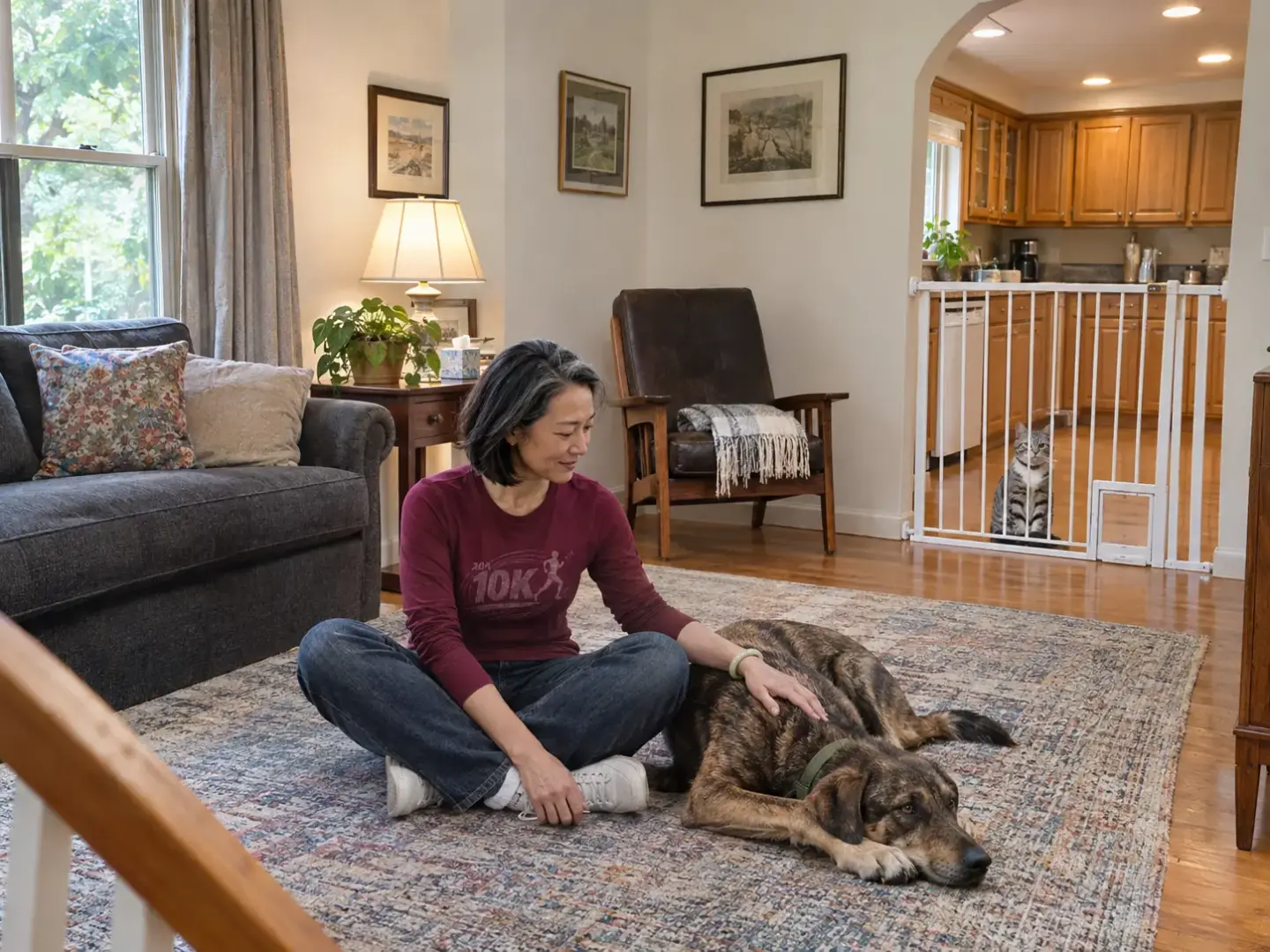
A cat who starts taking the long way round the living room, down the hall and through the bedroom, has lost a route, and the crate that appeared beside the sofa is usually the reason. Cats and dogs living together can work in a small apartment, whatever Ghostbusters promised, and the cat, far more than the dog or the breed, sets the odds. International Cat Care puts the goal for a mixed home at two animals going about their own business in the same space, a lower bar than friendship and a more reachable one. The sections below set up a small home for cats and dogs living together in order: what goes to a vet or a behaviorist first, how to check the dog before it moves in, the cat’s base, the barrier and the exits, the food and the litter box, and the first month.
Quick Answer
Yes. Cats and dogs can share a small apartment, and the individual animals decide it more than the species do. It works with an exit the dog cannot use, a second copy of each cat resource behind the dog’s line, and an introduction counted in doors and weeks. A cat who changes overnight goes to the vet first.
Cats and Dogs Living Together Comes Down to the Individual Animals
A week of reading on this subject turns up two confident claims: dogs and cats are natural enemies, and dogs and cats curl up together by the second day. Both describe real households, and neither tells you how a given cat and dog will do under your roof. What does predict it is a short list of facts about the two animals involved, and the first fact is about the cat.
Why the Cat Sets the Outcome
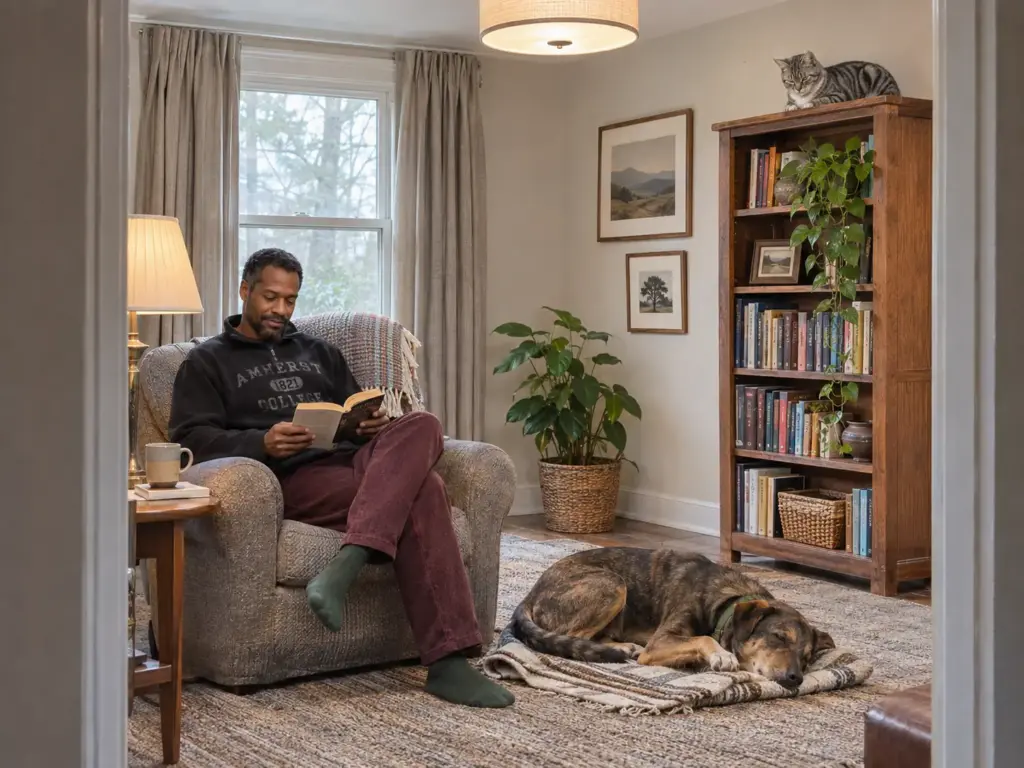
The University of Lincoln asked the owners of households with both species how well the pair got along. According to what a survey of 748 mixed-species homes found, “Typically, the cat appeared to be the main controller in determining amicability in the cat-dog relationship.” Cat discomfort also predicted a worse relationship than dog discomfort did, so the cat is the instrument to read. A wagging dog proves nothing; a cat who keeps using his rooms, his box and his bowl proves a lot.
That puts the disagreement where it belongs. The cat is describing a constraint: a route, a perch, a door he can get through. The person is describing a preference, a calm living room by Friday. A preference can wait for the constraint to be met.
A multi-pet home with two cats and one new dog makes a different sum. The dog has two animals to watch, and the cats can share the exit or compete for it. Everything below is written for one cat and scales to two by giving each cat a copy of each resource (fights between the cats are a subject of their own).
Nobody can promise that a given dog will never go for a cat. Prey drive gets assessed, not guaranteed, and the assessment comes up in a moment.
What the Odds Look Like for a Puppy
Chasing is the normal first day for a puppy, and the numbers say so. In the Dogs Trust study of 1,211 puppies, 48.6% chased the resident cat and 58.9% played with it, and just 7.3% showed only desirable behavior around the cat. A puppy that gives chase on day one is the common case, not a spoiled house: the training has not started yet.
The same study found better odds for puppies introduced before 12 weeks of age, introduced gradually over more than a single day, and living in a home that already had another dog. The dog’s age at the meeting moves the odds more than anything done with the cat afterward. For an adult dog, the equivalent of a puppy’s age is its history with cats in its last home.
An Older Cat With No Dog History
The Lincoln survey also tied the cat’s age at the introduction to the result, with younger cats doing better. An older cat who has never shared a home with a dog has more to lose and less time to adapt. He gets more time and more exits, never fewer, and the slowest version of every stage that follows.
What Belongs to a Vet or a Behaviorist, Before Any Furniture Moves
Gates, shelves and routines change where a cat and a dog meet. They cannot answer a question about the animal. So the line goes in before anything gets moved: a cat whose habits change from one day to the next belongs to a vet before he belongs to a floor plan, and a dog who fixes on the cat belongs to a certified trainer or a behavior specialist before he belongs to a gate.
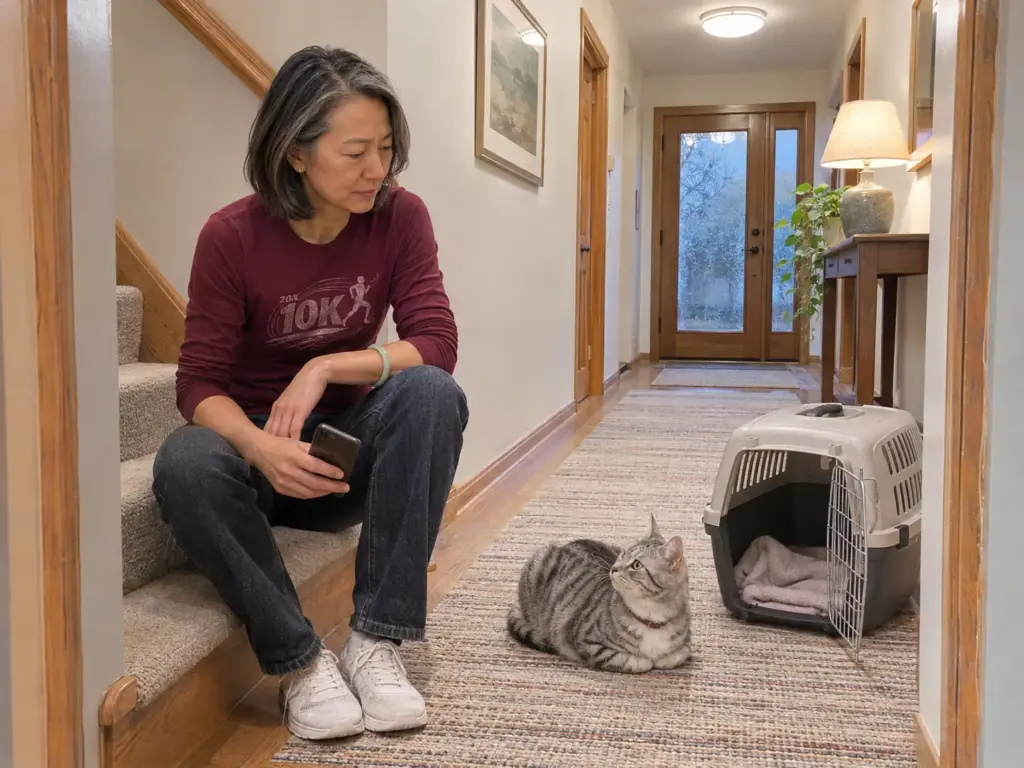
Call a vet or a specialist when you see any of these:
- The cat stops eating
- The cat stops using the litter box
- The cat hides for days at a time
- Either animal has a bite or a scratch that breaks the skin (a visit that day, not the next)
- The dog stiffens, stares and stays fixed on the cat, or whines or barks at the barrier (a trainer or behavior specialist, and the introduction stops)
That is as far as this guide goes on those signs. Explaining them is the vet’s job, and no gate or diffuser stands in for it. If the visit comes back clear, the work below is the next step; if it does not, the work waits.
Check the Dog Before It Moves In: Temperament, Prey Drive and Who Arrives First
A shelter profile gives the dog’s age, size and favorite toy. It seldom says what the dog does about a cat, and that is the question to settle before the first night. It can be settled with a closed door.
The One Test That Predicts Trouble
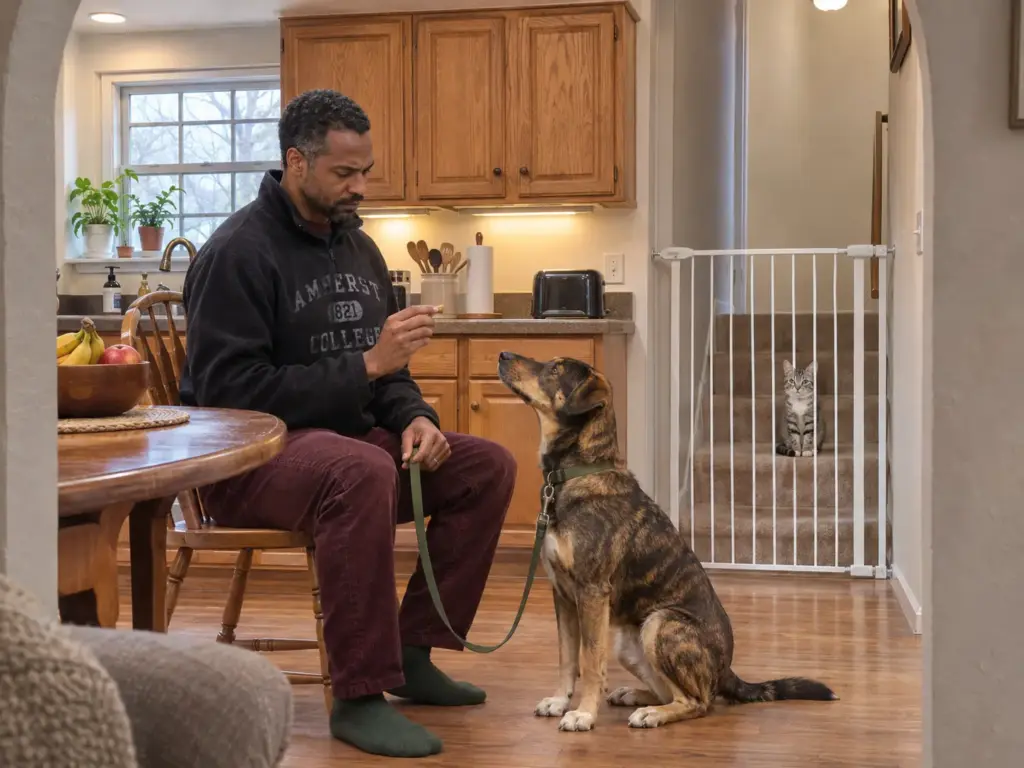
Watch what the dog does when it cannot reach the cat. Put the cat in the next room behind a closed door or a gate, comfortable and free to leave, and look at the dog’s side. A dog that sniffs, loses interest and wanders off is a dog to keep working with.
A dog that redirects onto the barrier, stiffens, stares, or whines and barks fixed on the cat is not “interested.” It is doing the first half of a chase with a door in the way.
Metro Nashville Animal Care and Control’s guide to introducing a new dog to a resident cat lists stiffening, a hard stare, and whining or barking while fixed on the cat as the signs that this dog is not ready to be near the cat. A dog that shows them does not need a better gate. It needs a certified trainer or a behavior specialist, and the introduction stops until one has seen the pair.
History counts too. If a shelter or a previous family says the dog chased cats, believe it, and either pick another dog or plan for far longer than anything below suggests. A breed decides nothing (no list of breeds is a safe list or an unsafe one), but size does decide which gate the apartment needs, and that comes up with the barrier.
Do the first watching with a closed door between the two and the cat in another room. A dog who gives up and wanders off is telling you something very different from a dog who parks at the crack and will not leave it, and you see the difference without the cat ever being at risk.
The Cat Moves In First, or Gets Its Space First
When the dog is the newcomer, the cat claims the space first. His base camp (built below) goes up two to three weeks before the dog crosses the threshold, so the cat is not losing rooms to a dog who is already inside. That window is a starting figure, and it runs short for an older cat, or for any cat whose day depends on one spot: the narrower his territory, the longer he needs to believe it is secure.
When the cat is the newcomer and the dog is the resident, the logic runs the other way. The cat gets the closed room, and the dog learns to walk past that door. The first day is settled by a test, not by a meeting, and the day-one test that decides whether to introduce at all was written for two cats, but the exit sized to the biggest animal applies just as well to a dog.
A newcomer much smaller than the resident needs the same two objects, a tall gate and a high refuge. Adding a kitten without crowding the resident cat works through both with a kitten and a resident cat, and the same logic carries over. A new animal’s health check belongs to the vet, and until it is done the newcomer stays apart.
Whether any cat and any dog can live together at all, and the step-by-step meeting for one particular pair, are subjects that need more room than this guide can give them.
Reading the Dog and the Cat at the Same Time
The dog’s body language gets read at the barrier, and the cat’s gets read in the house. For the dog, stiffening, a hard stare and a fixed whine or bark mean stop. A loose dog who turns away when called is a different animal. For the cat, stop watching what he does in front of the dog and count the rooms he skips.
A cat who hears the dog bark through the gate on day one can hide for days, coming out only to eat and use the box. That retreat starts at the barrier, before the two animals ever share a room. And a cat who hides for days sits in the vet list above, so that retreat goes to a phone call before it goes to a floor plan.
The Cat’s Base Camp: Count Everything It Owns Before the Dog Arrives
Start with a pencil and a list of everything the cat owns. How International Cat Care stages a cat-dog introduction begins by leaving the resident animal’s world unchanged, in a safe place that holds all of its resources: for a cat, food, water, litter trays, scratching posts, perches, beds and hiding places. Sort the list the way how a cat claims a home zone by zone sorts a home, with sleep and litter at the core, food and water around it, and the shared rooms and windows beyond. Every item that ends up on the dog’s side of the gate is a corner the cat stops using.
The One Room That Stays the Cat’s
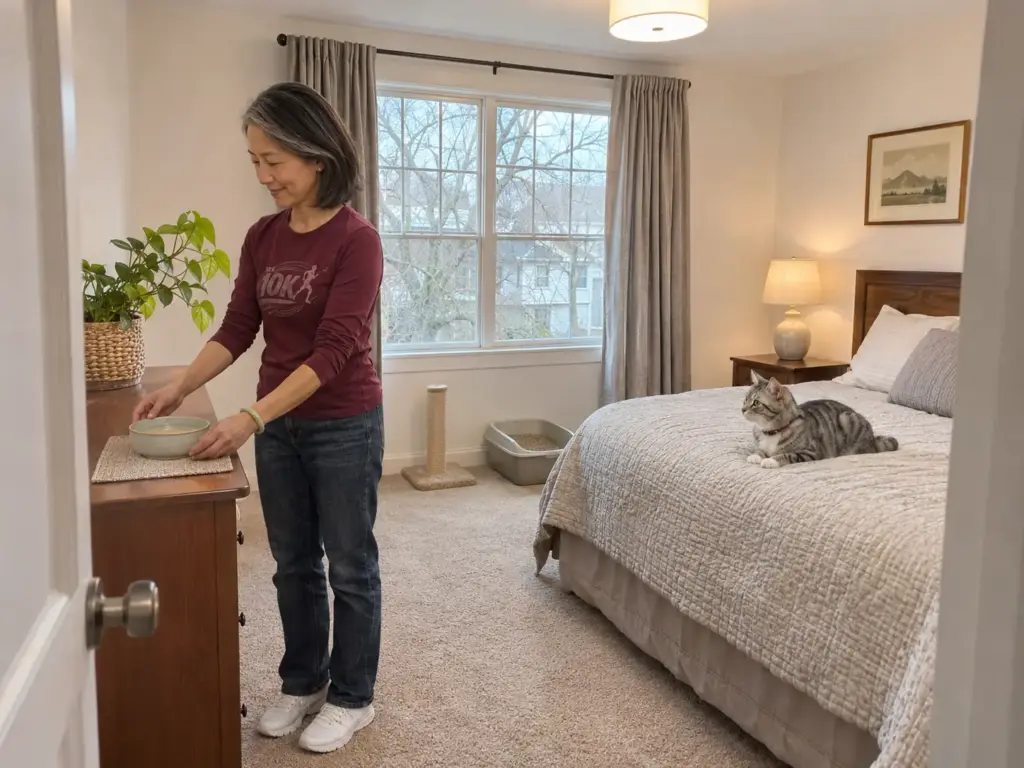
In a small apartment, the base camp is the room that already has a door. The door stays, and the gap beside or under it becomes the cat’s way out (the barrier measured below sizes that gap). With one bedroom and one bath, the bedroom is the cat’s and the dog gets a bed in the hallway. A dog can sleep in a hallway; a cat who loses his only door has nowhere to go.
A Second Copy of Everything, Behind the Dog Line
The dog line is the edge of where the dog can go: the gate, the closed door. Behind it is the cat’s side. Whatever the cat used before the dog arrived stays where it was, and a second copy of each resource goes behind the line: a box, a bowl, a bed, a post and a perch in the cat’s room. With two copies, the cat stops choosing between defending the first one and losing it.
The second copy has to sit in a different spot from the first. Why a second copy of each resource has to sit in a different spot is a rule from households with several cats, and it holds when the second animal is a dog. With two cats, the copies behind the line serve both of them.
What Moves and What Stays Put
For the first month the box, the bowl and the bed stay exactly where the cat found them. Moving the cat’s things the week the dog arrives takes two changes from him at once. If a box has to move to get behind the line, add the second one first and shift the original later, in small steps.
The Barrier a Small Home Needs, Measured Against the Dog’s Head
The barrier has two jobs that pull against each other: stop the dog, let the cat through. The opening that does the second job is the one that tests the first, so it gets measured against the dog’s head, not the cat’s frame. Work through the options in this order, free first:
- Hold a door you already have open, only as wide as the cat needs.
- Fit a gate with a cat door narrower than the dog’s head.
- Step up to a taller gate if the dog jumps.
Cutting a cat door into a door comes last, and in a rental it may never make the list. A gate is furniture that stays; International Cat Care’s picture of the barrier is a baby gate or a door across the hallway or the stairs, kept in place while the animals learn each other, not a phase to be dismantled on a date.
Start With the Door You Already Have
A closet door, a bathroom door or the bedroom door, held open just wide enough for the cat and not for the dog, is all the barrier many apartments get. Prop it with something already in the house and hold the gap against the cat’s shoulder width, then against the dog’s head. Rentals that forbid cutting and drilling do not change any of this.
When the door has to stay put without a doorstop, Door Buddy Pet Door Latch for Cats holds it with an adjustable strap fixed by 3M adhesive, with no tools and no cutting, and it leaves a gap the width of a cat. It is the no-drill fix for a door that cannot be cut. But the adhesive lets go under a determined dog and the strap can break, so it belongs only on a door the cat can also leave by.
A Gate With a Cat Door: Measure the Gap, Not the Cat
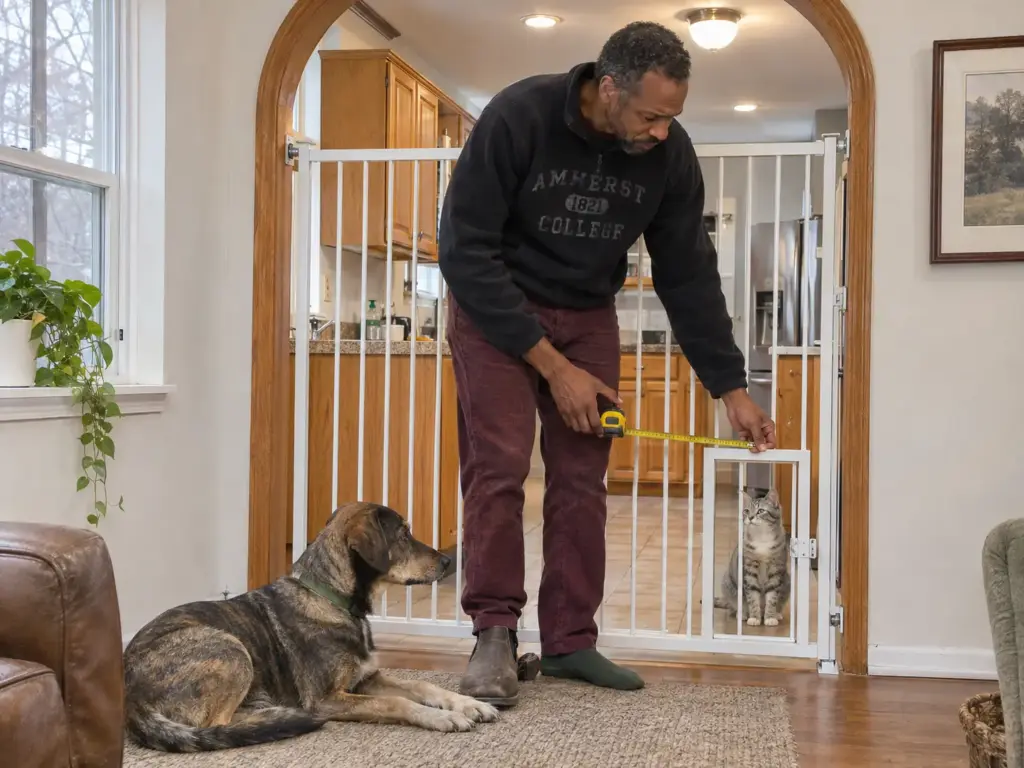
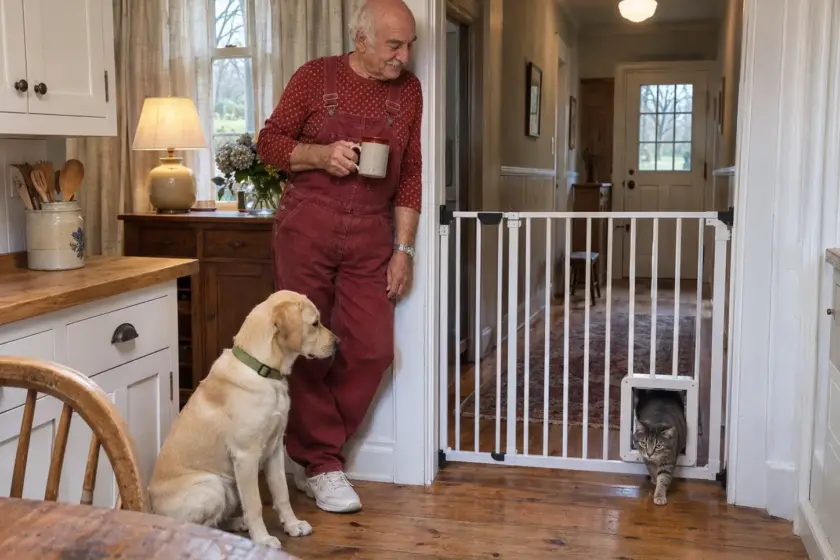
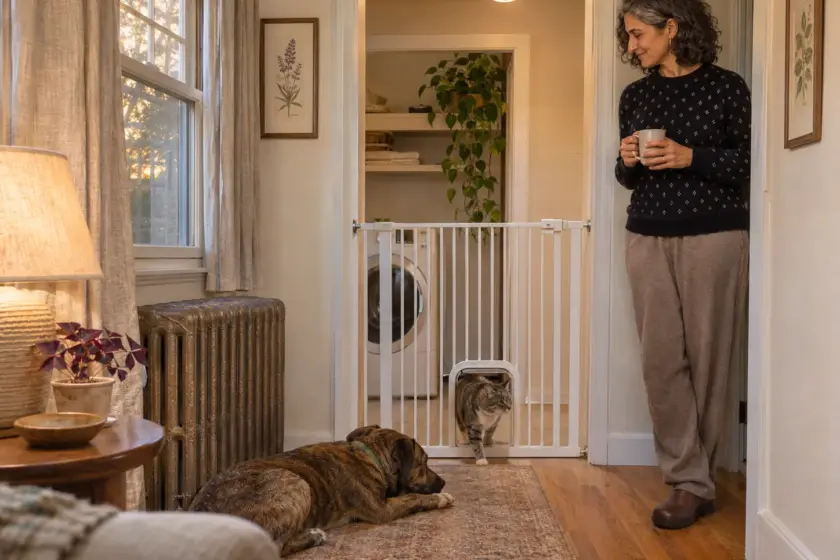
The usual advice is to buy a gate with a cat door and be done. In a home with a small dog it separates no one: a small dog goes through the slats of a standard gate and through the cat door as well, and then the gate is decoration. The number that decides it is the opening, held against the dog’s head. Cat doors on gates run from 7 by 5.5 inches up to 10 by 7 and 9.5 by 8, and a door that size is a door for a terrier.
Carlson 36″ Extra Tall Walk-Through Dog Gate with Small Pet Door is the budget-friendly pick among the gates here. It stands 36 inches, the extra-tall standard, fits openings from 29 to 36.5 inches, has a 16.5-inch walk-through and a 7.5 by 7.75-inch cat door, and mounts by pressure, so nothing is drilled. A very small dog whose head is narrower than that opening follows the cat through, and the fit can be poor in an opening of 32 to 34 inches, so measure the doorway at the top, middle and bottom before choosing.
A narrower cat door shifts the odds in the cat’s favor. The Carlson is the obvious pick for a doorway inside its range and a dog with a broad head.
For a wide opening, or a dog with a narrow muzzle, the second choice is the one that works (or rather, the one worth measuring first). Babelio 36″ Tall Pet Gate with Cat Door, CatPrivilege III has a 7 by 5.5-inch cat door with a two-level adjustment, so a dog’s head has less chance of following the cat, and it covers openings from 29 to 43 inches, which means a 38-to-43-inch doorway does not need a second extension. The hardware kit comes in the box. Its extension pieces can stop locking properly, the latch can run stiff, and it sits at the premium end of the group.
Hold a tape measure across the dog’s head at its widest point and compare it with the cat door opening on the spec sheet before ordering. If the head is narrower than the opening, the gate separates the two animals only on paper.
The Dog That Jumps
Thirty-six inches is the extra-tall standard, and it assumes a dog that does not jump. The height that decides is the height of the jump, not of the shoulders, so a dog that clears 36 inches needs the next step up. MYPET EasyPass Extra Tall & Wide Walk-Thru Pet Gate stands 41 inches, spans openings from 29.75 to 52 inches (a wide gap between a hallway and a living room), offers a cat door at 5, 6.5 or 8 inches, and mounts by pressure with no tools.
Its latch can fail to lock and its pieces can break, and the assembly gets mixed results, so test the latch every day for the first few days. No gate called dog-proof is dog-proof against a decided dog.
The same barrier is also safety equipment. If the household has ever had a cat fight, the gate is the tool to reach for first, and using a barrier instead of your hands when cats fight explains why the hands stay out of it. Which door and which gate suit a given doorway are questions with enough detail to fill separate pages, and this guide only sizes the problem.
The Escape Route and the High Ground the Dog Cannot Reach
A cat who no longer crosses the living room since the dog arrived is telling you which route got blocked. The job is to give him another one, and a second one above the dog.
Two Exits Per Room, One Off the Floor
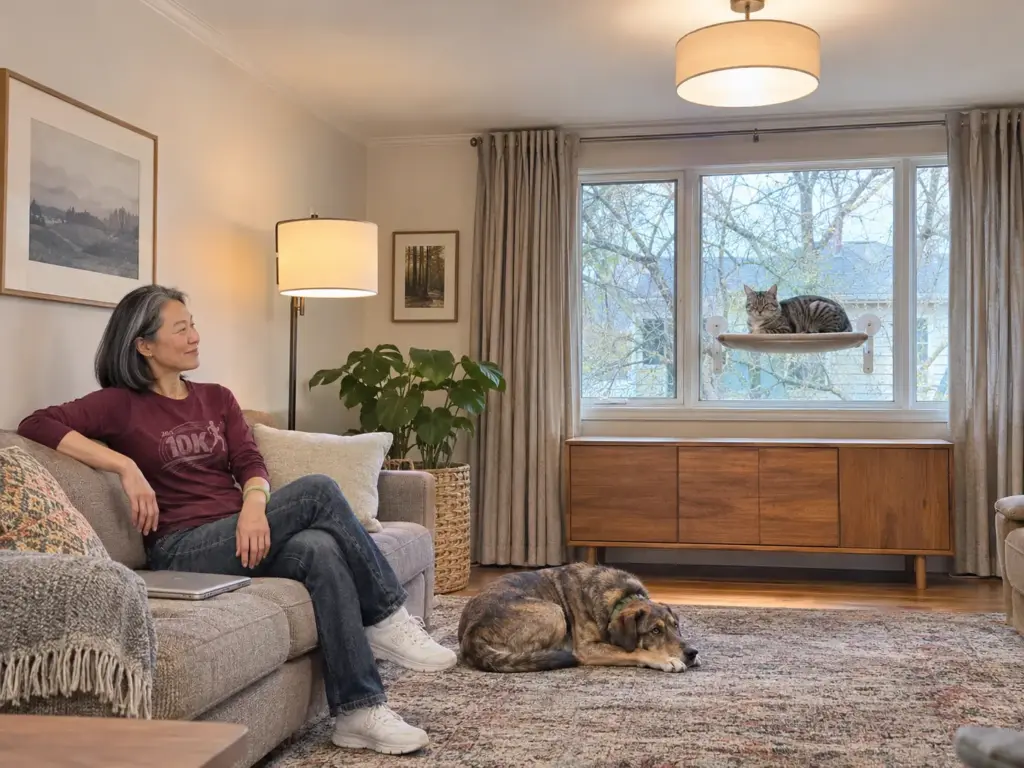
Every room the cat uses needs two ways out, and one of them is off the floor. A room whose only exit leads past the dog is a trap, and a room whose second exit ends in a dead end is the same trap with a delay. Count the exits room by room with the floor plan in hand, using how exits and loops shape a cat’s territory in a small apartment to see which loops are real. International Cat Care and Metro Nashville agree on the rule: the cat must always be able to leave.
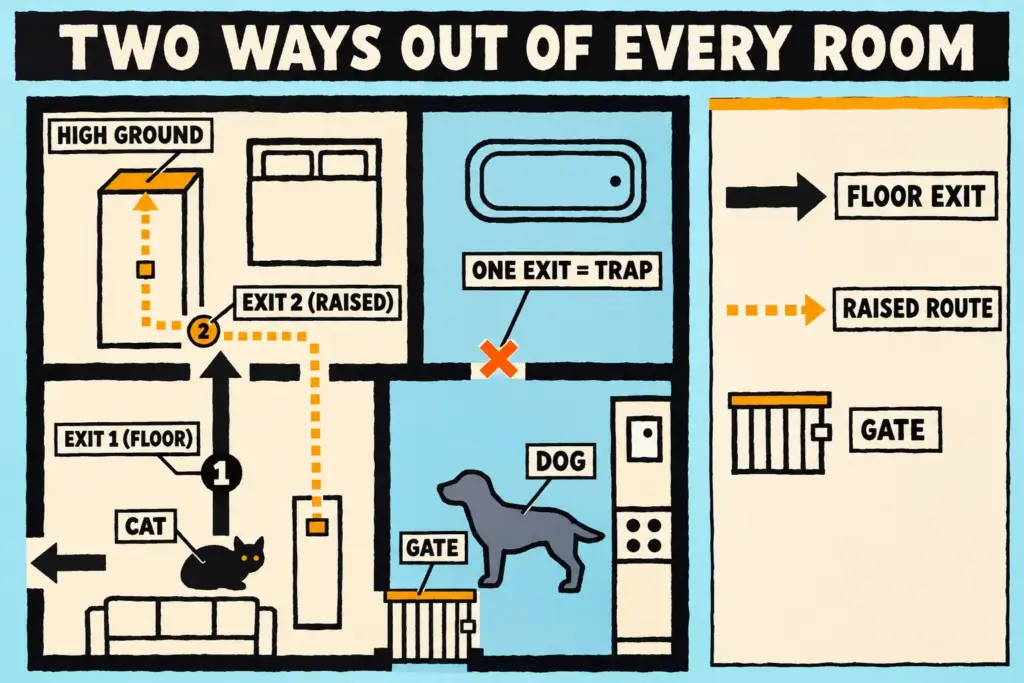
The free version comes first. The top of a wardrobe or a shelf the cat already uses, plus a continuous route up to it from a sideboard or a bookcase (a “cat highway”), gives him ground the dog cannot reach. The cat jumps, the dog does not, and nothing is drilled. And a cat on top of the wardrobe is using ground he won.
- A sideboard or low bookcase the cat can jump onto from the floor.
- A continuous step from there to the top of the wardrobe or a shelf.
- A seat at the window in the room where he already sits.
A Window Seat That Costs Nothing Until You Buy One
The window where the cat already sits is the cheapest high spot in the apartment, because nothing needs to be moved. A cat tree is the usual answer, and in a one-bedroom it eats the floor and the window wall; a seat that hangs on the glass does the job without taking either.
K&H Cat Window Perch, EZ Mount Kitty Sill is a 23 by 12-inch platform that grips the inside of the glass with suction cups, folds up and has a machine-washable cover. It gives a cat a seat above the dog’s reach without a tower. The suction cups can stop holding, and then the platform moves under the cat, so press them onto clean glass and check the grip every day at first.
The Retreat Starts With One Skipped Room
The cat does not announce a retreat. He gives up the windowsill first, then the hallway, and the day he stops coming to the kitchen at dinner time the house has already lost a room. Read the house by the rooms he skips, not by what he does in front of the dog. How a cat’s skipped rooms show who is being pushed out covers that reading between two cats, and it applies to a cat and a dog.
Food, Water and the Litter Box Behind the Dog Line
A dog that finds the litter box has found a snack, and a cat who finds the dog parked beside the box finds somewhere else to go. This section keeps the cat’s most private resources where the dog’s reach ends.
Why the Covered Box Fails the Cat
A lid gives the cat a single exit, and a dog learns to sit in front of it. The cat’s answer is to start holding it instead of using the box, which is a problem the lid created (a cat who stops using the box at all is a vet question first). How a lid changes the cat’s exit works through the numbers.
Top entry looks like the way out, and it swaps the dog problem for an age problem. It is a jump, and the cat who most needs a quiet box is the one who has stopped jumping. The senior entry limit on top-entry boxes is the second failure, and in a home with an older cat it is the one to plan around.
The Fix Lives at Room Level
Move the problem out of the box and into the room. A door the cat passes and the dog does not, a box set higher than the dog’s jump, a cabinet with a turn in the hallway (the cabinet option and the clearance it needs), or a box pointed at a wall with a foot of gap: any of those works, and the apartment decides which one fits.
A dog that eats what is in the box has an access problem, not a taste problem. The answer is taking the access away, not correcting the dog, and that subject is bigger than this guide can hold. The box count follows the blog’s rule of one per cat plus one, with at least one behind the line. With two cats the count rises by one, and the box behind the line serves both.
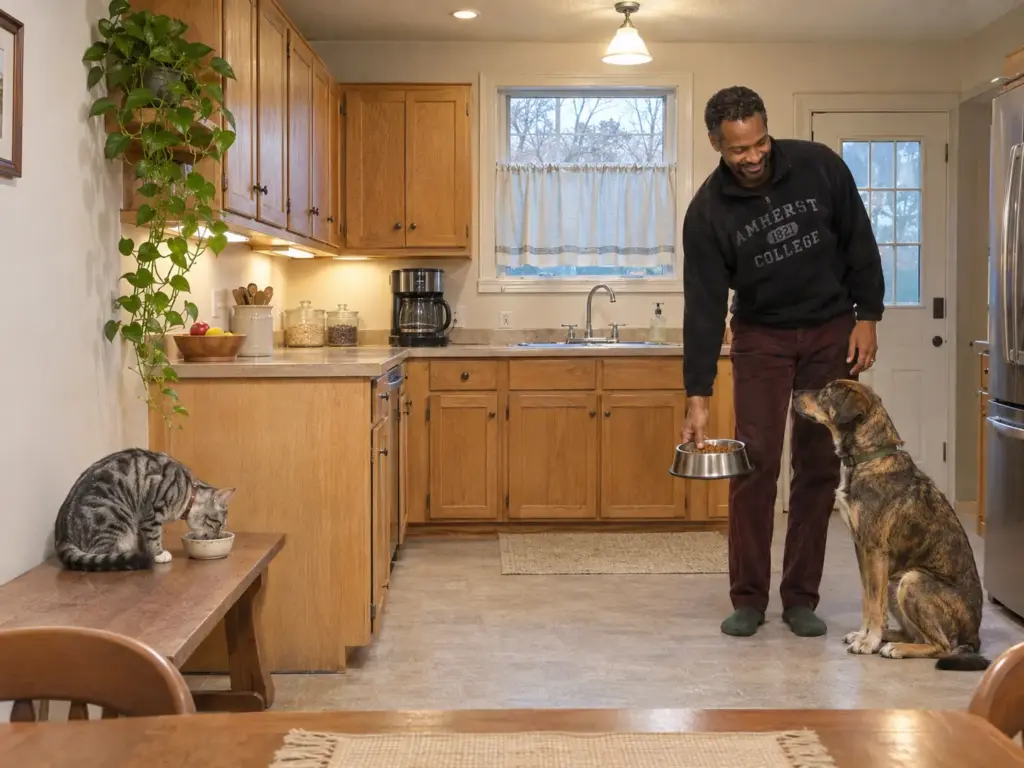
Put the cat’s box and food where the dog’s reach ends, on a shelf, behind a door the cat can pass, or on the far side of the gate. Set the height by what the dog can reach, then check the cat has a clear approach to it.
Food and Water: One Station Each, Well Apart
Each animal gets its own station, set well apart, and one bowl station per animal, five feet apart puts a distance on it. The cat’s station goes up where the dog cannot reach, and a feeding station measured against your dog’s reach shows how high that is. A shelf or a counter edge reached from a sideboard does it with no purchase at all.
A dog that guards its bowl and a cat that guards his are the same failure in two species, and what it means when a cat guards its bowl explains the cat’s half. Spacing the stations is the fix for both.
The First Month: Doors Before Faces, a Leash for Weeks, Two Cues
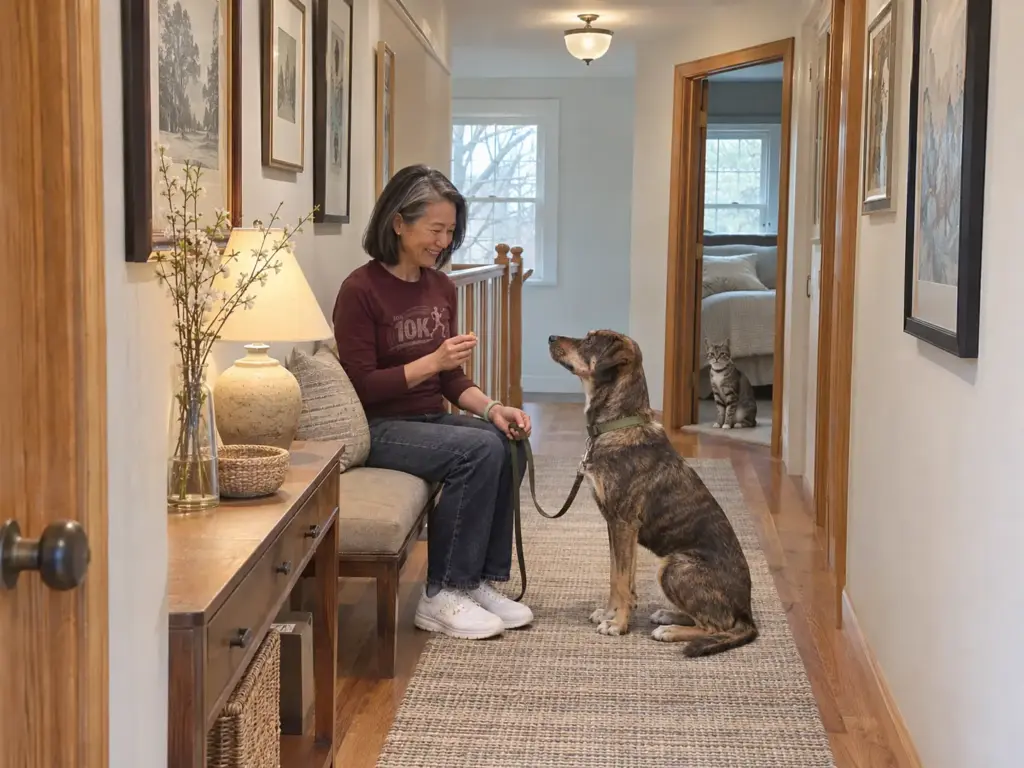
The first month is two lives running in parallel: the dog on a leash in the hallway, the cat doing his usual rounds at his usual hours, and one door between them.
From the Closed Door to the Open Room
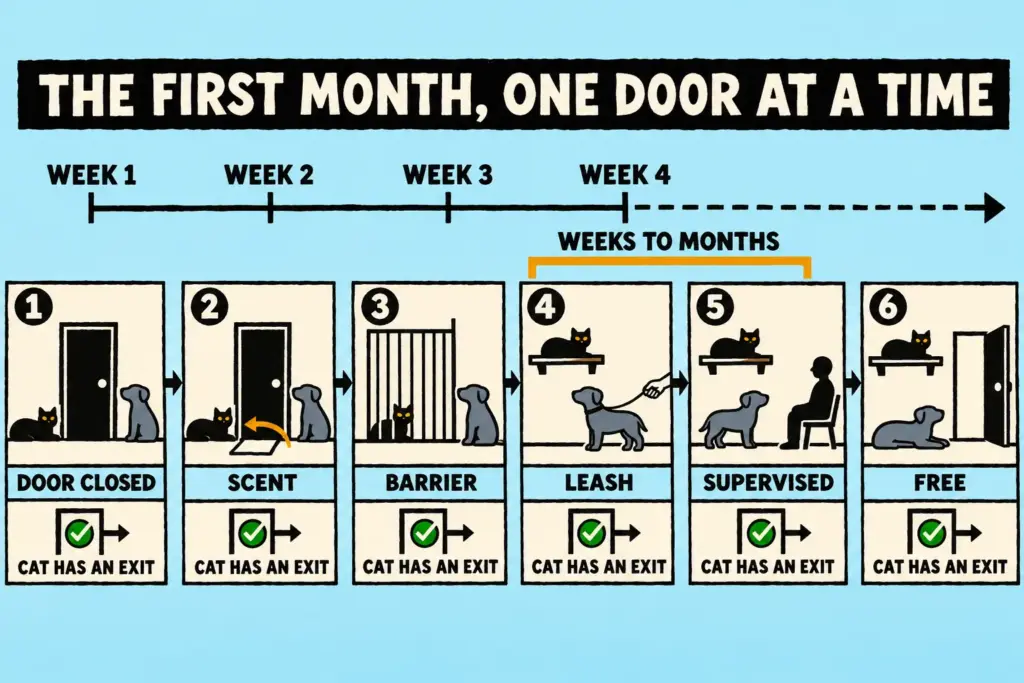
The stages run from a closed door to scent, then a barrier, a leash, supervised time and finally the open house. How to introduce cats in a small apartment, stage by stage lays out that order for two cats, and it carries over to a dog with the leash added. The target is the one International Cat Care names: both animals in the same space, doing their own things, with no push for them to interact.
The clock is long. Cornell’s veterinary college puts integration at days to weeks, depending on the dog, and sets a checkpoint at day ten: if neither animal is relaxed by then and the dog does not respond to a verbal cue, change something.
Metro Nashville Animal Care and Control on leash and supervision asks for more, a dog kept leashed and supervised around the cat for weeks or even months, with the cat always able to leave. The leash is not for the first meeting; it is for the first month. None of this is a promise of when the pair will relax, and how long to wait is counted in gates, not days explains the counting.
Scent gets swapped once and carefully, and where the scent item goes and why swapping can backfire covers the steps. Letting the dog sniff the cat inside a carrier on day one costs weeks: the cat hisses and swats, and the introduction restarts behind a closed door. A diffuser, if you try one, is a test of one vial with a start date written down, not the plan. The one trial of pheromones in mixed-species homes ran six weeks with 17 owners per group and relied on the owners’ own reports.
If the cat stops eating, stops using the box or hides for days, the introduction goes back to the closed door and the vet gets the call, as in the list above. The signs an introduction is failing between sessions covers the earlier signs, the ones that come before that line is crossed.
Two Cues Do the Daily Work
“Leave it” and “gentle” are the two cues that do the daily work in a mixed house. Teach them to the dog with positive reinforcement, far from the cat, before the cat is in the room at all. A dog who reliably drops its attention on a “leave it” gives the person a way to interrupt a chase before it begins.
Teach “leave it” with the cat out of the room and the door closed. Bring the dog to the barrier only when the cue holds with the cat’s scent in the room.
Time Alone With Each Animal
Each animal needs time with you while the other is out of the room, so neither starts guarding the person the way a cat guards a bowl. A walk for the dog and a play session for the cat, held apart, keep each relationship from turning into a contest.
Count the Exits First, Then Watch Which Rooms the Cat Takes Back
Cats and dogs can live together in a small apartment, and the cat is the one who decides how well it goes. A cat who changes overnight goes to the vet before anything else, and a dog who fixes on the cat goes to a certified trainer or a behavior specialist. The house gets ready before the first meeting: the cat’s world untouched, a second copy of each resource behind the dog line, and an opening sized to the dog’s head with a way out that the dog cannot use.
The free options come first: the door you already have, the top of the wardrobe, a box on a shelf. A gate is furniture that stays, not a phase you pass through. Buy only what the apartment cannot do without.
Day ten of the leash is the first real reading. Look at which rooms the cat has taken back, whether he has returned to the kitchen at dinner time, and whether his box and bowl are still his. If nothing has relaxed by then, change something in the setup instead of waiting for it to settle.
Tonight, walk each room with a pencil and a floor plan, mark every way out for the cat, and circle any room with only one. Then set the door of the cat’s room open to the width of his shoulders and watch whether he uses the gap by tomorrow evening.
Frequently Asked Questions
01Do cats enjoy living with dogs?
Many cats do, and in a mixed home the cat decides how well the pair gets along, according to a University of Lincoln survey of 748 households. A cat who keeps using his rooms, box and bowl is the sign to watch. One who stops eating, stops using the box or hides for days goes to a vet first.
02What is the 3-3-3 rule for dogs and cats?
The 3-3-3 rule is a rule of thumb, not a published standard: about three days to settle, three weeks to learn the routine and three months to feel at home. Use it as a frame for giving a new animal room to adjust, never as a promise that the pair will be friends by then.
03How long does a dog stay on a leash around a cat?
For weeks or even months, according to Metro Nashville Animal Care and Control, with the cat always able to leave the room. Cornell’s veterinary college sets a checkpoint at day ten: if neither animal is relaxed and the dog does not respond to a verbal cue, change something about the setup.
04Can cats and dogs live together in a small apartment?
Yes, when the cat has a way out the dog cannot use, a high spot, and a second copy of food, water and litter box behind the dog line. The base camp is the one room that already has a door.
05Does a covered litter box keep a dog out?
Not reliably, because a lid gives the cat a single exit and the dog learns to wait in front of it, so the cat starts avoiding the box. Room level is where it gets solved: a door the cat passes and the dog does not, or a box set higher than the dog can jump.
Leave a comment