Litter Box Furniture That Hides the Box, Not the Odor
Litter box furniture needs 24" x 20" of interior room, two vents at different heights & a box at 1.5x body length. Most listings clear none.

Alfredo RamsesFounder · August 25, 2026 · 22 min read

On this page9 sections
- 1What an Enclosure Actually Changes
- 2What the Cat Is Doing Inside a Box You Can't See Into
- 3Ventilation Is Two Openings, Not One
- 4One Cabinet Is One Location
- 5Where the Material Fails, and It's Always the Same Seam
- 6The Renter Version, and the Small-Apartment Version
- 7Placing It So It Reads as Furniture
- 8What to Do With All of This
- 9Frequently Asked Questions
Every product page for a litter box enclosure sells the same promise in two halves, and only one half is true. It will absolutely hide the box: guests walk past a cabinet, not a tray. The odor half is where the category quietly falls apart, because putting a lid on a smell does not remove the smell, it decides where the smell collects.
This site measures boxes and litters for a living, and the math inside a cabinet is the same math as a covered box, one size up and with the door shut. What follows is what an enclosure actually changes, what the cat needs it to clear before he will step in, and which of the six deeper questions gets answered where.
Quick Answer
Four things decide whether an enclosure works or just relocates the problem.
- It hides the box, it does not remove odor. Slower air means smell concentrates where the cat’s face goes.
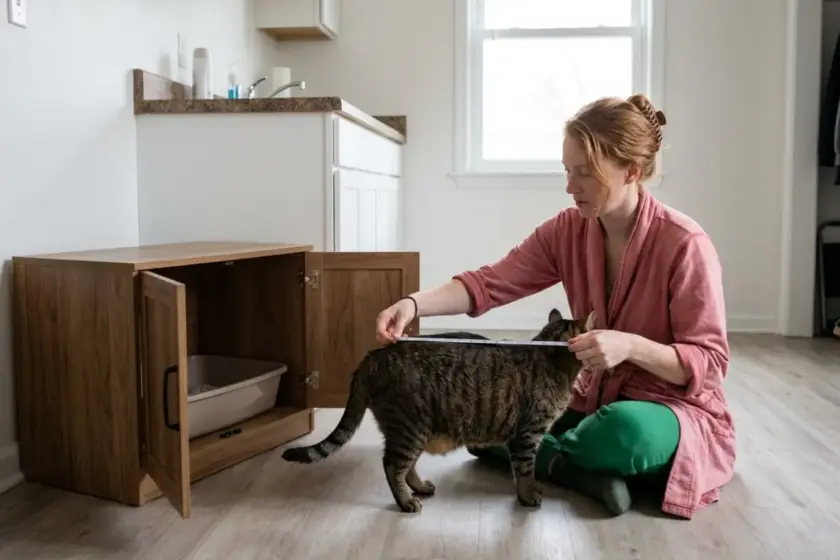
- Interior room decides everything: a box at 1.5x the cat’s body length, plus space to turn around it.
- Ventilation means two openings at different heights, not one cutout beside the door.
- One cabinet is one location. Two cats still need two places, not one cabinet with a divider.
What an Enclosure Actually Changes
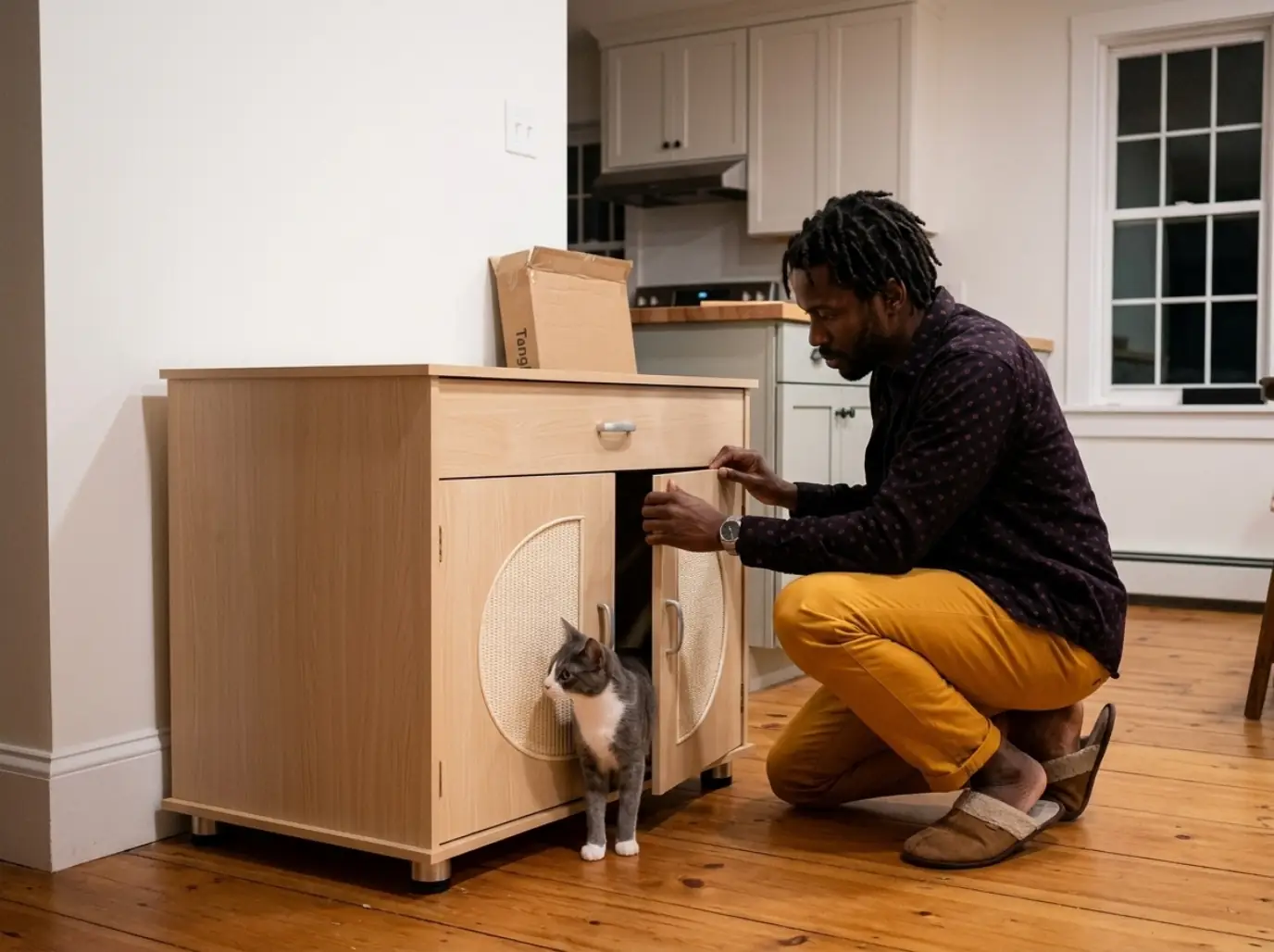
A cabinet does three real jobs and one imaginary one. The three real ones: it takes the box out of your sightline, it catches most of the litter that gets kicked over the rim, and it muffles a mechanical box enough that you stop hearing the rake cycle from the next room. Those are worth money and nobody should pretend otherwise.
They also arrive in a handful of shapes worth naming, because the access method is the part a listing photo hides: a front cutout, a flip-down door, a side entrance, or a top load lid you lift. Each one changes the exit the next section is about, and a top load changes it most of all, because a cat who has to climb out vertically has no sightline at all until his head clears the rim.
The imaginary job is odor control, and the reason it is imaginary is chemistry rather than craftsmanship. Urine and feces produce ammonia at a rate set by how much waste is sitting in the litter and how long it has been there. A wooden box around that process does not slow the reaction. It only decides where the product of the reaction ends up.
So the output stays identical and the distribution changes, which is worse for exactly one resident of your home. You stop smelling it from the couch. Your cat, who puts his face inside the cabinet twice a day, now walks into a small room where a day of ammonia has had nowhere to go. A lid contains smell rather than removing it, and everything in the covered-box research applies here one size up with the volume increased and the opening usually smaller.
There is a free diagnostic for this and it takes one day. Leave the cabinet closed for twenty-four hours after a normal scoop, then open the door and put your face down at the height of the cutout. If the room smelled fine and the inside of that cabinet does not, the furniture is containing odor rather than clearing it. That is not a design opinion, it is a measurement you can run tonight without buying anything.
Run the door test the way the cat runs it. Come home after two hours out, open the cabinet, and put your nose where the cutout is instead of standing over it. Noses stop registering a smell you live in, and walking in from outside is the only free calibration you get. If the room reads clean and the cabinet reads like a cabinet, you have an air path problem, not a scooping problem.
What the cabinet buys you on scooping is nothing at all, and this is the part worth being blunt about before any purchase. Twice a day is twice a day whether the tray sits in the open or behind a magnetic door. If anything the furniture works against the routine, because a door you have to open, a tray you have to slide out, and a scoop that lives in a drawer add friction to a job that only survives on being frictionless.
The cabinet is a decor fix layered on top of a habit. It does not replace the habit.
None of that decides anything until you know whether the box fits, because interior room is the gate everything else hangs on. The box still has to clear one and a half times the cat’s body length, measured nose to tail base, and then the cabinet has to fit that box with turning space left around it. For most adult cats that means an interior at least 24 inches wide and 20 deep for a single box.
Exterior dimensions on a listing tell you whether it fits your wall. They tell you nothing about whether it fits your cat. And on the safety question underneath all of this, whether an enclosure is bad for the cat gets its own answer with the full verdict.
What the Cat Is Doing Inside a Box You Can’t See Into
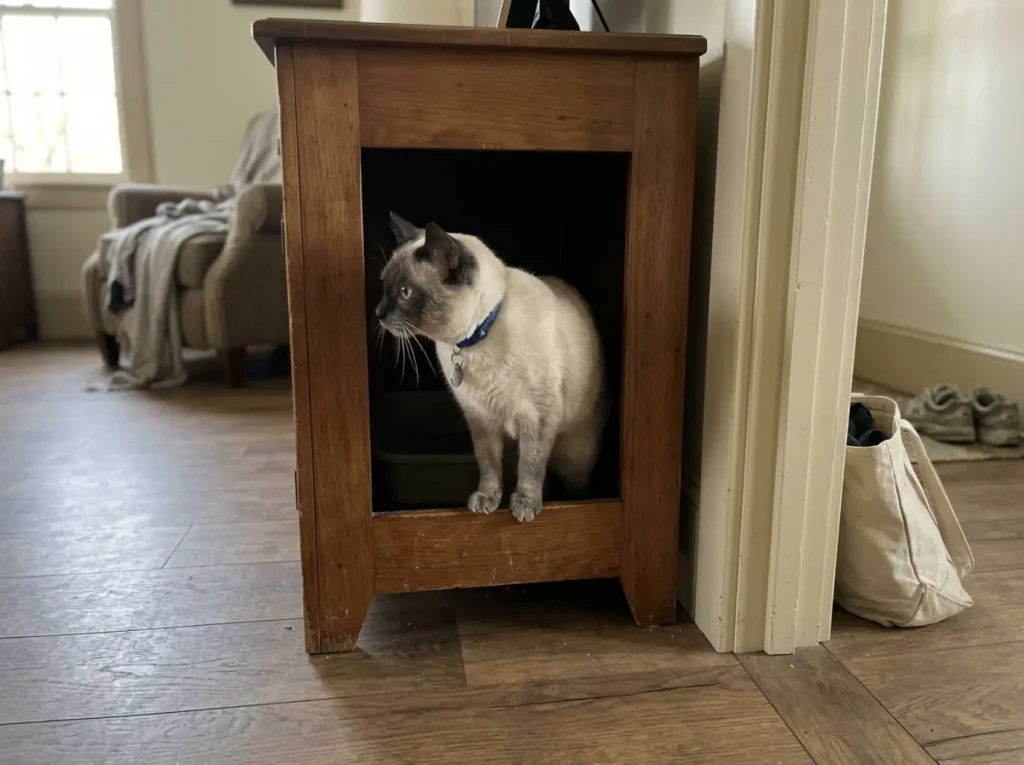
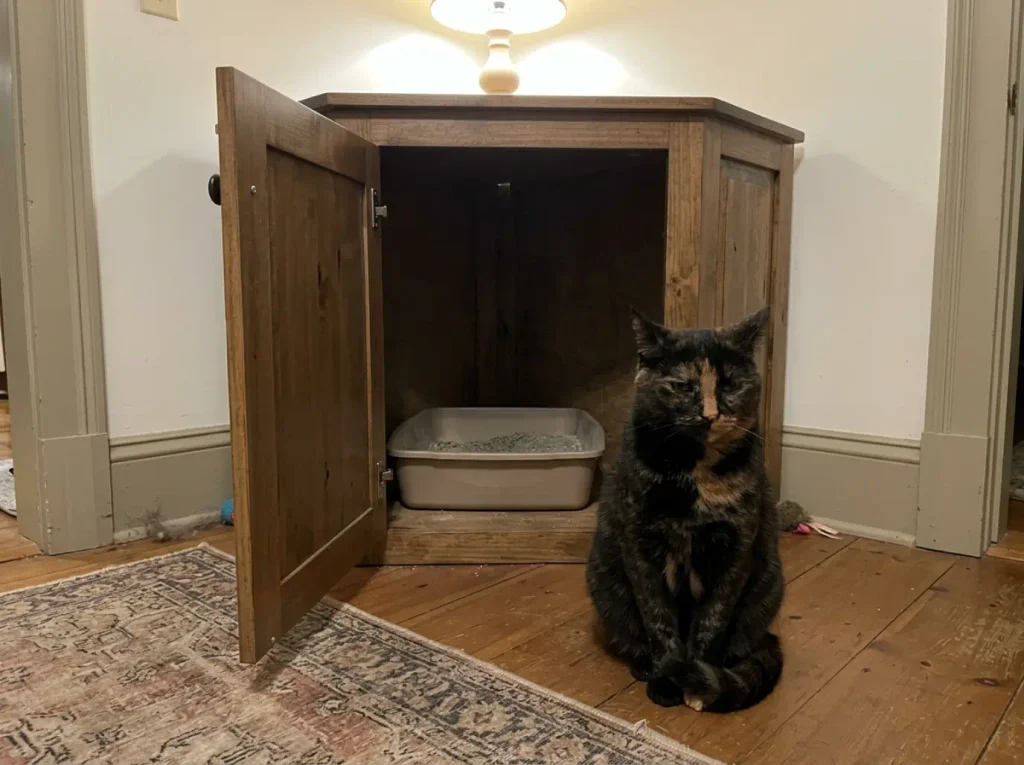
A cat mid-elimination is the least mobile he will be all day. He is squatting, committed, and physically unable to leave in the direction he is facing without a full second of reorganizing himself first. Every piece of litter box behavior that looks fussy comes back to that one fact.
He is not evaluating your furniture. He is evaluating whether he can see what is coming and get out if it does.
One opening means one exit, and a single-exit room is only a shelter until something appears in the doorway. Then it is a corridor with a dead end at the far side. In a single-cat apartment with no dog and no children this may never matter, and plenty of cats use single-entry cabinets happily for years.
In a house with another animal it matters constantly, because the second animal does not have to do anything hostile. Standing in the doorway is enough. The whole point of a second exit is that it gives him an escape route he can see before he needs it, which removes the question entirely.
- Can I see out? Sightline through the opening to the room, from the position he actually squats in.
- Can I get out? More than one route, or one route wide enough to clear at speed.
- Can I turn around? Floor space beyond the tray, not just tray space.
- Does the floor move? A tray that slides or a base that flexes under his weight ends the evaluation.
This is also the honest answer to the question that follows this category around: why don’t vets recommend closed litter boxes. The objection is about design and behavior, not medicine. A closed box gives a vulnerable animal one exit and no sightline, and the cabinet version of that is the same objection with thicker walls.
The numbers from covered boxes apply here one size up, which is why the enclosure is not a gentler version of a hood. It is a stronger one.
The conflict at the center of this whole category is worth naming plainly, because the market never does. You want the box out of sight. He wants to see out. Those are not the same want dressed differently, they are opposite wants, and the listing photos resolve the tension by simply not showing the cat’s point of view.
Every DTC product shot in this category is staged from the doorway of a bright living room. Not one is staged from inside the box looking out, which is the only angle that answers the question you actually have.
When it fails, it fails quietly and it fails in a way that is easy to read as spite. He goes next to the cabinet rather than inside it. That is not a protest. That is a cat who has decided the enclosed spot is not survivable and picked the nearest one that is, which is information you paid for and should use.
One line before we go back to the furniture: a cat who stops using any box, enclosed or open, is a vet visit before he is a furniture problem. Everything below assumes the vet has already cleared him.
Ventilation Is Two Openings, Not One
Every listing in this category says ventilated. Almost none of them says what would make that claim false, which is convenient, because the failing version and the working version look identical in a photograph. Air moves through an enclosure by convection and nothing else.
Warm, ammonia-laden air rises and needs somewhere high to leave from; cool air needs somewhere low to come in. Low intake, high exhaust, on opposite ends of the box.
That is the entire mechanism, and it is why one cutout beside the door ventilates nothing. It lets odor out the same way it lets the cat in. That is not airflow, it is a shared hole.
The reason “just add more air” fails as a fix is that ammonia is adsorbed rather than diluted. It binds to surfaces and to the litter itself, so moving air faster past saturated litter does not carry the ammonia away in proportion. What it does do is lift litter dust off the surface, and the animal breathing that dust is the one standing in the cabinet.
More CFM is not a free upgrade. Passive convection through two openings beats a fan pointed at the problem, every time, and it has no motor to fail.
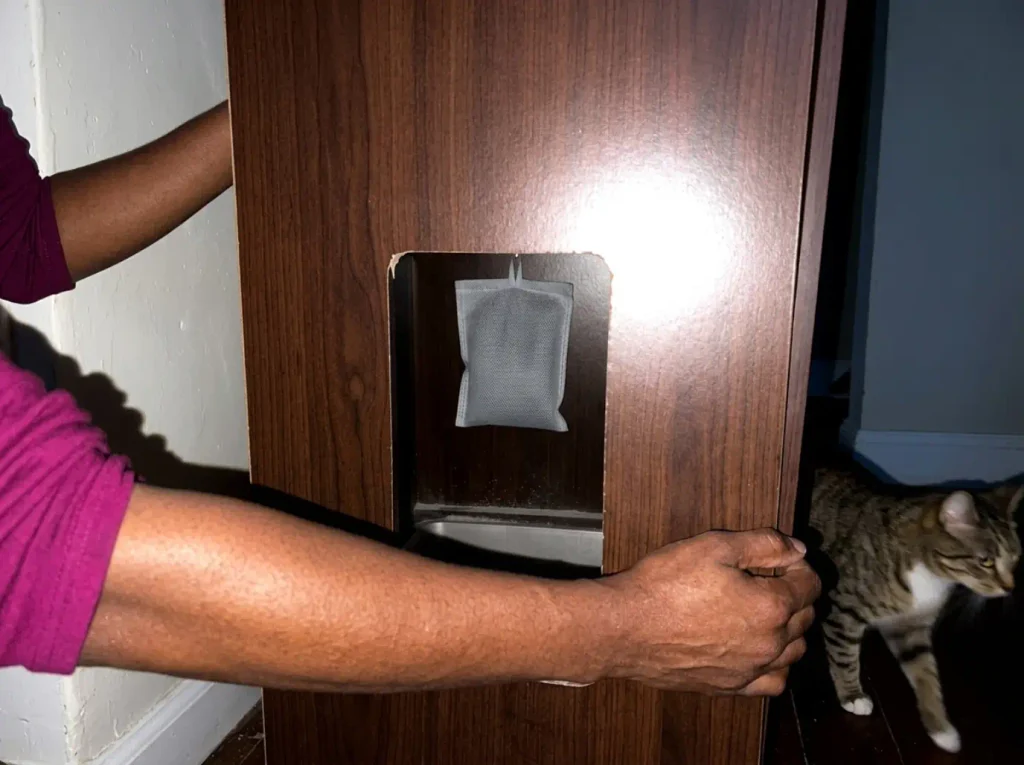
Where a cabinet only has the one door, the honest patch is adsorption rather than airflow, and it should be described as a patch. A pouch of PurifyLogix Activated Charcoal Litter Box Pouches taped inside the cabinet ceiling gives the ammonia something to bind to before it reaches the cat’s nose, and coconut-shell carbon is the version that lasts.
The caveat is built into the same mechanism: carbon needs air moving across it to keep working, so in a truly sealed cabinet it saturates and quietly stops. It buys you time in a bad air path. It does not create an air path.
Two openings at different heights beat one large one, and the cheapest way to create the second one is underneath. If your cabinet only has the cat door, raise the whole unit slightly on furniture risers or feet so air can move under the base and out the back. You have added a low intake without drilling a single hole in a piece of furniture you may want to resell.
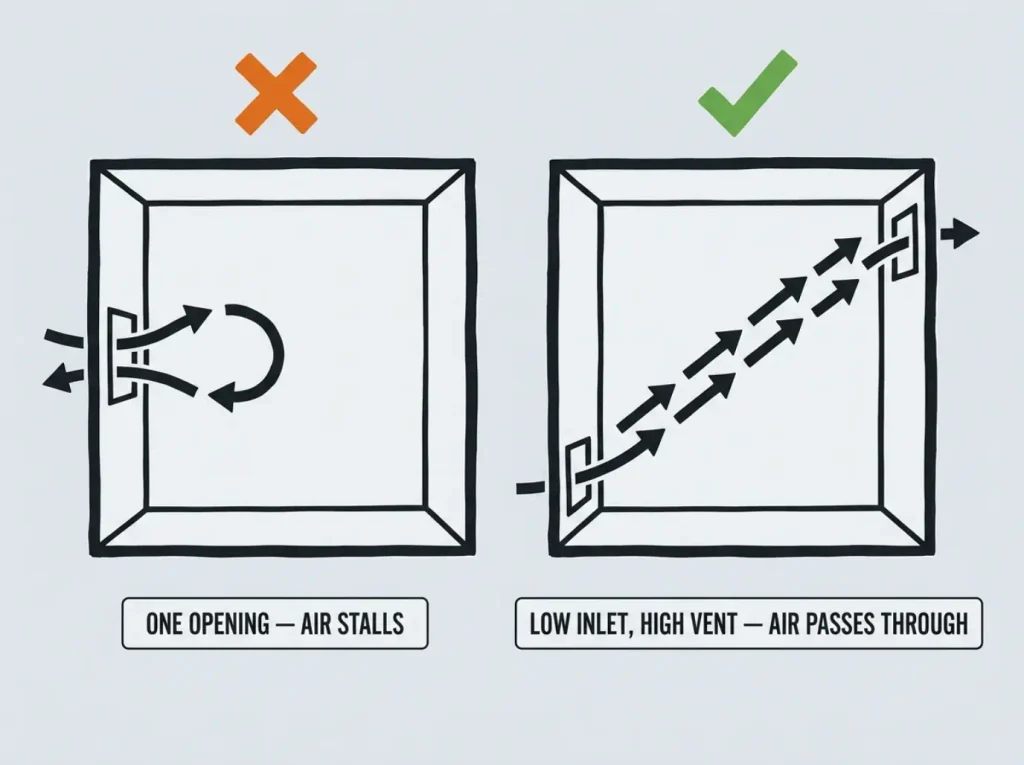
The specific failure to watch for is the two-door cabinet whose only air path is the sisal door panel itself. It photographs as an airy, textured, cat-friendly front and it is one opening, because both doors sit on the same face of the box. Air that comes in through a panel and leaves through the same panel has not passed through anything.
Before spending money on any of this, do the two free things: prop the door open for a day, and pull the cabinet an inch off the wall. Both change the air path and both cost nothing, which is how you find out whether the air path was ever the problem.
And none of this rescues a scooping cadence that has slipped, because ammonia is a clock rather than a threshold. It shows up when urine has been sitting long enough to break down, which is a matter of a day or so and not a matter of a week. If the smell comes back on a schedule you could set a watch by, that is why the smell comes back after you clean and no cabinet on the market has an opinion about it.
One Cabinet Is One Location
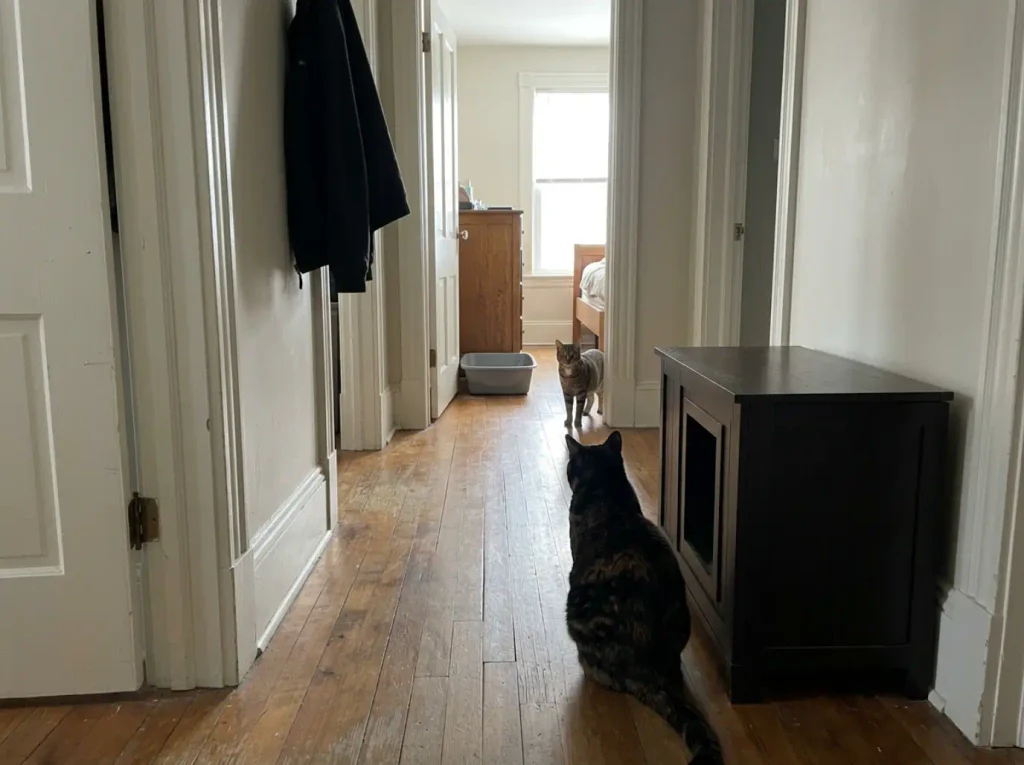
The listings say “for 2 cats.” What they mean is that two trays fit inside, which is a furniture specification wearing the costume of a resource specification. Two cats need three boxes in three places, and the rule counts locations rather than trays. Two boxes side by side inside a single cabinet are one place a cat can be cornered, with one approach, one exit, and one other cat standing in it.
The divider makes it measurably worse rather than better, and this is the part that reverses most people’s intuition. A divider looks like it creates two private rooms. What it actually does is take a compartment that had one exit and split it into two compartments that each have one exit, on the same face, sharing an approach. If the problem you were solving was two cats meeting at the box, the divider has arranged the meeting more efficiently.
The household most likely to walk into this is exactly the household that bought the cabinet for the right reasons. You have a small apartment, you have two cats, you found a wide unit marketed as the two-cat solution, and consolidating two ugly trays into one nice piece of furniture is the whole appeal.
Which is the trouble: the 1+1 litter box rule counts locations, not trays, and box locations are the one thing in a multi-cat home that cannot be consolidated. That is not a design flaw in the cabinet. It is a mismatch between what furniture can do and what the rule is counting.
So the second location goes somewhere else, and in a one-bedroom that usually means a different room rather than a different wall. If a different room genuinely does not exist, a different wall with its own approach and its own sightline beats the same wall, and both beat a divider. The furniture can absolutely be part of the answer. It just cannot be the whole count.
Where the Material Fails, and It’s Always the Same Seam
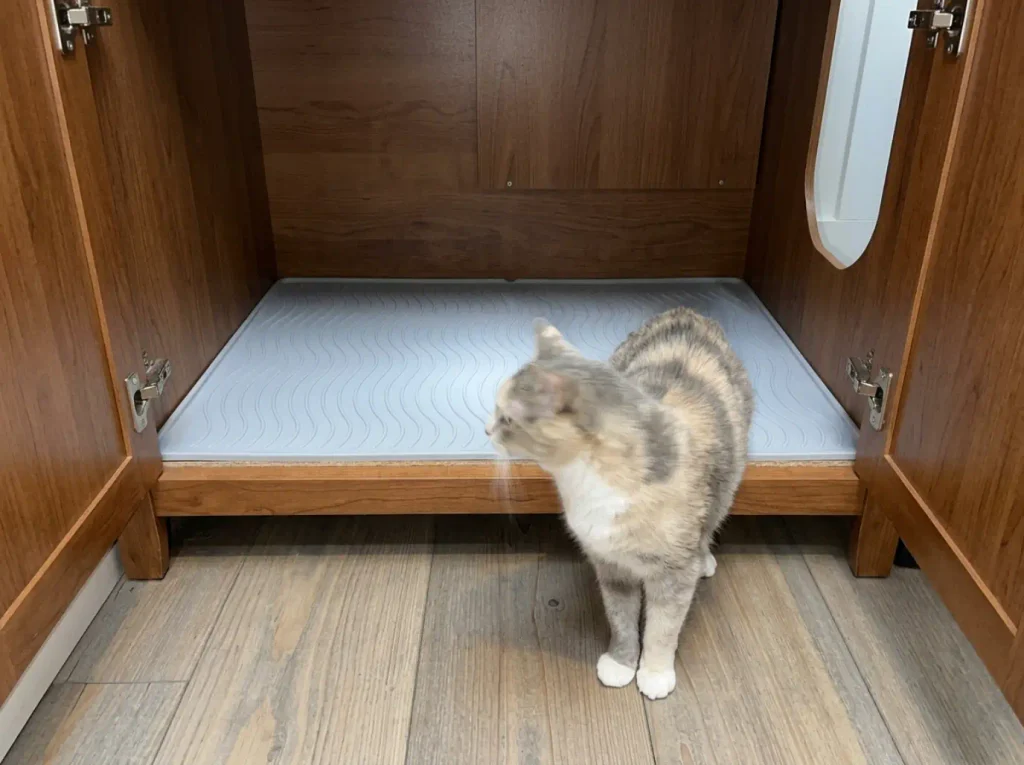
Comparing “solid wood,” “engineered wood,” and “E0-grade MDF” on a spec sheet feels like the responsible way to shop and mostly is not, because none of those bullets tells you where the piece will actually die. MDF and particleboard cabinets do not fail at the laminated front you are looking at in the photo. They fail at the unsealed base seam under the tray, where the interior floor meets the side panel, because that is where liquid pools and sits and wicks into raw board through an edge nobody finished.
What follows is not cosmetic and it is not reversible. Particleboard swells and crumbles once moisture gets past a compromised edge; MDF swells, warps, and then delaminates, the layers separating from each other — and MDF delamination at a base seam is not a repair, it is a replacement. What standing urine does to particleboard over months is documented in enough detail by people who have torn the material out to make the pattern clear, and the exterior finish is irrelevant to it.
Wipeable laminate protects a surface that was never the one at risk. By the time you can smell it, the smell is inside the board rather than on it.
Real protection is two things and neither is on the marketing bullets: a sealed interior floor, and a removable tray under the box that you can carry to a sink. The tray is the part doing the work, because it turns a spill into a thing you rinse rather than a thing that soaks. A waterproof mat under and around that tray is the cheapest interception there is, and the PetFusion ToughGrip Waterproof Cat Litter Mat in the Large size fits the floor of most mid-size cabinets with the edges turned up slightly against the side panels.
Silicone is the right material for this specific job because it holds a puddle instead of passing it through, which also means it needs rinsing rather than shaking out. Cut a cheap plastic boot tray to size first if you want to test the geometry before spending anything. Beyond that, sealing the interior properly is its own job with its own method.
The second failure is the access opening, and it is the one that gets designed in on purpose. A small, tidy, arch-shaped cutout looks intentional in a living room and narrows the exit the previous section argued for. Aim for at least 8 inches wide by 10 tall, more for a large or senior cat, and treat anything under that as decoration rather than a door.
Whatever the exterior claims to be, run a finger along the inside floor at the front seam before you assemble anything else. If it feels like raw board rather than finish, that is where the cabinet will end, and you have found it while the panels are still flat and easy to seal. A removable tray costs a fraction of what the cabinet did.
The premium end of this category is defined by The Refined Feline, whose cabinets are what people picture when they picture furniture that happens to contain a box, and the mid-range is where the tradeoff gets visible. Take a wide double cabinet with sisal panels on both doors: genuine storage, a door surface the cat can legitimately use, and an air path that depends entirely on those two panels facing the same direction.
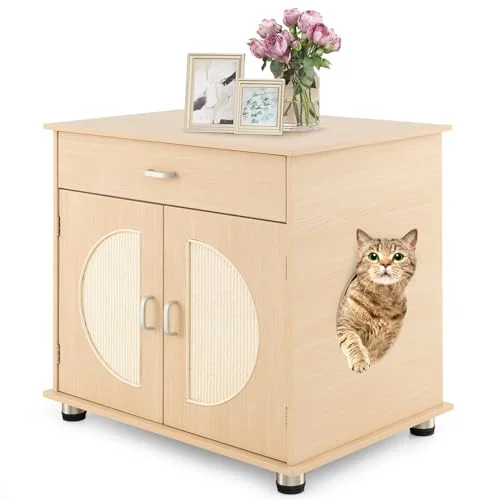
That is the tradeoff in one object, and the shopping comparison that ranks which cabinets hold up without trapping odor against each other belongs in its own article rather than in a pillar. What matters here is that you now know which spec to check first, and it is not the one printed largest.
The Renter Version, and the Small-Apartment Version
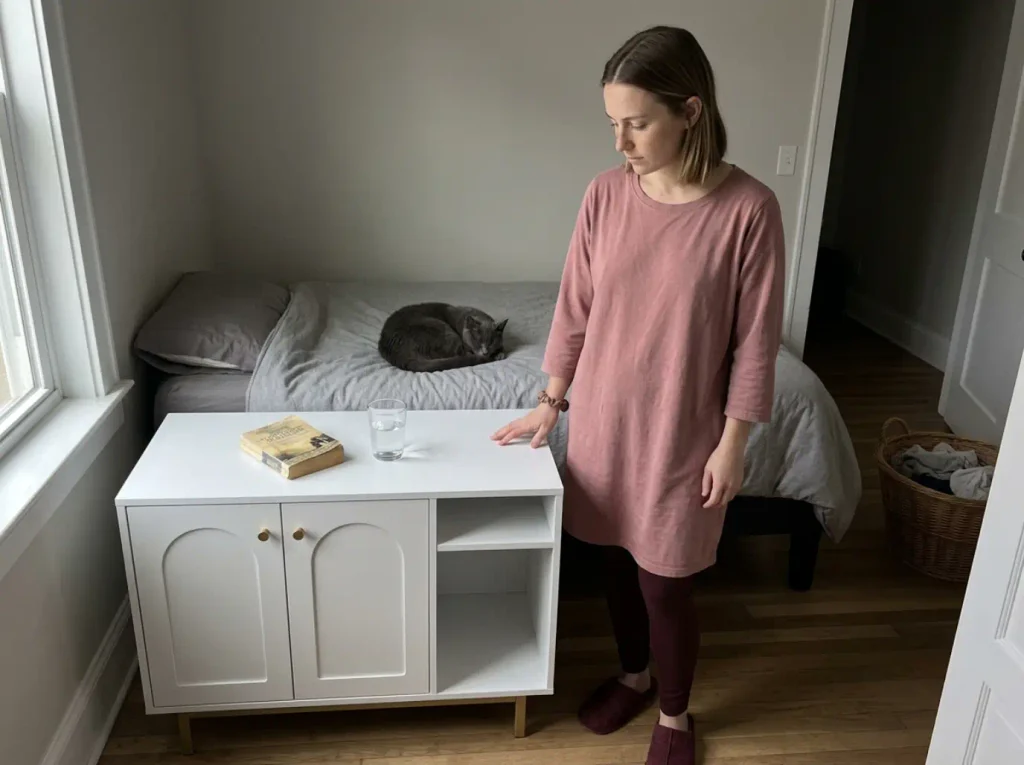
Most placement advice in this category assumes a spare bathroom, a laundry room, or a hallway with a dead corner in it. In a one-bedroom there are maybe three viable spots and two of them are wrong for reasons the cat will explain later. That constraint is where the small-apartment layout that actually works starts, and it is also the strongest honest argument for enclosure furniture, which is not the argument the market makes.
The real case is not concealment. It is that this is the one piece of cat equipment allowed to also be furniture. A nightstand that contains a box is a nightstand you were going to buy anyway; an entry bench that contains a box is storage you needed.
The footprint does two jobs instead of one, and in 500 square feet a doubled footprint is the whole game. Concealment is a side effect of that argument rather than the point of it.
Which sets a bar most listings quietly fail. If the piece has to survive being furniture, the top has to be stable enough to set a lamp on without wobbling, deep enough to be useful, and finished enough that you would not apologize for it. Almost all of it is flat-pack furniture, so budget an evening for assembly and check the panels for square as you go — a cabinet that racks slightly during assembly never sits flush against a wall again. A cabinet that is only pretending to be a side table gets found out in a week, and then you own a box container with a plant on top.
At the compact end, the Hzuaneri Cat Litter Box Enclosure with Storage is the version built for exactly this constraint: mid-size footprint, a wide sisal door, and no fixed interior divider, which means you place the box where the clearance works instead of where the manufacturer decided a compartment should be. The limitation is the same one the divider question exposes — it is a single-cat piece, and calling it a two-cat solution because two trays would technically fit is the mistake this article has already argued against.
Stability turns into a real safety question once the piece gets tall. A narrow, tall cabinet with a cat who jumps on top has a tip-over profile, and the CPSC’s guidance on anchoring freestanding furniture is worth reading if there are children in the apartment. Low and wide usually does not need it, which is what makes the format quietly renter-friendly cat furniture: no-drill by default.
Tall and narrow does, and a furniture strap into a stud leaves two small holes that fill with a dab of putty, which is a deposit conversation rather than a lease violation in most rentals. Check the actual wording of your lease rather than what the internet says your lease probably says.
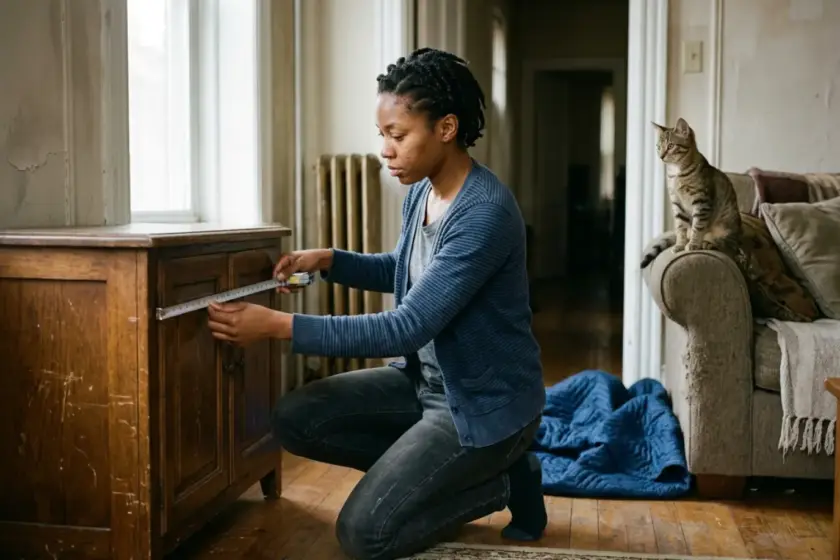
If the only free wall in the apartment is the one everybody walks past, the cabinet is not the fix. A single-exit box in a corridor is the worst version of both problems at once, and the cat will tell you within a week by going beside it. Measure the second-best wall before you measure the free one.
And here is where the anti-sell has to be honest, because it is the recommendation the whole category is built to avoid making. If the room genuinely will not take a cabinet, the answer is not a smaller cabinet. A shrunken enclosure fails on interior room, fails on the exit opening, and fails on air path all at once, which is three failures bought at the price of one solved sightline.
An open box in a better place beats a tiny enclosure in a worse one, every time. If a piece that fits does exist for your room, the hidden furniture picks for small apartments are sorted by footprint rather than by looks.
Placing It So It Reads as Furniture
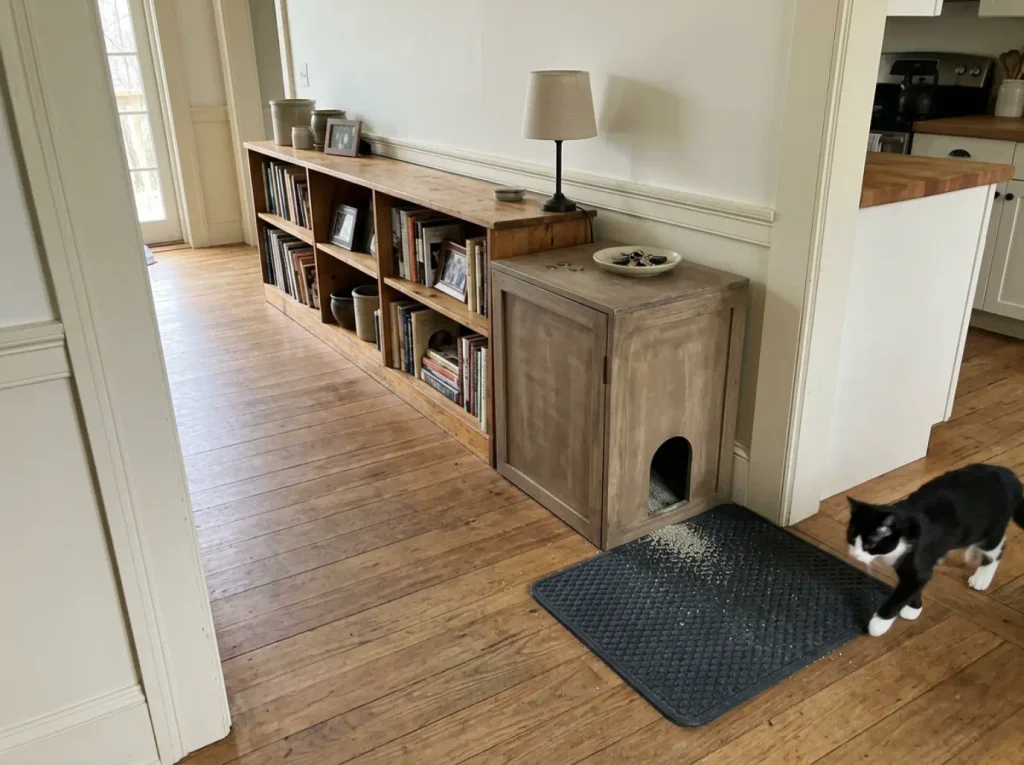
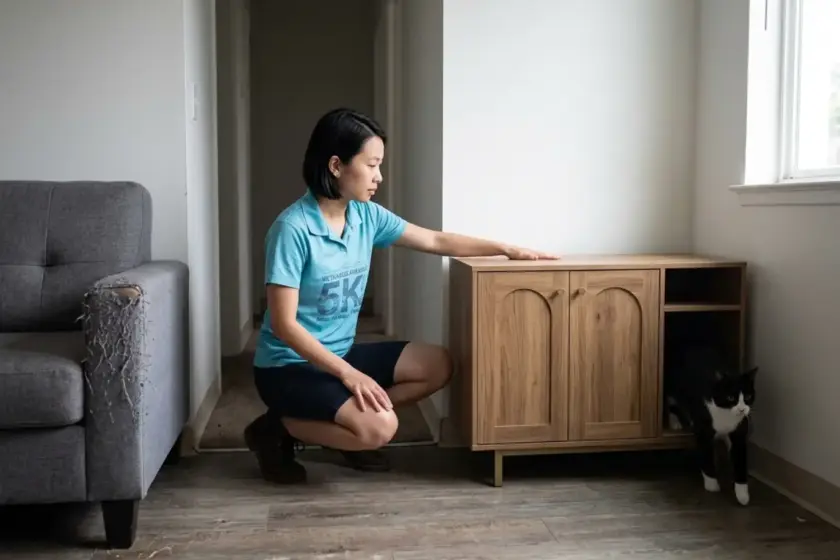
The cabinet is assembled and it is in the corner of the living room looking exactly like a cabinet with a cat hole in it. This is the part nobody warns you about, and it has almost nothing to do with the piece itself. Furniture reads as deliberate when it lines up with something: a wall run, the edge of a doorway, the height of the sofa arm beside it. Floating in the middle of a blank wall with a foot of air on either side, the same cabinet reads as an object that was put there for a reason, and the reason is visible from the front.
The other half of the illusion is what sits on top. An empty flat surface at knee height announces that the surface is not the point, which draws the eye straight to the cutout. A lamp, a plant, a bowl for keys, a stack of books: any of it converts the piece from a container into a table that stores something. This is the cheapest thing in the entire article and the one that changes the most about how the room feels.
Put something on top the day it arrives, before the room has a chance to establish what the piece is. An empty top reads as box container; a used one reads as furniture, and after a week nobody who visits will look at it twice. Skip this and you will spend six months noticing the cabinet every time you sit down.
What breaks the illusion faster than bad placement is the litter halo. Tracking changes character once the box lives in furniture: it is no longer scatter around a tray, it is a concentrated trail leaving one cutout in one direction, because every exit follows the same path. That is a tracking problem with a known fix, and the mat goes two steps from the exit on the line the cat actually walks rather than tucked under the cabinet where it catches nothing.
Then check it at three weeks, and check three specific things. Is the air path still clear, or has the cabinet drifted back against the wall. Is the underside of the tray still dry. And is the cat going in, or beside.
The last one is the only verdict that matters, and it arrives quietly. The cabinets that get abandoned are almost never the ones the cat rejected. They are the ones that made scooping harder, so the routine slipped, so the box got worse, so the cat left. If the door fights you every morning, the door wins eventually.
Whether a piece survives that first month depends mostly on where the enclosure goes so it looks deliberate, and if nothing on the market fits your room and your cat at once, building one that ventilates properly is a weekend rather than a career.
What to Do With All of This
An enclosure is a sightline fix and a containment fix, and both are legitimate reasons to own one. Scooping is still the odor fix, and there is nothing on any spec sheet that changes that.
Two openings at different heights, an interior that clears the box at 1.5x the cat’s body length with turning room around it, and an exit he can see through. Everything else on the listing is furniture rather than function, and you can shop the whole category on those three numbers.
One cabinet is one location. If there are two cats in the apartment, the furniture does not change the count, and no divider ever will.
Check back in three weeks, because that is how long it takes for a cat to deliver a verdict and for a new routine to start slipping. Look at whether the cabinet still sits off the wall, whether the tray is dry underneath, and whether the cabinet smells worse than the room with the door shut.
Before any of it, prop the door open for a day and put your face where his face goes. If that alone fixes the smell, the problem was always the air path, and you just learned it for free.
Amazon’s Audible — free for 30 days
Your cat won’t let you read. Let someone read to you.
Audible is Amazon’s audiobook library — thousands of titles, read out loud, on your phone. Free for a month, plus one audiobook to keep forever.
Frequently Asked Questions
01Are litter box enclosures bad for cats?
Not by design, by execution. An enclosure that clears the interior room, gives the cat a sightline out and moves air through two openings is fine. The version cats refuse is the one that narrows the exit and traps air.
02Why do vets not recommend closed litter boxes?
The objection is behavioral rather than medical. A cat eliminating cannot move fast, so he wants to see what is coming, and a closed box gives him a single exit. It is a design objection, and it applies more strongly to a cabinet than to a lid.
03Do litter box enclosures help with smell?
They contain odor rather than remove it. The ammonia is produced at the same rate either way, and the cabinet concentrates it where the cat’s face goes unless two openings at different heights let air pass through.
04What size should a litter box enclosure be?
Work backwards from the cat. The box needs about 1.5 times his nose-to-tail-base length, and the cabinet needs that plus room to turn around it, which usually means at least 24 inches of interior width. Enough to slide the tray in is not enough.
05Can two cats share one litter box enclosure?
Two trays inside one cabinet is still one location, and a divider removes the second exit from each side. Two cats want two separate places, which usually means two pieces of furniture or one cabinet plus an open box in another room.
Leave a comment