Automatic Cat Feeders and Who Ends Up Regretting One
Don't buy an automatic cat feeder until you know which of 4 problems you have (two are schedule fixes) + what actually breaks at month 6-24.

Alfredo RamsesFounder · September 15, 2026 · 25 min read

On this page9 sections
- 1What People Are Actually Trying to Fix
- 2The Five Kinds of Feeder, and What Each One Actually Does
- 3Where These Break, and It Is Not in Week One
- 4Two Cats Change the Answer Completely
- 5Wet Food, and Why It Is a Different Machine
- 6Where It Goes, and What That Costs You in a Small Apartment
- 7Keeping It Working, and When to Go Back to a Bowl
- 8The Short Version
- 9Frequently Asked Questions
Nobody wakes up wanting a machine on the kitchen floor. They wake up at five in the morning with a cat standing on their sternum, or they get home at eight and the bowl has been empty since noon, or the vet says the word “weight” and doesn’t say much after it.
Those are four different problems that all end at the same search box, and only two of them actually need hardware. Automatic cat feeders are reviewed everywhere by people who have owned one for eleven days, which is why the failures that matter, the ones that show up somewhere between month six and month twenty-four, never make it into a buying guide. This is the version that starts one step earlier: which of the four problems you have, what each of the five feeder types actually does, where they break, and what the free fix looks like when there is one.
Quick Answer
Before you compare a single model, work out which of these you are looking at.
- A scheduled feeder fixes a portion problem, not a food problem. If the bowl is always full, that is the thing making the cat round.
- Gravity feeders refill on demand and fix nothing about portions. They fix running out.
- Anything with a motor, a hopper and an app has a failure window at six to twenty-four months. The glowing reviews were written in week one.
- Two cats change the answer completely. Without selective access, the faster cat eats both meals.
What People Are Actually Trying to Fix
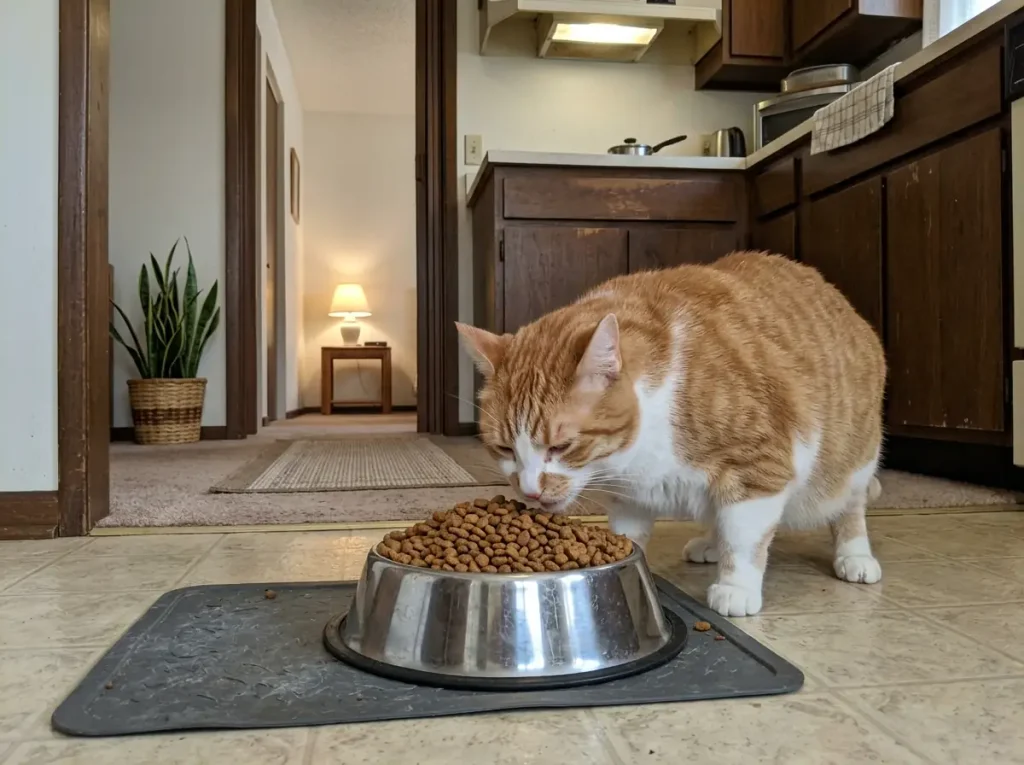
There are four reasons someone starts shopping for a feeder, and they get treated as one reason by every page that ranks for this. They are not one reason. Three of them have answers that cost nothing, and one of them genuinely needs a machine.
The first is free-feeding weight.
The bowl gets topped up whenever it looks low, the cat grazes twenty times a day, and over two years that turns into a cat who no longer grooms his own back end. Cornell’s Feline Health Center is blunt about the pattern: cats left free feeding on dry food all day end up heavier than cats on a meal schedule of two or three measured servings, and obesity is the most common nutritional disorder in American house cats. Read that carefully, because the useful part is what it does not say. It does not say you need a device.
The schedule is the fix. The device is optional. In a single cat household, a measuring cup and a phone alarm delivers exactly the same intervention as the most expensive hopper on the shelf, and it does it without an app. If the grazing is the problem, it is worth looking at what the bowl itself is doing to a cat that grazes all day before you look at what could replace it.
The second is a schedule that misses meals. You leave at seven, you get back at seven, and somewhere in the middle there was supposed to be a lunch that nobody was home to serve. This one is real, it is the honest case for a timer, and a timer solves it whether it costs thirty dollars or three hundred. What you are buying here is punctuality, not intelligence.
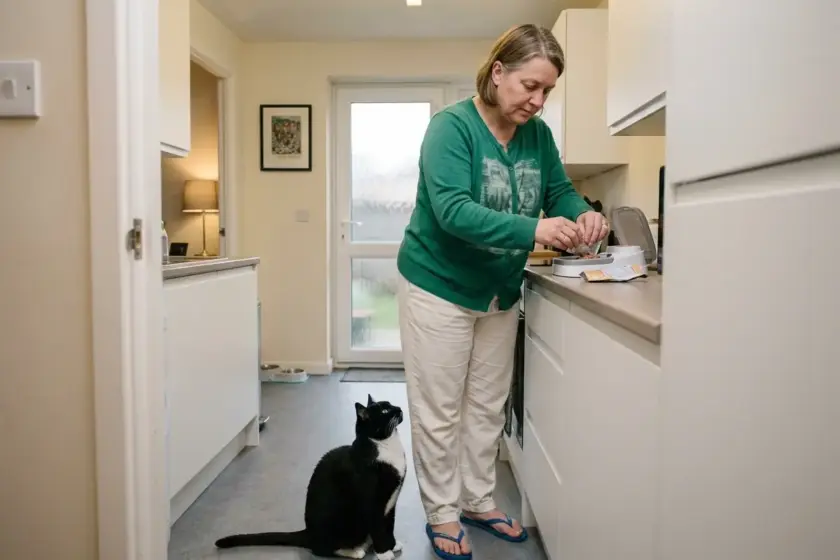
The third is the pre-dawn wake-up, and this is the one people misdiagnose most often. A cat who wakes you at 4:50 is not being difficult.
He has learned, correctly, that you are the thing that makes food happen, and he has worked out the earliest hour at which pressure on your chest produces results. He is not wrong. He is running a very successful system that you built.
The fix is to stop being the trigger, and the way you stop being the trigger is to hand the job to something that runs on a clock instead of on guilt. Owners in the feeder threads describe the same arc over and over: the cat tests the human for a week or two, the human holds, the feeder keeps its word every single morning, and the cat quietly transfers his attention to the machine. What changed was not the cat’s opinion about breakfast. It was who he had to negotiate with.
The fourth is food stealing between cats, and in a multi-cat household that is a resource problem before it is a hardware problem — closer to resource guarding than to anything a spec sheet measures. It belongs to the 1+1 rule and it gets a section of its own further down, because pointing a shared feeder at two cats does not portion-control either of them.
One boundary, and then we go back to the furniture. A cat who suddenly stops eating, or who suddenly starts eating far more than he used to, is a vet question and not a feeder question. That is a call, not a purchase. Everything in this article assumes a cat who eats normally and a human trying to organize when.
Before you buy anything, measure one full day of food into a cup and serve it in two goes, by hand, for three days. If the cat is fine, your problem was the schedule and a timer will fix it. If he is screaming at hour four, your problem is the portion size, and no feeder on earth fixes that.
The Five Kinds of Feeder, and What Each One Actually Does
Every listing says “automatic cat feeder,” and four of those five words are doing a different job depending on which box you are looking at. Sorting them by what they solve rather than by price is the fastest way to stop comparing a bare plastic tower to a microchip reader as though they were competing for the same slot.
| Type | What It Actually Solves | Wet Food? | What Breaks |
|---|---|---|---|
| Gravity | Running out. Nothing else. | No | Nothing. There is nothing in it. |
| Timed dish | A few hours of covered portions | Yes, briefly | The rotation motor and the lid seal |
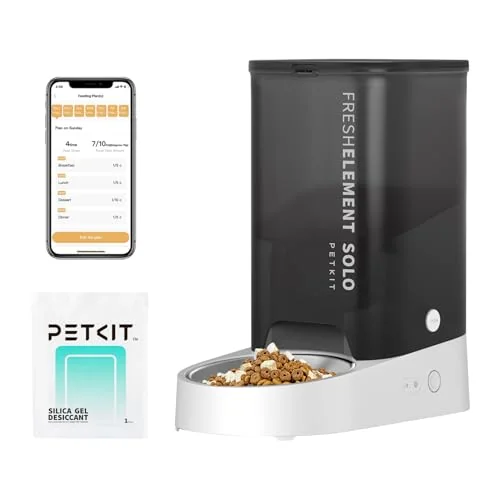
| Programmable hopper | Measured meals on a clock | No | Auger jams, portion drift, motor at 1-2 years |
| App-connected (WiFi) | Changing the schedule from elsewhere | No | All of the above, plus the network |
| Selective access (RFID feeder) | Deciding which cat is allowed to eat | Yes | Lid mechanism, batteries, tag pairing |
Gravity Feeders
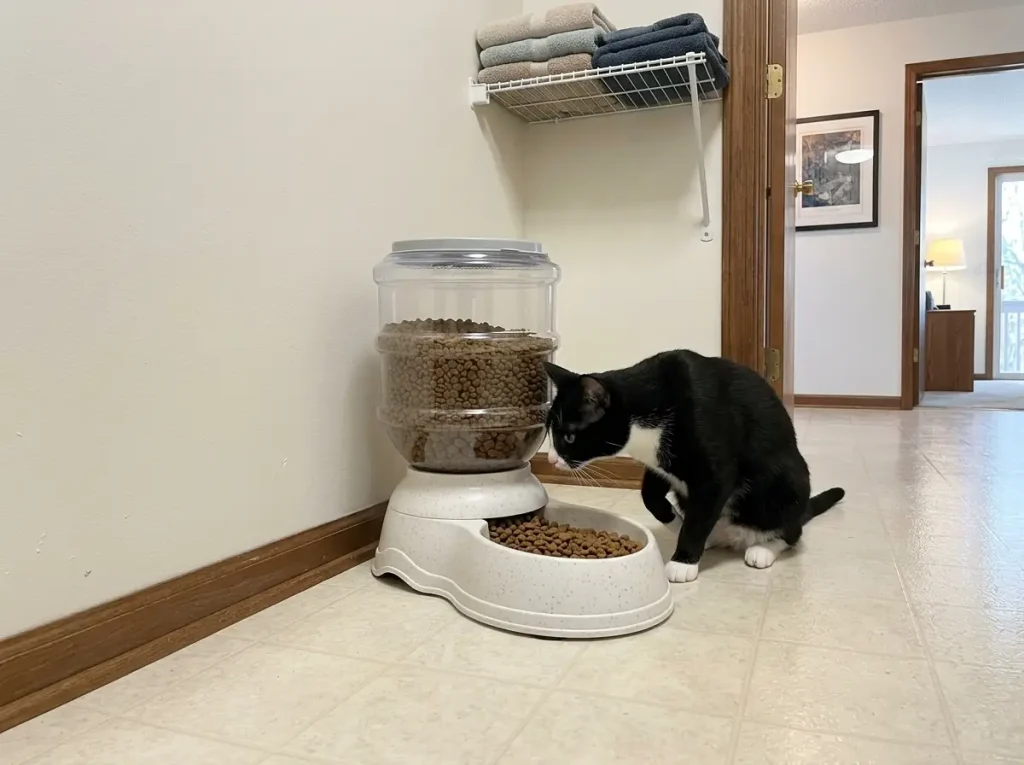
A hopper and a bowl, no electronics, no battery, no schedule. Kibble falls as the cat eats and the bowl stays full until the hopper empties. Which means, and this is the part the product page never phrases this way, a gravity feeder is free-feeding in a taller shape. If the reason you are reading this is a cat who has gotten heavy on an always-full bowl, this category makes that worse, not better.
What it genuinely solves is running out.
You go away Friday and come back Sunday and the bowl was never empty. That is a real problem and this is the honest, cheap answer to it. The Amazon Basics Gravity Pet Food Feeder holds a gallon, which for a single average cat is a long weekend with room to spare, and it has none of the failure modes in the next section because it has no moving parts to have them with. The caveat is the same as the category: it will not portion anything, and a food-motivated cat will simply eat until it stops falling.
Timed Dish Feeders
The dish-style feeder: a flat tray of covered compartments that rotates on a schedule, exposing one at a time. This is the only mainstream type that handles wet food at all, and only for a few hours in a cool room, or a little longer with cooling packs under the tray. Portions are fixed by the size of the compartment, usually five or six of them, so it is a good machine for “one lunch while I am at work” and a bad machine for “I am gone until Wednesday.”
Programmable Hopper Feeders
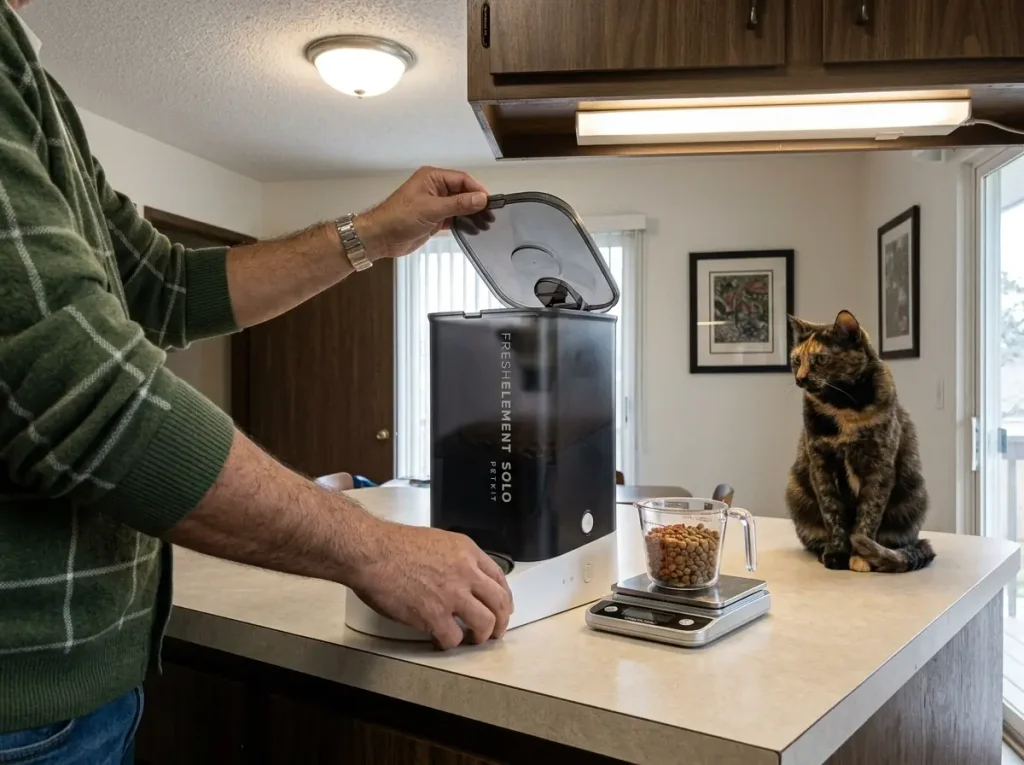
The mainstream shape: a vertical dry-food hopper, an auger that turns to move kibble down a chute, and a schedule you set with buttons on the unit. Hopper capacity across this category runs from roughly a cup and a half to thirty-two cups, and the number is close to meaningless until you translate it. Do that arithmetic in days for your cat, not in cups. A cat eating a third of a cup twice a day empties a six-cup hopper in about nine days, and most people looking at “six cups” assume considerably longer than that.
Portions are set in fixed increments, typically an eighth of a cup or about ten grams. Your cat’s actual daily intake does not necessarily divide evenly into those increments, and the rounding you do to make it fit is where portion drift starts long before any mechanical part wears out.
App-Connected (WiFi) Feeders
The smart feeder, or wifi feeder, is the same food dispenser as above with a radio in it. Be precise about what the app buys you, because the marketing is not: it buys you the ability to change the schedule from somewhere that isn’t your kitchen, and a notification when the hopper runs low. That is genuinely useful if you travel.
What it does not buy you is a more reliable auger, and it adds wifi connectivity issues and sensor failure to the list of things that can go wrong. The mechanical part that jams is identical, and you have added a network dependency on top of it. The same trade-off shows up with water fountains: more electronics in the room, more things that can quietly stop working while you are not looking.
Selective-Access (Microchip and RFID) Feeders
A sealed bowl with a lid that opens for one specific cat and stays shut for everyone else.
It reads the microchip already implanted between your cat’s shoulder blades, or a small tag clipped to a collar if the chip is not compatible. According to the Cat Fanciers’ Association, a chipped cat often does not need the collar tag at all, which is worth checking before you buy a second thing you don’t need.
This is the only category in the list with no manual substitute, because the thing it does is make a decision while you are out of the room. Everything else here is a clock with a hopper attached. Gravity is the cheapest and least capable, RFID is the most expensive and the only irreplaceable one, and the three in the middle are largely the same machine at different prices.
Where These Break, and It Is Not in Week One
Every five-star review of a feeder was written by somebody who has owned it for eleven days, and every one-star review is dated about a year later. The one-star reviews say the same four things with unnerving consistency, and none of the four appear in a single “best of” list, because they are not specifications you can put in a comparison table.
The Auger Jam That Dumps Four Meals at Once
Kibble wedges in the narrow dispensing channel, the motor keeps turning against the blockage, and when it clears it delivers everything that was queued behind it. Owners call it a chute jam, and it is the single most common mechanical failure across brands regardless of price. The reason it matters more than a missed meal is what it undoes: you bought this machine to stop a cat overeating, and its characteristic failure mode is serving four meals in one go to a cat who will absolutely eat all four. For a cat prone to gulping, that is a worse afternoon than a skipped lunch.
Kibble shape drives this more than anything else. Small round pieces flow. A fast eater makes this worse rather than better, because nothing in a hopper feeder does the slow feed job a puzzle bowl does. Large flat triangular pieces bridge across the opening and hold each other up, and if you switch food brands without thinking about it you can turn a feeder that worked for a year into one that jams weekly.
Portion Drift
The unit dispenses slightly less than the setting says. Not dramatically, not visibly, just a few grams short, meal after meal, as the auger wears.
Nobody catches it in week one because the difference is invisible in a bowl. People catch it about four months in, when the cat starts complaining an hour before dinner or a bag of food lasts noticeably longer than the last one did. The app has no idea. The app reports what it asked for.
The WiFi Lockout
This one is not user error, and the proof is that manufacturers publish standing troubleshooting pages for it. Petlibro alone maintains separate “cannot connect to WiFi or app” articles for at least four different feeder models, which is not what a company does about a rare, random glitch. Units fail to pair on first setup, or lose their network permanently after months of working fine, and the recovery lives in router settings that nobody expects to open on behalf of a pet feeder.
Before you assume the unit is dead and start a return, there is a ladder that works often enough to be worth the ten minutes: power-cycle the feeder, remove it from the app and re-add it, power-cycle the router, then go into your phone’s saved networks and forget the feeder’s own setup hotspot. That last one is the sneaky one. The feeder creates its own temporary network during setup, your phone remembers it, and then your phone keeps silently reconnecting to a hotspot that has no internet on it, which breaks app control in a way that looks exactly like a broken feeder. Factory reset is the last rung, not the first.
The Motor at One to Two Years
The honest lifespan of the moving part, based on what owners report rather than what warranties promise, sits somewhere between one and two years. That is well past the return window and well short of what a three-figure price tag implies. And the app connectivity usually goes before the hardware does, which produces the odd situation of a feeder that still feeds your cat perfectly on its last saved schedule while telling you nothing at all.
Which brings up the feature that matters more than anything on the spec sheet. A backup battery is the difference between a power outage while you were at work and “the cat did not eat today.” Dual-power units typically hold twelve to twenty-four hours on backup; battery-only units run about thirty days on a set of cells. On an old apartment circuit with a space heater on the same breaker, that is not a hypothetical scenario, that is a Tuesday.
None of this means a feeder is a bad idea. It means the failure profile is an argument for buying the simplest machine that solves the problem you actually have, because every feature you add is one more thing that can stop working in month fourteen.
The same question is worth asking about a self-cleaning litter box: who genuinely needs the automation, and who is buying a second problem to manage. And to be clear about proportion, a cat missing one meal is an inconvenience. A cat who will not eat for a day is a call to the vet, and that is true with a machine or without one.
Once a month, catch one scheduled meal in a cup and weigh it against what the setting says it should be. That is the whole portion-drift check, it takes a minute, and it is the only way you find out before the cat does. Put it on the same day you pay a bill so you don’t have to remember it.
Two Cats Change the Answer Completely
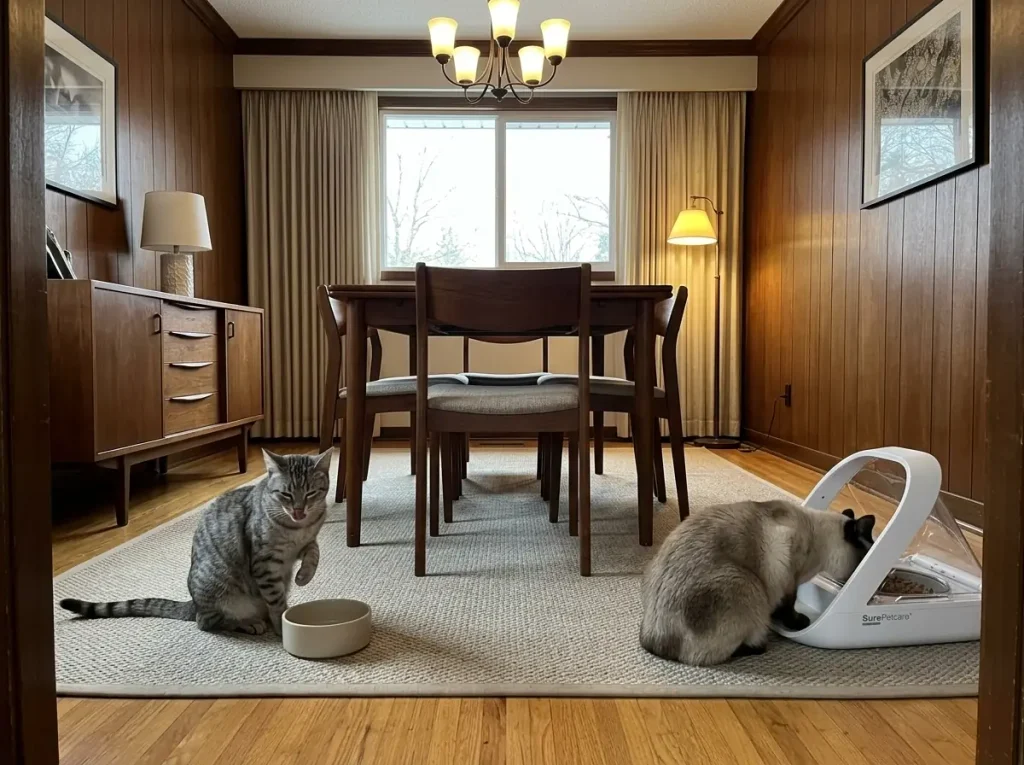
One cat and a feeder is a schedule. Two cats and one feeder is a race, and the faster cat wins it twice a day, every day, until one of them is round and the other is thin and you cannot work out why the food is disappearing so fast.
Here is the thing that gets skipped in every roundup: a shared feeder does not portion-control anybody. It portions the household. It puts an exact, measured amount of food into a bowl and then the cats divide it however their own politics dictate, which is almost never fifty-fifty. You have bought precision and handed it straight to a negotiation you are not present for.
The 1+1 Rule, Applied to Food
Start free, because free works more often than the internet lets on. One feeding station per cat plus one spare, spaced far enough apart that neither cat can watch the other eat.
Not “in the same room a few feet apart.” Out of line of sight, which usually means different rooms or at minimum opposite ends of one room with something solid between them. The reasoning is the same one behind two cats, two bowls, plus one: a cat who can see another cat eating is a cat who is eating fast, and a cat who eats fast finishes early and goes to see what is left in the other bowl.
In a small apartment this gets harder, not impossible. Opposite ends of the same room with a visual break in the middle, a sofa back, a shelf unit, the corner of a kitchen island, does most of the work. What you are buying with that spacing is time: enough seconds for the slower cat to get through his own food before the fast one arrives.
The other free version is feeding at the same time in separate rooms, supervised, and picking the bowls up after fifteen minutes. It works reliably. It also requires you to be home at both mealtimes, which is very often the exact thing the reader does not have, and that is where the free options run out.
When Spacing Is Not Enough
A food-motivated cat will cross an apartment. He will finish his portion in ninety seconds, walk the length of the place, and stand next to his housemate until the housemate gives up the bowl, and no amount of furniture between them changes that. This is the one case in this whole article with no free substitute, because the problem is not timing or geometry. It is that a decision has to be made about which cat while nobody is home to make it.
The Sure Petcare SureFeed Microchip Pet Feeder Connect holds one cat’s bowl behind a lid that reads the implanted microchip, or the RFID collar tag it comes with if the chip is not compatible, and stays closed for anyone else. It is the most expensive category here and it earns that in the one household it is built for.
Two caveats worth knowing before you commit. It holds a bowl, it does not dispense from a hopper, so you are still the one putting food in it. And a determined thief can learn to wait by the lid and dart in while it is open, which means the spacing advice above does not become irrelevant once you buy one, it becomes the thing that makes it work.
The Prescription-Diet Case
When one cat is on a specific diet and the other must not touch it, selective access stops being a convenience and starts being the point. This is the household where the free version genuinely is not sufficient, because “mostly” is not a useful standard when the food itself is the treatment. What is on the plate in that case is between you and your vet. What keeps the wrong cat out of it is hardware, and this is the hardware.
A dog in the house is a different access problem with the same solution, and feeding station height and placement does most of the work there before any electronics are involved.
Wet Food, and Why It Is a Different Machine
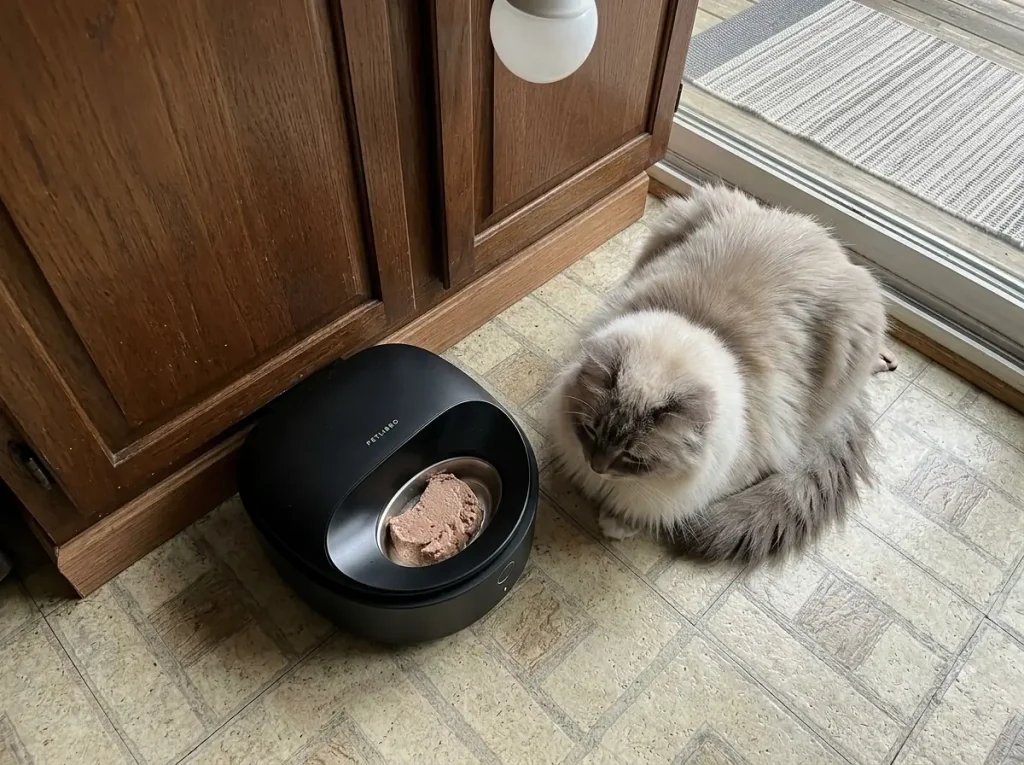
The listing says automatic cat feeder. The cat eats pâté. Those two facts are not compatible, and most people find that out with the box already open and the packaging in the recycling.
A vertical hopper moves dry kibble down a chute with a turning auger. That mechanism physically cannot move wet food. Not with a different setting, not with a firmware update, not with a mode you failed to find in the manual. This is a hardware category question and it has exactly two answers.
The first is a timed dish feeder, the rotating tray with covered compartments. It buys you hours, not days. With a frozen gel pack underneath and a genuinely cool room you can stretch that, cautiously, but the honest planning number is a single meal ahead rather than a weekend.
The second is a refrigerated dish feeder, which uses semiconductor cooling rather than ice packs and holds roughly three meals across about three days. The PETLIBRO Polar Automatic Wet Food Feeder is the clearest example of the category: three wet portions, a stainless steel bowl, no gel packs to freeze and swap. It is a small, specialized category with no cheap equivalent, which is worth saying plainly, and it is the proof of the point rather than an upsell. Wet food needs a different machine, not a different setting.
Bowl material matters more here than it does anywhere else in this article. Wet food leaves residue, plastic holds onto it in the fine scratches that develop with use, and a plastic bowl that gets a rinse rather than a wash starts to smell in a way a steel one does not. That is a hygiene attribute rather than a preference, and the full comparison of steel against plastic, and what each one does to leftovers belongs to the bowls side of this room.
And here is the answer for the most common situation of all, which is a cat who eats wet in the morning and dry for the rest of the day. Do not buy a wet-food machine for that. Buy a dry feeder for the daytime meals and keep being the person who serves breakfast. It is cheaper, it is more reliable, and it keeps one interaction a day between you and a cat who quite likes the arrangement.
Where It Goes, and What That Costs You in a Small Apartment
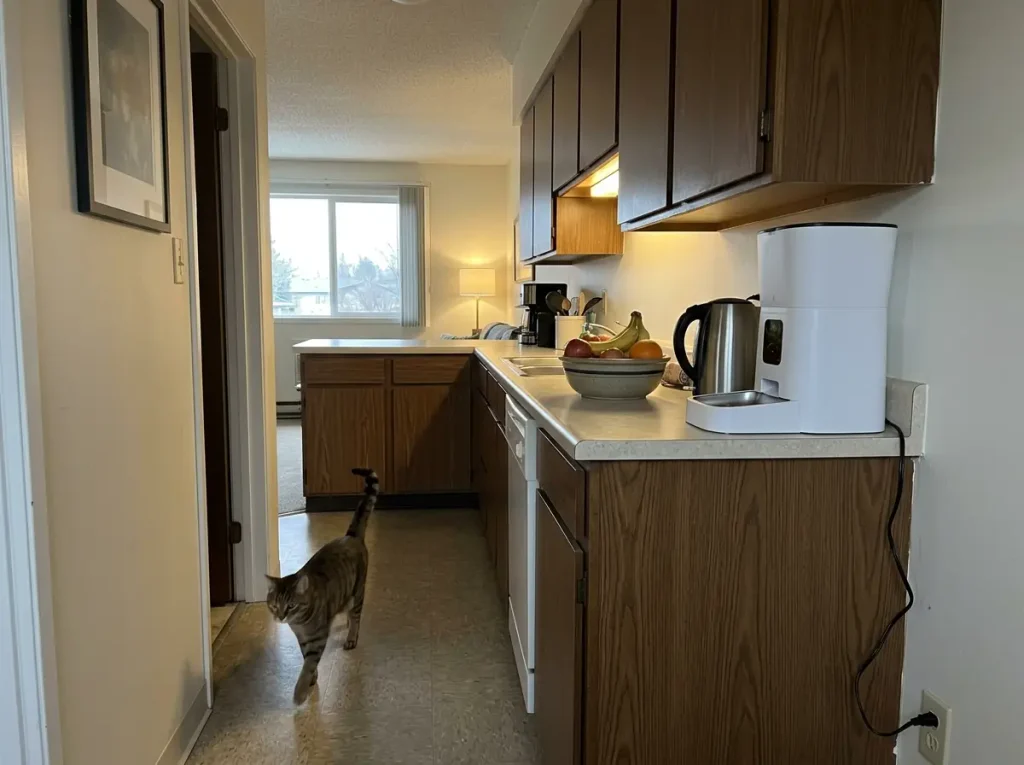
Reviews measure hopper capacity to the cup. Nobody measures what the thing does to a galley kitchen counter that already has a kettle, a dish rack and precisely two outlets, one of which is behind the microwave.
Counter, Floor or Neither
The cat wants it on the floor. That is where cats eat, that is where his head is comfortable, and a feeder on a counter means a cat who has to jump onto a counter to eat, which is a habit you will regret teaching him for reasons that have nothing to do with food. In an apartment kitchen where counter space is already spoken for, that is worth knowing before you buy.
Counter placement exists to solve a different problem: a dog who will eat cat food, or a toddler who will investigate a hopper. If neither of those lives with you, give the cat the point. He is right about this one.
The compromise that fails is the middle shelf of a wobbly unit, because a feeder needs to be stable enough that a cat leaning on it does not shift it, and heavy enough not to walk across the floor when a determined animal starts pawing at the chute.
The Outlet Problem in a Rental
A plug-in feeder needs power near the food, and rental kitchens were not laid out with that in mind. You cannot drill, you should not run an extension along a baseboard where a cat will treat it as a toy, and the outlet you do have is usually already occupied. The cord question is the same one a fountain raises, and it has the same short list of answers: get the cable behind furniture, get it up off the floor, or remove it from the equation entirely.
Removing it entirely is what battery-only units are for. They run about a month on a set of cells and they go wherever you want them, which in an older apartment is worth more than any feature on a spec sheet. The trade is that you have to remember to change the batteries, and a dead battery is a silent failure. Set a reminder the same day you set the schedule.
Noise, and Thin Walls
An auger cycling at six in the morning is audible through a bedroom wall in most apartments. It is a short mechanical grind, three or four seconds, and it is exactly the kind of sound that a sleeping brain flags as unfamiliar. Worse, the cat learns it in about two days and starts waiting for it, which means you have replaced a cat who wakes you up with a machine that wakes you both up.
The fix is placement plus scheduling. Put the feeder as far from the bedroom wall as the apartment allows, and set the first meal for a time you were going to be awake for anyway rather than the earliest hour that keeps the cat quiet. Thin apartment walls make noise a specification, not a footnote, and it applies to every powered thing you put on the floor of a small home.
Decide where the feeder goes before you plug it in, and pick a spot you physically walk past twice a day. A machine you have to go and find is a machine you stop cleaning, and an uncleaned hopper is where the caking and the smell start. Convenience is not laziness here. It is the maintenance plan.
Keeping It Working, and When to Go Back to a Bowl
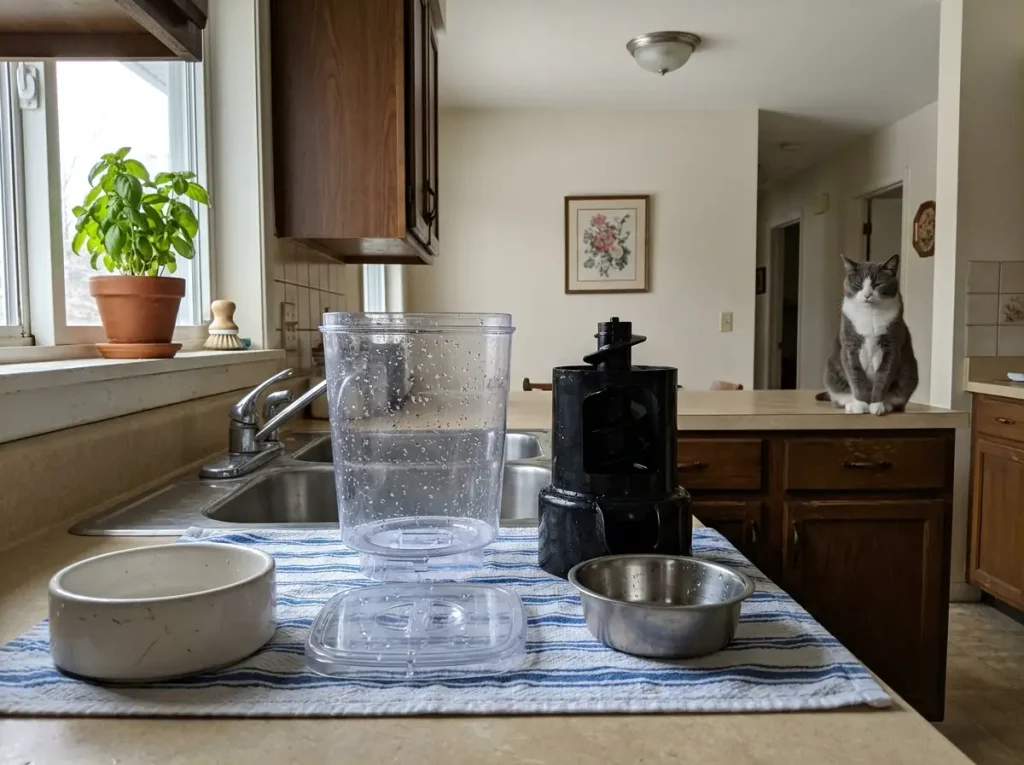
The system that works in week one and the system that works in month eight are not the same system, and the entire difference is what you kept doing.
The Monthly Routine
Four things, once a month, fifteen minutes total.
Empty the hopper completely before refilling it rather than topping it up. Wash the bowl properly rather than tipping the crumbs out. Check the seal and the chute for kibble dust and caking. Weigh one dispensed meal against the setting.
The first one is the mistake almost everybody makes. Topping up a hopper means the kibble at the bottom never leaves, and after six months of that you have food down there that has been sitting since spring, absorbing whatever the kitchen smells like and slowly going stale on top of it. Which is also the argument against buying the largest hopper you can find. A hopper sized for three weeks is a hopper that stales, and dry food is not shelf-stable forever once it is out of the bag and exposed to air every time the auger turns.
Worth budgeting for the ongoing costs too, because the running cost of an automated device is rarely the sticker price: batteries, the occasional replacement bowl, and with some brands a subscription attached to features that used to be free.
The Signs It Is on Its Way Out
Portions that are inconsistent from one meal to the next. A motor that sounds louder or takes longer to complete a cycle than it did. Meals arriving late, or the schedule drifting by a few minutes each week. None of these is dramatic and all of them show up months before the unit actually fails, which gives you time to plan an exit instead of improvising one on a Sunday night.
Going Back to a Bowl Without Undoing the Progress
Keep the original bowl. Not in a cabinet in the basement, in the kitchen, because it is the free fallback for the day the auger jams and a jam is not a scheduled event.
And here is the part that reframes the whole purchase. What you actually gained from the feeder was the schedule, and the schedule survives the machine. If it dies at month fourteen, you have not lost the ground you gained.
The cat is now a cat who eats twice a day at set times, and you go back to serving those meals yourself with a measuring cup, and nothing about his weight or his routine unwinds. The machine was the delivery mechanism, never the intervention. Height changes how comfortably a cat eats at that station too, so if you are setting a plain bowl back down after a year of a floor-standing feeder, elevated bowls are worth a look for some cats and not others.
One last time, and briefly: a cat who was fine on the schedule and suddenly is not is a vet question, not a troubleshooting question. Check the machine, by all means. Then stop checking the machine.
The Short Version
Work out which of the four problems you have before you look at a single product. Two of them are schedule problems that a timer solves, one is a resource problem that spacing solves for free, and only one of them, one cat eating another’s food while you are out, genuinely needs the expensive hardware.
Buy the simplest machine that solves the problem you actually have. Every feature is another part that can stop working at month fourteen, and the failure list in this article gets longer with every radio, sensor and app you add to a box whose job is to tip kibble into a bowl on time.
In a multi-cat house, spacing first and selective access second. A shared feeder portions the household, not the cat.
Come back to this in three weeks and check two things: whether the cat has actually settled into the schedule, and whether one dispensed meal still weighs what the setting says it does. Both of those drift inside three weeks, and both of them are quiet about it.
Start tonight, without buying anything. Measure one day of food into two meals and put them in the bowl you already own. If the cat is fine by Thursday, you just found out you needed a fifteen-dollar timer, not a three-hundred-dollar machine.
Amazon’s Audible — free for 30 days
Your cat won’t let you read. Let someone read to you.
Audible is Amazon’s audiobook library — thousands of titles, read out loud, on your phone. Free for a month, plus one audiobook to keep forever.
Frequently Asked Questions
01What type of feeder is best for cats?
The one that matches your problem: a gravity feeder if you only need the bowl not to run dry, a programmable hopper if you need measured meals on a schedule, and a microchip feeder if one cat keeps eating another’s food. There is no best type, because the five types solve five different problems.
02Can I Leave My Cat Alone for 2 Days With an Automatic Feeder?
The feeder can cover the food for two days, but food is not the only thing that needs covering. Water, the litter box, and someone noticing if the auger jams all matter just as much. Most of the failures owners report are exactly the kind that need a person in the room, so two days works best with someone dropping in once.
03Do Vets Recommend Using Cat Feeders?
The veterinary consensus is about the feeding pattern rather than the device. The American Association of Feline Practitioners’ feeding consensus statement favors scheduled or puzzle feeding over leaving dry food out all day. A feeder is one way to deliver that schedule, and a person with a measuring cup is another.
04Do Automatic Feeders Work With Wet Food?
Only the dish-style ones. A vertical hopper with an auger moves dry kibble and nothing else, so wet food needs either a timed dish feeder with covered compartments for a few hours, or a refrigerated one for a couple of days. It is a hardware difference, not a setting.
05How Long Do Automatic Cat Feeders Last?
The moving parts are the limit. Owners commonly report motors and augers failing somewhere between one and two years, with app connectivity going before the hardware does. Keep the original bowl, because the fallback matters more than the warranty.
Leave a comment