How to Introduce Cats in a Small Apartment, Stage by Stage
How to introduce cats in a small apartment, even with no spare room, in six stages the resident cat paces (+ the rule for when to stop).

Alfredo RamsesFounder · Updated October 30, 2026 · 19 min read

On this page12 sections
- 1Why Introducing Cats Takes Longer Than You Planned
- 2What Goes to a Vet Before Any of This Starts
- 3Base Camp: Give the Newcomer a Room With a Door That Closes
- 4No Spare Room: Sharing One Apartment in Shifts
- 5Scent Comes First, and Soft Things Carry It
- 6When the Resident Refuses to Go Near the Newcomer's Room
- 7Meals on Either Side of a Door
- 8A Gate Measured Against the Cat, Not the Box
- 9The First Meeting: Short, Watched, and Ended Early
- 10The Stop Rule: What Ends a Session and What Ends the Attempt
- 11Close the Door, Swap a Blanket, and Look Again in Three Weeks
- 12Frequently Asked Questions
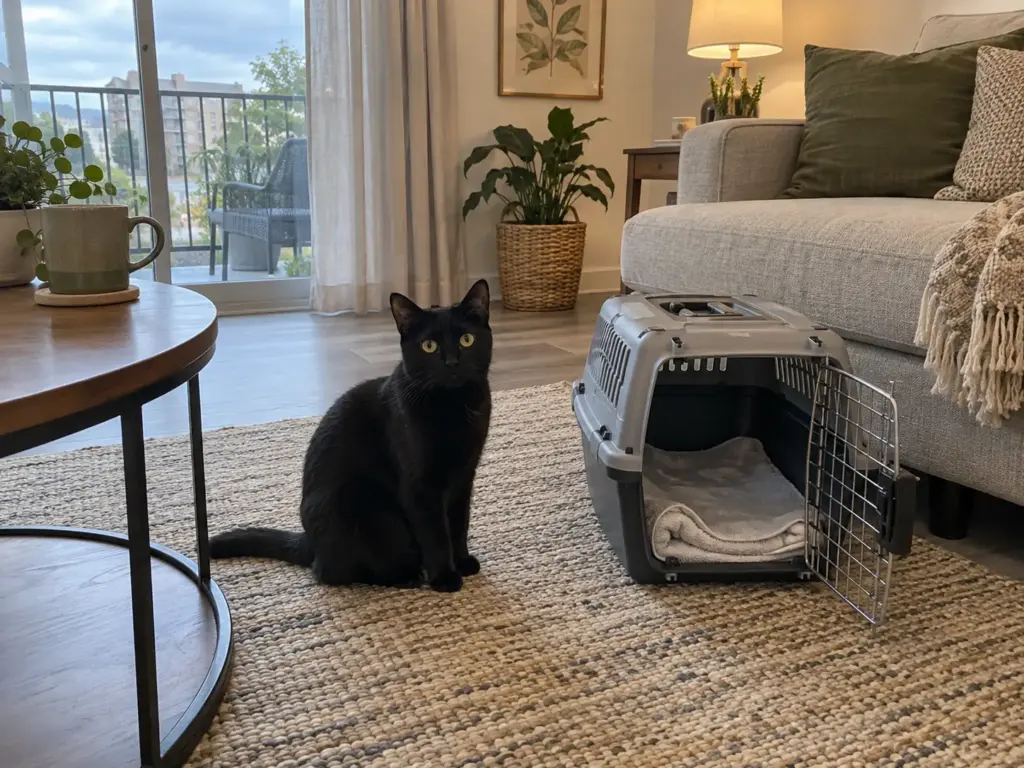
You are about to introduce cats, and the first problem is already in the hallway: your resident is sitting at a distance he chose, studying a carrier that smells like nowhere he has been. Territory, not personality, sets the speed here: he has had the apartment to himself, every chair arm carries his scent, and a stranger has just arrived inside it. The stages that the American Humane Society guide and long-running cat threads keep landing on all start from that fact, so the newcomer gets a room first and the two cats meet as smells before they meet as cats. This guide walks through those stages for a small apartment, including the one with no spare room, and ends with the rule for when to stop.
Quick Answer
Six stages, always in this order, with the resident cat setting the pace.
- Give the newcomer a room with a door that closes.
- Swap blankets and bedding so each cat meets the other by scent.
- Feed each cat on its own side of that door.
- Add a see-through barrier before any shared floor.
- Hold short, watched meetings and end them early.
- Stop and separate at a chase, a bite, or any wound.
Why Introducing Cats Takes Longer Than You Planned
The Resident Already Owns the Apartment
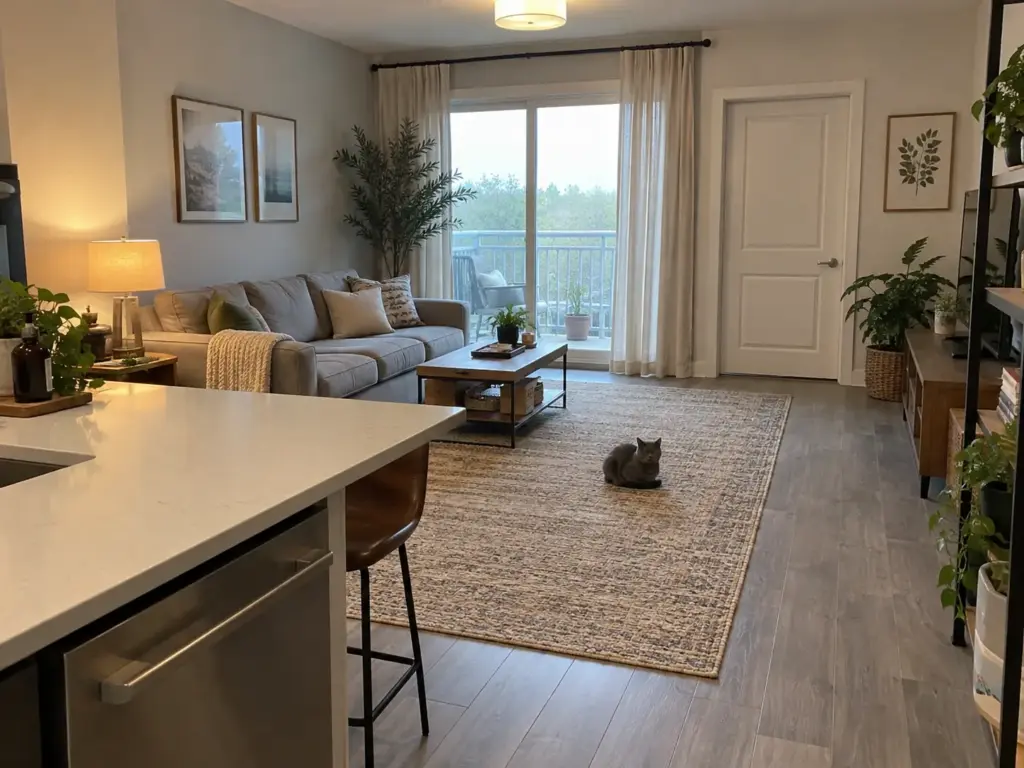
Introducing cats to each other starts from what the resident has already done to the place: by the time a new cat arrives, he has been writing his scent into it for as long as he has lived there. The sofa arm, the bedding, the doorframe he rubs his cheek against: that is his map, and it is why a resident cat reads a stranger’s smell as a change to the property and not as company. Watch what he does with the carrier. He sniffs it, circles it, maybe sits with his back to it, and all of that is a cat checking what has changed in his territory.
The newcomer has the opposite problem. He owns nothing here, so the first room you give him is the only ground he can learn.
What the Two Cats Are Actually Deciding
Neither cat is deciding whether to be friends. They are working out who uses which space, at what time, and whether the other’s smell is going to stay. A hiss at a closed door, two days of ignoring each other, sleeping at opposite ends of the hall: those are answers to that question, and in the early stages they are fine.
It is also why the early stages keep the cats out of each other’s sight. Scent is the one piece of information a cat can take in while neither of them has to back down.
Your Weekend Plan Is a Preference, Not a Rule
Most people schedule this like a move: new cat on Friday, shared sofa by Monday. That schedule is a preference, and the resident never agreed to it. Bringing in a second cat raises what a lot of people are wondering: how to split time between them so the newcomer gets love and attention without neglecting a very cuddly and needy older cat.
The question is about fairness, and fairness is a human measure. Equal time sounds right, but the resident is not counting minutes; he is checking whether his bed, his bowl and his hallway are still his. So the better call is the unequal one: leave his routine exactly where it was, put the extra attention on the newcomer’s side of the door, and let what the two cats do each day set the pace.
The rule of thumb takes six words: use your cat as a guide. How long each stage lasts, and whether any can be skipped, are separate questions with the same answer: the cats set it. The full cat introduction timeline gets its own piece on this site.
What Goes to a Vet Before Any of This Starts
Anything that hurts goes to a vet. This guide covers doors, scent, bowls, barriers and pace, and none of that replaces a phone call when the cat, not the house, is the question. When to see a vet during an introduction comes down to four signs:
- A bite, or any blood on either cat.
- A cat that has not eaten or drunk for a day.
- Litter avoidance that starts after the introduction begins.
- A fight that one cat cannot walk away from.
This guide does not say what any of those mean, and it will not tell you to wait and see. An injured cat also ends the attempt for now; it is not a slow stage.
Base Camp: Give the Newcomer a Room With a Door That Closes
Pick the Room the Resident Uses Least
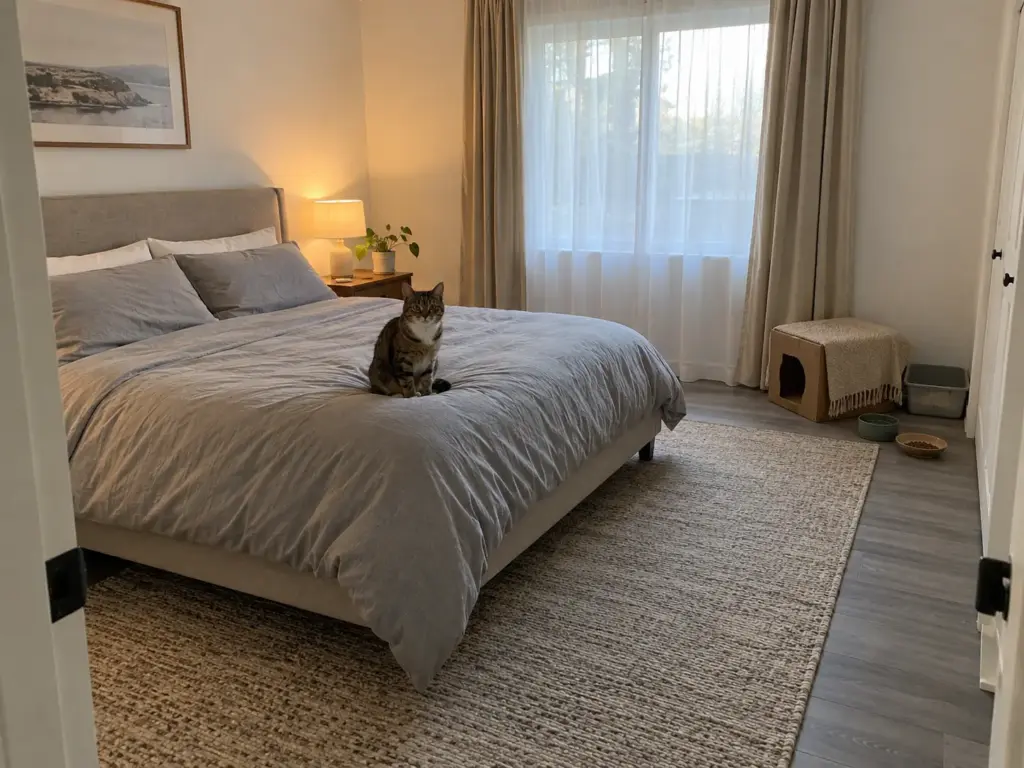
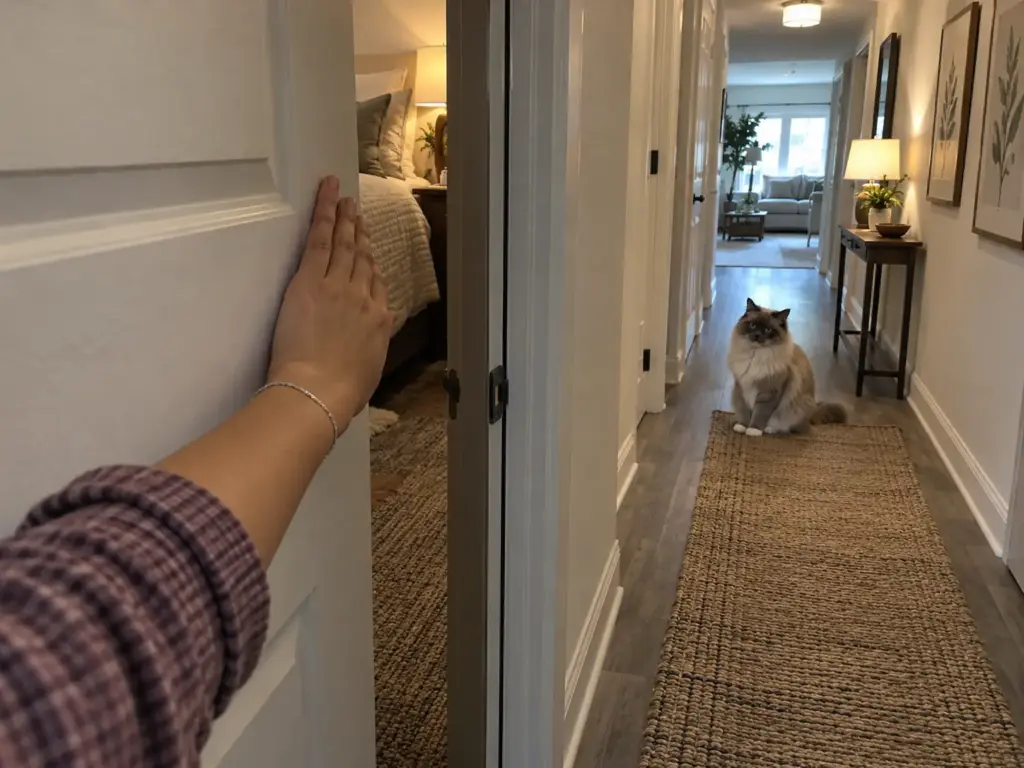
The newcomer’s room is called base camp: one closed room that holds everything he needs, so he can learn one small space while the resident keeps the rest of the apartment. Pick the room the resident visits least, so you are not taking a favorite spot from the cat who already lives there. In a one-bedroom apartment with no spare room to give, the bathroom that opens off the bedroom can serve as the kitten’s base camp.
A closed door is the point. A baby gate or a half-open door lets the two cats see each other before either has the smell of the other in the place he sleeps.
What the Gap Under the Door Is For
Measure the door gap before you pick the room. The American Humane Society’s six-step introduction asks for a room with an inch or two of clearance under the door, which is enough for smell and sound to travel both ways and too little for either cat to get through. Slide a ruler under it. If the door is tight to the floor, that room is not your base camp, however quiet it is.
Leave the gap open. A rolled towel or draft stopper along the bottom of the door feels like good manners toward the new cat, but it closes the one channel the two cats have for learning each other’s smell.
What Goes Inside the Room
Base camp holds a litter box, water, food, a place to hide and a bed. The litter box is where the count starts: one box per cat plus an extra is the 1+1 rule of thumb VCA Hospitals gives, which makes three litter boxes for two cats, and the newcomer’s first box goes into his room from day one. The resident keeps his own where it already is, because a box he can no longer find is a bigger change than any new smell.
How long the newcomer stays in there is the question everyone wants a number for. The usual minimum is seven days, and the next step waits for the cats and not for the calendar. A week is the wrong number for a resident who still will not eat near the door on day seven.
No Spare Room: Sharing One Apartment in Shifts
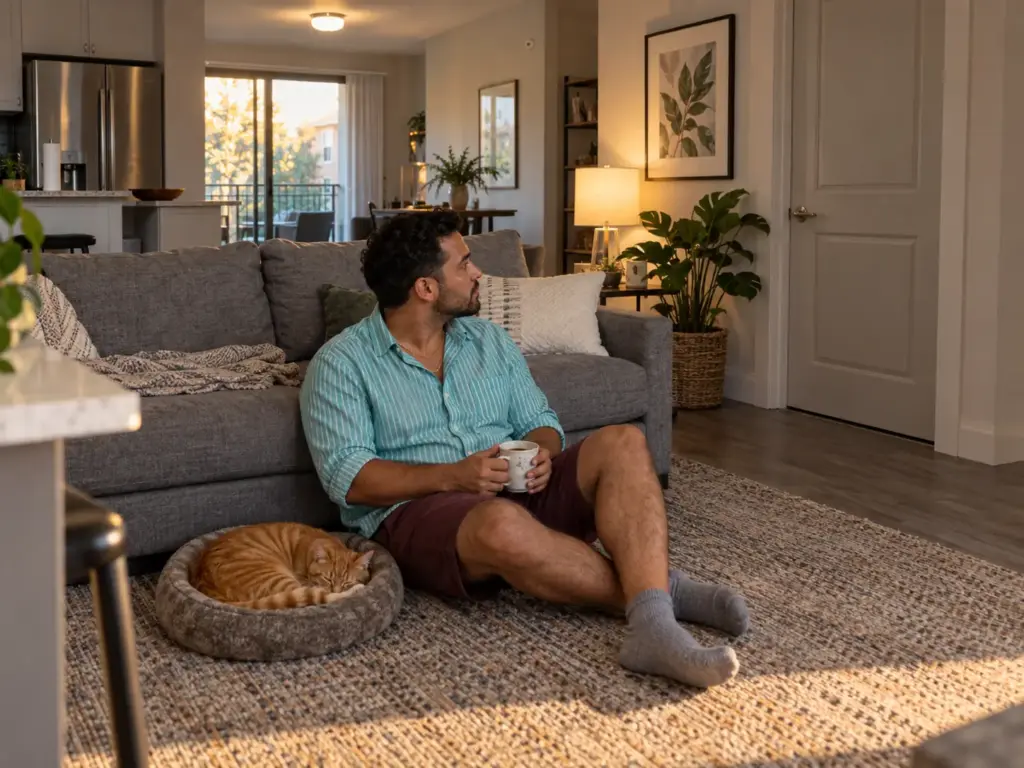
The Baby-Step Rotation: Newcomer in a Block, Then Resident
In a one-bedroom apartment you have two zones with a door between them, and the rotation uses both. The swap is often called switcheroo day: after the first week, the resident goes into a room of his own (not the newcomer’s) while the newcomer explores the rest of the apartment, so each cat ends up standing on the other’s scent without the two of them sharing a space. A second pattern is a safe room at night and out in the day. Laid out as a sequence:
- First week or longer: the newcomer lives behind the closed door and the resident keeps the rest of the apartment.
- Once both cats eat and sleep normally: a short swap block, the resident in his own room, the newcomer exploring the rest.
- Then alternate blocks, with each cat back in his own place when the block ends.
- The safe room stays the newcomer’s overnight and whenever nobody can watch, until the stages below are done.
Litter and Water Stay Whole While the Rooms Swap
Swapping rooms moves the cats, not the litter count. Two cats still need three boxes, and each cat keeps using the box he already knows, in the place where he already finds it. The spare goes to the zone where a cat has the longest walk to reach one. Water works the same way: every bowl stays where it was through every swap, because the cat on his way to drink is exactly the cat who will not want to find a new spot.
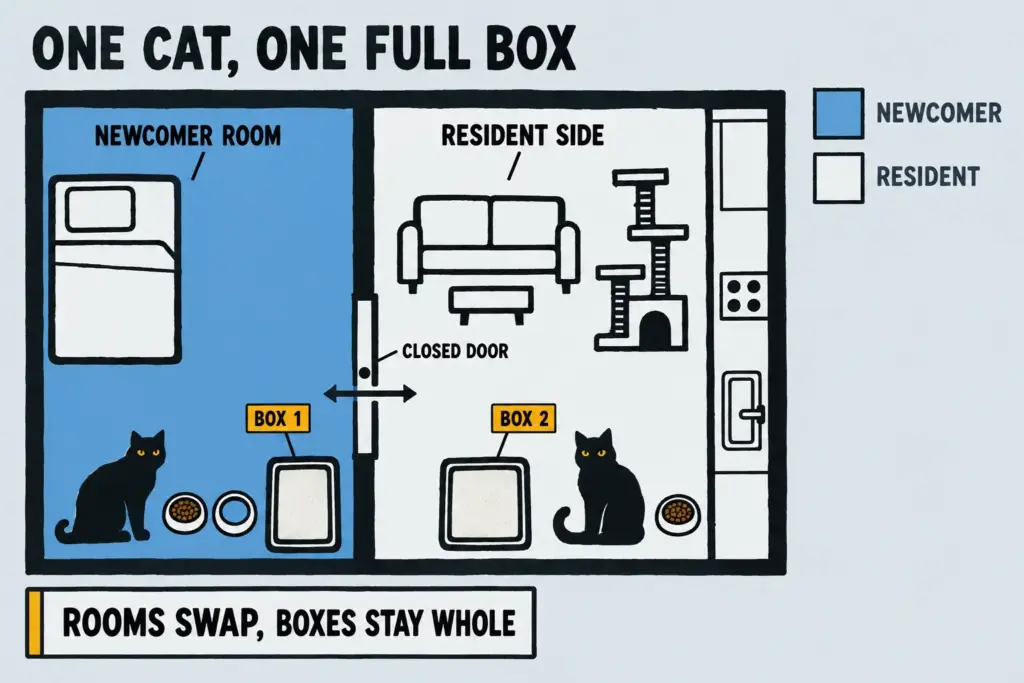
Where three boxes physically fit in one room and a bathroom is its own puzzle, and it has its own answer in a litter box in a small apartment, where it actually fits. (And if you landed here wanting to introduce a covered litter box without losing the box, that is a different job: the word “introduce” there is about a box, not a cat.)
When the Bathroom Is the Only Door
A studio, which is a one-room apartment, has one door that closes, and it is usually the bathroom. The newcomer lives behind it with everything from the base camp list, and the resident cannot be shut anywhere, so there is no second room to swap into. That changes the order: the rotation waits, and a see-through barrier (covered below) is what eventually lets the two share the day.
The bathroom off a bedroom works the same way with a bonus, since the bedroom door adds a second layer between the cats. Either way the rotation does not replace the first days behind a closed door; it only decides what happens after them.
Scent Comes First, and Soft Things Carry It
Cats learn each other through smell long before a meeting, so the next stage is moving it around. Swap blankets, beds and toys between the two cats, then switch them back every day or every other day. When a cat rubs his cheeks on a blanket he is leaving his cheek scent there, and that is the exchange doing its job.
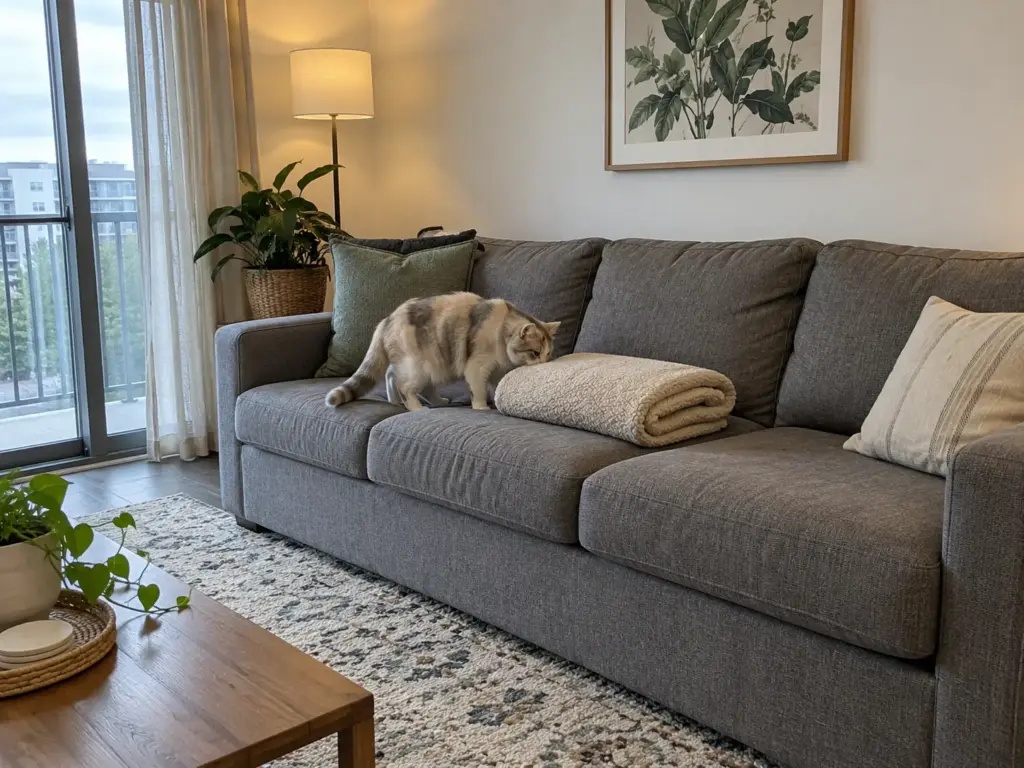
Keep an eye on the plain things while it happens. A cat that eats and sleeps normally while the blankets travel is telling you the stage can continue. A cat that stops eating is no longer a scent problem, and that goes back to the vet section above. The full method for scent swapping gets a piece of its own on this site; here it is enough to know that the stage exists and that it comes before any sight.
When the Resident Refuses to Go Near the Newcomer’s Room
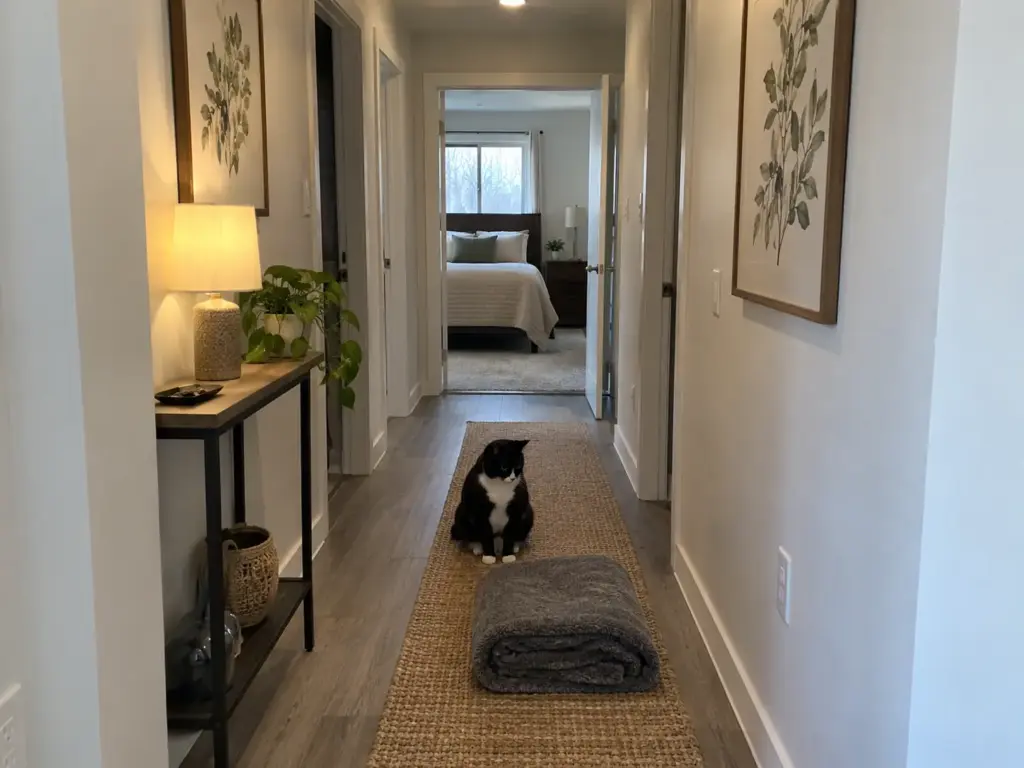
Why a Resident Won’t Lie on the Blanket
Sometimes the swap stalls because the resident will not come near the newcomer’s side of the apartment at all. In one version, base camp goes in a spare bedroom upstairs and the resident will not go upstairs at all. In another, neither cat will lay on anything soft like a blanket or towel, so scent swapping cannot even start. A third wrote that the elder cat “will not go into my bedroom because there is a scent of the new kitten in there.”
What the Refusal Is Telling You
It is easy to read this as a stuck plan. It is a restriction, and the cat who is refusing has the better view of it: the newcomer’s room now smells like a stranger, and the resident has decided where he stands in relation to that smell. You do not fix a restriction by pushing the cat through it. You loosen the step.
One more version of the same pattern: the resident ends up with a safe room while the newcomer roams everything else. Nobody planned that, and nobody has to undo it by force. The apartment is being shared on the resident’s terms, and the stages can start from there.
Moving Scent Without Moving the Cats
Bring the scent to the resident instead of the resident to the scent. Lay the newcomer’s blanket along the edge of the room the resident already uses, on the floor beside a spot he passes anyway, and leave it there. Then pick up the resident’s blanket and put it where the newcomer can reach it, without anyone walking into a room they have just refused.
A toy that passes under the door gives both cats a shared object with no meeting attached. A simple version is bells and string tied to the ends of a length of elastic and fed through the gap. Use it while you are in the room, then put it away.
Meals on Either Side of a Door
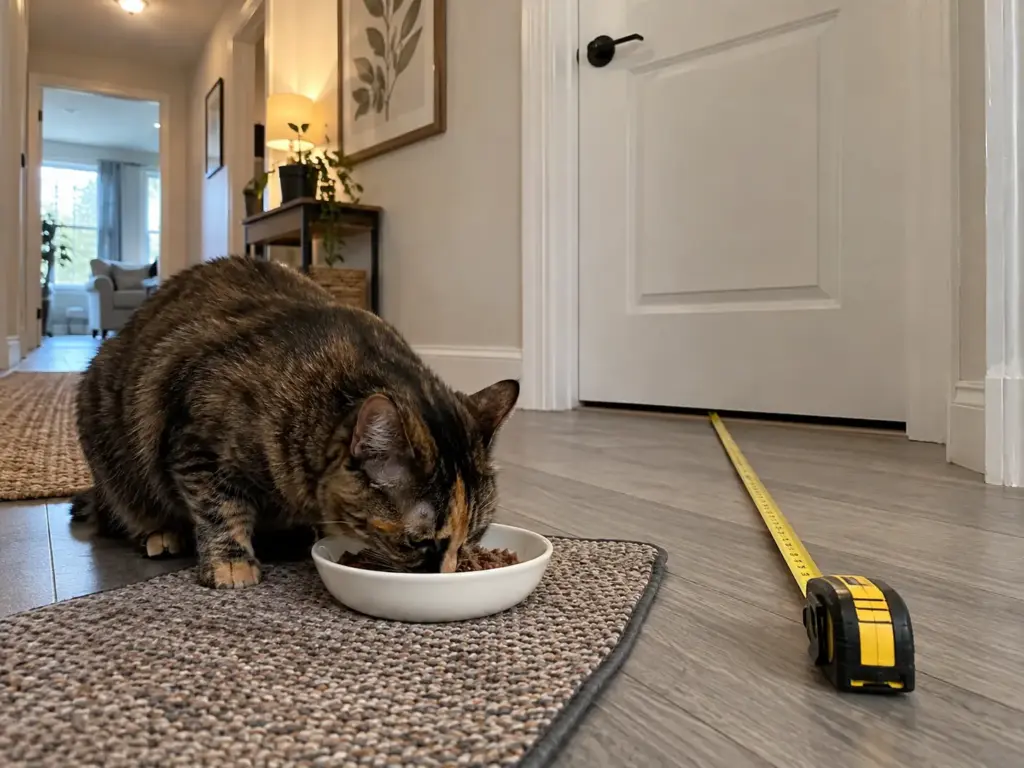
Where the First Bowls Go
Feeding on opposite sides of a door is where mealtimes start doing some of the work. American Humane puts each cat’s dishes close to the door, on their respective sides, so each one eats with the other’s smell a door’s thickness away. If a cat turns the bowl down, the same source says to try tuna or a treat on either side.
A cat that skips the meal entirely is a different matter. One refused bowl at the door is a setup problem; a cat that has not eaten for a day is the vet.
Moving Them Closer, Day by Day
The distances are rules of thumb, not figures from an authority. One way to do it is to start the bowls a few feet from the door the first day and move them a little closer each day after that, with the cats’ eating deciding whether tomorrow’s move happens at all.
Use a tape measure to move the bowls, not your eye. A bowl that jumps a yard closer in one meal skips the step the cat was still working on.
The numbers depend on the apartment. In a studio the three-foot start may run into the bed or the sofa, and the right move is to shorten the first distance and keep the one-foot steps, not to skip the door.
One Bowl Station per Cat, Even With Three
Each cat gets his own feeding station, even in a small apartment. The rule is covered at length in feeding two cats in a small apartment, by floor plan and in why two cats get two bowls plus one; for the introduction, the stations simply stay separate until the cats have been fed side by side across a barrier.
Water is its own measurement. Where the bowls sit relative to the food is explained in why cats drink away from food, and the three-cat case is in three cats, four water bowls. With three cats, run each pair through the same stages in turn and keep every cat’s food and water in the place he already uses.
A Gate Measured Against the Cat, Not the Box
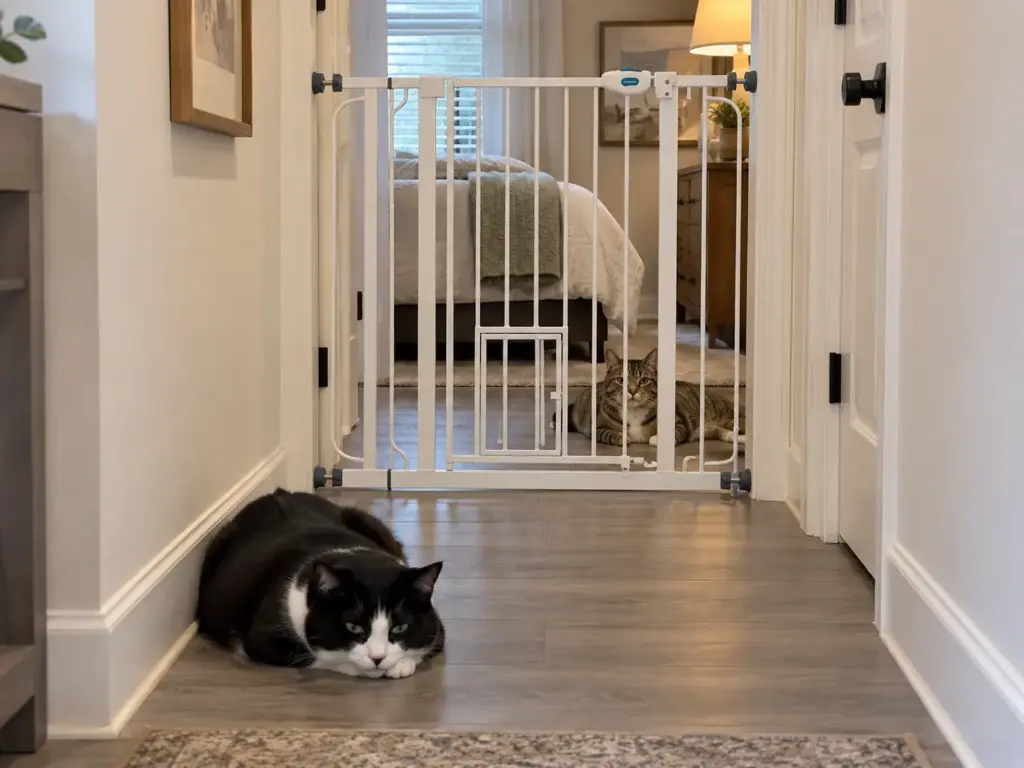
Why a Standard Baby Gate Is the Wrong Height
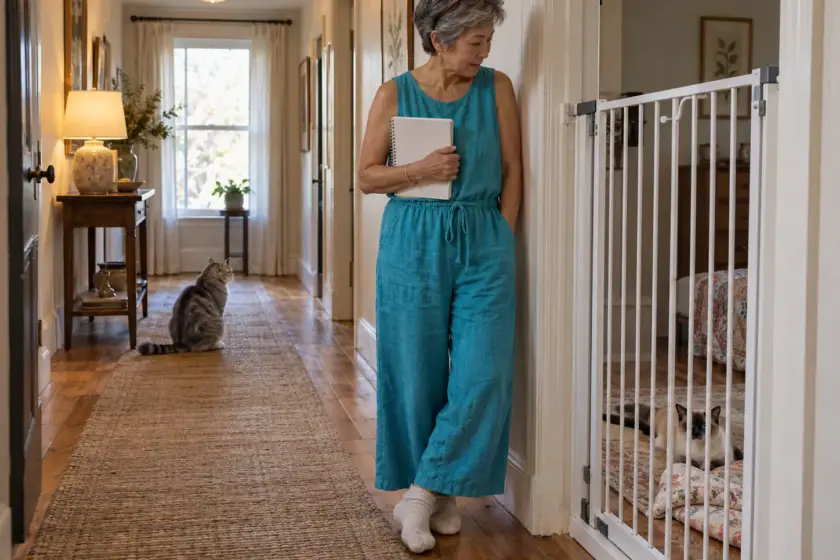
The barrier stage lets the cats see and smell each other without sharing a floor. It is also where the first purchase tends to go wrong. According to the American Humane Society, “A baby gate is perfect, but usually not high enough for cats, so you may need to stack two on top of each other.” That leaves the height to you, and the way to get it is to measure the cat.
Measuring the Barrier Against One Cat
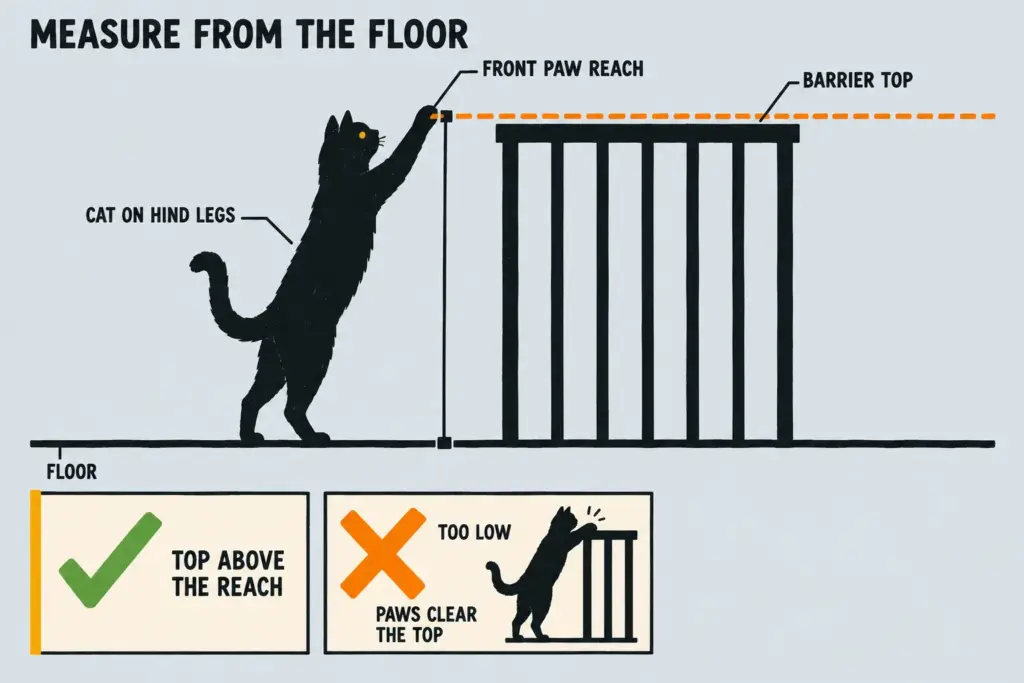
Stretch your cat out against a wall: front paws reaching as high as he will go, then mark the wall at the tips of his paws and add a couple of inches. That is the lowest the barrier can be, and it is a floor, not a target. Hold a tape measure to the mark and compare the number with a gate’s listed height, because American Humane’s own warning is that standard baby gates usually come up short.
Free options first. Free options include a screen door taken from a patio door, a mesh divider, any large mesh or sheer fabric, and all of those let the cats see and smell each other. The obvious pick is a tall gate, but the obvious pick stops being obvious when the free screen already fits the doorway, and the gate only starts to earn its place when the opening is awkward or a screen will not hold.
If you do buy a pet gate, the Carlson 36 inch Extra Tall Walk-Thru Dog Gate with Small Pet Door is a metal gate the cats can see and smell through, and its walk-through door lets you cross without lifting it. Per Carlson’s listing it stands 36 inches tall and fits openings from 29 to 31 inches without the extension and 34 to 36.5 inches with the included 4 inch extension, and it does not fit anything between 31 and 34 inches, so measure the doorway first. Amazon’s customer summary calls it sturdy and easy to install. Its flaws sit in the same listing: the height and the cat door size are each given two different ways, so treat 36 inches as the number and check the cat door when the box arrives.
Customers also report that the small door does not stay open and that the opening is too small. A cat door is built to let cats through, which is the opposite of this job, so confirm the small door can be held shut before you rely on it. Reviewers with dogs add that the cat door nearly passed a dog’s shoulders and that one dog jumped the gate. Put the number from your wall next to the listed 36 inches before you buy: it is built as a walk-through gate, not as a jump-proof one.
See-Through or Solid, and What Each Does
A see-through barrier lets scent, sound and sight arrive together; a solid one lets only scent and sound arrive. Move to the see-through one once both cats eat calmly at the door, because that is where visual contact starts, from a distance each cat chose.
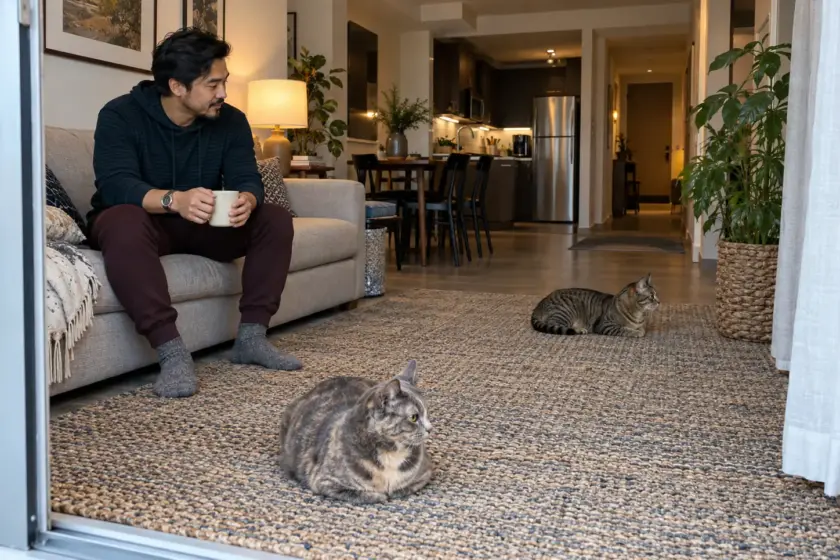
Picture an older female who charges the gate and hisses or growls, then backs off and lies down a short distance away. The pattern is the cat taking the distance she needs. If the first sight is too much for either cat, drape a sheet or sheer fabric over part of the barrier as a sight blocker, so the view arrives in steps.
The First Meeting: Short, Watched, and Ended Early
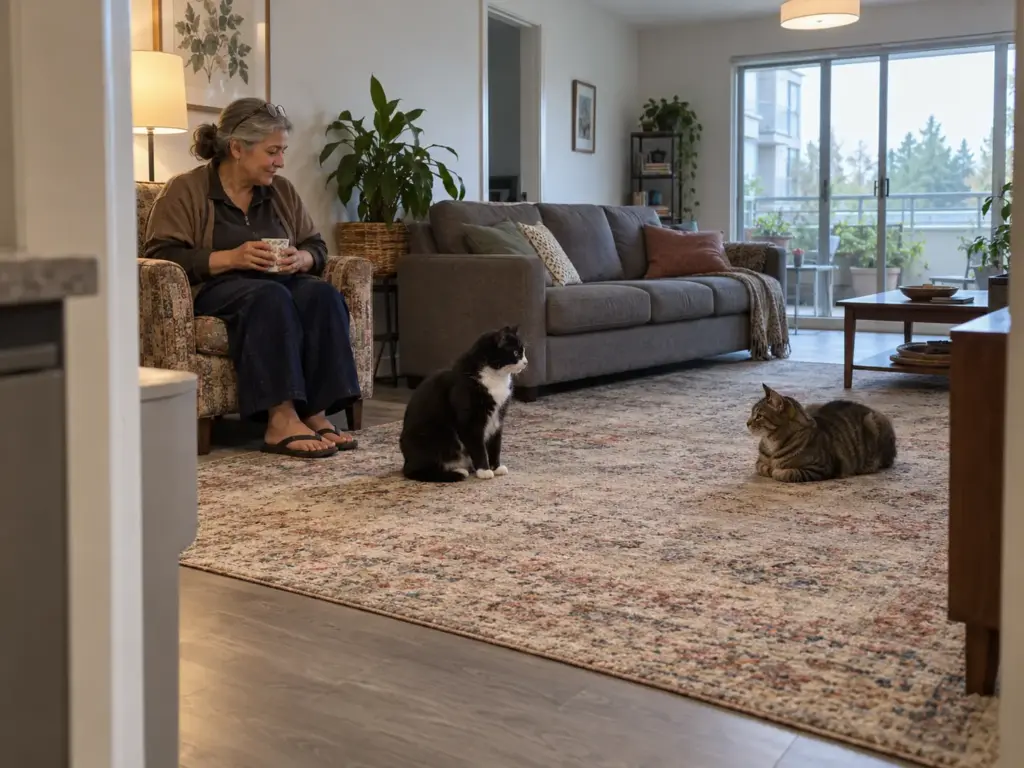
Where to Hold It
VCA Hospitals says to plan for the two to meet “under your watchful eye in neutral territory.” In a small apartment, neutral means a stretch of floor that neither cat sleeps beside or eats near. If every square foot belongs to one of them, hold the meeting at the barrier you have already used.
How Long, and Who Ends It
Keep the first supervised meeting short and end it before the room tightens. The cats set the pace, so a meeting that went well does not mean the next one gets longer. The person holds the door or the barrier; hands never go between two cats.
Decide before the meeting who ends it and with which door. Nobody should be working that out while the first cat stiffens.
Hissing Is Normal, Chasing Is Not
A hiss, a growl or swatting at the barrier belongs to a meeting. Lunging, claws out, smacking the floor and a chase that ends under the furniture do not, and the rule is to end the session when it tips from posturing into that.
And a cat that withdraws, such as a resident who keeps her own room while the newcomer has the rest of the apartment, is not failing the stage. Nobody should force that meeting. A kitten changes the rules, and that has its own piece on this site.
The Stop Rule: What Ends a Session and What Ends the Attempt
What Ends the Session
End the session at a chase, a shove, a staredown held without either cat moving away, or a cat that cannot leave the area. Use the door or the barrier, never your hands, and give the cats a few minutes apart before you decide anything about the next one.
What Ends the Attempt for Now
A wound ends the attempt. So does a fight that one cat cannot escape. Separate them into different rooms, and call the vet, as in the section near the top of this guide.
What carries on while the attempt is paused: one box per cat plus a spare, food on either side of the door, and the scent swap. When the vet is satisfied and the cats are eating normally, restart one stage back and not at the meeting.
What Has Its Own Guide on This Site
This guide gives the order and the stop rule once. Several questions around them have their own guides on this site: how long a pair needs, whether any step can be skipped, how to tell an introduction is failing, what changes with a kitten and which pheromone diffuser to use. A diffuser does not stand in for any stage here, so it comes after the doors and bowls, never in place of them.
One more case: expect to repeat an abbreviated version of the process when one or both cats come back from the vet or boarding, when you move, or when a child joins the household.
Close the Door, Swap a Blanket, and Look Again in Three Weeks
Three things carry most of this. The newcomer gets a room with a door that closes, because the apartment belongs to the resident. Smell goes before sight, so blankets, bowls and a barrier all come before a shared floor. And the stop rule is settled before the first meeting: a chase, a bite or any blood ends it, and a wound goes to the vet, not to the next stage.
Pick a date three weeks from now and run one test on it. Are both cats eating, sleeping and using their boxes where they did before the newcomer came, and is each stage still where you put it, or has the schedule drifted back to the weekend plan? A routine that held is the sign that the setup worked. One that slipped is a stage to repeat, not a verdict on either cat.
Today, with nothing to buy: close the door the newcomer will live behind, slide a ruler under it to see whether there is an inch or two of gap, and write the stop rule on a note by that door where you will see it.
Frequently Asked Questions
01How long does it take a cat to get used to a new cat?
It takes as long as the slower cat needs, and no date on the calendar shortens that, so the pace comes from what both cats do each day. The usual start is at least a week in a separate room. If either cat stops eating, call the vet.
02What not to do when introducing cats?
Do not put the two cats in one room on the first day, do not force a meeting, and do not skip the scent and meal stages. End a scuffle with a door or a barrier, never your hands. Any wound or blood is a call to the vet.
03How do you introduce a cat quickly?
You cannot skip a stage, because each one gives the cats something the next one needs, and the only thing that can shrink is the time between stages. That happens only when both cats are eating, sleeping and using the litter box normally.
04Do cats need separate litter boxes during an introduction?
Yes: one box per cat plus a spare, which makes three boxes for two cats, and each cat keeps his own while the rooms change. VCA Hospitals gives that rule of thumb. If a cat starts avoiding the box after the introduction begins, call the vet.
05How do I split my time between a new cat and my resident cat?
Do not split it equally, because equal time is a human idea of fairness that the resident cat did not ask for. Keep his meals, play and bed exactly where they were, and spend the extra time on the newcomer’s side of the door.
Leave a comment