Vacuuming Cat Hair Fails in Three Places, Fixed in Order
Don't buy a new vacuum yet. Vacuuming cat hair fails at three points, and two of the fixes are free [roll, bin, battery] in a set order.

Alfredo RamsesFounder · Updated October 31, 2026 · 24 min read

On this page10 sections
- 1What Actually Lifts Cat Hair Off a Floor, and What Only Moves It
- 2Failure One: the Brush Roll That Wraps, and the Free Fix
- 3Failure Two: the Bin That Fills Before the Room Does
- 4Failure Three: Run Time Against a Week of Shedding
- 5Hard Floor, Rug, Couch and Stairs: What Each Surface Does to the Machine
- 6Upright, Stick, Handheld or Robot: Picking the Type by the Failure You Can't Live With
- 7Filters and Bags: What Stays in the Room When the Hair Goes in the Bin
- 8The Cat's Side: Why the Machine Gets Used Less Than You Think
- 9Free the Roller Today, Then Log the Charges for Three Weeks
- 10Frequently Asked Questions
You vacuumed yesterday, and this morning the same strip of rug by the window is furred over again, because the cat keeps sleeping where the sun lands and his coat does not take days off. Vacuuming cat hair rarely goes wrong because the machine is bad; it goes wrong at one of three points, always the same three: the roller that stops turning, the bin that is full before the room is, the battery that quits before the floor does. The roller and the battery fail in familiar ways, and the order you fix them in matters more than the model on the box. None of the three needs a purchase to start, so this guide takes the machine apart in that order, then looks at the surfaces, the machine types, the filter and the cat who has to share the apartment with the noise.
Quick Answer
Fix the machine’s three failure points in this order, and bring the cat into the plan:
- Free the brush roll first, with the battery out or the plug pulled.
- Empty the bin before it fills, not after the room is done.
- Match the battery to one room, not the whole apartment.
- Let the cat see the machine switched off before it ever runs.
What Actually Lifts Cat Hair Off a Floor, and What Only Moves It
You ran the machine with the biggest number on the box and the hair is still lying in the weave, or it is in a tidy pile three feet from where you started. One owner describing a robot vacuum put the problem in a phrase: it “deposits it elsewhere.” A machine can move hair without gathering it. When you vacuum cat hair, the difference between those two jobs is mechanical, which means it can be mapped and fixed in order.
Suction pulls, the brush roll lifts
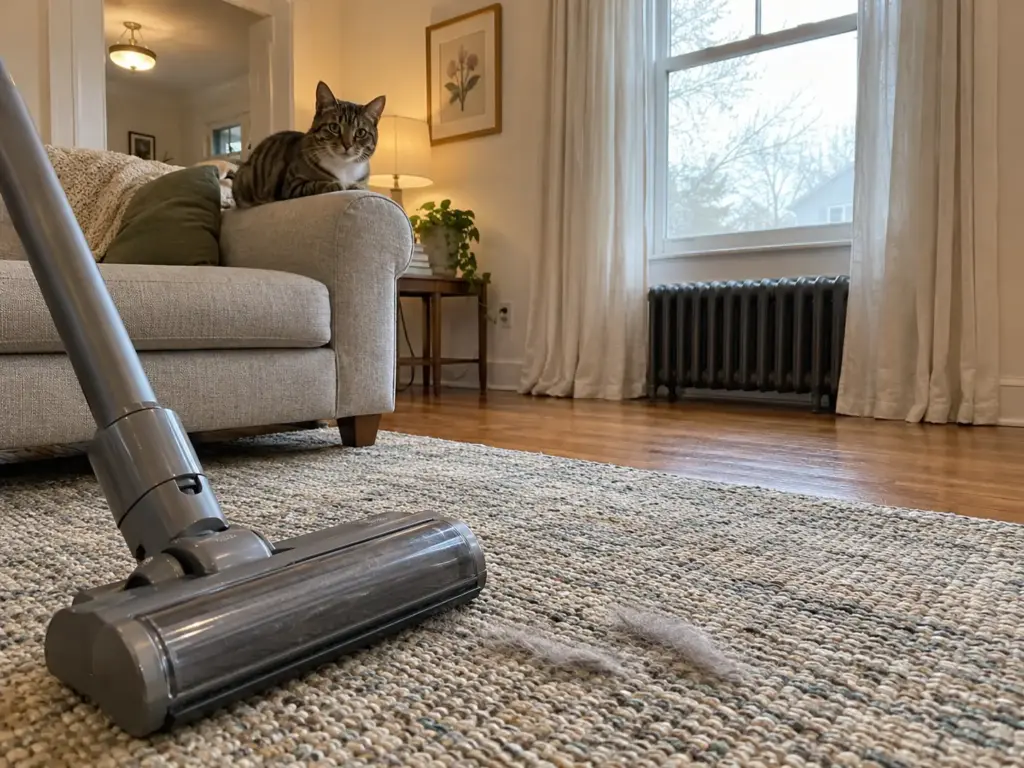
Any pet hair vacuum does two separate jobs, suction and agitation, and cat hair depends on the second one. Suction pulls loose material up the tube; the brush roll is what drags a fine strand out of a rug’s weave or off a floor where it clings, so there is something loose for the suction to take. With the roll stopped, the machine is pulling on a surface that is holding on. Clearing cat hair around the house without moving it covers what to do before a machine comes out; this guide covers the machine itself.
Power on the box is rated in air watts, and two popular pet hair vacuums list 306 and 270. A gap of 36 watts says nothing about whether the roll is turning, how big the dust bin is or how long a battery lasts, and the complaints owners post are about wrapped rollers, full bins and dead batteries, not watts.
Why a strong number on the box still leaves hair in the rug
What stays behind after a pass is what ditchdiggergirl calls “embedded hairs,” and the comment is blunt: “it doesn’t do the best job with embedded hairs (no vacuum does) and the fabric on our sofa holds cat hair like nothing I’ve ever seen.” The fiber holds the hair, and a bigger motor pulling on the same fiber does not change what the fiber holds.
The strongest machine in the house is also the weakest one if it stays in the closet. SleepyChapstick has a central vacuum that does the job well, but taking it out and putting it back costs two to three minutes, and the big machine is “so big and impractical” that using it every day becomes a chore. For a ten-second patch of tufts by the window, the machine at arm’s reach beats the better one behind a door.
The hair’s path from the floor head to the bin
Hair takes a four-stop route through any vacuum: the floor head, the brush roll, the bin and the filter. It stays at the first stop that cannot hold it, so the failure you notice at the end of the room is rarely the one that started it. A roll that wraps stops lifting, a bin that fills stops taking, and a filter that clogs slows everything behind it. The leftovers are what huggsypenguinpal calls “pet hair tumbleweeds,” the loose clumps that drift under the couch and the bed while the machine is busy failing somewhere upstream.
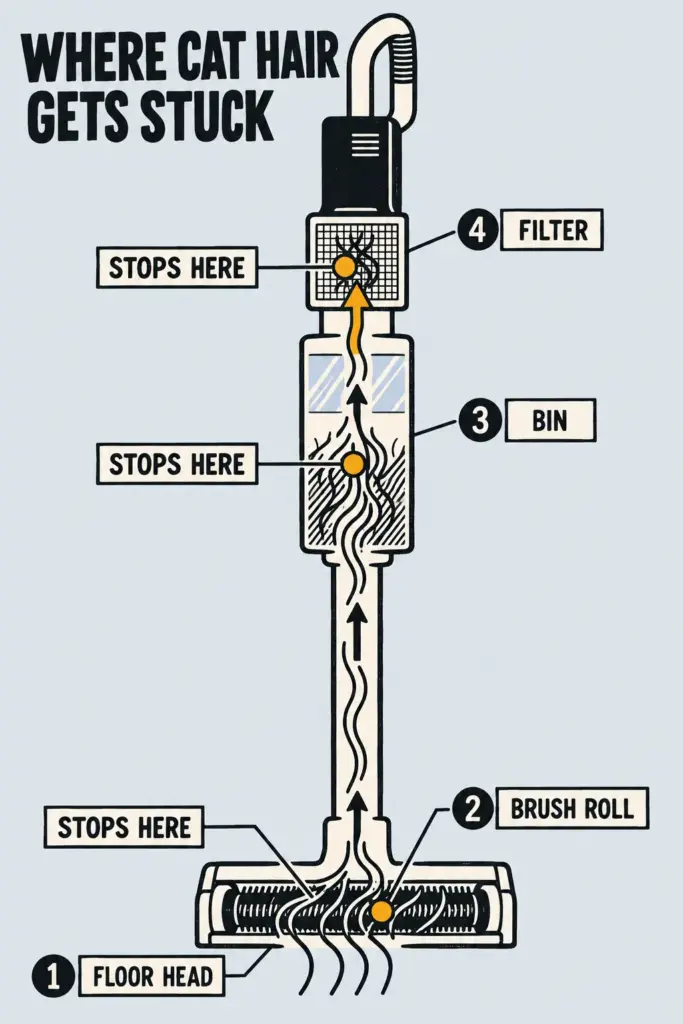
Each stop has its own way of giving up. At the cleaner head, hair and pellet litter roll ahead of a stiff brush instead of going in. At the roll, strands wind around the bristles until it spins without lifting, and at the bin the cup fills and the intake backs up. At the filter, fine dust packs the media or the filter slips out of its seat.
Hair also does not travel in a clean line: seantholemeuw wrote that “Cat hair tends to get into all the nooks and crannies of the vacuum, causing the cheap plastic parts to wear” (and, in their words, even start to melt). The rest of this guide walks the route in the order that is cheapest to fix, starting with the roll, which you can fix with a pair of scissors.
Failure One: the Brush Roll That Wraps, and the Free Fix
“Even vacuums that advertise as having self cleaning rollers get wrapped with hair,” says kirstyyycat666, and the label did not save their mother’s machine. It promised the wrap would never happen. It happened anyway.
Why a wrapped roll stops the whole machine
When the roll wraps, the machine still sounds like it is working. The motor runs, air moves, and a cord of hair drags around the roll instead of lifting anything off the floor. That is why a wrapped roll feels like lost suction, and why the first reaction is to blame the machine.
Manufacturer help pages from Dreame and Narwal add a wrinkle: too much suction drags hair into the brush hard, too little lets the roll spin poorly, and either way it tangles. A long coat tends to feed the wrap sooner than a short one, and a multi-cat home feeds it sooner than a home with one cat.
Power off, then free it
Power comes off before anything touches the roll. According to a vacuum care page from the Texas School for the Blind and Visually Impaired, “Disconnect cleaner from electrical outlet before servicing, such as changing bags or belts.” On a cordless that means the battery comes out, and most cordless sticks release the roll with a button on the floor head, so you lift it out and work on a table instead of upside down on the carpet.
Put the battery on a different shelf from the machine while you work. A battery you would have to go and fetch is a battery that cannot be clicked back in by accident.
Cutting along the grooves, once the battery is out
The method owners trust is plain scissors. kirstyyycat666 explains: “I use scissors and cut along the grooves on the roller since they make it easier to get under the hair.” The wrap comes off in strips rather than in a fight.
They also put a number on how often it happens in a home with two long-haired cats and a long-haired dog: “Not the animal hair. My hair does eventually, and it’s very easy to cut off of the roller. I probably have to do it about once a year.” So in that house the wrap came from human hair, and it was a yearly job.
A roll that wraps every week points at long hair in the house, or at a head that does not suit the floor, before it points at a defect.
Fixing it takes a pair of scissors you already own and a couple of minutes. Start here before you spend anything.
What an anti-tangle roll claims, and what owners report
The makers’ answer to the wrap is a different roll, an anti-tangle brush. Rubber, silicone or finned designs are said to lift hair toward the suction with less winding than bristles do, which is a manufacturer’s claim and untested.
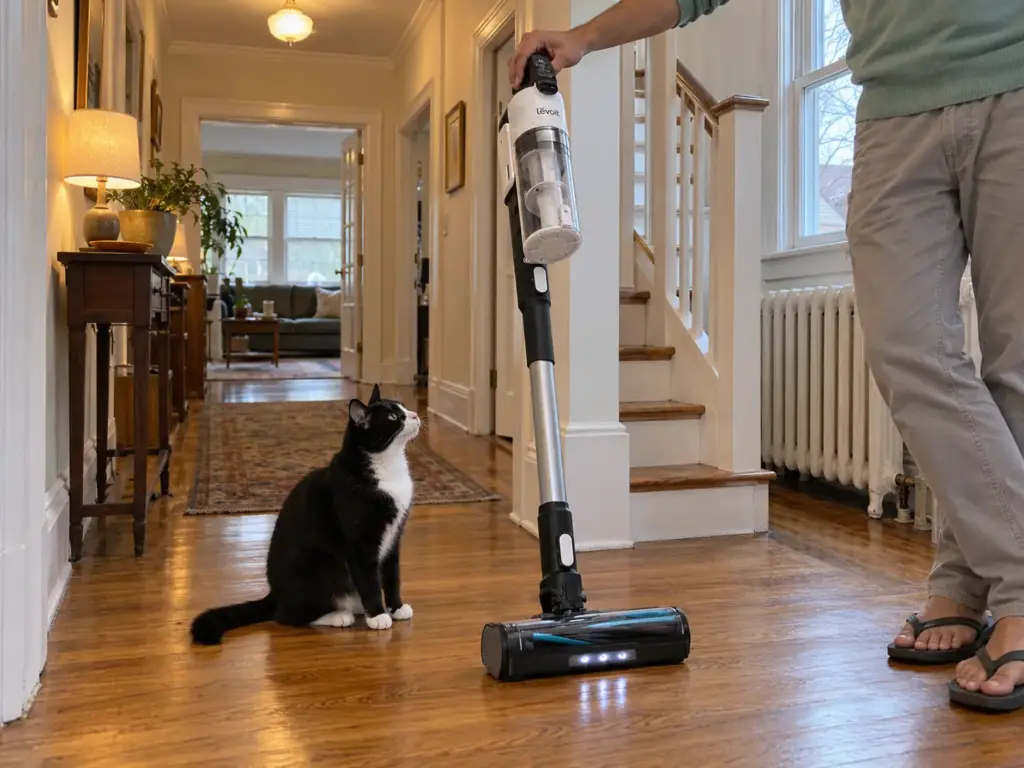
The Levoit LVAC-200 Anti-Tangle cordless vacuum is built around that claim: the listing sells it as anti-tangle for pet hair, with a run time of up to 50 minutes in the title, both in the seller’s words. Against that, rollers sold as self-cleaning can still wrap. Read the Levoit as a cordless that should wrap less, not one that never will, and keep the scissors where you can reach them. The listing gives a run time but no dimensions for the machine, so measure the corner where it would live before you count on it.
Failure Two: the Bin That Fills Before the Room Does
The arithmetic on a dust bin gets done only when it is full in the middle of the living room with half the rug still furred. Bin capacity is a unit of distance: the cup holds so much hair and litter dust, and the room is however many cups of it you made.
A small bin is a room-sized limit
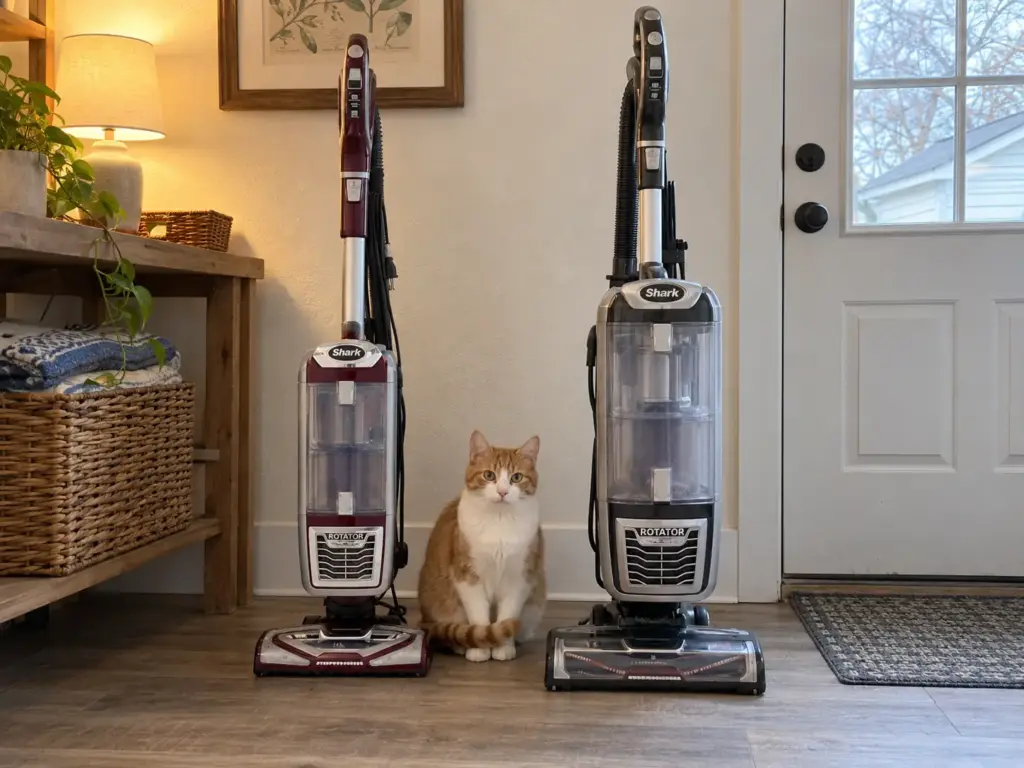
Bins in pet vacuums run from a 25-ounce handheld cup to over half a gallon on a large upright, and the small end fills faster than most people expect. The Shark NV752 Rotator Powered Lift-Away TruePet holds 0.88 quart (0.83 liter) per its listing, a bit over three and a half cups, small enough to fill inside a single room when two cats share the carpet. Its seller says the powered brush keeps spinning when you lift the pod off for stairs and upholstery, which is a claim and not a test. It is also an older model, and listings for it mix new and renewed units, so read the condition line before you order.
A big bin buys time, not a free pass
At the other end, the Shark ZU102 Rotator Pet Upright lists a 2.9-liter cup, about 0.77 gallon and roughly three and a half times the cup of the NV752. That buys more floor per trip, and a long carpeted hallway is where you feel it. It does not change the rule. A cup that fills halfway across the room stops the clean exactly as a small one does, only later.
The same school page that says to disconnect the machine before servicing also says to change the bag often and never let it fill, and a bin follows the same logic: empty it at the first sign it is nearly full, not when the suction drops. The 2.9-liter figure comes from the listing title, so it is the seller’s number until you hold the cup.
Where the clog really is: the nooks, not the bin
When a machine “clogs with fur,” the bin is rarely where it happens. The hair works along the route from the first section, into the neck between head and bin, around the ends of the roll and into the filter’s seat. A bin you empty on time does not protect any of those. What does is a glance at the neck and the roll ends every time the cup comes off, and a check that a washable filter sits where it belongs, because a filter can slip out of its seat without anything announcing it.
Litter dust and the housing of the machine
Litter makes all of this worse because its dust goes where hair does not. gorillamyke ran litter through a small handheld and reports that “the litter dust ended up messing up the engine, and it just started whining very loudly,” followed by a rule worth keeping: “do not use it for litter.”
The housing is where fine dust settles and stays. If the same floors collect both hair and litter, the cheapest fix is upstream, a mat at the box so less of it ever reaches the machine, which is the logic of litter that tracks out of the box in three fixes and one order. Two cats fill the cup sooner on hair alone, and tracked litter changes the sum again.
Failure Three: Run Time Against a Week of Shedding
The battery quits with half the floor left and the machine takes the blame, but the sum was never done: minutes in the pack on one side, a week of cat on the other. Nothing here is hard to measure, but your apartment’s numbers do not exist yet.
What 20 to 60 minutes of battery covers
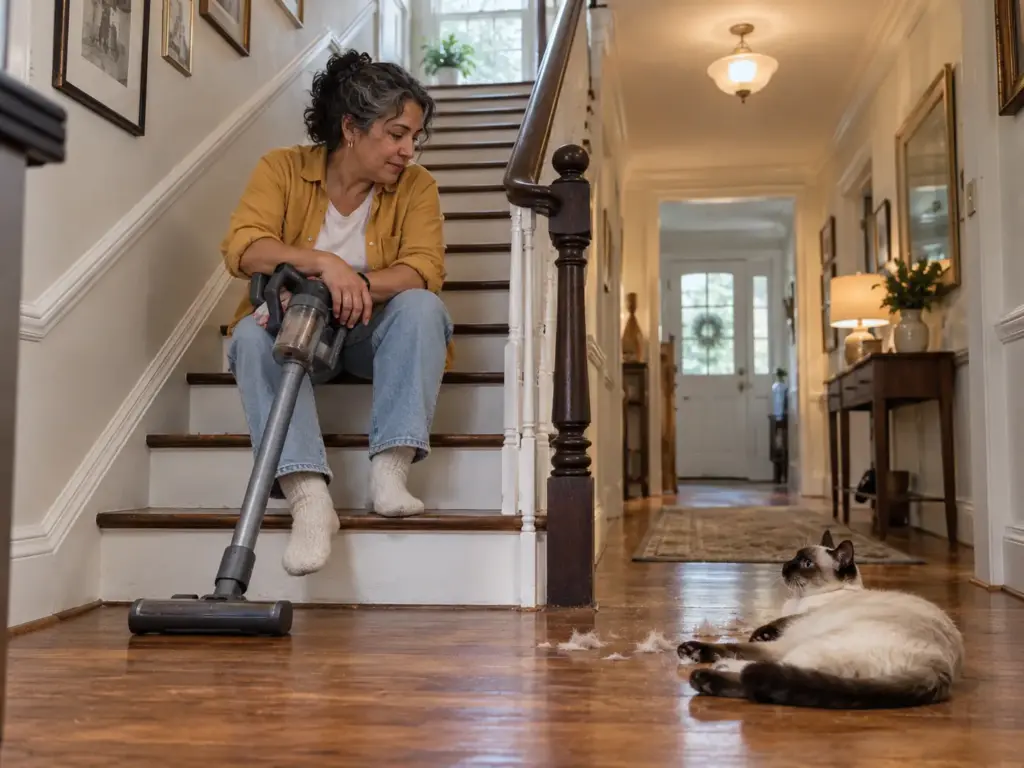
A home-products guide puts a new cordless at about 20 to 60 minutes per charge, with three to five hours to refill. Makers claim far more: from 20 minutes for a handheld up to 140 for a premium stick and 200 with a second battery, a tenfold spread that tells you these are claims and not tests.
One roundup lists a stick at 11 to 23 minutes and another at 60. A retail reviewer got about 20 minutes on high, enough to clear a couch and a carpet, and then waited around four hours for the recharge. The couch fits inside the battery. The recharge is the real wait.
And the minutes shrink. huggsypenguinpal’s cordless is about seven years old, and its battery, two to three years old, gives only “maybe 15 secs in high power” and a minute or two in normal mode; it still comes out several times a day for the tumbleweeds.
ChrisC1234 says that at three years a cordless “could only run for about a minute on a full charge.” Xarama keeps a shop vac for whole rooms because a cordless pack “only lasts for a few minutes.” A listing that says up to 50 minutes is a new pack on a good day, so plan around the figure you will have in year three.
Keep the log on the charger’s shelf, with a pencil: one tally mark per charge, a second per bin emptied. A pencil by the dock gets used in a way an app never will.
The week’s load is set by the cat, not the season
What the machine has to cover each week is set by the cat and the apartment: how many cats, how long the coats, how much carpet. Living with cat shedding in a rented apartment is the page for sizing the load itself.
The calendar does not rescue the sum either. Indoor cats shed year round, so there is no quiet month to coast through, and the plan has to be a weekly one rather than a spring burst. Two cats double the hair before anything else does, and a long coat adds to the wrap risk from the first failure.
One machine for every floor: split the rooms
The usual advice is to find a machine that can do the whole apartment in one session. In a rental with three kinds of floor that is often the wrong target, because a battery that dies at the edge of the third room spoils the whole job. Split it: one battery to one room or one floor, then onto the dock.
Owners already live this way. stressedpesitter describes a robot for the floors, “combined with a normal vacuum cleaner for furniture once a week, it seemed to work very well,” and Xarama sums up where it ends: “three vacuums for different purposes.”
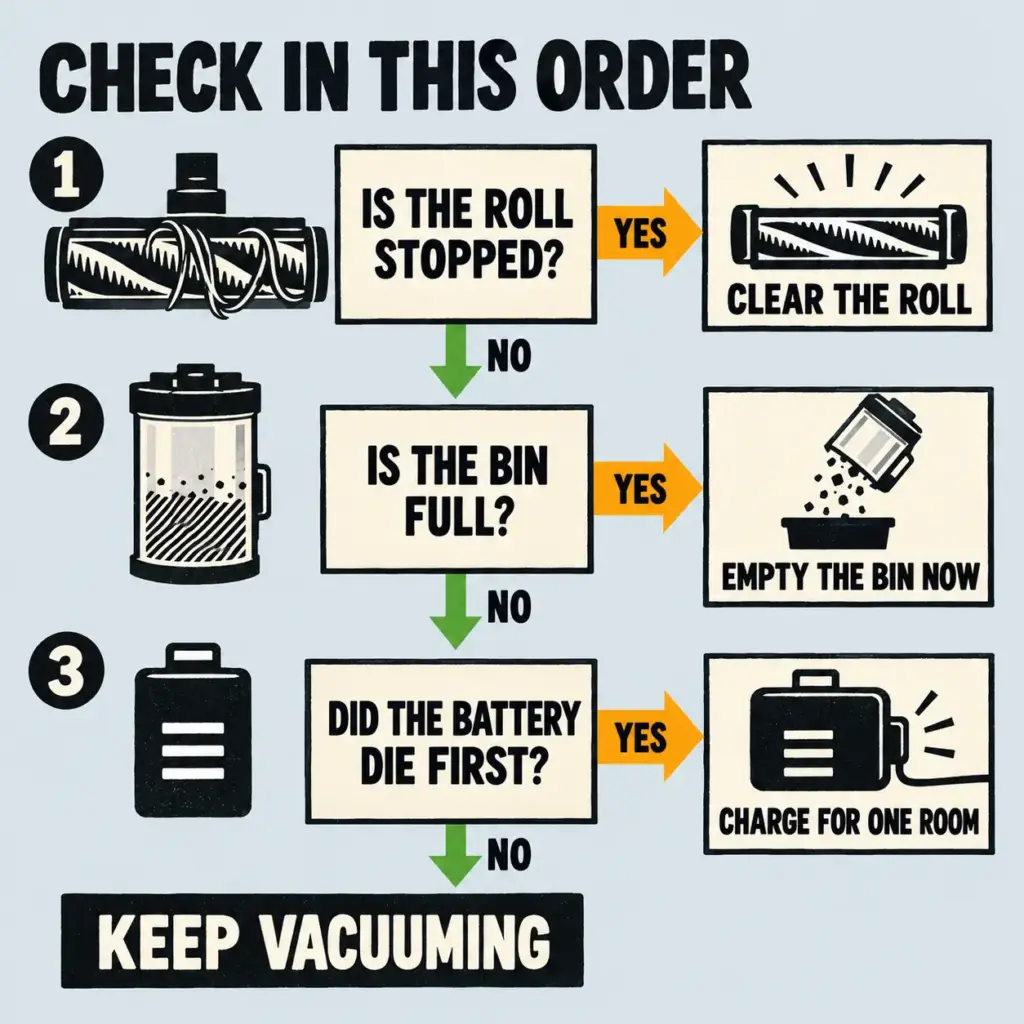
Whatever the machine, the three failures get checked in a fixed order: roll first, because a wrapped roll makes everything after it look worse, then the bin, then the battery. Run through them before each room, and when a pass ends early you will know which one ended it.
Anything that comes off the cat before it reaches the floor is hair the machine never sees, and brushing the cat on a schedule adds more usable minutes to the week than any battery upgrade.
What nobody publishes, and the log that fills the gap
There is no honest universal figure for minutes per room or for bin fills per week, because coat length, cat count, floor type and machine all move it. The numbers that matter are yours, and you can have them in three weeks with a pencil. Each week, write down:
- how many charges the week took
- how many times you emptied the bin
- how many times you freed the roll
Treat bin fills the way you would treat a hair count: a rough comparison between weeks on the same machine, not a verdict, because why counting hair misleads applies to cups just as it applies to the floor. The weekly pattern of the shedding itself is laid out in how long shedding lasts, week by week, and the log is the same gesture pointed at the machine.
Hard Floor, Rug, Couch and Stairs: What Each Surface Does to the Machine
One machine meets four surfaces and fails four different ways, so the surface matters more than the brand. In a rental you cannot swap the floor, which means you adapt the habit instead.
Hard floor: hair rolls, litter scatters
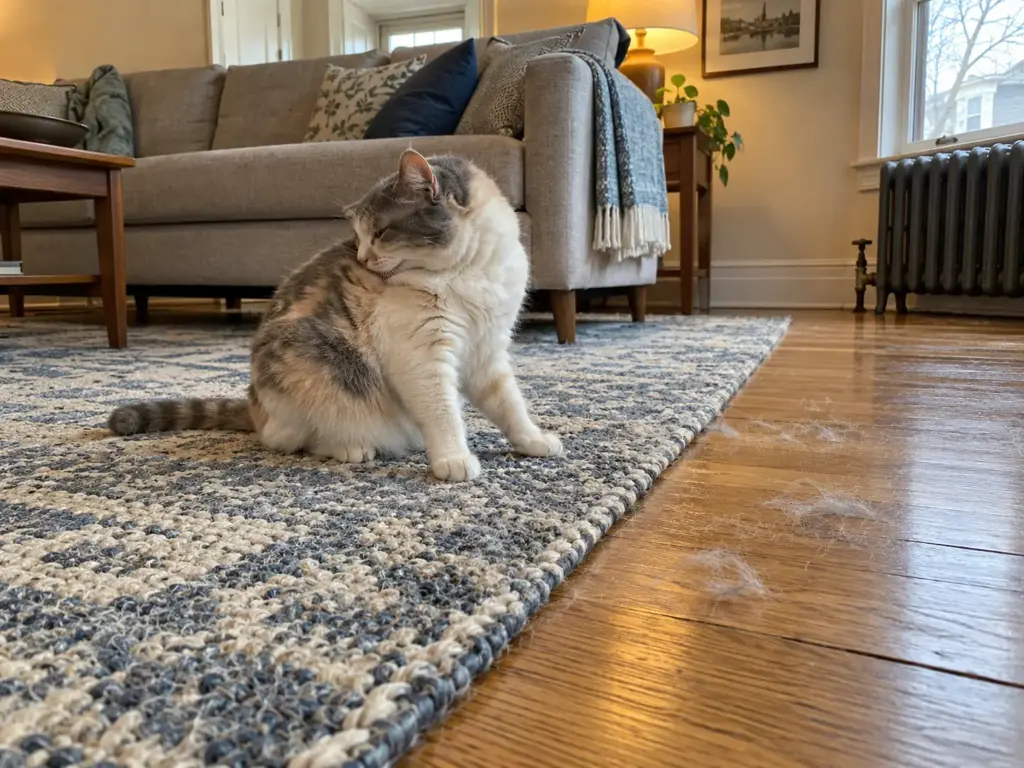
Hair on hardwood floors drifts ahead of the cleaner head, and pellet litter does worse. carteroneil’s cordless “doesn’t really work for the litter (pellet types) on my hard floor, super frustrating! Just pushes it around.” A stiff brush shoves pellets in front of it, a mismatch between the floor and the head, not anything the cat did.
Another owner loves a soft-roller head for litter dust on hard floors and says it works less well on carpet, a reminder that a head suits a floor, not a house. For the pellets themselves, Chemical_Pomelo_2831 skips the machine: “As far as cat litter, I use a broom as I’ve never found anything that works better.”
Rugs and carpet: the hair goes in the weave
A rug keeps hair where a floor lets it roll, so what is left after a pass is the embedded kind. More power does not solve it and can create a second problem. kirstyyycat666 says a pet upright “sucks so hard it’s actually difficult to push over dense rugs.” A machine you wrestle across the rug gets used less often, which lands you back at the closet.
Drag a rubber window wiper toward you across a cushion before the machine touches it, then vacuum the line it leaves. Lowland-lady says the rubber “pulls the hair out,” a trick used at a shelter on cat towers.
Couch and cushions: the tool, not the machine
The couch is mostly a tool problem. The floor head never goes up there, so the upholstery tool decides the result. SleepyChapstick’s complaint is exact: the squeegee that works well elsewhere “does not jump up in my sofa and clean that,” and the roller tool they tried instead messed up the fabric.
The fabric does most of the deciding. huggsypenguinpal’s couch is a “performance velvet” that does not trap fur, so a machine works well on it, and for woven furniture a cover goes over the couch cushions and moves aside to sit.
For anything in between, MsSloth420 uses a small squeegee “to get all the hair into a pile,” then lets a cordless wand “pick up the pile of fur.”
On stubborn fabric, ditchdiggergirl adds that “a pair of rubberized gardening gloves also works well,” a rubber glove that gathers the hair into a clump the crevice tool can reach. Cat hair off a rented couch, fabric by fabric goes through the fabrics one at a time; here it is only the machine’s part.
Stairs: the rented-place problem
Carpeted stairs are where the big machine goes to die in a rental. You haul it up, balance it on a tread, and quit halfway. Chemical_Pomelo_2831 skips the vacuum on the stairs and works the carpet with a small hair tool instead. The carpet is not yours to replace and the stairs are not worth a second machine, so look at them once a week with a stair tool light enough to carry in one hand.
Upright, Stick, Handheld or Robot: Picking the Type by the Failure You Can’t Live With
Each type protects you from a different failure of the three, so the question is which one you tolerate least. Buying picks are a separate question, and this page does not make them.
Corded: the battery stops being the problem
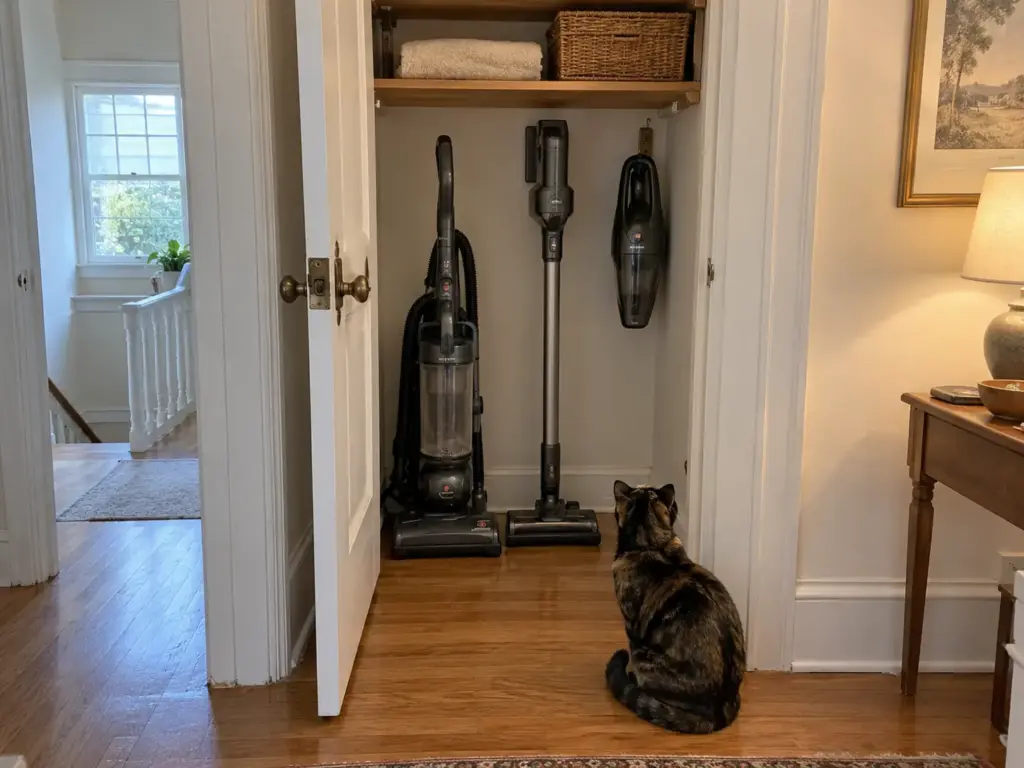
A corded vacuum ends the battery question and starts a different one. Severe-Explanation loves a corded pet upright but admits “it’s heavy,” and Xarama does not want to be “dragging the cord everywhere” for a quick job. The common pick is cordless, and the condition that flips it is a whole apartment in one session: when the job is long, the cord is the smaller failure.
Cordless: the one you actually pull out
A cordless stick vacuum is the machine that gets taken out, and the one that gets used beats the one that is better on paper. The failures of the first two sections arrive here fastest, because the cup is small and the pack is finite. Plan for the scissors, the early emptying and the room-by-room battery.
Handheld: the daily grab
goblin-fox, who shares a home with two dogs and two cats, calls their handheld a lifesaver because “it’s super easy to just grab and suck up little messes when I don’t want to get out my regular vacuum.” Handhelds are for the quick patch, not for litter, as gorillamyke’s engine found out. Use one for the daily tuft and leave the weekly job to something bigger.
Robot: it moves the hair into the corners
Robots run on a schedule, which is their strength, and they fail on hair the way the rest do. Academic-Pangolin883 reports that on theirs “cat hair gets stuck in all the nooks and crannies, and even sticks to the rubber wheels.” Whether a robot can carry the load is its own question, and this page does not try to settle it. With a multi-cat home or a long coat, the roll and the bin fail sooner whichever type you pick, and one cat with a short coat gives you the most slack.
Filters and Bags: What Stays in the Room When the Hair Goes in the Bin
The air in the room is the last stop on the route, and it depends on what the machine holds back. The fine dust that comes with cat hair either stays in the bag or the cup, or goes back to where you started.
Bagged or bagless: where the dust goes when you empty it
Owners disagree on almost everything, but matdragon is firm on this one: “having a bag is way better.” A bag is changed less often than a bin is emptied, and it is tied off and thrown away in one move. It still fills, and the school page’s rule holds for it too: change it often and do not let it become full. If your machine is bagless, tip it into the trash bag slowly with the opening held close, because a shake is where the loose dust leaves.
A washable filter that slips out
A filter that is not seated is not a filter, and some slip out of their seats. Check the fit each time the bin comes off. UncleGurm uses a pet-hair machine for a first pass and a second vacuum for the deep clean, a reminder that a machine can be good at hair and ordinary at fine dust. If anyone in the household reacts to the dust, that is a question for their doctor, not a filter spec.
The Cat’s Side: Why the Machine Gets Used Less Than You Think
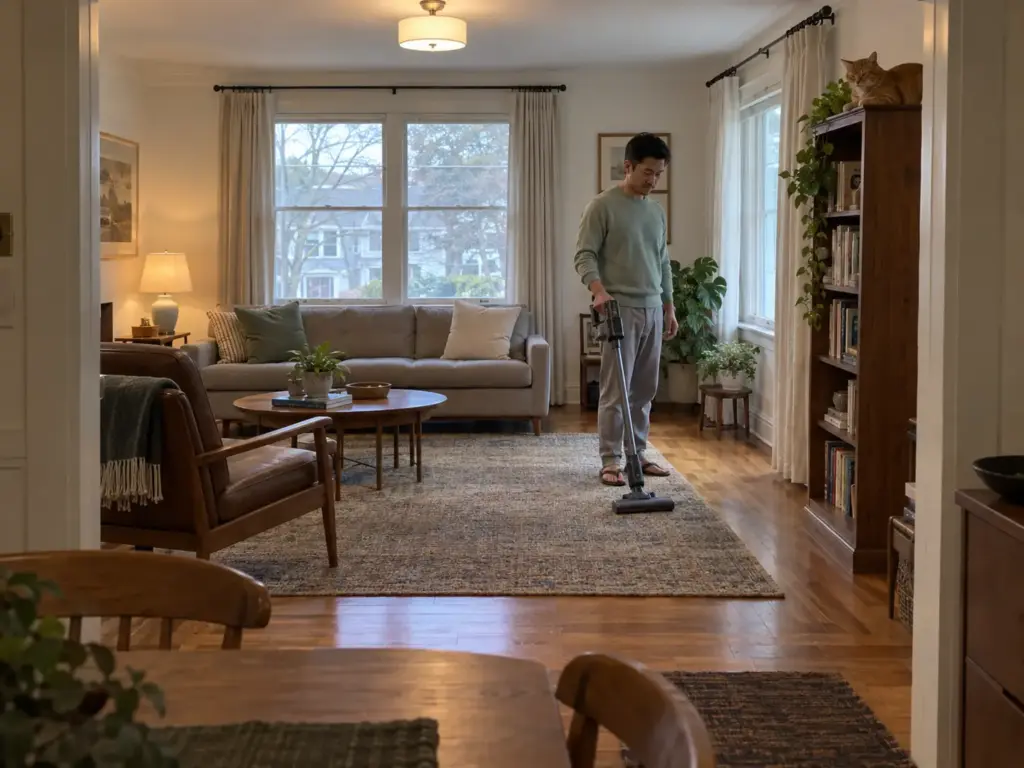
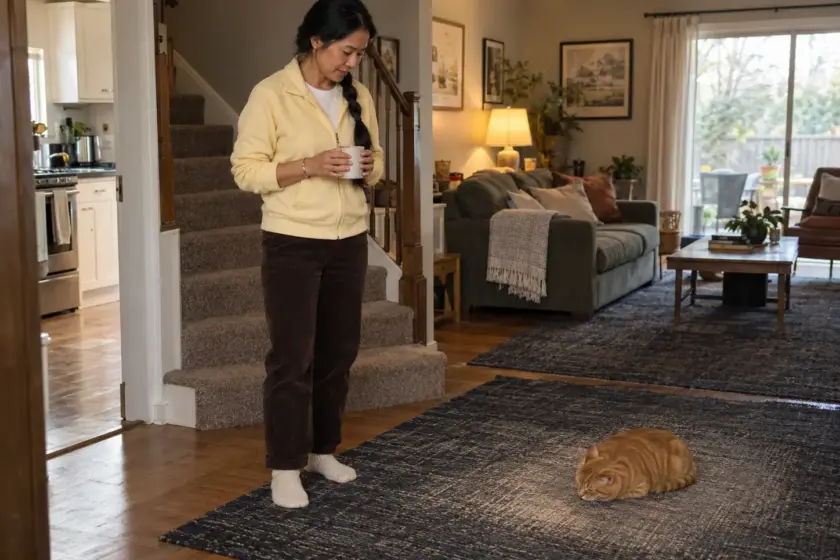
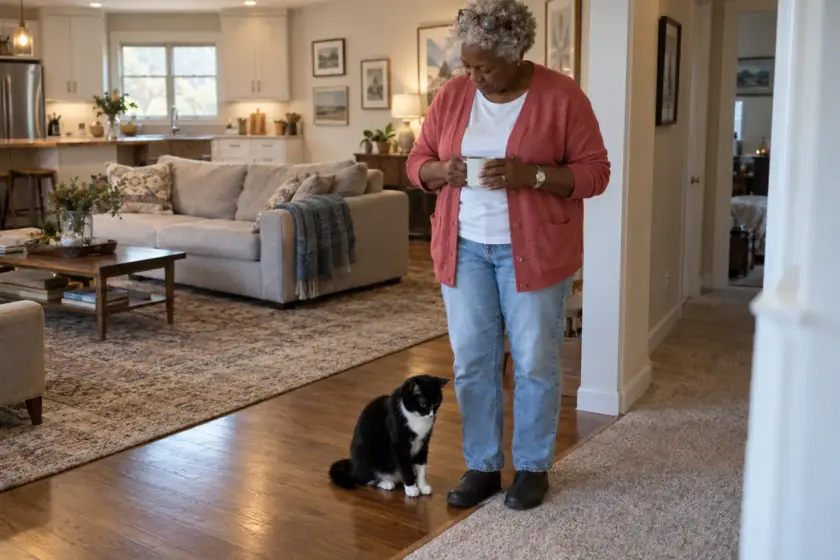
Picture the apartment from the floor. A motor starts in the room where he is sleeping and it does not stop for twenty minutes. He leaves, you vacuum the next day instead, the hair has had another day to spread, and the machine you bought to keep up with the cat gets used less than you meant it to.
Noise is a restriction, not a preference
When the cat and the person disagree about the vacuum, the cat is describing a constraint and the person is describing a preference. The constraint is the noise, which carries through every wall of a small apartment: there is no room far enough away to make it a different sound, only a somewhat muffled one. The preference is vacuuming today.
A cat who leaves the room has made the sensible choice for an animal with a motor in his living room. He is not misbehaving, and he does not owe the machine any courtesy.
It also costs you. A machine that sends the cat out of the room is a machine you start later and finish sooner, and both shortcuts mean more hair per pass. So the noise is not a side issue to the three failures; it feeds them.
One cat and two cats change the plan. With one cat, the route is a single line from the room you are in to the room he has chosen. With a multi-cat home, each cat picks a different refuge, and the machine has to be planned around all of them at once. The cat’s route is the first thing to plan for.
The route the cat takes when you start
A cat leaves by the exit he can reach without passing the thing that scares him. Imagine the order: you start in the bedroom, the door is the only way out and the machine stands in front of it. In an apartment where every room opens onto one hall, the order of rooms is the only lever you have.
The time of day is the second lever, and it costs nothing. Pick a window when the cat is already awake and settled somewhere else, such as after a meal, and use the same window each week so the machine becomes part of a routine instead of a surprise. A cat who has seen the machine come out at the same hour on the same days has one less thing to read from the room.
- Start in the room farthest from where he sleeps, with the exit behind him open.
- Leave interior doors open so he can retreat out of its reach.
- Vacuum the room he is not in, then move on once he has settled somewhere else.
With two cats the map gets a second tenant. The one who bolts runs toward the room where the other is lying, and a hallway that was an exit for one becomes a meeting point for both.
If they share a bed, do that room last, after both have moved on, so neither ends up between the machine and the other cat. And if one of them comes to watch instead of leaving, that is no problem to solve: it is the cat telling you the machine is already furniture to him.
Leave the machine out in the hallway the evening before you plan to use it, switched off and unplugged. It stops being an event and becomes furniture.
Let the cat watch it switched off first
The usual sequence is slow and boring, which is why it works. Put the machine out, off, in a corner of a room he uses, and leave it there for days. Move it a little closer over time, and give him a reason to stay nearby, such as a treat, until he stops reacting to the sight of it.
Only then switch it on, at a distance, for a few seconds. Short runs far from him come first, longer runs closer come later, and the first sign of stress sends you back a step. The goal is not a cat who loves the vacuum. It is a cat who stays in the room on a day it runs.
Free the Roller Today, Then Log the Charges for Three Weeks
The guide comes down to three moves. Free the roll before you spend anything, because a wrapped roll fakes every other fault. Empty the bin before the room is done, not after, and keep a hand on the neck and the filter seat.
Match the battery to one room, and move the cat’s route in front of the machine’s. If the hair keeps coming back after all that, the problem is where it lands, which is the work of fixing where the hair lands.
Three weeks from now, open the log. If the number of roll frees, bin empties and charges all fell, the order worked. If one of them stayed high, that is the failure to work on next, and the other two are probably fine.
Today, take the battery out and look under the head. Cut away whatever has wound onto the roll, and notice how much longer the first room lasts. Then look at grooming the cat ten minutes a session, because every strand that leaves on a brush is one the machine does not have to carry.
Frequently Asked Questions
01How do I get cat hair off a vacuum roller?
Pull the battery or unplug the machine, then cut along a groove of the roller with scissors and lift the hair away in strips. Most cordless heads have a release button for the roll. Human hair wraps more than cat hair, so expect a few times a year.
02Why does my vacuum push litter around instead of picking it up?
Pellet litter rolls ahead of a stiff brush on a hard floor, so the mismatch is between floor and head, not the cat. Litter dust can also work into the housing, so a small handheld is a poor match for litter. A rubber mat at the box catches the first scatter.
03How long does a cordless vacuum battery last with cat hair?
A new cordless runs about 20 to 60 minutes per charge, though makers claim anywhere from 20 to 200, and owners report the time shrinking within a few years. There is no reliable minutes-per-room figure for cat hair, so keep a log of your own week.
04Is a cordless vacuum enough for a rental with a cat?
For one floor and a light daily pass, yes; for the whole apartment in one go, the battery runs out first. Owners pair a light cordless or handheld for daily grabs with a bigger machine once a week.
05How often should I empty the bin?
Before it is full and before the room is done, because a full bin costs the machine its efficiency. A small bin means more trips and a big one fewer, but neither empties itself.

Leave a comment