How to Share a Small Apartment Between Cats and Kids
Tape one line on the wall, then build the cat's route, door and litter box around it to share a small apartment with cats and kids (renter-proof).

Alfredo RamsesFounder · November 10, 2026 · 26 min read

On this page11 sections
- 1Cats and Kids Start With One Measurement, the Reach Line
- 2Where the Layout Stops and a Professional Starts
- 3Which Cat Fits a Home With Children
- 4A Safe Room, One Closed Door, and Why the Crib Wins the Cat's Vote
- 5The Child Learns the Cat, Never the Other Way Round
- 6The Room That Used to Be the Cat's
- 7Who Scoops, Where the Box Goes, and What a Crawler Can Reach
- 8The Timetable That Starts Before the Baby Does
- 9Two Cats, One Child: Two Routes Out and Never a Corridor
- 10Measure Once Today, Then Watch Where the Cat Goes
- 11Frequently Asked Questions
Your daughter has just worked out that a chair turns the top of the bookcase into somewhere she can reach, and the cat who naps up there has worked out the same thing. That is the moment cats and kids stop being a question about temperament and become a question about the layout of one small apartment. The cat holds the only high ground he has, and the child is a new roommate who cannot read the lease. This guide shows how to share a small apartment between cats and kids by moving the furniture instead of the cat: the one measurement that sets the layout, the point where a professional takes over, the cat that fits, the safe room, the handling rules, the litter box, the nursery timetable and the two-cat version.
Quick Answer
Measure your child standing with one arm straight up, then run the cat’s route above that line with a second way down. Give the cat a door the child can’t pass, decide who scoops and where the box sits, and hand every medical question to the vet or the child’s doctor.
Cats and Kids Start With One Measurement, the Reach Line
Walk through your apartment at your child’s height and almost everything you called high turns out to be a step away from her hands. The bookcase, the top of the fridge and the windowsill all look out of reach until a chair or a toy chest slides underneath. One measurement sorts that out, and every other decision about where the cat lives follows from it.
Measure the Child With One Hand Up
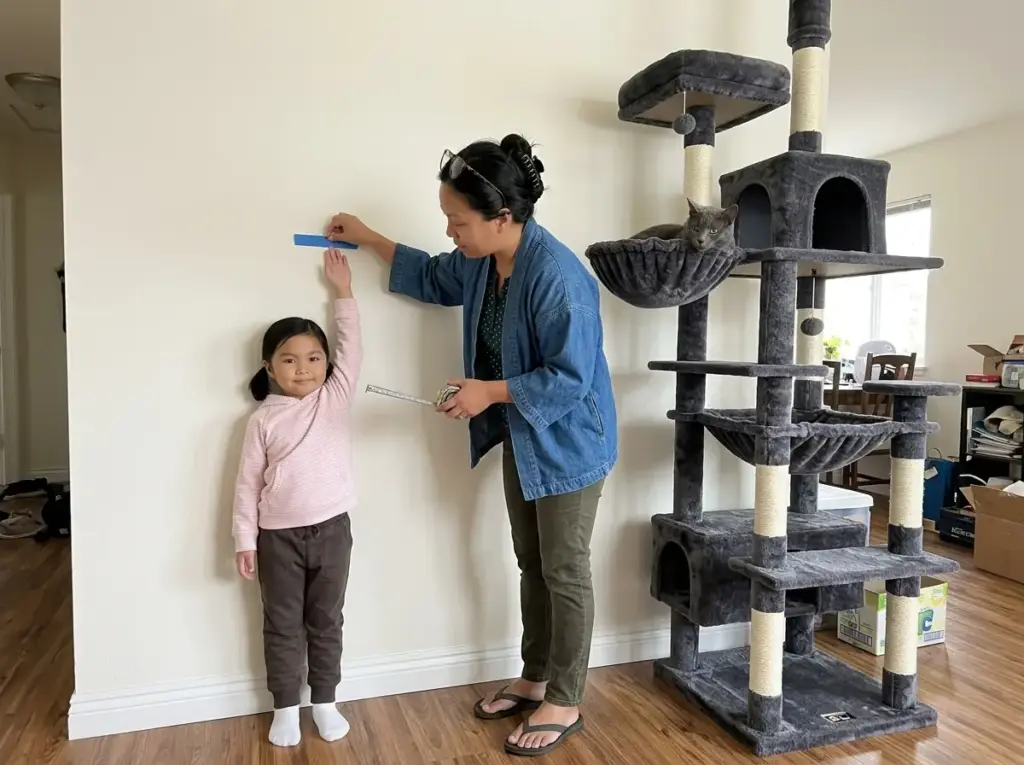
Stand your child against a bare wall with one arm stretched straight up and stick a short strip of painter’s tape at the level of her fingertips. Read the height with a tape measure and write it on the tape. The cat stays out of the room for this, and painter’s tape leaves a rental wall alone.
That mark is your reach line, and it belongs to your child. It goes out of date in weeks, not years, so measure again at every growth spurt, which in practice means the week her pants stop fitting.
Child-safety guidance from Victoria, Australia puts a locked cabinet at least 1.5 meters (about 59 inches) off the floor, and 1.7 meters (about 67 inches) for tall children. Those figures are for a cabinet with a lock, not a shelf, but they show how far above a standing toddler’s fingertips things are meant to sit. A cat tree that clears five feet clears that ceiling too.
Shut the cat in another room before you start, because a cat who sits beside the wall will be helping by the second try. Photograph the tape next to the tape measure each time. After two growth spurts the photos show how fast the line moves.
Put the Cat’s Route Above the Line, and a Second Way Down
Once the line is on the wall, his high route goes above it. According to the AAFP and ISFM environmental needs guidelines, “Access to an elevated area increases the cat’s vertical space and allows it to monitor its environment.” In a home with a toddler, height does a second job: it takes him out of reach without taking him out of the room.
The route also needs a second way down. A barrier leaves a cat with nowhere to go, while a route lets him leave, and a cat who cannot leave a corner will use the only defense he has left. That is the same logic behind why cat territory in a small apartment comes down to exits, not floor space.
And the perch has to be wide and long enough for him to stretch out full length. A four-inch ledge is a rim, not a perch, and a cat who skips it has not made a route.
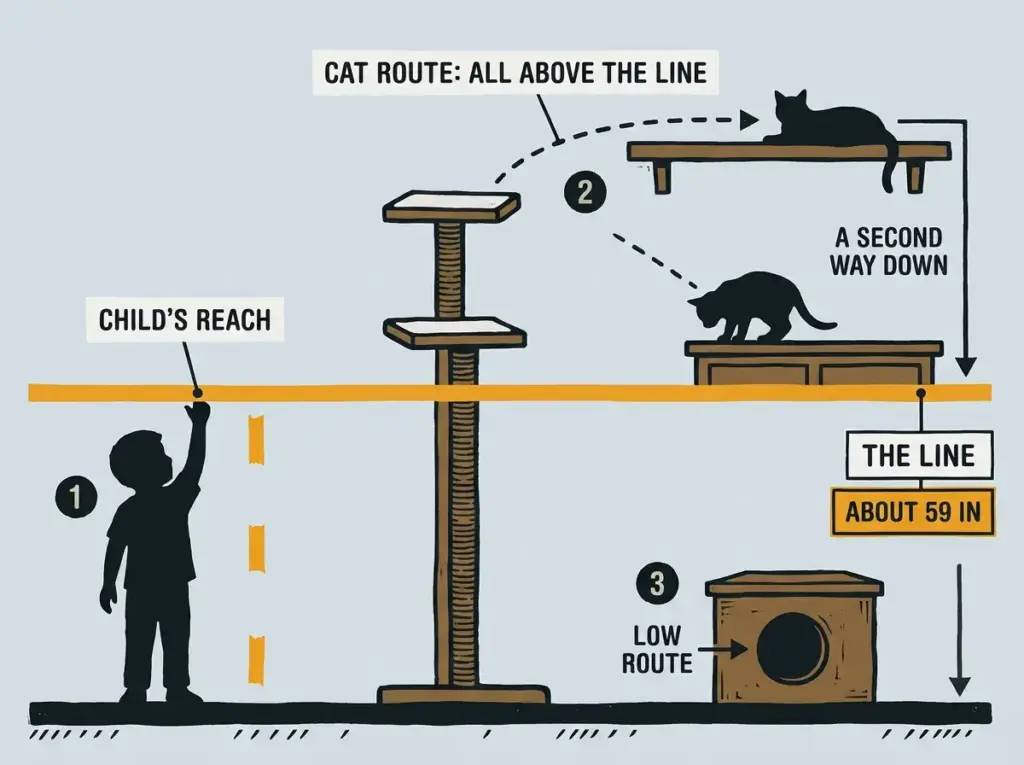
Start with what the apartment already gives him. Clear the windowsill and widen it with a sturdy board if it is narrow, keep the top of the bookcase he already uses and put something low beside it for the way down (or a wall shelf, if the lease allows drilling), and shut a door wherever a door will do. Check every spot against the tape: a perch that sits under the line is one the child’s chair reaches first.
If the apartment has no high ground to give him, the PAWZ Road 72 inch Cat Tree stands 72.4 inches tall, well above the 59-inch figure, on a 21.6 by 17.7 inch footprint. The 20 by 16 inch hammock is the lookout, and the covered condo (21 by 12 by 10 inches), which works as a cat den, gives him the low route in the same piece of furniture. Its weak spot is consistency: the build varies from one unit to the next, it can feel smaller in a room than the numbers suggest, and it needs a ceiling with clear space above it. A shorter tree of about 54 inches costs less and tops out below the 59-inch figure, so it only fits a home where your own tape mark sits well under it.
The Line Is Not a Wall
A reach line holds only while nothing sits underneath it. Boston Children’s Hospital’s childproofing guidance points out that items above floor level can still be within a toddler’s reach, and ConsumerMedSafety, a project of the Institute for Safe Medication Practices, reports that about half of childhood medicine poisonings in the US involve a child climbing on a chair, a toy or another object to get at the medicine. A child who wants the top shelf builds a staircase to it.
So the line comes with a second job: remove whatever she can push to the wall, and anchor tall furniture, because the Consumer Product Safety Commission asks for it, since a climbing child can pull a bookcase over. In a rental, that means asking the landlord before you drill. A closed door beats a high shelf every time, and the safe room below is built on that.
Where the Layout Stops and a Professional Starts
Almost everything in this guide is furniture, routes, litter and doors. A few things you will notice while you rearrange are not, and this is where the house stops explaining them.
The Cat Whose Habits Change Overnight
A cat who stops eating, drinks far more or far less than usual, uses the box differently, hides for days or loses weight has had a habit change from one day to the next. Call the vet before you move a single thing. This guide does not say what any of those changes mean, and a floor plan cannot tell you.
A Cat Scratch or a Cat Bite That Breaks the Skin
A cat scratch or a cat bite that breaks the skin goes to your child’s doctor, and whether it needs treatment is their decision. What a house can do is make the scratch less likely: the route above the line, the door that closes, a regular nail trim and the handling rules further down.
A Child Who Reacts to the Cat, and a Positive Test
Sneezing, itchy eyes or wheezing around the cat is a question for the child’s pediatrician, and nothing here says whether it is an allergy or what to do about it. The part that belongs to the house is dust, dander and hair, and how long cat allergen lingers in a home covers how that clears. A positive toxoplasmosis test, or a doubt during pregnancy, is for the pregnant person’s doctor. The litter section below says what a veterinary college and the ASPCA say about the box, and stops there.
What does belong to the house is the cat who hides because he has no way out of the room, or who hisses at a child who never approached him. Those are the subject of everything else here. Introducing a cat to a newborn, keeping a cat out of the crib, how a cat and baby get along, teaching children to touch a cat and toxoplasmosis in pregnancy each get only a clause in this guide, and none of them replaces the person who can examine your child or your cat.
Which Cat Fits a Home With Children
Whoever lives in your home already, or arrives soon, is a tenant whose lease never mentioned a child. Which cat fits depends on whether you are choosing him or he was there first, and the answer for both starts with how much room he has to leave.
An Adult Cat Over a Kitten, for a Small Child
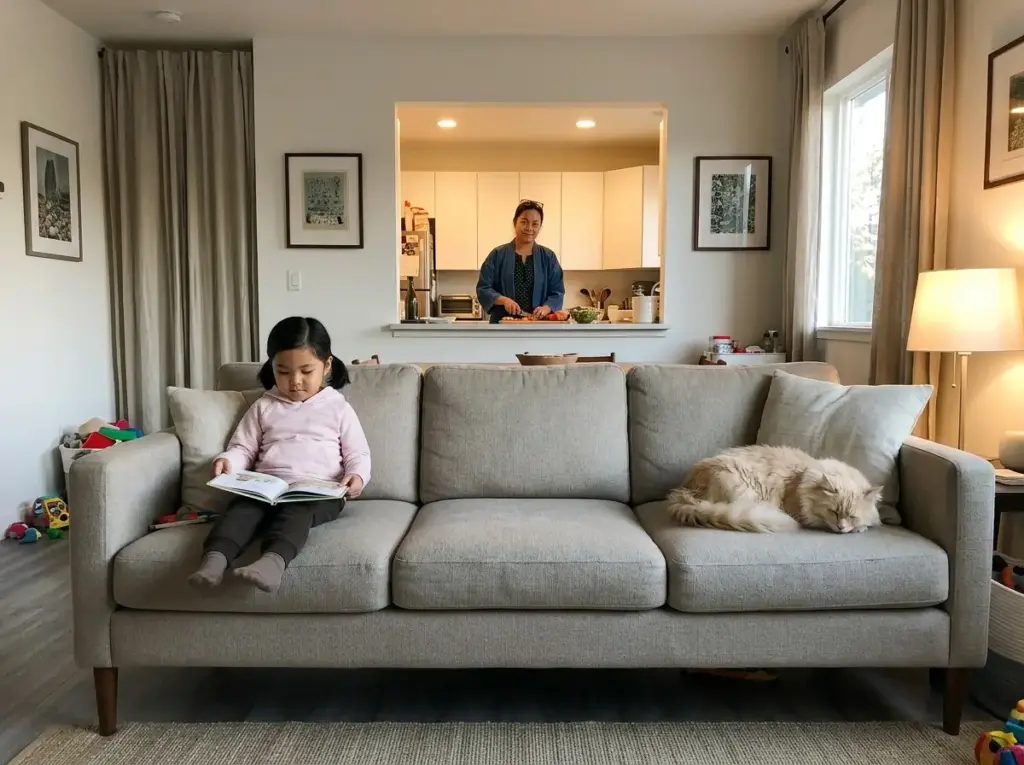
On adult cat vs kitten, American Humane recommends for children under five or six a cat two to three years old or older. A kitten is fragile and his claws are sharp, and a small child does not yet have the hands for either fact. There is a timing problem as well: the kitten is an adult within a year, while the child stays clumsy for much longer.
The cat the child inherits matters just as much. If he is eight and has had the sofa to himself for years, he does not need replacing, he needs a route and a door. The layout in the first and fourth sections gives him both, and a settled adult with an exit will usually adjust faster than a cat who is cornered once a day.
Meet the Cat More Than Once
With a shelter cat, meet him more than once, and then with the child present. The third visit shows more than the first: does he come over, drift away, or stay in the room when the child moves quickly? A cat who stays in the room and leaves when the noise starts has told you what he can live with, and he is describing a real limit, not a mood.
Temperament Over Looks, Breed Included
In the 2018 survey of 865 families, 57 percent of the cats were domestic shorthairs and 11 percent were domestic longhairs, so most family cats are mixed-breed and the label on his card tells you little. The useful lesson is to judge the individual cat in front of you.
The child is the one member of the household the cat did not choose. He takes that roommate the way he would take any other, with one more restriction on his space. Whether to rehome a cat for a medical or behavioral reason is a conversation for the vet and the child’s doctor, and no layout settles it.
A Safe Room, One Closed Door, and Why the Crib Wins the Cat’s Vote
Telling a family to keep the cat out of the nursery is half an instruction. The other half is where he goes instead, and in a small apartment the answer has to be a room he would pick himself.
The Cat’s Room Has Two Ways Out
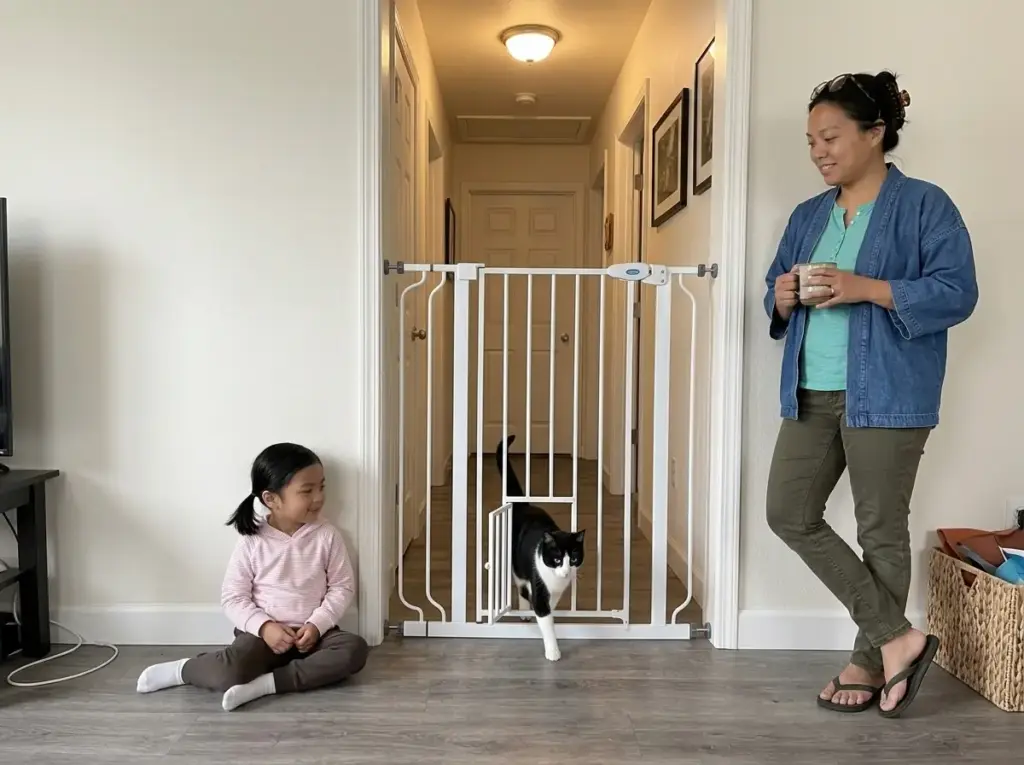
The safe room, his base camp, holds everything he needs: food, water, a litter box, a bed, toys and at least one hiding place, with a high route and a low one. AAFP and ISFM add that a safe place should have more than one entry so that nothing can easily block it, which in a home with a crawler means the child too. If more than one cat lives there, the box count goes up by the 1+1 rule. And the room is the cat’s, not the child’s: the Wisconsin Humane Society says young children should never follow the cat into it.
Stand in the doorway and ask whether a child sitting there could trap him inside. If the room has a single entrance and the answer is yes, it is a closet with a bed in it, and he will treat it like one.
The Closed Door Costs Nothing, and a Gate Is Not a Wall
The cheapest barrier in the apartment is a door, and a closed nursery door is the cheapest of all. Close it during naps, close it when you cannot watch, and a landlord never sees it. For a cat and toddler in one small apartment, a door beats a gate because it leaves no gap, no top rail to climb and nothing to hold on to.
The obvious pick for a doorway is a gate with a cat door, and in most homes it is the right one. The Carlson Extra Tall Walk-Through Pet Gate with Small Pet Door is 36 inches tall, fits openings from 29 to 36.5 inches wide, pressure-mounts without drilling and has a 7.5 by 7.75 inch door cut low into it. The cat walks through at floor level and the child meets a wall. The limit is the doorway: an opening wider than 36.5 inches, or one with no frame, needs a different answer.
The walk-through door is 16.5 inches wide, which is tight for some adults, the latch can be stiff and some door frames show wear after a while. If the doorway has a door of its own, a plain pressure gate plus a door strap is the cheaper route, and which pet gates with a cat door fit a rental doorway sorts the options by opening.
None of this makes a pet gate a child’s gate. As the Consumer Product Safety Commission’s childproofing guide puts it, “Pet gates should never be used as a child safety gate.” A baby gate at the top of stairs is screwed into the wall.
A pet gate only buys the seconds it takes you to reach the child. It is never the supervision.
Why the Crib Is the Best Bed in the House
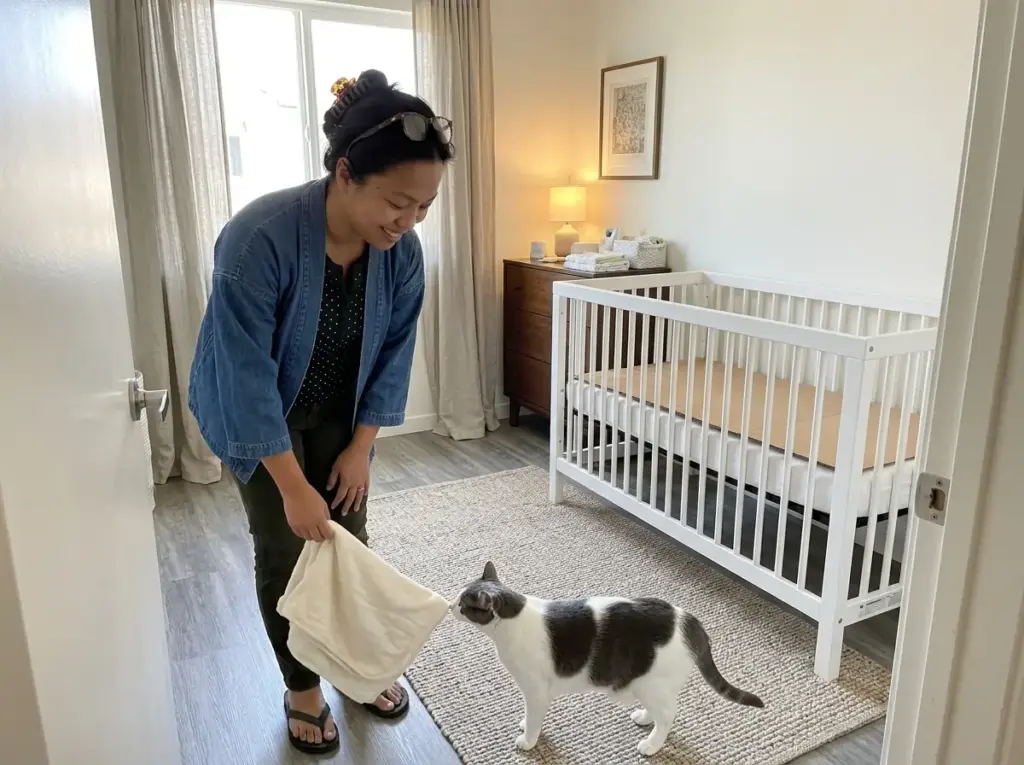
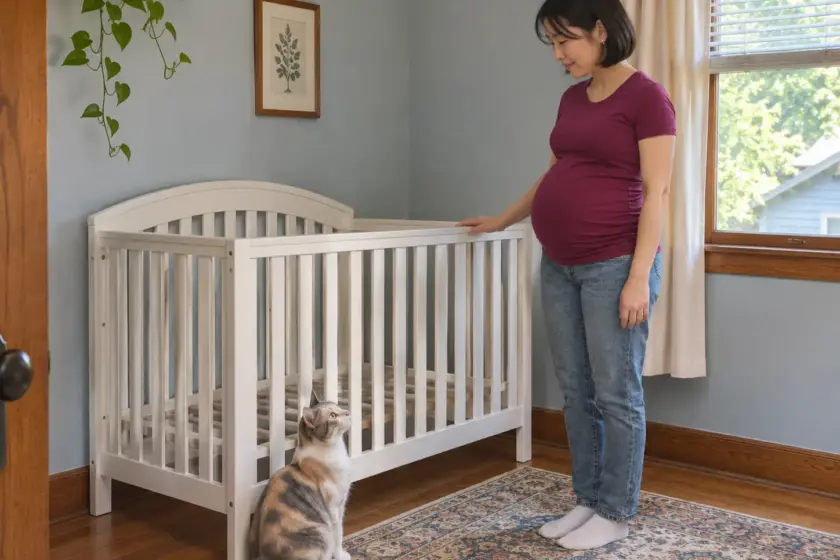
The crib is the highest, warmest and softest surface in the apartment, and now it smells like the newest member of the household. A cat looking for a warm place has picked the best bed in the house, and no scolding changes that. What works is a substitution: a spot as high, as warm and as soft as the crib that belongs to the cat, such as the top of the tree or a window perch in winter sun, plus a door that closes during naps.
The ASPCA says to turn the crib and the changing table into an unwelcoming surface at least a month ahead, with cardboard and double-sided tape. The crib is never the cat’s bed, and he does not end up in it by accident one day. If a cat chooses the crib to urinate, that is a question for the vet and not a training task.
The First Week Behind the Door
The cat learns his room the way he learns anything: in small pieces. Close the door for a few seconds with a treat in the bed, then for a few minutes, then for a couple of hours, and keep the room quiet and low in volume so it stays the place where nothing happens. If you sit in it with him, sit still and let him decide whether to come over.
The child has a task too, because she is the one who is learning the house. Show her the closed door and what is on the other side of it, and tell her that no one follows the cat in. The same stage-by-stage logic, with a stop rule for when he has had enough, runs through how to introduce cats in a small apartment, stage by stage.
The Child Learns the Cat, Never the Other Way Round
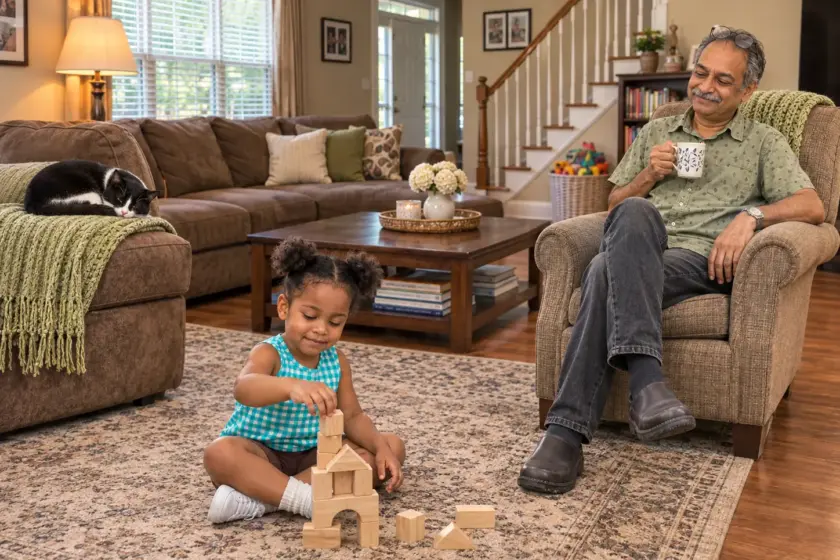
The most honest win in the child-cat relationship is not a cat in a lap. It is a cat who stays in the same room as the child and leaves when the noise starts.
Hands Out of the Way Until the Cat Asks
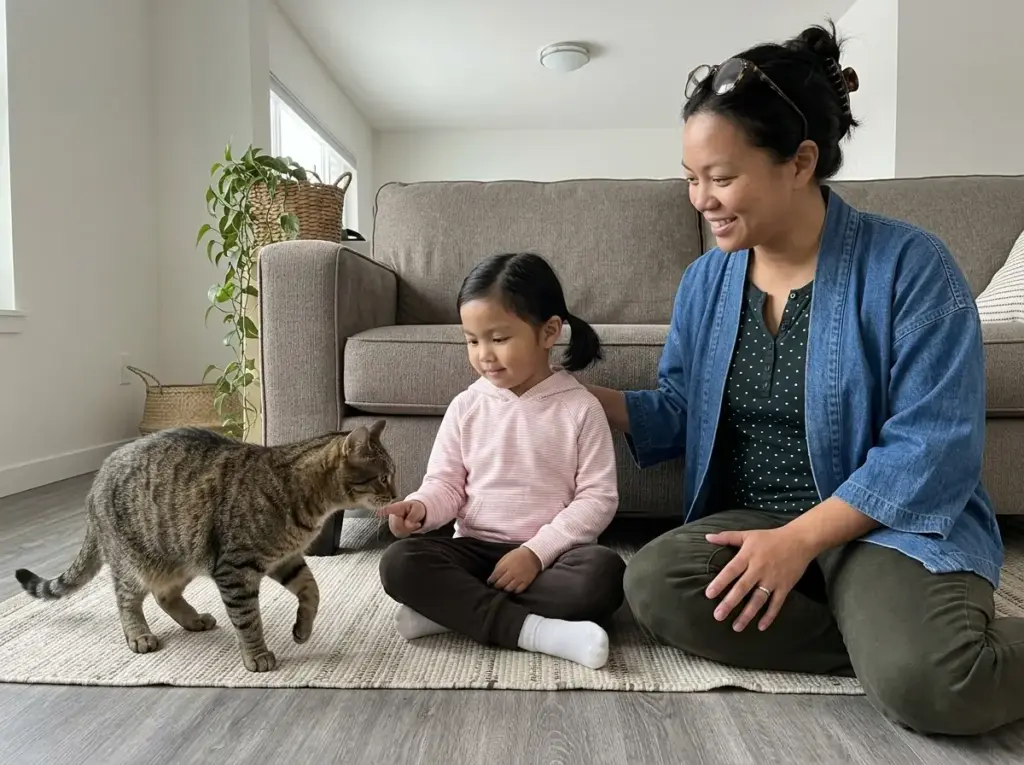
The first rule is the hardest for a four-year-old, the hands-off rule: hands stay out of the way until the cat solicits attention by walking over and asking. The child sits still, an adult sits beside her, and she offers the finger sniff, one finger held low. No carrying him like a ball, no belly rubs, no hugging or kissing.
Some places are never touched, whatever the cat is doing: while he eats, while he sleeps and while he is in the litter box. Nobody pulls him out of a hiding place either. The child learns the cat, and the cat keeps the vote on every contact.
Passive shared space is the first win: the child draws at a table while the cat works at a treat-dispensing toy on the far side of the room, and nobody touches anybody.
The Three-Second Round
The Wisconsin Humane Society teaches the three second rule for children over five, a petting round that works like this: three seconds of petting, hands away, then a look at the cat. If he walks off, it is over. If he nudges a hand or leans in, three more seconds are allowed, and then the child looks again. He is never held in place for it.
Count the three seconds out loud with her, then say “hands up” and make a game of lifting both. A child who has her hands in the air cannot be the reason the cat leaves.
Read the Tail and the Ears
Teach the child cat body language, starting with the tail. A tail flick or a tail twitch is not a happy tail. Flattened ears, ears swiveled to the side, dilated pupils, a hiss and swatting are the next steps up. Teach the child to read them as the cat asking for the interaction to end, because that is what they are.
The cat who scares himself is the one adults misread. He comes out to see what the noise is, notices the child, and swats a second late at a child who was never approaching him.
She screams, he takes the scream as confirmation, and the cycle of screaming and hissing repeats every time the same child visits. A correction does not break it. A route out of the room does, and the cat who leaves when the noise starts has won the only argument that counts.
The Toy Cat and the Wand
For the child who insists on a cuddle, a plush double of the family cat, with the same name, takes all the hugging she can give it. Gentle hands practiced on the toy are what she then tries on the real one, when the real one is asking.
For play, use wand toys, a feather wand with a long handle, never a small toy in a hand. In play he is in prey mode, pouncing at whatever moves, and petting during play can overstimulate him and end in redirected play, a swat at the nearest hand. The AAFP and ISFM guidelines say to keep hands and feet out of any type of play, and that settles the argument about whether he will learn on a hand under the comforter. No petting during play, and none right after it, either. The child’s age-appropriate handling follows a ladder that is a house rule, not a standard, and each step is earned with the cat, not with age:
- Youngest children, the three to five year olds, watch, and sit beside an adult who is with the cat.
- A little older, they offer a finger and use the wand with an adult close.
- From six to twelve or so, they give treats and run the wand on their own.
- Teenagers, and children from ten on, take a real share of the work, such as the water and the bowl.
Every contact stays supervised contact: a child is never alone with the cat, and never with a frightened one. Visiting children learn the same rules the moment they come through the door, and the cat goes to his room when they arrive.
The Room That Used to Be the Cat’s
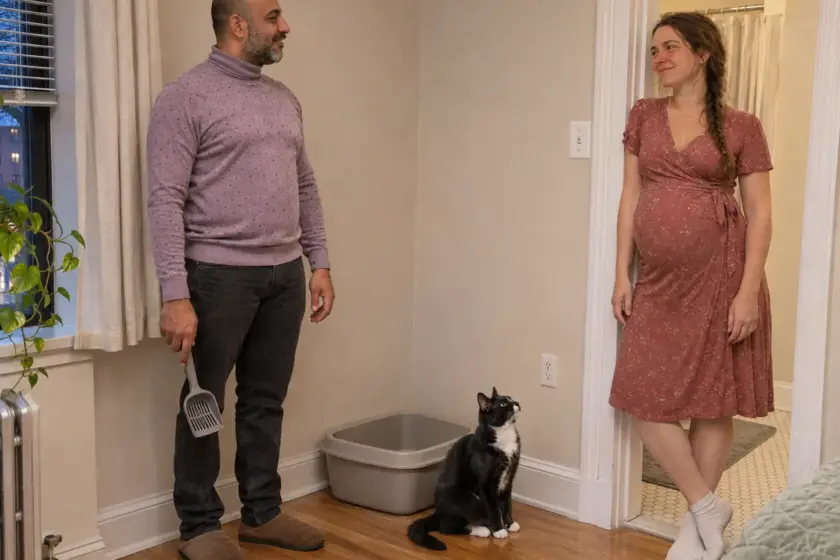
The apartment that makes this hard has one bedroom, a bathroom too small for a litter pan and a living room that doubles as the dining room. If the cat’s room was the only spare one, the nursery takes it and three things move at once: his bed, his box and his door. A box that creeps a few inches a day needs somewhere to creep to, and a one-bedroom has no such place.
One Bedroom, One Nursery, and Nowhere for the Box
Small homes with no spare room usually end up with the box in one of three kinds of place: in the shower, carried out while someone showers; behind a gate of its own; or inside a cabinet with an opening cut for the cat. The shower works until somebody needs a shower (which, with a child in the house, is often), and then the cat has to be able to find somewhere else when the water runs. A gate around the box is the furniture-free version, and a cabinet needs steps if the cat does not jump. The full one-bedroom case is in where a litter box actually fits in a small apartment.
Before you move anything, write down where he sleeps, eats and uses the box this week. Then change one thing at a time. When something goes wrong you will know which move did it.
The Door Cracked to Four Inches
Free first: a rubber wedge or a folded towel that holds the bedroom door open about four inches. The cat passes, the crawler does not. Four inches is also the figure the Consumer Product Safety Commission uses for window openings, and past it a crawling baby’s shoulders fit. A big cat may not fit through four inches, so try it with the cat before you trust it; if he does not fit, the door is not his route.
A strap does the same job without a wedge. The Door Buddy Pet Door Latch for Cats holds the door open between 2 and 6 inches, so set it at four. It sticks on with adhesive, with no tools, no drilling and nothing cut. The adhesive lets go on some door frames and a strap can break, and the maker’s door prop version, which holds the door open 3 to 5.5 inches and replaces the strike plate, does not rely on adhesive alone.
A cat flap cut into a gate or door looks tidier, but a crawler can get through or get stuck in it, and it gives a climber a foothold. If a cut-in door is still on the table, choosing an interior cat door by the real opening shows how to size it, but for a crawler the strap is the safer call.
A High Route When the Floor Is Gone
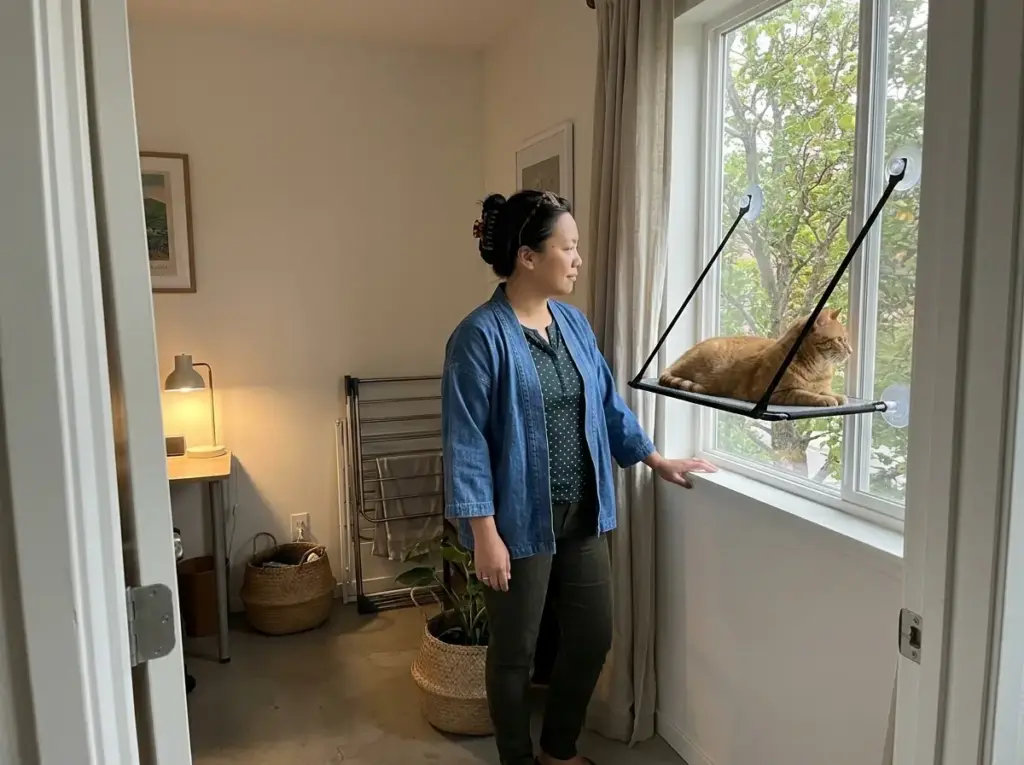
When no floor is left, the high route goes on the window. Clear the sill and widen it first, because it is free. If that is not enough, the K&H Cat Window Perch EZ Mount Kitty Sill has a 23 by 12 inch shelf, fits glass 27 by 23 inches, holds up to 50 pounds and folds up so the blinds still work.
It mounts with suction cups and needs no drill, which answers the renter’s problem. The cups let go on some windows, so press them again each week.
A window perch hangs at sill height, and that may sit below your tape mark. Treat it as his lookout and let the door do the barrier’s work. Give every change days, not one day, and watch how he uses the room before you change the next thing.
Who Scoops, Where the Box Goes, and What a Crawler Can Reach
The litter box brings three questions at once: who scoops, where it sits and how high the walls are.
Twice a Day, and Preferably by Someone Else
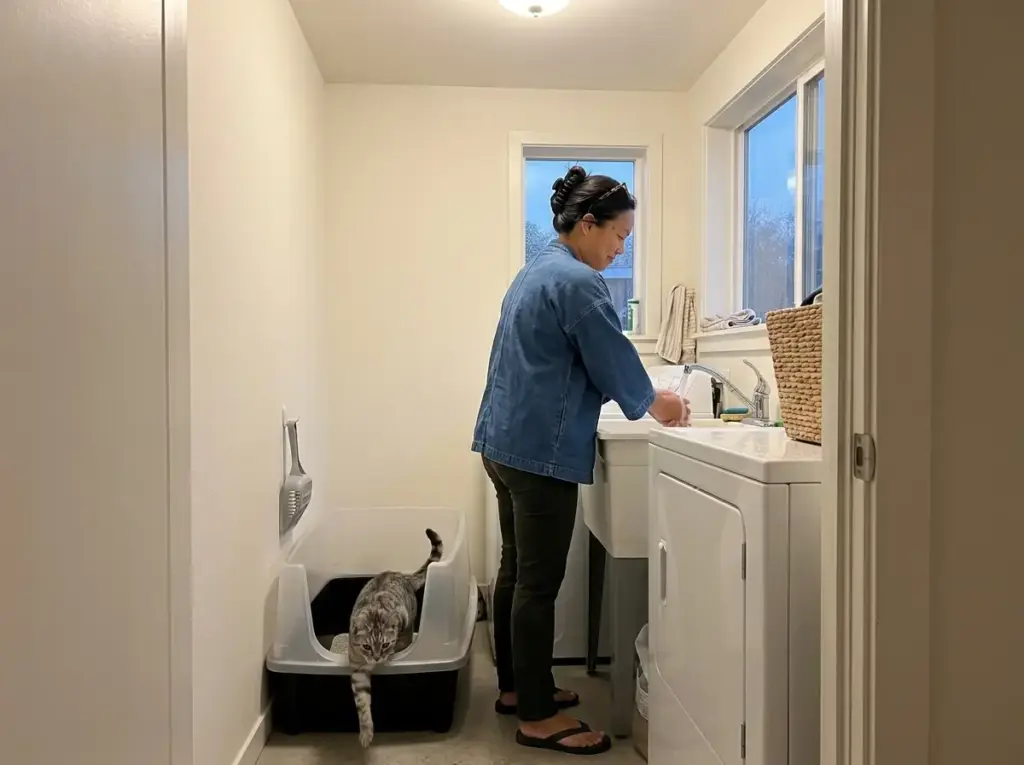
The ASPCA’s rule is to scoop twice a day, at the least, so that no cyst that has passed becomes infectious, and how often to scoop a litter box, per cat per day fills in the rest. Toxoplasmosis comes from the parasite Toxoplasma gondii. According to Ohio State’s veterinary college on litter boxes and pregnancy, “In fact, no stool actually contains infective material when it’s first defecated.” It takes one to five days to become infective, and the college calls the litter box the least common source of toxoplasmosis in the US, with undercooked meat far more common.
The clock runs in your favor only if the box is scooped daily, and that is also the case for handing the chore to the adult who is not pregnant. If nobody else can do it, the college says to wear gloves, change the litter every day and wash your hands. A question about a pregnancy or a test result is for the pregnant person’s doctor, and this guide goes no further than that.
A Box With Walls on the Right Side of the Line
The IRIS USA XX-Large High Sided Cat Litter Box measures 30 by 20 by 14 inches, with a curved entrance 6.5 inches high cut into the 14-inch wall. A cat can turn round in it, and the walls keep scatter and a rummaging hand on the near side of the line.
The entrance is a step: easy for a young cat and a real climb for an old one. It is big for a small apartment, since it needs 30 by 20 inches of clear floor and will not fit a tiny bathroom, and wet clumping litter sticks to the bottom of the pan. The same box in its Large size is the answer if there is no 30-inch wall.
Litter and toddler are a bad pair, and a high-sided box slows a crawler. But it does not stop a climber, so it is a second layer behind the door and never the first. The box sits on the cat’s side of the barrier, behind the closed door or the gate. When the apartment has no third room, it goes as far from the child’s floor as it can, with furniture between them, and the furniture does the work, not hope.
Moving the Box a Few Inches at a Time
The ASPCA advises making the litter box move gradual, a few inches a day, months ahead, to get it out of the future nursery. A cat does not accept a jump of several feet in one go, and a box that vanishes from its old spot looks to him like a litter box that has been taken away, a problem the apartment made and he did not.
The Timetable That Starts Before the Baby Does
Every item on the nursery list has a date, and all of the dates fall before the baby arrives. Someone handed the list in the last weeks of a pregnancy will find that most of it was meant to start earlier.
Months Ahead: Furniture in Place and the Box Moving
The ASPCA’s guide to cats and babies puts the first date months ahead: the box starts moving a few inches a day, away from the future nursery. The nursery furniture goes into its final place early too, so the cat gets used to the new shapes in the room long before anyone is in them.
One to Two Months Ahead: Switch the Routines
The calendar, in order: months ahead the box moves, one to two months before the birth the routine handover starts, at least a month ahead the crib and the changing table become unwelcoming, and sounds and smells come last. Every date sits before the baby.
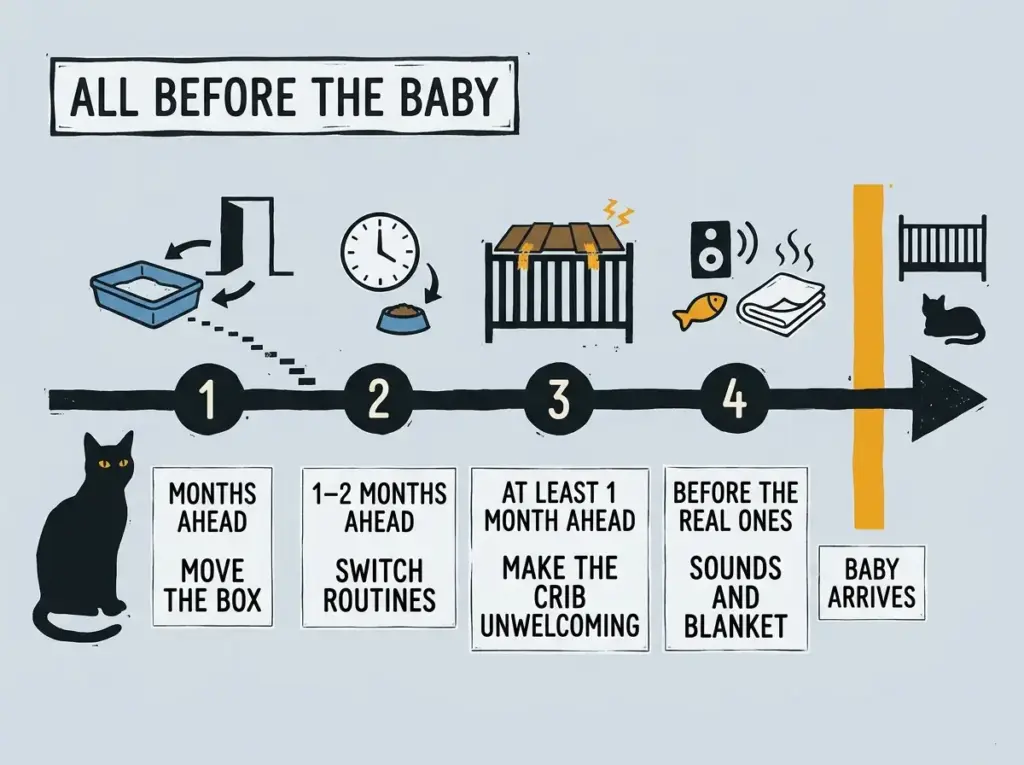
The routine handover comes early so the cat does not link the change to the baby. A change that lands on the day the baby comes home reads as cause and effect. The calendar goes first and the baby second.
Shift the meal or play time by a few minutes each day, not all at once. By the week the baby comes home, the new schedule is already the cat’s old one.
A Month Ahead: An Unwelcoming Crib
At least a month before the birth, cover the crib and the changing table with cardboard and double-sided tape. Cats dislike sticky surfaces, so that cardboard panel leaves the spot no longer the best bed in the house by the time the baby is in it. Nothing in the calendar needs buying. What you buy, the gate, the strap or the perch, is bought to make the house work, not to meet a date.
Sounds and Smells Before the Real Ones
Play baby sounds at low volume while he gets a treat, so the sounds go with something good: a positive association built before the real thing. Bring home a receiving blanket that smells of the baby and let him sniff it before the baby arrives. Neither is forced: if he leaves the room, he leaves, and you try again later. The closed door and the route above the line are what hold all of this up the day after.
Two Cats, One Child: Two Routes Out and Never a Corridor
One cat changes the arithmetic in a home with a child. Two cats change the layout, and the child is the one thing in the apartment neither of them chose.
The Only Cat Is the One Under Pressure
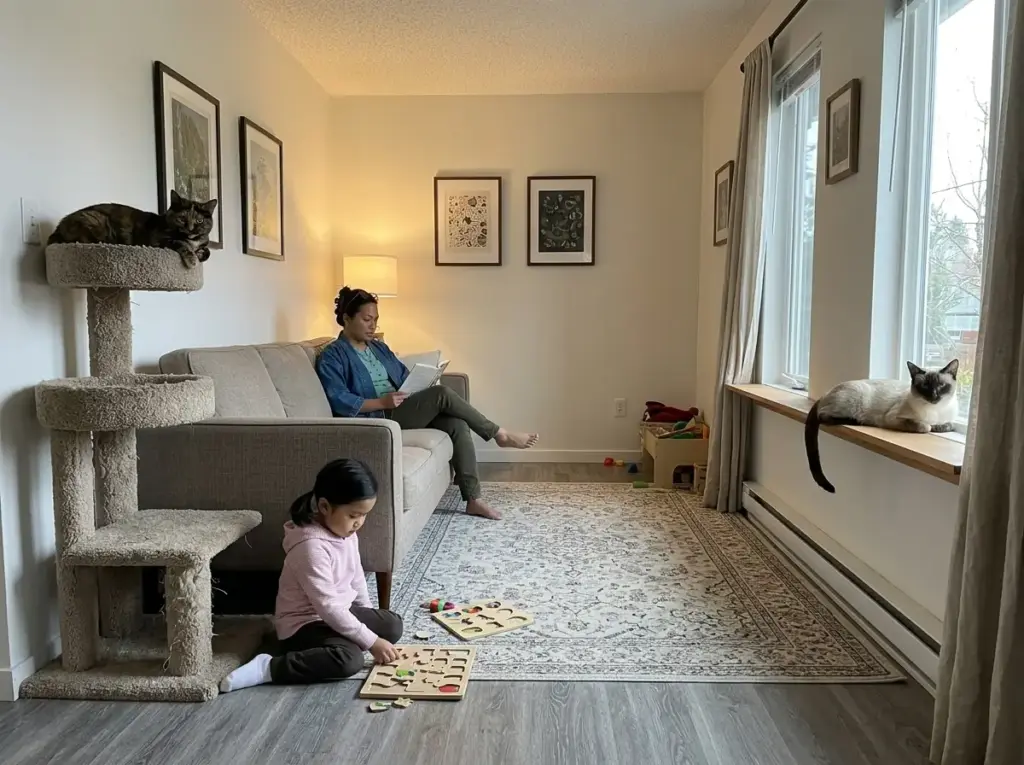
In a 2018 survey of cats and children in 865 families, a household’s only cat was associated with more defensive behavior and less affection toward people. Cats were rated very affectionate with children aged three to five only 14 percent of the time, against 32 percent with adults. That is not a law, and it is no reason to adopt a second cat for a child’s sake. It shows how much of the pressure lands on one animal when the apartment gives him one place to be.
Two Cats Means Two Routes Outside the Line
With two cats you need two routes above the reach line and two exits from every room. The AAFP and ISFM guidelines ask for at least as many safe places as cats, each with more than one entry, and a minimum of two of each resource: resting, feeding and toileting. You count places, not square feet, and how many cats a home can hold, counted in stations walks through that count. A spare that sits in the same corner does not count, which is the point of the one-resource-per-cat-plus-one rule.
The Child Is Never the Corridor Between Two Cats Avoiding Each Other
Picture two cats who avoid each other and a child on the rug between them. Each time one cat crosses the room, the child is in the path. Lay the room out so the way from one cat to the other stays clear and the child sits to the side, never in the middle. Why an escape route can turn into a trap shows how a cat with one exit behaves when something blocks it.
Move a piece of furniture to open the path, clear a windowsill and shift a box before you buy a second perch. If the cats actually square off, that is a matter for how to stop cats fighting when there is no second room, and a child is not the cause of it.
Measure Once Today, Then Watch Where the Cat Goes
Today’s change needs nothing from the shop: tape the reach line on the wall with the child standing against it, shut a door and clear a windowsill. The rest is what those moves hold up: a route above the line with a second way down, a door that belongs to the cat and not the child, a scoop rota that does not fall on the person who is pregnant, and a box on the cat’s side of the barrier. Questions that are not the house’s, a cat who changes a habit overnight, a bite that breaks the skin, a child who reacts to him or a positive test, go to the vet or the doctor.
Then watch for two weeks. After any change to the layout, see whether he uses the route and still sits in the room, and leaves when the noise begins. Measure the line again the week the child outgrows her pants.
Frequently Asked Questions
01What is the best age for a child to get a cat?
For children under five or six, American Humane recommends an adult cat of two or three years or older over a kitten. Kittens are fragile with sharp claws. Meet the cat more than once and watch how he handles a child’s noise.
02How high should a cat’s route be in a home with a toddler?
Above what your child reaches standing with one arm up, measured at home and repeated at each growth spurt, with a second way down. The published ceiling for a locked cabinet is 1.5 meters, about 59 inches. A route is not a lock, so the closed door comes first.
03Can a cat and a toddler share a room?
Sharing is not the default: the cat’s safe room is not a room for a young child, and the crib is never the cat’s bed. Give him a spot as high, warm and soft as the crib that is his, and close the door during naps.
04Is a pet gate enough to keep a toddler away from the cat’s things?
No. The Consumer Product Safety Commission says a pet gate is not a child safety gate. It buys the seconds you need to reach the child and is never the supervision. A gate at the top of stairs is screwed to the wall, and a cat flap gives a climber a foothold.
05Who should scoop the litter box when someone in the house is pregnant?
If you can, someone else, every day. The ASPCA says to scoop at least twice a day, and Ohio State’s veterinary college says stool is not infective when first passed. If nobody else can, wear gloves, change the litter daily and wash your hands. Pregnancy questions go to your doctor.
Leave a comment