How to Reduce Cat Shedding by Fixing Where the Hair Lands
Reduce cat shedding without replacing the sofa: put a washable layer where the hair lands, brush by coat type & measure the results in 3 weeks.

Alfredo RamsesFounder · October 6, 2026 · 21 min read

On this page8 sections
- 1Reducing Cat Shedding Means Lowering the Load Your Home Carries
- 2Start With the Few Changes That Go to a Vet, Then Move the Furniture
- 3Decide Where the Hair Lands Before You Buy Anything
- 4Take the Loose Coat Off the Cat, With the Tool That Fits the Coat
- 5Read Your Own Brush and Towel to See If Any of It Is Working
- 6Pick Up What Is Already Down Without Dreading the Vacuum
- 7Cover His Spot Tonight, Then Compare the Brush in Three Weeks
- 8Frequently Asked Questions
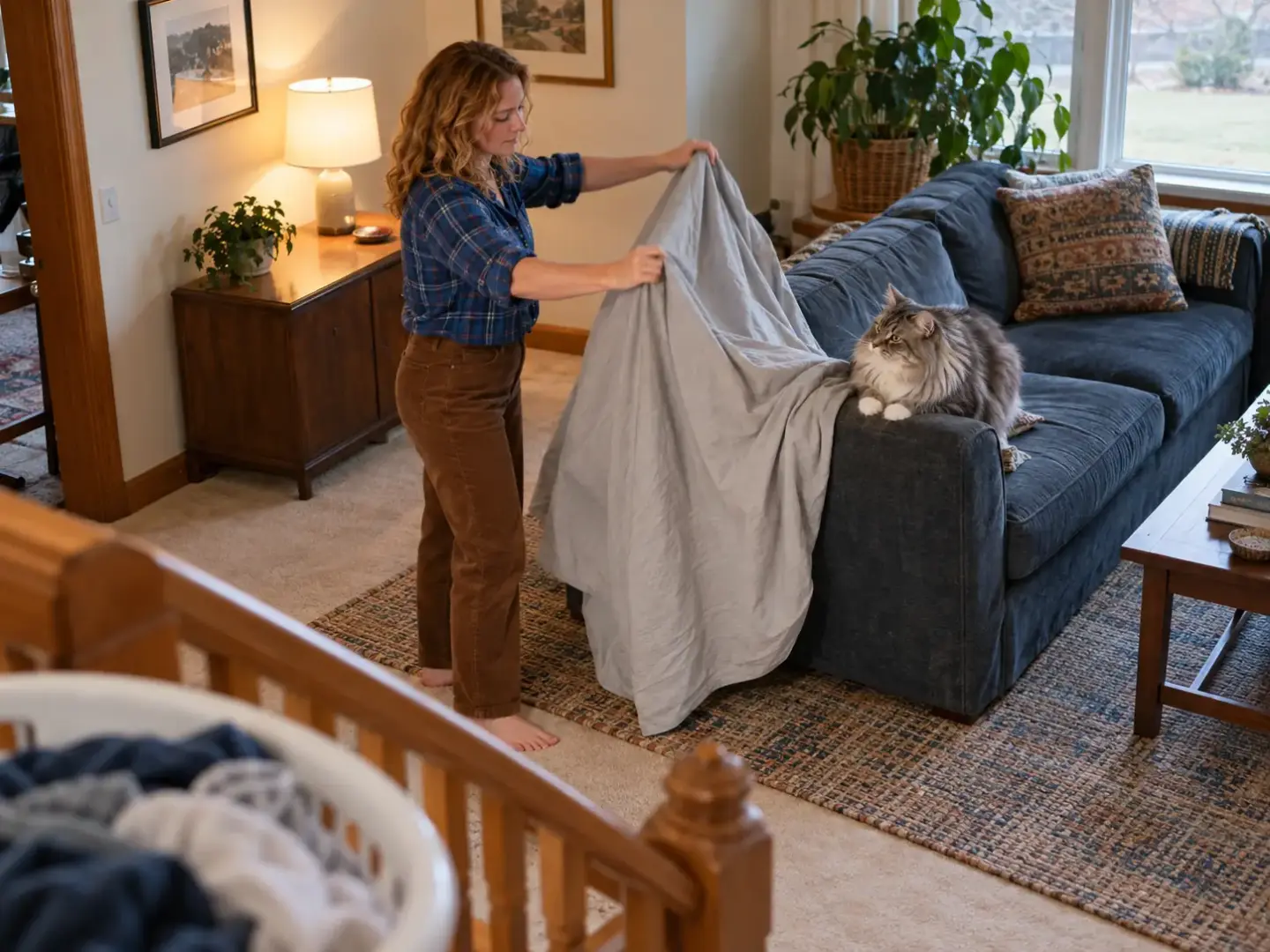
You pull on dark jeans, sit on the left arm of the sofa for one phone call, and stand up with a gray stripe running from hip to knee. That arm is where your cat sleeps, and he picked it well: it is warm, it is high enough to watch the door, and it is right next to wherever you sit. VCA Animal Hospitals and International Cat Care both describe indoor cats as shedding all year, so working out how to reduce cat shedding comes down to lowering how much of that hair reaches the places where you sit, sleep and get dressed. Below, in order from free to paid: where the hair lands, what comes off the cat, what you pick up afterward, and how to tell whether any of it is working.
Quick Answer
A healthy cat never stops shedding, but you can cut how much hair reaches your sofa and clothes. Work in this order:
- Cover the spot he already sleeps on with something washable.
- Brush out loose coat with a tool that suits his coat length.
- Pick up fallen hair with a light vacuum or a reusable roller.
- Compare the same brush’s weekly haul to see whether it drops.
Reducing Cat Shedding Means Lowering the Load Your Home Carries
If you are reading this, you probably have a routine already. You brush, you roll, you vacuum, and the hair keeps arriving, which makes the routine look broken. It usually isn’t. A healthy cat has no off switch, and a plan judged against a finish line that does not exist will always look like it is losing.

What a healthy indoor cat keeps doing all year
According to VCA Animal Hospitals’ coat-care guide, “Cats that share our homes often shed their undercoat and guard hairs at low levels all year round.” Some cats in cooler climates add two heavier rounds, one in late spring and one in late fall, but an apartment cat living under lamps and steady heating mostly keeps a low, constant shed. The mechanism behind it, and why an indoor cat has no off season, has its own article. What matters here is the consequence: there is no date to wait for.
The scale gets real fast in a multi-cat home. One owner in an r/CatAdvice thread on shedding vacuums one or two fistfuls of loose fur off the floors every day, before counting the bedsheets, the sofa and the chairs, and another calls the drifting clumps “furnados.” The answer experienced owners give a first-timer in that thread is a shrug and a welcome to the wonderful world of catting.
The shed belongs to the cat. The sofa, the bed and the closet belong to you, and those you can do something about.
The order that spends the least first
The usual advice opens with a better brush. For a reader whose real complaint is the jeans and the sofa, that’s the wrong first purchase, because a brush only reaches hair still attached to the cat, while the hair he has already dropped keeps landing wherever he lies.
Start one step earlier, with where he lies, which costs you a spare sheet. (The brush still matters to reduce shedding around the house; it just moves to step two.)
The order this site uses for living with cat shedding in a rented apartment runs like this: decide where the hair lands, take the loose coat off the cat, pick up what has already fallen, then measure. Each step makes the next one smaller. A washable layer on his spot means less hair for the vacuum, and a regular brushing means less hair on the layer.
Before you buy anything, name the one place the hair bothers you most: your clothes, the sofa or the floor. Work on that zone alone for the first week, so you get a before and an after you can actually see, and so you know which purchase, if any, is worth making.
What does not work, said once
A few fixes cost money and lower nothing. A rubber brush loosens hair well and then lets go of it, so much of what it lifts drops onto the bed or the sofa you were trying to protect. A pricier deshedding tool doesn’t change the rule either: it pulls more hair off the cat, and that hair still has to land somewhere. One owner in the same thread paid a groomer extra for an anti-shedding service and got back a cat who ended up stress licking afterward.
Shaving is the other one people ask about. Bond Vet’s own guide makes the point that shaving does not stop shedding, because the hairs simply come out shorter. Some owners also run sticky lint tape over the cat himself, which other owners argue against because of what it can leave on the coat, so keep the tape for the sofa. And if the amount of hair changes suddenly, or you can see skin, read the next section before anything else.
Start With the Few Changes That Go to a Vet, Then Move the Furniture
Everything else in this article treats shedding as a housekeeping load. A few changes sit outside that, and the right move there is a call to your vet rather than another brush. Take any of these to the vet before you change anything at home:
- Bald patches, or thin and patchy areas in the coat
- Skin that looks red, irritated or scabbed
- Dandruff, or a coat that turns greasy
- A cat who stops grooming, or overgrooming one area without letting up
- A sudden jump in shedding, or a heavy shed out of season
- Any change in appetite or litter box habits

This article won’t tell you what to feed a cat so he sheds less, which supplement or shampoo to try, why one particular cat is losing hair, or whether shaving or sedation makes sense for grooming. Each of those needs someone who can examine the cat, and when cat shedding is a problem gets its own article on this site. If none of the signs above fits your cat, the rest of the job is about the apartment.
Decide Where the Hair Lands Before You Buy Anything

Find the spot the cat has already chosen
One owner in the r/CatAdvice thread noticed their cat lying in the one warm corner of the room and guessed he shed more there because of the heat. Whatever the reason, the pattern holds in most homes: the hair is thickest where the cat spends his hours. Bond Vet makes the same point from the clinic side, that a cat’s favorite sleeping spot collects most of the loose hair.
Walk the apartment and look for it. Most homes have two or three of these spots, not ten: the sofa arm, a corner of the bed, a windowsill, the top of a radiator cover. He chose them for warmth, height and a view of you, which are good reasons, and pushing him off them usually just moves the hair to the next warm place. In a rental you can’t replace the sofa or drill a shelf to lure him somewhere else, so the sensible move is to leave the cat where he is and change what he lies on.
A washable layer instead of a new sofa
The free version is an old bedsheet folded into quarters and laid on his spot. Once or twice a week it goes in the wash with your towels, and the hair goes with it instead of working its way into the upholstery. A folded sheet looks like exactly what it is, which is the price of free.
If you want something that stays flatter and looks like it belongs, a washable pet throw does the same job with a little more grip. The PETMAKER Waterproof Pet Blanket is 60 by 50 inches and 2.2 pounds, sherpa fleece on one side and coated, waterproof flannel on the other, and one reviewer says the hair sticks to it rather than to the comforter underneath. That’s enough to cover one sofa seat or a corner of the bed, not a full sofa. One buyer says it can’t go in the dryer, so it spends a day drying on a rack, and another says the two layers are joined only at the edges; keep the folded sheet as the stand-in for drying day.
The obvious bigger move is a slipcover for the full sofa. For most homes it’s the wrong first call, because a sofa cover only earns its place when the cat uses the full length, say two cats sleeping at opposite ends.
The renter-friendly version of that is the PureFit Reversible Quilted Sofa Cover fits seats up to 66 inches wide, flips to a second color, and holds on with straps and foam tubes, which protects a rental sofa that was never yours to replace. Reviewers say it doesn’t stay tucked in no matter how far the foam tubes go down, and some say it slides when they sit. For a cat with one spot, the throw on that spot does more with less fuss.
Lay the washable layer on the exact spot he already sleeps on, not on the spot you would like him to use. Cats rarely follow a blanket to a new place. They follow the warmth and the view, and the hair travels with them.
One shared spot or two, with two coats in the house
Two cats sharing one sleeping spot pile both coats into the same layer, and when one is long-haired and the other short, the long coat sets the amount. Giving each cat a spot of its own, each with its own washable layer, splits the laundry and tells you whose hair is whose, which pays off later when you start measuring. If they insist on sharing, put the larger throw there and wash it twice as often.
Color does part of the work. Owners in the thread who choose dark furniture, dark throws and rugs to hide the hair call it working smarter, not harder, and one who adopted a tuxedo cat simply accepted hair as an accessory. That’s a fair call. A throw that matches the coat hides the hair rather than removing it, but it buys you days between washes.
During the heavy weeks of the year, some households go much further. One owner of two cats, one long-haired and one short, keeps both out of the bedroom for those weeks, vacuums daily, wipes every surface daily and keeps everything in closed cabinets. It works, and it’s exhausting. A smaller version gets most of the benefit: keep the closet door shut, put one layer on the bed where they sleep, and keep a set of inside clothes apart from the ones you wear out, with a quick lint roller pass by the door on your way out.
Take the Loose Coat Off the Cat, With the Tool That Fits the Coat
“I brush and brush. Couple a times a week. I alternate between a deshedder and a normal brush and it never stops.” That’s an owner of a medium-haired three-year-old male on r/CatAdvice, and the complaint is common because the routine sounds right.
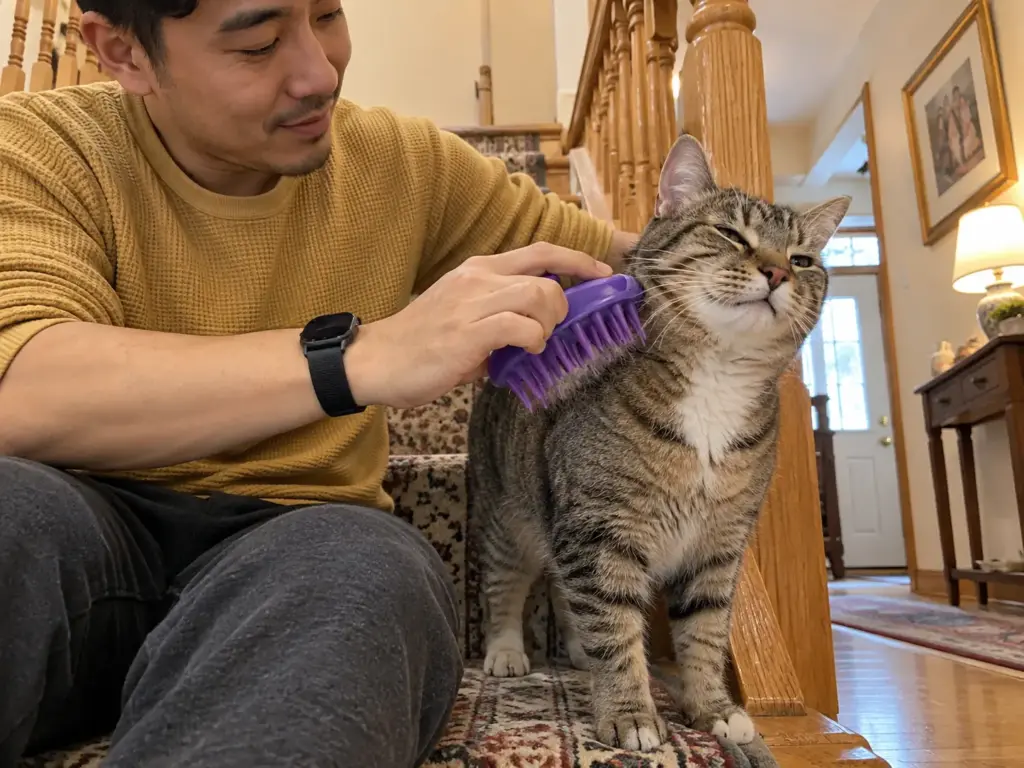
The cat isn’t the problem. Usually the tool doesn’t suit the coat, or the brush loosens hair it never holds on to, or there’s no number to show whether the routine is gaining ground.
A short, dense coat needs a surface tool
The coat decides the tool. VCA’s guide to brushing by coat recommends stiff bristle brushes for short coats and long-toothed metal combs or brushes with offset tines for medium and long ones, and notes that some combs are made to lift clumps of undercoat during heavy shedding. International Cat Care’s kit for a short-haired cat is a bristle brush plus a rubber grooming pad or mitten, the same idea as a grooming glove.
One owner in the r/CatAdvice thread brushes every night with a boar bristle brush and adds a deshedding brush once a week or more in the warm months. One of the two cats in this house is a British Shorthair, and hers is exactly that kind of coat: short, thick and plush, the type a surface tool clears and a long comb mostly glides over.
The free first try is a dish glove. A clean rubber glove, slightly damp, run along a short coat in the direction the hair lies pulls loose hair into rolls you can pick off, and International Cat Care names a damp rubber glove as the final sweep after brushing. Brush her on the bare sofa and you’ll be rolling the sofa afterward. Better: brush on the washable layer and put the layer straight in the wash, because whatever the brush lets go of lands on something already headed for the machine.
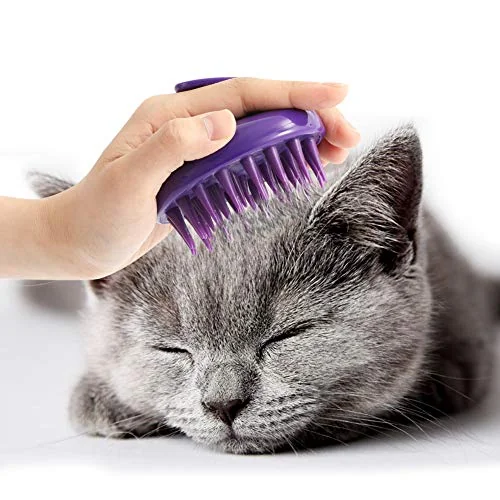
That habit matters most with a rubber brush, the next step up for a short, dense coat. The silicone one below is washable, soft enough for a cat who doesn’t love being handled, and its pins reach the loose hair under the surface of a plush coat. It has one real limit, and the card spells it out.
In the heavier weeks, loose undercoat builds up faster than a rubber brush can lift it, and that’s where a small deshedding brush earns a place. The SleekEZ Cat Brush for Shedding is 5.5 by 3 inches and 1.5 inches deep, easy to hold, and made to lift undercoat rather than skim the top. Reviewers describe its blade as super small, which suits a compact shorthair and means a lot of passes on a very large long-haired cat. For that cat, the tool changes.
A large, long coat needs one that reaches below the topcoat
The other cat in this house is a very large ginger Maine Coon, and a double coat like his holds its loose hair deep, where a rubber brush or a glove barely reaches. VCA says long, silky or curly coats need brushing every day, and International Cat Care’s order for a longhaired cat is a wide-toothed comb first, then a rubber mitten, then a final sweep with a damp cotton or rubber glove.
A slicker brush fits into that routine as the step that gets below the topcoat. The Coastal Pet Safari Cat Self Cleaning Slicker Brush measures about 8.75 by 5 inches, with stainless steel pins and a button that pushes the collected hair off the pad, and reviewers single out how easily the hair comes off once it fills. The pins are metal, so one buyer’s warning is the right one: let them ride through the fur without pressing into the skin. Some cats find it strange at first, which argues for short first sessions.
It isn’t a comb either, and for tangles both VCA and International Cat Care point to a comb, so the slicker goes after the comb rather than instead of it.
This is also where a single-cat routine breaks in a mixed home. A tool that works on a long coat drags on a short one, and the rubber brush that clears a plush shorthair barely touches a Maine Coon’s undercoat, so two coats in one apartment means two tools on the shelf.
One cat or two, and when to stop
The cadence follows the coat, not the household. Long coats get a daily pass; short coats can usually go once or twice a week, which matches what International Cat Care and VCA describe and what long-time owners report keeping up. With one of each, you run two brush routines, and the long-haired cat sets most of the hair load on your floors. Brushing frequency in detail belongs to this site’s grooming articles; here the point is that one schedule for two different coats shortchanges one of the cats.
International Cat Care’s grooming guide lists the signs a cat has had enough: skin rippling or twitching, a thumping tail, sudden freezing, ears rotating back, the head turning sharply toward the brush, a growl. Its rule is short: “If grooming is a struggle, it should be stopped.” A cat who learns that the brush means a fight starts leaving the room when he sees it, and after that he sheds on the sofa on his own schedule. A cat who won’t let you brush him at all is a separate problem, with its own article here.
End every brushing session a little before he asks you to. A few short passes that finish while he is still loose and relaxed teach him the brush is tolerable; one long session that ends in a twisting escape sets the next three back.
Read Your Own Brush and Towel to See If Any of It Is Working
Reducing shedding means nothing without a number. The owner who brushes a couple of times a week and says it never stops could be removing twice what they did a month ago, or half, and has no way to tell. Two measurements settle that, and both use things you already own.
The weekly haul off the same brush
Once a week, use the same brush for the same number of minutes on the same spot, on the same day if you can. That session is your hair haul, and the first one is your baseline. Pull the hair off the brush, press it into a ball, and compare it with last week’s, either by eye against a coin or by noting a rough size on a sheet of paper taped inside a cabinet door. This is the same method as the weekly brush log used to follow a heavy shed week by week, and it works for the same reason: the number only means something next to the one before it.
Read the trend over three or four weeks, never a single session. A big week during a seasonal shed pushes the haul up without anything going wrong, and a small week after a few missed days says more about your schedule than about his coat. On its own, the haul tells you how much loose coat the cat is carrying that week; what it means depends on the second measure.
A plain towel under the favorite spot
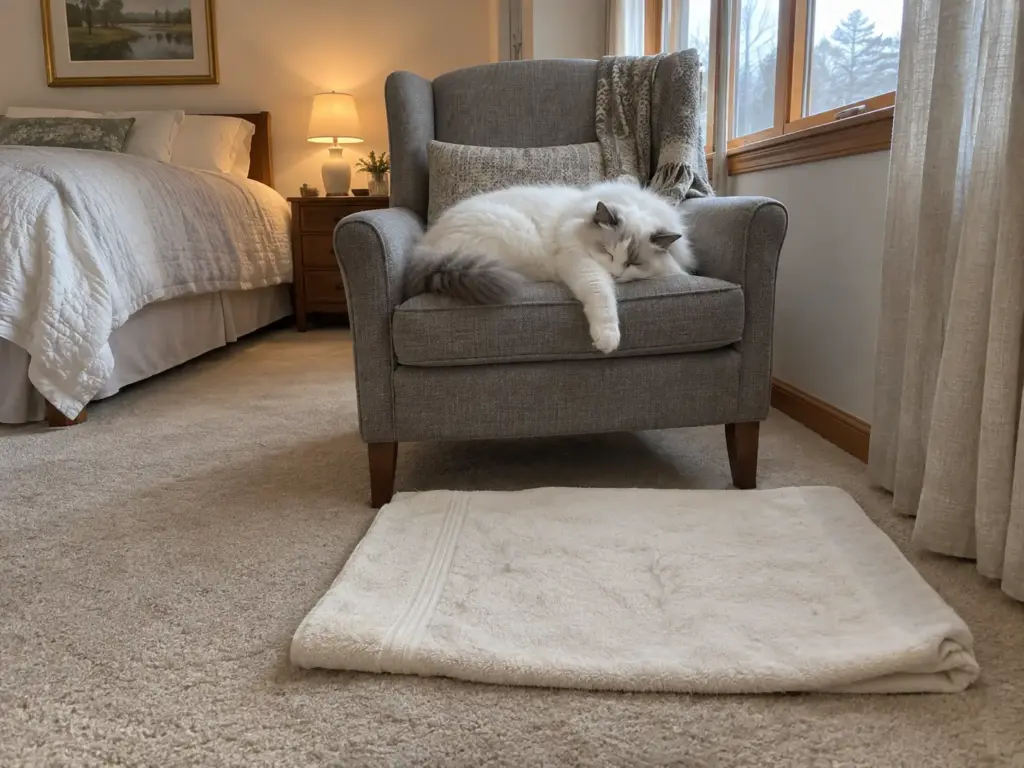
The second measure catches the hair that falls without any brushing at all. Lay a plain towel on his favorite spot, in a color that contrasts with his coat, and leave it for a week. Then fold it inward, shake it out over a trash bag and look at the clump.
Compare that clump week to week. If the brushing is taking loose coat off the cat, the towel should collect less over time even while he keeps sleeping in exactly the same favorite spot. It’s crude (a towel is not a scale), but it tracks the thing you care about, which is how much hair reaches the furniture. And if either number jumps or crashes in a way the season doesn’t explain, that belongs to the vet list above, not to a measuring problem.
Read the two numbers together, because each one alone can mislead. A bigger brush haul with a lighter towel means the routine is catching hair before it falls, which is the result you want. A bigger haul and a heavier towel can simply be a seasonal stretch, and the answer then is patience plus the same routine. With two cats, keep a haul per cat and a towel per spot; a shared towel tells you the household total and nothing about which coat is driving it.
If after three weeks the brush haul is flat and the towel isn’t getting lighter, change one thing at a time. Move the layer if he has shifted spots, swap the tool if the coat is long and you’ve been using a surface brush, or add one more session a week. Change all three at once and you’ll have a cleaner sofa with no idea which change did it.
Pick Up What Is Already Down Without Dreading the Vacuum

The vacuum that actually comes out of the closet
An owner in the r/CatAdvice thread who wears black most days vacuums at least once or twice a week, and the detail that makes it work is the machine: a lightweight vacuum, so it’s “easy to whip out without it feeling like a huge laborious thing.” The most powerful vacuum looks like the obvious pick for pet hair. In a small apartment the one that earns its keep is the one light enough to grab on a weeknight, because a heavy canister parked behind the coats gets used once a week if you’re lucky.
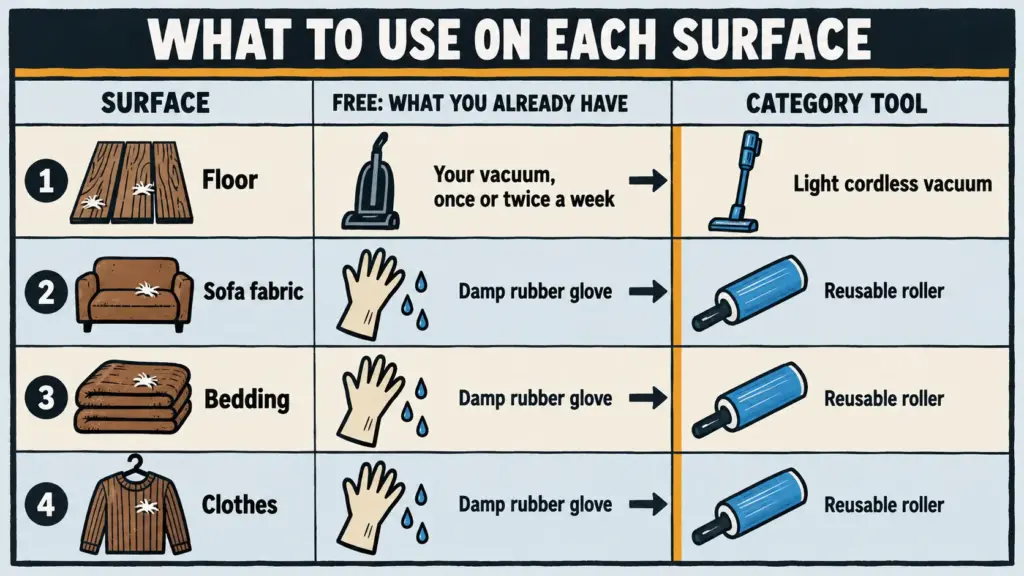
The free version is the vacuum you already own, taken out on two fixed days a week instead of whenever the floor looks bad. Fixed days count for more than suction, since keeping that cadence beats one big clean at the end of the month. If yours is heavy enough that you keep putting it off, that’s the case for a cordless stick vacuum.
The Levoit Cordless Vacuum Cleaner LVAC-200 weighs 6.2 pounds and stands 43.3 inches tall, holds itself upright and lies flat to get under a sofa. Battery life is where it falls short: it’s the complaint that keeps coming back in its reviews, with about 30 minutes on the floor head and 12 in Turbo, and one reviewer wants a dust cup that empties more easily. Thirty minutes covers the floors of a small apartment on the normal setting, not a Turbo pass through every room.
An air filter or air purifier helps with the hair that floats before it lands, as Bond Vet notes, but it comes after the spot, the brush and the vacuum, not before them.
A roller for the sofa and the bed
Between vacuum days, the hair you notice most is on fabric: the sofa cushion, the duvet, the arm of the chair. The free tool is the damp rubber glove again, dragged across the upholstery in one direction, which rolls the hair into a strip you can lift off with your fingers. It’s slow on a big surface and fine on a single cushion.
For more fabric than a glove can manage, a reusable pet hair roller is quicker than getting the vacuum out for one seat. The ChomChom below needs no sticky refills, which is the reason it beats a tape roller for daily use. It does have a weak spot, and the card names it.

Keep the roller and the light vacuum where you can see them and reach them in five seconds, by the door or tucked beside the sofa. A tool stored behind other things in a closet comes out when guests are on their way, and not much otherwise.
Cover His Spot Tonight, Then Compare the Brush in Three Weeks
A healthy cat keeps shedding, so the target is less hair on your sofa and clothes, not a cat who stops. Three things carry most of the weight:
- Put a washable layer on the spot he already chose, before you buy anything.
- Match the brush to the coat, and stop each session while he is still calm.
- Take any sudden change in his coat or skin to the vet, and keep the rest in the apartment.
Three weeks from now, run the same brush for the same minutes and shake out the towel from his spot, because that’s about when a new brushing habit starts to slip, and the two numbers will show it before your jeans do.
Tonight, before anything goes into a shopping cart, fold an old sheet onto the place he is sleeping right now, and on wash day look at what comes off it.
Frequently Asked Questions
01How do I stop my cat from shedding so much?
You can’t stop a healthy cat from shedding, but you can lower how much hair reaches your sofa, bed and clothes by controlling where it lands. Cover his sleeping spot with something washable, brush with a tool that suits his coat, and pick up fallen hair weekly. A sudden change or visible skin goes to your vet.
02What can I feed my cat to stop shedding?
Food and supplements are a question for your vet, who can examine your cat and knows his history, so this site doesn’t give diet advice for shedding. What you can change at home is where he sleeps, which brush you use and how often the fallen hair gets picked up.
03How do I reduce cat hair in my house?
Start with the spot where your cat sleeps, because hair collects where he spends his hours, and cover it with a washable throw or an old sheet. Then brush out loose coat with the right tool for his coat, and vacuum or roll the fabric once or twice a week.
04What is the easiest way to deshed my cat?
Use the tool that matches his coat and keep the sessions short, stopping while he is still relaxed so he lets you do it again tomorrow. A rubber brush or a damp glove suits short, dense coats, while long coats need a comb and a slicker that reach below the topcoat.
05How often should I vacuum with a cat that sheds?
Once or twice a week is the cadence long-time owners describe, and a light vacuum you can grab in seconds gets used far more often than a heavy one. Between vacuum days, a reusable roller or a damp rubber glove takes care of the sofa and the bed.




Leave a comment