Best Dematting Comb for Cats That Won’t Snag the Skin
Best dematting comb for cats: PETTOM (7.5 in) first, Hertzko (9 in) for one small knot, GoPets skipped + the 6 mm daylight gap that decides it.

Alfredo RamsesFounder · October 13, 2026 · 19 min read


On this page8 sections
- 1A Dematting Comb Passes or Fails at the Skin, Before the Brand Matters
- 2Rounded Teeth Come First, and Where Their Reach Runs Out
- 3Fingers at the Skin, Comb on the Tips, and the Coat That Changes the Pick
- 4The Serrated Comb Is for One Small Knot, Held Clear of the Skin
- 5Dogs-and-Cats Listings, and the Groomers Who Say a Comb Is the Wrong Tool
- 6Test the Comb in the Drawer First, and Know Where the Comb Stops
- 7Run the Skin Test Today, Then Look at the Same Spot in Three Weeks
- 8Frequently Asked Questions
You bought a comb because the listing promised it would deal with a mat, and the first real knot it met just dragged the coat along with it. One reviewer in a five-cat home, where a long-haired cat “gets knots something awful,” bought a mat-cutting comb and found it never cut anything; the mat only gave way after many strokes of the comb. The best dematting comb for a cat is the one that slides between the knot and the skin without catching, and a comb already in your drawer can show you whether yours does before you buy anything. Below you get the skin test, the rounded-tooth comb that passes it, the serrated comb for one small knot, the dogs-and-cats listings that fail it, and the point where the ASPCA says scissors are never the answer and the comb goes back in the drawer.
Three combs come up for this job, and they sort cleanly by what each one does at the skin.
| Comb | What it does at the skin | The knot it suits | Verdict |
|---|---|---|---|
| PETTOM Steel Grooming Comb 7.5 inch | Rounded tips nudge hair aside; nothing cuts | A small, loose knot, tips first | First comb in the drawer |
| Hertzko Grooming Dematting Comb | Serrated edge that has to stay clear of the skin | One small knot already opened, with daylight under it | Second, for that knot only |
| GoPets 2-in-1 Dematting Comb | Cat reviews report snagging and a tug on denser mats | None; it does not cut and it pulls | Skip |
A Dematting Comb Passes or Fails at the Skin, Before the Brand Matters
A dematting comb for cats has one job, and it happens in a gap you can barely see: between the knot and the skin. If the comb cannot enter that gap without catching, the brand, the steel and the star rating change nothing. Our guide to how to handle matted cat fur, sorted by reach ranks every dematting tool for cat mats by how deep into a mat it goes; this article takes the first rung, the comb, and works out which comb earns a place and when the answer is none.
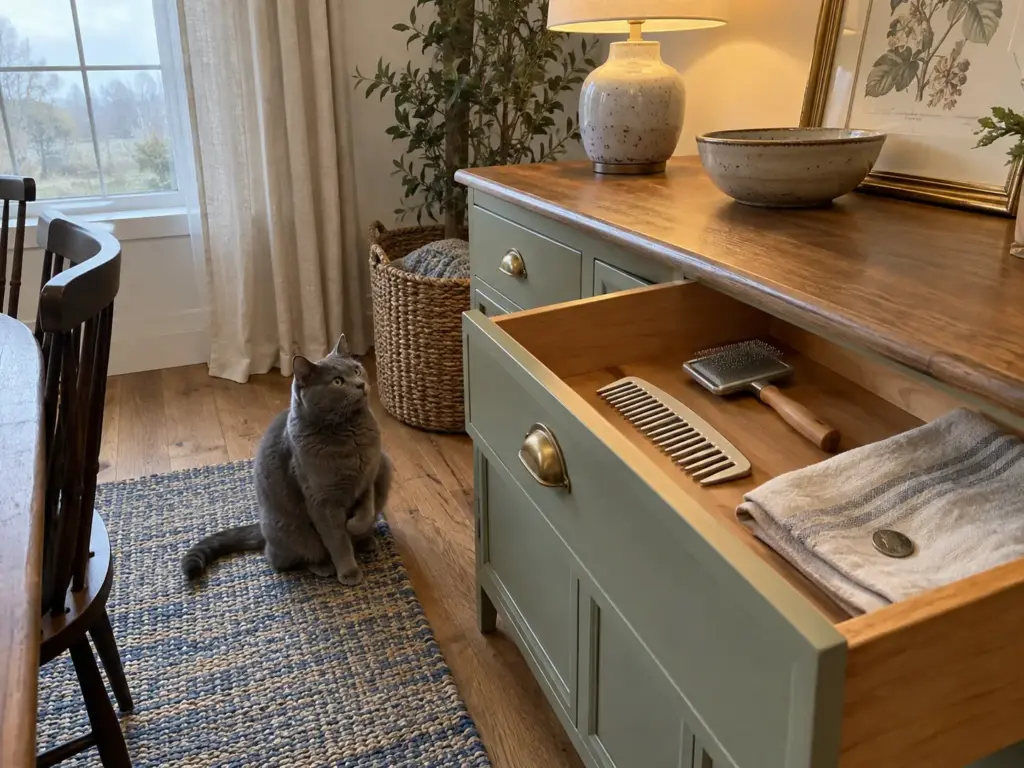
Under a mat the skin does not lie flat. It gets pulled up into the knot, so a tug on the knot reaches the cat directly, and a cat who twists away on the first stroke is reporting a real constraint: the comb is working her skin through the hair. A reviewer of a serrated comb, writing in 2016, had hoped it would slide under the mat close to the skin and found it “didn’t slide through or under any of the matts.” The listing had promised something the comb could not do at the skin, and a product photo never shows that part.
Four kinds of tool sit on the shelf, and each one meets the skin differently
The names on the packaging overlap, so sort by what touches the cat:
- Wide-tooth comb with rounded tips. Blunt, spaced teeth move hair aside and work a knot open from its outer edge. Nothing on it cuts.
- Rake or undercoat rake. A row of widely spaced pins on a handle that reaches deeper into a thick coat; the pin tips are what arrive at the skin on every pass.
- Slicker brush. A pad of fine bent pins made for smoothing and loose hair. On a knot it works the surface and does little at the base.
- Mat splitter. The blade splitter: a hooked or toothed cutting edge built to slice a mat into strips, which is a dog-coat tool that stays out of a cat’s coat in this house.
A flea comb belongs on none of those lines: its teeth sit too close together to split a mat. Only the first tool is a comb in the sense this article means. Every other row adds something sharp or fine that reaches the skin before you can see it.
The test: does the comb pass between the knot and the skin?
The test that separates a mat from a tangle, laid out in the comb test that separates a mat from a tangle, doubles as a buying test.
Hold the knot between two fingers where it meets the skin, then slide the end of the comb under the knot’s outer edge with the teeth pointing away from the skin. A comb that passes the skin test glides under without catching hair and without the skin moving. One that fails catches, drags the knot sideways or lifts the skin with it. Run it with a comb you already own before you pay for another.
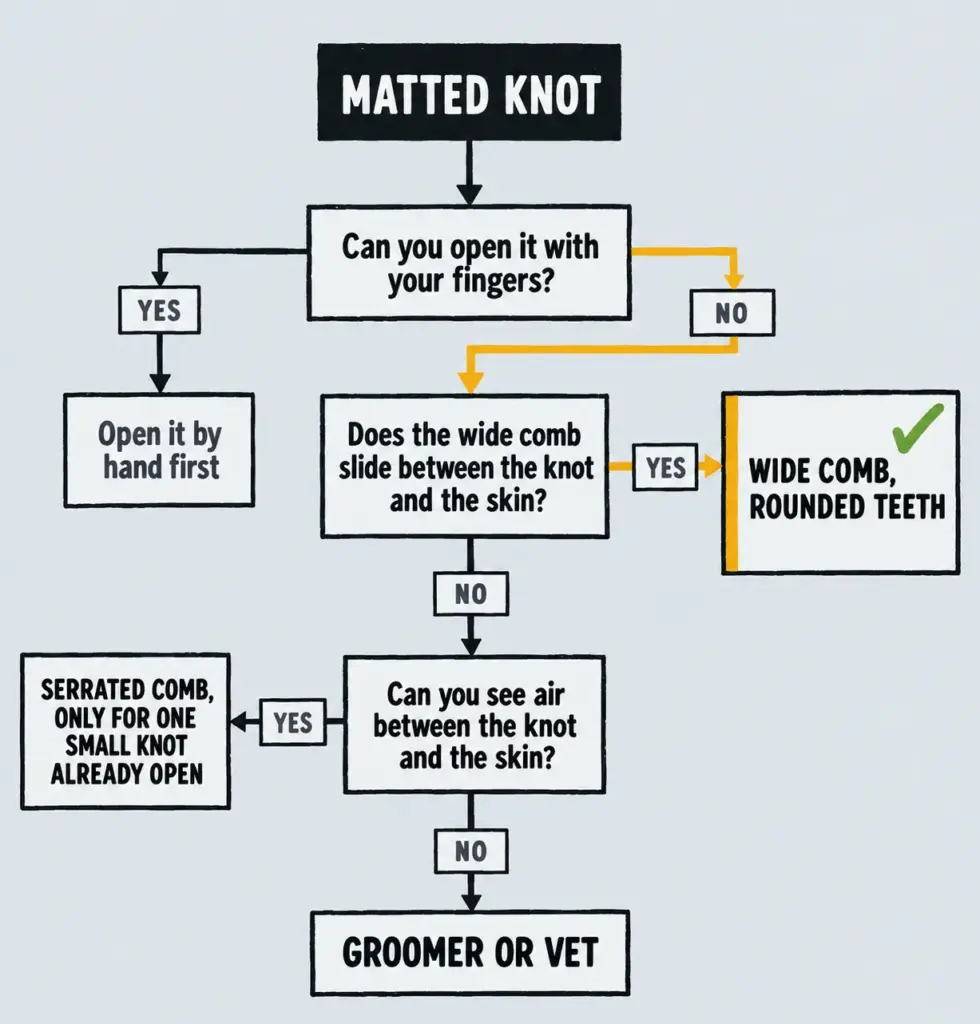
The margin matters as much as the pass. Petful’s mat guide asks for a good quarter inch, about 6 mm, of space between mat and skin before any blade comes out. Carry the same margin over to a comb: if you cannot see that daylight, the knot sits too close for a home job, and a comb that “almost” fits (the usual story) is a comb that tugs.
Run the skin test with the comb already in the drawer, on the loosest knot you can find, and stop the moment the cat leans away. If that comb passes, the purchase is over before it starts; if it fails, you have learned which feature to shop for.
The knot a comb can open at home, and the number that depends
The limit is the nickel line: a nickel-size mat, about 0.8 inches (21 mm) or smaller, loose, on skin that stays still when you touch it, is comb work. The mechanics of working a small mat open live in a sibling article, so this one stays on the choice of tool.
That number is a ceiling, not a promise. A 10 mm knot pressed flat against the skin has no gap for a comb to enter, while a loose 20 mm knot with air under it does. Size is the first filter and the gap is the second, and a knot has to pass both.
Some knots never reach the comb stage. One that will not open between your fingers, or skin around it that looks red, smells off, feels damp or moves with the knot when you lift it, is for a groomer or a vet to look at first, and the comb stays where it is.
Rounded Teeth Come First, and Where Their Reach Runs Out
Picture a drawer in a house with two coats: one cat with short, dense hair that holds a knot like a fist, one with long, fine hair that tangles behind the shoulder. One comb usually ends up serving both, and it serves one of them better. Which one decides whether that comb belongs in the drawer at all.
What rounded teeth mean at a cat’s skin
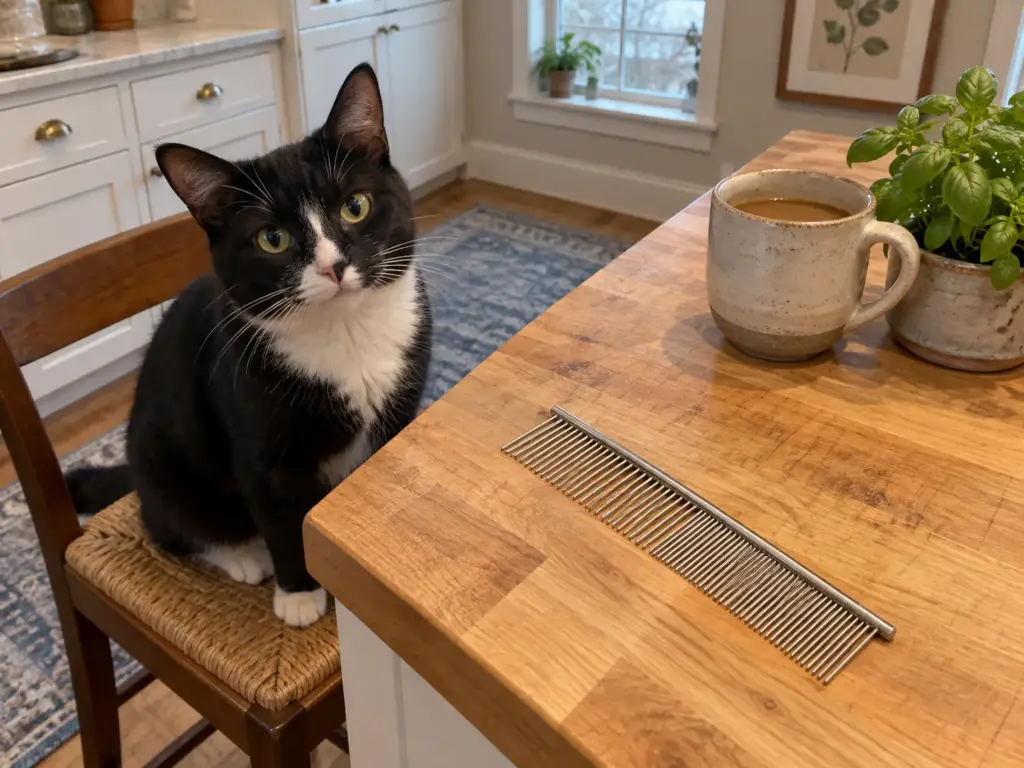
Rounded teeth are blunt at the tip, so the comb moves hair aside instead of through it. At a cat’s skin that matters because the tip is the part that arrives first: a blunt tip nudges, a pointed one scratches. A rounded-tooth comb does not cut the mat. It opens it from the outer edge, a few hairs at a time, which is slower and is also the reason it passes the skin test. The slowness is the price of that.
Two sides: the coarse one opens, the fine one finishes
The comb this house puts first is the PETTOM Steel Grooming Comb 7.5 inch, in the Comb B version with a coarse side and a fine side. It is 7.5 inches long with a 2 by 2 inch head, and a metal comb for a session wants at least 6 to 8 inches, so it sits inside that range. The coarse side takes the first pass on a knot, from the tips of the hair inward. The fine side comes in only once the knot has opened, to pick up the small tangles it leaves behind.
Start with the fine side and its closer teeth load up with the whole knot and pull at the roots.
Before you buy it, though, check the comb already in your drawer. If it has rounded tips and passes the skin test from the last section, you own the first slot already. The grooming-kit guide settles which comb earns the first slot in the grooming drawer; this article reaches the same pick from the skin up.
Coarse side first, always. Switch to the fine side only after the knot has opened and the comb moves through without resistance; if the fine side meets resistance, you are back to the coarse one.
Where it fails: fine, silky hair slips between wide teeth
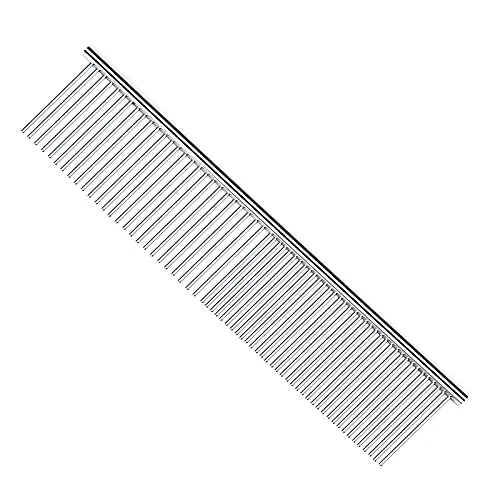
The limit shows in the reviews. A Persian owner gave the comb one star in February 2025 under the title “Didn’t Work On My Persian at All,” and a 2021 review says the teeth are “spaced way too far apart to get the last small tangles out.” Both describe a fine coat. The hair slides between wide teeth and the tangles stay exactly where they were.
The Amazon title itself calls the item both “Dog Combs” and a “Cat Comb for Removing Tangles and Knots,” and a comb made for both coats is tested hardest by the finest one.
On a fine coat, the work shifts to your fingers. Tease the edge of the knot loose first, then bring the comb in for what the fingers have already opened. And skip the flea comb as a rescue, since the closer teeth that make it good for fleas are what keep it from splitting a mat.
Fingers at the Skin, Comb on the Tips, and the Coat That Changes the Pick
A Maine Coon owner’s July 2026 review says none of their cats liked a comb “because of how it tends to snag.” That is a cat describing a constraint, and the objection holds: a comb that snags is tugging at the skin through a knot. How you hold the hair decides most of what the comb does.

Fingers hold the hair at the skin, and the comb works the tips
Petful’s mat guide gives the rule in one line: hold the fur closest to the skin with your fingers before brushing or pulling at the mat. Your fingers take the tug that would otherwise travel down the hair to her skin, and the comb gets to work the free end of the knot, the tips, where nothing is anchored. Work from the tips toward the skin in short strokes, and keep the comb moving away from the hand that is holding the hair.
Skip the bath first. The same guide warns that adding water to the coat can make a mat set even tighter, so a wet cat is not an easier cat. Once the cat objects, stop. What a cat objects to when it will not hold still is its own subject, and stopping at the first gesture is the rule here, not a defeat.
Slide two fingers between the knot and the skin before the comb touches anything. If you cannot get two fingers in, you have just run the skin test without a comb, and the answer is in your hand.
A few minutes every day until the knot is gone sounds sensible, but it asks more patience of the cat than most have. Plan one knot per session instead, and end the session at the first objection, not the second.
Fine and silky, or dense and double: the pick changes, not just the technique
The knots form where the cat cannot reach: behind the shoulder, under the front leg, over the lower back. Why the mats sit behind the shoulder and over the lower back has the cause; the coat decides the tool. A fine, silky coat, like a long-haired cat’s, slides through wide teeth and keeps the small tangles, so it leans on fingers and patience. A dense coat on a short-haired cat holds the knot tighter against the skin and rewards teeth with more reach.
In this house one cat has a short, dense coat and one is a large long-haired Maine Coon, and the same comb does not suit both. That mismatch is common: most people own one comb and two coats.
One cat or several: the same comb is not the same purchase
With one cat, the question is simply which comb passes the test on her coat. With two cats and two coats, one comb is rarely the answer. The rounded-tooth comb serves both coats as a starting tool, and the serrated edge serves neither by default, because it only suits a single small knot that is already open. Brush choice by coat type is settled in a sibling guide; here, buy against the coat of the cat who has the knot, and keep each comb in the same drawer so the pair is never matched to the wrong cat by habit.
With two coats in the house, test the comb on the finer one first. Wide teeth fail on the fine coat before they fail anywhere else, so that is the coat that tells you the most.
The Serrated Comb Is for One Small Knot, Held Clear of the Skin
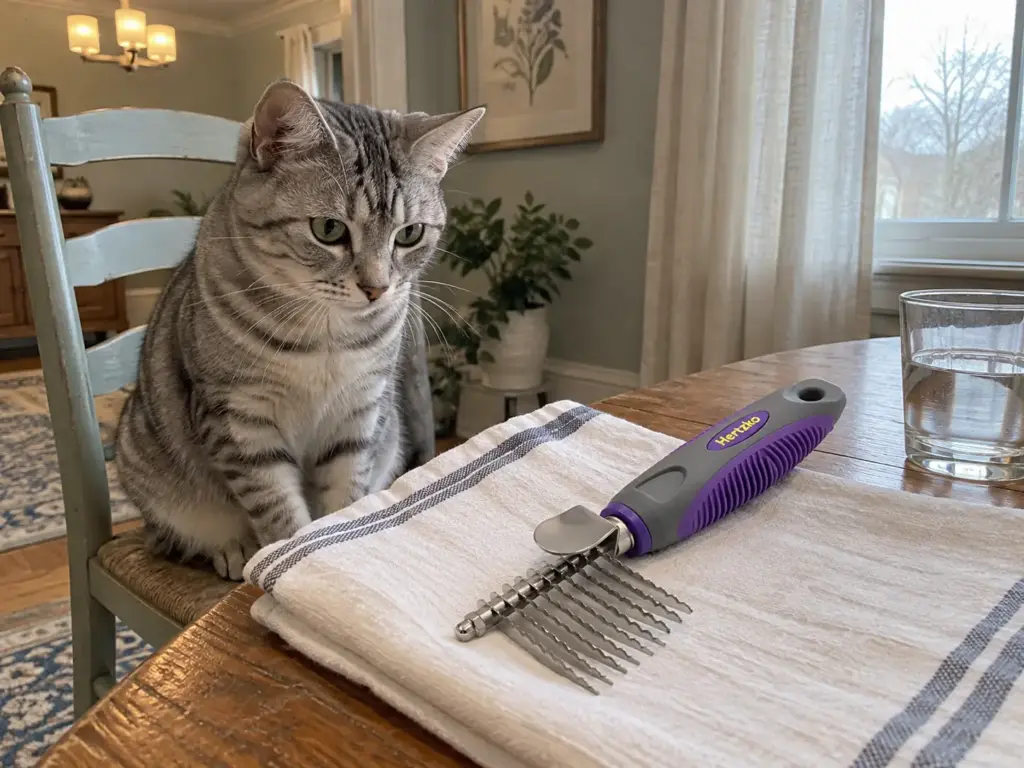
“I was just expecting from the description that it would work better than it actually does,” wrote a Hertzko reviewer in 2016. The description says “dual-sided blades,” and anyone reading that sentence asks the question that matters: is a blade safe against the skin of my cat? The honest reading is that this is a comb with a serrated edge, and it earns a place only when the knot is already open and sits clearly away from the skin.
What the edge is, and what it is not
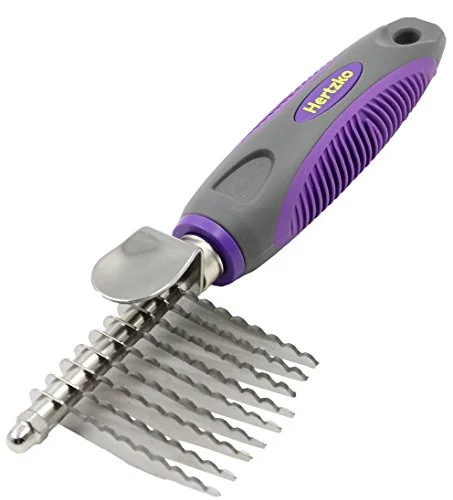
The Hertzko Grooming Dematting Comb measures 9 by 3 by 1 inches, with serrated teeth 2.5 inches long and a thumb rest on the handle. Serrated means the edge is toothed, and the listing calls it a blade. That is the reason it is useful on one small knot and the reason it has no business against the skin: an edge cannot tell hair from skin.
The knot it suits, and the knot it does not
The knot for this comb is small, already opened by the wide comb, and has visible daylight between it and the skin, about the 6 mm margin from the first section. You work with the hair and from the tips, never cutting toward the skin. The two combs do not compete: the wide one opens a knot, and the serrated one finishes a small knot that has already yielded.
The reviews of this comb read like the skin test in reverse. A 2016 reviewer found it “didn’t slide through or under any of the matts,” and a 2024 reviewer found the blades not sharp enough to deal with matting “without pulling on my cats skin too hard.” Both read like a knot lying too close to the skin for the edge to work, which is the case this comb was never meant for.
Find the skin with your fingers before the edge goes anywhere near the knot, then work from the tips only. If your fingers cannot find the skin through the knot, the edge never starts.
When the edge stays in the drawer: if you cannot see where the skin is
Leave the edge out for a flat plate of felted hair, for a knot you cannot find the skin under, and for any knot the wide comb did not open at all. Going up a tool is not the answer to a knot that will not move. A knot that stays shut after fingers and the wide comb belongs with a groomer or a vet, and when a matted cat belongs with a groomer and not at home covers how to tell, and what that visit looks like.
Dogs-and-Cats Listings, and the Groomers Who Say a Comb Is the Wrong Tool
A listing titled for dogs and cats promises one comb for both, and that promise is where the cat’s measurement goes missing. The numbers on the page describe the comb, never the cat.
A dogs-and-cats label does not print the cat’s measurement
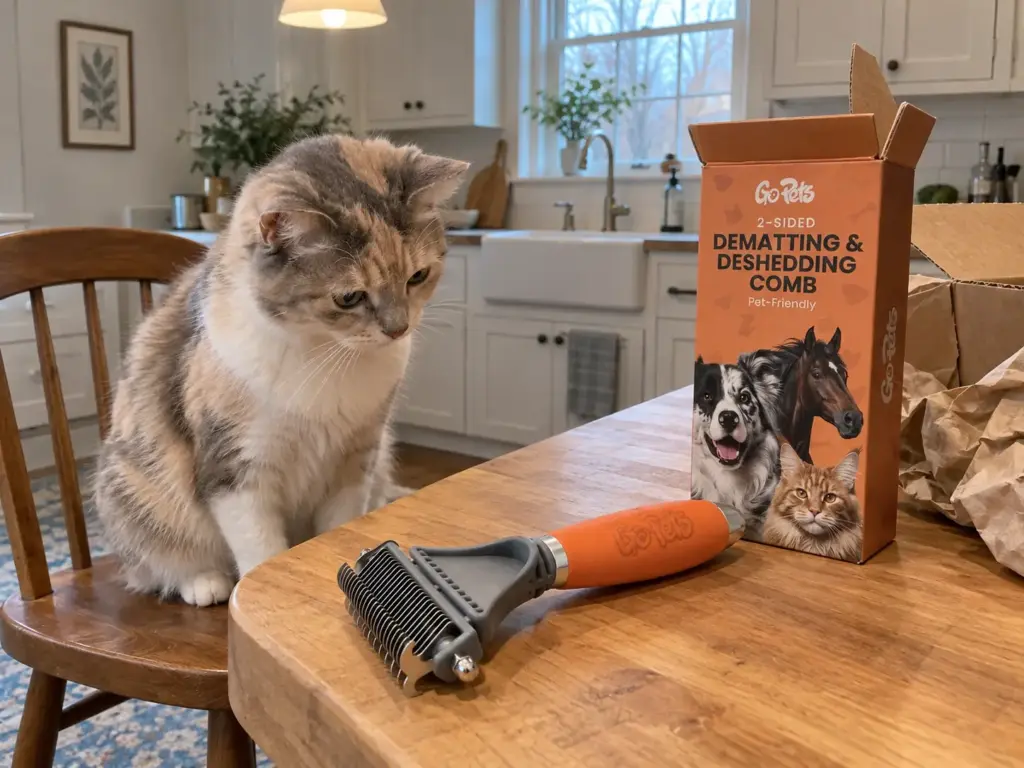
Take the GoPets 2-in-1 Deshedding & Dematting Comb, a double-sided comb measuring 8.9 by 2.5 by 1.4 inches, with a 12-tooth side for knots and a 23-tooth side for loose hair. The listing talks about “sharp stainless steel blades” and “rounded ends” in the same breath, which tells you the edge sits on the curve of the teeth. It earns a mention because it is the comb you will see when you search, and it earns a skip from the cat reviews: the five-cat reviewer found that it “doesn’t actually cut the fur,” a Maine Coon owner wrote that it “pulls on denser mats and hurts,” and another review in 2026 said it was “Not as large as video showed.”
Nothing in the numbers says whether a 2.5 inch head snags a fine coat or fits the skin behind a front leg. That gap is where the listing stops helping. A bladed edge turns up on other grooming tools too, and blade caps on deshedding tools get their own guide.
Read the measurements against the cat, not the photo: tooth length, head width, and whether the edge is blunt or sharp. If a listing never prints the tooth length, you are buying the picture.
What dog groomers say, and why this house does not follow them
In dog-grooming forums a professional groomer’s view is blunt: a comb “is not really used for de-matting.” The same threads reach for slicker brushes, a conditioning spray and thinning shears instead. Part of that is fair, because a comb alone is slow, and the ASPCA draws the same split: early, mild mats can be brushed out, and mats that have progressed need clipping. The comb in this house is for the early, loose knot.
Where this house stops following the dog groomers is the shears. Under a mat on a cat the skin has been pulled up into the knot, so the point of a thinning shear can reach it before your eye sees it, and a cat who shifts mid-snip closes the gap. Dog-coat methods that end in a cut were built for a table, a groomer and a dog that holds still. The same goes for the blade splitter, a favorite in those forums, which stays out of a cat’s coat.
Never scissors, and the line the ASPCA draws
According to the ASPCA’s advice on preventing matted coats, “NEVER cut mats out with scissors. Your pet can unexpectedly move or jerk resulting in a severe laceration or puncture.”
Clippers sit in the same risk group. Catster’s mat guide notes that even in experienced hands, scissors and clippers lead to skin cuts. The sorting in this article ends where it does for that reason: a comb for a loose knot, a serrated comb for one small knot already opened, and a groomer or a vet for everything else.
Test the Comb in the Drawer First, and Know Where the Comb Stops
Take the comb already in the drawer and run the skin test on the loosest knot you can find (on a long-haired cat that is rarely a search). If it has rounded tips and slides under without catching, you do not need another, and no listing can improve on that result. If the only comb in the house is a flea comb, it does not count: its teeth sit too close together to split a mat.

The buyer who gets there most often is the cat who can no longer groom herself. An older cat that can no longer reach its own back grows knots in exactly the places the comb is built for, the lower back and the base of the tail, so the comb earns its place there and nowhere else.
The stop line is not ours alone. The ASPCA puts it plainly: “If you notice a mat which cannot be easily brushed out, your pet should visit a groomer or veterinarian.”
Where the comb lives matters more than it sounds. Keep it with the rest of the cat grooming kit in one drawer, bring it out when the cat is already settled, and put it away before the first tug, so the comb never becomes the thing she associates with the knot. The routine in how often to brush your cat by coat keeps the coat open enough that the comb rarely has to come out.
Run the Skin Test Today, Then Look at the Same Spot in Three Weeks
Three things to carry out of this: a comb passes or fails in the gap between the knot and the skin, not on its listing; a rounded-tooth comb comes first, with the serrated comb reserved for one small knot that is already open and clear of the skin; and scissors never, with any knot that will not open between your fingers and the wide comb going to a groomer or a vet.
Three weeks out, look at the spot where the first knot was. If a new knot has formed in the same place, the coat or the cat’s reach is the issue, and a better comb will not fix it; if the spot is clean, the routine is working. A cat tends to accept or refuse a change quickly, while a human routine tends to slip by the third week, so that is the window to watch.
Today, take the comb you already own, find one loose knot smaller than a nickel, and run the skin test for a minute, stopping the moment she leans away. Note which side of her it was on; that is the spot to check first next time.
Frequently Asked Questions
01What is the best comb for removing matted cat hair?
The best comb for matted cat hair is a rounded-tooth steel comb with a coarse and a fine side, used on a small, loose knot from its tips. A serrated comb is second, for one small knot already opened. Nothing with a blade belongs on the skin.
02Do dematting combs work?
Yes, on a small, loose knot where the comb can slide under the knot without catching; no, on a knot pressed against the skin. Reviews from 2016 to 2026 report the same split. A knot that will not open goes to a groomer or a vet.
03What comb should you use for matted hair on a long-haired cat?
Use a rounded-tooth wide comb first, with your fingers holding the hair at the skin, and work from the tips of the knot toward the skin. On fine, silky hair fingers do more of the work. A flea comb’s teeth sit too close together to split a mat.
04Can you use a dog dematting comb on a cat?
You can if the comb has no exposed blade and a head sized for a cat, but a dogs-and-cats label rarely prints the cat’s measurement. Run the skin test first. A comb with blades on the curve of the teeth stays in the drawer.




Leave a comment