How to Tell Why Your Cat Is Peeing Outside the Litter Box
Why is my cat peeing outside the litter box? 5 floor clues, a box 1.5x his length (24-30 in), unscented litter scooped twice a day + 2 boxes.

Alfredo RamsesFounder · November 17, 2026 · 23 min read

On this page11 sections
- 1Read the Floor Before You Change Anything
- 2The Vet Comes First, and One Sign Means Tonight
- 3A Box Sized to the Cat, With a Wall It Can Clear
- 4Litter, Scooping and the Smell a Cat Judges
- 5Where the Box Sits, Even in a Small Apartment
- 6How Many Boxes, and the Ambush Problem With Two Cats
- 7Stress, Territory and Marking Are Not the Same Thing
- 8Cleaning the Spot and the Two-Week Reset
- 9When the Vet Has Cleared the Cat and It Still Happens
- 10Call First, Measure Second, Then Change One Thing a Fortnight
- 11Frequently Asked Questions
The box is spotless, the puddle is by the radiator, and the question you typed, why is my cat peeing outside the litter box, has a better answer than a grudge. A cat who skips a clean box is answering a problem in the house: a wall too high to clear, a smell he cannot stand, a doorway that leaves him cornered, or a box that has become the place where something hurts. According to Cornell Feline Health Center’s guide to house soiling, “House soiling is the most common behavior problem reported by cat owners.”
The floor tells you which kind yours is, if you read it before you touch anything. This guide reads that evidence first, puts the vet at the front of the line, then works through the box, the litter, the spot, the number of boxes, stress and marking, and the cleanup, one change at a time.
Quick Answer
Work through these in order, because the order is what keeps the result readable:
- Call the vet first, tonight if a male cat strains and passes little.
- Size the box at 1.5 times the cat’s length; low walls for seniors.
- Switch to unscented clumping litter and scoop twice a day.
- Add boxes in different spots, and change only one thing every two weeks.
Read the Floor Before You Change Anything
The usual first move is to change everything at once: new litter, a new box, a diffuser, a different corner, all inside the same fortnight. The puddles stop for three days, or they don’t, and nobody can say which change did what.
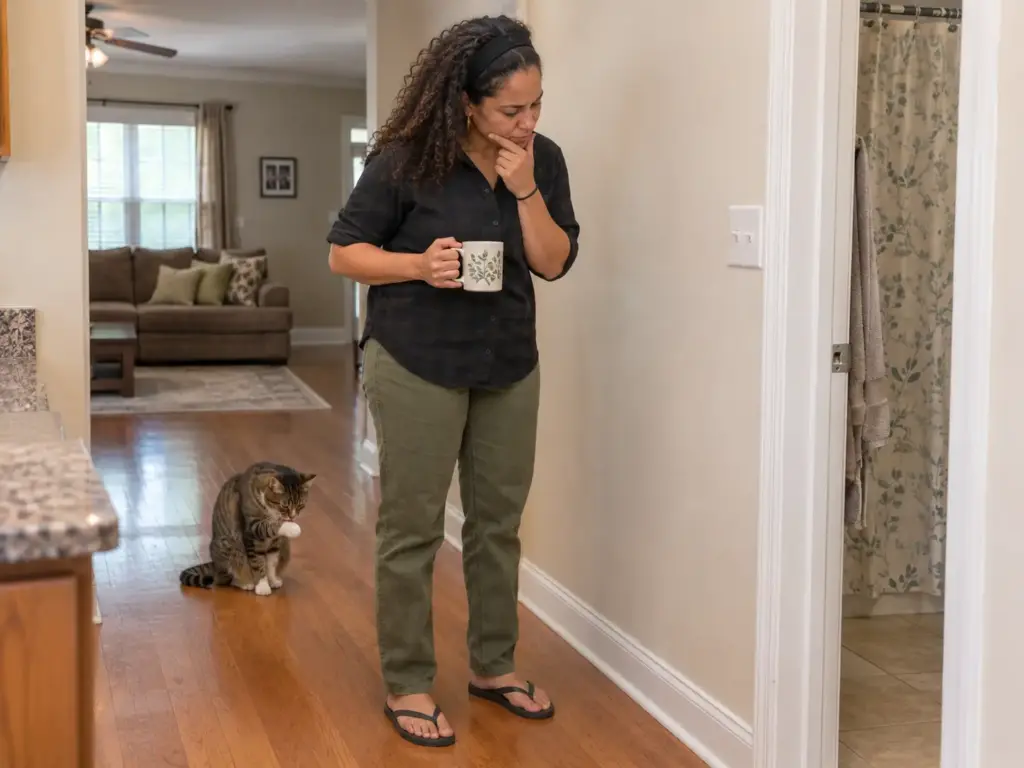
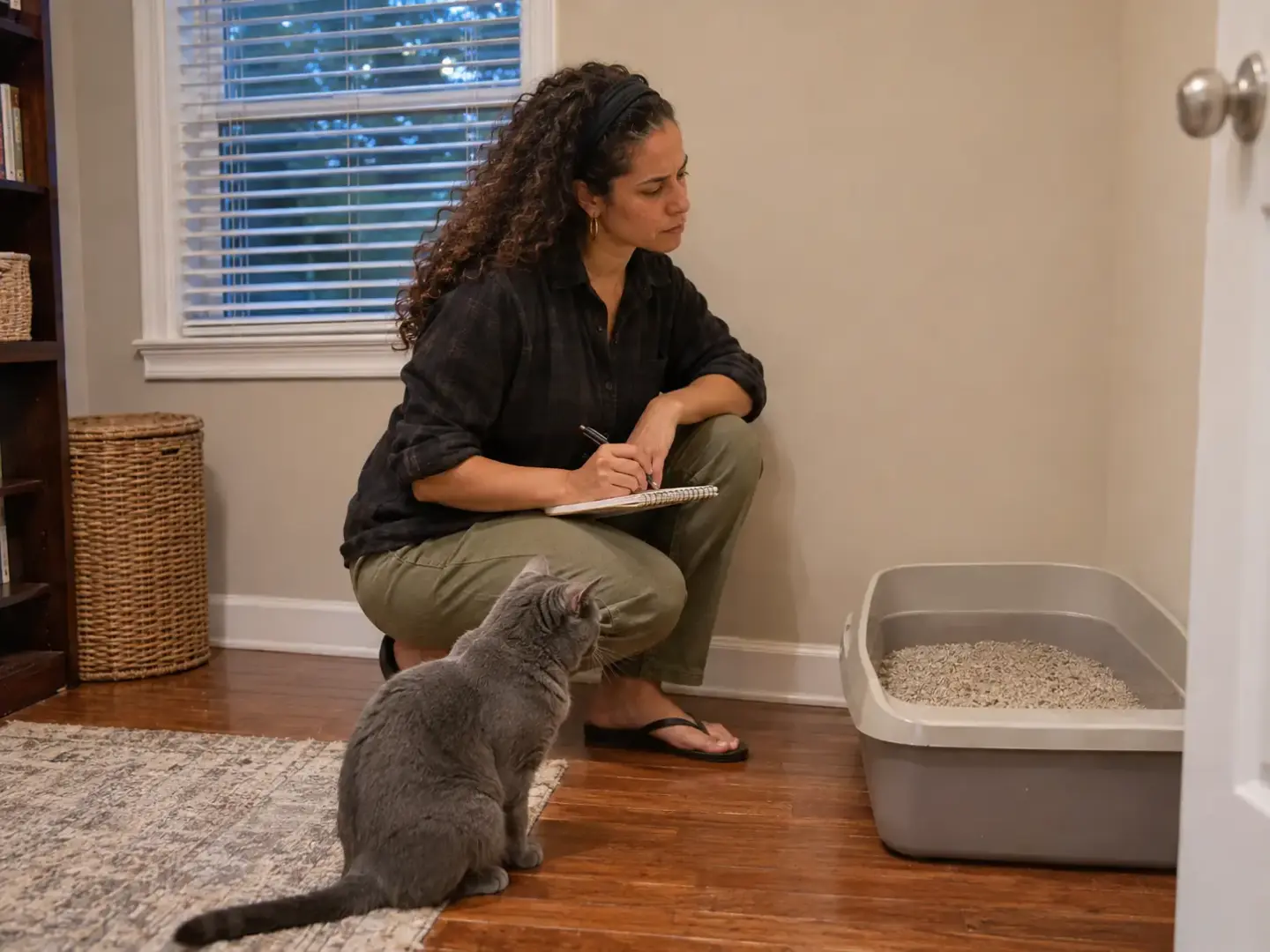
A cat with a problem leaves five readable pieces of evidence on the floor (posture, height, amount, surface and timing), and collecting them takes a few minutes and no shopping. None of it is a diagnosis. It tells you where to start, and the vet comes first whatever you find. It also settles one worry: at least 10% of cats develop an elimination problem at some point, according to the ASPCA, so this is a common event and not a defect in your particular cat.
Posture and Height Split Marking From a Full Bladder
A cat that is urine marking stands up, treads with his back feet, quivers his tail and aims a small amount at a vertical surface. A cat that is simply urinating squats on a horizontal surface and empties his bladder. International Cat Care on soiling indoors draws the same line, and the height of the stain gives it away from across the room.
Wet at floor level points to an accident or a rejected box. A streak on the baseboard, a door, a curtain or a piece of electrical equipment somewhere between roughly 6 and 20 inches up points to marking, and Cornell says cats usually spray on vertical surfaces such as the backs of chairs or walls.
Amount belongs in the same reading. A full puddle and a thin streak are two different messages, even when they land in the same room.
What the Surface Says: Soft and Scented, or Hard and Cool
Look at what he chose to wet. Soft and scent-soaked (a bed, a pile of laundry, the bath mat) tells you he has developed a surface preference, and Cornell notes that a cat who likes soft surfaces seldom picks tile. Hard and cool (tile, the bathtub, the sink) tells you the box or its location is the thing being refused (the name for that is litter box aversion). If the cold, hard floor is what he keeps choosing, the box is the first suspect, and how to choose a litter box by size, sides and entry covers the hardware in detail.
The Timing Notebook: Every Day or After One Event
Does it happen every day, or only after something? Cornell ties marking to a territorial threat (a new cat, outside cats near a window, new furniture or carpet), and International Cat Care adds a moved box, a bad experience in the box and plain fear. A notebook with the hour, the spot and the height, kept for a few days, turns “my cat has changed” into a pattern.
Together, the five readings sort the case into four piles: call the vet, look at the box, look at the territory, or both. And one boundary stays fixed. Whatever the notebook says, it does not tell you what is wrong with the cat. The vet section below takes it from here, and that part belongs to someone with a stethoscope.
Keep the notebook on a shelf outside the litter room, and write down the spot and the height before you clean the stain. Once the cloth has been through the area, the evidence is gone.
The Vet Comes First, and One Sign Means Tonight
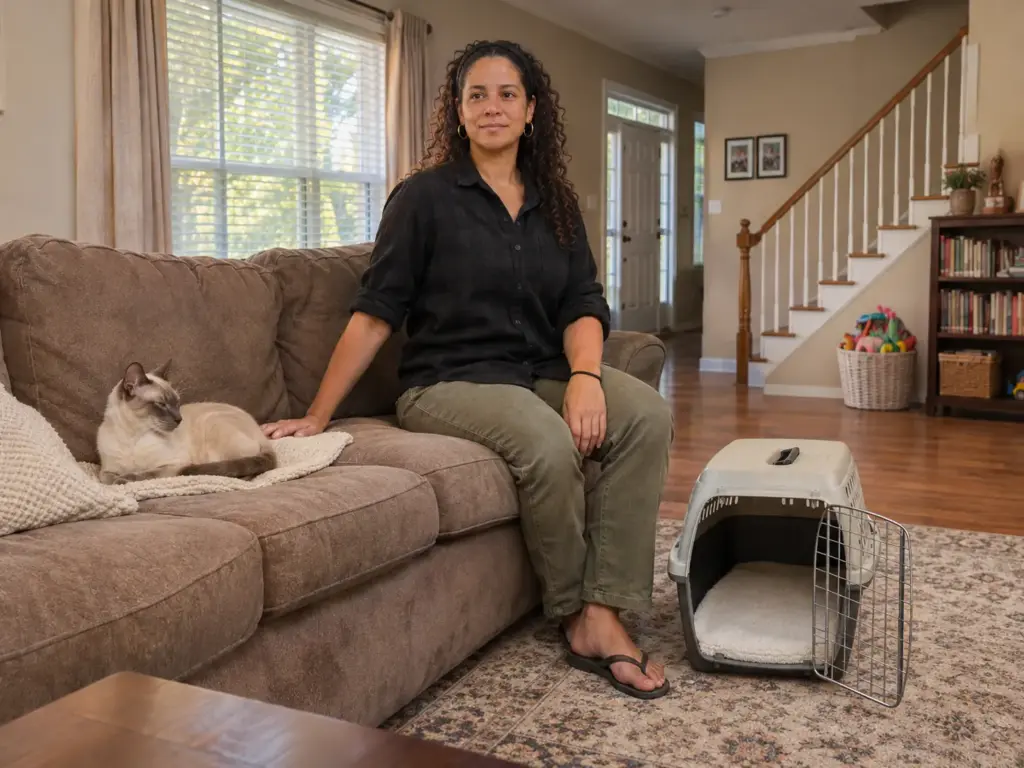
Somebody reading this is already standing in the pet aisle looking at boxes, or in the supermarket looking at litter, and has not called anyone. The sudden habit change is a question for a veterinarian before it is a question about furniture, and it gets said here once, in the place it belongs. The cat leaving a puddle may have learned that the box is where it hurts. Nothing in the house can fix that.
Why the Pet Shop Waits Until After the Vet
No new box fixes a pain. A new litter on top of a cat who already links the box with discomfort only spreads the blame across five variables, and Cornell puts the pain association plainly: urinary inflammation makes urinating painful and increases urgency, “particularly if he associates the litter box with pain.” Change the box first and you will never know which of the two things you fixed, or whether you fixed either.
The Conditions a Vet Checks, Said Plainly
Cornell Feline Health Center’s guide to house soiling names the medical territory: urinary inflammation, kidney disease, thyroid disease, diabetes, and the diseases of age that affect mobility or thinking. None of them can be read from the floor, and this page does not try to explain them. They are a list of what the vet looks at, and that is all they are here.
These are reasons to pick up the phone today and not next week:
- The cat is urinating more than usual, or drinking more than usual.
- The habit changed from one day to the next.
- He has stopped using the box completely and nothing in the house changed.
The One Sign That Means Tonight, Not Monday
One picture is different from all the others. A male cat who walks to the box again and again, straining to pee and producing little or nothing, is an emergency. In the words of the Merck Veterinary Manual on urethral obstruction (where UO is shorthand for the blockage), “Animals with UO might exhibit frequent nonproductive attempts to urinate.”
A complete blockage causes uremia within 36 to 48 hours and can be fatal in about 72, and Merck adds that owners often mistake it for constipation. International Cat Care gives the same instruction: a cat who is trying to urinate and cannot, or passes only small amounts, has to be seen urgently.
Call today, and bring the notebook.
Give the vet what the floor showed (the hour, how high, how much, which surface) instead of “he pees outside the box.” The detail saves questions in the exam room and visits afterward.
A Box Sized to the Cat, With a Wall It Can Clear
Somebody bought the box labeled “large,” and the cat still goes beside it. Of course he does. Litter box size on a label is a marketing word, and the cat needs a measurement. A wall a young cat never notices is the barrier for an older one.
Measure the Cat, Not the Label
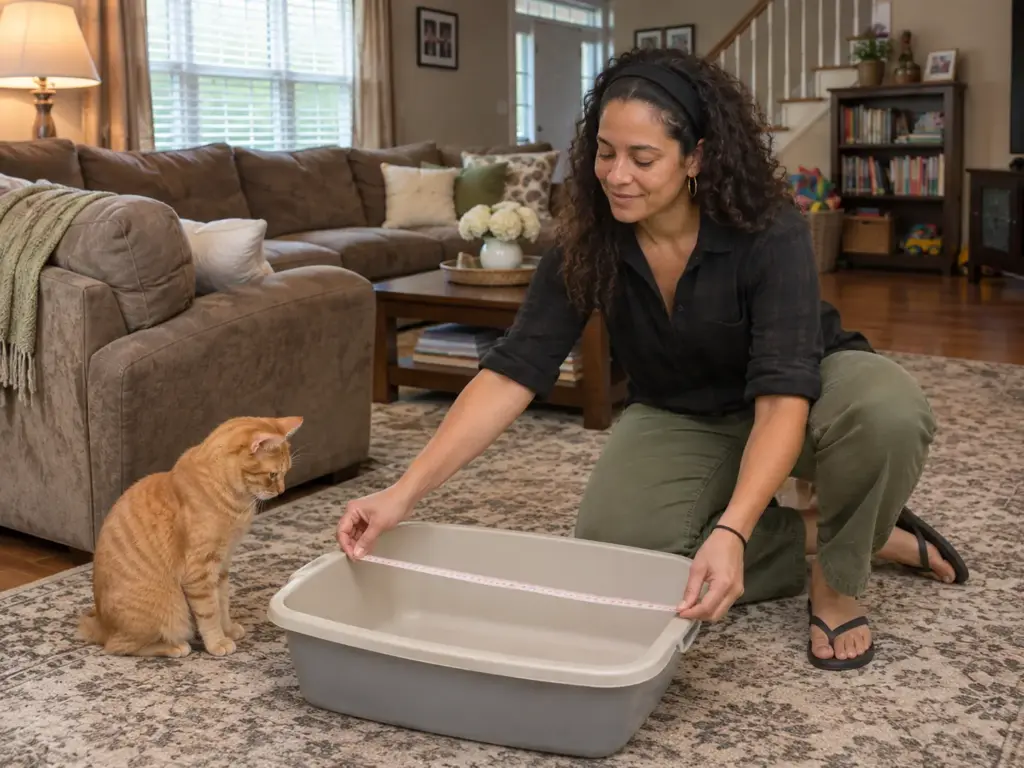
Stand the cat up beside a tape (a sewing tape works) and measure from the tip of his nose to the base of his tail. International Cat Care’s guide to choosing a litter tray says the tray should be about 1.5 times that length. For an adult who measures 16 to 20 inches, that is a litter box 24 to 30 inches long, enough to turn around without brushing a wall. The box sold as “large” is usually 19 inches (the IRIS and Amazon Basics “large” boxes are both 19 by 15 by 11.75), which is a size most adult cats are asked to turn around in.
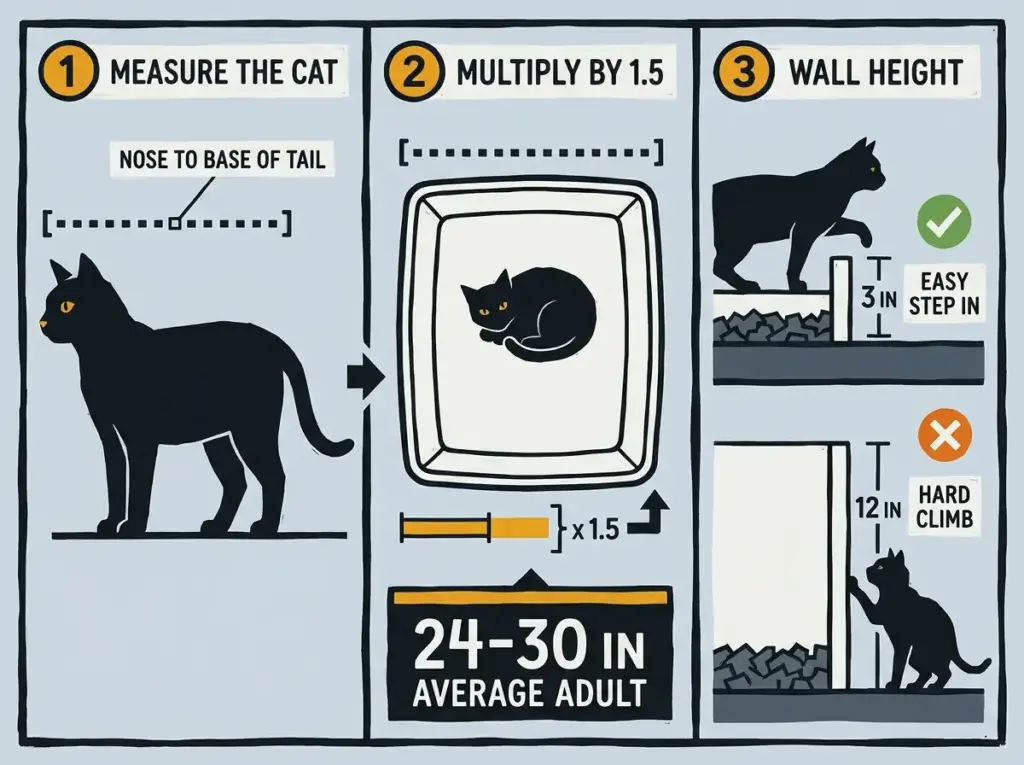
The full breakdown by type of cat is in what size litter box a cat needs, in inches, and its numbers agree with these.
Before spending anything, a plastic storage tub with a low door cut into one side and the edge sanded smooth makes a wide, low entrance and holds a proper depth of litter. If the tub does not appeal, the KITCATY 2-Pack Stainless Steel Litter Box measures 23.8 by 16 by 12 inches per tray, just under the 24-inch line, and the second tray in the pack meets the one-per-cat-plus-one rule without a second order. Stainless steel does not hold odor. But it arrives as a covered box with a litter-trapping pedal at the door, and the lid has to come off before a cat who is avoiding his box will walk into it.
The cheap end is the Amazon Basics Large Cat Litter Box, 19 by 15 by 11.75 inches with an open top and a lowered front. At 19 inches it suits a cat of about 13 inches from nose to base of tail, so it is a small cat’s box or a second box, and the scoop that comes with it is awkward to use.
Measure the cat standing, nose to base of tail, and multiply by 1.5 before you open a store page. A listing cannot argue with a number you wrote down yourself.
The Step-Over Decides It for an Older Cat
An older cat, or any cat whose joints make a jump hard, needs a low-entry box with a wide tray, fine soft litter and perhaps a step. A high-sided box and a top entry are the barrier, according to International Cat Care and the ASPCA. You see it by watching him go in: a hop, a pause at the edge, or climbing in with the front paws only is the step-over height failing, and it is not stubbornness. A cat that stops jumping overnight needs a veterinarian’s eyes before he needs a lower box.
Open also beats covered for a cat who is steering clear of the box, because Cornell recommends a box with a 360-degree view. The reasons are in the multi-cat section further down.
Litter Depth Against the Wall
Depth is where the published numbers disagree, and they are answering different questions. The ASPCA says most cats prefer 1 to 2 inches. International Cat Care gives about 3 centimeters, a little over an inch, as a minimum. The working band here is 2 to 3 inches, or 3 to 4 with clumping litter, because that is the depth that keeps clumps off the tray floor in a big box.
One number is what the cat picks, the other is what keeps the box scoopable. If you can see the bottom of the tray through the litter, a digger is going to hit plastic and a climber is going to scatter it, and how much litter to put in and why depth beats volume has the detail on both figures.
Litter, Scooping and the Smell a Cat Judges
A clean box to a human is a box that smells like nothing. To a cat it is a box that smells like itself, and not like lemon. The owner who wipes the tray with a “fresh” product, adds a deodorizer and sets a litter box liner has built a wall of chemistry that the cat’s nose reads long before he steps in.
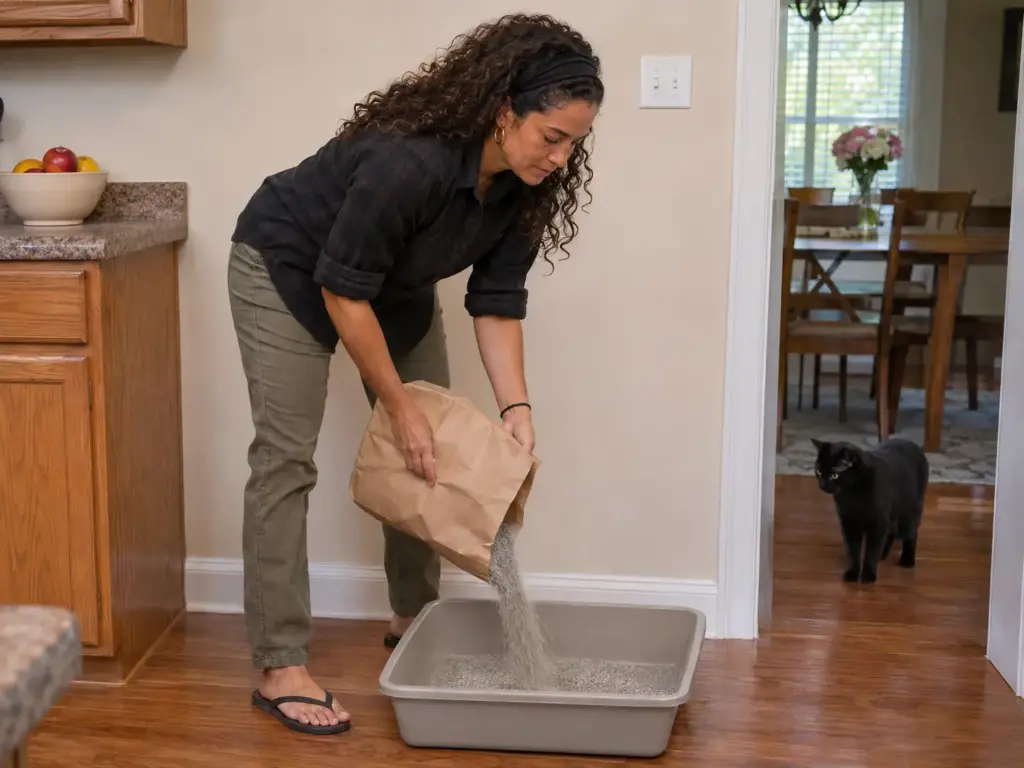
“The box was clean” is the owner’s defense, and it is often true. Cleanliness is one variable out of ten.
Unscented Clumping Beats Anything That Smells Fresh to You
Cornell on why most cats prefer unscented litter goes further: deodorants, strongly scented cleaners and plastic liners can push a cat out of the box, and International Cat Care adds that a liner that catches a claw is a good reason not to go back in. The free fixes come first. Scoop more often, drop the deodorizer, pull the liner. They take no money and no new bag of anything.
If the litter itself needs to change, Dr. Elsey’s Ultra Unscented Clumping Clay Cat Litter is a medium-grain, hard-clumping clay litter, low-dust and with no perfume, and it is the unscented clumping type the sources describe. It does track more than the label suggests with some cats, so put a mat at the exit.
Any unscented clumping litter works for the same reason, and the bag is not the point. The point is a smell the cat can tolerate at nose height and a litter that does not throw dust in his face.
Scoop Twice, Wash Weekly, Dump Every Two to Four Weeks
The ASPCA says to scoop daily, with once a day as the minimum. Twice is the better number, and International Cat Care gives it. The popular “deep clean weekly” is only half right, because the weekly job is the wash: scrub the tray with unscented soap or baking soda.
With clumping litter the full dump is every two to four weeks, and with non-clumping litter it is weekly. No ammonia anywhere near the tray. How often to scoop a litter box, per cat per day sets the daily rhythm, and when to wash the tray and when to dump the whole box separates the two jobs.
Switching Litter Without a Second Rejection
A refused new litter is a second problem stacked on the first. So the switch goes slowly, mixed in over days, and never in the same fortnight as other changes (the method in the cleanup section below explains why). Switching litter without losing the box walks through the mixing.
Keep the scoop at arm’s length from the box but out of the cat’s line of sight. Two short sessions a day with it do more for a box than a fresh bag of litter every month.
Where the Box Sits, Even in a Small Apartment
A box can be big, clean and unscented and still be in a spot the cat refuses, and litter box placement is the variable people check last. The person prefers not to see it, so it goes where nobody walks. The cat has a different list of needs, and in a rented one-bedroom with no spare room, the two lists collide.
Quiet Is Not the Same as Cornered
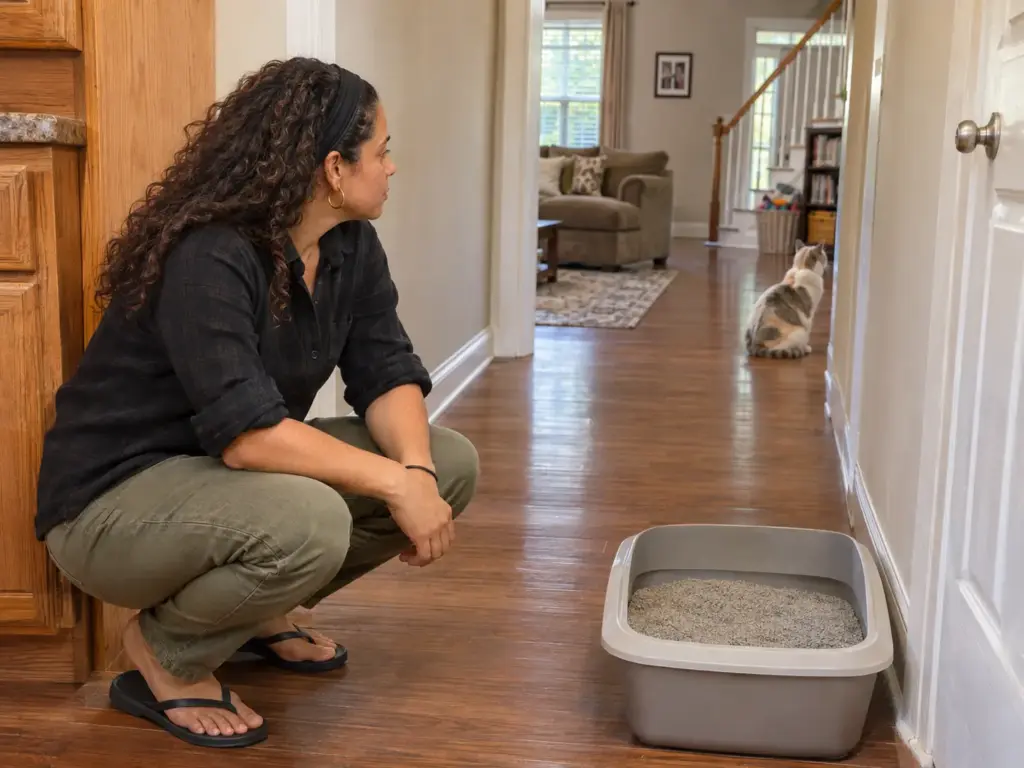
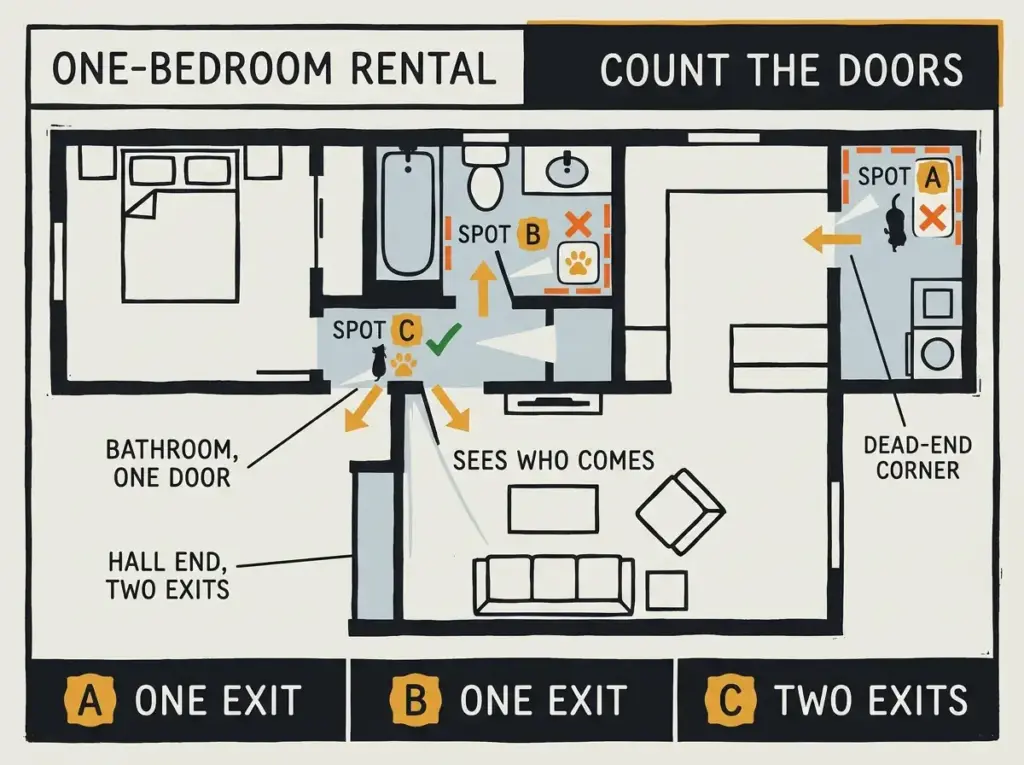
The standard advice is a quiet spot, and in a small apartment the only quiet spot is often a dead end: the gap beside the washer, the corner behind a door. The cat wants to see who is coming and to have more than one way out. The ASPCA on litter box problems asks for a box that is quiet and away from food and water but not cornered, and Cornell asks for a position with more than one way out and not boxed in on three sides. Quiet, then, is only half of what the spot needs: it is privacy with a way out.
The Honest Shortlist for a Rented One-Bedroom
Start with the free move: take the box to where the cat already spends his day, beside the bathroom door, at the end of the hallway, behind the sofa. The room the cat actually uses beats the room a person would choose, and nothing here needs a drill or a landlord’s permission. The spots that tend to work are a hallway landing with two ways out, a place next to an open bathroom door, and a living-room corner with a view of the entrance. The spots that only look like they work are the closet with one door, the bathroom whose door gets closed, and the wall beside an appliance that starts up with a clunk.
For the full set, see where to put a litter box, and three places to never, and for a place with no spare room, where a litter box actually fits in a small apartment.
The Basement and the Laundry Room Trap
A frequent failure sits outside the box altogether. Every box is on one floor, the basement or a single room, and the cat walks down, urinates beside the box and walks back up. The tray is clean, so the tray is not the problem: the route is. Why cats refuse a litter box in the basement explains the trip, and a second box on the floor where he lives ends it.
One cat, one well-placed box settles the position question. With two or more cats, who can block whom starts to decide it, and the box-count section below covers that.
Stand where the cat would stand, back to the box, and count the doors and gaps you can see. One exit is a dead end.
How Many Boxes, and the Ambush Problem With Two Cats
Two boxes in one corner is a single address. A cat reads them as one resource, and the second box adds nothing. The number of litter boxes matters, and where each one sits matters just as much, and in a multi-cat household there is a third factor that nobody sees: who is waiting outside.
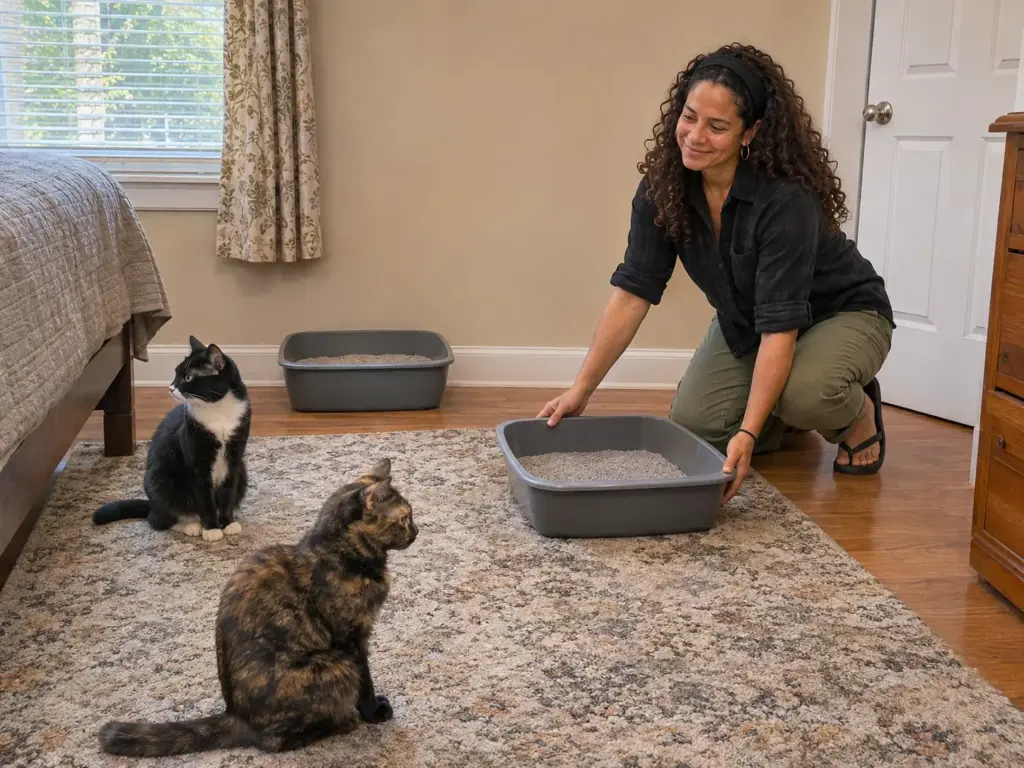
One Cat Still Needs Two Boxes
The N+1 rule is one box per cat plus one, in different places. For a single cat that is two boxes, two addresses. International Cat Care on choosing a litter tray gives the formula and notes that boxes grouped together count as one, and the ASPCA’s example is three cats, minimum four boxes. How many litter boxes two cats need covers the case people ask about most.
Two boxes for one cat is the rule. Two boxes pushed together is one box. The free move is boxes in separate rooms: pull them apart and remove the lid from one, then check from the doorways of the living room whether one cat can block another’s way.
A Box With One Door and a Housemate Outside
A covered litter box (a hooded box) with a single opening in a home with two cats is a trap with a lid. The cat inside has one exit, and another cat can sit just outside it. Cornell and International Cat Care both describe this arrangement: a covered box with one way out plus a housemate is enough for a cat to abandon a box that is clean, large and unscented. The remedy Cornell gives is a box with a 360-degree view and more than one way out, and the detail of lids is in covered and uncovered boxes, compared by the numbers and when a litter box enclosure becomes a trap.
A robot box does not rescue this. It makes a clean box, not an inviting one, and a cat that has already decided the floor is safer keeps deciding it. What a self-cleaning box does and does not fix explains where the limit is.
Where the Second Box Goes When There Is No Spare Room
The second box goes where the cat already passes the day, and not wherever the apartment has a free corner. It cannot sit on the same wall as the first or in sight of it, or the cat reads them as one.
The stainless pair from the size section gives you the hardware for two trays. The placement is still the work. Why a spare resource fails when it sits next to the first explains the mechanism, and how exits and dead ends shape territory in a small apartment maps the two-door idea onto a real floor plan.
Count exits, not feet. If a cat can leave the box two different ways without passing another cat, the position works.
Stress, Territory and Marking Are Not the Same Thing
What if the box is not the problem? Marking, household stress and ordinary urination separate by height and posture, which the first section covers. Here the question is what moves each one and what the house can do.
Marking Is a Message About Territory
Marking tends to follow a territorial threat. Cornell lists a new cat, outside cats, and new furniture or carpet. International Cat Care on what triggers soiling indoors adds a moved box, a bad experience in the box and plain fear.
None of it is bad manners. The apartment changed, and the cat read the change. The cat that targets a person’s bed or lap, the one that returns to a single spot and the question of punishment are separate puzzles, and this guide only points at them.
What a Change in the Home Sets Off
A new baby, a new pet, moving house, visitors and a changed schedule are all environmental changes, and the cat registers every one. Bringing a baby home to a cat that lives there first covers that one household change without making a medical claim out of it. The free responses come first: close the curtain or block the lower window so the cat cannot see the visitor outside, put the box back where it was, keep the feeding routine, and leave each cat’s zones and hiding places open.
Where a Pheromone Diffuser Fits, and What It Does Not Do
A plug-in pheromone diffuser is environment support, not a treatment. The FELIWAY Classic Cat Pheromone Calming Diffuser Kit goes in the room where the marking happens, plugged into an outlet that already exists. The effect is uneven from home to home, and some units give off a burning smell, so check it during the first hour. For a home with several cats, which pheromone diffuser suits a home with several cats narrows the choice.
Write down what changed in the home in the two weeks before the first stain: a visitor, a rug, a cat at the window. It is the cheapest clue there is.
Cleaning the Spot and the Two-Week Reset
The owner at the end of the rope changes five things in one fortnight (the box, the litter, the number of boxes, a diffuser, the food) and cannot say which of them did anything. That is the moment this section exists for. The cleanup comes first, because a spot that still reads as a toilet will keep pulling the cat back, and then the order of changes, which is what makes the rest readable.
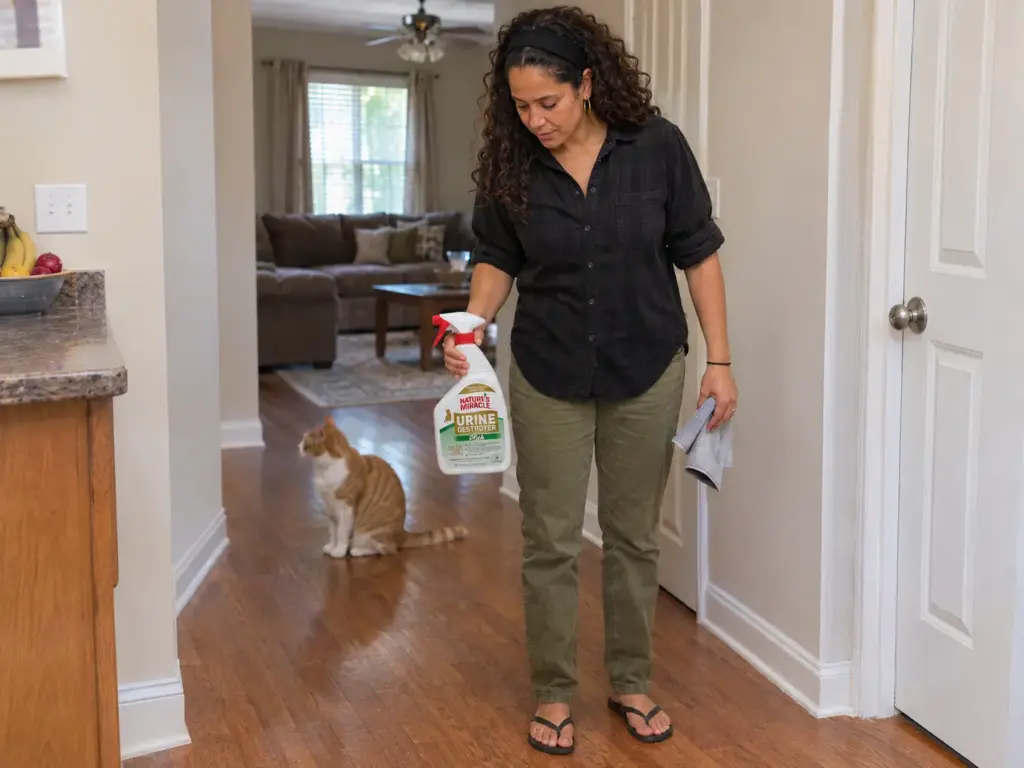
Neutralize the Smell, Do Not Perfume It
Your nose is not his. A stain that has stopped smelling to you can still carry residual smell for him and be a bathroom, and cats tend to go again where they already have. Cornell and International Cat Care on cleaning an area a cat has soiled say to wash with a commercially produced enzymatic cleaner and to neutralize the odor, not mask it, and to stay away from ammonia-based products, because ammonia smells like urine to a cat. Why the ammonia smell starts half an hour after the pee explains why the spot keeps reading as a toilet.
The Nature’s Miracle Cat Urine Destroyer Plus is a bacteria-based enzymatic cleaner for the floor, the baseboard and a washable cover: soak the area, leave it for 15 minutes and blot with a clean cloth. The “fresh” scent is strong to some noses right after use, the opposite of what a cat tolerates on a spot he is being asked to forget, so air the room afterward. How the box design affects what is left in the room is in which litter box design holds the least odor.
One Change at a Time, Fourteen Days Each
This is the method used here, and no vet source prescribes it as such. Begin with what you have already done and read off the floor (the first two sections). Then make a single change every fourteen days, in the order of the sections above: box, litter, spot, number, stress. Write the date of each change in the notebook before you make it.
There is a tension in this, because the ASPCA says speed matters, as a surface preference can set. An ordered method is quick enough. Five changes at once are not, because they leave a result nobody can read.
The fourteen days are for reading, not for sitting still. If the pattern shifts (no longer at floor level, no longer by day), that is information. If it gets suddenly worse, go back to the vet section.
The Cheap Ladder Back to the Box
Retraining on a budget starts with something already in the house: a training pad goes on the floor exactly where the cat already goes, with a handful of litter on top. Then the pad moves into a shallow box, and more litter goes in each week until the box is a box again. Leave the pad in place too long and it becomes the address, so it has to be withdrawn.
The rule is never punish: no scolding, no rubbing a nose in the stain, nothing of the kind. The cat is describing a restriction (a wall he cannot clear, a smell he cannot stand, a door he does not trust), and punishing the description only teaches him to hide it.
Date each change in the notebook before you make it. Two weeks later, memory will tell you everything happened at once.
When the Vet Has Cleared the Cat and It Still Happens
A cat who has been cleared and still urinates outside the box has picked a surface and a spot, and that has become a habit. It is not a failure of the person or a fault in the cat. Cornell notes that the longer the behavior goes on, the more likely it is to become a habit, and the ASPCA on why speed matters with litter box problems says the refusal can turn chronic. A certified cat behavior consultant (a CCBC) is the next door when the vet has cleared the cat and the order of changes has been followed without a result.
Age changes the answer. An older cat needs a low wall, a wide tray, a step, and the box closer to where he spends the day, and what changes for an older cat, with the vet first covers the rest. A senior cat who changes habit overnight needs the veterinarian before any box. In the meantime, cover or put away the soft surfaces he favors with something that cannot be soaked, and put the box where he chose, then walk it back a little at a time, as on the ladder.
Call First, Measure Second, Then Change One Thing a Fortnight
The order is the answer. A vet visit comes before any purchase, because pain turns the box into the place that hurts, and a male cat who strains and passes little cannot wait. After that the box is measured against the cat at 1.5 times the length, the litter is unscented and scooped twice a day, and the boxes multiply and move to where the cat already spends his day. Then comes one change at a time, dated in a notebook, so the result stays readable.
Read each change at the fourteen-day mark. A cat takes to a box or turns it down in days, and a person’s new routine slackens sooner than the cat’s habit does, so if the notebook shows no shift by then, the scoop schedule is the first thing to re-check.
Tonight, write down what the last puddle looked like: height, amount, surface, hour. If two boxes sit in one corner, pull them apart. If one has a lid, take it off.
Then watch where the next puddle lands. Lower, higher or somewhere new says more than any product page.
Frequently Asked Questions
01Why is my cat suddenly peeing outside the litter box?
A sudden change in where your cat pees is a question for a veterinarian first, because medical problems change toilet habits and cannot be read from the floor. Cornell lists urinary pain, kidney and thyroid disease and diabetes among them. After the vet, look at the box, litter, spot and number of boxes, one change at a time.
02When should I take my cat to the vet for peeing outside the box?
Go the same day if a male cat keeps visiting the box and passes little or nothing; for any other change of habit, go before you change anything in the house. Bring notes on the hour, height, amount and surface you saw.
03How do I get my cat to pee in the litter box again?
Work in order, one change at a time: vet first, then box size, litter, location and number of boxes, with fourteen days between changes. Clean every stain with an enzymatic cleaner so the spot stops smelling like a toilet to him.
04What is the difference between a cat spraying and peeing outside the box?
A cat that is spraying stands, quivers his tail and aims a small amount at a vertical surface; a cat that is urinating squats on a horizontal surface and empties his bladder, as International Cat Care describes. Height and posture tell them apart.
05How many litter boxes does one cat need?
One cat needs two boxes in different spots, because the rule is one box per cat plus one. Two cats need three, and boxes pushed together count as one.

Leave a comment