How to Stop Cats Fighting When There Is No Second Room
Cats fighting in a small apartment? A 36-inch gate, 24 to 48 hours apart, one resource per cat plus one, and when the vet comes first [guide].

Alfredo RamsesFounder · November 3, 2026 · 21 min read

On this page12 sections
- 1Cats Fighting or Playing? How to Tell in Ten Seconds
- 2When the Fight Comes Out of Nowhere, the Vet Comes First
- 3The First Minute: What to Do While It Is Happening
- 4Why No Second Room Makes the Fighting Worse
- 5Splitting One Apartment When There Is No Spare Room
- 6One of Everything, Plus One, Spread Around the Apartment
- 7Every Cat Needs a Way Out, Above or Behind Something
- 8The Window Trigger: Fix the Sightline Before You Buy Anything
- 9Neutering and Pheromone Diffusers: What They Help and What They Cannot
- 10When the House Is Fixed and the Fights Are Not: Back to Contact, or a Behaviorist
- 11The Fight Is Pointing at the Missing Exit
- 12Frequently Asked Questions
You hear a thump in the hallway, then a yowl, and by the time you reach the doorway one cat is on the back of the sofa and the other is under the table. In an apartment with no spare room, cats fighting is rarely a question of temperament: it is two animals sharing one doorway, one window ledge and one line of sight, with no way to put distance between them. Cats in a home they cannot leave need an exit more than they need a verdict on who started it. This guide shows how to stop cats fighting without a second room: how to read the fight, what to do in the first minute, how to split one apartment between two cats, and what to change so it stops coming back.
Quick Answer
Work through these in order, and stop at the first one that belongs to the vet.
- Read it first: play, a real fight, or a sudden change for the vet.
- Keep your hands out and cut the fight with a noise far from the cats.
- Separate with a barrier they can see through, and take turns with the space.
- Spread one litter box, bowl and bed per cat, plus one, around the apartment.
- Give each cat a way out and a hiding spot, and block the window sightline.
- Reintroduce in stages, and call a behaviorist if the fights keep coming.
Cats Fighting or Playing? How to Tell in Ten Seconds
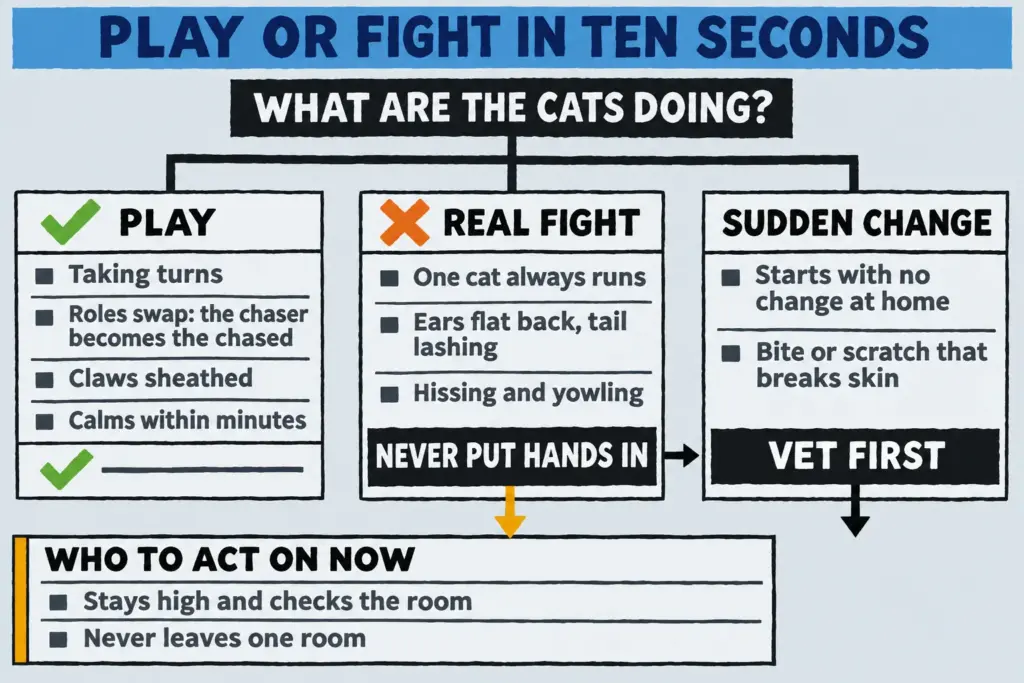
A thump and a burst of noise from the next room can be play fighting or the start of a cat fight that ends with one cat hidden for the rest of the day. You get about ten seconds to decide whether the cats are playing or fighting, and the call gets easier once you know what separates a game from a fight: who takes turns, how loud it gets, and where each cat ends up.
Play Takes Turns, a Fight Does Not
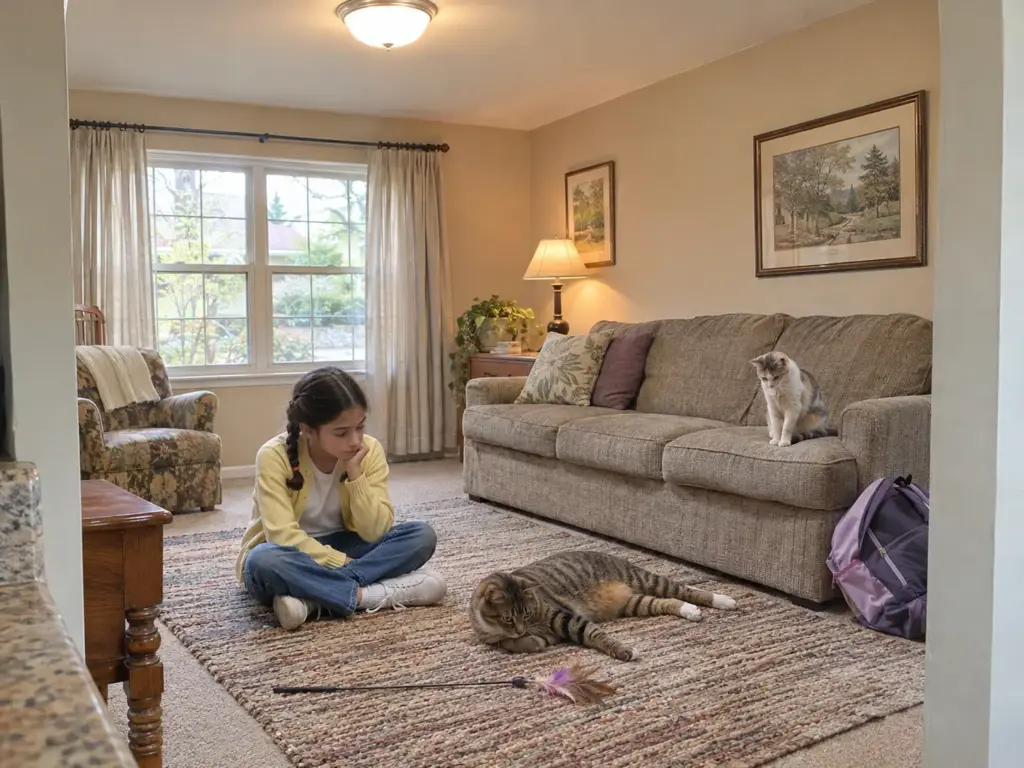
Play is reciprocal. The cat doing the chasing becomes the cat being chased a few seconds later, and the swats land with the claws tucked in. Most of it looks like this:
- The chaser and the chased swap roles, so neither cat is always the one running
- Swats and bites are gentle, the claws stay in, and the noise is low or absent
- Both cats pause, shake it off and go back to their own business within seconds
A real fight has a different shape, and it is usually lopsided:
- One cat is always the one fleeing while the other keeps pursuing
- Flattened ears, a swishing tail and flailing paws with the claws out
- Hissing, growling and yowling, and afterward one cat hides or both stay rigid
The One Cat That Stays High and Checks the Room
Play with swapping roles can be left alone. The cat to act for is the one that stays up high (the sofa back, the top of a wardrobe, the highest shelf) and scans the room before it crosses it, or the one that never leaves a single room at all.
That cat is not shy. It is reading a floor where the other cat will come after it, and staying out of reach is the sensible response. The cat doing the chasing is no villain either; it is working inside a layout that lets it.
Picture a cat that has taken over the top of the bookcase and comes down for water only when the other cat leaves the room. That apartment is working as a trap for it, and that one detail tells you more than any amount of noise. (It also explains the cat that suddenly “gets antisocial”: it has simply stopped crossing a floor it does not trust.)
The Ears, Tail and Back (Cornell’s Lines Between Attack and Fear)
Cornell Feline Health Center separates a cat on the offensive from a cat in fear by posture. On the offensive, the pupils are dilated, the ears go back, the tail stands up with the fur raised and the back arches. In fear, the ears flatten out to the sides and the tail is held close or tucked beneath the cat.
A cat curled low with its tail tucked is retreating, while a cat with an arched back and an upright tail is still in the fight. Read both cats, because a fight is two postures at once and they rarely match.
When Neither One Fits (Go to the Next Section)
Some conflict makes no noise at all. A cat that avoids the other, lives in one room and comes out only when the coast is clear is not getting along, and International Cat Care counts that quiet standoff as conflict too. And a fight that arrives out of nowhere, with nothing moved or changed in the apartment, is not a furniture question yet. Both lead to the same place, the vet question that comes first.
When the Fight Comes Out of Nowhere, the Vet Comes First
According to Cornell Feline Health Center’s guidance on feline aggression, “The first step in managing an aggressive cat is to ensure that there is no medical reason for aggressive behavior.” That sentence decides the order of everything else in this guide, so it goes before a single piece of furniture moves.
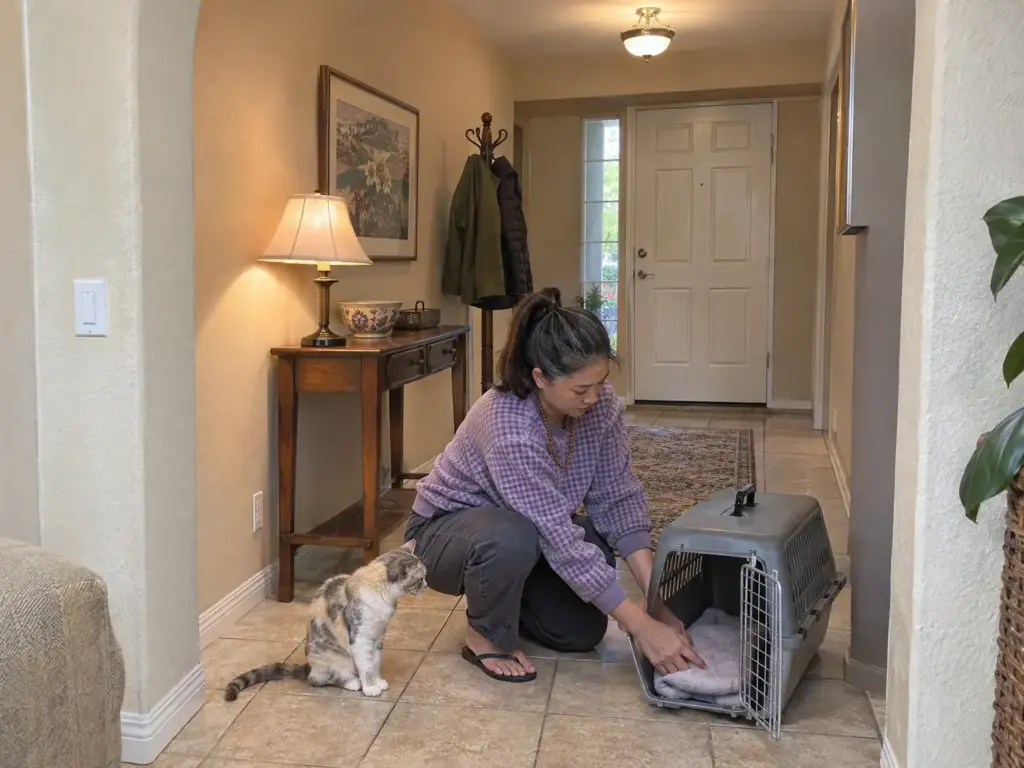
The line between the two kinds of problem is simple. Whatever changes overnight, and whatever hurts, is a question for the vet. Whatever repeats by place, by time of day or by window belongs to the apartment, and the rest of this guide is about that.
Sudden fighting between two cats that got along for years, with nothing moved in the apartment, is in the first group. This guide does not guess at why.
Call the vet before changing anything in the house when you see:
- A bite or a scratch that breaks the skin (a wound can look small and still hold bacteria)
- A fight that one cat could not get out of
- A cat that stops eating, drinking or using the litter box after a fight
- A change of character from one day to the next
If the visit comes back clean, everything below is the follow-up to it, not a replacement for it.
The First Minute: What to Do While It Is Happening
Every instinct says to grab the nearest cat or fire the water bottle. The first minute is mostly about what you leave undone.
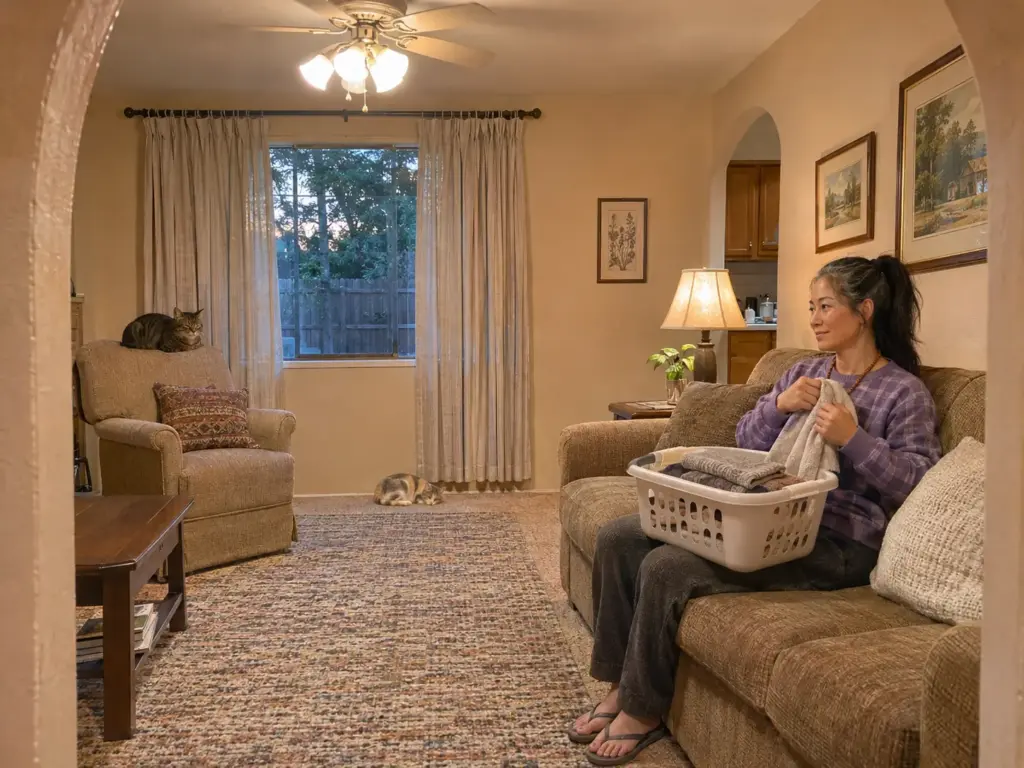
Hands Stay Out, Always
Cornell is blunt on this: never put a hand or any other part of yourself between cats that are fighting, because you can be seriously injured. A cat mid-fight is running on adrenaline, and the warm thing that suddenly appears between the two of them is your arm. Whatever you plan to do, plan it from arm’s length or farther.
Break It From a Distance, Not From the Middle
Three things work from a distance: a loud noise made away from both cats and away from your hands (a heavy book dropped on the floor), a toy thrown past them so a new target pulls their attention, and a cushion or blanket dropped between the two so they lose sight of each other. Then stop. Do not chase the cat that runs.
Leave a throw blanket folded on the arm of the sofa, or wherever the fights tend to start. Dropping it between the cats breaks the line of sight, and your arm stays out of reach. You cannot fish for a blanket in a cabinet while two cats are going at it.
Why a Clap or a Spray Can Backfire
A clap or a squirt from a water bottle feels like the obvious interrupter. It also puts you in the middle of the fight. The reasoning here, and it is reasoning, not a study, is that a sound or a spray that comes from a person makes the person part of the conflict. The cat starts to read you as part of the threat, and the next time you walk into the room the tension rises before anything has happened.
So move the noise away from the cats and out of your hands: the book on the floor, the toy flying past, the cushion falling between them.
After the Cut-Off: Let Both Cool Before Anyone Is Touched
Do not pick up either cat, and do not talk to them or reach for them while they are still wound up or right after (International Cat Care is clear on this).
If the apartment has a spare corner or a closed door, each cat goes somewhere separate. If it does not, dim the lights and stop looking at them. Letting them cool down ends this episode, not the problem, and nothing here promises the fight will not return. Everything from here on is aimed at that.
Why No Second Room Makes the Fighting Worse
A cat in a house with two spare rooms can lose an argument and walk away from it. A cat in a studio loses the argument and then lives inside it. That is the part of the problem a temper explanation misses: for cats living together in a studio, the missing exit does most of the damage.
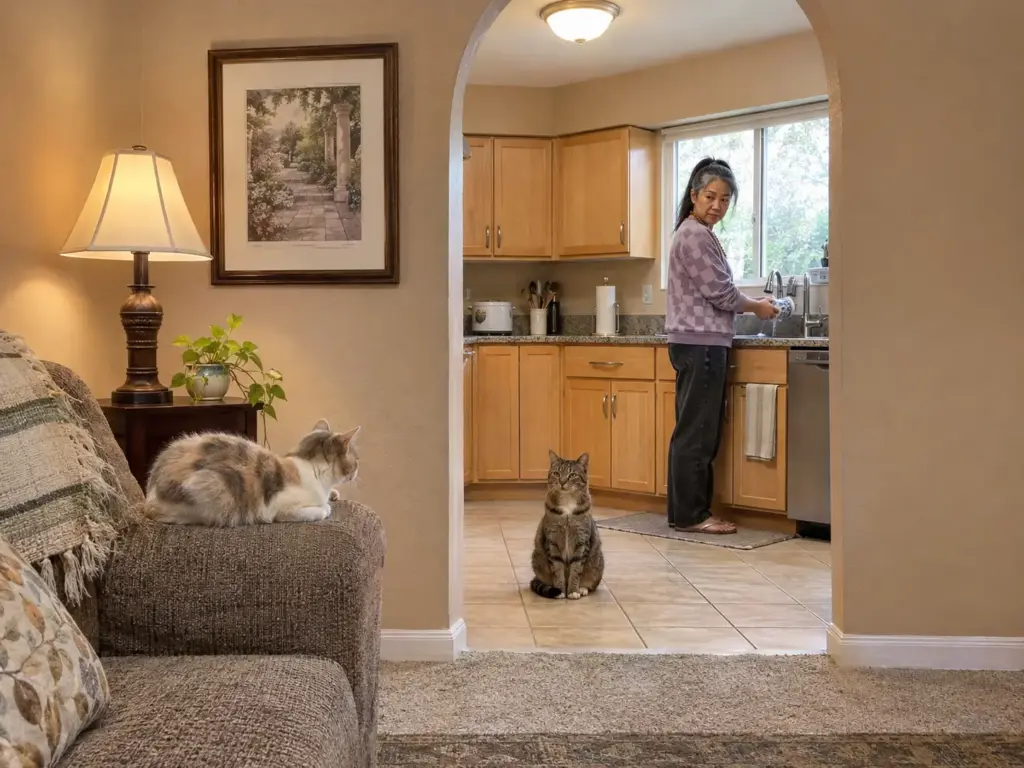
Two Cats, One Doorway
Two conflicts show up over and over in apartments without internal doors. In the first, one cat sits in the doorway or the hallway and the other has to pass it to reach anything. In the second, one cat holds the high spot and watches. Neither is bad faith; both are territorial behavior in too little space.
A single litter box in a bathroom, a single bowl by the refrigerator or a single ledge at the window gives the second cat one route in and no way around the first, and that is enough.
What a Cat Sees From the Couch (Sightlines)
From the couch, a cat sees the entry, the kitchen and the front door, and every one of those lines is a place where the other cat can appear. In a small apartment the lines cross: the ledge looks at the hallway, the hallway looks at the box, the box looks at the bed. A cat that cannot get out of the other’s view is a cat that is on watch all day, and watching is tiring. (Hence the cat that starts sleeping in the closet.)
The Human Wants Peace Today; the Cat Needs an Exit
You want the fight to be over. The cat wants somewhere to go where the other cat cannot see it. Those are different requests, and the second one is the one that holds. A cat that lives in a single room because the other controls the rest is not at peace, and International Cat Care counts that avoidance as conflict.
Add a third cat and the pattern changes again: two can settle into a team and push the third out of the water, the box or the bed.
Splitting One Apartment When There Is No Spare Room
The standard separation, 24 to 48 hours with the cats in different rooms, comes from International Cat Care’s advice on conflict between cats, and it assumes a spare room with a door. A studio or a one-bedroom rarely has one. So the plan changes shape: the barrier is whatever the apartment offers, and a schedule does the work a second room would have done.
Start With What You Already Have: A Door, a Panel or a Schedule
Begin with the nearest thing to separate rooms: a door that closes, usually the bathroom or the bedroom, and split the day into blocks of hours. One cat has the apartment while the other has the room, then they swap.
Each space needs a full set: litter, water, food and somewhere to hide. A cat that must leave its room to reach the litter box has ended the separation. The rotation does not split the litter count, by the way; that stays one per cat plus one, and the part on resources sorts out the spread.
When no door is available, a barrier will do. According to the Cornell brochure on barriers between aggressive cats, “Using barriers such as baby gates or panels made of cardboard, light wood, or plastic to separate aggressive cats can be very effective.” A sheet of light wood or plastic across the opening counts. It buys time without ending the problem, and a determined cat can clear it, so treat it as a pause.
A Gate With a Small Door, Measured Against the Opening
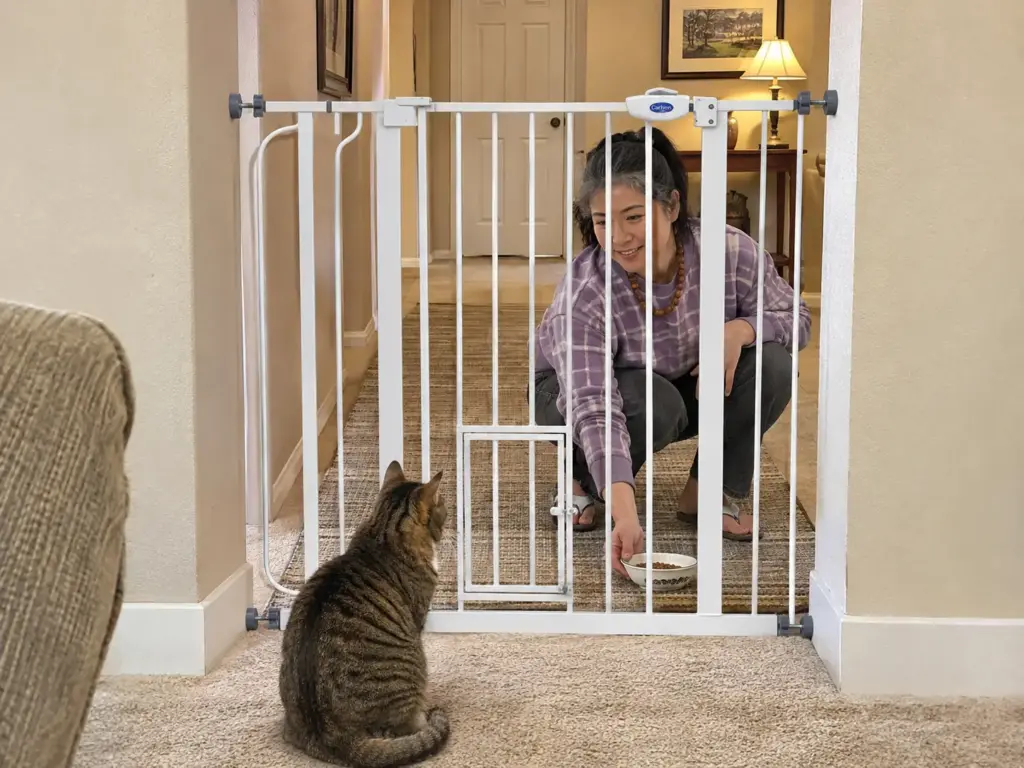
Pick a gate when the free options run out, and pick it with a tape measure. The Carlson Extra Tall Walk-Through Pet Gate with Small Pet Door (see it on Amazon) stands 36 inches tall and fits openings from 29 to 37 inches wide, so an opening of 38 inches takes it out of the running.
You can see through it, which lets each cat keep the other in view without contact, and the small door lets a cat cross without anyone lifting the gate, which matters in the stage where the barrier stays but traffic resumes.
Check one thing before relying on it: while two cats are meant to be apart, whatever fits through that small door is not separated. It is also a weaker fit for stairs, for doorways wider than 37 inches and for rentals, and a cat set on getting over will test every one of those 36 inches. If your opening is wider, the panel from the last part is the better pick.
Meals on Either Side: Rotating Who Has the Room
Feed the cats on opposite sides of a closed barrier, with the bowls set back so neither cat is pressed against it. The ASPCA puts a couple of feet between cats that eat near each other, and that spacing is a sensible starting point at the barrier too. Where two feeding stations fit in a small apartment is worked out in Feeding Two Cats in a Small Apartment, by Floor Plan.
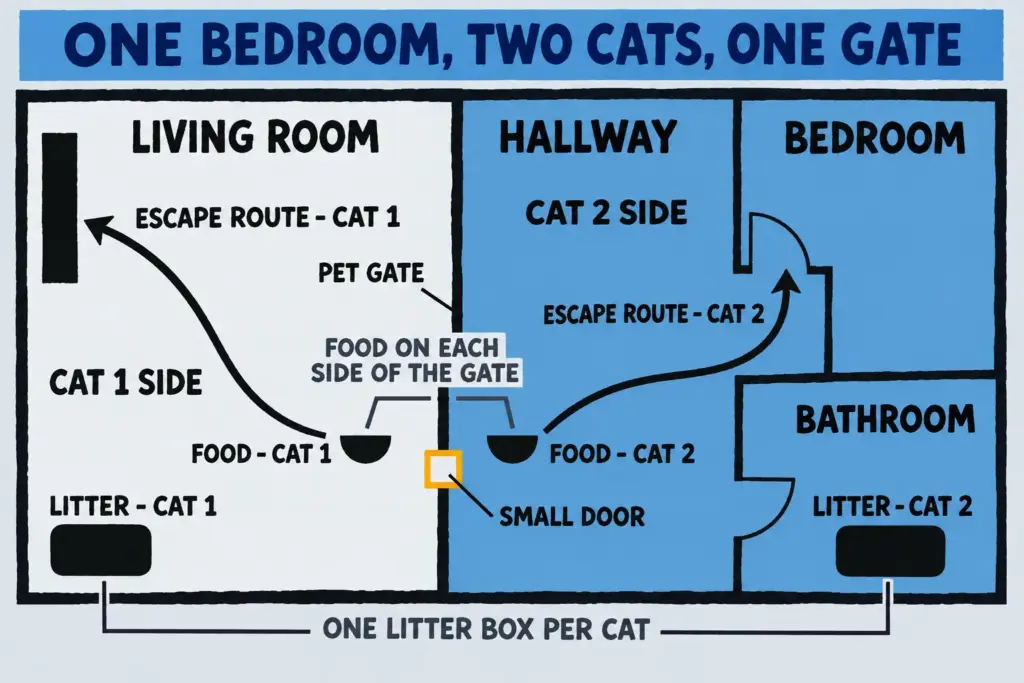
The rotation works when the swap is dull: one cat goes in, the other comes out, bowls are down on both sides, and nobody has to be caught or carried.
Set up the room as if a cat were moving in for a week: litter box, water, food and a place to hide, all in place before the first swap. Sit in that room for ten minutes first: whatever you find yourself going out to fetch is missing from the setup.
How Long Before You Open It: The Gates, Not the Days
The clock is short at the start and loose after it. International Cat Care gives 24 to 48 hours of full separation, Cats Protection puts three to five days behind a barrier before the next step, and the ASPCA opens a door one inch at a time. After that the days stop being the unit. A cat eating calmly with the other one a barrier away has passed a gate; a cat that watches from the top of a shelf has not.
How Long Before Introducing Cats Depends on Gates, Not Days lays out that calendar of stages, and the full sequence with only one door is in How to Introduce Cats in a Small Apartment, Stage by Stage.
A separation that drags on for months does not stay a plan. It turns into furniture: the gate stays up, one cat has the bedroom, and nobody remembers how to take it down.
One of Everything, Plus One, Spread Around the Apartment
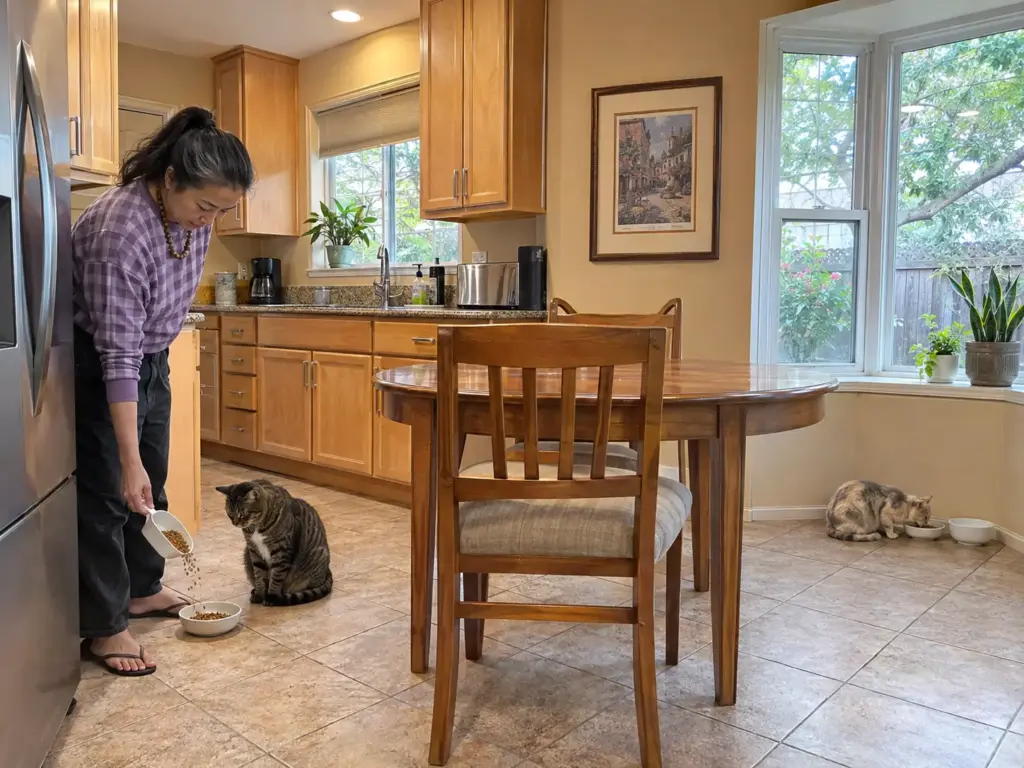
International Cat Care’s formula for a multi-cat home is one resource per cat plus one, in different places. The count is easy; placement is where it breaks. Two litter boxes pushed together in the same corner of the bathroom count as one for the cat that cannot get to them.
Litter, Food and Water Are Three Different Fights
Each resource is its own argument. Litter is about privacy and approach, and for two cats the count usually lands at three, as set out in How Many Litter Boxes for Two Cats? Three, Usually. Food is about turning your back on the other cat, and a shared bowl turns into a queue.
Do Cats Share Food Bowls? Two Cats, Two Bowls, Plus One goes through what to do instead. What gets repeated, per cat plus one:
- A litter box
- A water bowl
- A food bowl
- A bed
- A perch
Spread Out Beats Lined Up
Bowls in a row, or in a corner that makes one cat eat with its back to the other, rebuild the standoff at every meal. Keep them a couple of feet apart at the very least (that is the ASPCA’s figure for cats eating near each other), and farther if a doorway gives you the room. Move a bowl or a box a few feet before adding another one; that is the first try.
With Three Cats, the Math Changes
With three cats a fight is no longer a pair problem. Two can team up and keep the third away from the box or the water, so the count grows and the spread has to grow with it. Three Cats, Four Water Bowls, and Here’s Why works that through for water.
Every Cat Needs a Way Out, Above or Behind Something
A cat that cannot leave a room without passing the other cat has no exit, however big the room is. The exits come in two kinds, up and behind, and most apartments already have some of both.
Height Is Free When the Furniture Already Has It
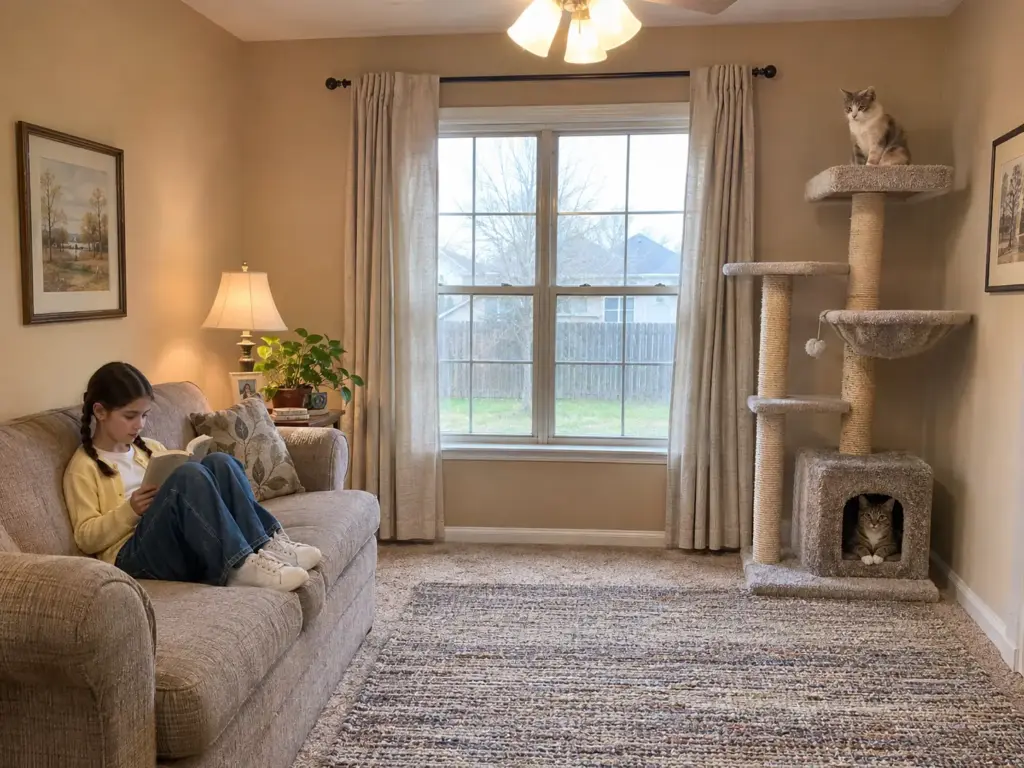
Vertical space is the cheapest exit, and the back of the sofa, the top of a bookcase and the top of a wardrobe are all free height. A cat on the high point sees the room and cannot be reached from the floor. Wall shelves work as an exit too, though that is an idea to plan around, not a how-to. Check that the high spots are not one-way: if the only path up passes the other cat’s bed, it is a trap with a view.
A Hiding Spot Is Not a Prison
A cat that retreats into a box or a covered bed is choosing, not sulking. Leave it there. Coaxing it out takes away the one place where it cannot be seen, and a cat that cannot disappear stays on guard.
Two Exits From Every Room, Not Just One
From each room the cat needs two ways out; with one, the cat that arrives second is cornered. A litter box in a dead-end corner, or in a bathroom with a single door, doubles as a trap, and Litter Box in a Small Apartment, Where It Actually Fits goes through spots that leave the cat a way out. A very active cat needs outlets for its energy as well as separation: play sessions, puzzle feeders, set mealtimes. Ways out to look for:
- Up: the sofa back, a shelf, the top of a wardrobe
- Behind: a covered bed, or a box under a table
- Away: a spot the other cat cannot see from the doorway
- Through: a second route out of each room
The Window Trigger: Fix the Sightline Before You Buy Anything
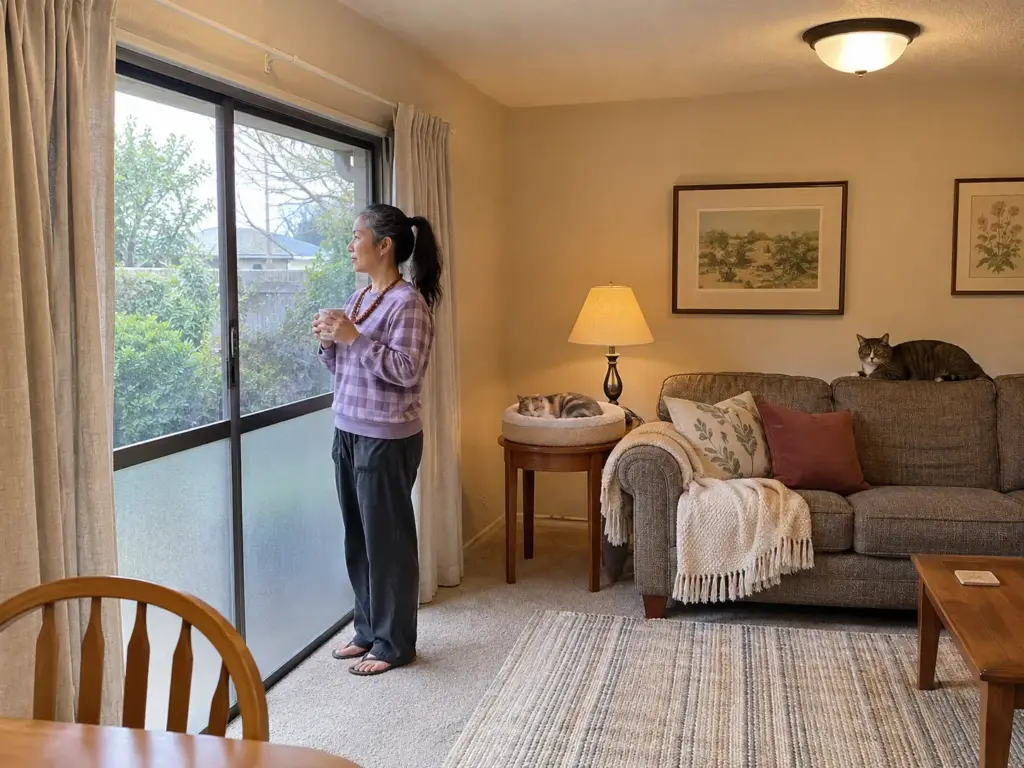
Plenty of fights start at the glass. A cat watching an outdoor cat, or a bird, through a window or a glass door cannot get to it, and the cat sitting nearby pays for the frustration. The fight then looks like it came from nowhere, when the trigger happened half a minute earlier a few feet from the sofa.
What a Cat at the Glass Does to the Cat on the Couch
The pattern has a name, redirected aggression: tension that cannot reach its target lands on whoever is closest. The cat on the couch was simply the nearest cat. It tends to show in the apartment where one cat spends the afternoon pressed against a glass door and bursts the moment the other one walks past. If it still happens with the window covered, or with no visitor in sight, take it to the vet question at the top of this guide and do not guess.
The Fixes, Ranked by Cost
Start with the free one: move the bed, perch or cat tree off the line of the window so the cat cannot sit looking at the yard. Next comes frosted window film across the lower part of the glass, which blocks the low view and leaves the light. Last is a cat flap that reads a microchip or a magnetic collar, which keeps visitors out when the visitor is the one coming through a door.
Film is the tempting fix because the result is visible, but the bed moves first: the move takes minutes, and the result tells you whether the film is needed at all.
Lie down where the cat lies and look at the glass. Whatever you can see from there, the cat sees too, and the lower third of the pane is where film earns its place.
When the Visitor Is Not Outside: the Cat Flap
If the visitor is a stray that comes in through a cat flap, the flap is the fix: a model that reads a microchip, or a magnetic collar, lets in only the cats that live there, as both Cats Protection and International Cat Care point out. For a cat that turns up at night, lower the blind or draw the curtain. Skip scaring it off with water from inside; that adds noise and a person to the scene.
Neutering and Pheromone Diffusers: What They Help and What They Cannot
Two aids come up again and again, and each has a limit worth knowing before you count on it.
Intact Males Fight More
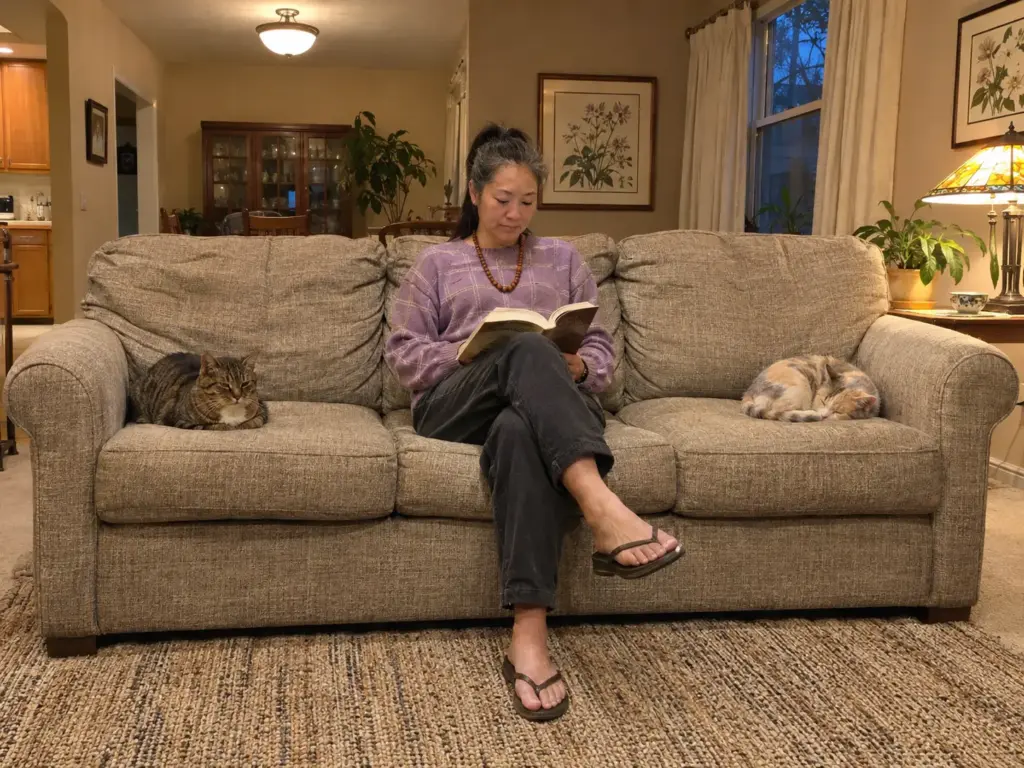
Unneutered males fight more, according to ASPCA’s guide to aggression between cats in a household. What that means for a particular cat is a conversation with the vet, and this guide does not go further than the fact.
A Diffuser Sets a Mood, It Does Not Break Up a Fight
A plug-in pheromone diffuser such as FELIWAY MultiCat (see it on Amazon) adds to the background of a calm home, and the full test of it, with the evidence and the rooms it suits, is in Best Pheromone Diffuser for Introducing Cats in an Apartment. It does not stop a fight or fix a bowl in the wrong place, and some households notice no change at all. Treat it as one more piece of a house that already has its exits.
When the House Is Fixed and the Fights Are Not: Back to Contact, or a Behaviorist
You have moved the bowls, opened up the high spots, covered the window and rotated the space, and the cats still go for each other. That is the point to go back to contact, but slowly, and to know where the line to a specialist sits.
Treat Them Like Strangers Again
International Cat Care’s advice is a gradual reintroduction, treating the cats as if they had never met: a barrier first, scent next, food on each side, then a door open one inch at a time (the ASPCA’s step). Skipping a stage is how two calm cats end up back at the hissing, so keep the order even when the pace is slow. The steps in full are in the introductions guide linked earlier.
How Long Is Long Enough: Let the Gates Answer
No source gives a useful number for this, because the stages set the pace: a door, then a meal, then a short meeting. Move on only when the cat on the high shelf comes down and eats near the other. If one cat stays up high, will not eat near the other, or the chasing does not stop, go back a stage.
Signs a Cat Introduction Is Failing Show Up Between Sessions shows how to read that between sessions, and Can You Introduce Cats Right Away? Only After a Day-One Test covers the day-one test and the route back.
When to Ask for a Behaviorist
Cornell puts the threshold plainly: tension that cannot be managed with these methods may call for a consultation with a veterinary behaviorist. That is a threshold, not a diagnosis, and it does not promise an outcome. Whether to rehome a cat is a decision this guide leaves to the vet and the behaviorist.
The Fight Is Pointing at the Missing Exit
A fight that keeps happening is a home with no exit in it, not a cat with a temper. If it came from nowhere, the vet comes first. After that, the order is a barrier the cats can see through, a schedule that gives each of them the apartment in turn, one of everything plus one spread across the rooms, an exit and a hiding spot for each cat, and a slow return to contact, stage by stage.
Once the door is open again, give it a week and look at one thing: which cat takes the high spot, and whether it comes down to cross the room. If one is still stationed up there checking the floor before every crossing, go back a stage and hold it. Days to a few weeks is the clock here, because the cats set it and the calendar does not.
Today, with no purchase: move a bed or perch off the line of the window, and move one bowl to a spot the other cat does not have to walk past. Then watch where each cat goes at its next meal.
Frequently Asked Questions
01What do you do when cats are fighting?
Keep your hands out and break the fight from a distance, using a loud noise made away from the cats or a cushion dropped between them. Once they part, leave both alone until they calm down, and touch neither cat until then.
02Is it normal for cats who live together to fight?
Some friction between housemates is normal, but a fight that repeats, or one cat staying in a single room because of the other, is not. A fight that starts suddenly goes to the vet first.
03Why would two cats suddenly start fighting?
A sudden change in how two cats treat each other goes to the vet before anything in the house is touched. If the visit comes back clean, look at the window, the resources and whether each cat has an exit.
04How long will cats fight each other?
There is no fixed number of days for cats fighting, because each stage of reintroduction sets the pace and the calendar does not. International Cat Care suggests 24 to 48 hours of separation, and Cats Protection puts three to five days behind a barrier before the next step.
Leave a comment