Are Hypoallergenic Cats Real? The Breed Label Doesn’t Hold
Are hypoallergenic cats real? In a 64-cat study, ordinary shorthairs varied 80-fold (0.4 to 35 µg/ml) & age mattered more than coat color.

Alfredo RamsesFounder · Updated October 31, 2026 · 13 min read

On this page6 sections
You have a list of breeds open in one tab, and the word printed above each one is hypoallergenic, which sounds like something a lab signed off on. So are hypoallergenic cats real, or is it a label that attached itself to certain breeds and never came off? It is a claim about breeds, and the largest saliva study the whole field leans on measured ordinary neutered shorthairs, not one breed from those lists. What follows covers what the word promises, what stands behind each name, what moves the allergen number inside any breed, and how to check the one cat you would actually bring home.
Quick Answer
No, not in the way the word promises. Every cat makes the main allergen, and the label only ever meant less, a breed average nobody measured. Even ordinary shorthairs differed over 80-fold from cat to cat, so a breed name tells you whom to visit, not what to expect. Your health questions go to your doctor.
Are Hypoallergenic Cats Real? What the Label Promises and What Was Measured
Picture a man who had never touched a cat without reacting, cuddling one at a friend’s house the day after she called it hypoallergenic, and coming out fine. It is a good story and a small one: one cat, one afternoon, and the result belonged to that cat, not to the breed on its papers. The prefix in the word says as much. Hypoallergenic means less allergenic, not free of allergen, and the people in those threads keep saying so in nearly the same words while the label keeps getting heard as none.
Where the allergen is made, and why a coat is only the carrier
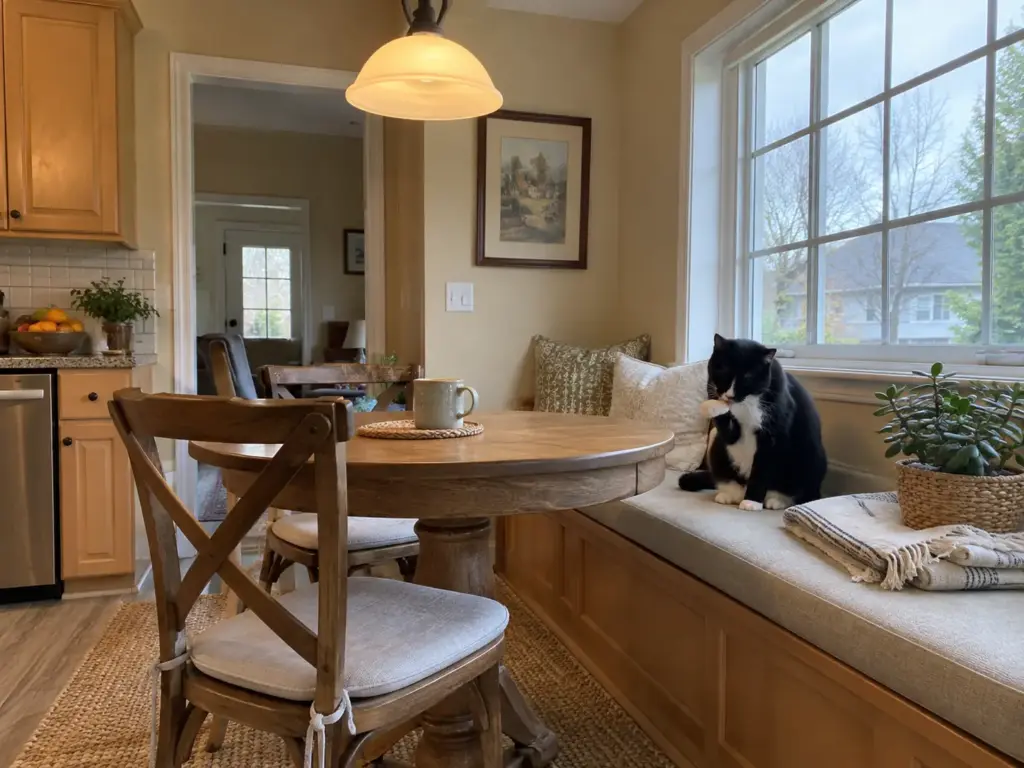
Every cat makes Fel d 1, the main cat allergen, mostly in the sublingual (under the tongue) and sebaceous glands, so it ends up in cat saliva and on the skin. When she grooms, the cat spreads it over her coat. The fur is the carrier, not the factory, which is why a cat with less fur is not a cat with less source. Ohio State’s veterinary college adds the detail that explains the sofa: the highest concentration sits on the face and neck, where the oil glands cluster, and it moves around by licking and by the cat rubbing her face on a person or a piece of furniture.
The protein is small and light, so once it is airborne it stays up for a long time and then settles into carpet, bedding and upholstery. That is the part a breed label cannot see, and the reason how a home holds cat allergen for months gets its own guide here.
What 64 shorthair cats measured, and who paid for it
The numbers people borrow trace back to one paper. The authors of a 2019 study of 64 neutered house cats in the *Journal of Feline Medicine and Surgery* open by admitting that “the scientific data supporting particular cats as hypoallergenic is lacking.” Then they collected saliva over a year from healthy adult neutered domestic shorthairs, aged 1.2 to 15.3 years and weighing 3 to 9 kg, living in two colonies, one in Missouri and one in Ontario. No Siberian, no Balinese, no Sphynx, nothing from a hypoallergenic breed list.
The authors are employees of Nestlé Purina, which also funded the work, and Purina’s own committee approved the protocol. That does not make the numbers wrong, and Ohio State, with no such tie, says the same thing about breeds in the next section. It does mean you should know whose hands the dataset passed through before you quote it.
Before you trust a claim that cites a study, ask two things: which cats were measured, and who paid. For the breeds on the lists, the answer to the first one is none of them.
Who answers which question
Two questions hide inside the one you searched. Whether your symptoms are allergic, how strong the allergy is and whether you can live with a cat belong to a doctor or an allergist; Ohio State’s own handout tells readers to see a doctor to be certain the cat is the cause. Anything about the cat’s skin, her weight or a change in how she looks or acts belongs to her vet. This article checks a label and a house, and it stops there.
The Breeds on Every List, and What Backs Each Name
You have two breeds circled and a long commitment attached to each, and the label is the reason they are circled. It helps to know what each name actually rests on.
The names every list repeats
The same names come up again and again: Siberian cats, Balinese cats, Sphynx cats, Devon Rex and Cornish Rex cats, Russian Blues and Bengal cats, with Javanese, Oriental, Burmese and Tonkinese added by some. None of them was in the 2019 study. An Ohio State veterinary handout on cat allergies says the differences in allergen production between cats are “not related to the length of hair or breed of cat,” and that cats free of allergen do not exist.
A coat that sheds less is a separate claim. Less cat hair on a rented sofa is a fair thing to want, and breeds that shed less on a rented sofa covers it, but it is a hair claim and not an allergen one.
The Sphynx: no coat, same protein
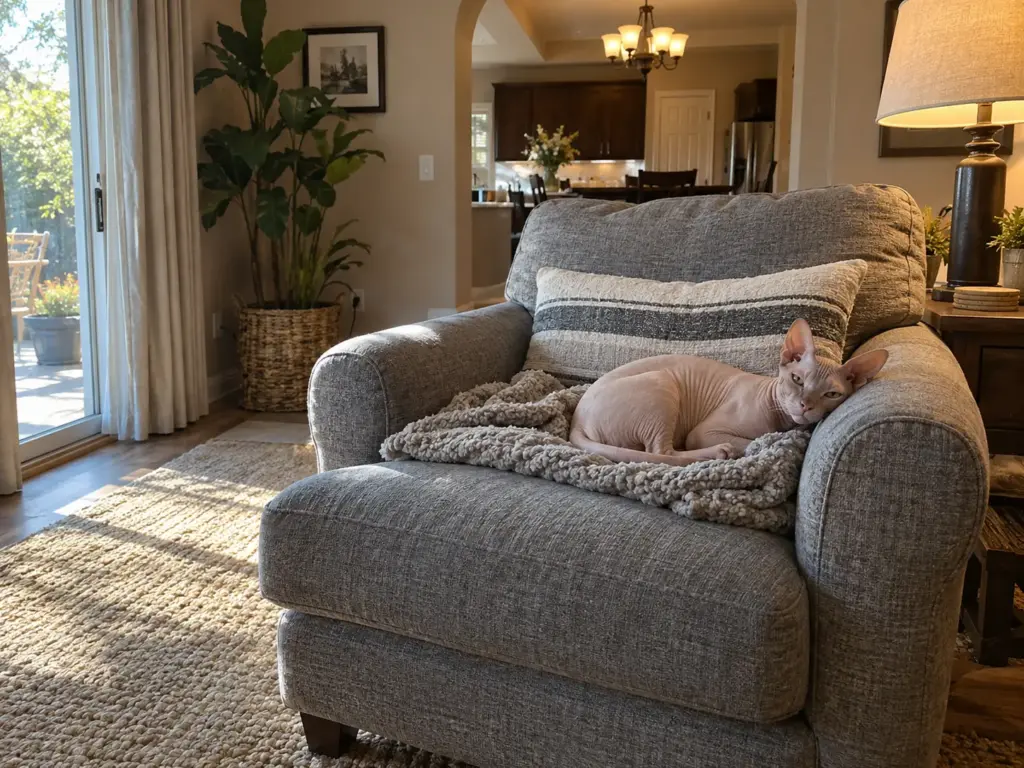
The Sphynx is the obvious pick for anyone allergic: no coat, so surely no problem. According to a veterinary-science review by two University of Adelaide researchers, the Sphynx is hairless but still produces Fel d 1, and there is no evidence that any specific breed is free of the problem. The glands and the saliva are still there, and a hairless cat licks herself like any other. A bare coat means less fur to hold the protein, not less protein made.
So the obvious pick is the one with the clearest reason to disappoint (the better call is to put her on the visit list like any other cat and judge her there).
What bare skin costs the cat
Here the cat has the point. Without a coat to take up skin oil, a Sphynx’s skin gets oily, so it usually needs regular cleaning with a cat-safe product, sometimes cat sunscreen, and a sweater when the room runs cool. How often a particular cat needs a bath is her vet’s call, and no number from a breed page should replace it. A cat that dislikes water or being handled in a sink has a real objection to the arrangement: the person picked the look for the label, and the cat gets the sink.
Choosing one of these breeds for the label means paying for the breed, and sometimes for the extra care, on a promise that was never measured.
Use a breed name as a list of cats to go and see, never as a result. What counts is the one cat in the room and how many times you have been in the room with her.
What Moves the Number Inside Any Breed
The tidy rules are easy to remember: pick a light coat, pick a female, pick a small cat. The 64-cat study tested all three, and the rules mostly did not survive.
What did not predict it: coat color, weight, and whether a neutered cat is male or female
Across the 64 cats, yearly average saliva levels of Fel d 1 ran from 0.4 to 35 µg/ml, a cat-to-cat variation of more than 80-fold among ordinary neutered shorthairs. Inside a single cat the readings swung by an average of 57 percent in one group and 85 percent in the other, so one sample is a snapshot of that day, not her number.
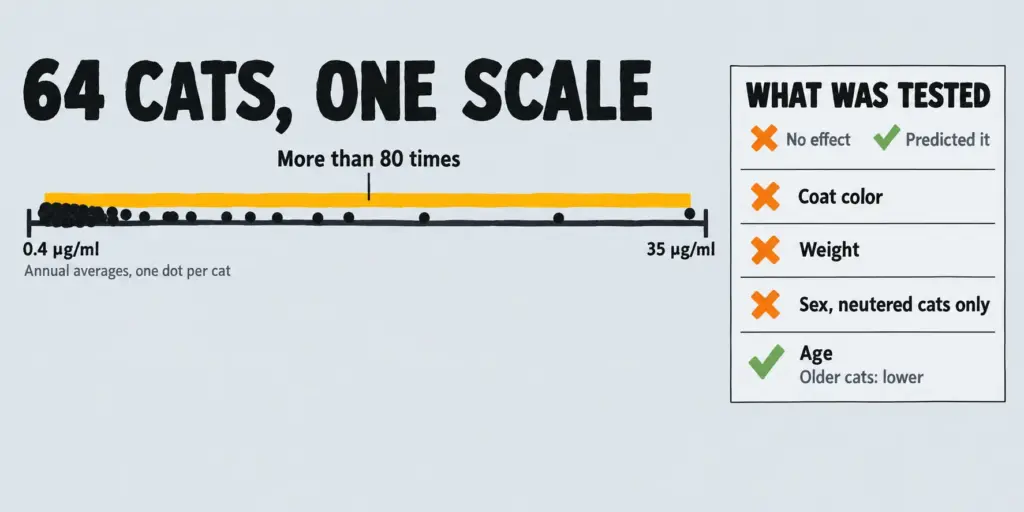
Coat color had no relation to the average level, and neither did weight. Whether a neutered cat was male or female made no difference either, and earlier studies disagree with each other. A rule that says dark-coated cats make more allergen is repeating something this study could not find, so a light cat is not a safer bet. Why one cat affects a given person more than another has its own mechanism, covered in why one cat itches you more than another.
What did: age, and whether the cat is neutered
Age was the one factor that did: older cats tended to have lower salivary levels. Read that with care. The cats were adults between 1.2 and 15.3 years, so this is no case for adopting a senior cat, and an older cat brings vet needs of her own.
Neutering is the other lever, and it comes from Ohio State rather than from the study: an intact male cat produces more allergen, and the levels drop after neutering. Whether and when to neuter is the cat’s vet’s decision, so it goes here as a fact and not as a nudge.
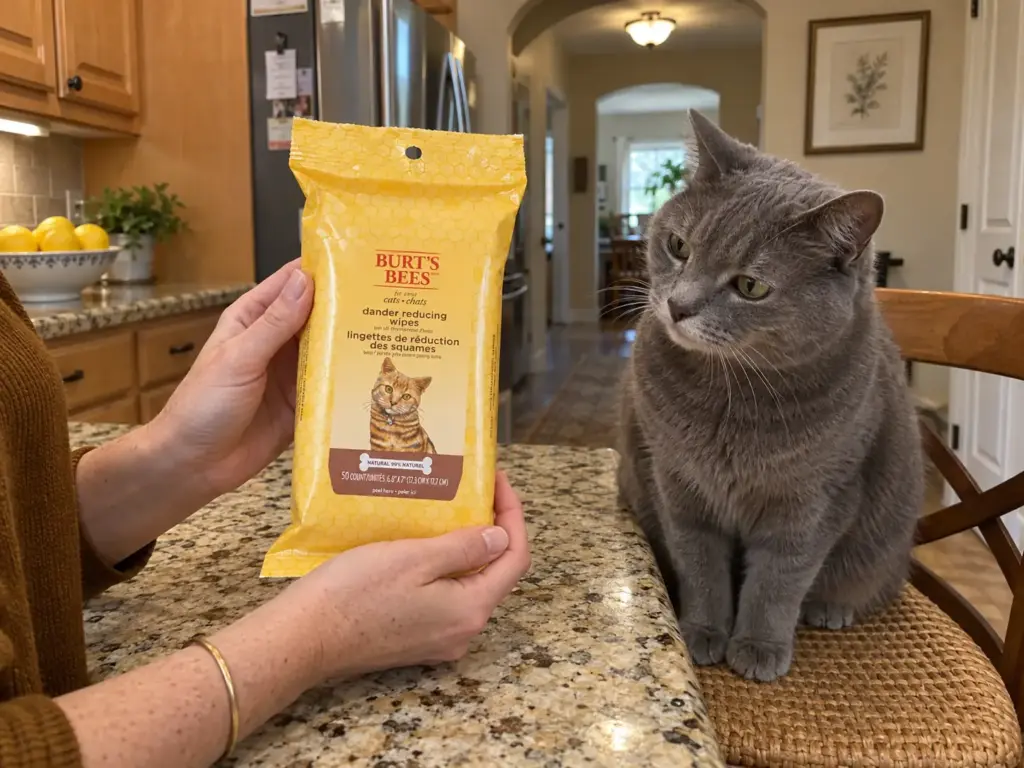
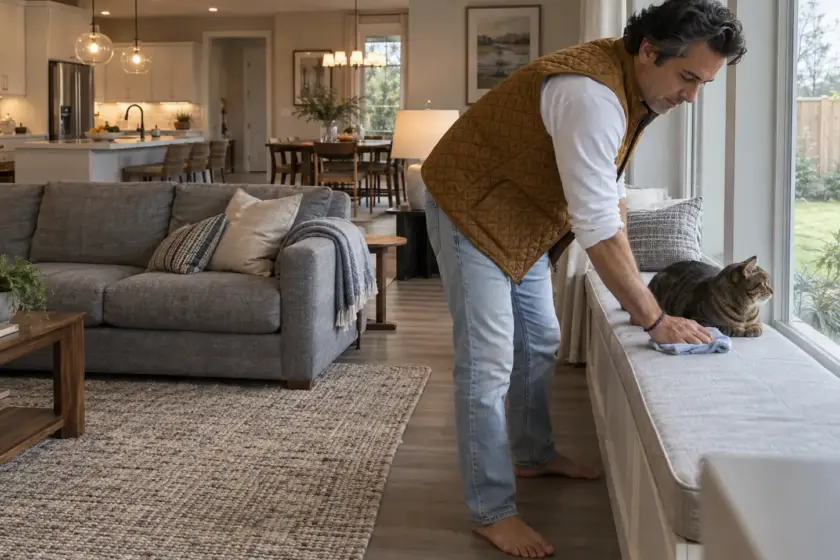
Before any product, a soft cloth dampened with water, wiped along her back and, if she allows it, over the face and neck where Ohio State says the allergen concentrates, takes surface dander off and is free. If that routine sticks, Burt’s Bees for Pets Cat Dander Remover Wipes (6.8 x 7 inch cloths, 50 to a pouch; Amazon’s listing is a three-pack) do the same between baths. The maker says they help reduce dander and flaking, but they lift what sits on the coat, not what the cat makes. Buyers say the pouch is awkward to pull wipes from, and the question of whether licking afterward could hurt the cat sits unanswered on the Chewy page, so that one goes to her vet.
One cat or several
Ohio State is plain about the multi-cat effect: the more cats in the house, the higher the concentration of allergen. That is not a rule for how many cats to keep, and nothing here says a second cat doubles anything. But with an 80-fold spread, a second cat is a second draw from the same wide range. A person who did fine around one cat has learned something about that cat and nothing about the next one (and if you are adopting a pair, visit them together, because that is the house you would have).
Spread your visits to one cat over different days. The study asked for saliva samples on days that were not consecutive because the same cat’s number moves from one day to the next, and a single afternoon can catch her on a low day or a high one.
Checking the One Cat in Front of You
You are in someone’s living room with a breed sheet in your head and a cat watching from the end of the sofa. The sheet is about breeds. She is one cat with a number of her own, and she is the one who lives in the house.

Repeat visits, not one afternoon
The common advice is to pick the cat, not the breed, and it is good advice with a weak spot: it gets followed once. The man with the one good afternoon is the pattern, and there is another side: people who did fine with a cat of their own and found that other cats were another matter. Treat the first visit as a trial visit, not a verdict.
Go back on a different day, and spend the time in the part of the house where she would actually live. What living with a cat looks like hour by hour when someone is allergic picks up from there, once you have chosen.
What the study needed to call a cat a low producer
The 2019 team did what a breed label cannot: it measured the individual cat. Four saliva samples, ideally on days that were not consecutive, spotted a stable low producer cat, one with a yearly average below 4 µg/ml, about 91 percent of the time. That is a research method run on colonies of cats, and the paper describes no service a shopper could order at an adoption desk.
Take it as the reason the breed label disappoints, not as a step for your list. Testing yourself belongs to your doctor, and her skin, her bathing and any change in her belong to her vet.
What you can do is the rougher version of the same idea: several looks at one cat on several days, in place of one look at a name. It is not a measurement. It is the next best thing to one.
Between baths, for the cat that hates the tub
Ohio State says bathing a cat weekly, if possible, can cut allergen by up to 84 percent, and that a shampoo made for pets is the right kind. That is the advice, and it fails the cat who will not stand the tub: a weekly cat bath for a cat who fights the water is a weekly argument she wins on points. For a Sphynx, how much bathing the skin wants is her vet’s call and not a schedule from anyone’s guide.
For the cat in between, the free version comes first: a damp cloth and a brush (how often to brush a cat by coat type sets the rhythm). If you then want a rinse-free step, Burt’s Bees for Pets Waterless Cat Shampoo Spray (10 fl oz, pump bottle) is a between-baths option, not a bath. It will not replace a full bath if your cat actually needs one. Buyers mention leaks from the bottom of the bottle under pressure, so check it when it arrives.
A Second Visit Tells You More Than the Label Does
Three things to carry out of this. The label describes a breed average that nobody measured, so it cannot describe the cat you would bring home. The usual predictors, coat color, weight and whether a neutered cat is male or female, did not hold in the one large study, and age was the exception that did. And the check that works is slow and plain: see that one cat more than once, on different days, and leave your health questions to a doctor and hers to her vet.
Three weeks after she comes home, look at whether the routine you set up is still running, the cloth, the brushing, the room rules, and take what you notice to your doctor instead of deciding it yourself. Routines like these are the first thing to lapse once the novelty is gone, and a note on what slipped is more useful in that appointment than a memory.
Today, ask for a second visit with the cat you are leaning toward, on a different day from the first. If she is already yours, run a damp cloth along her back before you buy anything.
Frequently Asked Questions
01Are cats truly hypoallergenic?
No. Every cat produces the main cat allergen, and the word hypoallergenic only ever claimed less of it, never none, so no cat is truly free of it. Ohio State’s veterinary college says allergen-free cats do not exist.
02Are there 100% hypoallergenic cats?
No. Every cat makes the allergen, and in the 2019 study of 64 neutered shorthairs the yearly averages ran from 0.4 to 35 µg/ml, so cats differ widely but none reached zero.
03What is the #1 most hypoallergenic cat?
No breed holds that title in the evidence. The large saliva study measured ordinary shorthairs, not the breeds on the lists, so a breed name points to cats worth visiting, not to a measured result.
04Can I have a hypoallergenic cat if I’m allergic to cats?
That is a question for your doctor or an allergist, not for a breed list. Ohio State’s veterinary handout tells people to see a doctor to be sure the cat is the cause. Visit the specific cat more than once.
05Does a hairless cat still cause allergies?
Yes, it can, because the allergen comes from saliva and skin glands, not only fur, so a Sphynx still makes it. Her bare skin also needs care, and how much is her vet’s call.

Leave a comment