Best Air Purifier for Cat Allergies, by Quiet-Speed CADR
Core 400S: 249 cfm on the box, 134 cfm under 45 dBA. See how that changes the best air purifier for cat allergies in a bedroom (+ the HEPA label check).

Alfredo RamsesFounder · Updated October 30, 2026 · 19 min read

On this page8 sections
- 1What an air purifier delivers at night is about half the number on the box
- 2What a purifier cleans, what it leaves alone, and who answers the symptom question
- 3Reading the label: HEPA, "HEPA-type" and the ozone question
- 4The bedroom pick, judged at the speed you can sleep beside
- 5What the cat does to the purifier: the vent, the hair, the pre-filter
- 6Odor first, more than one cat, and what the filters cost
- 7Quiet-speed math, the filter grade, and the mesh you check in three weeks
- 8Frequently Asked Questions
The box says 249 cubic feet of clean air a minute, and you plan to run the machine beside your bed. Those two facts do not meet: the number printed on a purifier’s box is its airflow at top speed, and top speed is the setting you will turn down before you can sleep next to it, so the best air purifier for cat allergies is the one whose airflow still counts at the speed you can live beside. The cat is not going anywhere (it is his bedroom too), and the figures below come from published lab measurements and spec sheets, with every disagreement between sources named instead of settled by picking the friendlier number. In order: the number that decides the buy, what a purifier does and does not do, how to read the filter label, the bedroom pick, what the cat does to the machine, and what changes with odor, a second cat and the filter bill.
Quick Answer
Four checks decide this purchase, in this order.
- Measure the room: volume in cubic feet divided by 12 is your CADR target.
- Read CADR at the quiet speed, under 45 dBA, not the box number.
- Check the filter grade on the spec sheet: True HEPA, HEPA-type or no claim.
- Compare how long each filter lasts and what replacing it costs.
What an air purifier delivers at night is about half the number on the box
A purifier is working against a problem that lasts, and how long a home holds cat allergen after the cat is gone is measured in months, not nights. So the machine has to be one you will leave running, and it has to run in the room where you sleep. That is a noise question before it is a filtration question: a purifier switched off at bedtime delivers zero, whatever the box claims.
Top-speed CADR versus the speed you can sleep next to
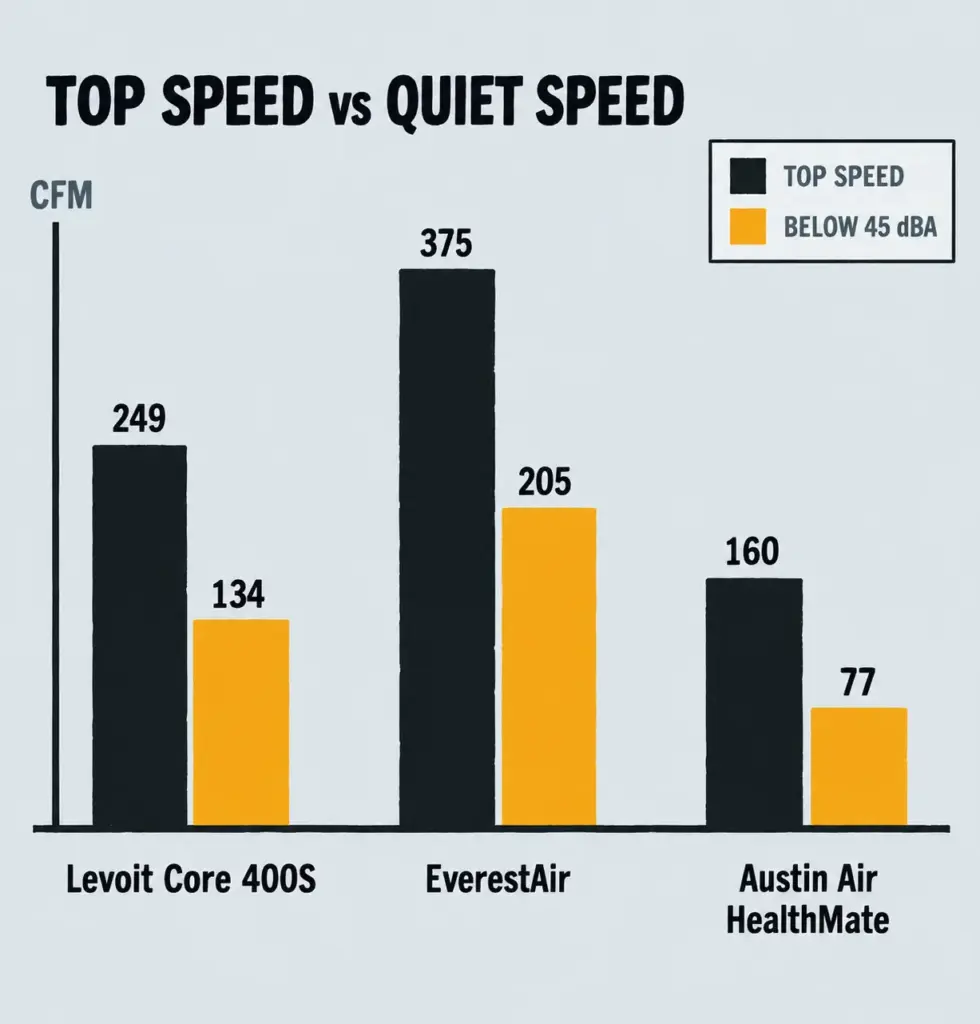
CADR, the clean air delivery rate, is the volume of filtered air a unit pushes out each minute, counted in cubic feet (cfm). The headline figure is measured at the top fan speed. HouseFresh’s lab measured the Levoit Core 400S at 249 cfm there, then measured it again at the loudest setting that stays under 45 dBA: 134 cfm, or 54 percent of the box number. At its sleep setting the unit read 35.5 dBA; at top speed it read 60.3 dBA from three feet away.
One unit could be an accident, so look at three. The same lab prints both figures, top speed and under 45 dBA, for the Core 400S (249 and 134), the Levoit EverestAir (375 and 205) and the Austin Air HealthMate (160 and 77). The quiet figure lands between 48 and 55 percent of the top figure in all three. Until you find the quiet number for a model, halve the box figure as a rough first guess.
The labels do not help you find that number. Buyers often ask what a label like HEPA SLEEP mode even means, and the fair reading is that the name of a sleep mode or night mode says the fan slows down, not how much air still moves.
Turning CADR into air changes for a bedroom
An air change is one full room’s worth of air passing through the filter, and testers size purifiers at five air changes per hour. The arithmetic is short: CADR times 60, divided by the room’s volume in cubic feet.
What follows is our arithmetic, not a lab’s, and it assumes an 8-foot ceiling, the same ceiling that makes HouseFresh’s 373 sq ft for the Core 400S work out at exactly 249 cfm and five changes. That room holds 373 x 8 = 2,984 cubic feet. At top speed: 249 x 60 / 2,984 = 5.0 air changes an hour. At the quiet speed: 134 x 60 / 2,984 = 2.7.
That gap is the shortfall in two numbers: sized to the box, the same machine delivers roughly half the air changes it promised the moment you turn it down to sleep.
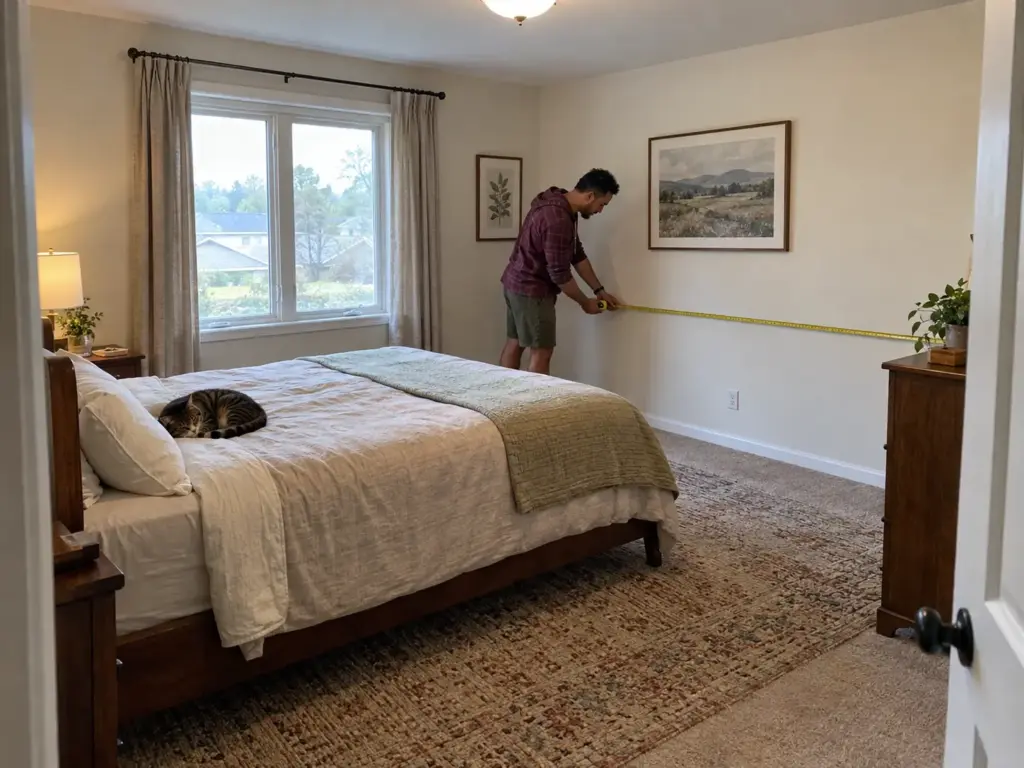
Run it the other way for your own room. Multiply length by width by ceiling height and divide by 12; the result is the quiet-speed CADR that gives five changes an hour. A 12-by-14-foot bedroom with an 8-foot ceiling is 1,344 cubic feet, so it needs about 112 cfm at the speed you can sleep beside, and the Core 400S’s 134 clears it.
The two-thirds rule (CADR at least two-thirds of the floor area) is the same arithmetic at an 8-foot ceiling. If the bedroom door never closes or the room opens onto the rest of the apartment, the sizing arithmetic for a small apartment works through that case.
Why the same model gets two different room sizes
The Core 400S is sized at 373 sq ft in HouseFresh’s test and at 403 in Health.com’s, and the Amazon listing for the Core 400S-P repeats the 403. Same machine, 30 square feet apart. The EverestAir gets 562 square feet from a CADR of 375 in one test and 558 from a CADR of 360 in another.
The two inputs behind each figure are the CADR used and the ceiling assumed, and the box prints neither. A higher ceiling quietly shrinks the room a unit can handle. And some listings print an “up to” coverage several times bigger than any five-change room; treat that as a headline, not a size.
Use the lab’s CADR, divide your room’s volume by 12, and distrust any square-footage line you cannot reproduce.
Measure the ceiling as well as the floor. A nine-foot ceiling holds an eighth more air than the eight-foot ceiling the sizing assumes, so the same unit gives about a ninth fewer air changes.
What a purifier cleans, what it leaves alone, and who answers the symptom question
A purifier is one tool in a house full of cat hair, and it helps to know where its job starts and stops before you compare models. This section draws that line, and the doctor’s question sits on the far side of it.
What it does to the air in one room
A purifier, or room air cleaner, pulls room air through a filter and pushes it back out, one room at a time. Particles floating in that air get caught, dust, hair fragments and dander among them; whatever is not floating does not. The air in the next room is that room’s job. No outside authority will pick a model for you, either: the EPA states that it neither certifies nor recommends particular brands of air cleaners, so the spec sheet held against your room is the only judge on offer.
What it can’t reach: the sofa, the floor, the bedding
Dander that has settled sits in the sofa arm, the rug and the mattress, and a purifier never touches any of it; it only catches what gets stirred back into the air. A household with two cats and an allergic partner may say that nothing has helped. The answer is usually about the house and not the box: carpets and upholstery. Those are surfaces a machine cannot reach, and the cat did not choose any of them.
That is why the free work comes first, and why the machine is one piece among several. If you are the one with the allergy, what the day looks like when the person in the house is the allergic one shows where a purifier sits in the routine.
Who answers the question about symptoms
Whether a purifier changes your allergy symptoms is a question for your doctor, and so is anything involving asthma. This page measures the machine, the room and the filter, and stops there.
Reading the label: HEPA, “HEPA-type” and the ozone question
The label is where most of the confusion starts, because the same word means different things on different boxes. Two checks cover it: the filter grade, and whether the unit makes ozone.
True HEPA, “HEPA-type” and no HEPA wording at all
A real HEPA filter carries a rating, usually stated as 99.97 percent of particles at 0.3 microns. The word on a box, a mode or a product name does not carry that rating with it. Three kinds of label turn up: a filter described as True HEPA, one sold as a HEPA-type filter, and a listing that never says the word at all.
The failure is easy to find. Some buyers have sent a purifier back after finding it had no HEPA filter in it.
The Core 400S shows how muddled the label gets. HouseFresh writes: “The particle filter was initially sold as H13 HEPA but it isn’t HEPA.” Health.com calls the same filter H13 True HEPA. The Amazon listing for the Core 400S-P describes an “Efficient Midlle filter” (the typo is the listing’s own) that captures 99.97 percent of pollutants as small as 0.3 microns, and it never uses the words True HEPA.
The EverestAir-P is quieter still on the subject. HouseFresh reports that Levoit first advertised an H13 HEPA filter and then removed every mention of HEPA from its marketing, and the Amazon title offers “HEPA Sleep Mode,” which names a setting and not a filter grade.
So this page does not write True HEPA for either Levoit, and it makes no HEPA claim for the Austin Air, the Coway or the Vital 200S-P, whose grades were not confirmed. For the Core 400S, hold it to the number its own listing prints. Whether the filter earns the word is a disagreement between testers, and the spec sheet is the only place you can settle it for the model you actually buy.
When a mode name sounds like HEPA (sleep, pet, allergy), skip the name and find the filter grade itself in the spec sheet before you accept the word.
Ionizers, ozone and the CARB badge
Some purifiers add an ionizer or another electronic stage, and those can produce ozone as a by-product. The rule from the EPA is blunt. According to the EPA’s guide to air cleaners in the home, “Avoid portable air cleaners and furnace/HVAC filters that intentionally produce ozone.” A purely filter-based unit has no such stage; in CARB’s terms, a mechanical device is one that does not generate ozone or ions.
California adds a badge. According to CARB’s list of certified air cleaning devices, “Since 2010, all portable indoor air cleaning devices sold to people or businesses in California are required to be certified by CARB.” Electronic models have to pass an ozone limit of 0.050 parts per million.
Read the badge for what it is, a check on ozone and electrical safety and not a measure of airflow, so a certified purifier can still be undersized for your room. This page does not claim the badge for any model on it, so look a model up on the list before you trust a CARB certified label.
Whether an ionizer is a good idea around someone with asthma is a question for the doctor, not for a label.
The bedroom pick, judged at the speed you can sleep beside
The pick for the bedroom comes from the rule in the first section: the airflow that is left at the speed you can sleep beside. Before any machine, though, the room gets its own work.
Free first: the room it goes into
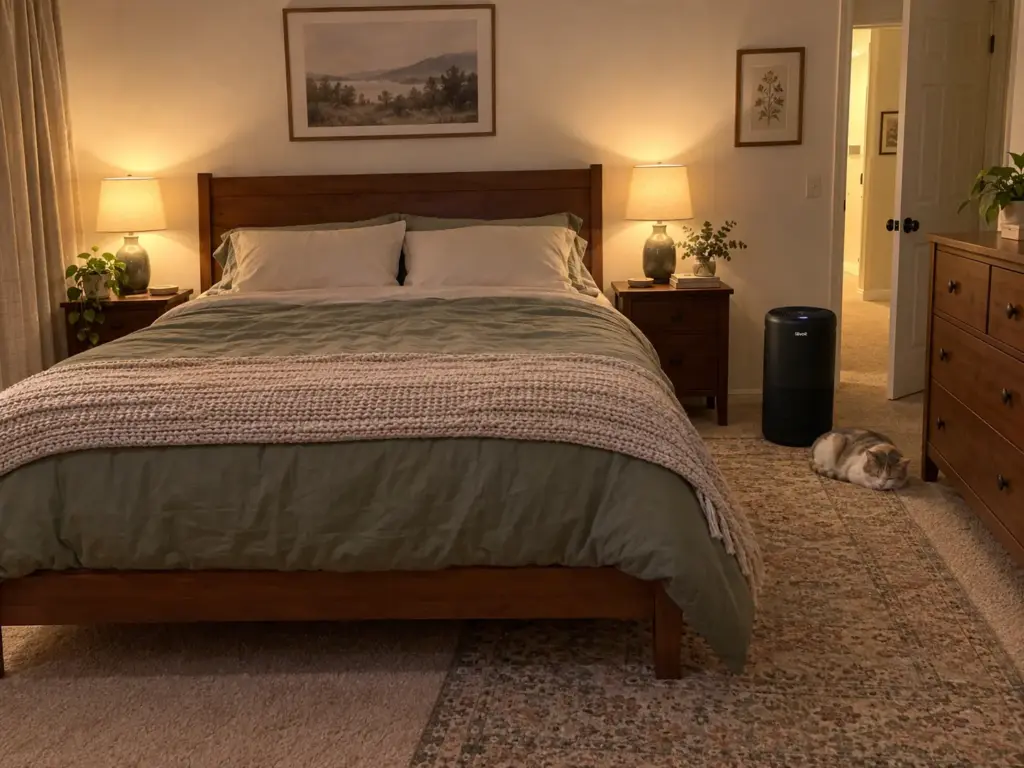
Work on the room before a machine. The bedroom is where the unit will run all night and where the cat has likely slept for years, which makes it his room by long occupation; the cat is not the problem to be solved here, the hair in the mattress and the rug is. Taking the bedding to the wash, vacuuming the floor and deciding how many hours the cat spends on the bed need no purchase, and they leave the filter less to chase. The order that makes sense is to limit the cat’s time in the bedroom and clean the room first and only then ask what a machine still has to do.
Why the Core 400S is the bedroom pick
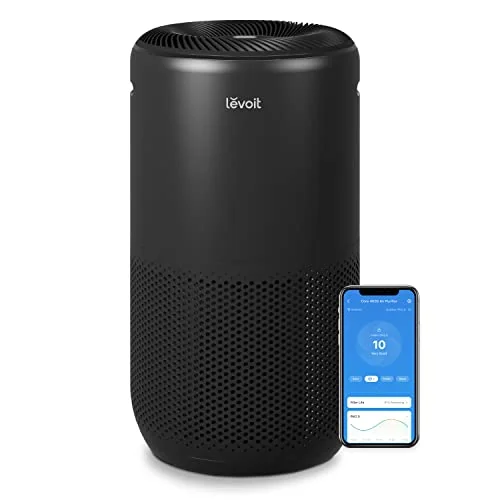
The rule of this page chooses it. HouseFresh measured 134 cfm under 45 dBA and a sleep setting of 35.5 dBA. By the divide-by-12 rule, 134 cfm carries five air changes an hour in a room of about 200 square feet with an 8-foot ceiling (134 x 12 = 1,608 cubic feet), which is a normal bedroom with room to spare. The box says 249, but the bed will hear 134.
One naming note, once: Amazon sells the Levoit units on this page with a “-P” suffix (Core 400S-P, EverestAir-P, Vital 200S-P), while the lab figures quoted here come from the versions without it. The hardware being identical is not confirmed, so read them as figures for the same family.
Where it falls short
Two things hold the Core 400S back. The first is the HEPA question above. The second is the filter: Health.com puts its life at six months, and the carbon and the particle filter are bonded, so once the carbon is used up you replace the whole thing. A cat in the house does not change that clock, but it does change the pre-filter’s, which is the next section.
What the cat does to the purifier: the vent, the hair, the pre-filter
A purifier in a house with a cat meets the cat sooner than it meets any dust: he sits on it, and his hair reaches its first filter before anything else does. Two things follow, where he lies and how often the mesh needs washing.
The vent the cat lies on
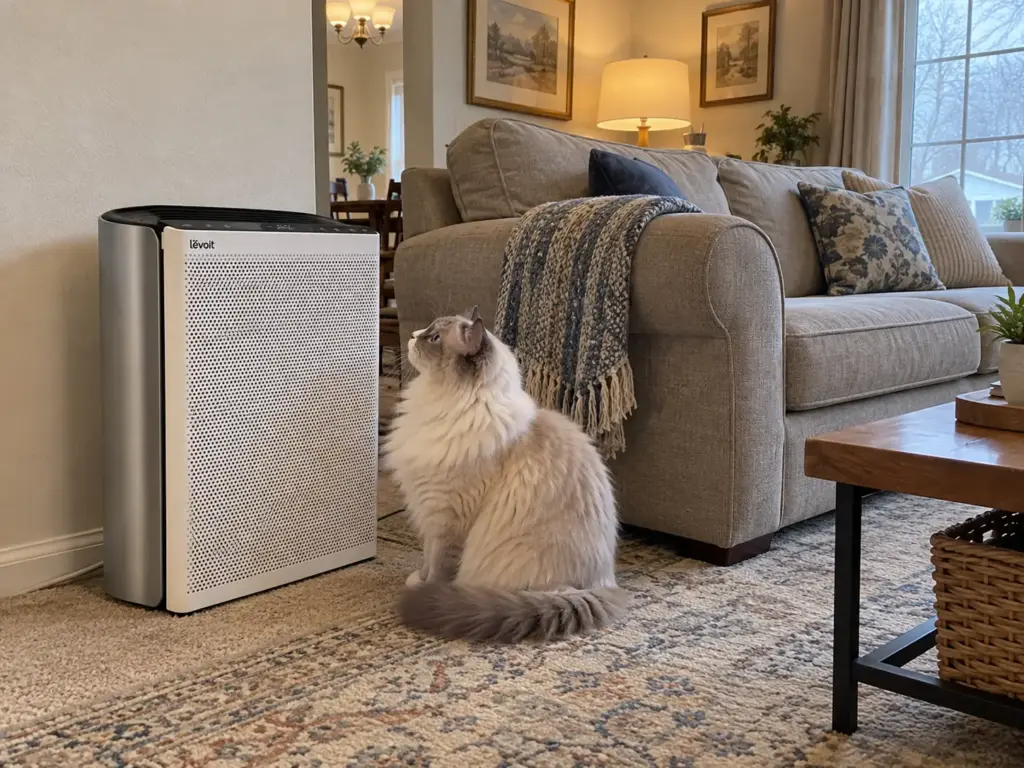
A tall machine with a flat top, in the bedroom or the living room where he already sleeps, is the best perch in the room, and on the furniture question he is right. The trouble is that on some models the top is also the air outlet. HouseFresh says of the EverestAir: “The air vents can move, but you can set the angle so they are not fully open if you expect your cat to lie on top.” A cat lying across an outlet is sitting on the part that moves the air, so set the angle before he picks the spot.
The Levoit EverestAir-P is the large-room unit: 375 cfm at top speed and 205 under 45 dBA, sized by HouseFresh at 562 square feet for five changes an hour (a second test measures 360 cfm and 558 square feet). Its washable pre-filter captures noticeably more pet hair, according to AirPurifierFirst. Against it, Levoit stripped the HEPA wording from its marketing, so the grade is something to settle on the spec sheet, and 205 is the figure to size from, not 375.
The hair he leaves on that perch lands in the bed too, which a purifier never touches. Add one more habit to the same routine and check the basket before the wash.
Hair in the pre-filter: two cleaning schedules
Cat hair finds the first filter it meets, and that is the mesh pre-filter in front of the main one. Without it, the HEPA filter clogs fast with cat hair.
With it, the job turns into a chore: in a second thread, “the mesh pre filter works very well with cat hair you can vacuum the hair off easily.” A third voice puts the rule in two sentences: “A lot of pet dander gets caught in the pre-filters. You need to wash the pre-filters regularly.”
How often is where the sources split. Health.com says the Core 400S pre-filter needs cleaning every 2 to 4 weeks. A review of the Vital 200S in homes with cats says “at least twice a week.” Different machines, and a gap of at least fourfold.
The longer interval is the one likely to fail in a house where a cat sheds into the mesh. Start from the twice-a-week end and loosen it only when the mesh looks clean as you lift it out.
Vacuum the mesh with a brush attachment, and let a washed one dry fully before it goes back. When the vacuum keeps leaving hair behind on any surface, where vacuuming cat hair fails and how to fix it in order is the page for that.
After three weeks of normal running, lift the pre-filter out and look at it. A thick mat of hair means a weekly wash; a thin film means you can stretch the interval. The mesh tells you more than the schedule on the box.
The cheaper unit that asks more of you
The Levoit Vital 200S-P is the budget step down from the Core 400S: a CADR of 245 cfm, a main filter rated for about 12 months and a washable pre-filter. AirPurifierFirst, which tested the Vital 200S, names it the best value for pets and notes that it produces no ozone. The same review asks for the most attention of any unit here: “I recommend cleaning it at least twice a week to keep it working optimally.”
On paper it is the sensible buy. In a house with a cat shedding into the mesh, the unit that needs washing twice a week is the one that gets forgotten, and a clogged mesh moves less air than the CADR on the sheet. No under-45-dBA figure is printed for it in the lab data used here, so halving 245 gives a guess of about 120 cfm, enough by the divide-by-12 rule for roughly 180 square feet. A guess drawn from other models, not a measurement.
Odor first, more than one cat, and what the filters cost
Not every household buys a purifier for the same reason, and some of the numbers above shift with the reason. Smell, a second cat and the running cost each move the choice.
Odor and allergen are two different jobs
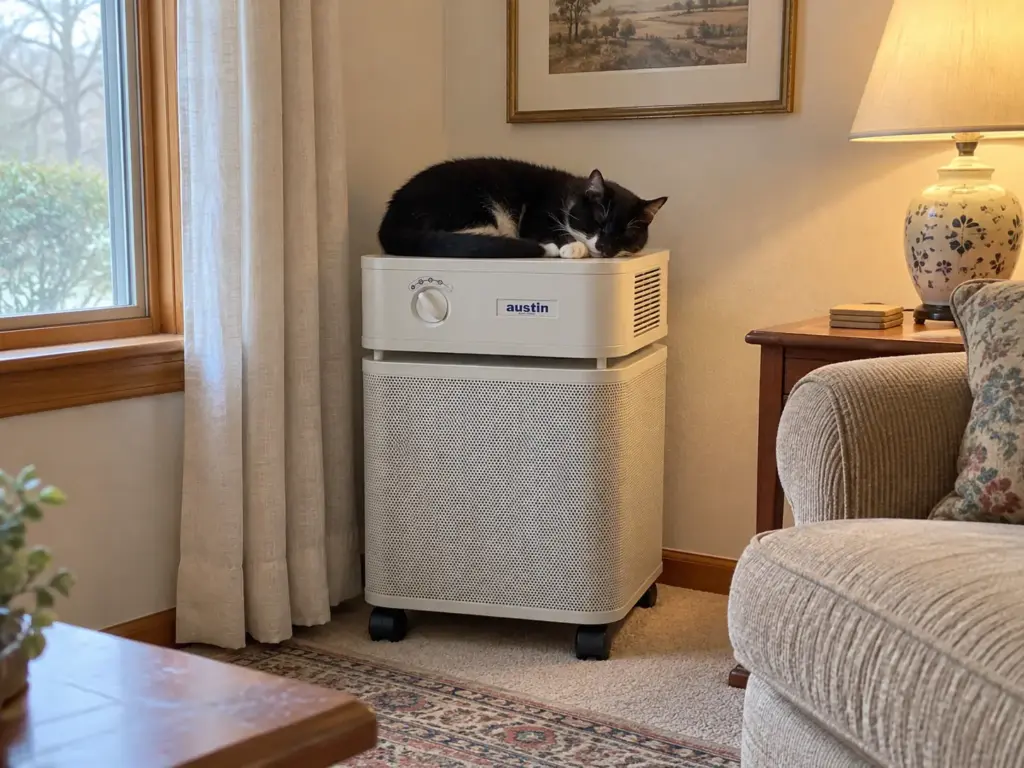
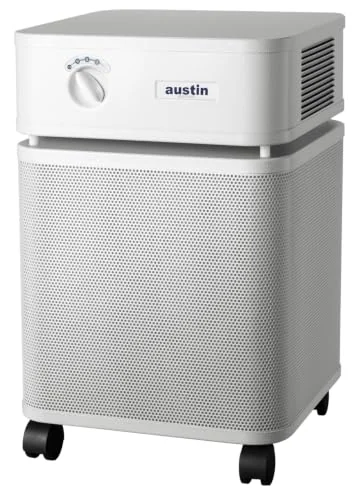
Activated carbon deals with smell and the particle filter deals with what floats, and a machine can be strong at one and ordinary at the other. The Austin Air HealthMate is the clearest case. HouseFresh names it the best for homes with multiple smelly pets, and writes that it is “great at removing odors and VOCs from the air but its particle filtration is as good as much smaller devices.” Its CADR is 160 cfm at top speed and 77 under 45 dBA, it draws 147.6 W at top speed, and it has a flat top that many cats will enjoy sleeping on, so he will.
If the litter box is the reason you want a purifier, that is the odor job, and the machine is the second line behind the box, not the first. What to put near the litter box for smell covers what goes beside it, and why litter box odor comes back after you clean covers the cause a filter cannot reach.
One cat versus several
No test separates one cat from four, so this part is reasoning, not a result. In a multi-cat home each cat sheds and sheds dander into the same air, so the airflow a room needs should rise with the number of cats and not only with the square footage. The pre-filter will show it first. Treat it as a reason to size on the high side: if the divide-by-12 arithmetic for your bedroom lands close to the line, the next size up is the safer error.
The open-plan version of the question comes up often: does one purifier cover 800 square feet? The arithmetic answers part of it. Five air changes an hour at an 8-foot ceiling in 800 square feet needs about 530 cfm (6,400 cubic feet divided by 12), more than any single unit on this page delivers even at top speed, and the EverestAir’s 375 is the strongest.
For that exact room on a tight budget, a ready-made unit giving five changes an hour does not fit the budget, and two Corsi-Rosenthal boxes, box fans fitted with filters, are the better bet. That is a do-it-yourself option, not one of the picks on this page.
What the filter costs over time
The purchase is the first bill. The filter is the one that repeats, so compare machines on filter life and on what each change costs.
The Coway Airmega Mighty2 shows the pattern. It has a slidable, washable pre-filter that HouseFresh says minimizes pet hair and fluff, 260 cfm at top speed and 390 square feet at five changes. Its carbon and particle filters are bonded: when the carbon is full, within six to nine months, the whole filter is replaced even if the particle side still has life in it. The carbon sets the schedule, not the part that catches particles.
The lab data used here prints no quiet-speed figure for it, so halving 260 gives a guess of about 130 cfm; check the spec sheet before relying on it.
The HealthMate is the opposite bet. HouseFresh calls its filter replacement expensive but needed only about every five years, and the running draw sits on top of that bill.
Compare the upkeep, not just the machine: divide what one replacement filter costs by the months it lasts, and compare units on that number.
Quiet-speed math, the filter grade, and the mesh you check in three weeks
Three things carry the decision. Size the machine to its quiet-speed CADR and not the box number: your room’s volume divided by 12 is the figure to beat. Read the filter grade in the spec sheet and not the name of the mode, and hold the Levoit units to the numbers their own listings print. Wash the pre-filter on a cat’s schedule, which runs closer to twice a week than to the printed monthly one.
In three weeks, lift the pre-filter out and see how much hair is sitting on it; that sets how often you wash it from then on. The main filter runs on a calendar of months, so it is not what you check at three weeks.
Today needs no purchase: strip the bed and take the bedding to the wash, then measure the room’s length, width and ceiling and divide the volume by 12. That number is the quiet-speed CADR to ask for. After a few nights, notice the one thing you can judge without a doctor: whether the quiet setting fades into the room or has you reaching for the off switch. A machine you switch off is cleaning nothing.
Frequently Asked Questions
01Do air purifiers really work for cat allergies?
A purifier filters the air that passes through it in one room, and a well-sized unit running at a speed you can sleep beside does exactly that. Whether it changes how you feel is a question for your doctor.
02What is the best air purifier for people with cat allergies?
The best purifier is the one whose quiet-speed CADR still covers the room you sleep in, not the one with the biggest number on the box. On that test this page picks the Levoit Core 400S-P for a bedroom; a larger room, odor or a second cat changes the answer.
03Are air purifiers worth it if I have a cat?
Only if you will keep up with the pre-filter, because a cat fills it much faster than the printed care schedule assumes. Wash the bedding and clear the bedroom first; a clogged or switched-off unit does nothing.
04Do HEPA filters remove cat allergens?
A true HEPA filter is rated to catch very fine particles, but many purifiers put the word on a mode or a name instead of a rated filter. Two testers disagree about the Levoit Core 400S filter, so read the grade on the spec sheet.
05Is one purifier enough for 800 square feet?
Not by the arithmetic: five air changes an hour in an open 800 square feet with an 8-foot ceiling needs about 530 cfm, more than any single unit on this page delivers. Two units or a DIY box-fan filter are the usual answers.
Leave a comment