Why Cat Hair Makes You Itch in the Spots the Cat Touched
Why cat hair makes you itch where the cat touched you, plus a 64-cat study with an 80-fold saliva gap between two ordinary cats [ECARF, Mayo].

Alfredo RamsesFounder · Updated November 1, 2026 · 13 min read


On this page6 sections
- 1Why Cat Hair Makes You Itch Starts With the Cat Cleaning Itself
- 2The Spots Where the Itch Lands, and Why They Are the Ones You Touched
- 3Why One Cat Itches You More Than Another
- 4Cut the Contact You Control, Free Steps First
- 5Hands Before Face Today, and a Look at the Itch Map in Three Weeks
- 6Frequently Asked Questions
You pet the cat, rub one eye, and the itch shows up in that eye, or on the forearm he was curled against. The cat did nothing wrong. Washing himself is routine for him, and it is the moment the protein from his skin and saliva lands on his coat. That is why cat hair makes you itch in such specific places: wherever your skin met that coat.
ECARF, the European allergy research foundation, and Mayo Clinic describe the route behind a cat allergy, and this page follows it from his coat to your hand, through the spots where the itch lands, to why one cat feels different from another, and finally to the contacts you can cut.
Quick Answer
The hair is the courier, not the cause. A cat’s skin glands and saliva put a protein on his coat each time he washes, and the itch lands wherever your skin touched it: the petting hand, the face it touched next, the forearm he licked. What it means for you is a question for your doctor.
Why Cat Hair Makes You Itch Starts With the Cat Cleaning Itself
What the glands and the saliva leave on the coat
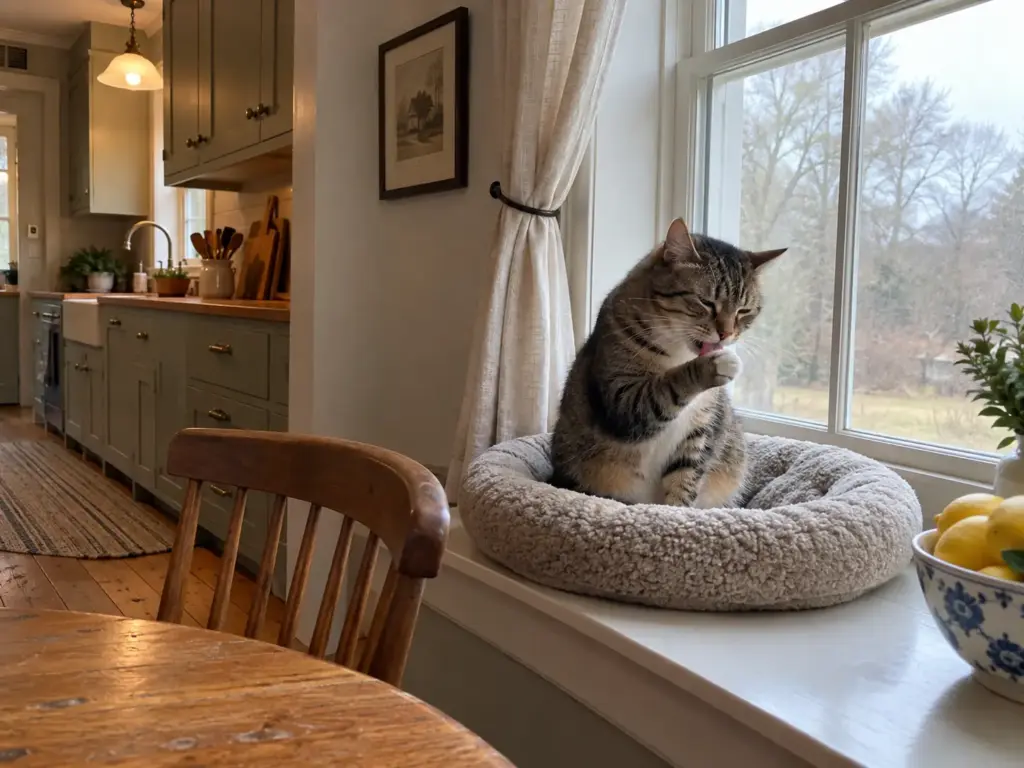
A cat’s coat is never just hair. The allergen protein Fel d 1 is made in his sebaceous glands (skin oil), his salivary glands and his anal glands, and Mayo Clinic lists dander, saliva, urine and sweat among the places it turns up. Best Friends Animal Society says it in one line: the dander riding on the hair is the culprit, not the hair.
Dander is made of tiny flecks of dry skin, far too small to see on a stroke, so what you notice on your fingers is hair while what matters rides along unseen. Cat saliva is part of the same load, so the palm that strokes him is stroking a coat his own glands and mouth have already been over.
Where that protein goes once it leaves the coat, and how long a home keeps the allergen, is the house’s story. This page stays on the skin.
Why a clean cat is the one spreading it
Grooming is the cat doing his job, and it is also the step of allergen transfer, where the protein moves from where it is made to where your hand will land. The moment is the wash itself: the European allergy research foundation ECARF explains, “Whenever the cat cleans itself, the allergen is spread onto its fur.”
Cats wash because that is how they keep a coat in order, so no version of this story ends with a cat who stops. The adjustment has to happen on your side of the sofa.
How the hair carries it to your hand
Once the protein is on the coat, the coat is what you reach for. Every stroke from head to tail drags your palm through the same hair he just washed, and the loose hair and dander that come away on your fingers are the protein’s ride to wherever your hand goes next. Picking the hair off your sleeve feels like it should settle things, but the strand is only the courier, and what it delivered is already on your skin.
It also explains something that seems to contradict the hair theory. A cat who sheds very little can still leave you itching, because the protein comes from his glands and his mouth, not from how much fur he drops. The amount of hair on your sleeve is a poor measure of what reached your skin, and a clean sleeve proves less than it seems to.
The hair is the part you can see, which is why it takes the blame.
The Spots Where the Itch Lands, and Why They Are the Ones You Touched

The hand that pets and the face it touches next
Follow one petting session outward from the cat. His coat holds the protein, your palm and fingers go through that coat, and the hand that just did that goes where hands go on their own: an eye, the bridge of the nose, the chin, a cheek. After the face comes the sleeve the same hand wiped on, and after the sleeve the arm of the sofa where you both ended up. Mayo Clinic notes that direct contact with a pet someone reacts to can trigger allergic dermatitis, so direct skin contact alone can be enough for itchy skin to show up.
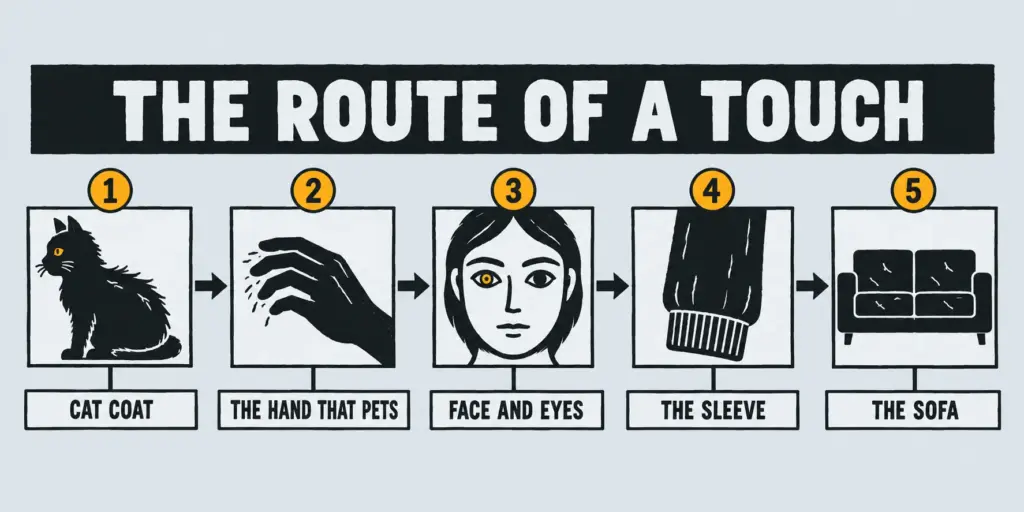
The order matters because it is the order you can interrupt. Of all the links between his coat and your face, the hand is the only one with a faucet nearby. The standard advice is to wash after petting, and that fails the moment he settles on your lap for an evening and your eye itches halfway through. The better rule is to wash before your hands go anywhere near your face, whenever that moment comes.
Keep a box of clean tissues within reach of wherever he sits with you. When an eye needs rubbing and the sink is across the apartment, the tissue does the touching instead of the hand that was just in his coat.
Skin the cat licked, scratched or pressed against
Allergy references list the same short set of spots: where a cat has licked, scratched or bitten you. Each one is a different way of putting his saliva or his coat onto your skin. A lick on the wrist leaves saliva, one of the places the protein is found, directly on you. A claw dragged along the forearm, or a long cat draped across your chest, puts skin against coat for as long as he stays there.
None of that is aimed at you. A lick, a scratch and a lean are ordinary things a cat does to a warm, familiar person, and the cat is entitled to all three. The itch has a map because each contact left something at a particular spot, and the spots to look at first are the ones he used.
The sleeve that carries it where the cat never went
A long-sleeved shirt worn on the sofa goes into the hamper, or onto the chair in the bedroom, and that is how you can itch in a room he has never entered. Mayo Clinic notes that dander has this second way of traveling: “It also collects easily in upholstered furniture and sticks to your clothes.”
The same shirt, dropped on a chair beside the bed, meets the bedding the cat sleeps on if he is allowed up there, and the route loops back to your face at night. Fabric is a house question and belongs to the guide linked above. The sleeve is the part that is yours.
What belongs to your doctor, not to this page
Everything above traces a route. It cannot tell you what any itch of yours means. ECARF lists itching, redness, conjunctivitis and hives as the signs animal hair allergy produces, with skin and breathing the two areas it affects most, and that list is all this page will say about symptoms. If you notice any of them after time with a cat, or any trouble breathing, take it to your doctor, who is the person who can test.
ECARF also notes that a skin test, or any other allergy testing, shows whether your immune system has become sensitized, not what will happen on any given day, so a result opens a conversation rather than closing one. If it is the cat who is scratching, licking or losing coat, that goes to the veterinarian first, and this page stops at naming the visit.
Why One Cat Itches You More Than Another

Two ordinary cats can differ by 80 times
The comparison most readers make is a simple one: the other cat never did this to me. The numbers back the feeling up. In a one-year study of 64 house cats, researchers measured the protein in their saliva, and the lowest yearly average for any cat was 0.4 µg/ml while the highest was 35.0 µg/ml, a gap of more than 80-fold. These were typical pet shorthairs, not a special breed.
That is saliva, not your skin, so it cannot predict how any one person reacts. What it shows is how far apart two ordinary cats can sit, which means your cat is one individual with his own level, not a category. Those were yearly averages, too, so the gap is not one cat having a bad week. It also cuts both ways: how a friend’s cat felt on your lap predicts very little about yours, and how yours feels predicts very little about the next one you meet.
The low producer you cannot spot by looking
A subset of the 64 cats held steady, low levels for the whole year. Nothing you can see on a cat marks him as one of them: the study found them by measuring saliva, and a test on the cat is the only thing that tells you.
So the cat you cannot stop itching around has not failed anything. He is simply nearer one end of a wide range than the cat you remember.
Each time you notice an itch, jot down which cat was the last one under your hand and which spot it is. After a week you have a list of contacts to hand to your doctor, and you have drawn it without guessing what the itch means.
What more than one cat adds to the same hand
With two or three cats, the same hand goes through two or three coats, each with its own level, and the question of which cat is responsible gets harder to answer by feel. No study sits behind this part. It is the plain arithmetic of contact: a long coat and a short one add two different amounts to the same palm, and the sofa gets the sum.
It would also explain why a house can feel worse after a second cat arrives even though the first cat never changed, since the same hand now touches two sources before it reaches your face. The cats are not competing. They are two coats, and you only have one pair of hands.
That is why the contact habits in the last section matter more in a multi-cat home than the question of which cat is at fault. You cannot wash your hands once per cat and still pet them all, but you can wash them once before your face, and that rule covers every coat in the room.
Cut the Contact You Control, Free Steps First
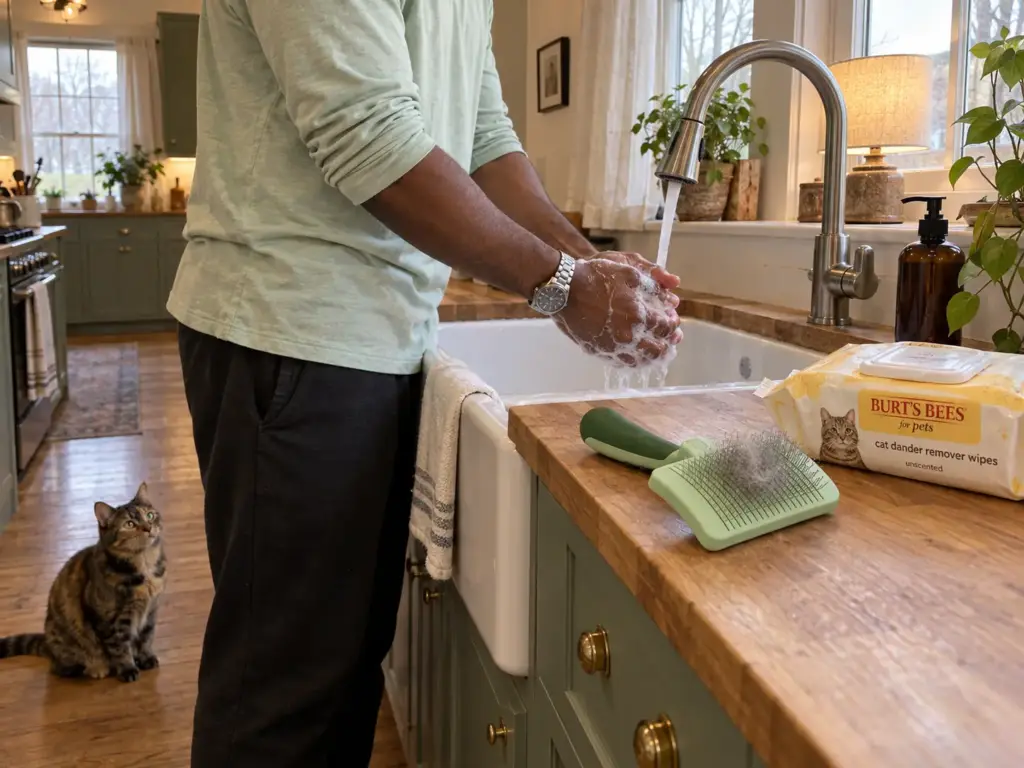
Wash your hands before they touch your face
Three changes cost nothing, and they come first because they sit on the links the earlier sections traced. Best Friends Animal Society advises washing your hands right after petting a cat, and the version that holds up in a real apartment is the one above: before your hands reach your face.
- Wash your hands after petting him, and before they touch your eyes, nose or mouth.
- Keep your face clear of the cat’s coat while he is on your lap or chest.
- Shake out the shirt you wore with him, or change it, before it reaches the bedroom.
The sleeve is the easiest of the three to forget, and keeping hair out of clothes covers the order of doing it. They shorten the distance between his coat and your face, and that is all they do.
What the brush pulls off, and who ends up holding it
A grooming brush lifts what sits on the coat, and ECARF’s line about grooming says what sits on the coat. So what the brush pulls off is more than loose hair, and whoever empties the brush handles all of it. That is an inference, not a study result, but it follows from the order of events.
The Coastal Pet Safari Self Cleaning Slicker Brush (2 x 5 x 8.75 in) has a button that releases the collected hair with one push, so you are not picking it out of the pins with your fingers. Buyers of the Safari line point to a flaw that matters here: on a cat with little underfur, the long, thin hairs do not catch easily without several rounds of grooming, and flakes can build up after a while of brushing. That is exactly the material your hand would otherwise be handling. (The reports cover the Safari line in general, and the exact model is not confirmed.)
The popular pick is not automatically the right one: on a fine, thin coat the slicker’s pins let the hair slip past, and the brush that suits the coat may be a different design altogether. The brush that suits the coat walks through that choice. For a lower-cost route, the Cat Brush with Soft Rubber Pins, Washable Silicone, 8 x 4.5 x 2.5 in rinses clean instead of being emptied, and expect the same multiple passes on a fine coat.
And if he leaves after two strokes, he has told you the length of the session. When the cat objects to the brush is the better place to start than a harder brushing.
Empty the brush into a bag held open right where you brushed, then wash your hands before you touch your phone or your face. The phone is the next thing hands go to, and it ends up carrying the same film.
Wiping the coat before the cat reaches the lap
What the brush does not reach, a damp wipe along the coat may: Best Friends Animal Society lists pre-moistened wipes among its tips for taking dander and loose hair off a pet. Burt’s Bees for Pets Cat Dander Remover Wipes, Unscented come 50 to a pack (the listing is a three-pack), each wipe 6.8 x 7 in.
In allergy households the routine is to brush the cat and then wipe him down before he comes in the house. Some people reverse the order. The usual complaint is the packaging, since the pack lacks a pop-up container.
A wipe is a cold, damp stroke across a coat he did not ask to have touched, and a cat who walks away has voted. Keep it to the door or the hallway, before he reaches the sofa.
Brush first and wipe second, and do both at the door or in the hallway rather than on the sofa. That way what comes off him ends up in the bag and the trash, not in the cushion you sit on afterward.
Hands Before Face Today, and a Look at the Itch Map in Three Weeks
The itch lands where your skin met the protein, not where the hair is. The contacts you control are your hands, your face and your sleeve, and the free steps go first. Your doctor handles the testing and whatever the itch means, and the veterinarian handles it if the cat is the one scratching.
In three weeks, check whether the habit to wash hands before your face still happens without thinking and which spot, if any, still itches. That spot tells you which contact to look at next, or what to bring to your doctor. If the brush stays in the plan, a grooming routine of ten minutes keeps sessions short enough that he lets you finish.
Today, go to the sink before your hands reach your face the next time you pet him, and notice which spot, if any, itches afterward.
Frequently Asked Questions
01Can cat hair make you feel itchy?
Yes, but the hair is only the carrier: the itch comes from the protein on it touching your skin. The spots are usually the ones the cat or his coat touched, such as the hand that petted him and the face it reached next.
02How do I tell if I am allergic to my cat?
Only a doctor can tell you, using allergy testing, and even then a result shows a sensitivity rather than a verdict. This page traces where contact happens and stops before the diagnosis.
03How long does cat hair stay allergic?
No source gives a figure for how long the protein stays on your skin or hands after petting, so this page gives none. The house has its own clock: see how long a home keeps the allergen.
04Can you become allergic to cat hair later in life?
That is a question for your doctor, who can review your history and run the tests; a page about contact points cannot answer it for you.


Leave a comment