Cat Breeds That Shed Less on a Rented Sofa
Cat breeds that shed less, sorted by coat: Cornish Rex (under 9 lb), Siamese, Birman, Russian Blue (2-3 week shed) + what each costs a rental sofa.

Alfredo RamsesFounder · October 6, 2026 · 22 min read

On this page9 sections
- 1Cat Breeds That Shed Less Are Real, and "Less" Is Not "None"
- 2Why Breed Lists Disagree, and What to Read Instead
- 3Short, Sleek Coats: Siamese, Oriental, Bombay and Ocicat
- 4Rex, Wirehair and Hairless Coats Trade Hair for Oil
- 5Dense Double Coats Sit in the Middle, Not at the Low End
- 6What a Low Shedder Costs a Rented Apartment
- 7One Cat or Several, and Where a Low Shedder Comes From
- 8Read the Coat, Price What It Charges Back, Then Go Touch the Cat
- 9Frequently Asked Questions
You have three breed pages open, a dark sweater with a pale film across the front, and two rules already settled: no hairless cat, and nothing priced like a used car. The hair on that sweater is not a cat misbehaving; it is a coat doing exactly what coats do, and a coat’s structure decides how much of it ends up on a sofa your lease will not let you replace. Cat breeds that shed less are real, but the breed name is the weakest clue you have, while the way the Cat Fanciers’ Association and VCA Animal Hospitals describe each coat tells you nearly everything. So this guide reads the coat first: the three families that leave the least hair, the one family that only looks low, what each low-shedding coat charges a rented apartment in return, and where you can find one without a breeder’s waiting list.
Quick Answer
Every cat with fur sheds, but these coats leave the least hair on furniture:
- Pick a rex, wirehair or hairless coat for the least loose hair (expect skin oil instead).
- Choose a short, fine coat (Siamese, Oriental, Bombay, Ocicat) for a weekly brush and little hair.
- Look at long coats with no undercoat, like the Birman and the Javanese.
- Treat dense double coats (Russian Blue, British Shorthair) as heavy shedders in short bursts.
Cat Breeds That Shed Less Are Real, and “Less” Is Not “None”
Somebody at work hears you are thinking about a cat and offers the easy answer: just pick from the cats that don’t shed. You already suspect that sentence is wrong, and you are right to. Some coats leave measurably less hair on a sofa than others, but every cat that lives indoors drops a little hair all year, so “less” only means something when you know what it is being compared against.
What “less” is actually measuring
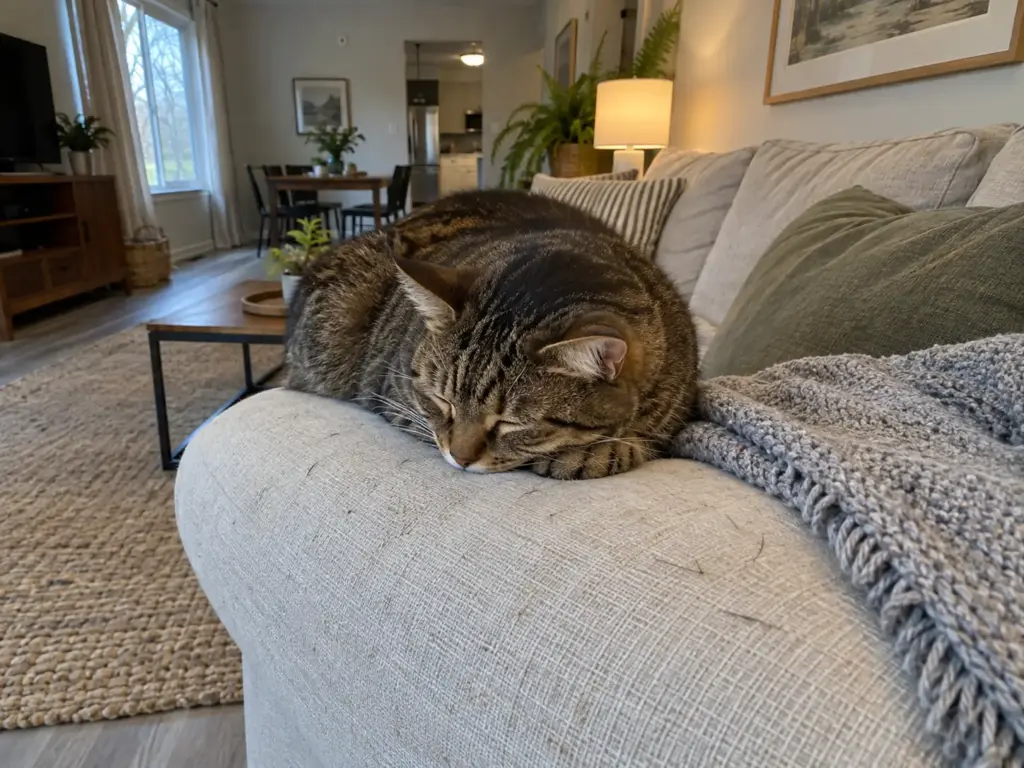
Low-shedding cat breeds really do exist. According to VCA Animal Hospitals’ guide to coat care, “Some cats shed very little, such as the Sphinx and the Rex breeds, while others shed a lot, like the Maine Coon cat.” That gives you two ends of a scale, and most cats sit somewhere between them. For a renter, the scale that matters is narrower than the one breeders talk about: it is how much ends up on the upholstery, the bedding and the dark coat by the door, which is the ground this site’s guide to living with cat shedding in a rented apartment covers from end to end.
A coat can differ from another on three counts, and each one changes what lands on your furniture:
- What it is made of. One layer or two, with or without the long, stiff guard hairs, or no coat at all.
- How long the hair is. Short hair drops in small pieces you barely see; long hair drops in strands that cling to fabric.
- When it lets go. A steady trickle all year, or quiet months broken by a few weeks when the undercoat comes out in clumps.
Breed name and reputation are guesses stacked on top of those three. Once you can answer them for a given cat, the breed label adds very little.
Why the same warning closes out each breed list
VCA’s second point is the honest limit of this whole subject: cats that share our homes often shed both their undercoat and their guard hairs at low levels all year round. Central heating and indoor lighting flatten the seasons, which is why an indoor cat sheds all year instead of in two clean bursts. So even the lowest-shedding coat leaves a light, constant trickle on whatever it sleeps on.
The people who live with these cats say it more bluntly. In an r/Pets thread from someone who wanted a cat that didn’t shed, one reply put the rule in a single line: “All cats with fur are going to shed.”
Another commenter, talking about the rex breeds, added the detail that explains the reputation: “they will shed. It won’t feel as much because their fur is really short.” Short hair reads as less on a sofa because each piece is small and lies flat. It still comes off.
What this list leaves out on purpose
Less hair on the sofa is not the same as hypoallergenic, and whether any cat suits a person with allergies or asthma is a question for your doctor, not for a coat chart. Allergies get their own place on this site. Breed health and the skin of hairless and rex cats stay out of this guide as well: what follows is coat structure and what each coat does to an apartment, which is the part a renter can actually plan around.
Why Breed Lists Disagree, and What to Read Instead
You opened four tabs and got four different answers, and assumed you had misread one of them. You didn’t. The lists are measuring different things and calling all of them “shedding”.
The same cat on opposite sides of the line
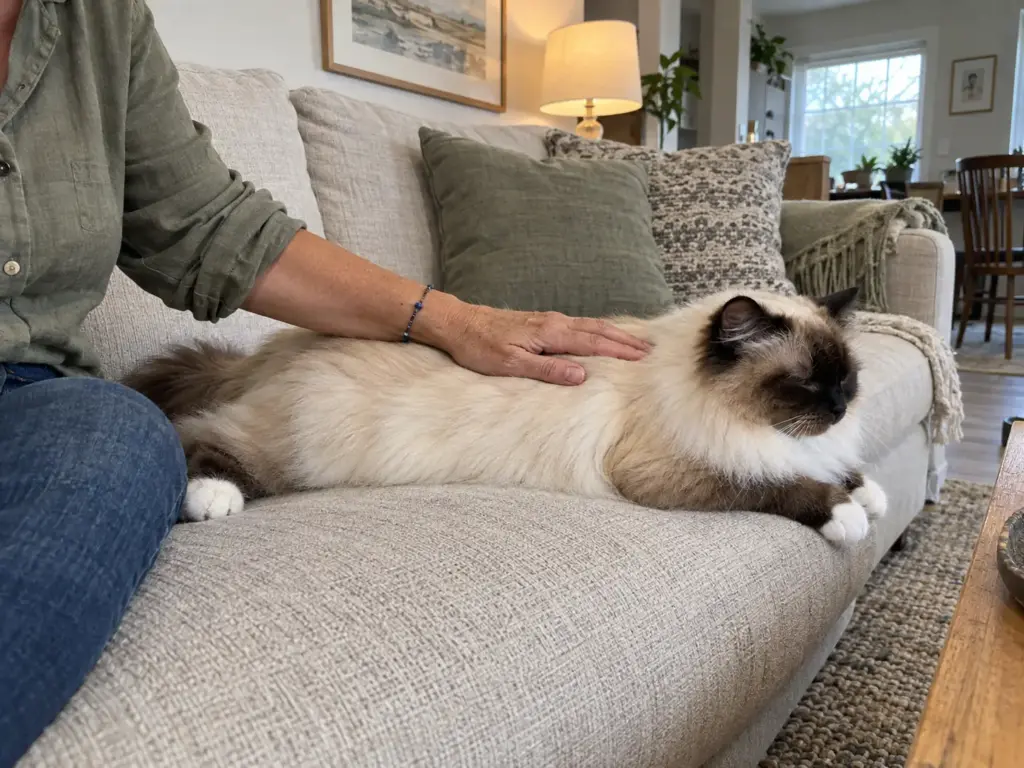
Four Paws puts the British Shorthair first on its list and says it “hardly sheds”, and it describes the Bengal as a light shedder. Purina’s low-shedding collection names eight breeds and includes neither of them, while a separate Purina page on moderate shedding places the British Shorthair and the Bengal in the middle, alongside the Maine Coon. Chewy lists the Bengal, the Birman, the Exotic Shorthair and the Russian Blue as breeds that don’t shed much. Same cats, opposite answers. One source is looking at hair length, another at coat structure, and another at a breed’s reputation, so a short dense coat can land on the “low” side of one page and the “moderate” side of the next.
| Coat family | Breeds the sources name | What the apartment gains | What it costs |
|---|---|---|---|
| Hairless | Sphynx, Peterbald, Donskoy | Almost no loose hair | Skin oil on fabric, a weekly wipe, a cat that wants company |
| Rex | Cornish Rex, Devon Rex | Soft down, no guard hairs to drop | Oil, a coat that chills easily |
| Wiry | American Wirehair | Loose hair stays caught in the coat | You find it when you pet or brush |
| Short, single layer | Siamese, Oriental, Bombay, Ocicat, Burmese, Abyssinian | Little hair, one weekly pass | Short hairs still show on pale fabric; the Siamese is vocal |
| Long, non-matting | Birman, Javanese | Long coat without the undercoat mat | Still a long coat on dark clothes |
| Dense double | Russian Blue, British Shorthair, Exotic Shorthair | Quiet most of the year | Two to three heavy weeks, once or twice a year |
Single coat, double coat, no coat
Most cats wear two kinds of hair. The guard hairs are the longer, coarser outer layer, the ones that give a coat its shine and its color; underneath sits the undercoat, a soft, dense down that keeps the cat warm and is the part that comes out in clumps. A double coat has a lot of both. A single coat is mostly one layer pressed close to the skin, and the rex coats go further and lose the guard hairs altogether.
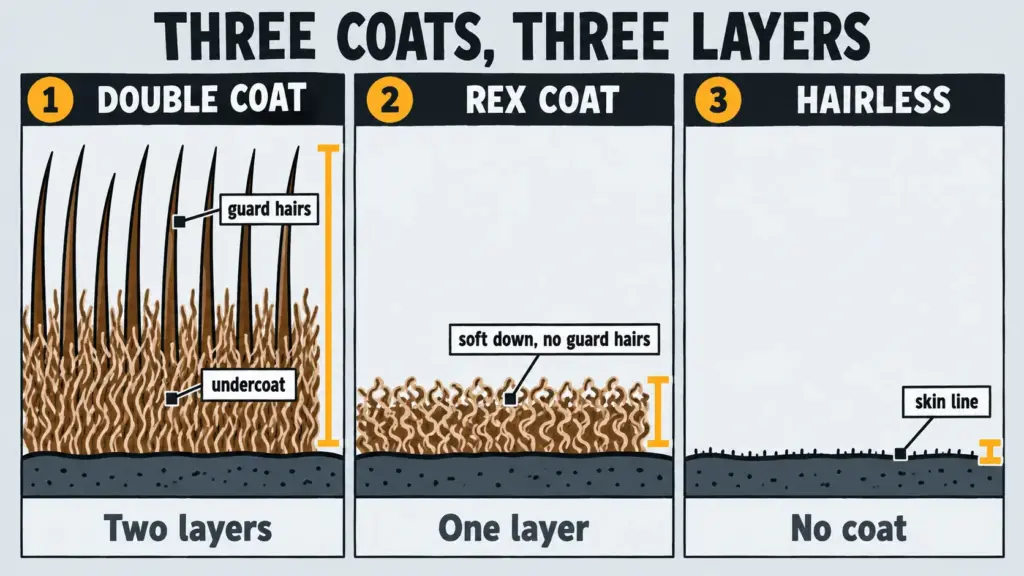
With that in hand, the sources group neatly. The CFA describes the Cornish Rex coat as having no guard hairs and the Devon Rex as soft and wavy. The American Wirehair coat is wiry and holds loose hair, per the CFA and Litter-Robot.
The Siamese, Oriental Shorthair, Burmese, Singapura and Abyssinian wear short, fine coats that lie close, according to Chewy and Litter-Robot. The Birman and the Javanese grow long coats that don’t mat. The Russian Blue, British Shorthair and Exotic carry dense double coats. And the Sphynx, Peterbald and Donskoy barely have a coat at all.
Long hair is not the same thing as a long list of hair on the sofa
The Birman is the one that surprises people. A long coat sounds like the worst choice for a renter, yet Chewy, quoting a CFA allbreed judge, calls the Birman relatively low-shedding because its coat doesn’t mat and needs little grooming, and Litter-Robot says the same of the semi-long Javanese. What fills a lint roller is the undercoat letting go, and a long coat without much undercoat has less of it to release. Length decides how visible each hair is; structure decides how many come out.
You will also meet the phrase “sheds minimally” in breeder and judge descriptions. In the mouths of people who own these cats it means less than the last cat they had, never zero, and that’s the fair way to read it. One more gap is worth saying plainly: no breed registry or vet group publishes a coat length or a hair count for any breed, so nothing here pretends to give you grams of hair per week. Structure is the most anyone can measure, and it turns out to be enough to choose with.
Short, Sleek Coats: Siamese, Oriental, Bombay and Ocicat
Picture a one-bedroom with thin walls, a renter who has finally got the hair under control with a short-coated cat, and a neighbor on the other side of the bedroom wall. This group is the cheapest in hair and the most expensive in something else, and the something else depends on the breed.
The weekly rubber pass
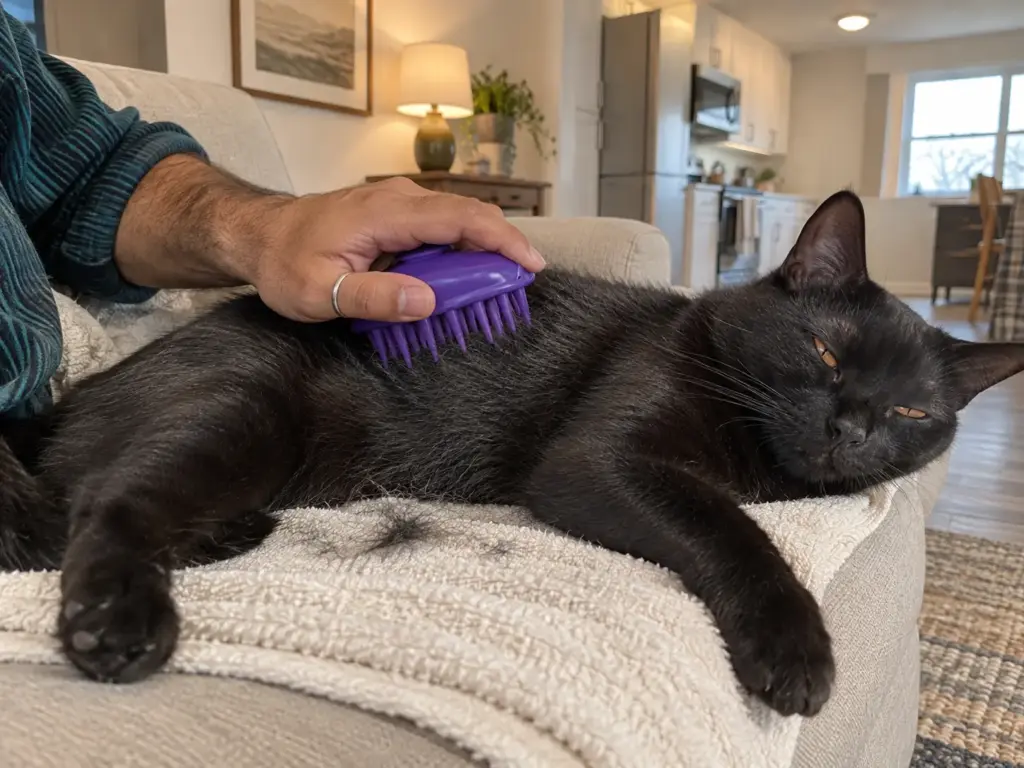
A short, fine, tight coat lies smooth under the palm and drops small hairs that disappear into most fabrics. It still needs a pass. Litter-Robot puts the Ocicat at roughly one weekly rub with a rubber curry comb, and the r/Pets thread offered the same lever for any cat: brushing at least once a week catches the hair before the furniture does.
Before you buy a tool, wet your hand, wring it out, and stroke it along the coat from neck to tail a few times. The damp palm lifts the loose hair into a little roll you can drop in the trash. If you want something that does more per stroke, the Cat Brush with Soft Rubber Pins (8 by 4.5 inches) is the plain version of that rubber curry, and it washes clean under the faucet once you’re done. It loosens hair well, but it doesn’t trap what it loosens, and owners report the hair ending up on the bed or the couch, so use it somewhere you can sweep, or over a towel.
The fine comb once the dead hair is out
Chewy quotes a CFA allbreed judge on the Siamese: a low-maintenance coat, best brushed with a fine-tooth comb, which sheds minimally once the dead hair is out. That last clause is the useful part. The comb isn’t for the loose bulk, which the rubber brush or your hand already removed; it’s for the fine short hairs that the rubber skims over.
A steel comb is the simplest way to do that, and the PETTOM Steel Grooming Comb is 7.5 inches long with coarse and fine teeth and rounded tips. Treat it as exactly that, a 7.5-inch steel comb for a short, fine coat. It’s sold as a dog comb, so nearly all its reviews come from poodle owners, some buyers say the teeth bent after a few uses, and one reviewer disputes the “stainless” in the title.
Before you commit to a coat type, stroke an adult cat of that type with your bare hand, against the grain once and then with it. A short, fine coat lies smooth again almost instantly and leaves only a few hairs on the palm; a dense coat springs back up and leaves a soft fuzz. Your hand learns the difference in thirty seconds, faster than any breed description.
What the Siamese type charges instead: noise
The usual advice to a renter fed up with hair is to get a short-haired cat, and for the hair it works. It breaks against a different clause of the lease. The CFA describes the Siamese as having a large repertoire of vocalizations, and a cat who talks through the day talks through shared walls too. If your building is thin-walled and your neighbors are close, a quieter short coat is the better call.
The Siamese stays on the list for people with thicker walls or a ground floor. (The cat, for the record, has every reason to talk: he wants your attention and he has worked out that his voice gets it.)
Rex, Wirehair and Hairless Coats Trade Hair for Oil
If you have been comparing lint rollers on the assumption that a hairless or curly cat ends the problem, this is the section that rearranges the shopping list. These three coats leave the least hair on furniture of any in this guide. What they leave instead is quieter and harder to roll off.
Rex coats: soft down and no guard hairs
The rex coat is the one people point to first, and the breed standard explains why. The Cat Fanciers’ Association’s Cornish Rex breed standard describes the coat as “short, extremely soft, silky, and completely free of guard hairs.” With no long outer hairs to work loose and ride your sleeve to the sofa, the Cornish Rex sheds far less of what you’d see. The same CFA page lists the price: the coat is fragile, gives little protection from the sun, and the cats chill easily, enough that CFA suggests a sweater.
The Devon Rex wears a soft, wavy version of the same idea. Neither is hairless, and the r/Pets commenter’s line about rex cats holds here: they shed, it just doesn’t feel like much because the hair is so short. In that thread, rex, hairless and curly coats get lumped together as “designer breeds”, said with equal parts envy and price shock.
Wirehair: the coat that keeps its own loose hair
The American Wirehair is the odd one in this group. CFA describes the coat as springy, dense and coarse to the touch, crimped right down to the hair inside the ears. Litter-Robot notes that the wiry texture catches loose hairs so they’re less likely to fall. In practice the shed hair stays tangled in the coat until a hand or a brush finds it, so you meet it while petting him on your lap rather than on the cushion after he leaves.
Hairless cats: the oil lands on your furniture
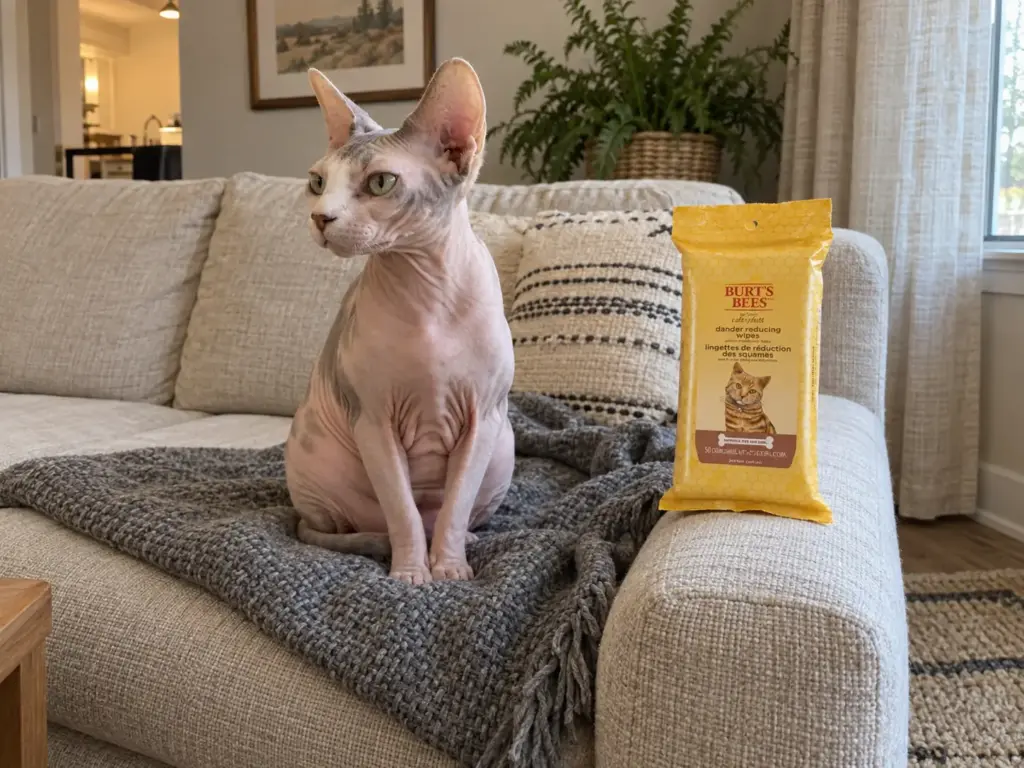
This is where the obvious choice stops being obvious. All cats’ skin makes oil, as Chewy quotes a CFA representative saying, and a normal coat soaks most of it up. Take the coat away and the oil has nowhere to go but the next surface: the sofa arm where he sleeps, the pillowcase, the sleeve of the sweater you were wearing when he climbed on you. Litter-Robot says hairless breeds need a weekly sponge bath or wipe-down for exactly this reason, and that the Cornish Rex becomes oily faster.
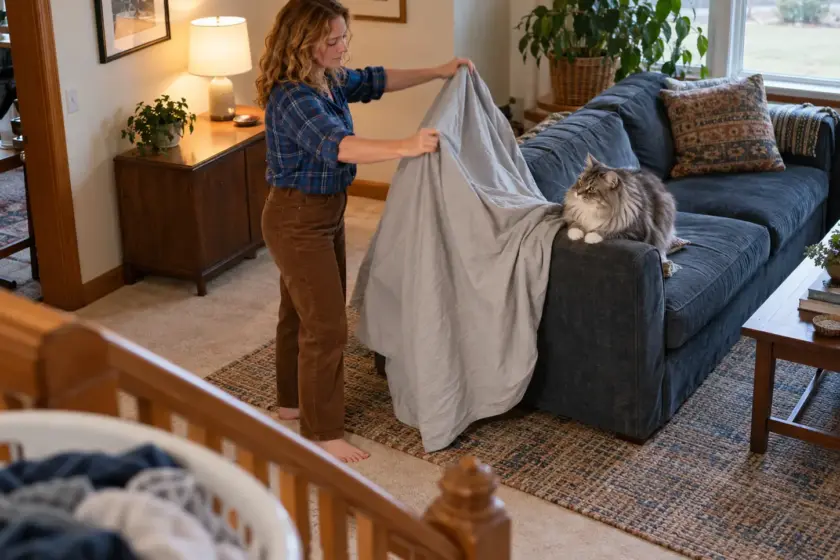
The cost of the hairless cat didn’t disappear. It moved from the brush to the washing machine. A lint roller does nothing for a gray-tinged patch of oil on a pale fabric arm, which is why the first purchase for a hairless or rex cat in a rental is a washable throw over his favorite seat, not a roller.
The throw goes in the wash; the sofa underneath stays the color the landlord remembers. And if the skin or coat of a cat who already lives with you changes, that goes to a vet before it goes anywhere near a cleaning routine.
The weekly wipe, and the free version first
Start with what Litter-Robot describes: a soft cloth or a sponge, damp with warm water, used to wipe down the cat from behind the ears to the tail once a week. Most cats tolerate it better as a few short strokes than as one long bath, and a cloth that goes through the wash with the throw adds nothing to the shopping list.
If you want something ready to grab, Burt’s Bees for Pets Cat Dander Remover Wipes, Unscented come 50 to a pack (the listing is a pack of three), and the directions match the cloth routine: behind the ears, down to the tail. Here they are a quick way to take oil off the coat before it reaches the fabric, nothing more. They’re unscented, though some buyers still notice a wet-wipe smell on them, and others call them a waste of money next to a damp cloth.
Put the washable throw down before the cat arrives, and wash it on the same day you wipe him. Tying the two jobs to one day means the oil never gets a full week to work into the fabric underneath, and you only have to remember one routine.
Dense Double Coats Sit in the Middle, Not at the Low End
You read “hardly sheds” on one page, brought home a plush gray cat, and then met the other page a few months later, when the sofa turned the same gray as the cat. Nobody lied to you. A dense double coat really is quiet for most of the year, and then it isn’t.
Quiet most of the year, heavy for two to three weeks
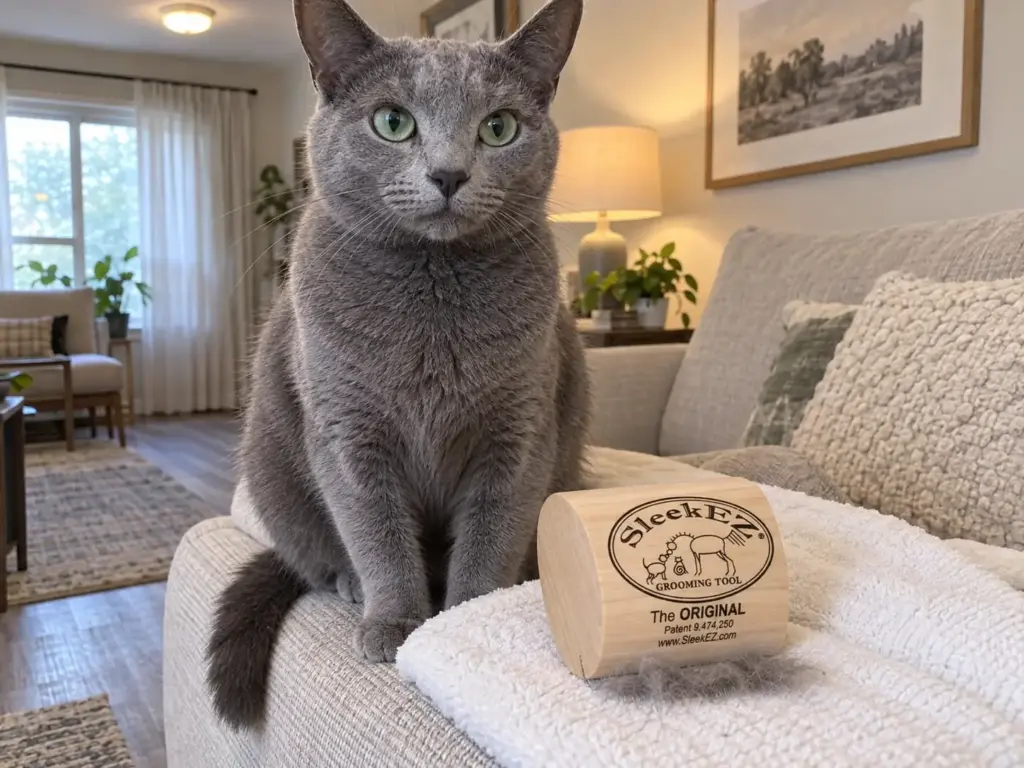
The Russian Blue is the clearest case. CFA’s Russian Blue breed standard describes a short, fine, plush coat whose double layer stands away from the skin because it is so dense. Chewy, quoting a CFA allbreed judge, says the breed generally sheds over two to three weeks, once or twice a year.
Between those windows you will see little hair. During them the undercoat lets go in soft clumps, and the guide to how long a shed lasts, week by week follows a coat like this through the whole stretch.
For the burst, start with what you already own: the rubber brush and a damp rubber glove, used daily. Bring out a fixed deshedding tool only when the rubber fills up on every pass. Actually, scratch “only”: on a very thick coat you’ll likely want both, the rubber first to lift the loose surface and the SleekEZ Cat Brush for Shedding after it to pull the undercoat that’s already let go. The tool is about 5.5 inches long and reviewers call the blade “super small” on a big cat, so a large dense coat takes a lot of passes, and the plastic tabs can sit proud of the teeth.
When a dense coat starts to blow, break the brushing into several short sessions a day instead of one long one. Stop when his tail starts flicking, not when the brush stops filling. He gets to decide when it’s over, and that is what keeps him willing to sit for it again tomorrow.
Why the British Shorthair lands on both sides of the line
Four Paws calls the British Shorthair a cat that hardly sheds; Purina files it under moderate shedding, next to the Bengal and the Maine Coon. Both can be right about the same short, dense double coat: one is describing its quiet months, the other the year averaged out. One of the two cats this site is written around is a British Shorthair, so for this house that coat is a daily fact, not a line on a breed page. If the timing of those weeks confuses you, it’s because indoor cats blur the calendar, and the article on when the hair seems to move with the season explains why the burst arrives when it does.
The big coats: Maine Coon and Siberian
VCA’s own example of a cat that sheds a lot is the Maine Coon, and the long, heavy coat explains it: lots of undercoat, long strands, and a big cat to grow them on. The other tenant behind this site is a large, long-haired Maine Coon, so the high end of the scale is a lived-in fact in this house rather than a line from a breed page. The Siberian is a dense double coat too, so the same plan applies. Whatever label a breeder’s page gives either breed, plan for the brush and the bursts, not for a low-shedding cat.
What a Low Shedder Costs a Rented Apartment
Run the numbers on your own place first: one bedroom, a lease that rules out loud pets and new flooring, and a job that keeps you out from nine to six. Every coat that leaves less hair charges something back, and nobody has put a hair-load figure on any of it, so the costs below come as directions, not grams.
Oil and the washable layer
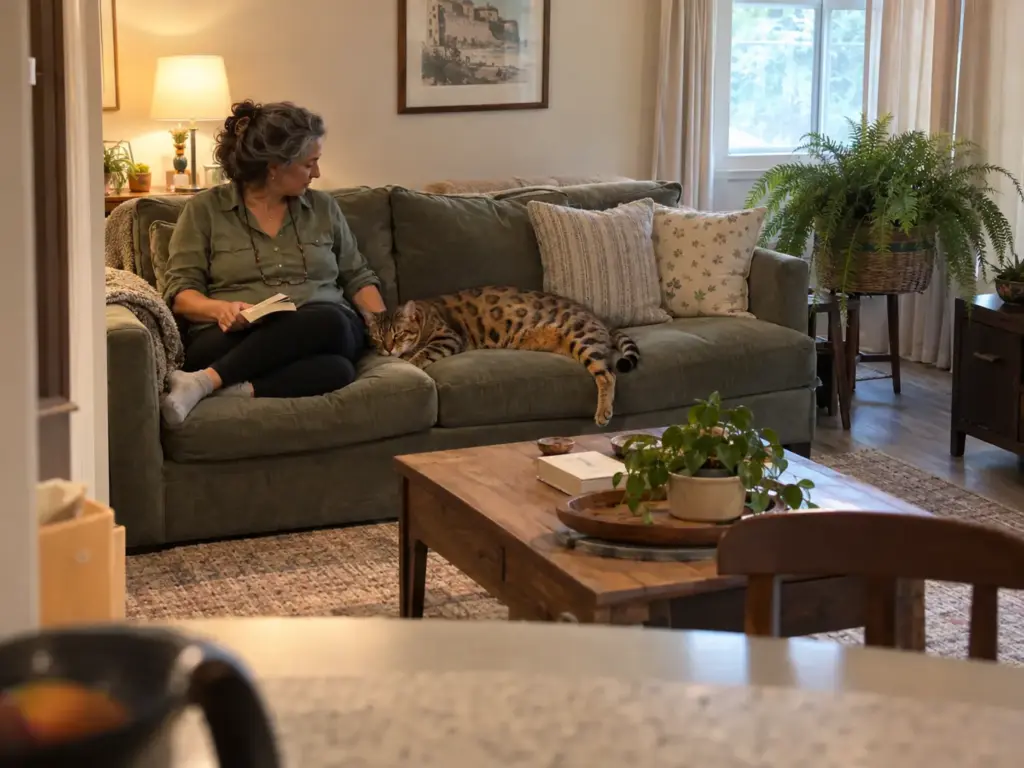
The rex and hairless coats, as covered above, put skin oil on sofa arms, bedding and sleeves instead of hair. The answer in a rental is a washable layer on the cat’s chosen spots plus the weekly wipe, and the full routine for fixing where the hair lands applies to oil just as well.
In a rental, the oil is the bigger of the two problems for a plain reason: moving day. Hair lifts off most fabric with a roller and a damp glove in an afternoon. Skin oil that has soaked into a fabric sofa arm for a couple of years is a darker, slightly stiff patch that a roller can’t touch, and if the sofa came with the apartment, that patch is what the landlord sees at the walk-through.
Leather and faux leather wipe clean; woven fabric holds on. So match the layer to the furniture: a cotton throw you can wash hot on a fabric sofa, and on a leather one, a cloth wiped over his spot whenever you wipe him.
The thin Cornish Rex coat adds a small, real cost of its own: CFA’s warning that these cats chill easily means a renter with no say over the building’s heating may end up buying the sweater CFA mentions, and the coat’s low sun protection is one more reason not to leave him on a sunny windowsill all afternoon.
Noise and company
Noise, in the case of the Siamese, travels through walls you don’t own. Company is the cost people forget. CFA writes that the Sphynx thrives on the companionship of other cats and does not do well left alone for long, and the Cornish Rex page describes cats that want to be with their person all the time.
The low-hair cat is usually the high-contact cat. A cat like that, alone for ten hours, is reporting a real shortfall when he greets you at the door at full volume or follows you from room to room all evening, and he’s right about it. These breeds suit someone home most of the day, or a home with a second cat, better than a single renter with long office hours.
Size: a low shedder can still be a big cat
Four Paws calls the Bengal one of the largest cat breeds, which undercuts the “perfect for a small apartment” pitch it sometimes gets. At the other end, the Cornish Rex typically stays under nine pounds. And CFA describes Maine Coons as bigger than plenty of small dogs.
A big low-shedder is still a big cat: more food, more cat on the sofa, and a box sized for him. Work out how big the box has to be for a cat that size before he comes home, and if the budget is tight, there are options for a box that fits a big cat without a big bill.
One Cat or Several, and Where a Low Shedder Comes From
If you already share the apartment with a long-haired cat and you’re wondering whether a rex will finally fix the sofa, this section is the one to read slowly. The cat you already have matters more to the answer than the one you’re choosing.
One cat in the apartment
With one cat, the coat you pick sets the hair load, full stop. A short, close-lying coat with a weekly pass leaves a light trickle; a rex leaves less hair and some oil; a dense double coat leaves little for months and a lot for a few weeks. You can plan the furniture around any of those.
A second cat does not cancel the first one’s hair
The tempting math is that adding a low-shedder halves the hair. It doesn’t. The long-haired cat already on the sofa keeps shedding exactly as before, and the new cat adds his own share on top, smaller but not zero.
In a multi-cat home, that means a long-haired cat and a newly adopted rex give you more hair than before, plus oil. Add the low-shedder because you want the cat, not because you expect the sofa to improve.
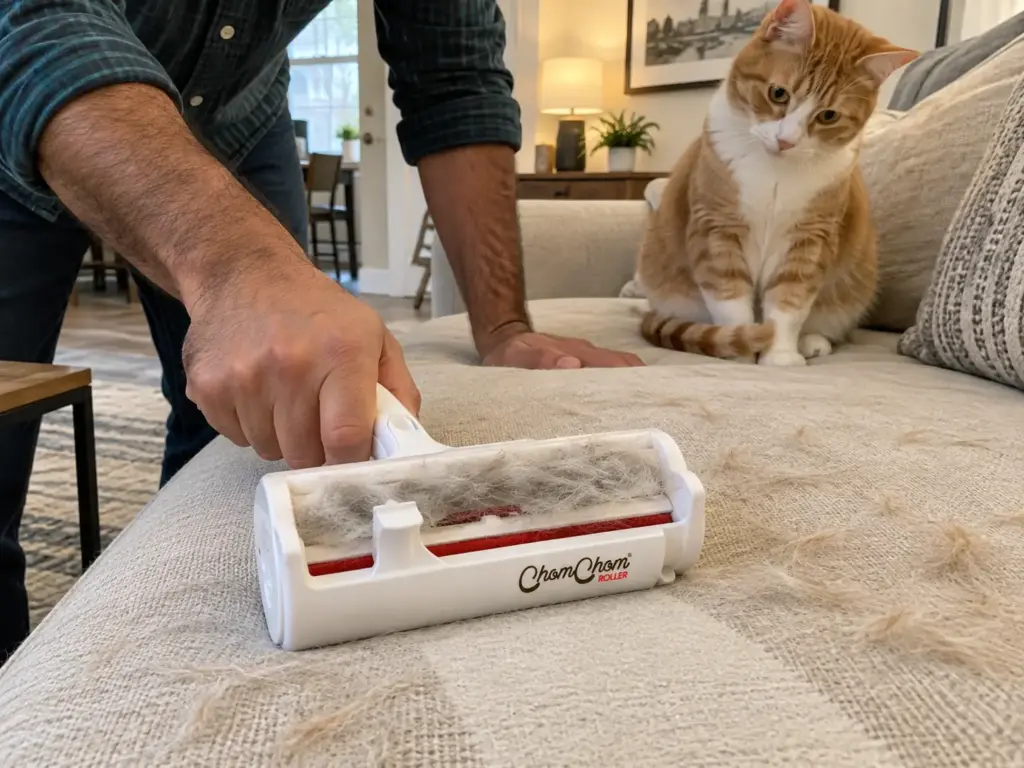
Whatever the coat, a low shedder is not a no-shedder, and some hair will be on the cushions. A damp rubber glove or a grooming mitt dragged across the fabric rolls most of it into a clump you can pick up by hand. For bigger stretches, the ChomChom Roller Pet Hair Remover is reusable and needs no sticky sheets, collecting hair into a chamber as you roll it back and forth. Some owners found they had to roll “excessively” for a clean result and that it feels flimsy, and the chamber is small enough that you’ll empty it often.
Shelter or breeder: a coat you can touch
The r/Pets thread was blunt about availability: most cats are not purebred, as one commenter put it, so a shelter is unlikely to hold a particular breed’s coat. What a shelter does hold is a lot of mixed breed domestic shorthairs, and that’s where reading the coat beats reading the label. Feel the cat in person, adult rather than kitten, and look at how short and close the coat lies. A commenter in the same thread said shorthairs have smaller hairs and fewer of them, then added the caveat that keeps it real: “it’s still going to shed a lot.”
If your heart is set on a particular breed, the same thread pointed to a cheaper door than a kitten: an older cat, or a retired breeder released from a breeding program, and it also warned to check the breeder carefully. Either way, one rule from earlier still holds: if a cat already living with you suddenly changes coat, that’s a question for the vet, not a breed question, and the guide to where an ordinary shed ends and a vet question starts shows where that line sits. For most renters, a short, close-lying coat, a weekly brush and a washable layer on his favorite spot will do more for the sofa than any breed name.
Read the Coat, Price What It Charges Back, Then Go Touch the Cat
- Read the coat, not the ranking. Ask what it’s made of, how long the hair is, and whether it sheds all year or in bursts. Those three answers sort any breed faster than a label.
- Every low-shedding coat charges something back. Oil and a weekly wipe for rex and hairless cats, noise for the Siamese, size for the Bengal, company for the cats that want you home, and a breeder’s price for most purebreds.
- A cat you can touch beats a breed name. A short, close-lying coat on a shelter adult, plus a weekly brush, is the most renter-friendly bet there is.
Three weeks after the new cat settles in, or after you start the weekly brush or wipe, look at the sofa arm and the pillowcase where he sleeps and compare what’s there, hair or a faint oily patch, with what you expected when you chose him. That’s long enough for him to pick his spots and for you to find out whether the routine actually stuck. And today, before buying anything, throw a washable blanket over the spot where your cat already sleeps, and run a damp hand down his back once to see what your coat type really leaves behind.
Frequently Asked Questions
01Which breed of cat has the least hair fall?
No breed sheds nothing, but hairless, rex and wiry coats leave the least loose hair on furniture, followed by short, fine single-layer coats like the Siamese. Each one charges something back: oil, a weekly wipe, or noise.
02What cat breed is the lowest maintenance?
A short, sleek coat like the Siamese or the Bombay is the lowest-maintenance coat, needing roughly one quick pass a week. Low-shedding is not the same as low-maintenance: rex and hairless cats need a weekly wipe instead.
03Are there small cat breeds that shed less?
Yes, the Cornish Rex typically stays under nine pounds and has a short, soft coat with no guard hairs, so it sheds little. The Bengal shows up as a light shedder in some places but is one of the largest breeds.
04Do indoor cats shed less?
Not really, because VCA notes that cats living in homes often shed their undercoat and guard hairs at low levels all year round. Indoors, the shed becomes a steady trickle instead of one or two big seasons.
05Which cat breeds shed the most?
Long, heavy coats like the Maine Coon shed the most, and VCA names it as a cat that sheds a lot. Dense double coats such as the Russian Blue and British Shorthair shed in short, heavy bursts rather than constantly.
Leave a comment