How Often to Brush Your Cat? Weekly at Minimum, by Coat
How often to brush your cat: weekly for short coats, up to every other day for medium, daily for long (+ a 4-spot comb test to check it).

Alfredo RamsesFounder · October 6, 2026 · 18 min read


On this page8 sections
- 1How Often to Brush Your Cat Starts With the Coat, and Weekly Is the Floor
- 2The Point Where a Coat Question Becomes a Vet Question
- 3What Pushes the Number Up, and the Ceiling That Caps It
- 4A Comb Test Tells You Whether Your Number Is Enough
- 5When the Cat Gives You One Minute, Brush in Pieces
- 6Your Apartment, Your Hair Budget, and Two Coats Under One Roof
- 7One Number per Cat, and a Comb to Prove It Holds
- 8Frequently Asked Questions
You have a number in your head for how often to brush your cat, probably once a week, and a cat who decided forty seconds into the session that it was over and left with a ripple running down his back. He has a point: his limit is real, and a schedule that pretends it isn’t lasts until the evening he slips under the bed the moment the brush comes out. The welfare and veterinary sources agree on a minimum for each coat, and owners trading notes in r/CatAdvice describe a spread that makes one calendar per household useless: one cat would sit for hours, another lasts about ten minutes, and a third answers the brush by going for the cat beside him. Below is the weekly floor for short, medium and long coats, what pushes it up, a comb check that tells you whether your number is enough, and how to meet it with a cat who gives you a minute.
Quick Answer
The coat sets the weekly minimum, and the cat’s patience sets the upper limit:
- Short coat: at least once a week, up to twice a week.
- Medium coat: once a week up to every other day.
- Long coat: daily, or every few days if he won’t allow daily.
- Go up a step when a comb catches behind the ears or in the armpits.
- Treat the frequency as the floor and his tolerance as the ceiling.
How Often to Brush Your Cat Starts With the Coat, and Weekly Is the Floor
Three answers tend to float around at once: once a week, every day, and “it depends.” Each one is right about a different cat. The coat type decides the minimum, and once a week is the lowest figure the welfare sources give for any coat, so treat it as the floor you never drop below rather than the target you aim for; how a session runs from first stroke to last, meanwhile, lives in our guide to the weekly routine and the order of the four jobs. This piece stays on the number.
A short-haired cat is not asking for less care. He is asking for fewer sessions, and a long-haired one is asking for more of them, shorter. Get that backwards and both cats end up avoiding you.
Short coats: once a week at the very least, up to twice
International Cat Care’s grooming guidance puts a short coat at a minimum of once a week, and the ASPCA’s grooming tips land on one or two brushings a week. Two independent organizations arriving at almost the same words is about as firm as a grooming figure gets. Owners in the r/CatAdvice threads report living a little above that: three or four short passes a week for short-to-medium coats, and a single weekly one for the ultra-short coats that barely hold a loose hair.
Once a week is the floor for a slim, single short coat, though. A dense short coat, the plush kind that stands up off the skin instead of lying flat, behaves more like a medium coat once the undercoat starts letting go, and I would start that cat at two sessions a week and let the comb test later in this article decide whether he stays there.
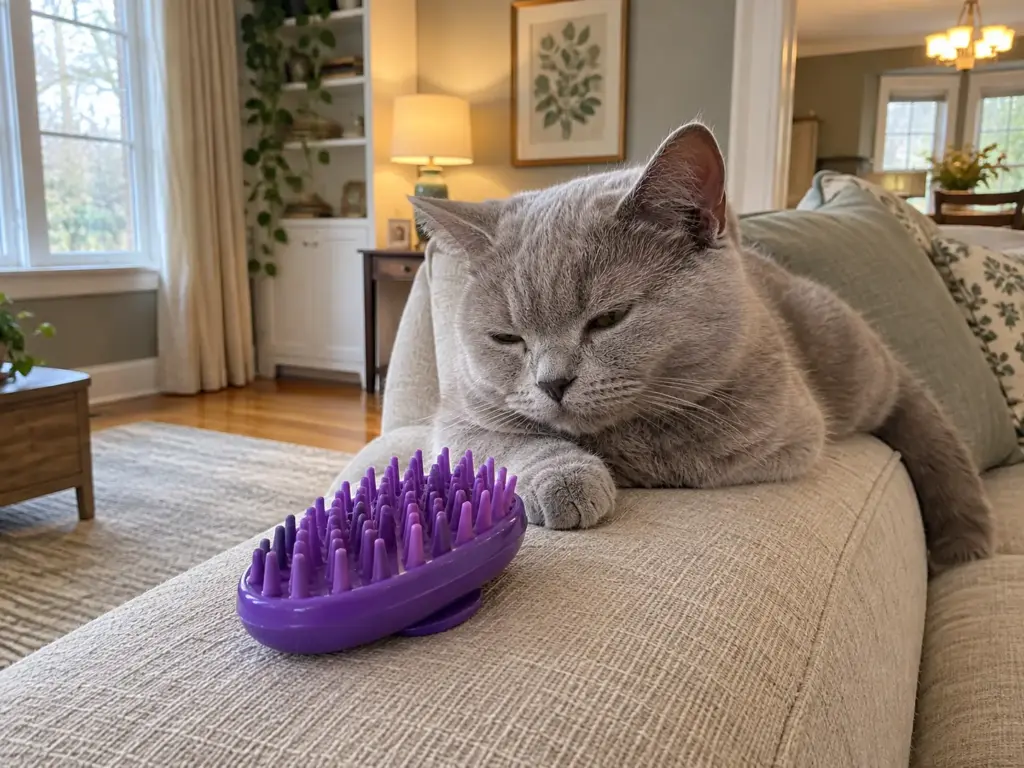
Before buying anything, try a damp rubber dish glove drawn with the lay of the fur. International Cat Care uses that kind of sweep to finish a session, and on a short coat it lifts a surprising amount of loose undercoat. If you want a tool for the weekly pass, a rubber-pin brush is the next step: the Cat Brush with Soft Rubber Pins runs about 8 inches long, washes under the faucet, and its soft pins feel closer to a hand than to a comb, and owners of brush-shy cats say this soft type is the one that wins them over. Buyer reviews on Amazon flag its limit: it loosens hair without holding on to it, so part of what it lifts ends up on the bed or the sofa (brush over a towel and that stops mattering).
Leave a damp rubber glove next to the spot where your short-haired cat naps. One slow pass down his back while he is already drowsy counts toward the weekly floor, and he never sees a brush come out of the drawer.
Medium coats: the band between the other two
Plenty of medium-haired house cats sit here: longer than a sleek shorthair, no ruff or britches, a coat that looks easy until you part it at the armpit. The usual figure for a medium coat is once a week up to every other day, which sounds vague until you notice it is two bands stitched together. The lower end suits a medium coat that lies flat and sheds little; the upper end suits one with a thick undercoat that mats where the legs meet the chest. Breed explains some of that spread, and the piece on which breeds shed less and why their coats behave that way walks through the coat structures behind it.
Start a medium coat at once a week. Actually, start at twice, because a medium coat tangles at the armpits well before you can see it from the sofa, and it is easier to drop a session after two clean weeks than to work out a knot that has had a month to settle. The comb test below is what tells you which end of the band your cat belongs in.
Long coats: daily, and what to do when the cat won’t allow it
For a long, silky or curly coat, International Cat Care and VCA both say daily, and International Cat Care adds the condition that matters most: only for as long as your cat is comfortable. That one clause holds the whole schedule together. Daily is the floor for the coat, and the cat’s comfort is the ceiling for the session, so a daily brush that lasts a minute meets the rule. A weekly brush that lasts half an hour does not, however thorough it feels.
When a long-haired cat won’t accept daily, GoodRx’s fallback is every few days, with a trigger to go back up: if the comb is hard to pull through, brush more often. Picture a cat who walks off after the second stroke every evening. Every few days, done calmly, keeps more of his coat in order than seven evenings that each end in a scuffle, and the comb in the next sections tells you whether every few days is holding.
The Point Where a Coat Question Becomes a Vet Question
Brushing frequency answers questions about loose hair and tangles. It does not answer questions about skin or health, and some of what you notice with a brush in your hand belongs to someone else. If the coat looks different from one week to the next, if patches of skin start to show, if there is a lump or a sore under the hair, if he pulls away from a spot he always allowed, or if a cat who used to sit calmly for the brush starts avoiding it altogether, call your vet first and let the brushing calendar wait.
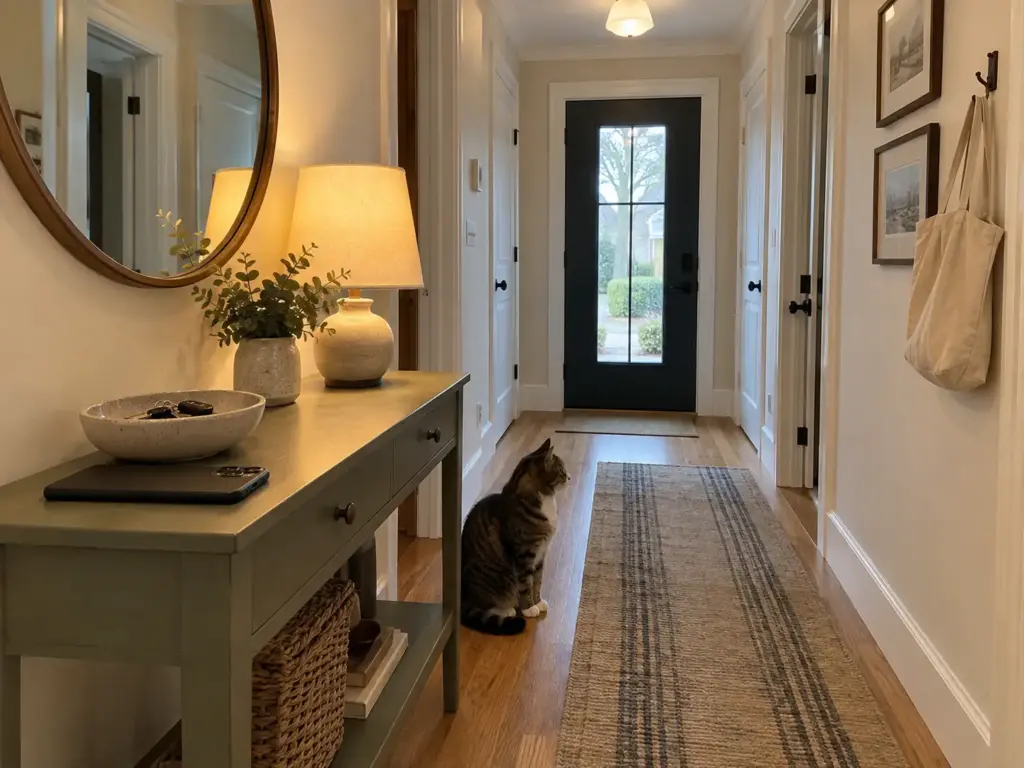
This article stops there on purpose, and so does any change to the number. The neighboring piece on when shedding itself stops being normal covers where ordinary hair loss ends.
What Pushes the Number Up, and the Ceiling That Caps It
Brush more and the sofa looks the same, or brush less and it fills up inside a week: either way, the number has moved under you. Two things push it up, the season and the cat’s age, and one thing caps it.
Shedding season, and the indoor cat that has none
VCA describes the heavy sheds as coming in late spring and in fall. The cat on your sofa follows a flatter curve, and VCA Animal Hospitals’ guide to grooming and coat care says that cats living in homes often shed undercoat and guard hairs at low levels “all year round.” Why a heated, lit apartment flattens the season is the subject of a separate piece on why indoor cats shed all year.
So an apartment cat does not need a seasonal calendar. He needs the same calendar with a temporary bump. When tufts start collecting along the baseboards in spring or fall, add one session a week; when the comb runs clean at the old number for two weeks in a row, drop back. But the bump is smaller than it looks from the baseboards, and the article on whether cats shed more in summer explains why the hair seems to move around the apartment more than it increases.
A senior cat usually needs gentler and more frequent sessions
GoodRx notes that older cats may benefit from frequent, gentle brushing. Even a short coat can need more help as the cat gets older, which turns a once-a-week cat into a twice-a-week one without anything else changing. Gentler means a softer tool, shorter passes, and brushing him where he already lies (his own bed, the warm end of the sofa) instead of lifting him onto your lap.
Why an older cat has stopped grooming himself is a question for the vet, not for the brush. Once that call has been made, the job at home is the same as for any cat: more sessions, each one short enough that he stays relaxed through it.
The ceiling: when more brushing stops helping
There is an upper limit, and the sources that mention it point to the same sign: skin that looks irritated. GoodRx adds that the pins of a slicker can be rough on a cat’s skin. If the skin looks red or sore after a session, stop and call your vet without trying to work out the cause. Short of that, the rule is mechanical: keep the bristles in the hair rather than on the skin, and don’t go back over the same patch again and again.
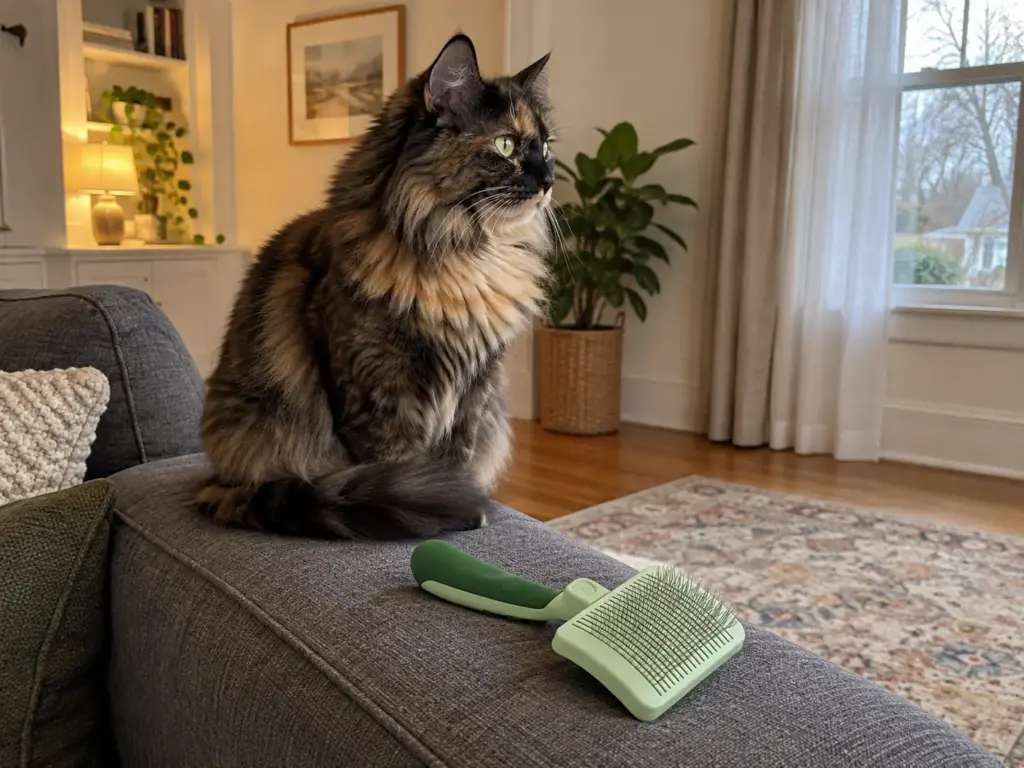
In the high weeks, the free move is one extra pass with your hand or the damp glove rather than a harder tool. For a long coat that genuinely needs a daily brush, the slicker is the type most people reach for, and the Coastal Pet Safari Cat Self Cleaning Slicker Brush earns its spot with a release button that pushes the collected hair off the pins in one press.
A daily session survives when the cleanup is quick. Its weak point is the same steel pins that make it work. A buyer in the Amazon reviews warns to keep them on the fur and off the skin, and GoodRx makes the same point about slicker pins in general.
Which is where the obvious pick stops being obvious. If your long-haired cat pulls away the moment the pins touch him, the rubber brush from the short-coat section becomes the daily tool, and the slicker drops to a weekly pass on the thickest parts of the coat. Less hair per session. More sessions he stays for.
A Comb Test Tells You Whether Your Number Is Enough
You brush on schedule and still have no idea whether the schedule is working. A comb settles it in one pass, and it measures the coat instead of your good intentions.
The four places tangles start, and a comb that has to pass
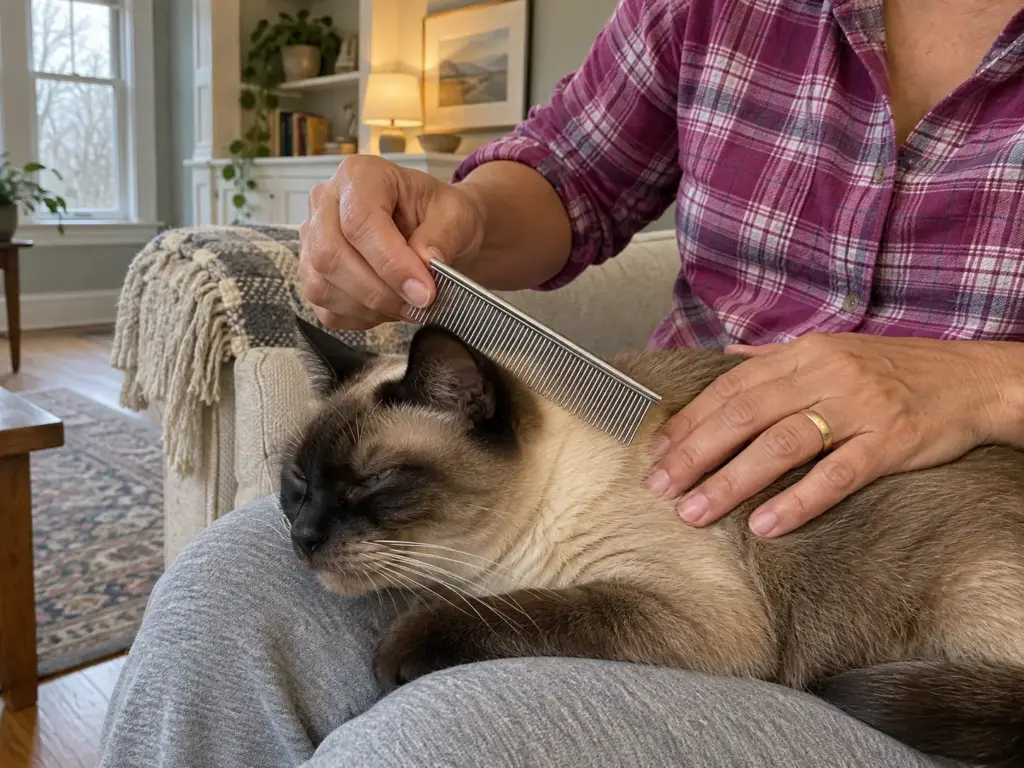
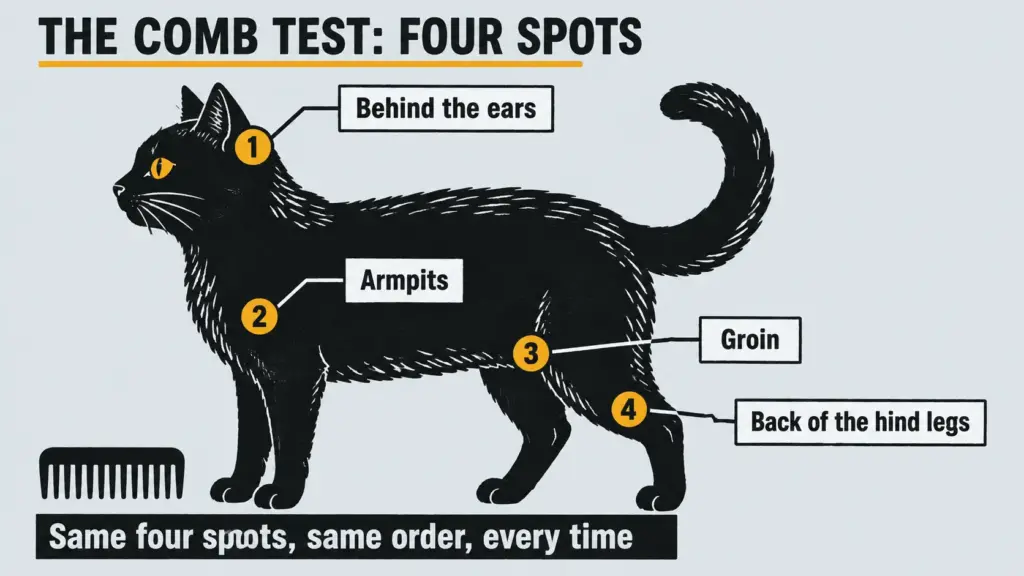
Tangles start where the coat rubs and folds: behind the ears, in the armpits, in the groin, and along the back of the hind legs. VCA, GoodRx and International Cat Care all name the same spots, and they are your test.
Run a comb slowly through each one, from close to the base of the hair out to the tip, without pressing into the skin. If it slides through all four without catching, the number you use is enough. If it snags, the number is short, even when the coat looks smooth from across the room.
Any comb works for the test, including one you already own. If you are buying one, a steel comb with two tooth spacings covers both coats: the PETTOM Steel Grooming Comb is 7.5 inches long with a coarse end and a fine end, so the same tool runs the test on both cats in a mixed house. Some buyers on Amazon report teeth bending after a few uses, and some say it is bigger than they expected.
Run the comb through the four spots in the same order every time (ears, armpits, groin, back legs) and jot down which ones caught, once a week, in your phone’s notes. After a month you can see whether one spot always snags, which means that spot needs attention rather than the whole cat needing more sessions.
Reading the result: raise it a notch, or leave it
A clean pass at all four spots means your number holds. Leave it alone; the urge to brush more because brushing feels virtuous is how cats end up at the ceiling.
A catch in one spot calls for a targeted fix, not a new schedule. Add a short pass on that spot alone, or fold a quick daily look into petting (a look at the armpits, groin and the backs of the ears is not a session). Catches in two or more spots, or a comb you have to tug, mean the band is wrong: move up one step on the ladder from once a week to twice, to every other day, to daily. Then hold the new number for a full week before you test again, so you are judging one change at a time.
A tangle already pulled tight against the skin is a different situation. Combing harder is what teaches a cat to leave the room when the comb appears, so leave that one for your vet or a groomer and keep testing the rest of the coat.
The second signal: where the hair ends up
The comb is the precise test; the apartment is the slow one. Pick a single surface the cat uses every day, the throw on the sofa or the blanket at the foot of the bed, and look at it on the same day each week. More hair on the sofa throw after a week at your current number says the number is short. The same amount or less says it holds.
In a small apartment that one throw works as a meter, and it agrees with the comb more often than not; when the two disagree, trust the comb, because a throw also collects whatever the season is doing.
When the Cat Gives You One Minute, Brush in Pieces
One owner in r/CatAdvice describes “sneak attack” brushing that turns into a sword fight. The cat has the better argument. A session sprung on him without warning is one he gets to end, and he ends it with claws. The weekly floor does not have to arrive in one piece.
Fewer, shorter, more often
International Cat Care’s advice is to set smaller goals for each session, goals your cat can easily tolerate, and to stop if grooming turns into a struggle. Another owner in the same thread describes a cat with “1 min worth of patience.” Over a week, seven one-minute passes add up to more brushed coat than a single session that ends at the second stroke, and every one of them finishes before he decides he is done.
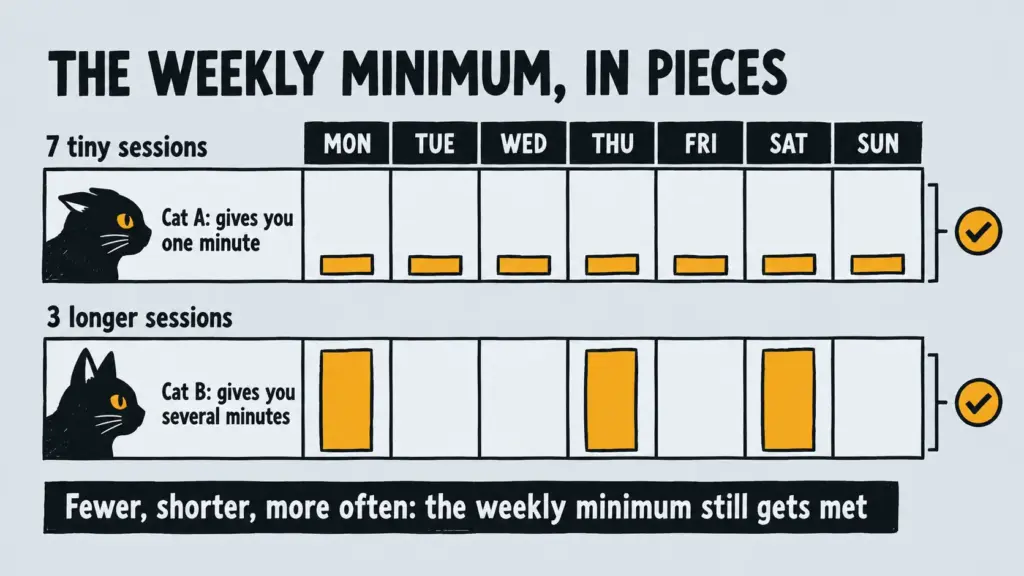
The usual advice to give your cat “one good brush a week” assumes a cat who stays put. For the one-minute cat that session never happens, so the better plan is a session count instead of a session length. Your job during each minute is to watch for the end before it arrives: International Cat Care names a sharp turn of the head toward the brush and a sudden burst of self-grooming as the signals. Stop there, on your terms, and never restrain him to finish the stroke; the next minute tomorrow starts calm.
Play first, brush second, food last
The order that keeps coming up among owners runs play, then brush, then feed. One owner puts it simply: play first, brush once the cat is tired, then serve the meal. Feed him first and he has what he wanted from you, so the brush is just an interruption between dinner and his nap.
Kittens under about a year are their own case. Owners describe young cats refusing almost every session, and nothing about that needs reading into. Keep the minutes short and try again later.
Give the cat something to do while the brush works
Several owners describe the same trick for a cat who treats the brush as prey: a second brush he is allowed to bite while you use the first, which one of them calls an “emotional support brush.” Others brush during a meal, and one feeds a lickable treat slowly over the whole daily brush.
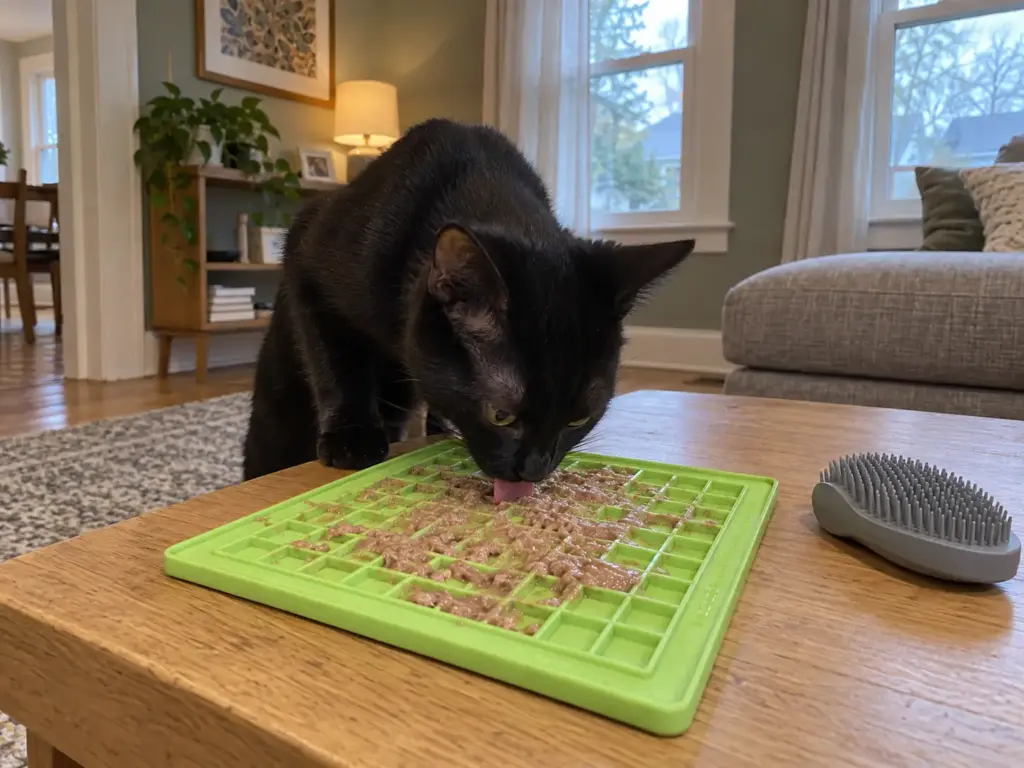
The free version takes a spoonful of his usual wet food spread thin on a flat plate. If you want the licking to last longer, a lick mat does that job: the LickiMat Classic Playdate is a flat, textured mat you smear food into, so each lick pulls up a little at a time and the cat stays planted for the length of a short session. The listing itself says plainly that it is not a chew toy, asks you to supervise, and points chewers to a tougher version. With a cat who bites through things, stick with the plate.
Brush only while he is licking, and put the brush down the moment he lifts his head from the food. He learns that the brush comes with the treat and leaves with it, so the minute ends on something he liked.
Your Apartment, Your Hair Budget, and Two Coats Under One Roof
Brush in a small living room and the hair you lift does not leave. It settles on the sofa, your sleeves and the rug, and by the weekend it looks as if you never brushed at all.
Where the hair lands, and what to put under the brush
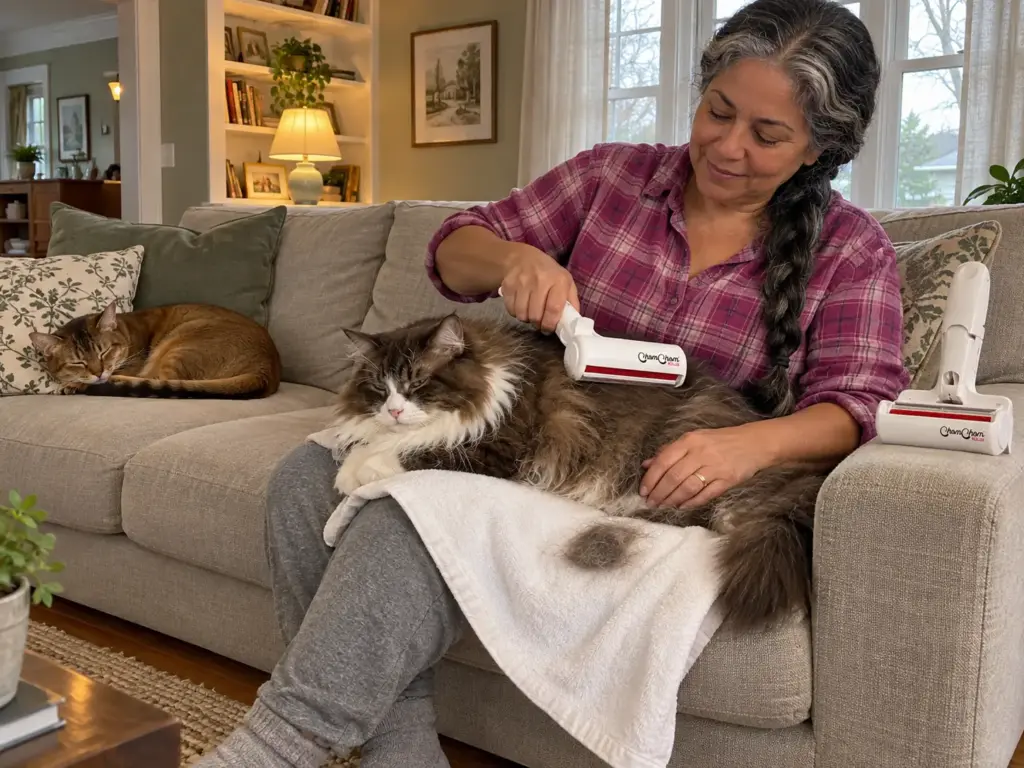
Owners in apartments describe the same few habits: a towel across the lap during the session, then a hand vacuum over the floor; brushing on the balcony during the heavy weeks so the loose hair drifts off outside; and an air purifier with a HEPA filter running in the room while they brush. All three come down to deciding where the hair goes before it goes there. Pick one brushing spot and always use it, and the cleanup shrinks to one towel and one patch of floor, an idea the piece on how to reduce shedding by fixing where the hair lands carries through the rest of the apartment.
Whatever still reaches the sofa can come off with the same damp rubber glove dragged across the cushions, which rolls loose hair into clumps you can pick up by hand. For a quicker pass, the ChomChom Roller Pet Hair Remover is a 7.5-inch reusable roller with no sticky sheets to replace. Some owners in the Amazon reviews say they had to roll it excessively to get results and that it feels cheaply made, so expect a few more passes than the box suggests.
Keep one old towel just for brushing and lay it in the same spot every time. When the session ends, fold it inward with the hair inside, shake it out over the trash or outdoors, and the floor never sees most of what came off the cat.
Two cats with different coats get two calendars
In a multi-cat home, every resource gets counted per cat rather than per household, and the brush follows the same rule as the litter boxes. In the apartment this site is written from, a very large long-haired Maine Coon lives alongside a compact British Shorthair with a dense short coat, and nothing about one brushing plan fits both: the long coat needs the daily minimum with the coarse end of a comb, while the short, plush coat does well on two weekly sessions with something soft. One shared “brush the cats on Sunday” plan shortchanges the long coat and overworks the short one.
Tolerance splits the same way. The threads are full of houses where one cat would sit for an hour and the one next to him lasts a minute, and a single household routine ends up set by the least patient cat.
Give each cat his own line on the calendar and his own trigger (one after the evening play session, the other while he licks his plate), and run the comb test on each cat separately. Two calendars sound like more work. But each one only has to suit the cat it belongs to.
One Number per Cat, and a Comb to Prove It Holds
Set each cat’s floor by his coat: at least weekly for short, once a week to every other day for medium, daily for long, with every few days as the fallback when daily isn’t possible. Let the comb overrule the calendar: four spots, a clean pass means keep the number, a catch means go up one step. And when something about the coat or the cat’s reaction to the brush changes suddenly, that goes to your vet before any number moves.
Three weeks from now, run the comb through the same four spots at the same number. If it still slides through, the schedule is holding; if it starts catching, the coat has told you the calendar needs another step.
Tonight, before you decide on anything, run a comb (or just your fingers, feeling for the tug) through the backs of his ears, his armpits, his groin and the backs of his hind legs, and note which spots catch.
Frequently Asked Questions
01Are you supposed to brush your cat every day?
Only a long-haired cat needs daily brushing, and only for as long as he stays comfortable; a short coat needs at least one session a week. If a long-haired cat refuses daily, every few days is the fallback. A sudden change in his coat or in how he takes the brush goes to your vet.
02How often should you brush a short-haired cat?
Brush a short-haired cat at least once a week, and up to twice if the coat is dense or he is getting older. Owners often settle on three or four quick passes a week. The comb test at the ears, armpits, groin and back legs tells you which number fits your cat.
03Can you brush a cat too much?
Yes, too much brushing can irritate a cat’s skin, especially with the steel pins of a slicker brush pressed against it. Keep the bristles in the hair, skip repeat passes over one patch, and if the skin looks red or sore, stop and call your vet.
04What if my cat only lets me brush for a minute?
A minute counts, so split the weekly minimum into one-minute sessions spread across the days, with play before and food after. Stop at a sharp head turn or a sudden burst of self-grooming. Short, frequent sessions cover more coat than one long fight.
05Does a senior cat need to be brushed more often?
Older cats usually do better with gentler, more frequent sessions. Use a soft tool and brush him where he already rests. If he has stopped grooming himself, that question belongs to your vet.


Leave a comment