Reduce Cat Dander in a Small Apartment With No Door to Close
Reduce cat dander in a small apartment with a damp cloth, detergent-washed covers + the air-changes formula (CADR x 60 / volume) for one room

Alfredo RamsesFounder · Updated October 30, 2026 · 17 min read

On this page9 sections
- 1Reduce Cat Dander in a Small Apartment Where There Is No Other Room
- 2Where This Article Stops and Your Doctor Starts
- 3Damp Cloth First, HEPA Vacuum Second, on Every Surface the Cat Uses
- 4Keep the Cat's Perch and Change What Covers It
- 5Measure the Room, Then Size the Air Cleaner by Air Changes
- 6The Furnace Filter and Who Owns It
- 7What a Lower Air Number Buys, and What It Leaves Behind
- 8Start With the Sill Today, Then Take Stock in Three Weeks
- 9Frequently Asked Questions
You vacuumed on schedule, washed the bedding, wiped the shelves, and you still itch on the sofa bed with the cat asleep across the room. Shutting the bedroom door only works if you own a second room. To reduce cat dander in a small apartment with one open space, treat the bed, the couch and the cat’s window perch as a single pocket of air that all three share. Below: which surfaces to wipe first, what to wash without taking the perch away from him, how to size an air cleaner with arithmetic instead of the box, and what a cleaner room does and does not buy you.
Quick Answer
With one room and one shared pocket of air, the order matters:
- Wipe the cat’s surfaces with a damp cloth, then vacuum with a HEPA filter.
- Keep the perch, cover it, and wash the cover with detergent.
- Size a HEPA room air cleaner by air changes an hour, not by the box.
- Check the furnace filter for MERV 10 or higher, if you control it.
What itches on you is for your doctor, and the cat’s skin and coat are for his vet.
Reduce Cat Dander in a Small Apartment Where There Is No Other Room
A renter who moves into a high rise apartment that still holds a previous tenant’s pet hair may keep doing regular laundry, wiping down and vacuuming, and wonder whether it is just a matter of time. The next line explained why it might not be: “The place doesn’t have any air circulation.” Swap the previous tenant for a cat who lives there today and the problem gets harder, because the source never leaves the room.

Where the allergen is: the apartment, not only the cat
According to a National Institutes of Health review of indoor allergen control, cat, dog and mouse allergens “are most commonly associated with small particles and are, therefore, readily airborne.”
The same review reports Fel d 1, the main cat allergen, in 99.9% of 831 U.S. homes where dust was vacuumed from bedroom and living-room floors and furniture. A cat or dog lived in only 49.1% of them. Half the homes had no pet at all and still had the allergen.
That is why how long a home keeps cat allergen matters more than how much the cat shed this week. The allergen sits in the dust and the cloth for weeks after the animal that made it has left, and it floats back up whenever something stirs the room. In a one-room apartment, everything that stirs it is within arm’s reach of your pillow.
Why one open room changes the advice
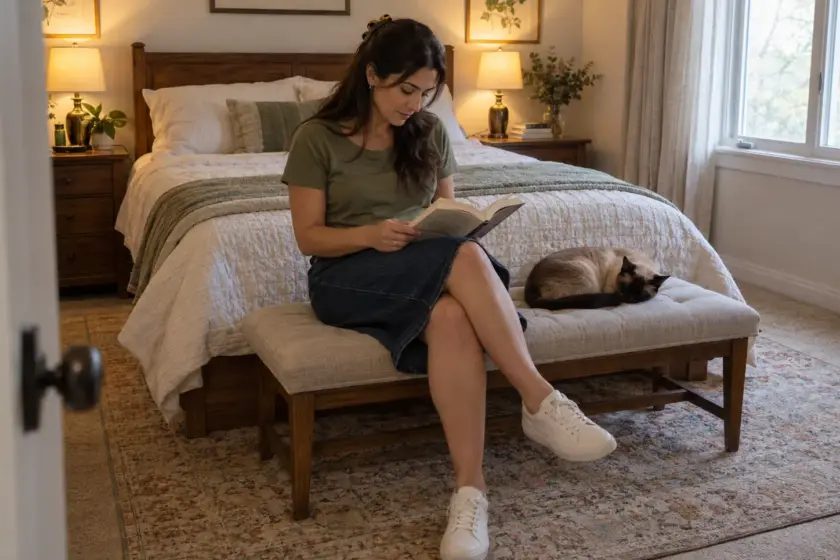
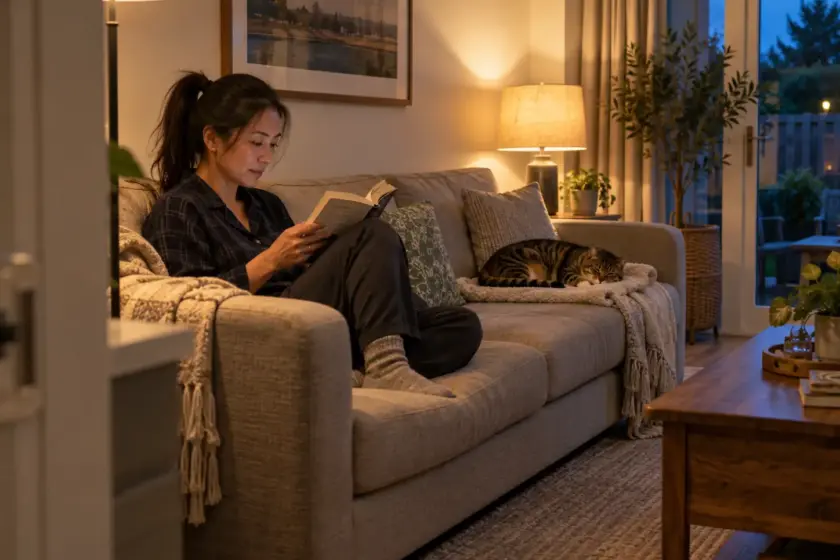
Shutting the bedroom door separates the place where you sleep from the place where the cat spends his day, and that only works if there is a bedroom. In a studio the sofa bed, the couch cushions, the cat’s window perch and the corner where an air cleaner would go all sit in the same air volume, so whatever the cat leaves on the perch reaches your bed without crossing a threshold.
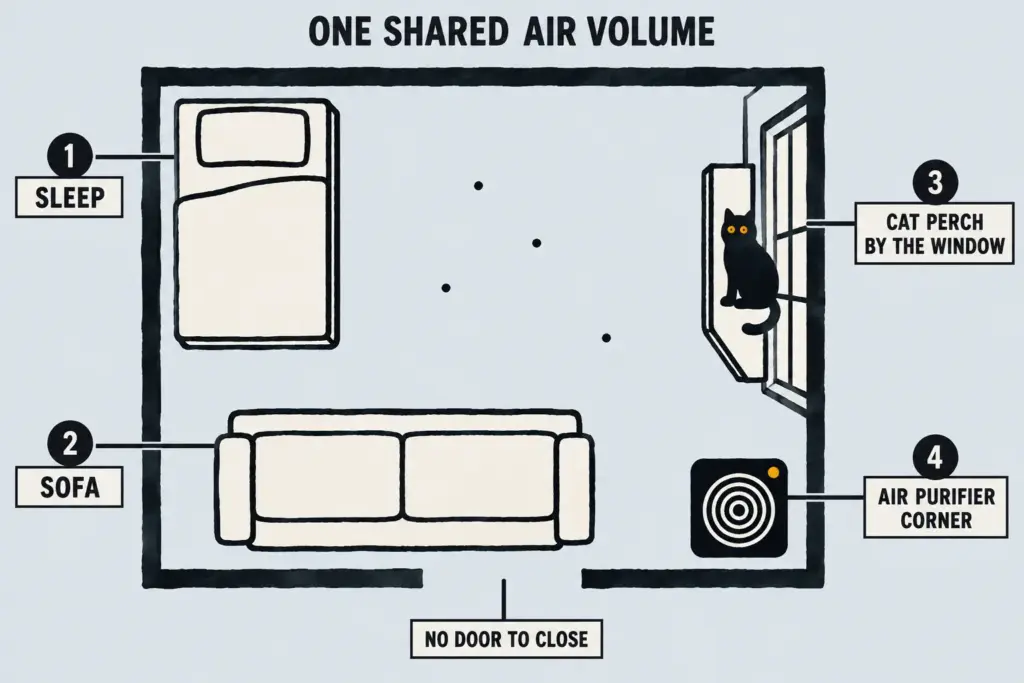
One caution on that. The trials in the NIH review put air cleaners in bedrooms and living rooms, and its cat section does not describe a trial of one open room. Treat “one room, one volume of air” as reasoning about how air moves, not as a finding, and read the rest of this page with that label on it.
What the cat is doing in that room
His spot is not a preference you can talk him out of. The window perch is warm, high, has a view, and puts him within sight of you; the corner of the sofa is soft, stable and where you sit. Those are constraints, and a cat who has found a place that meets all of them will not trade it for a spot you like better. So the plan on this page leaves his places where they are and changes what covers them and how often it is washed, which is the part of the room you can actually negotiate.
Add a second cat and the room gets a second set of favorite spots and a second blanket’s worth of fabric, all in the same air. No source gives a figure for how much that adds, so this page does not make one up. It just means every step below runs twice.
Where This Article Stops and Your Doctor Starts
What happens inside you belongs to your doctor or an allergist: whether the itch is an allergy, what to take for it, whether tests or treatment make sense, and whether you will ever stop reacting to your own cat. This page does not touch any of that. For an allergist’s own words on the home side of the question, there is an allergist’s answer from the Asthma and Allergy Foundation of America.
What happens inside the cat belongs to his veterinarian. His skin, his coat, how often he is bathed and whether he is shedding more flakes than usual are not furniture questions, and a cat whose habits shift overnight needs a vet’s eyes before you move a single cushion. And whether the cat stays or goes is a decision for your household and your doctor, not for a page about an apartment.
What this page covers is the room: the surfaces, the fabric, the air and the filter. That is the part where a few good changes make the place hold less allergen.
Damp Cloth First, HEPA Vacuum Second, on Every Surface the Cat Uses
The hair on your clothes after you clean, the “pet hairs on things” a renter described, is the visible leftover and not the same problem as the itch. Fel d 1 comes from the cat’s skin and saliva and travels on dander too fine to see, which is why a sofa can look spotless and still be holding it.
The free pass: a damp cloth on the cat’s own surfaces
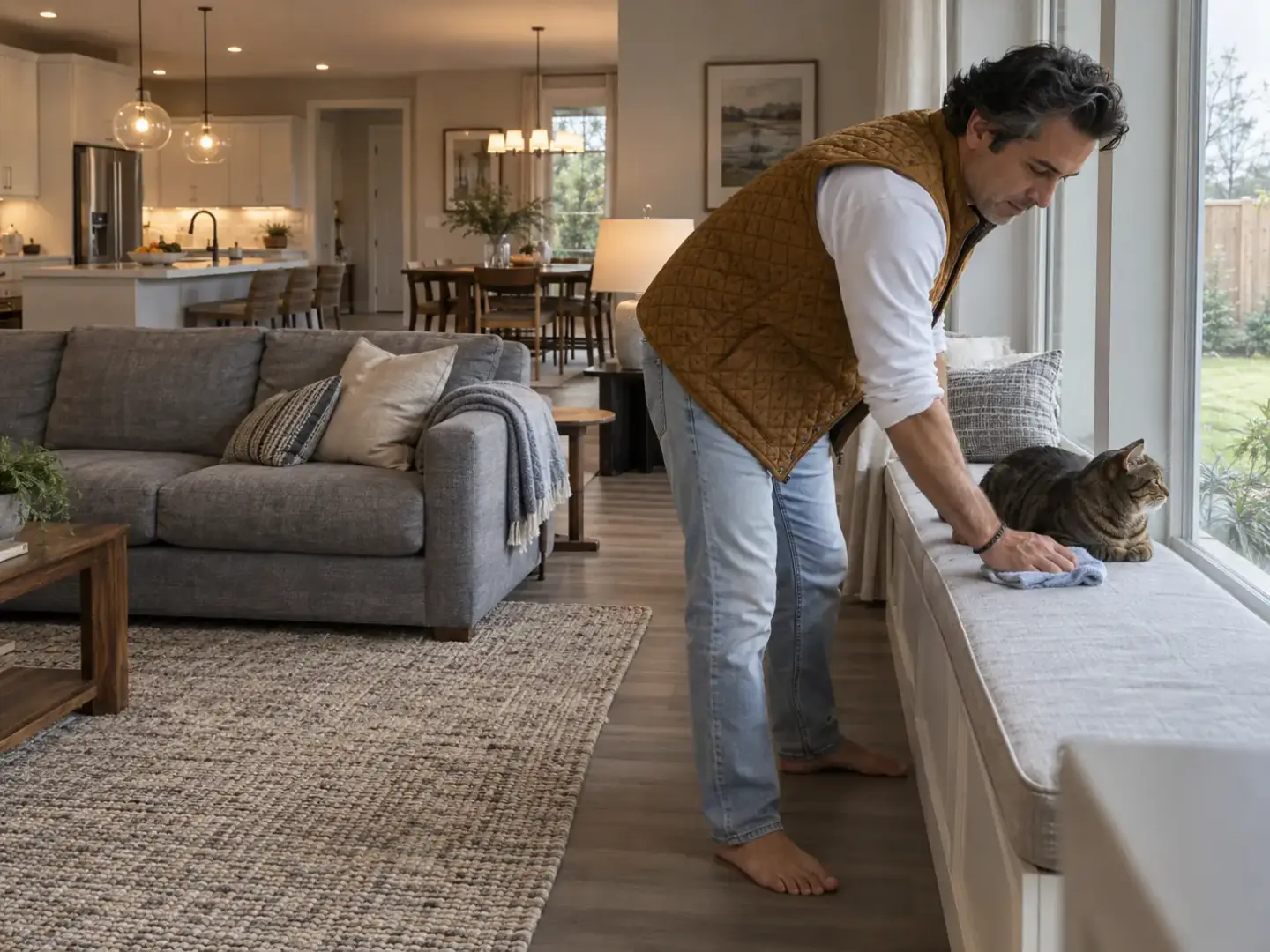
Start with a damp cloth, because it picks the allergen up where a dry broom or a quick flick of a duster sends it back into the air you are about to sleep in. Then work out where he spends his day. Wipe all surfaces anywhere the cat might have hung out, window sills and the tops of cabinets included. Those are his places, not yours, and you can clean the floor as often as you like and never touch them.
Go from high to low: the sill and the cabinet tops, the edge of the perch, the sofa arms, and the floor last, so whatever drops is collected in the same walk through the room. A hard floor takes the cloth directly. A rented rug does not get pulled up. For dust mites, the same NIH review calls removing carpets or furniture coverings not feasible for families who do not own their homes, and the logic carries over to cat allergen, so in a rental the practical question is hardwood against carpet as the lease leaves it, with the cloth doing the work either way.
Wipe from the top down in one pass: sill and cabinet tops first, the floor last. Whatever falls while you work lands on a surface you have not cleaned yet, and the floor pass picks it up.
Then a vacuum with a HEPA filter
The cloth handles what is within reach. The vacuum handles what has dropped and what the cloth could not get under. Which machine to buy is its own question, and what to look for in a vacuum in a rental covers it; the order the vacuum fixes go in covers the sequence. The only point to add here is that a HEPA filter belongs second, after the cloth.
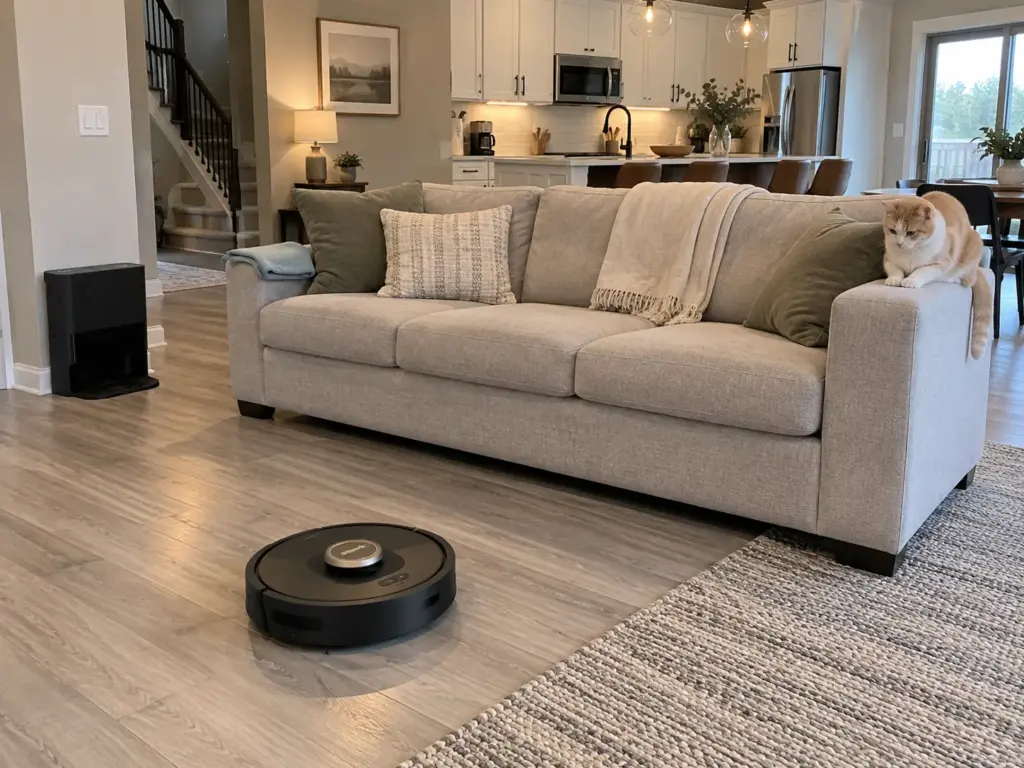
In a room with no door, a robot makes a reasonable second pass. The Shark AV2501AE AI Robot Vacuum with XL HEPA Self-Empty Base has a HEPA filter and a self-emptying base, and that base matters in an apartment you cannot close, because you are not carrying a dusty bin through the room you are trying to clean. It covers the floor and nothing above it, so it does not replace the cloth on the sill.
Two cats, one room: more surfaces, same pass
With two cats there are two sets of favorite places in one room, so the cloth walks past both before it reaches the floor. The routine does not change; the route gets longer. How often the vacuum has to run depends on the spot, and how often to vacuum with a cat breaks that down by place and by floor.
Keep the Cat’s Perch and Change What Covers It
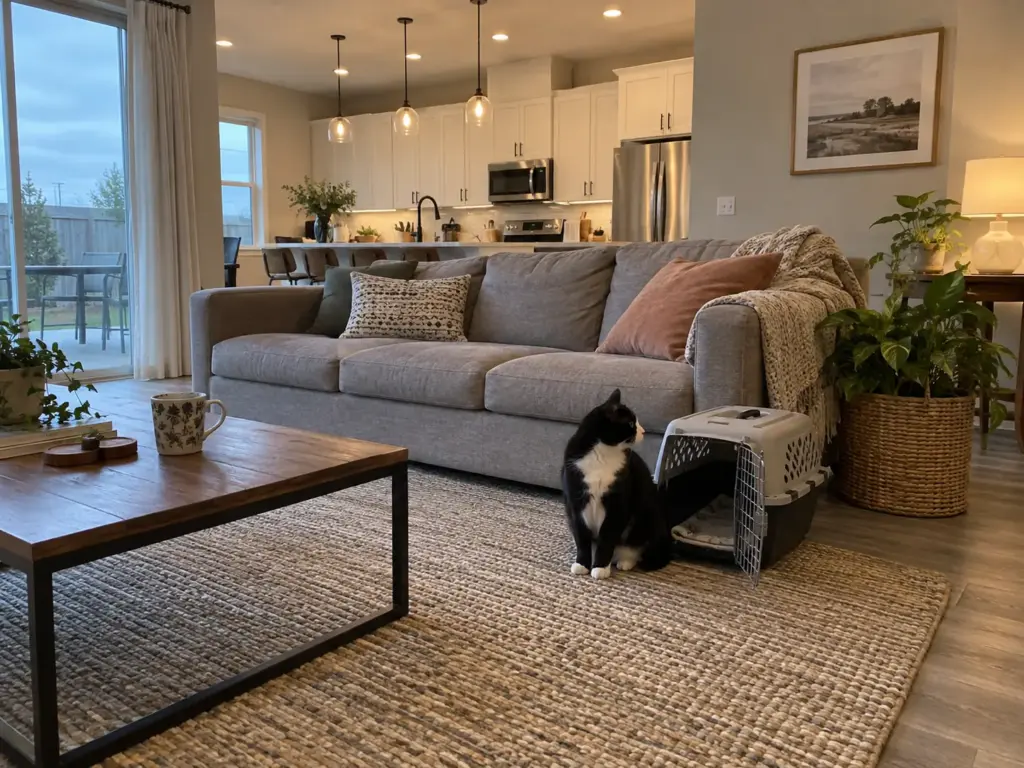
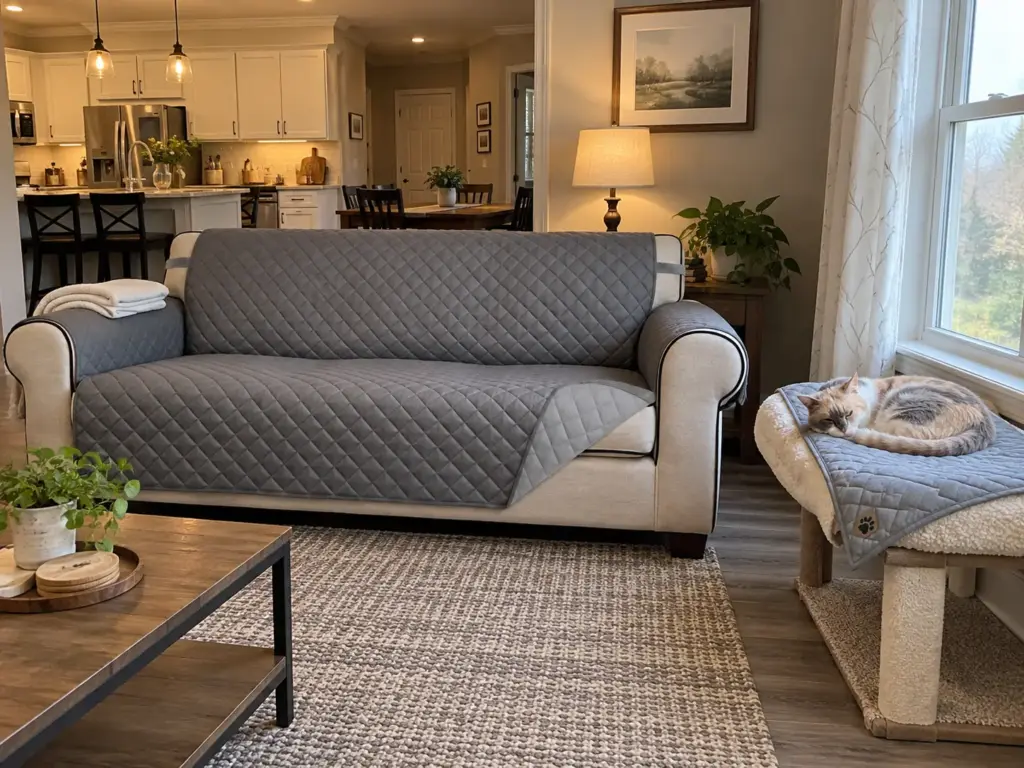
The obvious move in a rental is to remove whatever the cat sleeps on. It fails twice: the sofa is rarely yours to haul out of a rental, and the perch or cat bed is the best spot in the room as far as the cat is concerned. The better call is to leave both where they are and change the layer on top.
Why the cat’s own spot is where the allergen waits
Removing or covering cloth upholstery lowers cat allergen, according to the NIH review. The same review describes those measures as effort-intensive and costly, and says the effects may be transient. Read that as a schedule: the cloth the cat sleeps on is the allergen reservoir, and the work has to be repeated, which is why you want washable covers that go in the washing machine.
That also explains why a cat will not give the spot up. It is warm from his own heat, it smells like him, and it is where the sun lands. He is not asking for much, and he does not need to be moved.
Wash it with detergent; a dryer alone does not do the same job
In the washing study the review cites, mechanical washing with detergent removed Fel d 1 from fabric. Drying alone did a poorer job on Fel d 1, though it did fine on dog allergen. So a cat blanket that only goes through the dryer has not had a detergent wash, and the wash is the part that matters here. The review gives no water temperature, so follow the care label on the fabric and use detergent.
The dryer you already own still has a job, and it is the hair: using the dryer you already have for hair covers that, while the allergen needs the wash. And after the wash, check the sheets, because cat hair that survives the bedding wash is a separate problem with its own fix.
Shared building machines add one more wrinkle. Pet hair can also end up on clothes from the building’s shared laundry, so run the cat’s blanket by itself and wipe the drum before the next load goes in.
The sofa cover, and the cat’s blanket on the perch
The sofa is where the allergen waits for you, and a rented sofa does not go anywhere. What does go in the wash is a cover. The PureFit Reversible Quilted Sofa Cover in the 66 inch size is aimed at a two-seat sofa and is machine washable at 30 °C (86 °F) or cooler, no bleach. Amazon’s own summary of the reviews says others report it slips off when sitting down, and the seller describes it as water-resistant, not waterproof.
If your sofa’s fabric is the problem rather than the cover’s fit, pet hair off a rented couch, fabric by fabric is the place to decide what the cover has to grip.
For the perch, skip the replacement and lay a blanket over it. The PETMAKER Waterproof Pet Blanket in gray comes in 50 by 60 inches, which is enough to cover a cushioned window perch with room to overhang, and the listing says to wash it in cold water and tumble dry on low. No repeated complaint about it turned up in the reviews that could be read. The risk is the cat’s vote, because a cat takes days to accept or reject a change in his bed, so give it that long before you judge it.
The blanket goes on top of the perch, never in its place. With two cats, give each his own or share one, and plan for two washes.
Measure the Room, Then Size the Air Cleaner by Air Changes
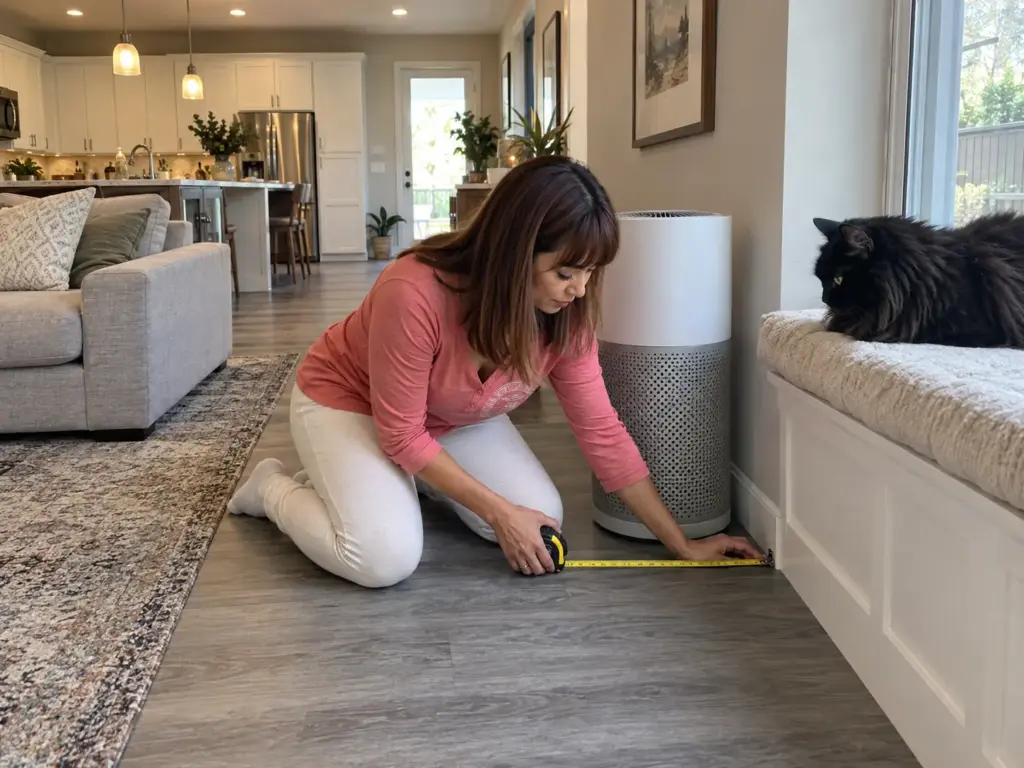
The box on a room air cleaner states a coverage in square feet, and that number leaves out the one measurement that decides how the air moves: how tall your ceiling is. A cleaner rated for a room the size of yours may still be slow in a room with a high ceiling, and square footage alone will not tell you.
The one number to work out: air changes an hour
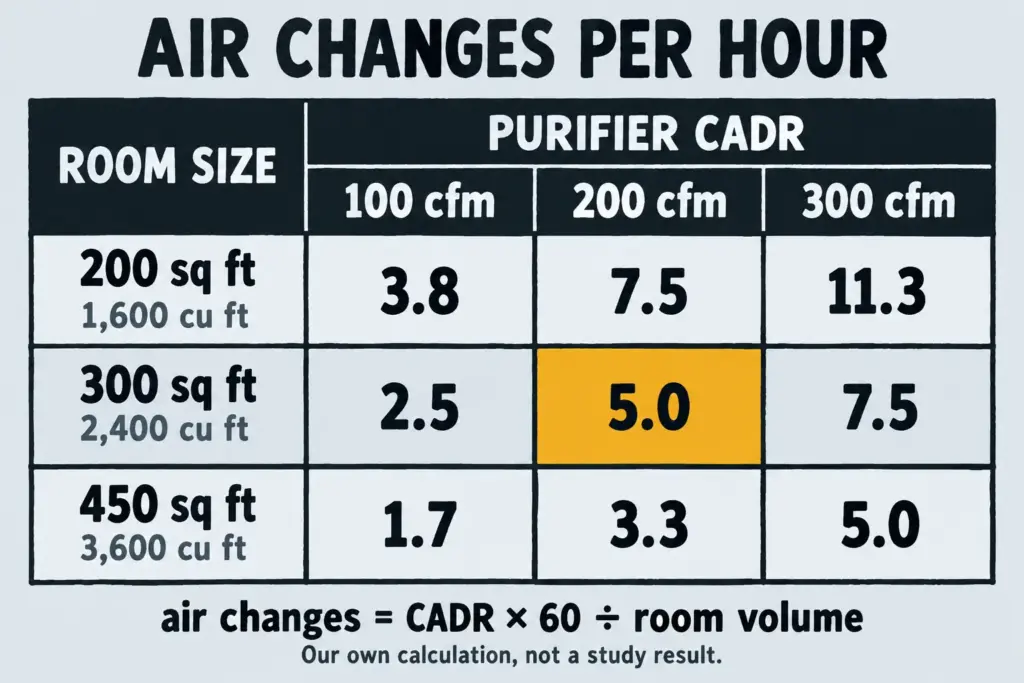
Air changes an hour (air changes per hour in the trade) is how many times the cleaner pushes the room’s whole volume of air through its filter in 60 minutes. The formula is the cleaner’s CADR (the clean air delivery rate, printed on the box in cubic feet a minute, or cfm) times 60, divided by the room’s volume in cubic feet. Take a 300-square-foot room with an 8-foot ceiling: that is 2,400 cubic feet. A cleaner rated at 200 cfm gives you 200 times 60 divided by 2,400, which is 5 air changes an hour.
This is our arithmetic, not a study. The NIH review gives no target number of air changes for cat allergen, so treat the result as a way to compare cleaners and rooms against each other, not as a pass mark.
The filter type is a separate matter. In the allergist’s answer on HEPA filters, the Asthma and Allergy Foundation of America’s allergist says: “Use a high-quality, high-efficiency particulate air filter (HEPA) to help remove airborne allergens.” The category to look for is a HEPA air purifier sized for the room. Which model is a separate decision, and this page stays with the category.
Where it goes when the whole room is one air volume
Most people tuck an air cleaner into a corner away from the foot traffic. In one room that corner may be the worst place, because the air that matters travels between the perch and the bed. Putting the cleaner somewhere that stretch of air passes through makes more sense, though that is a hypothesis about placement, not a result from any trial.
A renter will like that this is a plug-in. It needs no drilling, no opening a wall and no landlord’s permission. The cost shows up at night, because a cleaner running on the setting that does the work is a sound you and the cat will both hear in a room neither of you can leave. The setting you can live with all night beats the stronger one you will switch off after the first evening.
A trick worth trying is to run a purifier with a charcoal filter first, because it may help you figure out where the worst areas are to concentrate on. That is practical advice and not a proven method, but it takes only an afternoon.
Run it before you trust it
Run the cleaner for a few days on the setting you intend to keep at night, since the arithmetic above assumes it is on. A cleaner that goes off to sleep delivers zero air changes for those hours, and the number on paper does not know that. After a few days you will know whether it is loud enough to be switched off, which is a better test than any rating.
Write three numbers on the side of the air cleaner’s box: the room’s square feet, the ceiling height and the cleaner’s CADR. The next time you move apartments or replace the unit, the air-changes calculation can be redone from the box in a minute.
The Furnace Filter and Who Owns It
The HVAC filter in a forced-air system is the one place where the whole apartment’s air passes through something on its way back to the vents. ASHRAE guidance, as the NIH review reports it, says a MERV filter rated 10 or higher works best for removing pet dander. The review’s own modeling used MERV 12 or higher, so do not read the model’s result as a promise for a lower rating.
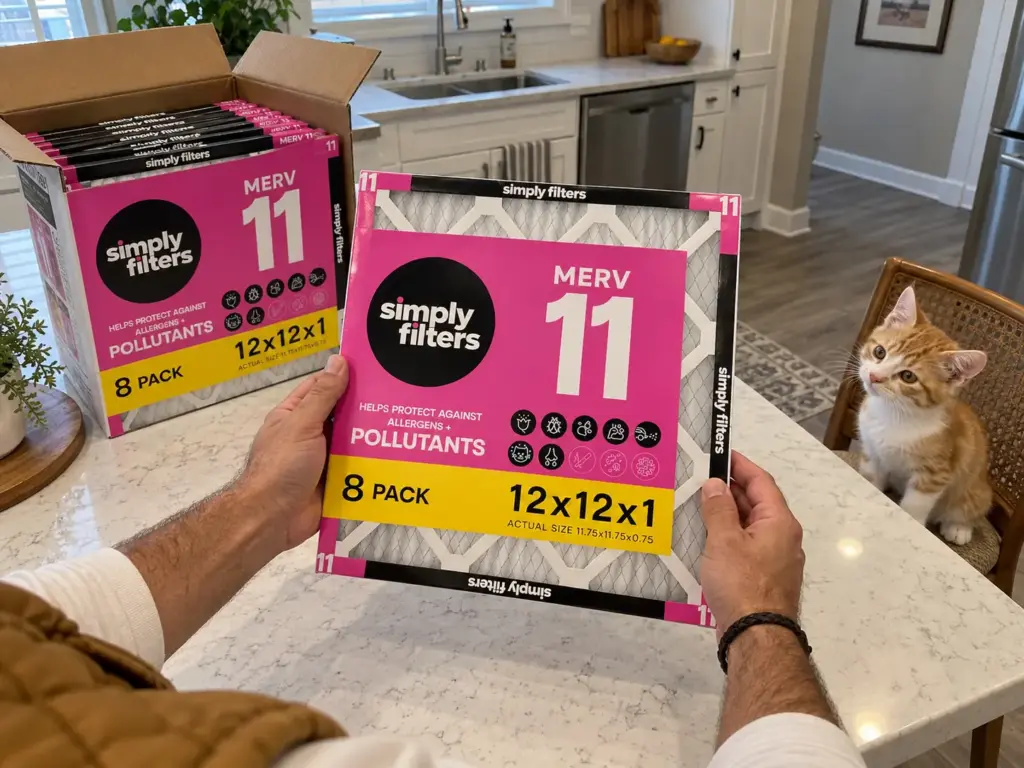
Before you buy anything, ask who is supposed to change it. In a rental the filter often belongs to the landlord. The blunt advice for a renter with a pet-hair problem is to ask the landlord for help or accommodations. The filter is an easy place to start that conversation: ask who changes it and what size the slot takes, then ask whether they would use a higher rating when they do.
If the answer is that you buy it, the Simply 12x12x1 Air Filter, MERV 11, 8 Pack meets ASHRAE’s MERV 10 minimum and the listing names pet dander. The size on the label is nominal; the listing gives the real size as 11.75 by 11.75 by 0.75 inches, so a slot built for a full 1-inch filter may not hold it. It also sits below the MERV 12 line in the review’s model. If your slot is 14 by 14, the matching size is the Simply 14x14x1 Air Filter, MERV 11 in the same pack.
And if your apartment has no central filter (a radiator, a mini split or a window unit), this section does not apply, and you can move on. Even where it does, a furnace filter does not solve a room’s allergen on its own; the budget version, cleaning the air vents and dryer filters with a vacuum, is a good first step because it requires no purchase.
Read the size printed on the frame of the old filter before you order. “12x12x1” is the nominal size, and the real filter measures a little under that.
What a Lower Air Number Buys, and What It Leaves Behind
You bought the cleaner, the number on it fell, and you still itch. The trials in the NIH review explain how both can be true.

What the trials found when the air got cleaner
In the trials in the National Institutes of Health review, the picture is mixed. In a trial with 36 children, HEPA cleaners in the bedroom and living room lowered the cat allergen in the air, while the dust on surfaces barely changed. In a trial with 35 adults, a HEPA cleaner made no difference to the allergen in settled dust or to symptom scores. In a trial with 30 adults, adding a HEPA cleaner to frequent vacuuming changed neither the settled dust nor the air compared with vacuuming alone.
Read together, the air number can fall while the dust on the sofa stays put. What a cleaner buys is a cleaner airborne number, and not a clean room.
The measures the review describes are removal measures: washing the fabric, wiping damp, filtering the air. It describes no neutralizer spray.
Why the cat’s spot still decides the week
The dust on the perch and the sofa is what the cleaner cannot reach, and it is where the cat spends his day. That is why the cloth on the sill and the wash on the blanket carry more of the week than the machine in the corner, and why the air cleaner works best as a partner to them and not a replacement.
Keeping it going past week three
A cat accepts or rejects a change in his bed within days. A human routine, left to memory, tends to slip by the third week. So attach each job to something you already do: wipe the perch edge when you wipe the counter, put the blanket in with the next load, and check the air cleaner’s filter against its maker’s schedule on the day you swap the furnace filter. An hour-by-hour timetable for living with the cat lays out where each of these fits in a day.
Start With the Sill Today, Then Take Stock in Three Weeks
Three things carry this page. In one room, the cat’s own surfaces get a damp cloth before the floor gets a vacuum. His perch stays, and only its cover and its wash change. And air changes an hour is a number you can calculate for your own room, which buys less than the box suggests.
In three weeks, look at two things: whether the cat has kept the blanket as his and whether the weekly wash still happens without you having to remember it. If the itch has not moved by then, that goes to your allergist, not to another purchase.
Today, take a damp cloth to the window sill, the tops of the cabinets and the edge of the perch, from the top down, with the floor last. That is the first pass in a room where nobody can leave.
Frequently Asked Questions
01How do I keep cat dander to a minimum in a small apartment?
Wipe the surfaces the cat uses with a damp cloth first, then vacuum with a HEPA filter, and wash the fabric he sleeps on with detergent. The perch stays where it is; only its cover and its wash change.
02Do air purifiers get rid of cat dander?
A room air cleaner with a HEPA filter lowers the allergen floating in the air, but not what has already settled into fabric. In the trials in the NIH review, dust and symptom scores barely moved, so it is one part of the work.
03Will I eventually stop being allergic to my cat?
Whether you will stop reacting to your cat is a question for your doctor or an allergist, and this page does not try to answer it. A cleaner apartment changes how much allergen is around you; whether your reaction changes is for them to say.
04What neutralizes cat dander?
The route the NIH review supports is removal: washing the fabric, cleaning damp and filtering the air. Its evidence does not rest on a spray, so start with the cloth, the wash and the filter.
05Is it just a matter of time for the cat hair and itch to go away after cleaning?
Hair on your clothes and allergen in the dust are different problems: the hair is what you see, and the allergen is what sits in the cloth and the air. Expect weeks, not days, and a routine that holds. If the itch stays, that goes to your doctor.
Leave a comment