What to Put Near a Litter Box for Smell, and What Not To
What to put near a litter box for smell [ranked]: charcoal at 90-day swaps, baking soda under the litter + 6-12in purifier clearance.

Alfredo RamsesFounder · August 22, 2026 · 18 min read

On this page7 sections
The box gets scooped every morning. The room still smells by six. So something goes next to it, usually a scented candle, a plug-in air freshener, or an odor eliminator spray with a cat on the label, and a week later the room smells like lavender sitting on top of ammonia.
Most of what people put near a litter box is aimed at the human’s nose, and the cat is the one who has to stand still in it twice a day. This is what actually belongs there, how far away it goes, how much of it you need, and the short list of things that quietly make the problem worse.
Quick Answer
In order of value, not in order of price:
- Move the box out of the cabinet or closet first. Free, and the biggest change here.
- Put an unscented activated charcoal pouch beside it, replaced every 90 days.
- Sprinkle a thin layer of baking soda under the litter, not on top.
- Add an unscented liner so the box’s own plastic stops holding odor.
- Buy a carbon air purifier only if the first four didn’t finish the job.
What Actually Belongs Next to a Litter Box
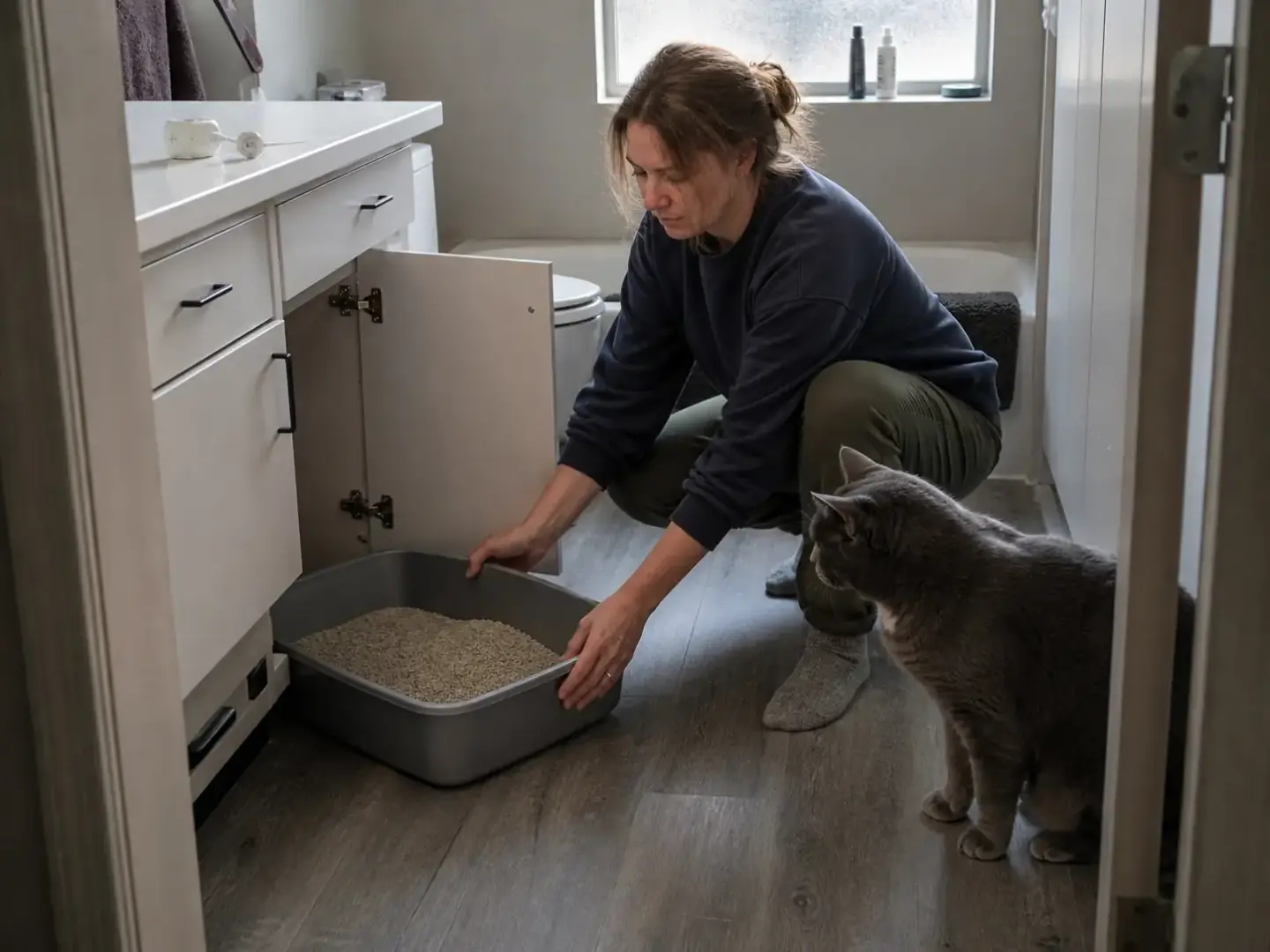
Before anything gets bought, there is a free move that outperforms the entire list below it, and almost nobody makes it because it works against the instinct. The box is probably tucked into a cabinet, a hall closet, or a corner behind a door, because that is where a box you would rather not look at goes. That enclosure is exactly why the room still smells after you clean, and it is worth knowing why the smell comes back after you clean before you spend a dollar on it.
Ammonia needs some air to disperse. Take it away and the concentration climbs in a pocket of trapped air until something opens the door, and then the whole reservoir arrives in the hallway at once. A ventilated area needs less help than an enclosed one, and an enclosed space needs more air turnover than an open room, not less. Litter box placement is doing more work here than anything you can buy.
Now the objects. Four are worth having, and only one does real chemical work.
- Activated charcoal — the one object that removes ammonia instead of covering it. Buy this first if you buy anything.
- Baking soda — the same active ingredient as most branded litter additives, in a box you probably already own.
- An unscented liner— stops the box’s plastic from absorbing odor permanently, which is why a scrubbed box can still carry cat urine smell after a rinse.
- A carbon air purifier — conditional, expensive, and last. Section five covers when it earns its place.
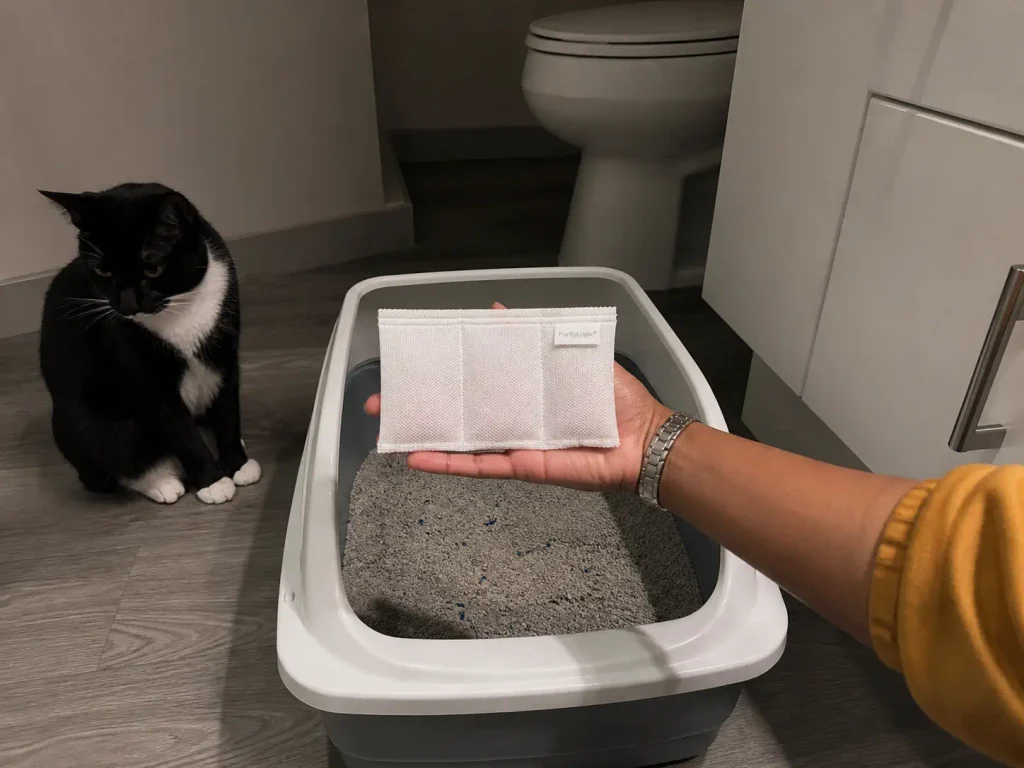
Activated charcoal is different from everything else sold for this, and the mechanism is the reason. It works by adsorption, which is not a typo for absorption. Air passes over a surface riddled with microscopic pores, and the ammonia molecule physically bonds to that pore surface and stays there. Captured and held, not diluted and not covered. That is the whole argument between charcoal and every scented product in the aisle. The PurifyLogix Activated Charcoal Litter Box Pouches are the ready-made version of that mechanism, six coconut-shell charcoal satchels you set beside the box with nothing to measure out. The catch is that pre-portioned convenience costs more per use than the raw material. If you would rather portion it yourself, Kitty’s Odor Stopper is the same active ingredient in a four-pound bulk bag, cheaper across a year but with an open bag of black granules to store and dose.
Baking soda is the budget entry, with one condition attached. Thin layer under the litter, not dumped across the top. On top, your cat digs through a cloud of powder and you get it on the floor within a day; underneath, it sits where liquid reaches it. Read the ingredient list on almost any commercial cat litter deodorizer and sodium bicarbonate is doing the work, which makes the branded version mostly packaging and a cat on the front.
The liner is the one people skip, and it explains a specific frustration. You scrub the box, rinse it, dry it, refill it, and within an hour it smells faintly like a litter box again. That is not the litter.
Plastic is porous enough that months of urine contact leave the box itself carrying odor, and no amount of scrubbing pulls it back out. A liner puts a disposable barrier between the two. Get an unscented one, for reasons the third section will spend some time on.
How Far “Near” Actually Is
Every article about this says place it near the litter box and moves on to the next bullet. Near is doing a great deal of work in that sentence. Six inches and six feet are both near, and only one of them does anything, so here are the numbers nobody publishes.
The Charcoal Pouch, and How Many a Room Needs
One pouch is sized for the air immediately around one box. It is not a room treatment and was never designed as one. Set it within a foot or two of the box, slightly above rather than on the floor beside it, and it works on the air actually carrying ammonia. Put it across the room because that is where the shelf happens to be, and it is adsorbing your living room.
The part that costs people money is the scaling. Two boxes in the same room is two pouches, not one bigger one, because adsorption is a surface-area problem and surface area does not travel. A single pouch covering two boxes is not doing half the job at each. It is sitting near one of them.
The Purifier, and Why the Floor Beside the Box Is Wrong
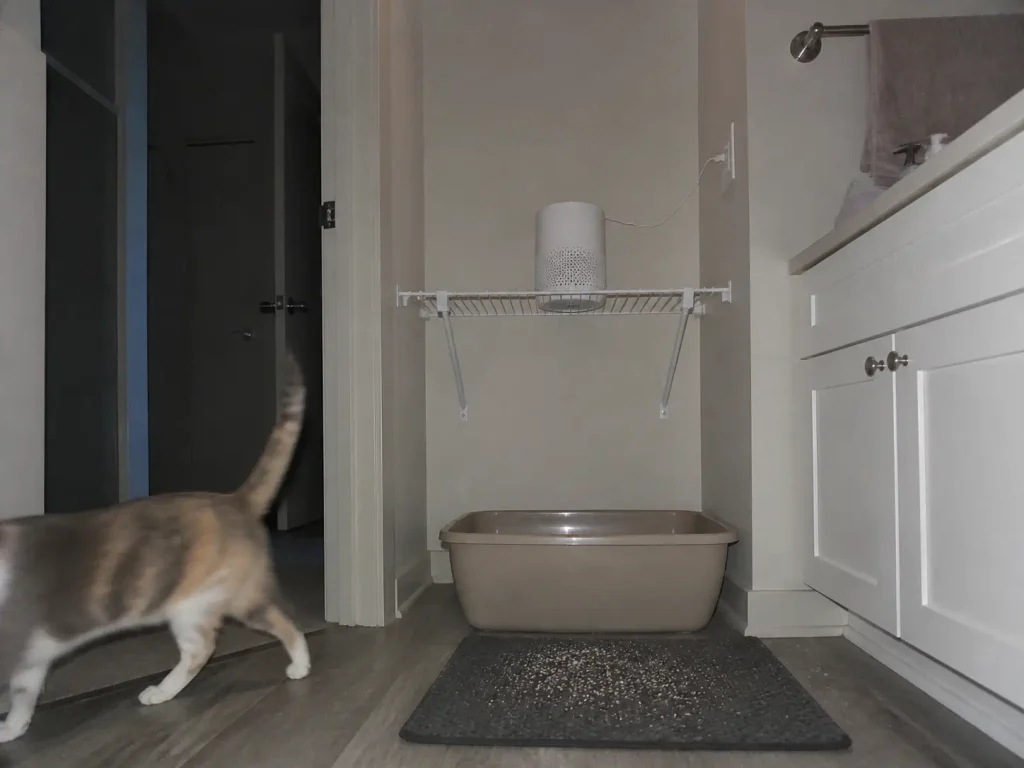
Here is the physics nobody mentions in a buying guide. Ammonia is lighter than air, and it rises. It diffuses upward rather than pooling near the floor, which means the obvious placement, a unit on the floor right next to the box, puts the intake underneath the thing it is trying to catch. Raise it onto a shelf a couple of feet up and it intercepts the plume instead of chasing it.
Elevation beats proximity, and it is free to change.
The floor has a second problem: at litter level the intake fills with kicked-out dust long before the carbon has anything to complain about.
A small purifier on a shelf above the box will outperform a bigger one on the floor beside it. Ammonia rises, so the shelf unit is filtering the air that carries the smell and the floor unit is filtering the air underneath it. Before you upgrade the device, move the one you have up two feet and give it a week.
Clearance, Which Is the Number That Gets Ignored
A carbon filter unit needs 6 to 12 inches of open space around its intake and its exhaust. Wedged into the corner behind the box, which is exactly where a tidy person puts it, the intake is starved and the airflow rating on the packaging becomes fiction. The unit still hums, the light still glows, and it moves a fraction of the air it claims.
Sizing is the other half. As one air-quality guide puts it, aim for a CADR of at least two-thirds of the room’s square footage, so a 150 square foot bathroom wants roughly 100 CFM and a 300 square foot laundry room wants roughly 200. That ratio catches people out in the direction nobody expects.
The box says large rooms, you have a small bathroom, and you assume you are covered with room to spare. But those coverage claims assume ordinary household air, not a box producing ammonia continuously behind one door with no window. The small room is the harder job.
What the Box Itself Needs
Off the wall, out of the enclosure, and not facing into a corner where the air it produces has nowhere to go. If the box is covered, all of this matters more rather than less: the hood stores ammonia inside and releases it in a burst each time the flap swings, so whatever you put nearby has to catch that burst near the opening, not tucked around the back where the air never travels.
What Not to Put Near the Box, and Why It Backfires
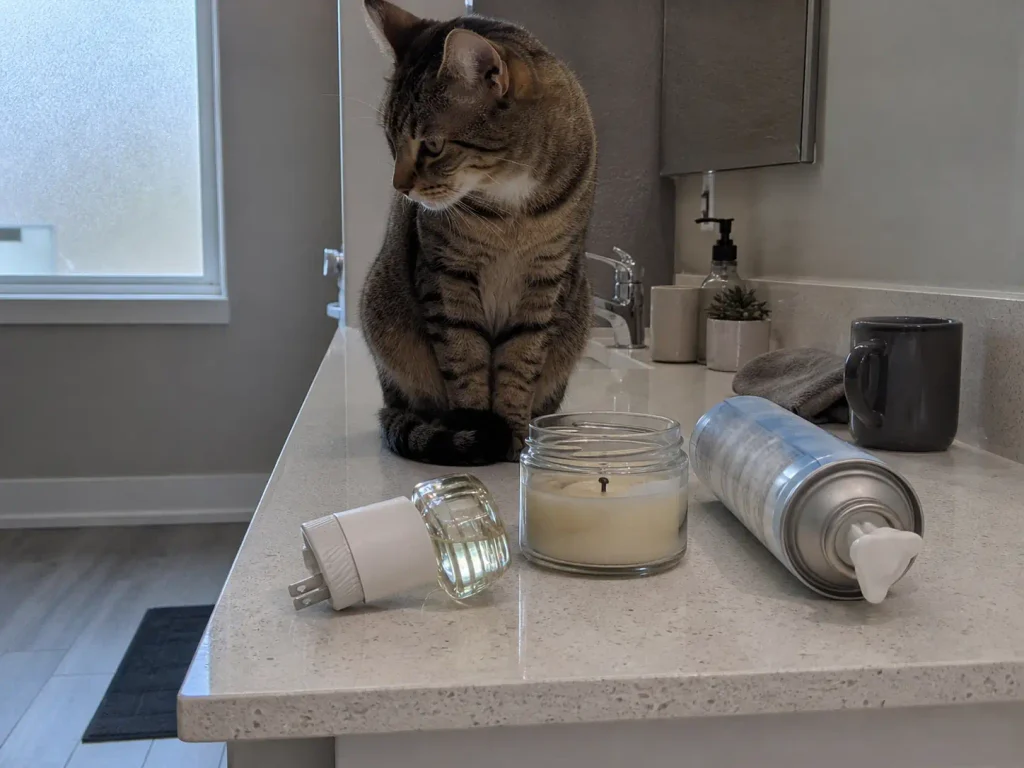
This is the section you did not come for. Somewhere near that box there is probably a plug-in, a candle, or a bottle of spray marketed specifically for litter areas, and it is a strong candidate for why the problem got worse rather than better.
Scented Sprays, Plug-Ins and Candles
Start with what these products do to the ammonia, which is nothing at all. A scented product near a litter box has never removed a single molecule of anything. Fair trade for a hallway. Much worse trade at a spot where your cat has to stand still, dig, turn around and stay put for a minute or two, with a nose nothing like yours.
This is the sharpest version of the conflict the whole topic runs on. You want a room that smells like something. Your cat needs a box that smells like nothing. Both of you are being reasonable and only one of you gets to be right, because your want is a preference and his is a constraint.
Masking is not the neutral middle option it looks like. It is a choice made against the resident.
The Chain, Spelled Out
The reason this matters more than a mild inconvenience is what happens next, and it happens in days rather than months.
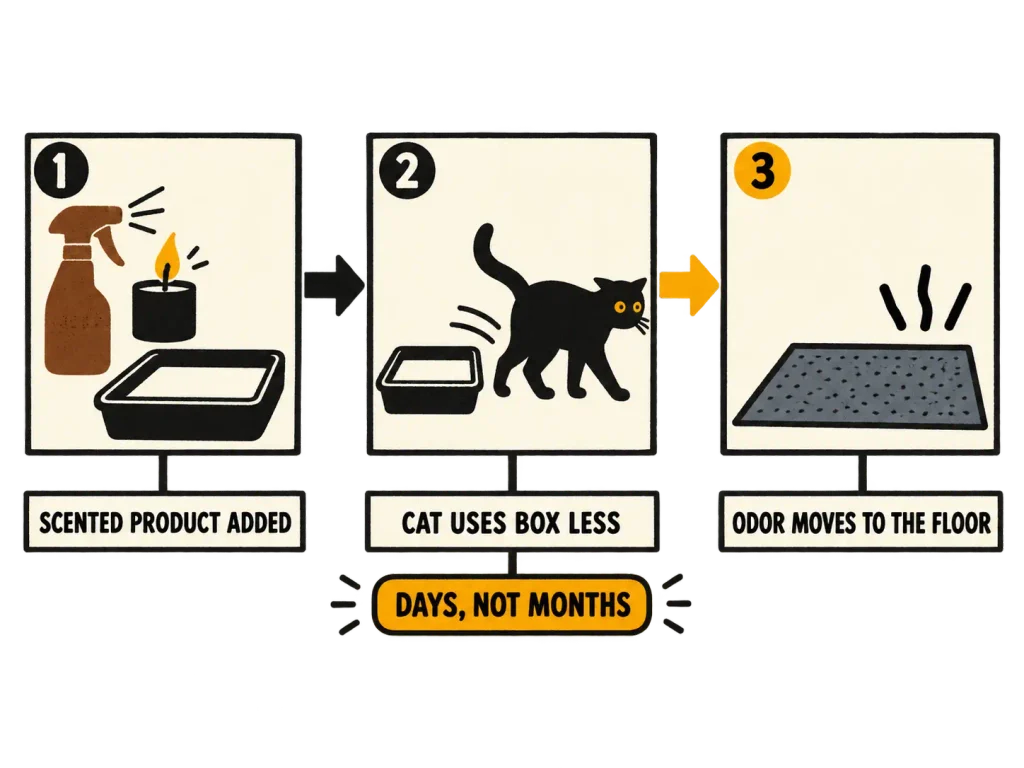
A strong new scent appears next to the box. Your cat starts using the box less, not dramatically, just a little more reluctantly and a little less often. He holds it longer, or he finds somewhere that smells like nothing, which in an apartment usually means a rug, a bathmat, or the corner of a closet.
Now the odor is in the floor instead of the litter, where scooping cannot reach it and where the residue quietly invites a repeat. You bought a candle to fix a smell and ended up with a smell you cannot scoop.
Litter threads have a phrase for the first step, boycotting the tray, and the stories follow the same shape: someone changed something near the box for the best of reasons, and the cat filed a silent objection nobody connected to it for weeks. No protest and no mess on day one, just a box getting used slightly less, which is invisible until it isn’t.
Scented Litter and Most Deodorizing Additives
Same logic, closer to the source. Cornell’s Feline Health Center notes that most cats prefer unscented litter and boxes without hoods, and that any change in scent should be introduced gradually rather than all at once. An abrupt strong fragrance at the elimination site is a known trigger for avoidance. That rules out most of the perfumed additives sold next to the litter on the same shelf, and it is the reason the liner recommendation above carried the word unscented and the charcoal recommendation carried it twice.
It is tempting to file this as a soft preference, the sort of caveat you tack onto the end of a paragraph. What argues against that is how consistent the failure stories are in cat forums, and how slow they are to be noticed: the change happens in one week, the accidents start three weeks later, and almost nobody links the two. A soft preference does not produce that pattern. Box avoidance does.
Ozone generators get sold for odor and are not appropriate for a room anyone lives in, cat included. That is the whole entry.
If something scented is already sitting by the box, take it out and change nothing else for a week. Pull the plug-in and switch the litter and add a pouch on the same afternoon and you will have no idea which move did the work, or which one your cat objected to. One change, one week, then the next.
When One Cat’s Setup Doesn’t Scale
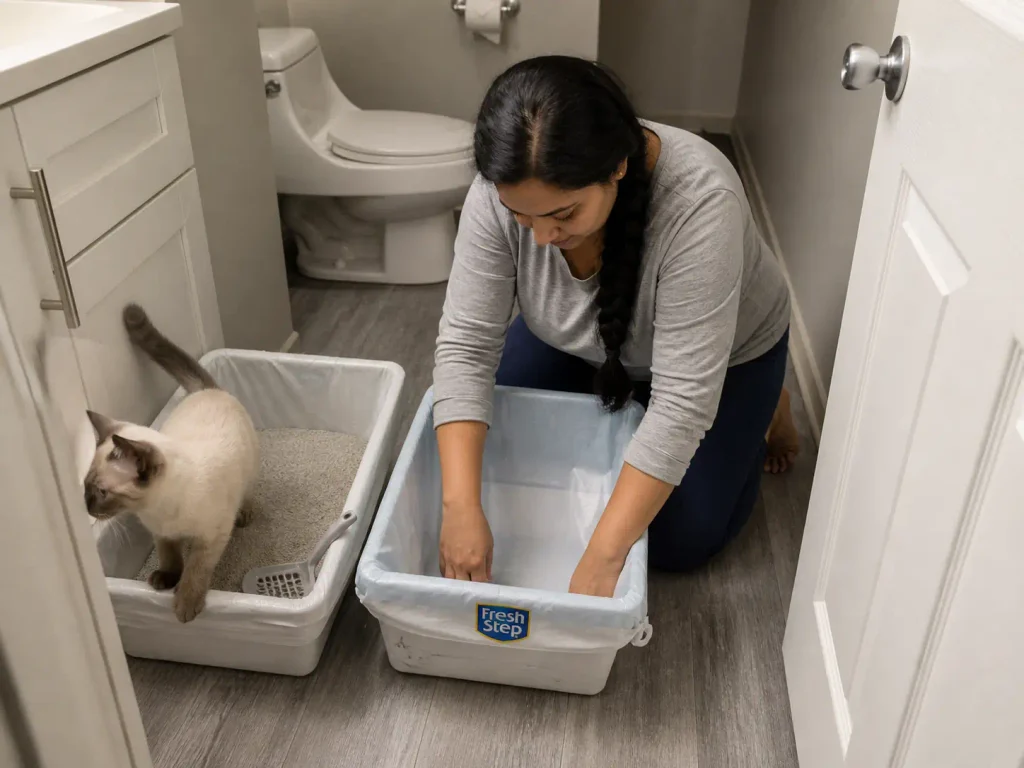
Nearly every article on this subject answers the question for one cat and one box without ever saying so. The reader in a multi-cat household, two cats and three boxes, follows the same advice, buys one pouch, puts it by whichever box is nearest, and cannot work out why the apartment still smells.
The Pouch and the Box Count
Odor absorption is per box, not per household. Same arithmetic as Cornell’s one box per cat plus one, applied to the objects that sit beside them, and it is the step everybody skips. One pouch across three boxes is not a third of the problem solved. It is one box covered and two doing whatever they were doing before.
Charcoal does not project: it treats the air that reaches its pores. Three boxes means three pouches, and if that sounds expensive, it is the strongest argument here for the bulk bag over the pre-made satchels.
The Room, Not the Box
Once several boxes share one room, the sizing unit shifts. You are no longer treating the air around a box, you are treating a room with multiple sources of ammonia smell running continuously, and that is where the CADR ratio starts to matter more than how many pouches you own. Two boxes in a 60 square foot bathroom is a genuinely hard air problem, and no object placed nearby fully solves it. Ventilation does most of the work and the objects trim the rest.
The Rental Version
One bathroom, no control over the HVAC, no spare room, and a landlord who would rather you did not modify anything. This is the most common version of the problem and the one every purifier buying guide ignores, because the answer does not involve buying a purifier.
Ranked for that situation: the pouch is the highest-value single object, the liner is second, the purifier is a conditional third rather than the opening move. The liner earns second place for a specific reason in a small space.
With more boxes and less air, the plastic takes on odor faster, and once it does, that box contributes smell even on the day you scrubbed it. Fresh Step Drawstring Litter Box Liners come unscented in a 30 by 17 inch size that fits most large boxes, and the unscented spec matters here for everything the last section said. The trade is real, though: a determined digger shreds a liner, and a shredded liner traps urine underneath, which is worse than no liner at all. If your cat digs to the bottom every time, skip them and replace the box itself more often.
Then the date problem, which multiplies. Activated charcoal saturates in roughly 90 days. After that the pores are full and it does nothing. It does not smell bad, it does not look different, and it does not announce its retirement.
The pouch bought in spring has been decorative since June, and the smell that crept back looked like a product failure when it was a calendar failure. With three boxes, that date arrives for all three at once.
Write the replacement date on the pouch with a marker the day it goes in, three months out. Ninety days is invisible and a date on a bag is not. It is the difference between a product that works and a product that worked.
If you want the routine underneath all of this rather than the objects that sit beside it, the full routine that sits behind all of this covers litter choice, scooping cadence and box hygiene scaled to how many cats you have. This article deliberately stops at what you put there.
The One Device Worth Buying, and When It Isn’t
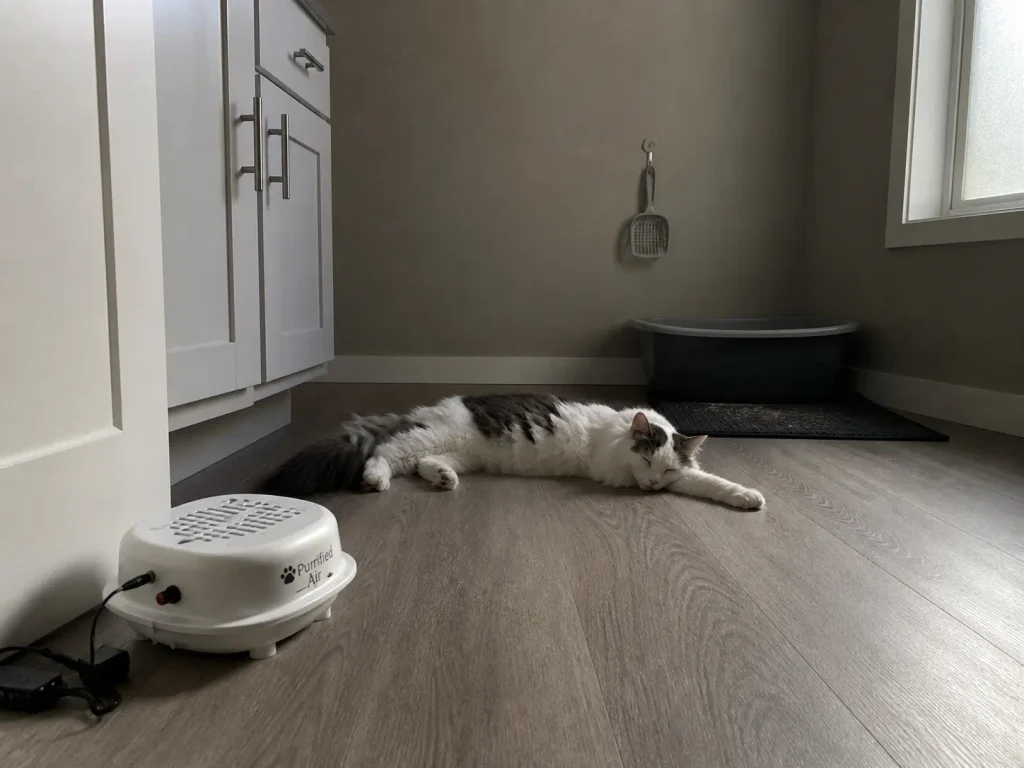
Every article about litter box smell written by a company that sells air purifiers arrives at the same conclusion, and you can guess what it is. So here is the other version: probably not yet, and here is the test.
The Condition
The purifier makes sense when four things are already true.
The box is out of the cabinet with air on both sides. Charcoal is in place and not older than three months. You are scooping daily. Nothing scented is anywhere near it.
Meet all four and still smell it, and a purifier is solving a real remaining problem. Skip any of them and it is an expensive way to cover for a placement mistake that was free to fix.
The most repeated story in purifier threads is the same disappointment: an expensive unit bought for exactly this, running for weeks, no real change. It is almost never the product. It is a starved intake in a corner, the wrong size for the room, a floor unit sitting beneath the ammonia, or a box still inside a cabinet.
What to Look For, in Specs That Matter
One distinction decides whether the device does anything at all for smell, and the category runs on people not knowing it. HEPA filters catch particles. Ammonia is a gas, not a particle, and it passes through HEPA untouched. The part doing the odor work is the activated carbon stage, and a purifier without one is a dust filter with a good review score.
Check for carbon before anything else. Zeolite alongside it is the upgrade worth having, because zeolite targets ammonia specifically rather than odor in general, and ammonia is precisely what a litter box produces.
Where It Goes
Everything from the second section applies. Six to twelve inches of clearance on intake and exhaust, elevated rather than on the floor, a few feet from the box rather than pressed against it, out of the litter-scatter zone. A well-chosen purifier in a bad position is a badly chosen purifier.
Check the carbon stage before you look at the CADR number. A high airflow rating with no carbon in the stack is just a high rate of moving smelly air around the room, and it is the specification most often used to sell purifiers to people with cats.
Most whole-room purifiers are built for dust and pollen and treat odor as a bonus line on the box. The Purrified Air Litter Box Air Purifier is built the other way around, which is why it is the one here.
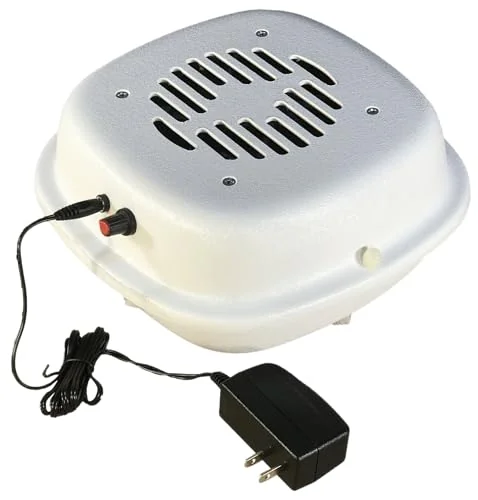
One more thing about carbon in any format, purifier included: it supplements airflow, it does not replace it. A pouch in a sealed closet still smells, and so does a purifier in the same closet, because both are treating air that has nowhere to go. The free move from the first section is not a cheaper alternative to the device. It is what makes the device worth owning.
And the honest close. If moving the box and adding a pouch fixed it, the money stays where it is and reading this far was a waste of your afternoon in the best available way. That is the outcome most apartments get, which is why the device is fifth on the list instead of first. Charcoal comes in other formats too, and Remodeez makes a pouch in the same category if you want a second brand to compare against.
What to Do Tomorrow Morning
Move the box before you buy anything. Out of the cabinet, off the wall, air on both sides of it. It is free, it takes a minute, and in a small apartment it is the largest single change available.
If you buy exactly one thing, buy activated charcoal, and write the replacement date on it the day it goes in. Ninety days from now, that pouch is decoration, and a marker is the difference between a system that works and a system that used to.
Anything scented near the box is working against the resident, and the invoice arrives as urine outside it. That includes the litter, the liner, the spray, and the candle you lit because a guest was coming.
Give it three weeks. Not three months, because three months is a long time to live with a smell, and because a cat tells you what he thinks of a change within days while a human routine tends to slip somewhere around the third week. At the three-week mark you will know two things: whether the room actually cleared, and whether your cat agreed with what you did to his bathroom.
Start with the cabinet. Pull the box out, leave it in the open for a week, and see what the room does on its own. If it clears, you just saved the cost of a purifier and the only thing you spent was a minute of rearranging.
Amazon’s Audible — free for 30 days
Your cat won’t let you read. Let someone read to you.
Audible is Amazon’s audiobook library — thousands of titles, read out loud, on your phone. Free for a month, plus one audiobook to keep forever.
Frequently Asked Questions
01What absorbs litter box odor best?
Activated charcoal, and it is not close. It adsorbs the ammonia molecule onto its pore surface instead of covering it with a second smell, which is the whole difference between charcoal and anything scented. Baking soda is the budget version of the same idea and the same active ingredient as most commercial additives.
02Is it OK to put an air freshener near a litter box?
No, and it is the most common way this problem gets worse. A strong fragrance where a cat has to stand still is a known reason cats start using the box less, and a box used less becomes a smell in your floor instead of in the litter. Take the plug-in out before you change anything else.
03How far should an air purifier be from the litter box?
A few feet away, with 6 to 12 inches of clear space around its intake and exhaust, and higher rather than beside it. Ammonia is lighter than air and rises. Wedged into the corner behind the box, the intake is starved and the rated airflow stops meaning anything.
04Does baking soda actually work in a litter box?
Yes, in a thin layer under the litter rather than dumped across the top. It is the same active ingredient as most of the odor eliminator powders sold for this, so the main thing the branded version adds is packaging. On top of the litter it mostly ends up on your floor.
05How often do you replace a charcoal pouch?
Roughly every 90 days. After that the carbon is saturated and stops taking on new odor molecules. It does not smell bad or look any different, it just quietly does nothing, which is why writing the date on it the day it goes in is worth the ten seconds.
Leave a comment