When Cat Shedding Is a Problem, and Why Hair Count Misleads
Don't judge when cat shedding is a problem by the sofa. Bald patches, skin or grooming changes are a vet call (+ a towel test to track it).

Alfredo RamsesFounder · October 6, 2026 · 20 min read


On this page7 sections
- 1When Cat Shedding Is a Problem for the Cat and When It Only Is for the Sofa
- 2The Changes on the Cat Itself That Belong to the Vet, Listed Before Anything Else
- 3Build Your Cat's Normal on Paper Before You Need It
- 4With Two Cats on One Sofa, the Hair Can't Tell You Which One Changed
- 5When the Cat Is Fine and the Apartment Isn't, Free Changes Come First
- 6Judge the Cat, Measure Him Against Himself, Then Fix the Couch
- 7Frequently Asked Questions
You pull a black sweater out of the closet and find a pale haze across the shoulders before it is even on, with a matching patch on the sofa arm where your cat spends his afternoons. That haze feels like evidence, yet all it really records is where he sleeps and how long since you last vacuumed.
Texas A&M’s veterinary college opens its own piece on this with the same black shirt, and then moves the question off the fabric and onto the cat. So when cat shedding is a problem depends on which problem you mean: the one a vet should see, or the one your apartment can’t keep up with. Below is how to tell the two apart, how to record your own cat’s normal before you need it, which of two cats changed, and what the house needs if the cat is fine.
Quick Answer
Cat shedding is a problem when your cat stops looking like himself: bald or thin patches, skin that changes, grooming that rises or stops, or a clear jump against his own earlier weeks. Those go to the vet. A full-coated cat leaving drifts on the sofa is a housekeeping load, and the apartment can handle that part.
When Cat Shedding Is a Problem for the Cat and When It Only Is for the Sofa
The word “problem” is doing two jobs in that question, and mixing them up sends people the wrong way in both directions.
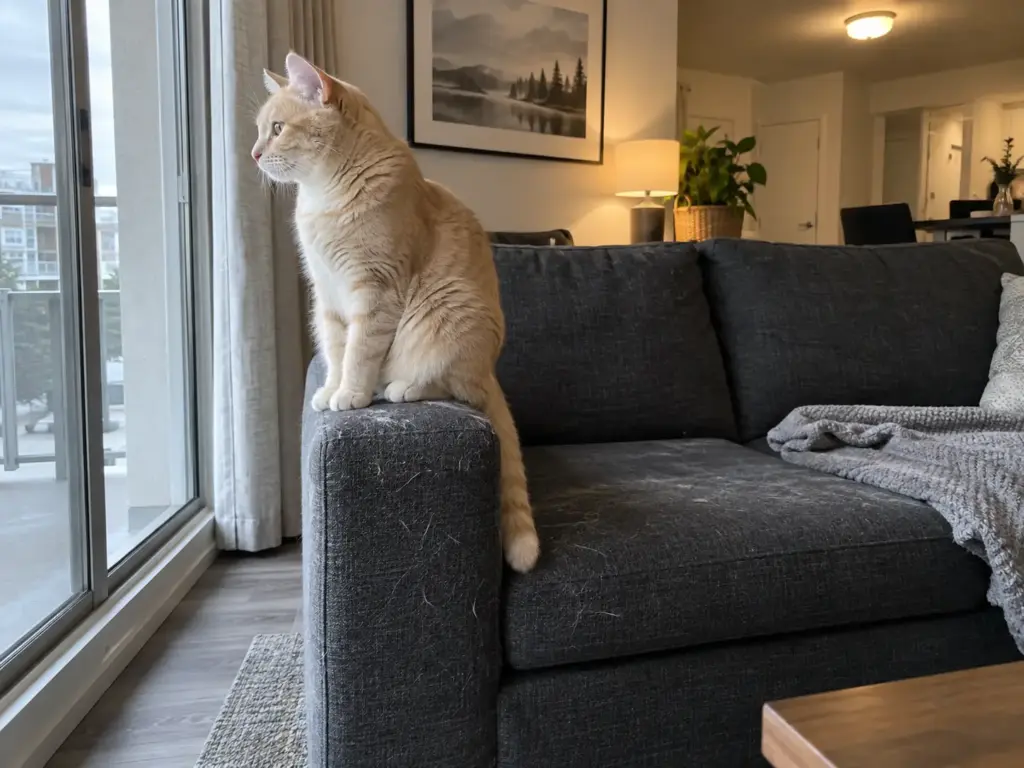
One owner books an appointment because the couch has turned gray. Another buys a third brush while a thinning coat shows over the cat’s hips, thinner than it was last month. The first is a load the apartment carries. The second is a change in the cat, and that one belongs to a vet.
The Sofa Counts Every Cat That Has Ever Sat on It
A sofa is a terrible scale. It keeps every hair from every nap until somebody vacuums, so what you see on any given day is the cat’s output, multiplied by the days since the last pass, plus whatever a second cat added.
Owners of two cats on r/CatAdvice call the hair drifting around their rooms “furnados,” and one of them described pulling a fistful or two off the floors daily with both cats healthy. That figure describes a household. It says nothing about either coat.
The cat chose that cushion because it is soft, warm and next to you, and he is right on all three counts. So the drift on it tells you about his habits, not his health. If you want the wider picture of where the hair goes and how a weekly routine fits a lease, it lives in the guide to living with cat shedding in a rented apartment. This article stays on one question: is this the cat, or the house?
A Hairy Room Next to a Coat That Still Looks Full
Turn around and look at the cat. Run a hand along his back, down both flanks, over the hips and to the base of the tail, and part the hair in a few places while you are there. Texas A&M’s veterinary college draws the line between shedding and hair loss in one sentence from Dr. Alison Diesel: “The biggest difference between normal shedding and alopecia in cats is that with normal shedding, there is not appreciable hair loss on the animal.”
Put plainly, a hairy room next to a coat that still looks full, even and the same length everywhere is the normal picture. A long-haired cat in a heavy week can leave clouds on every surface and still look as plush as ever. The coat that should get your attention is the one that looks thinner on the cat himself, however clean the sofa happens to be that day.
Why How Much Is Not on the Vet’s List
Read the warning signs vet schools actually list and the volume of hair isn’t on them. No grams, no handfuls, no bags of vacuum dust. What the lists carry are things you see on the cat, which is the next section. An indoor cat dropping hair in every month of the year isn’t on them either: why an indoor cat has no off season is its own subject, and year-round shedding by itself is the ordinary case for a cat who lives inside.
The usual instruction is to watch for “excessive shedding,” and that phrase is where people get stuck. Excessive compared with what?
One owner of a first indoor cat put it well on r/CatAdvice: brushing a couple of times a week, alternating a deshedding tool with a regular brush, the hair never stopping, and no way of knowing whether the amount was normal or too much. That owner wasn’t short of hair. They were short of a baseline, a record of what this particular cat looks like in an ordinary week.
You can’t borrow that baseline from another cat or from a chart, because there isn’t one. You can build it, though, and it takes one towel and ten minutes a week (section three has the routine). Once it exists, “a lot” turns into a comparison, and the two meanings of “problem” stop overlapping.
The Changes on the Cat Itself That Belong to the Vet, Listed Before Anything Else
This part is short on purpose. It names what to look for on the cat and stops there, because what any of it means is a conversation for the exam room. If one item below turns up alongside a change in the coat, book the vet visit. You don’t need to work out the reason first, and you shouldn’t try.
- Scratching, biting, chewing or pulling at the coat. Any of them, in any spot, more than you usually see.
- Grooming that rises. Excessive licking, longer sessions, or the same patch licked again and again.
- Grooming that drops. A dull coat over the back or hindquarters, greasy or clumped, because he no longer keeps it up.
- More hairballs than usual for him. Your own count is the comparison.
- Sores, irritated skin or flaky skin where you part the hair.
- Any change in appetite, energy, or vomiting, whatever the coat looks like.
Bald Spots, Thin Areas and Whether They Match Left to Right
Part the hair with two fingers over the shoulders, along each flank, at the hips, inside the back legs and on the belly if he allows it. You are checking two things: whether skin shows where it didn’t before, and whether a thin area on one side has a twin on the other. The Merck Veterinary Manual’s note on shedding draws the line in plain terms: shedding may be abnormal when it leaves obvious loss of the coat and bald spots.
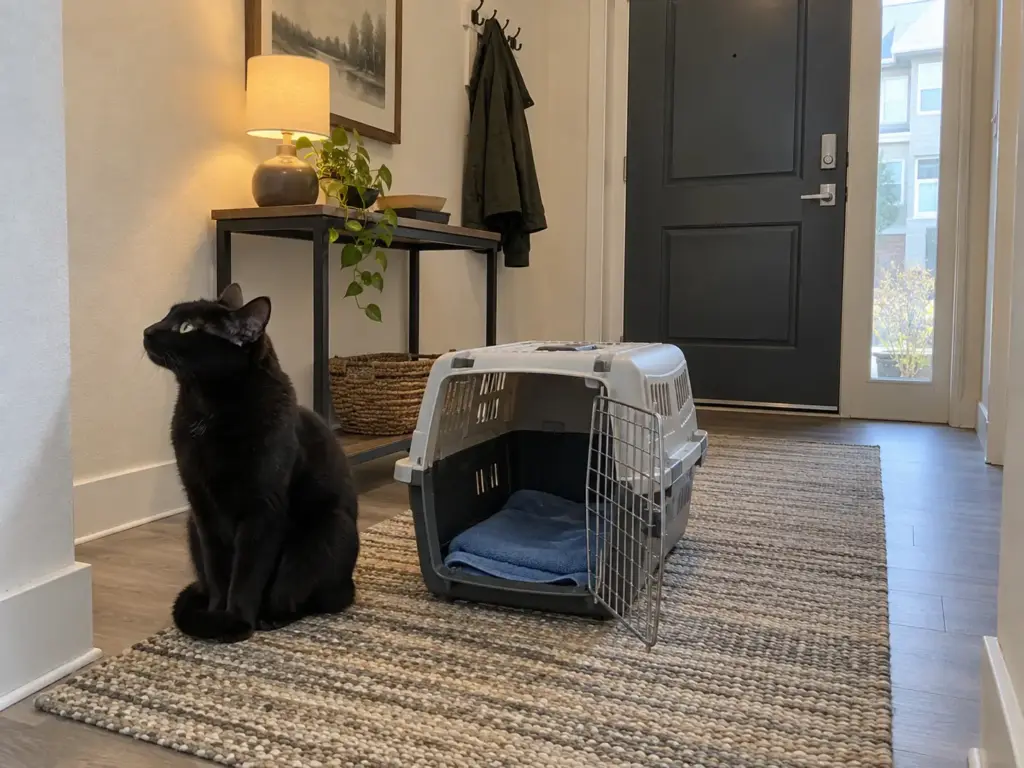
Whether the pattern matches left to right is something you write down and the vet weighs. You note it with a date and a photo. You don’t read it.
Skin, Licking and Hairballs, Noted and Not Explained
Grooming is the hardest change to see, because a cat is grooming for so much of the day already. Cornell’s Feline Health Center on how much cats groom puts it at 30 to 50 percent of a cat’s day, and Dr. Pamela Perry writes there that “Because cats groom frequently, owners usually don’t notice a problem until they observe significant hair loss or skin lesions.” Cornell also sets the owner’s limit: a quick look through the coat for mats, and past that, the vet steps in.
So the job at home is noticing and recording. Where he licks, and whether it is the same place each time.
Whether hairballs turn up more often than they used to. Whether the skin looks different when you part the coat. Each goes in a note with the date.
Then stop. What is causing it, what to feed him, supplements, medication, baths, shaving, anything meant to calm him down: all of that belongs to the appointment. An article that tries to answer those questions is guessing on your cat’s behalf, and your vet has the cat in front of them.
The Thin Spots That Are Normal for Your Own Cat
Some cats come with thin areas built in. Texas A&M names a few: the hairless breeds such as the Sphynx, the ear flaps of an aging Siamese, and the sparse patch just in front of the ears that plenty of cats of any breed have. Those spots look alarming the first time you notice them, which tends to be the day you are already worried about something else.
Photograph them now, while your cat is fine, so the comparison already exists when you need it. (Most people skip this, and then spend an evening squinting at a phone screen trying to remember whether that patch was always there.)
A Groomer’s Remark Is Not a Vet’s Finding
In one r/CatAdvice thread, a groomer told an owner that their cat shed too much and sold an extra de-shedding session on the spot. Afterward, the owner noticed the cat licking more than before.
Two things come out of that story. A groomer’s opinion about volume isn’t a medical finding, however confident it sounds. And a new routine, whether a new groomer, a new tool or a new schedule, is itself a change, so it goes into your notes and gets mentioned on the call.
The move people make again and again in these threads is from buying another brush to booking the appointment. What triggers it is never the sofa. It is the skin, or the grooming.
Build Your Cat’s Normal on Paper Before You Need It
Every vet call about a coat runs into two questions sooner or later: since when, and how much more than before. Without notes, the answers are a feeling, usually “a lot” and “a while.” With four weeks of notes, they become a comparison.
There is no fixed figure for too much hair from Texas A&M, Merck or Cornell, so the measure that works is your own cat against his own earlier weeks. What follows is a method rather than a standard, and everything it needs fits in one drawer.
Same Brush, Same Minutes, Same Spot
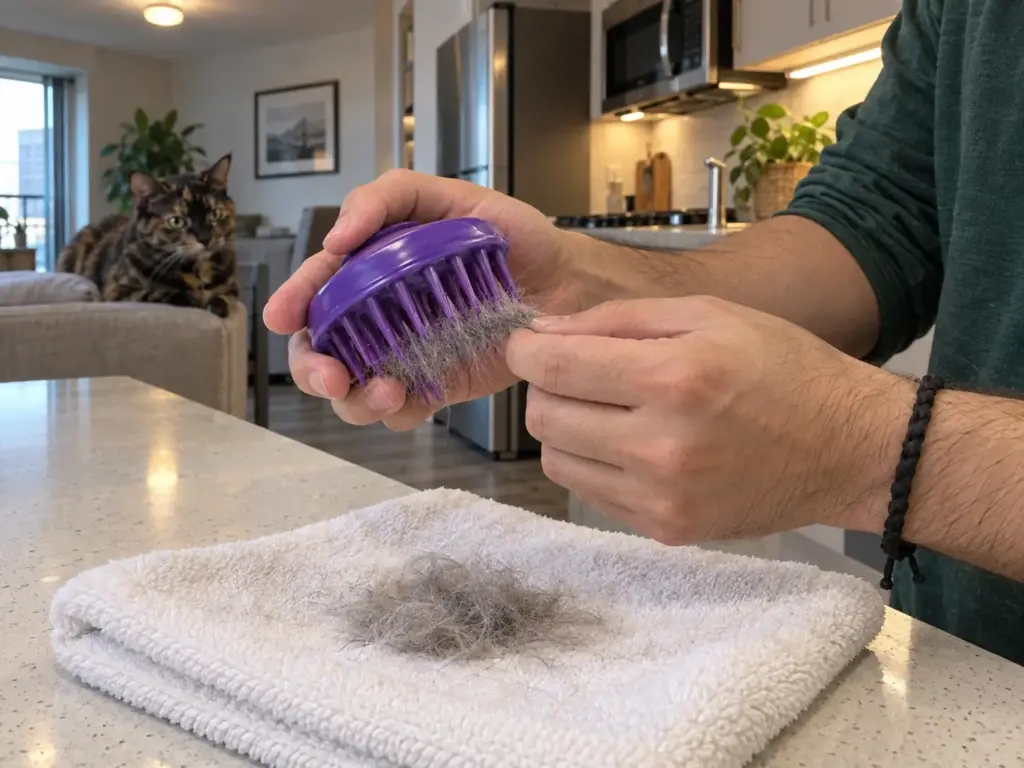
Pick one day a week. Sit the cat on a plain white towel, brush the same stretch of coat (one side, from the shoulder to the base of the tail, is easy to repeat) with the same tool for the same number of minutes. White matters because a pinch of loose fur shows on it the way it never does on a patterned throw.
Roll the hair haul into a loose ball, set it in the middle of the towel and photograph it with the date in the note or the file name, and you have a brush log. The amount means nothing on its own. It only means something next to last week’s haul from the same routine.
The standard advice says to brush every day during heavy weeks, which is fine for the coat. For the record it causes trouble, because a daily session changes what the weekly one collects, and the comparison quietly breaks. Brush daily if he enjoys it, but keep the measured session on its fixed day and treat the rest as housekeeping.
You can start with a damp rubber dish glove, the kind already under most sinks, run along the coat until the hair rolls up. If you want a tool that stays identical week after week, the Cat Brush with Soft Rubber Pins is a washable silicone brush at 8 by 4.5 by 2.5 inches, small enough to live folded inside the towel.
It rinses clean under the faucet, so last week’s hair never sneaks into this week’s count. Reviewers point out that it loosens hair more than it holds onto it, and some ends up on the bed or the couch. Brushing over the towel turns that weakness into part of the haul.
Choose one day of the week and roughly the same part of the day for the measured brushing, and don’t change tools halfway through a month. A new brush pulls a different amount, so if you switch, treat that week as the start of a new baseline and say so in the note.
A Dated Photo of the Same Places
The haul tells you about volume. The photo tells you about the coat. Use the same window, the same distance and the same handful of places each time: the shoulders, both flanks, the hips, the base of the tail, plus any of those normal thin spots from the last section.
Before anyone in a cat forum will offer an opinion on shedding, somebody asks for a post-brushing photo. A dated set of your own is that photo with a history behind it.
Write the month beside each one as well. The time of year shifts your cat’s baseline, and the months when the hair moves are a subject of their own. What matters here is that a heavy month set against a quiet one is a calendar effect, not a change in the cat, so compare like with like: this week against the last three, or this month against the same month a year ago once you have it.
Take the coat photos by the same window at the same distance, with the cat settled rather than mid-stretch. A shot under a lamp or with the flash on makes a normal coat look patchy, and that comparison is worse than none.
Turn the Notes Into What You Say on the Phone
When something from the list in section two shows up, the notes become the call. Bring the dated photos for the vet and the dated hauls. Add a line on whether the hair coming out looks whole or like short, broken hair (describe it, don’t name a reason). Say how many cats live in the apartment, and list anything new at home in the last month: a new cat, a new litter, a move, a new cleaning product, a new groomer.
Facts, in order, with dates. The vet looks at the pattern, where it sits on the cat and whether the hairs were shed or broken, so this is the raw material that helps.
A comparison beats an adjective every time. “He’s shedding loads” leaves the vet guessing. Two hauls three weeks apart, the second plainly bigger, with a thin patch over one hip that wasn’t in the first photo, gives them a place to start.
And if a shed simply runs longer than it usually does for this cat, write down the week it began and call the vet. How long a shed usually runs has the typical ranges if you want to see where yours sits, and the main shedding guide on this site lays the same weekly log out as a four-week table.
With Two Cats on One Sofa, the Hair Can’t Tell You Which One Changed
With two cats, or any multi-cat household, everything above gets harder in one specific way. One sofa, one vacuum, one roller and two coats, with the hair in all of them mixed together. The two-cat owner on r/CatAdvice counting fistfuls off the floor each day had a perfectly good measure of the household and no measure at all of either cat. If one of them has changed, the other one’s normal hides it.

Brush Each Cat With the Same Tool and Write Down Whose It Was
So the routine from section three runs per cat: the same tool, the same minutes, the same stretch of coat, the same towel, and a name on every note. It is the reasoning behind one station per cat at mealtimes, where a shared bowl hides who is eating what. A shared couch hides whose coat is shifting in exactly the same way.
Keep the notes separate and never average them. In the house behind this site, a very large long-haired Maine Coon shares the furniture with a dense-coated British Shorthair, and one brush doesn’t even serve the two of them the same way. A combined number would bury whichever coat moved under the one that didn’t. Two short entries a week, one per cat, is all it asks.
Brush both cats on the same day and write the cat’s name on the note before you start, not after. Once two hair balls are sitting on the towel, you can’t tell whose was whose.
The Older Cat Who Stopped Keeping Up Can Look Like the Heavy Shedder
In a two-cat home, the cat everyone calls the shedder isn’t always the one whose coat changed. A senior cat who has stopped reaching his back can look as if he’s dropping far more than before: the coat there goes dull, greasy and clumped, often from the base of the tail upward, and loose hair stays tangled in it instead of being groomed away. One foster on r/CatAdvice described a 15-year-old with fur like that, and after a professional groom the cat looked like a new animal.
That is an observation to report, not a puzzle to solve. Tell the vet he has stopped keeping up with his back and let the exam handle the why.
PetMD points out that mats like these won’t sort themselves out and that older skin is delicate, so they go to a groomer or the clinic, never to a pair of kitchen scissors. Neither cat is the culprit in any of this. You are only working out whose coat moved, so you know which cat to bring in.
When the Cat Is Fine and the Apartment Isn’t, Free Changes Come First
Say the cat cleared everything in section two. The coat is full, the skin is clean, the grooming hasn’t changed and the vet has no concerns. The hair is still on the duvet, though, and you rent a small apartment, so the sofa isn’t being replaced and nothing is getting screwed into the wall. This is the other meaning of “problem,” and it belongs to you and the apartment.
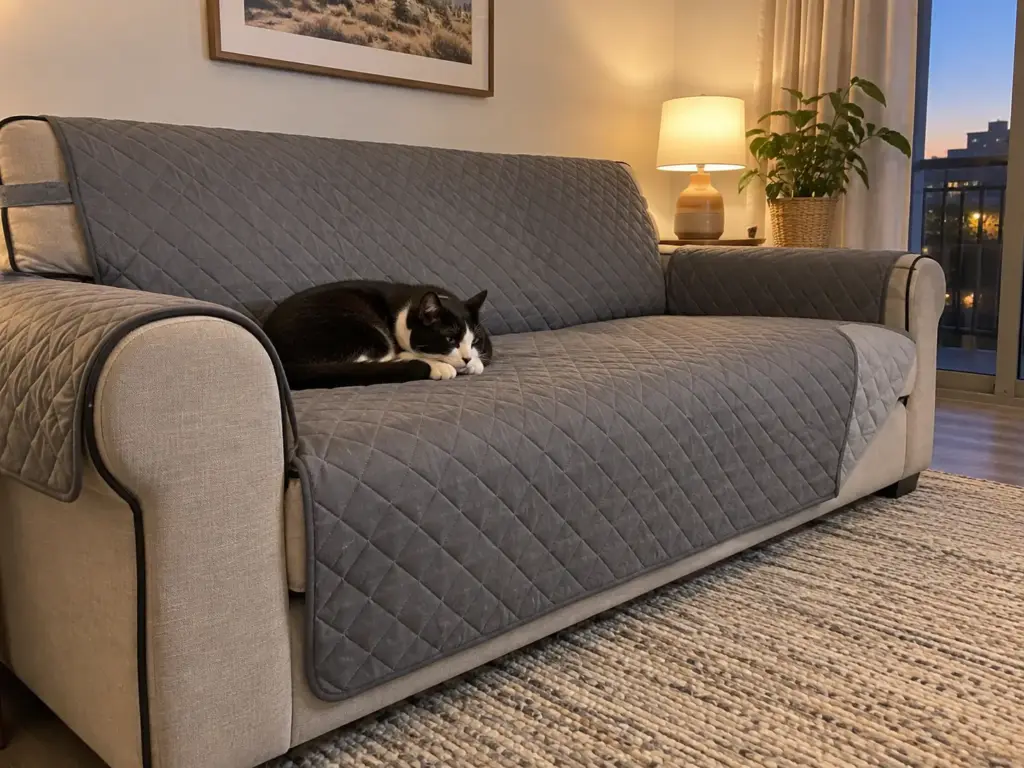
He sleeps where it’s warm and where you are, which is a sensible choice, so the change goes under him rather than against him.
Move the Sleeping Spot and Wash One Layer First
Start with the free changes. Owners on r/CatAdvice with one long-haired and one short-haired cat keep both out of the bedroom during the heavy weeks “to have a refuge away from the hair,” and that single closed door does more than most purchases. The cats keep the sofa, the window and the rest of the place. Swap open shelves for closed cabinets where you can, since open ones collect every drifting tuft.
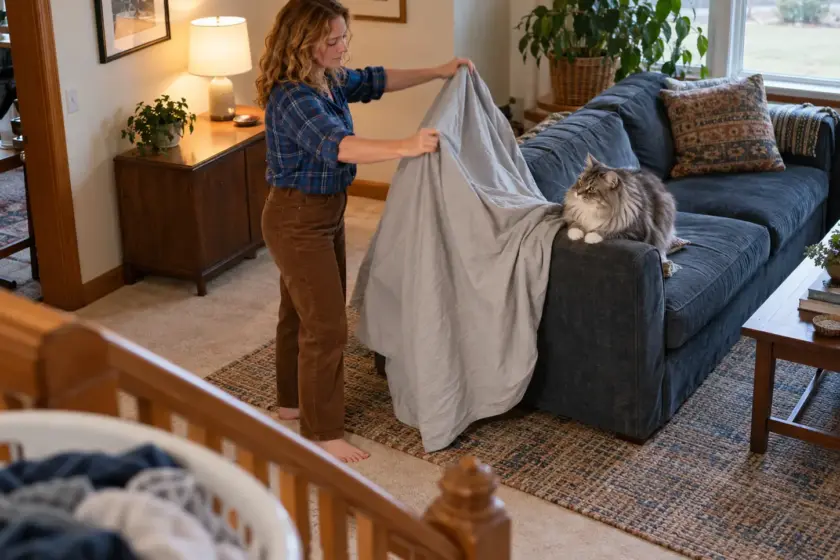
Then find where he actually sleeps on the sofa (the dent and the faded patch of fabric give it away) and lay a washable throw you already own over exactly that spot. Wash it once a week. The hair lands on something that goes in the machine instead of something you have to work over by hand, and he keeps the cushion he picked.
Put the layer on his spot through the wash on the same day you do the measured brushing, so one weekly slot covers both jobs. In the heavy weeks, keep the bedroom door shut if you want one room that stays clear.
Where the Roller and the Washable Cover Earn Their Place
Products come in after that, and only for hair that has already landed. The free version for upholstery is a damp cloth or the same rubber glove, dragged in one direction until the hair gathers into a strip you can pick up.
A roller is what most people reach for first. If the cat sleeps in one spot, though, the better first buy is a layer that catches the hair before it works into the weave, with the roller kept for the patches the layer doesn’t cover. For those patches, the ChomChom Roller Pet Hair Remover is reusable, about 7.5 inches across, and needs no sticky refills; a commenter on r/CatAdvice said it beat their lint rollers on the couch. Some buyers say it takes a lot of back-and-forth passes and feels flimsy, so it suits a cushion rather than an entire sofa.
For the layer itself, the PureFit Reversible Quilted Sofa Cover fits seats up to 66 inches wide and goes on with straps and non-slip foam, with nothing to stick or drill, which is what makes it renter-friendly. Reports on how well it stays put disagree. One comparison summary says buyers find it slides off despite the foam and straps, while another reviewer says it stayed in place and came through two washes fine, so tuck it deep into the cushions and check it after the first week.
If a full cover is more than the problem calls for, the PETMAKER Waterproof Pet Blanket at 50 by 60 inches does the same job on one cushion or the foot of the bed. It is smaller and cheaper than the cover and goes in the weekly wash like the throw it replaces. No complaint about it came up repeatedly in buyer reviews, and the throw already in your closet still does the same thing for free.
Brushes, slickers and deshedding tools are a separate comparison, and the full lever plan and the tool comparison sit in their own guide.
When to Stop Managing the Hair and Pick Up the Phone Again
The house routine has a limit, and the cat sets it. If the weekly photo starts to show skin, if the haul shows a sudden increase against his own earlier weeks, or if the grooming changes, everything in this section goes back on the shelf and section two takes over again. No amount of buying for the apartment fixes a change in the cat.
Keep taking the photos in the good months too. They are what tells you, next time, which kind of problem you are looking at.
Judge the Cat, Measure Him Against Himself, Then Fix the Couch
Three things to take from this:
- The amount on the sofa is not the threshold. A change on the cat is: thin or bald patches, different skin, grooming that rises or stops, or a jump against his own weeks. That change goes to the vet, described and dated, not explained.
- Build the baseline before you need it. One fixed tool, the same minutes on the same stretch of coat, a white towel and a dated photo, kept per cat if you have more than one.
- If the cat is fine, fix the house for free first. A closed bedroom door in the heavy weeks and a washable layer on his chosen spot come before any roller or cover.
Three weeks after your first note, run the same tool over the same stretch of coat for the same minutes and set the new haul and photo beside the first ones; if either has moved beyond what his ordinary weeks look like, call the vet with both pictures ready.
Today, lay down a white towel, do one timed brushing, photograph the haul and the coat with today’s date on them, and put the throw that lives on his cushion into the wash.
Frequently Asked Questions
01Should I be concerned if my cat is shedding a lot?
Worry about changes on the cat, not the amount on the sofa: bald or thin patches, different skin, grooming that rises or stops, or a jump against his usual weeks. Any of those is a call to your vet. A full, even coat next to hairy furniture is a housekeeping job.
02How do I know if my cat’s shedding is normal or too much?
Measure him against himself, with the same brush, the same minutes and the same patch of coat once a week, plus a dated photo of the haul and the coat. Vet sources give no fixed amount for too much, so his own earlier weeks are the comparison that counts.
03What can I give my cat to reduce shedding?
Anything given by mouth, whether a food change, a supplement or a medication, is a question for your vet, who knows your cat’s health and history. At home, what you can change is where the hair lands: a washable layer on his spot and a weekly brushing over a towel.
04What months do cats shed the most?
Many cats drop more hair around spring and fall, but an indoor cat often sheds steadily all year, and a heavy month alone is no sign that anything is wrong. Note the month beside each weekly photo so a seasonal rise is never mistaken for a change in the cat.
05Do cats eventually stop shedding?
No, a healthy cat sheds for life, and the amount rises and falls over the weeks instead of ending. What deserves a note and a call to the vet is a shed that runs well past the usual length for that particular cat, or one that leaves thin patches behind.



Leave a comment