Feeding Two Cats in a Small Apartment, by Floor Plan
Feeding two cats in a small apartment takes 8 spots (2 food, 3 water, 3 litter). Where station two goes in a studio, a one-bedroom & an open-plan room.

Alfredo RamsesFounder · September 28, 2026 · 24 min read

On this page8 sections
- 1Why Feeding Two Cats in a Small Apartment Keeps Going Wrong
- 2Count the Spots Before You Place a Single Bowl
- 3Where the Two Stations Go, Floor Plan by Floor Plan
- 4A Feeding Routine That Fits a Workday
- 5When Nobody Is Home to Referee
- 6Keeping Two Stations Working in a Small Kitchen
- 7Count First, Buy Last
- 8Frequently Asked Questions
You put two bowls down in the only free corner of the kitchen, a foot apart, and within a week one cat is finishing both. He isn’t greedy: the apartment gave two cats one good spot, and he got there first. The joint feeding guidance from the AAFP and ISFM, the two big feline-medicine organizations, says it without hedging: cats are built to eat small meals alone, and feeding two cats in a small apartment goes wrong whenever the floor plan offers only one place to do that. What follows is the count of spots two cats actually need, where the second station goes in three common layouts, a routine that survives a workday, and the point where a device becomes the honest answer.
Quick Answer
Two cats in a small apartment need two separate places to eat, and everything else follows from that:
- Set up two stations, not two bowls in one spot.
- Count eight spots first: two food, three water, three litter boxes.
- Put the second station behind a door frame, a wall corner or up high.
- Feed both at set times and lift the bowls after twenty minutes.
- Add a microchip feeder only after three weeks of that failing while you’re out.
Why Feeding Two Cats in a Small Apartment Keeps Going Wrong
Most two-cat households describe it the same way. One cat eats his dinner, walks over, eats hers, every single meal, and before long somebody is calling him a pig. He is reporting a layout problem, and he’s reporting it accurately.
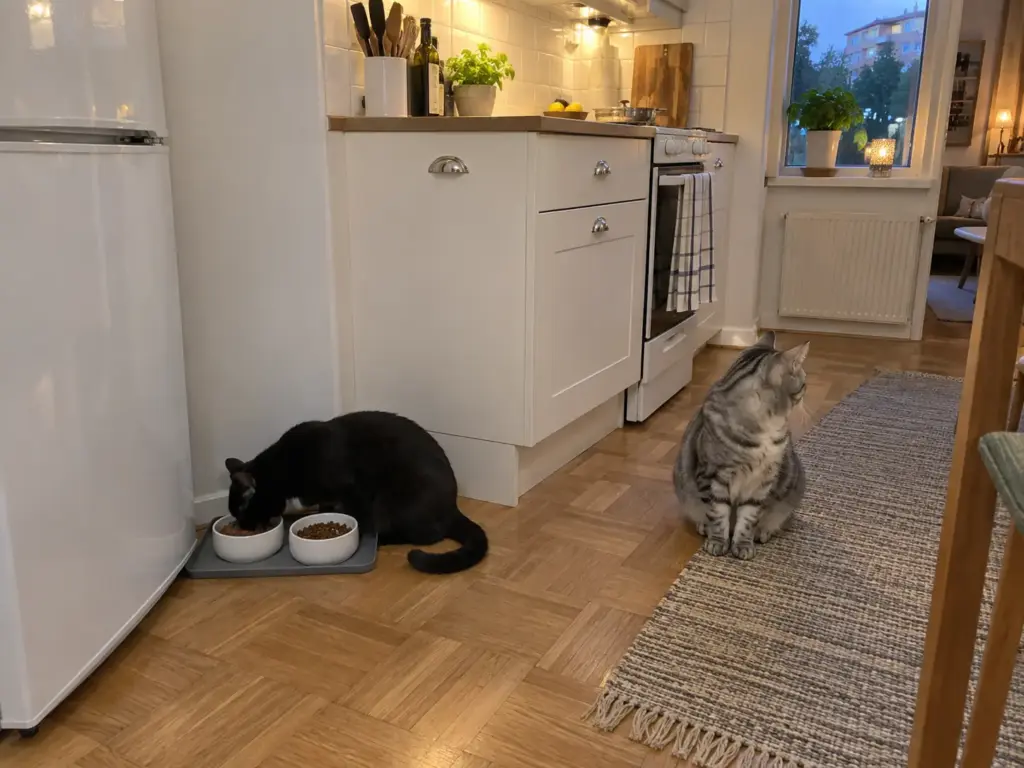
One Good Spot, Two Cats
Every small apartment has a spot like this. It’s off the walking line, nowhere near the litter box, on hard floor, with a wall behind it and a view of the room, which is everything that decides where the bowls go in an apartment in the first place. In a studio or a one-bedroom there is usually exactly one of it, so both bowls end up there, a foot apart, because it was the only place that passed every test.
The short version of why that fails: two cats share the spot, not the bowl, and a feeding station only ever belongs to one of them at a time. Two dishes on one tray are one station, whatever the packaging says. Everything below is about building a second spot in an apartment that seems to have none.
What the Faster Cat Is Actually Doing
Watch one meal. He finishes, lifts his head and walks straight to the other bowl, not because he’s hungrier than she is but because the bowl is still there, still full, and nobody is guarding it. Cat forums call it food stealing, and nearly every two-cat home recognizes it within the first week of the second cat moving in.
From his side it’s a sensible decision. According to the AAFP and ISFM’s own consensus statement on feline feeding, “Cats naturally prefer to eat small, frequent meals alone, thus competition for food can cause conflict and pre-feeding aggression.” Put two solitary eaters in one corner and one of them ends up eating for two, while the other learns to eat fast or leave early.
He isn’t the problem. The corner is.
The Quiet Version, Where Nothing Looks Wrong
Plenty of pairs never get as far as a standoff. The same consensus statement notes that cats sharing a feeding spot may show no obvious tension at all, and that is the version that runs for months. No hissing, no swatting. Just stress at mealtime in its quietest form: a cat who eats with one ear turned toward the room and walks away from a half-finished dish the moment the other one stands up.
The only visible result, eventually, is two cats who no longer look alike: one a little heavier, one a little lighter, and nobody able to say when it started. That’s resource guarding done with posture instead of noise, and it’s why a calm kitchen proves so little.
Which leaves the disagreement this whole article is about. You want the bowls in the tidy corner, where they’re easy to fill and easy to sweep around. The cats are telling you that corner is one place to eat, and one place is not enough for two. They’re right about the constraint; the corner is your preference.
Count the Spots Before You Place a Single Bowl
“I don’t have room for a second feeding station” is where almost everyone starts. You usually do. You just haven’t counted upward, or behind a door, or with the litter boxes in the same sum.
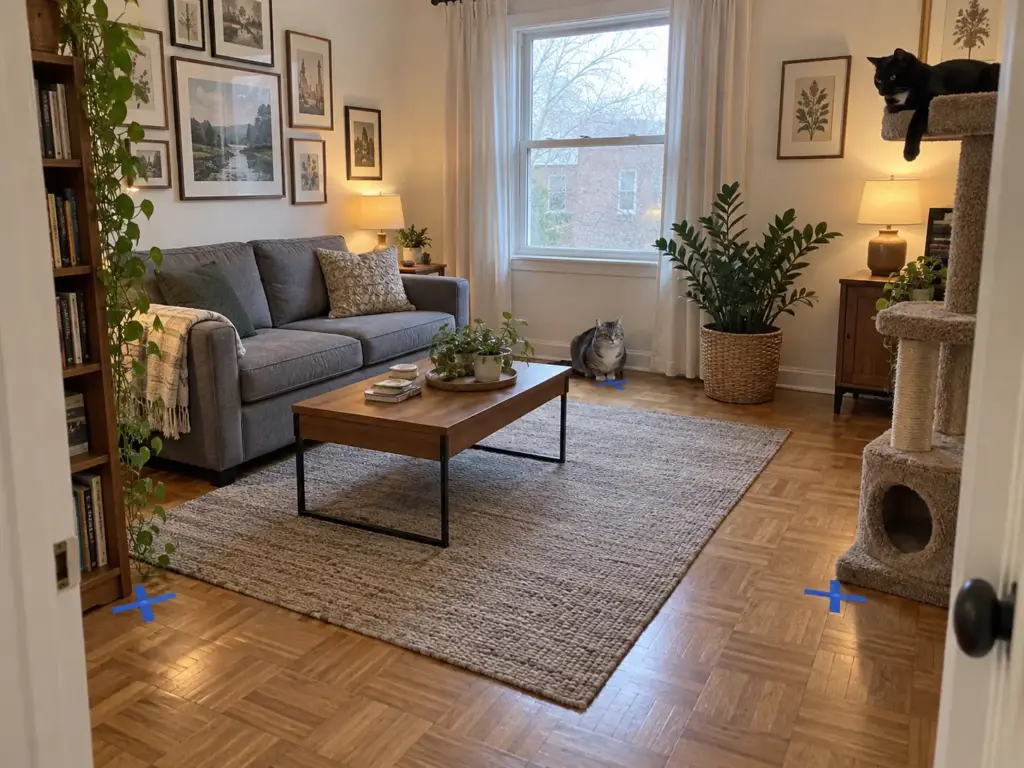
The Two-Cat Count Is Eight Spots, Not Two Bowls
Take the rule every multi-cat household runs on, one per cat plus one, and apply it to everything a cat needs a place for rather than just the food.
Three litter boxes. Three water bowls, spread out (and yes, three water bowls means three surfaces growing film, which is a washing problem for later). Two feeding stations. That’s eight separate spots, and most small apartments are running two cats on three: one feeding corner, one water bowl, one box.
Apply the rule strictly and food gets a spare too, which makes nine. On paper that’s correct. In a small apartment with meals on a schedule, the spare feeding station is the one worth giving up, because food bowls are only down for about twenty minutes twice a day, while water bowls and boxes are in use around the clock. A spare that sits empty twenty-three hours a day isn’t earning its square footage.
To be straight about where the eight comes from: it’s this site’s own arithmetic from the plus-one rule, not a figure from a study. Nobody has published a number that sizes this to a floor plan, and the reasoning is more useful to you than a number would be anyway.
It also explains why a second cat can feel like it shrank the apartment. One cat gets by on five spots: one bowl, two water bowls, two boxes. The second cat doesn’t add one spot. It adds three.
The Litter Boxes Claim Their Spots First
Place the boxes before you place a single bowl. The AAFP’s feeding guidance is that feeding stations shouldn’t sit close to litter boxes, and a box has far fewer places it can work than a bowl does. It needs floor, two ways out, some privacy and room for you to stand and scoop, while a bowl needs a level patch of anything.
So the thing with fewer options goes first, and the bowls take what’s left. In a small apartment the three boxes tend to land in the bathroom, on a closet floor with the door left open, and in one corner of the main room. Picture a generous circle around each of those three. Food doesn’t go inside any of them, and in a studio that alone can rule out a third of the floor.
Finding Spots You Already Have
Now walk the apartment and list every surface that’s level, hard, reachable by at least one of your cats and out of the walking line. Don’t judge them yet. You’re collecting candidates, and they come in more shapes than floor corners:
- A floor corner with a wall behind it and a view of the room
- The end of a counter nobody cooks on
- A deep windowsill, especially one a cat already naps on
- A sturdy shelf or the top of a low bookcase
- A cat tree shelf or platform wide enough that a bowl doesn’t hang over the edge
- The floor just inside the bathroom door
- A closet floor with the door left ajar
Vertical territory counts as separate spots, and not on a technicality. A shelf four feet up is a different place from the floor underneath it, as far as a cat is concerned, and the AAFP guidance tells you to factor in each cat’s agility when you use elevated spots. That means a height station can be a real option for one of your cats and useless for the other (a heavy, short-legged cat and a long, springy one will sort out who gets the shelf faster than you can).
Walk a typical one-bedroom this way and the list usually runs somewhere between six and ten candidates. A studio tends to land nearer four to seven on the floor, which is short of eight, and that shortfall is exactly why the windowsills and shelves matter. Those ranges are rough judgment, not survey data, and your own list is the only one that counts.
Put a strip of painter’s tape at every candidate spot and leave the strips for two days before you move a single bowl. Then look at which ones have cat hair stuck to them. The spots your cats already sit on are your shortlist, and they picked it without being asked.
One renter rule for the whole list: every spot has to work as it is. No drilling, no shelf that needs the landlord’s sign-off, no spare room you don’t have. If a spot only exists once you buy hardware for it, cross it off and keep walking.
Where the Two Stations Go, Floor Plan by Floor Plan
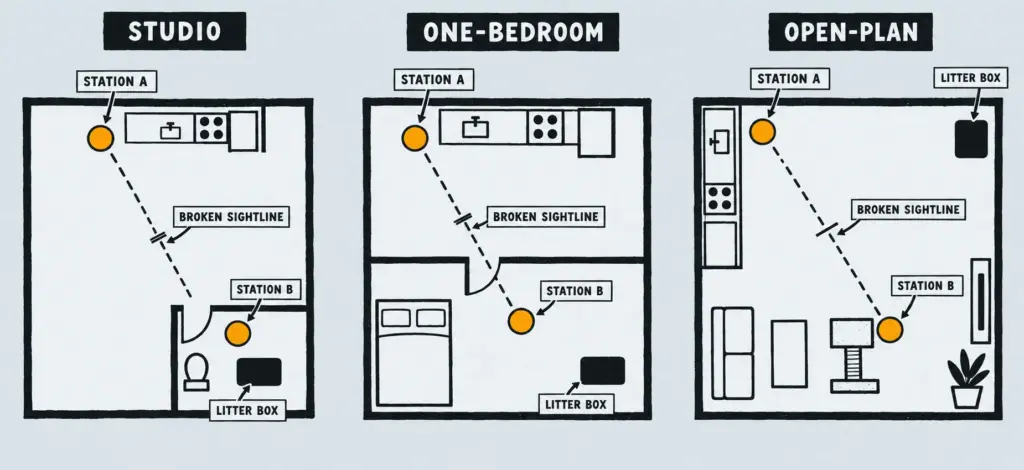
Every guide on separate feeding says to use separate rooms. If you live in one room, that advice has nowhere to land. The working distance this site uses is the four-to-six-foot rule for two stations, with the sightline between them broken, and what that rule can’t do on its own is tell you where those feet are in your apartment. So here they are, in the three layouts most small apartments come in.
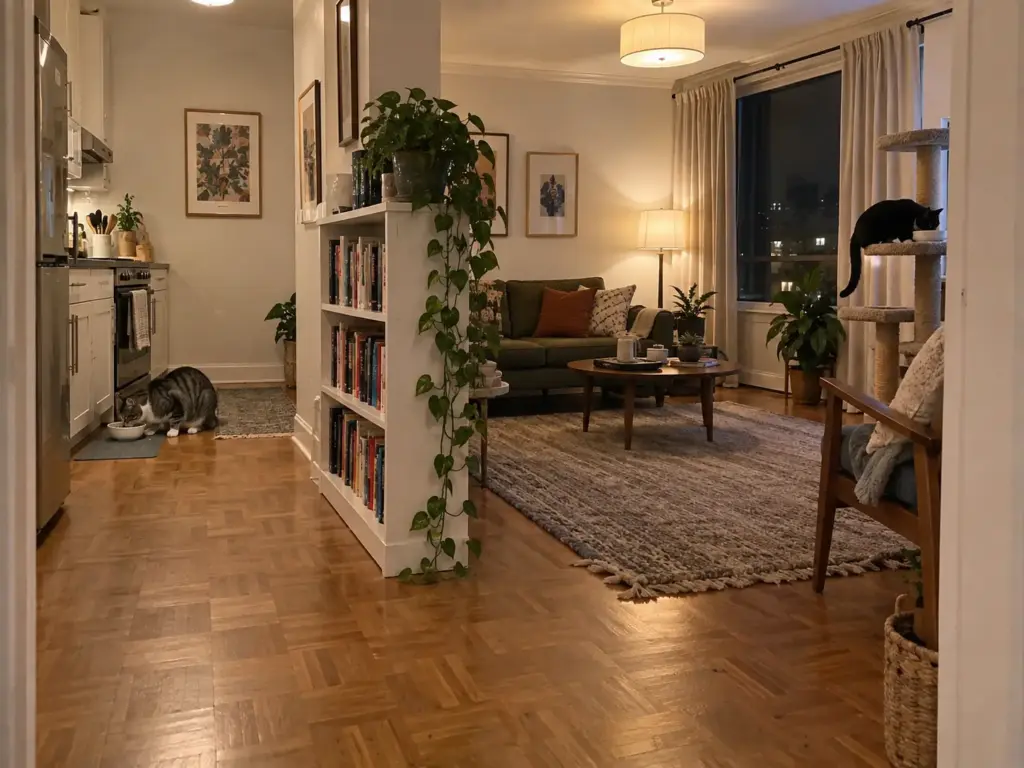
The Studio, Where the Bathroom Door Is the Second Room
In a studio, the only interior door that closes is usually the bathroom’s, which makes it the nearest thing you have to a second room. Where the bathroom door swings inward, as it usually does, the floor just inside and behind it is out of sight of the entire apartment. For a cautious eater, that’s close to ideal.
The catch is the box. If a litter box already lives in the bathroom, a bowl in there breaks the rule from the last section, and the bathroom is off the table as it stands. Your two honest options are to move that box to a main-room corner with two ways out and turn the bathroom into the feeding room, or to leave the bathroom alone and build the second station with a partition instead.
The partition version puts station A on the floor at the kitchen end, against the wall. Station B goes on the far side of something that blocks the view: the end of a kitchen island, a bookcase turned at a right angle to the wall, the back of the sofa, with the bowl on the floor behind it, or countertop feeding at a counter end if that cat jumps cleanly. When the cat you’re protecting is clearly the smaller of the two, a sturdy box with an entrance cut to her size does the same job for next to nothing. None of this is as good as a door, but for two cats who tolerate each other and have a pace problem rather than a guarding one, it’s usually enough.
If the bathroom becomes the feeding room, it goes to the cautious cat. Wedge the door so it stays a couple of inches open. She can hear the apartment and leave whenever she likes, and the pushy one can’t slip in without shoving a door, which is more commitment than most cats will spend on a bowl that isn’t theirs.
The One-Bedroom, Kitchen and Bedroom Instead of Kitchen and Kitchen
The most common one-bedroom mistake is putting both stations in the kitchen, because that’s where the food lives. You already own a second room. Kitchen for one cat, bedroom for the other with the door ajar, and you have two rooms of separation at zero cost.
The bedroom feeding area needs a hard surface. On carpet, a washable tray under the bowl does it (the carpet is what starts to smell, not the bowl). For a confident climber, the top of a dresser works, as long as he gets up there in one clean jump rather than a scramble that sends the bowl off the edge.
Then let the bedroom do a second job. Cats tend to sleep there, which makes it the natural home for one of the three water bowls, on the opposite side of the room from the food. In the kitchen, put the remaining station on the side away from the doorway, so the cat eating there isn’t the first thing anyone steps around on the way to the fridge.
The Open-Plan Living Room, Where Height and a Corner Do the Work
Open-plan with a galley kitchen is the hardest of the three, because there are no doors to use and the kitchen itself is useless for feeding. A galley is one long walking line with cabinets on both sides, and there’s no spot in it that isn’t underfoot whenever someone cooks. So the stations leave the kitchen entirely, and height and corners do what doors can’t.
Station A goes on the floor just outside the mouth of the galley, against a wall, with open floor in front and a way out on either side. That one belongs to the cautious cat. Station B goes across the room and up, on a cat-tree platform or a deep windowsill, with the back of the sofa or a bookcase breaking the line of sight between the two. Height is doing most of the separating here, and it lines up with the separate case for raising one of the two bowls that some cats make on their own.
The assignment matters. The confident climber goes up; the cautious cat stays on the floor near an exit, because the cat who worries needs more than one way out and a shelf only has one. Of the two residents behind this site, one is an eleven-pound British Shorthair for whom a counter is a project, and the other a very large Maine Coon for whom it’s a step. In a pairing like that, the split assigns itself.
Three Layouts That Fail in Every Apartment
Some setups fail whatever the floor plan, and they’re worth checking for before you move anything else. Two bowls on one tray, or one dual-bowl feeder, is one station however wide the gap. Both stations along the same wall is also one station, just with a hole in the middle, because the cats watch each other the whole meal. My rule for this one is blunt: if you can see both bowls from one spot without turning your head, you have one station.
A station in the walking line between the front door, the fridge and the sofa gets stepped over at every meal. The cat eating there eats in short bursts, leaves food behind, and gets called a picky eater for it.
And bowls that face each other, even across a room, put each cat’s eyes on the other while it eats. Keep the wall behind each cat and the room in front, but angle the stations so neither view lands squarely on the other cat.
A Feeding Routine That Fits a Workday
Separate stations work beautifully on a Sunday. By Wednesday the bowls are back side by side, and it wasn’t the layout that slipped.
Two Meals, Twenty Minutes, Then the Bowls Come Up
Pick two feeding times and keep them. Both cats get fed at the same moment, each at their own station, and after about twenty minutes both bowls come up, finished or not. A bowl left down is free-feeding by another name, and the faster cat will find it before you’ve got your shoes on.
Staggered meals, one cat and then the other in the same spot, are the standard free advice, and they work well for anyone home all day. Fitted around a commute, they double the time you spend standing in the kitchen at seven in the morning, and they’re the first thing to get skipped. Feeding both at once at two stations asks less of you, which is why it survives a bad week.
When you’re home, a closed door for the fifteen or twenty minutes of the meal fixes most of what’s left, for nothing. It just needs you there.
Who Eats First, and Where
Put the cautious cat’s bowl down first. Well, first and quietly: if the rustle of the bag brings him running, she never gets her head start. Set hers down at her station, then walk his to his, and by the time he reaches his own dinner she’s already three mouthfuls in.
He’ll trail you across the apartment to make sure he’s first. Let him follow you to his bowl, not to hers, and the order soon becomes his routine as much as yours.
Put both meal times and the pick-up time on your phone as alarms for the first three weeks. The routine doesn’t break on the day you forget. It breaks on the day you’re running twenty minutes late and put both bowls down wherever is fastest.
Slowing Down the Cat Who Finishes First
Before you buy anything, work out whether you have a pace problem or a guarding problem, because the fix for one does nothing for the other. If he’s simply a fast eater who then wanders, that’s pace. If he parks himself between her and her bowl, that’s food guarding, and no bowl on earth will help.
For pace, start with a dinner plate. Spread his wet food thin across it instead of piling it in a bowl, and a meal he’d finish by gulping in under a minute takes several. It costs nothing, and for a lot of pairs it closes the gap on its own.
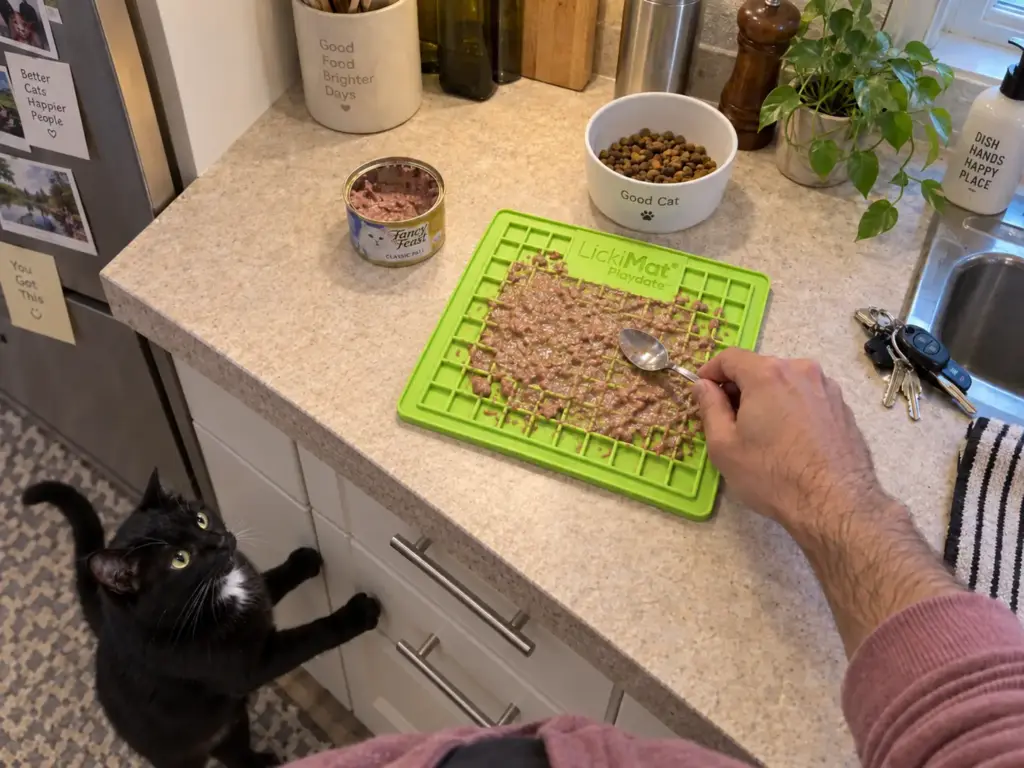
If it doesn’t, the LickiMat Classic Playdate takes the same idea further: a textured lick mat he has to lick his food out of rather than bite it off, which stretches a wet meal until the slow eater has caught up. It only works with wet or soft food, and it needs a rinse after every use or the grooves keep whatever you missed.
Kibble households need a puzzle feeder or a slow bowl instead, since dry food just scatters off a mat. The Bifeaw Slow Feeder Cat Bowl is the budget cat slow feeder there, a low silicone bowl with a raised ripple pattern that makes him pick pieces out a few at a time, and it takes wet food too. It goes in the dishwasher, and silicone is one of the materials that handles the dishwasher without fuss. Its limit is every slow feeder’s limit: it stretches his meal, but once he’s finished, the bowl can’t stop him walking over to hers. That part is still the routine’s job.
The Eight-Hour Gap in a Ten-Hour Day
This is where the workday bites. PetMD’s guidance is that adult cats should eat at least every eight hours, and breakfast at seven with dinner at six-thirty leaves eleven and a half hours in the middle of the day.
The overnight gap is the easy half: a small third meal at bedtime, at the same two stations, closes it. The daytime gap is the hard half, and the tempting fix makes it worse. Kibble left down all day to cover lunch undoes everything above, because the faster cat eats his share, then hers, and you come home to two empty bowls and no idea who ate what.
A timed feeder at each station can put a midday portion down on schedule. But it puts it down for whichever cat shows up, and with nobody home, the faster one shows up twice.
When Nobody Is Home to Referee
Every free fix in this article has the same hidden requirement: somebody standing in the apartment deciding who eats where. Close a door, pick up a bowl, walk the confident cat to his station. At noon on a Tuesday, nobody is doing any of that.
Three Weeks, Then Decide
Before you spend anything on a device, give the free routine three full weeks: two stations, set times, bowls up after twenty minutes, a bedtime meal. Three weeks is long enough for the cats to accept or reject the new stations, which they tend to settle within days, and long enough for your own routine to show where it slips, which tends to happen right around the third week. It’s also the moment to read up on automatic feeders and who ends up regretting one, because it’s more people than the listings suggest.
If both cats are eating at their own stations at the end of it, you’re done, and you didn’t buy anything. If the confident one is still clearing both stations on workdays, the layout isn’t what failed. The referee is missing, and no amount of rearranging furniture replaces one. You’ll usually see it at dinner: the cat who lost her midday portion eats her evening meal like it’s the first food she’s seen all day.
One case skips the wait. If a vet has put one cat on a food the other must not eat, and nobody is home at mealtimes, there’s nothing to test: the most reliable way to keep the wrong cat out of that bowl while you’re gone is a bowl that only opens for the right one.
What a Microchip Feeder Solves, and What It Doesn’t
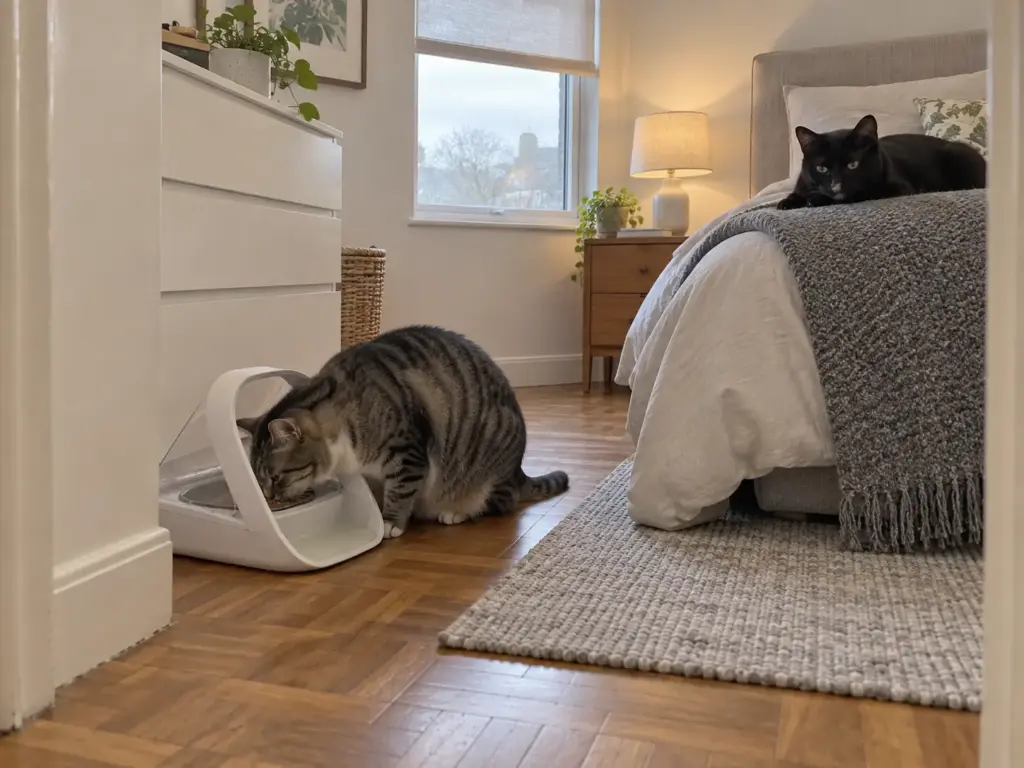
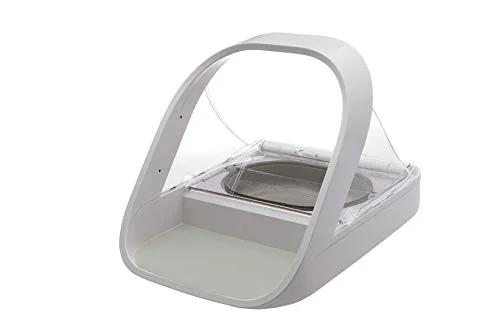
A microchip feeder reads the chip a cat already carries, or an RFID tag on a collar (the same device is often listed as an RFID feeder), and opens only for the cat it has been taught. HomeRunPet, which makes feeders of this kind, describes the lid staying sealed, or closing again fast, when an unregistered cat puts his head in. Think of a bouncer checking ID at the door of the bowl on every single visit, not just the first.
The part that matters most in a two-cat apartment is what it records. The SureFeed Connect, the model PetMD names for exactly this job, weighs what goes in and what’s left, so instead of “the bowl was empty” you get a number for each cat. That turns out to be the most useful thing in the last section of this article.
What it doesn’t do is control the room. PetMD makes the point directly: even a good automatic feeder can’t stop a dominant cat from hovering around a timid one while she eats. The bowl is protected. The cat eating from it isn’t, which is why where the feeder goes matters as much as what it does.
The obvious plan is one gated feeder per cat. In practice, most two-cat homes need exactly one, for the cat who’s losing food: he keeps his ordinary bowl, hers only opens for her, and you’ve bought half the hardware. Honestly, it’s still the most expensive rung here by a wide margin, and it asks for patience at the start, because a lid that moves near her food is a strange object to a cat. The usual advice is to prop it open for the first several days, until she has learned that the new thing is just a bowl.
Finding a Spot for It in a Small Apartment
The feeder doesn’t replace a station; it is one. It’s a countertop unit that needs no drilling, but it still takes a spot from the count you made at the start, and it needs what any station needs: a hard surface, out of the walking line, away from all three boxes.
Because it protects the bowl and not the cat, put it where she can eat with a wall behind her and a view of the room, so nobody can come up on her from behind while her head is under the hood. In the three layouts above, that means whichever station is already hers: the bathroom or the partition station in a studio, the bedroom in a one-bedroom, the floor spot at the mouth of the galley in an open-plan room.
Put the feeder exactly where the protected cat already eats, not where it’s handy for you to fill. A lid that moves is enough novelty for one week without the room being new as well.
Keeping Two Stations Working in a Small Kitchen
Two cats, two feeding stations, three water bowls, one small sink. Maintenance is where small apartments give up on the setup without ever deciding to.
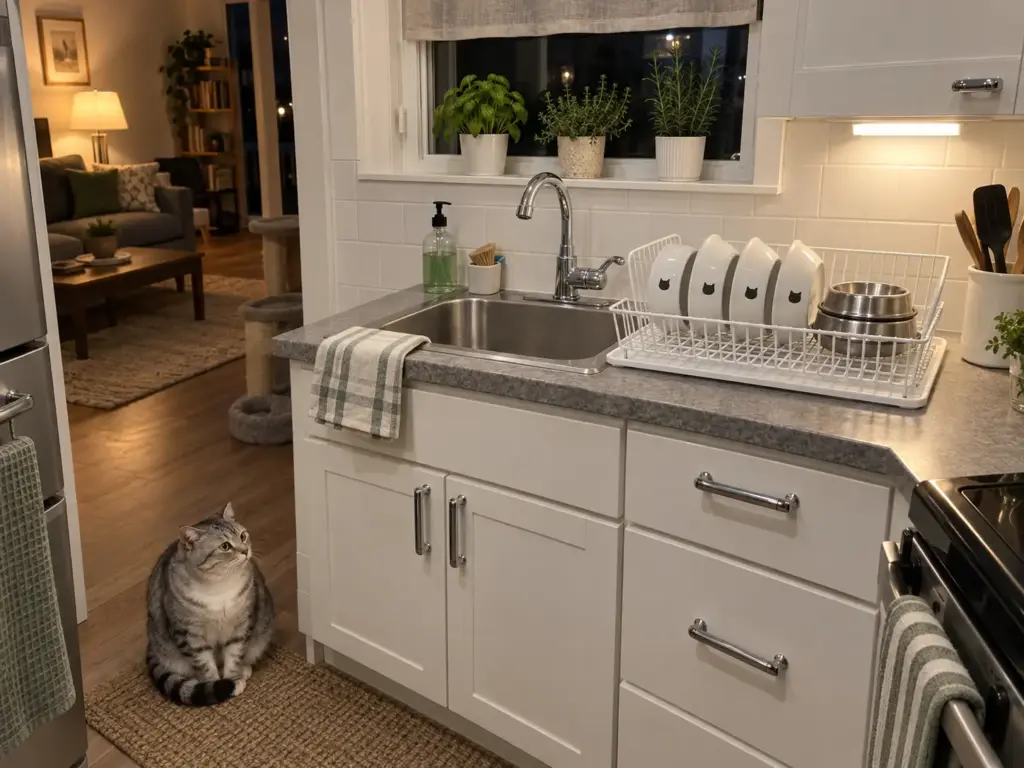
Double the Dishes, One Small Sink
Two food bowls after every wet meal plus three water bowls a day is a lot of washing for a kitchen with one sink and a drying rack the size of a cutting board. On a tired night, that pile is the real reason the second station gets merged back into the first: one bowl is less to wash than two.
The fix is a second set. Keep one full set of bowls in use and one clean in the cabinet, and swap them as a set rather than washing each bowl the moment it’s empty. It doubles the bowls you own and cuts the number of trips to the sink. The schedule for how often each of those bowls actually needs washing is worth a look once you’re running five of them, because the water bowls are on a shorter clock than most people assume.
Watching What Each Cat Eats
Separate stations buy you something beyond peace at dinner. With one shared bowl you know the household ate. With two stations and bowls that come up after twenty minutes, you know what each cat ate at every meal, without weighing anything: you just look at what’s left in each bowl when you pick it up.
If one of those bowls starts coming back fuller than usual, and keeps doing it, that’s a call to your vet, not a change to the layout.
Back to the kitchen, then. The cheapest portion control there is also makes the bowls readable: the same size of bowl and the same portion at every meal, so a leftover actually means something. Two different bowls holding two different portions make what’s left impossible to read at a glance.
When the Stations Drift Back Together
The instinct is to tuck the second station somewhere out of the way, and that instinct is why it fails. Out of the way for you means awkward to fill at seven in the morning, and the awkward station is the one that creeps back toward the kitchen, a few inches every few days, until one morning both bowls are side by side again and nobody decided it.
So make the far station the easy one. Keep that cat’s food in a small lidded container right next to her station, with its own scoop, so feeding her is one motion instead of a trip. Once the food lives at the far station, it stops being the far one.
Count First, Buy Last
Three things change how this goes. Count before you place anything: two cats need about eight spots, and the litter boxes pick theirs first. Use the doors, corners and heights your floor plan already has, whether that’s a bathroom door in a studio, a bedroom in a one-bedroom or a cat tree across an open-plan room. And fix the routine before you buy a device, because set times and bowls that come up after twenty minutes solve most of this for nothing.
Put a reminder in your phone for twenty-one days from today. On that day, look at two things: whether both cats still eat at their own stations on a day you’re out, and whether the far station has crept back toward the kitchen.
Tonight, take the second bowl out of the kitchen and put it behind the nearest door frame. If it holds for three weeks, you just saved the price of a feeder.
Amazon’s Audible — free for 30 days
Your cat won’t let you read. Let someone read to you.
Audible is Amazon’s audiobook library — thousands of titles, read out loud, on your phone. Free for a month, plus one audiobook to keep forever.
Frequently Asked Questions
01Is it safe to feed two cats at the same time?
Yes, feeding two cats at the same time is safe and usually easier, as long as each one eats at its own station, out of the other’s line of sight. Neither cat spends the meal waiting and watching. Lift both bowls after about twenty minutes so nothing is left for the faster eater to finish.
02How far apart should two cats’ food bowls be in a small apartment?
Far enough that neither cat can watch the other eat, and in a small apartment a wall, a door frame or a height difference does that better than open floor. Where there is room, four to six feet with a broken sightline works. In a studio, a bathroom that does not hold the litter box can be the second room.
03How many litter boxes do two cats need in a small apartment?
Two cats need three litter boxes, one per cat plus one, and in a small apartment they get placed before the food, because a box has far fewer places it can work. Keep both feeding stations well away from all three.
04Is it okay to have two cats in a small apartment?
Yes, two cats can live well in a small apartment, because floor area matters less than how many separate spots it offers, shelves, windowsills and cat-tree platforms included. Two cats need about eight: two feeding stations, three water bowls and three boxes. Most small apartments have them once you count upward.
05What is the 3-3-3 rule for cats?
It is a rough adjustment timeline shelters give for a newly adopted cat: about three days to decompress, three weeks to learn the routine and three months to feel at home. For feeding, it argues for giving a new cat its own station from day one rather than sharing first and separating later.


Leave a comment