Best Automatic Feeder for Multiple Cats, Chip or Not
Don't buy a dual-bowl feeder to stop food stealing (17 inches won't do it). Three multi-cat problems, three different setups & only one needs a chip.

Alfredo RamsesFounder · September 21, 2026 · 24 min read

On this page8 sections
- 1Which Multi-Cat Feeding Problem You Actually Have
- 2Cats Don't Eat Family Style, and That's the Whole Problem
- 3The Free Fix, and When It Stops Being Enough
- 4How Far Apart the Stations Have to Be
- 5The Feeder That Only Opens for One Cat
- 6The First Week, and What the Log Tells You After It
- 7Conclusion
- 8Frequently Asked Questions
The cat who finishes the other one’s portion is not being greedy. He is a solitary hunter who has been handed a shared dinner table, and he is doing the only sensible thing with it. The cat behavior consultants who get quoted in every buying guide keep making the same point in the same words, and the multi-cat weight research exists precisely because nobody can tell who ate what from a bowl two cats walk up to.
So the question is not which automatic feeder for multiple cats wins a ranking. It is which of the three multi-cat feeding problems you actually have, and which setup matches it, chip or no chip.
Quick Answer
Three multi-cat problems, three different machines:
- One cat steals or guards food, so you need a feeder that opens only for that cat (chip or collar tag).
- One cat is on a different diet or being weighed, so you need the same gate plus a record of who ate.
- No conflict, just uneven portions, so two ordinary timed feeders far apart, one feeder per cat. No chip needed.
Which Multi-Cat Feeding Problem You Actually Have
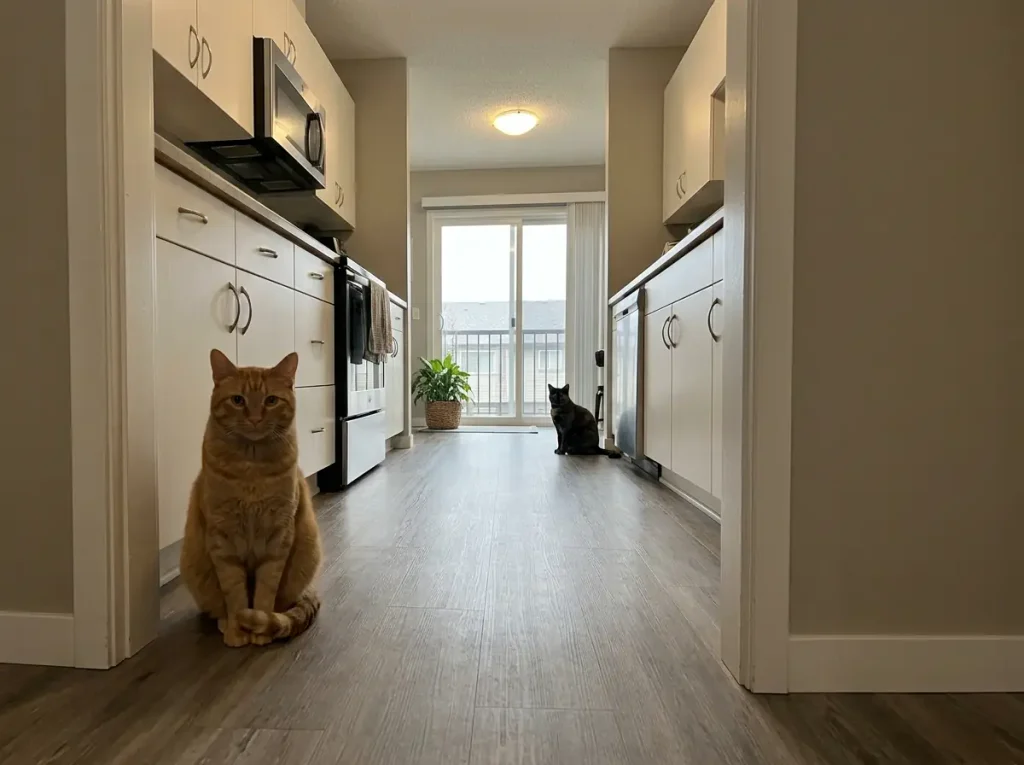
Everyone arrives at this search with the same sentence: one of them eats the other one’s food. And that sentence turns out to mean three completely different things, which is why so many households buy the wrong machine, watch nothing change, and then buy a second one. Sorting yourself into the right case first is free, and it is the difference between a fix and a return label. If you have not settled on a feeder at all yet, start with what an automatic feeder does and doesn’t fix and come back once you know you want one.
Case one is food stealing and resource guarding. One cat physically blocks the other, or inhales the second bowl the moment its own is empty. Case two is a special diet cat
or being monitored, where the problem is not fairness but keeping one specific cat out of one specific food. Case three, the most common multi-cat household by a distance, is the one where nobody guards anything and the portions simply land unevenly because one cat is faster. Two of those three do not need a chip, and a chip will not improve them.
The Cat Who Guards, and Why Size Has Nothing to Do With It
The word the forums use is food bully, and it is worth knowing because it describes a job, not a weight class. The cat doing it is usually not the biggest one in the apartment. It is the confident one, the one who arrives first and eats with his shoulders square to the room. A nine-pound cat who is sure of himself will take a fifteen-pound cat’s dinner without a sound, and the fifteen-pound cat will let him, because backing off costs less than a disagreement.
Which is why nothing you see looks like a fight. There is no hissing, no swatting, no drama to photograph.
There is just a cat who waits, a bowl that empties, and a human who assumes the quiet one simply is not hungry. The guarding is doing its work in the silence.
The Cat on a Different Diet
This one is not about fairness at all. If a vet has put one cat on a specific food,
the goal is not that both cats get equal portions. It is that one cat gets none of something.
Portion size stops mattering and access starts. That changes the requirement completely: distance helps, but it is not a guarantee, and a cat with fifteen minutes and no supervision will get to a bowl on the other side of the apartment. This is the case where physical gating is the only honest answer, and it is worth saying plainly rather than burying it under product names.
What the diet is for, and whether it is working, is a conversation with the vet who prescribed it. The feeder’s job is logistics.
The House Where Nobody Guards and Portions Still Land Wrong
Then there is the ordinary version, and it is the one most readers actually have. Two cats who get along, one bowl or two bowls side by side, and one cat who eats faster and drifts over to finish whatever is left. Nobody is blocking anyone. The fast cat is just faster.
The trap here is free-feeding, dry food left out all day, because it hides all three cases equally well. When the bowl is always full, nobody can see who ate, and the household runs for months on the assumption that things are even. They usually are not. And the deeper problem is that cats don’t share a bowl the way the bowl implies in the first place, which is the next section and the reason the hardware market is shaped the way it is.
The expensive mistake, reported over and over, is buying for case one when you have case three, or the reverse. A dual-bowl unit bought to stop a determined thief is money spent on the wrong problem. So is a microchip feeder bought for two cats who were never in conflict.
Cats Don’t Eat Family Style, and That’s the Whole Problem
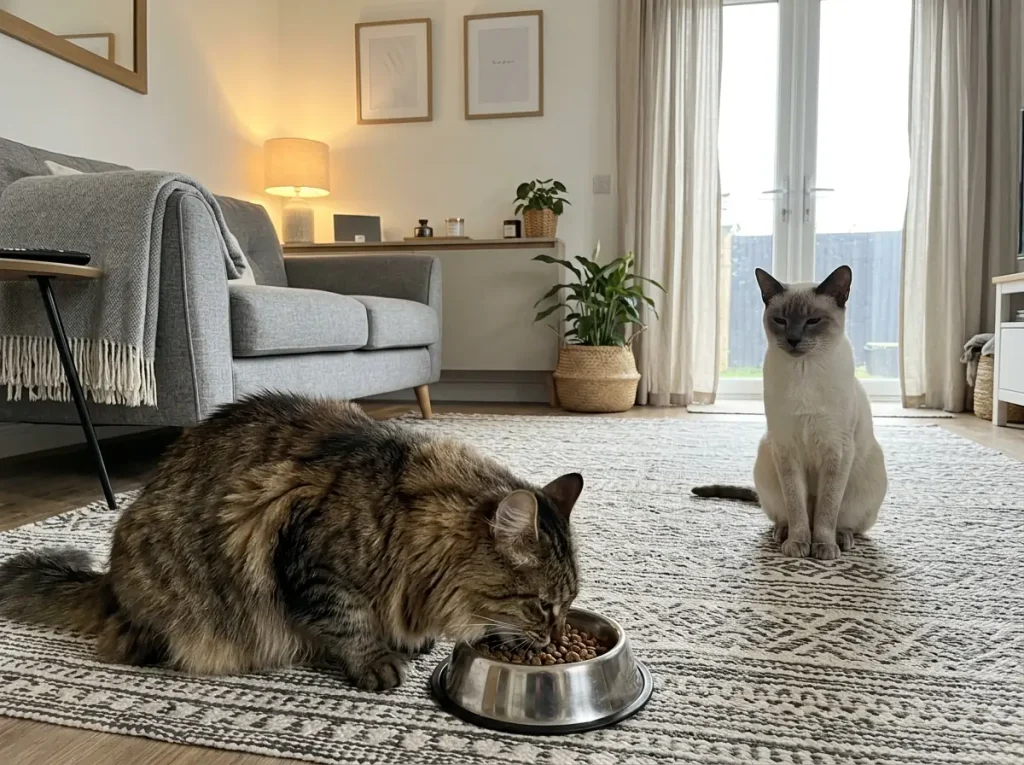
You have been thinking of mealtimes as a dinner table where somebody is taking more than his share. It is not a table. It is two solitary hunters who happen to have the same address, and the only thing they have agreed on is not to make an issue of it.
Cats evolved eating small prey, alone, several times a day. There is no version of that where two cats bring down a mouse together and divide it. So a cat eating next to another cat is not sharing. He is tolerating, which is a different activity with a different cost.
Cat behavior consultant Mikal Delgado puts it in four words that ought to be printed on the box of every dual-bowl feeder ever sold: cats are not family style eaters. The community even has a name for the assumption itself, family style eating, and it is exactly the assumption most multi-cat hardware is designed and marketed against.
What Tolerating a Housemate at Dinner Actually Costs
Tolerating is not free, and the bill does not arrive as a fight. It arrives as a cat who eats faster than he would alone, so he can be finished before anything happens. Or a cat who eats less and walks away with food still in the dish. Or a cat who simply waits, standing a meter off, until the other one is done and the good stuff is gone.
None of that registers as conflict. It registers as “he’s a slow eater” or “she’s just picky,” which are the two sentences that keep a bad feeding arrangement alive for years.
If you have ever watched one cat carry a mouthful of kibble out of the kitchen to eat it on the hallway rug, that is the same instinct wearing a different hat, and it is the same reason cats keep moving food away from the bowl you carefully positioned. He is not being odd about the dish. He is taking what he caught somewhere he can eat it without keeping one eye on the door.
Why “Just Feed Less” Corrects the Wrong Cat
Here is where the shared bowl gets genuinely expensive. When a household notices one cat looking heavier, the reflex is to put less food out. But the food was never going into two cats in a known ratio. It was going into an unknown split, and cutting the total cuts it for both, which usually means the cat who was already losing portions loses more.
That is not a theory. It is the reason the research on multi-cat weight management uses per-cat monitoring in the first place: a shared bowl makes intake genuinely unknowable, and the weight management guidance for multi-cat homes rests on portioned, monitored meals for exactly that reason. That is a management fact about bowls, not a judgment about any cat. If a cat’s weight has actually changed, that is a vet’s call and not an article’s.
So the answer is almost never a bigger feeder. It is as many feeding points as you have cats, which turns out to be a spacing problem before it is a shopping problem.
Before you buy anything, watch one meal without intervening. Note the order they arrive in and which one leaves first. That order tells you which of the three cases you have, it takes four minutes, and it is the only diagnostic in this article that costs nothing.
The Free Fix, and When It Stops Being Enough
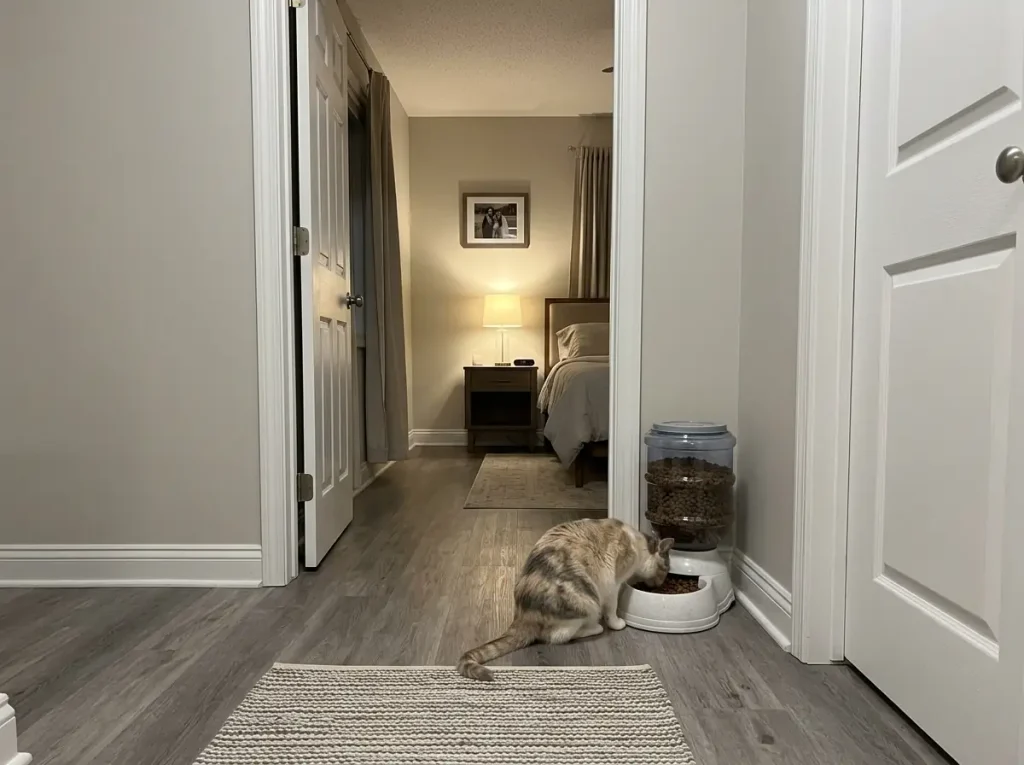
Before a single machine goes in the cart: a closed door at mealtime does what a several-hundred-dollar feeder does. Put one cat in the bedroom with his food, put the other in the kitchen with hers, wait twenty minutes, open the door. That is the whole method, it is reported constantly by households who cannot yet spend on hardware, and it works.
The reason it is not the end of the article is not that it fails. It is that you have to be home.
The Closed Door, and the Twenty Minutes It Needs
Twenty to thirty minutes is the real feeding window, because a cat who is separated tends to eat properly rather than racing, and a cat who is finished will tell you at the door. You need a room with a door that latches, a bowl or a hopper inside it, and the discipline to do it at both meals per day.
What kills it is a slip in the feeding schedule, and it is always the same story. It holds for a week, maybe two.
Then there is a late shift, or a dinner out, or one of those evenings where everything runs forty minutes behind, and the food goes down in the kitchen because it is the fastest option. The guarding cat wins by default. The manual fix doesn’t survive a busy week, and the three-week mark is where most people find that out.
So be honest about your own routine before you buy anything. If you are home for every meal and you always will be, you do not need the hardware in this article. Two cheap feeders behind two doors is your answer and you can stop reading.
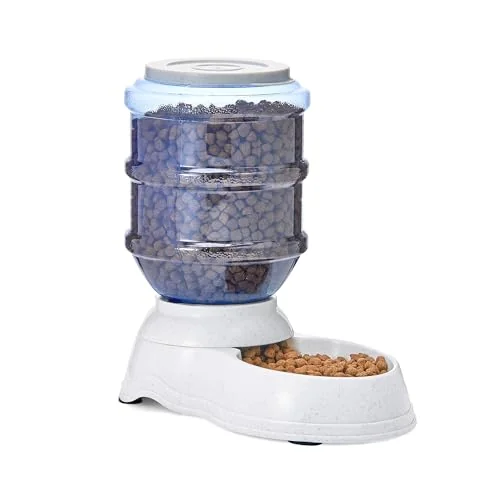
The cheapest hardware for that method is a plain gravity hopper feeder, one per cat, because the door is doing the separating and the machine only has to hold food. Gravity feeders take dry food only and they feed whoever shows up, which would be a problem in any other section and is the entire point in this one.
Protecting the Cat Who’s Losing, Instead of Gating the One Who’s Taking
Here is the reframe that a lot of households land on, and it is cheaper than the obvious approach by a wide margin. Stop trying to lock the thief out. Feed the victim separately instead.
I used to point people straight at a gated feeder the moment the word “stealing” came up. After enough threads where somebody solved the same problem with one basic timed feeder in the spare room, I stopped.
A simple programmable upright feeder for the cat who is losing portions costs a fraction of a wifi feeder with selective access for the cat who is taking them, and in a two-cat house with no prescription diet involved, it ends the problem just as completely. The thief still gets his food. He just does not get hers.
It does not work for case two. If one cat has to be kept out of a specific food, protecting the other cat is not enough and you need the gate. But for plain unfairness between two healthy cats, it is the cheaper half of the same solution and almost nobody suggests it.
How Far Apart the Stations Have to Be
Everybody says “separate feeding stations.” Nobody says how separate. And it turns out there are two completely different numbers hiding behind that phrase, which is the real reason the dual-bowl feeder somebody bought did not fix anything.
Two Bowls on One Machine, and What 17 Inches Actually Buys
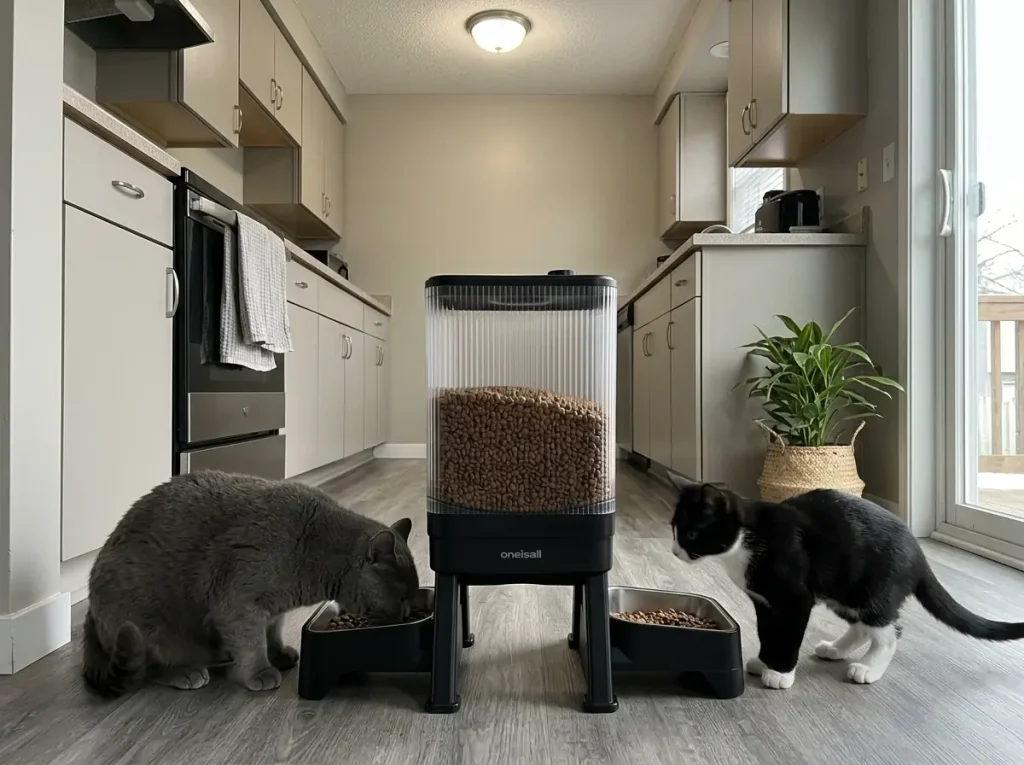
Tier one is the gap between two bowls on the same unit. The widest currently on the market is about 17 inches, sold as roughly 15% wider than a standard 5L dual-bowl feeder, and it is the only concrete spacing figure any manufacturer publishes. Treat it as a floor, not a target.
What 17 inches buys you is the end of casual competition: two cats who already tolerate each other can eat at the same time without their whiskers in the same dish, and the faster one has to make a visible decision to cross over rather than just leaning. That is worth having.
What it does not buy you is protection from a determined guarder. Twelve inches means nothing to a committed food bully, and neither does seventeen, because two bowls bolted to the same slab of plastic do not read as two places to a confident cat. They read as one station with a wide dish.
Four to Six Feet, and What That Means in One Bedroom
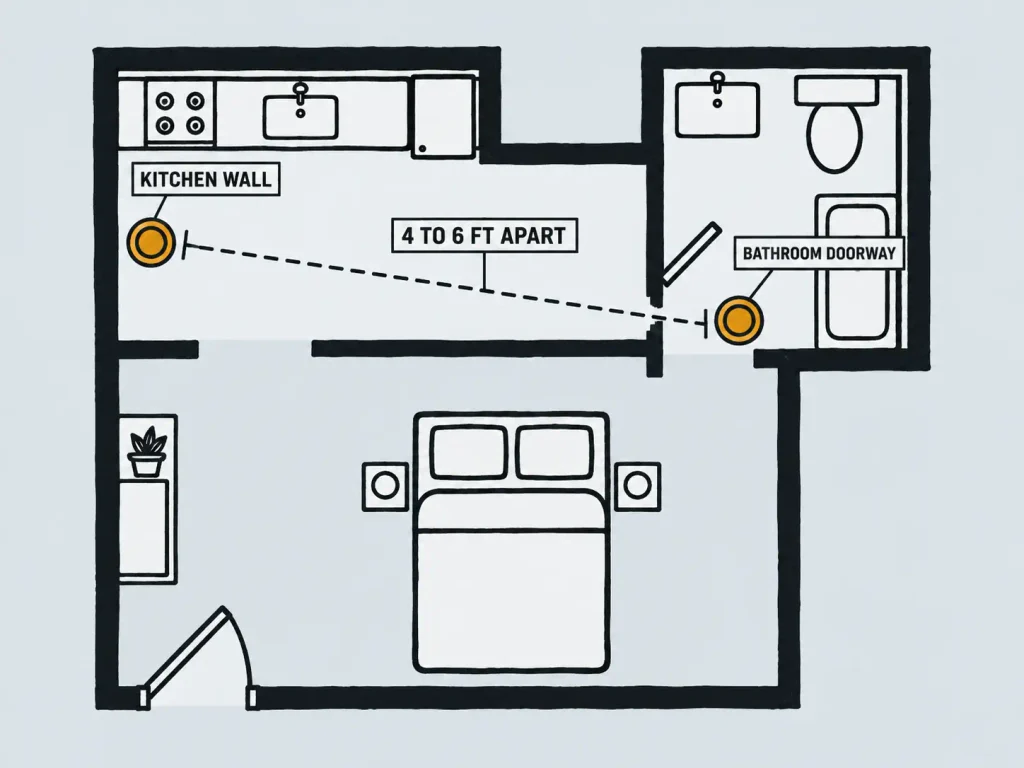
Tier two is room scale, and the working guidance is at least 4 to 6 feet between stations, angled so the cats are not facing each other while they eat. Different rooms is better.
This is the number that applies when there is real guarding, and it is roughly two long strides, which is more than it sounds like when you are standing in a kitchen.
In a small apartment, a one-bedroom or a studio, 4 to 6 feet means opposite walls, and it means giving up the idea that both feeders live on the same counter. One station in the kitchen and one just inside the bathroom with the door cracked is a genuine two-room setup, and it costs nothing but the willingness to have a feeder in the bathroom.
The inside of a closet counts too, door left ajar, feeder a foot inside. It is not elegant. It is the renter-friendly version: 4 feet of separation in an apartment that does not have 4 feet to spare anywhere else, and nothing screwed to a wall.
The counting rule underneath all this is the same one that decides litter boxes, so if you are running two cats on one feeding point, check whether you are also running them on too few boxes. It is the same counting rule that decides litter boxes, and the household that has one problem usually has the other.
Going Vertical When the Floor Is Full
When there is no floor space left, the apartment workaround is height: one feeder on a low shelf or a sturdy side table, one on the floor beneath or across from it. Vertical distance does some of the work horizontal distance would.
It comes with a condition, and it is worth being clear about it. This only works when the two cats differ enough in confidence or agility that the one on the floor will not simply follow the other one up. If both cats jump well and one of them wants the other’s food, you have moved the argument to a shelf. For a heavy, short-legged cat and a lighter one, or for an older cat and a young one, it can genuinely separate them.
Pace it out before you buy anything. Four to six feet is about two long steps, and if the only place both stations fit is one kitchen wall, you do not have two stations. The bathroom doorway is the second room you already own.
For two cats with no dietary conflict and no guarding, a dish-style feeder with a genuinely wide gap is the answer, and it solves timing and portion control in one box instead of two.
The Feeder That Only Opens for One Cat
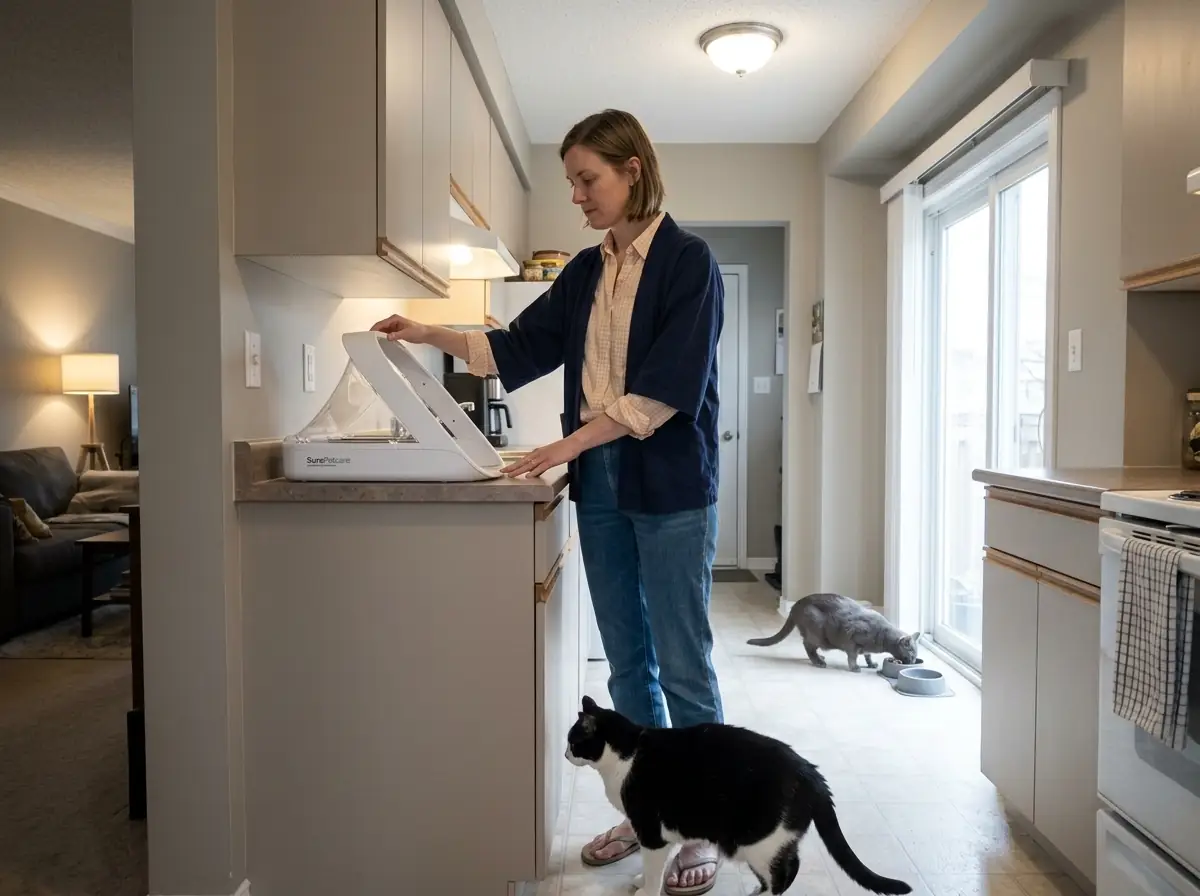
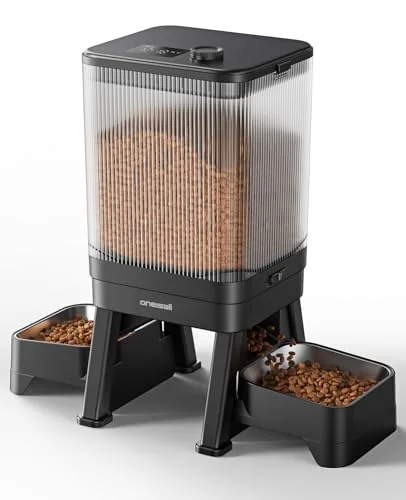
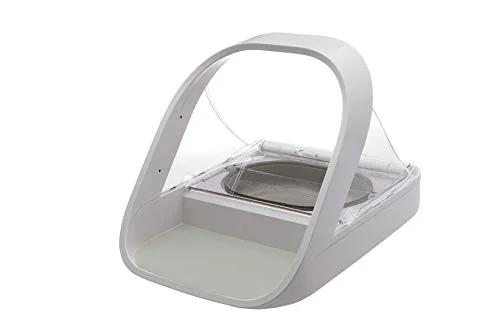
This is the part people think is exotic, and it isn’t. Your cat almost certainly already has the identification built in: the microchip a shelter or a vet put between his shoulder blades. An RFID feeder reads it, the lid lifts for him, and the tamper-proof hood does not lift for anyone else.
The real question is not whether the technology works. It is which form of identification your particular household can actually run.
There are three answers, and the comparison is about what the cat has to wear, not about which smart feeder has the longest spec sheet, not about which brand won a roundup.
| Feeder | What the cat has to wear | What it gives you |
|---|---|---|
| SureFeed Microchip Connect | Nothing — reads the implanted chip | A lid that physically will not open for the other cat |
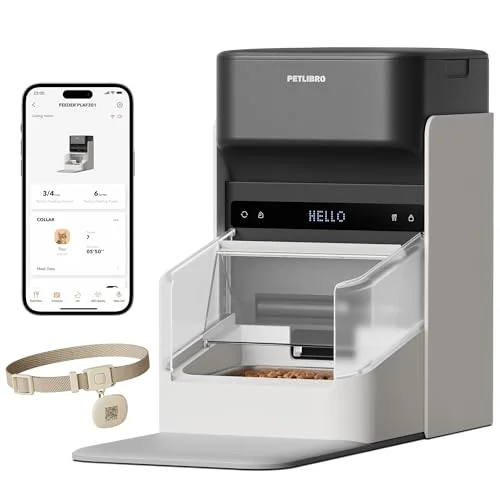
| PETLIBRO RFID Collar Tag-Activated | A light RFID tag on the collar | The same gate, as long as the collar stays on |
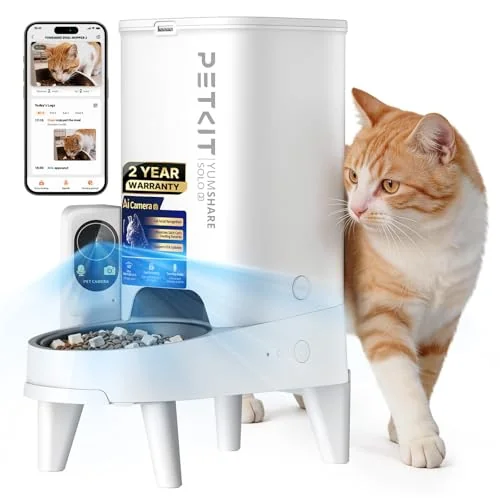
| PETKIT Multi-Cat Recognition with Camera | Nothing — camera recognition | A record of who ate, not a locked lid |
Microchip, When the Cat Is Already Chipped
This is the cleanest version of the idea. The chip is already in the cat, there is nothing to buy for him, nothing to fasten around his neck and nothing to lose under the sofa. You press a learn button, the cat walks up, the unit scans him and stores him. Registration takes about ten minutes for the whole household.
Capacity is not the constraint people expect either. A unit that stores up to 32 profiles is not a two-cat product with a two-cat ceiling, so a three-cat or four-cat house is comfortably inside the design. The limit you will hit first is physical: one gated feeder per cat who needs gating, and a place to put each one.
A Tag on the Collar, for the Cat Who Isn’t
If the cat is not chipped, the mechanism does not change. The feeder reads a small RFID tag clipped to the collar exactly the way it would read an implant, the lid behaves identically, and the unit usually ships with the tag in the box. It is the cheaper route into selective access, and for plenty of households it is also the more practical one.
The pega is the collar. A tag that is off the cat is a tag that is not opening anything, and a cat who slips a breakaway collar on a chair leg has just locked himself out of dinner. If your cat wears a collar reliably already, this is the sensible choice. If he takes it off twice a month, buy the chip reader or the camera instead.
Camera Recognition, for the Cat Who Won’t Wear a Collar
Then there is the cat who is not chipped and will not keep a collar on, which is a real combination and not a rare one. Camera recognition identifies the cat by sight, with nothing on him and nothing in him.
And here is the honest distinction, because the marketing tends to blur it: a camera feeder mostly logs who ate rather than physically gating a lid. That is a genuinely different product.
If your problem is “I do not know who is eating what,” it answers the question completely. If your problem is “this cat must not get into that food,” a record of him doing it is not a solution. Know which sentence is yours before you spend.
What the Hood Costs the Cat
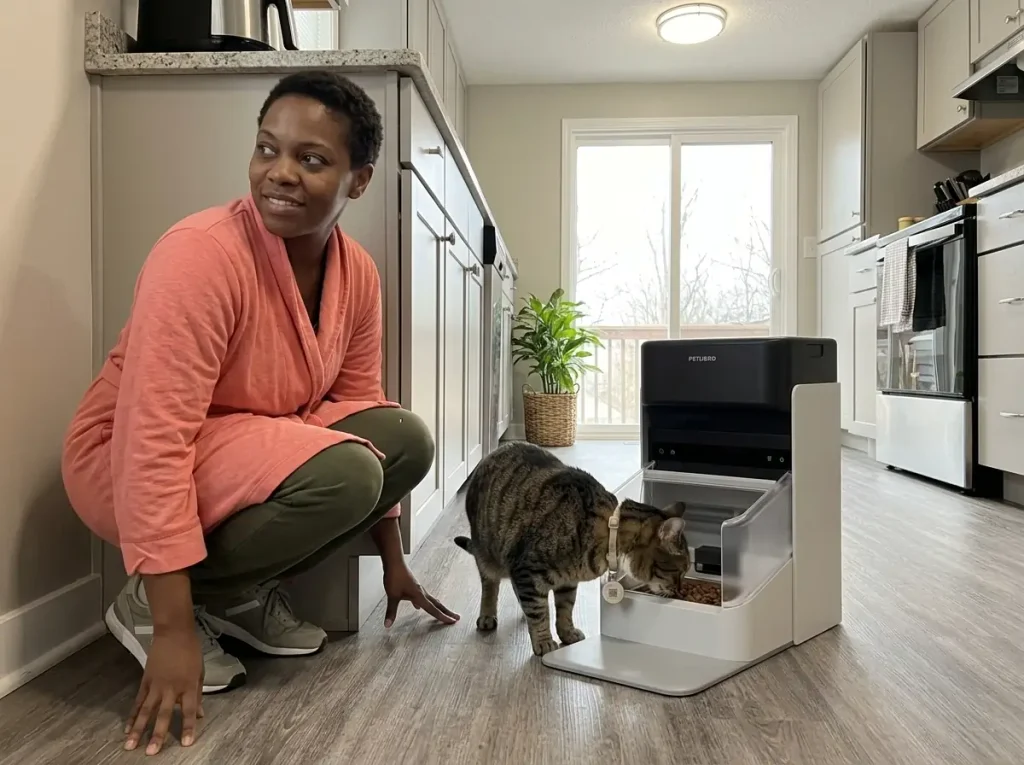
Every gated feeder puts a hood over the bowl, because that is how the gate works, and it is a trade the cat pays and the human does not. A cat with his head inside a plastic tunnel cannot see the room. For a confident cat that is nothing. For a cat who already eats with his ears swiveling, it is the whole problem, and it is why a gated feeder that gets refused is usually refused for this reason rather than for the chip.
So placement matters more for a gated feeder than for an open bowl, and in the opposite direction from what you would guess. Wall behind it, open floor in front, out of the traffic lane between two rooms. Give him back with the position what the hood took away.
The same selective-access trick is what solves the other multi-species version of this, so if the competition at dinner is a dog rather than a second cat, the mechanism for keeping a dog out of the same bowl is the one you want.
The First Week, and What the Log Tells You After It
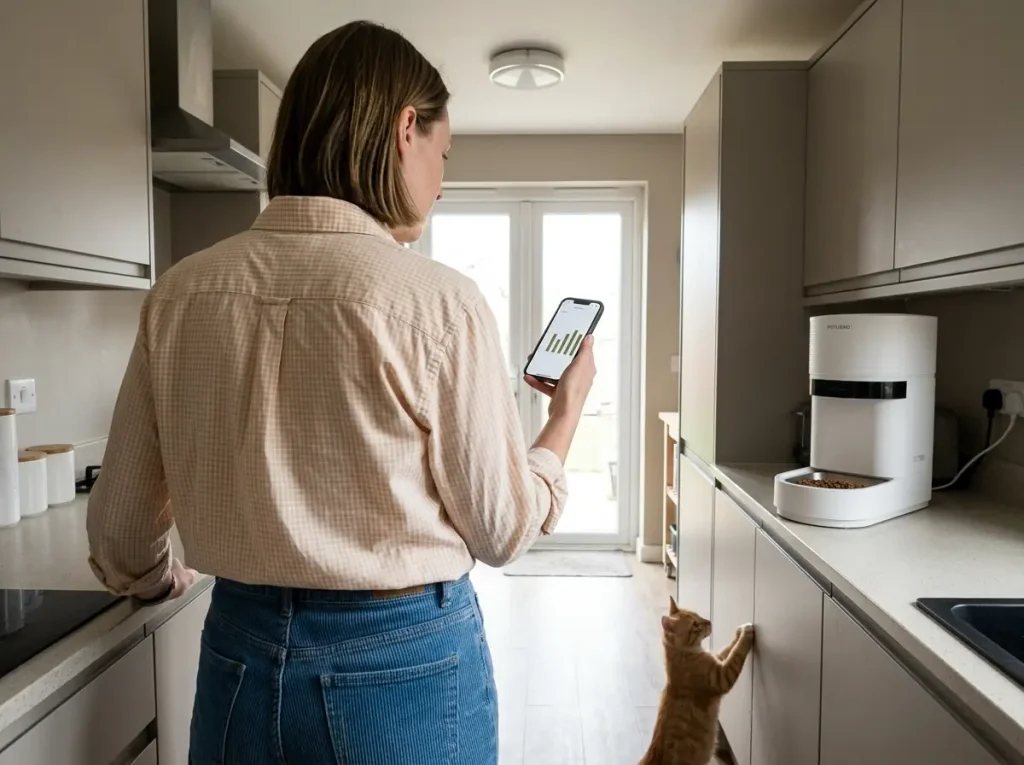
The machine arrives. The chip is registered in ten minutes. And then the cat sits in front of it and refuses to put his head under a lid that moved once. This is the part that decides whether the thing gets used or returned, and it is the part nobody puts in a review.
Why the Lid Is the Problem, Not the Chip
Recognition is not what fails in week one. The lid is. It moves, it makes a noise, and the cat who was standing over it takes two steps back and reassesses everything he thought he knew about that corner of the kitchen.
Then he sits at a distance and watches it. This goes on for a few days, and it ends the way most standoffs with a cat end: he gets hungry, comes back, and tries again on his own terms.
He is not being stubborn. A lid that opens when he approaches is, from where he is standing, a thing that moves by itself near his food. Backing off is the correct response to that, and the fact that he re-tries at all is the concession.
Using the Training Mode Instead of Skipping It
Manufacturers already know this, which is why several units ship with a multi-stage training mode that opens the lid only partway to start with and widens over days. It exists because skipping it breaks trust, and rebuilding trust with a cat takes considerably longer than the four days the training mode asks for.
Use it. And while you are at it, keep feeding both cats in sight of each other in the old arrangement for the first few days, then move the gated unit to where it is going to live. Changing the food and the furniture in the same week hands the cat two things to refuse and leaves you unable to tell which one he objected to.
What the First Month of Records Shows
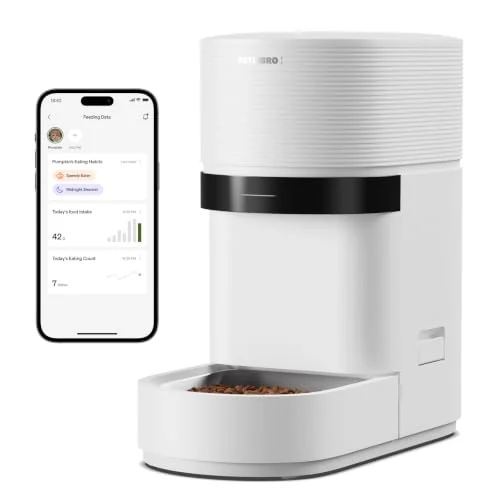
Then the data arrives, and this is the part that reorganizes a household. The story that keeps surfacing in multi-cat threads is the same one every time: somebody sets up a weighing feeder with app control, opens it after a few weeks, and finds that one cat has been eating around 70% of the food.
Not for a week. For as long as anyone can remember. It was invisible because there was never a number, only an impression, and the impression was that things were roughly fair.
A scale measures what actually landed in the bowl, which is portion accuracy rather than portion setting, and the two are not the same number.
That number is worth having on its own terms. What you do with it is a conversation with a vet, not with this article, and especially so if either cat’s weight has moved.
The other thing the first month exposes is you. Cats settle inside a fortnight, one way or the other, but the human half of a routine loosens at about week three, and that is when a setup that only works while you are paying attention quietly stops working. Once the hardware is chosen, the next decision is how many meals to set it for, and getting that right is most of what keeps the routine from needing you.
Register the chip with the feeder sitting where the cat already eats, not where it is going to live. Two changes at once gives a cat two reasons to refuse, and you will not know which one it was.
Conclusion
Decide which of the three problems you have before you buy anything. Theft, a separate diet, or plain uneven portions are three different situations, and two of them do not need a chip at all.
Distance does most of the work a machine gets credit for. Two ordinary feeders on opposite walls beat one clever feeder on the counter, every time, and the 17 inches a dual-bowl unit gives you is a floor for cats who already get along rather than a substitute for the 4 to 6 feet that guarding actually requires.
And if you are home for every meal, a closed door and two cheap feeders is the entire solution. Try that before you spend.
🗓️ Come back to this in three weeks. Cats accept or refuse a new arrangement inside a fortnight, and the human half of the routine is the part that slips by week three. Check three things: who is arriving at the food first, whether both cats are finishing, and whether you are still running the gated feeder the way you set it up or whether you have started leaving the lid propped.
Move one feeder to the far wall tonight and shut a door at dinner. If that settles it, you have just saved yourself the machine.
Amazon’s Audible — free for 30 days
Your cat won’t let you read. Let someone read to you.
Audible is Amazon’s audiobook library — thousands of titles, read out loud, on your phone. Free for a month, plus one audiobook to keep forever.
Frequently Asked Questions
01Do I need one automatic feeder per cat?
In most multi-cat homes, yes. One feeding point per cat, in separate places, is the arrangement behavior consultants keep recommending. The exception is a household where nobody guards food and portions are the only issue, where one dual-bowl unit with a wide gap covers two cats.
02Will a microchip feeder work if my cat isn’t microchipped?
Yes, with a collar tag instead. The feeder reads the RFID tag the same way it reads an implanted chip, and most units ship with one in the box. If the cat removes collars, a camera-recognition feeder logs who ate without the cat wearing anything.
03How do I stop one cat from eating the other’s food?
Gate the food physically, or separate it by distance. A selective-access feeder that opens only for one cat is the version that survives a busy week. Feeding in separate rooms behind a closed door does the same job for free, as long as you are home for every meal.
04Can two cats share one automatic feeder?
Only when neither cat guards food and both eat the same diet, and then the unit needs two bowls set as far apart as it offers — around 17 inches at the widest on the market. If one cat blocks the other, the same unit will not fix it however the bowls are spaced.
05How long does it take cats to get used to an automatic feeder?
Usually a few days to a couple of weeks, and it is the lid motion they are adjusting to rather than the machine itself. Use the training mode if the unit has one, and register it where the cat already eats before moving it to its final spot.
Leave a comment