Can Cat Bowls Go in the Dishwasher? Check the Material
Cat bowls in the dishwasher [the real rules]: 18/8 steel, plain glaze & 100% silicone go in. Sanitize hits 150°F; the eco cycle never does.

Alfredo RamsesFounder · September 28, 2026 · 18 min read


On this page8 sections
- 1What the Answer Actually Depends On
- 2The Materials That Survive It, and the Ones That Quietly Don't
- 3The Cycle That Sanitizes, and the One That Just Rinses
- 4Where the Bowl Goes in the Rack
- 5What the Cycle Leaves Behind
- 6Whether One Cat Justifies the Load at All
- 7Turn the Bowl Over Before You Buy Anything
- 8Frequently Asked Questions
You are holding the bowl. The dishwasher door is open, the rack is half full, and you have just turned the bowl over to look for the little symbol everyone talks about. There is nothing printed on the bottom. Not a word.
That blank underside is why cat bowls in the dishwasher gets searched at all, and none of the top results solve it, because every one of them is written for pets in general or for dogs. The cat part changes the answer: a cat puts its nose into the bowl before the first bite, so what the cycle leaves behind is a real consideration and not a theoretical one. Here is what the answer depends on, which materials survive, which cycle is doing the work, where the bowl goes in the rack, and whether an apartment with one cat should be running a load for two bowls at all.
Quick Answer
Yes, if the bowl is stainless steel, plain glazed ceramic or 100% silicone. Painted ceramic, wood and thin plastic do not survive repeated hot cycles, and most cheap cat bowls carry no dishwasher-safe symbol at all, so the material answers the question instead of a label. Use the sanitizing cycle with heated dry if the point is to disinfect.
What the Answer Actually Depends On
There is no rule about cat bowls. There is a rule about materials, and it is the same rule that governs the mug you drank coffee out of this morning. Whether this bowl can go in depends on one condition: can it take a sanitizing cycle without the surface giving up.
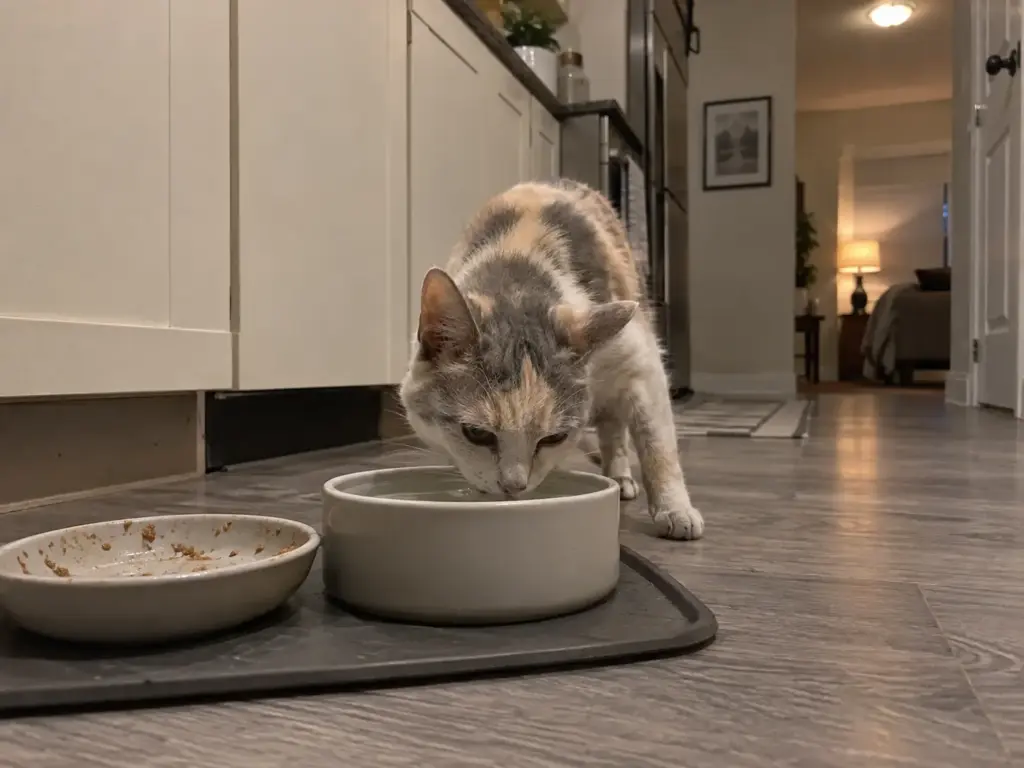
That is a relief, because it means you already own the information you need. It is on the bowl, not in a manual you threw away, and it sits alongside the rest of where the bowls sit and what quietly wears them out.
The Label Is the Gate, Not the Species
The CDC’s position on this is plainer than most people expect. Pet bowls can be washed in the sink or the dishwasher if they are labeled dishwasher-safe, and running them in the same load as your own plates is acceptable. The gate is the label, not the animal.
So the question was never “are cat bowls dishwasher-safe,” which has no answer, but “is this bowl dishwasher-safe,” which does. Two bowls sitting six inches apart on the same kitchen floor can give you two different answers, and usually do.
Why This Is a Daily Question, Not a Weekly One
A wet-food bowl gets washed after every meal. A dry-food bowl and a water bowl get a daily wash. That is the CDC’s own pet-bowl cleaning schedule, and the appliance side lands on the same split independently.
According to the CDC, “Pet bowls: Clean after every use for wet food and every day for dry food and water.”
That cadence is the whole reason the dishwasher question matters. Nobody agonizes over a chore they do on Sundays. You are deciding this two or three times a day, every day, for as long as the cat lives with you, which is exactly why a system that only works when you are in the mood is not a system.
Running Them With Your Own Dishes
Mixing is permitted, and the cross-contamination worry behind the question is the reason people ask it at all. The cautious version is a separate load, and both positions are defensible. The honest answer is that in a small kitchen with one dishwasher and no counter space, the separate load is the one that quietly stops happening by the second week, and a habit you actually keep beats a stricter one you abandon. Sanitizing heat does not care whose plate it is.
The Materials That Survive It, and the Ones That Quietly Don’t
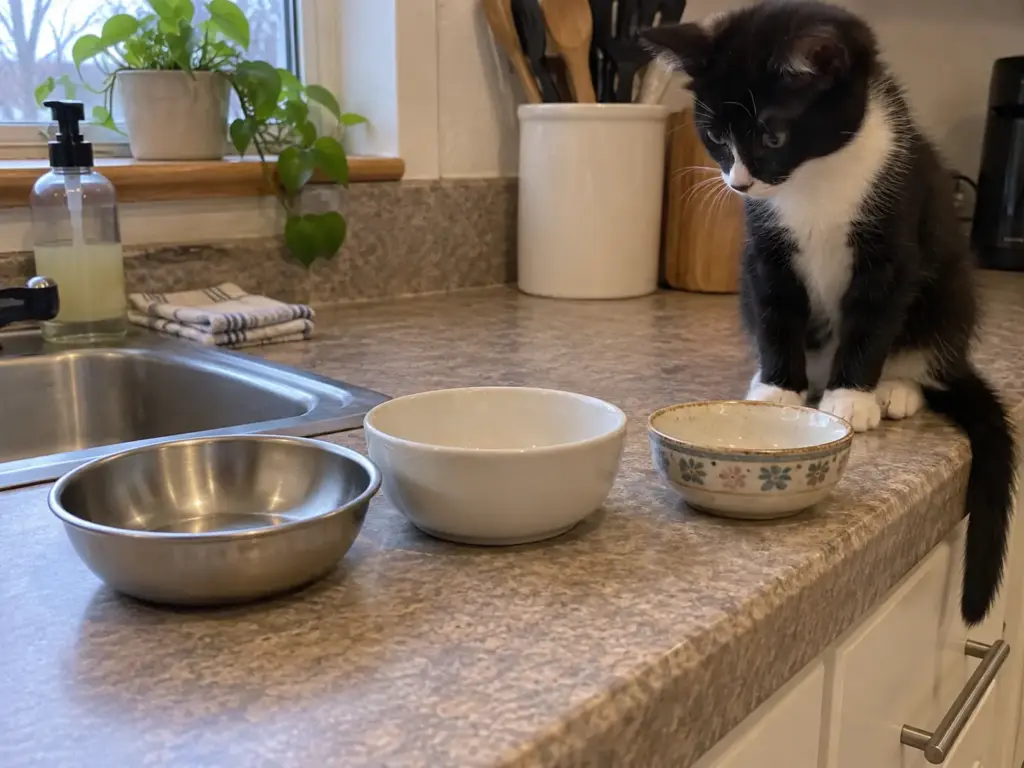
The bowl that went cloudy after a few months did not fail randomly. The painted one that lost its pattern around the rim did not fail randomly either. Both were hand-wash-only, and nothing on either of them ever said so. Before you buy anything, turn over what you already have, because the material tells you more than a missing sticker ever would.
Stainless Steel, and the Number Stamped Underneath
A stainless steel bowl is the safe default. Maytag’s Gerrod Moore calls stainless steel the most sanitary material for pet bowls, durable, easy to maintain and usually dishwasher-safe, and nothing in the research argues with him.
But steel is not one material, and this is where the cheap ones separate from the rest. The spec to look for is a 18/8 or 304 stamp on the underside. Americat Company specifies that 18/8 steel will not alter the taste of food and will not corrode despite constantly holding water and being washed. Ungraded import steel is where the little rust freckles and bacteria buildup show up after a few months of hot cycles, usually around the base where water pools.
The Americat Company stainless steel cat bowls come as a two-pack in that graded 18/8 steel, which makes them a clean comparison point for whatever unmarked steel bowl you are currently holding. If yours is stamped, you already have the answer and you do not need to replace anything.
Glazed Ceramic Versus Painted Ceramic
Ceramic gets treated as one category and it is really two. Plain glazed ceramic handles the dishwasher fine. Painted or hand-decorated ceramic is where it falls apart, and the failure point is not the clay, it is the decoration and the glaze sitting on top of it.
Repeated 150-degree rinses lift color, craze the surface into a spiderweb of hairline cracks, and turn a smooth bowl into a textured one. Moore’s framing is that ceramic and plastic are more porous and often were never designed for the dishwasher at all, which makes them hand-wash-daily whether or not the box admits it.
If your ceramic bowl has already started crazing, the ceramic cat food bowl set is a food-grade, wide and shallow four-pack that is a straightforward swap. The catch with any ceramic is the one ceramic has always had: it is the material that does not survive being knocked off a counter.
Silicone, the One Nobody Mentions
Silicone is the third safe material and almost nobody names it. 100% silicone takes hot cycles without warping, without scratching and without holding odor, which is more than a thin plastic bowl can claim in any of those three.
Most readers do not own a silicone bowl, but a lot of them own a silicone mat under the bowls, and the mat is the item that actually collects the wet-food splashes. The Amazon Basics silicone pet feeding mat has raised edges that keep the mess contained and goes through the same cycle as the bowls it sits under. One caveat that applies to every silicone item in a dishwasher: it comes out of the machine lighter than everything else in there, and light things move.
The Bowl With Nothing Printed on the Bottom
Here is the part the ranking results skip. There is no universal dishwasher-safe icon, and no standard care label behind it. Manufacturers do not agree on one, so what you are looking for is a box with water lines on the underside, and a line struck through it means no.
Absent any symbol at all, and cheap cat bowls are usually absent any symbol at all, there is no manufacturer claim in either direction. Nobody has promised you anything and nobody has warned you off.
Which is why the material becomes the label: plain glazed ceramic, stamped 18/8 or 304 steel and 100% silicone go in; painted or crackled ceramic, wood and thin injection-molded plastic stay at the sink. “Hand-wash only” is forum shorthand for a bowl people worked this out about the hard way, over several cycles, long before they found anything printed.
Turn the bowl over in the store, not at home after the third cycle. A box-with-water-lines symbol on the underside is a claim you can hold the manufacturer to. A blank bottom on a painted bowl is the one to assume is hand-wash-only, and assuming that costs you nothing.
Thin plastic loses on heat, and it also loses on something else entirely. It scratches, and those scratches hold what you cannot rinse out, which is why plastic has a second problem that has nothing to do with heat. The two failures compound: the hot cycle warps and micro-abrades the surface, and the abraded surface is the one that traps residue. And the same steel-or-ceramic decision shows up when the bowl is raised, because a stand changes the height and nothing about the material.
The Cycle That Sanitizes, and the One That Just Rinses
Most people run the same cycle for everything and assume hot water is hot water. It is not, and the difference has a number attached to it.
What 150 Degrees Is Doing That a Normal Cycle Isn’t
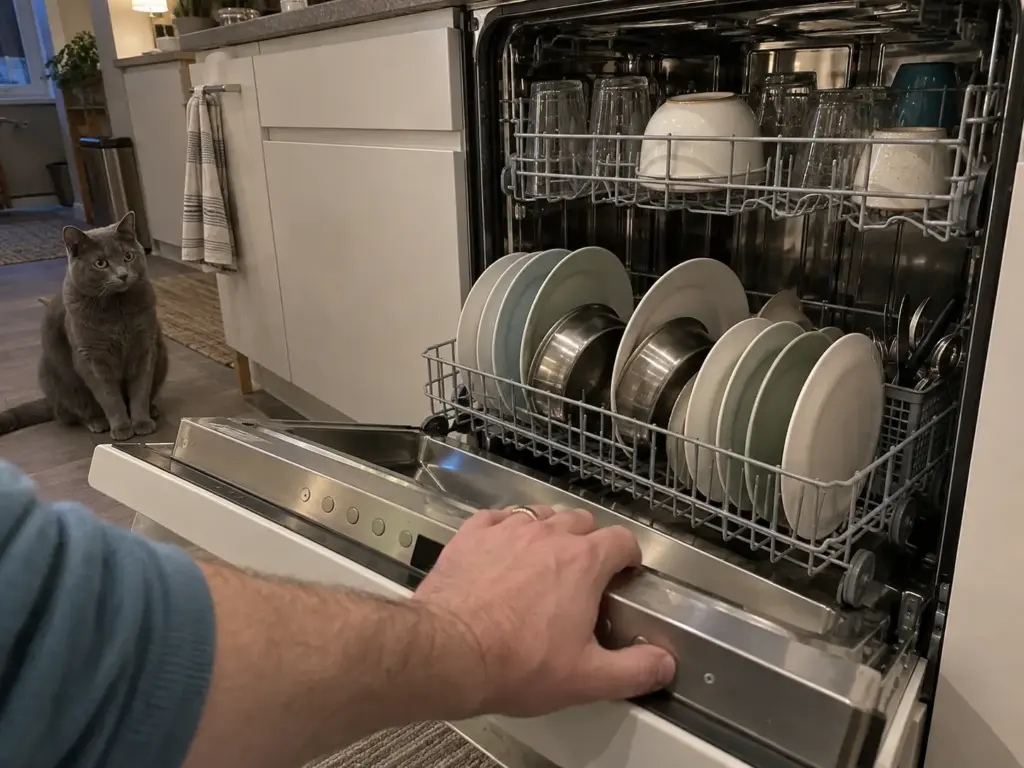
📏 The NSF residential standard for a sanitizing dishwasher requires the final rinse to reach roughly 150°F, with the wash phase at or above 135°F, hitting a 5-log reduction in bacteria. That is 99.999%, and that is what a dishwasher’s sanitizing cycle is actually required to hit. It is what the sanitize button buys you, and a high-temperature wash is measurably different from the eco cycle you run to save water.
The eco cycle cleans. It does not disinfect. The gap between the two is not a matter of degree either, because the eco setting saves energy precisely by running cooler and longer, which is the opposite trade from the one you want here.
The organisms that guidance is written around are the ordinary kitchen ones, salmonella and E. coli, which move between a pet bowl and a countertop exactly the way they move between a chopping board and a countertop. For a dry-food bowl that distinction usually does not matter much; kibble residue is dry and the bacterial load is low. For a wet-food bowl that sat out for twenty minutes at room temperature before you cleared it, in a home with someone immunocompromised, elderly or very young in it, the distinction is the entire point of this section.
The conventional advice is to run everything on the setting that uses the least water. In practice, the bowl that holds wet meat protein twice a day is the one item in the machine that earns the hotter cycle, and the way to have both is to time it: run the eco cycle on the days the load is mostly plates and glasses, and save the sanitize button for the evening load with the bowls in it.
The Heat-Dry Setting Is Half the Instruction
The CDC’s guidance maps onto the NSF number cleanly: any wash setting is acceptable for routine cleaning, but to disinfect, use the high-temperature or sanitizing setting and the heat-dry setting. People read the first half and skip the second, because heated dry is the setting everyone turns off to save energy. Turning it off after a sanitizing wash gives back part of what the heat just did, since a bowl that air-dries slowly in a humid box is a bowl sitting in warm moisture for an hour.
If your machine has a sanitize option, heated dry is not optional. It is the second half of the same instruction. Check whether yours ships with a “Sani Rinse” or a pet sanitize cycle, because that button is exactly what the CDC language is describing and most people never press it.
Skip the Vinegar Rinse
The vinegar trick circulates constantly and it does not hold up. The CDC is explicit that there is not enough research showing how well vinegar neutralizes germs, and it does not endorse it as a disinfectant. It will cut hard-water film, which is a different job and a real one. But if the thing you are trying to accomplish is disinfecting a bowl, the sanitize cycle does it and the vinegar does not.
Where the Bowl Goes in the Rack
“Top rack only” is a habit most of us apply to anything that feels remotely delicate. For bowls it is backwards about half the time.
Heavy on the Bottom, Light on the Top
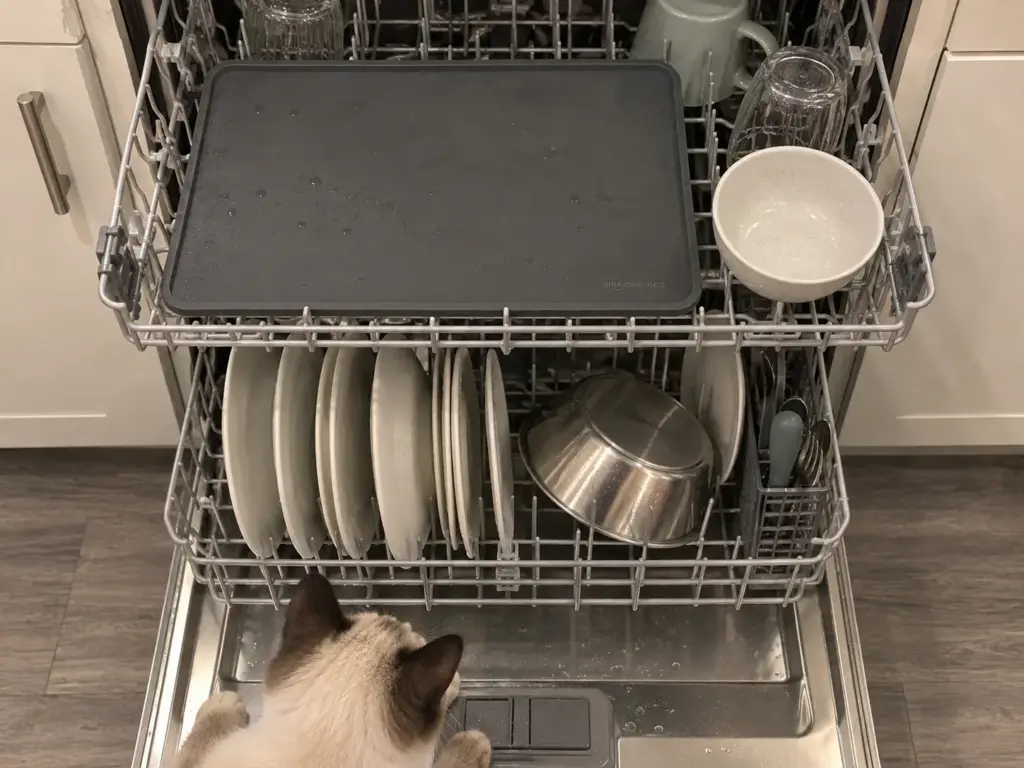
Maytag’s rule reverses the instinct: lightweight bowls, including dishwasher-safe ceramic, go on the top rack, and heavier bowls like large stainless steel ones go on the bottom.
The reason is spray pressure and proximity to the heating element. The bottom rack takes the harder spray and sits closer to the heat, which heavy steel shrugs off and light ceramic and silicone do not. A light bowl down there is also the one that flips under the spray arm and finishes the cycle upside down, full of the water everything else just drained into it. Silicone mats go on the top rack, laid flat rather than folded, because folded silicone traps water against itself and comes out wet in the crease.
Angle Them So They Drain
Load bowls face-down at an angle and they drain. Load them level and they hold a puddle straight through the dry cycle, then come out wearing a film that the sanitize setting had already removed once. That is it. Tilt them.
Two or three cats changes this from a loading question into a capacity question, because four to six bowls a day stop fitting around the human dishes. It is worth knowing how many bowls a multi-cat house is actually running before you assume tonight’s load has room, and that math gets its own section below.
What the Cycle Leaves Behind
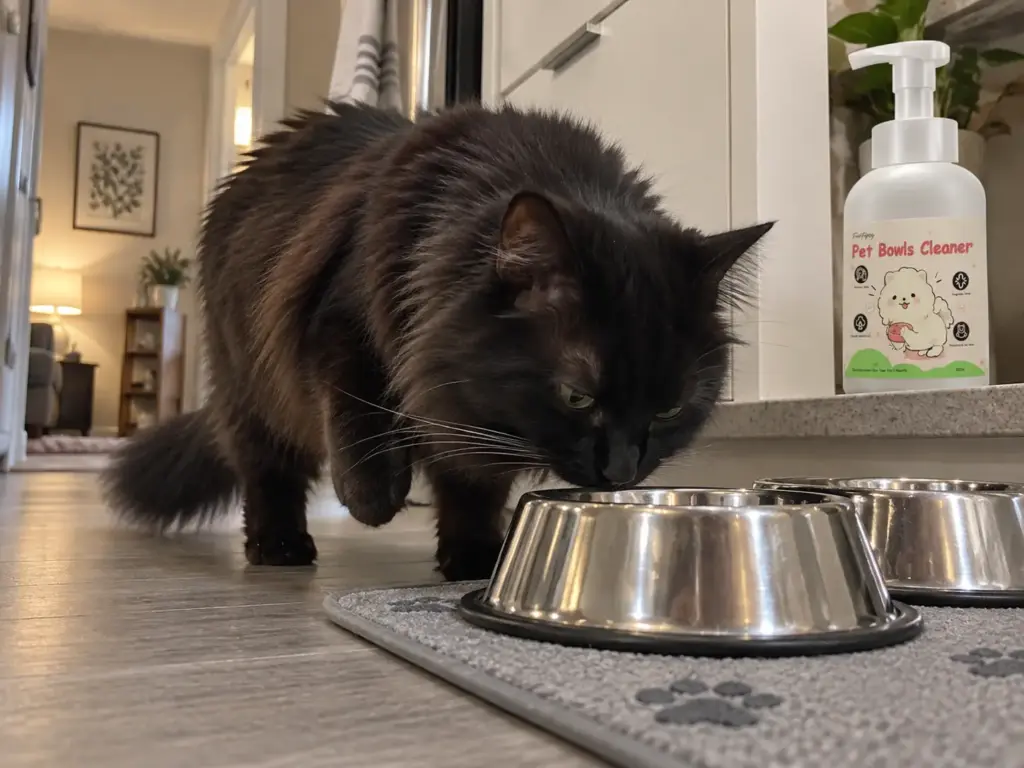
This is the section where the cat part finally changes the answer. You do not press your face into a plate before you eat off it. A cat does exactly that, every single time, and it does it before it commits to the first bite.
The Residue Is Real, and the Manufacturer Says So
Maytag states it without hedging: residue can always be left behind after a cycle, even when you cannot see it, which is why they recommend a detergent free of harsh chemicals and fragrances. That is the appliance manufacturer saying it, not a nervous pet blog. On a dinner plate, invisible residue is a footnote. On a food surface that gets inspected by nose at a range of half an inch, it stops being a footnote.
Your Cat Checks the Bowl Before the First Bite
Watch the order of operations sometime. The bowl goes down, the cat arrives, the nose goes in, and only then does the eating start or not start. A faint scent you would never register sits precisely at the point of decision.
So a bowl that smells clean to you can still be a bowl the cat hesitates over, and that hesitation is information rather than fussiness. He is not being difficult about dinner. He is telling you the bowl still smells like the machine, and on that specific question his equipment beats yours by a wide margin.
Owners on cat forums describe the same thing over and over: a faint soap or water-softener smell on bowls fresh out of the dishwasher, and a cat who circles the bowl before settling.
Unscented Detergent and a Rinse Under the Tap
💰 Both fixes are free, so do them before you buy anything. First, switch to an unscented detergent with no built-in rinse-aid or lotion additive; the additives are what people end up blaming, and the swap happens at the same shelf you were already shopping at. Second, run the bowl under the tap for three seconds after the cycle, before you refill it. Between those two, most of this goes away.
Rinse-aid is the additive most owners end up blaming, and the design brief explains why. It is engineered to leave a film so water sheets off the glass instead of spotting it, which is why a fragrance-free detergent without one is the easier swap. A deliberate film is the last thing you want in something a cat puts its face into.
The case where a dedicated cleaner earns its place is narrower than the marketing suggests: a bowl that has held wet food, gone through a full cycle, and still feels faintly slick under your thumb. That bowl residue is biofilm, not soap, and neither an unscented detergent nor a tap rinse is aimed at it. The Furrtripsy pet bowl cleaner mousse is pH-balanced and fragrance-free for exactly that job, in a 10-ounce bottle that will outlast the problem. It is an addition to the two free fixes and not a replacement for either, and if your bowls already come out squeaky you do not need it.
🚑 One boundary, and then back to the bowl. A cat that stops eating, keeps walking away from a full bowl, or changes its eating habits suddenly is not a detergent puzzle to solve by trial and error. That is a vet visit, today, and everything in this article assumes the vet has already cleared him. Within that assumption, a bowl that looks fine and still gets avoided is usually a material or a cleaning problem, and both of those are yours to fix.
Whether One Cat Justifies the Load at All
Running a full dishwasher cycle for two small bowls feels wasteful because it is, and the energy and water use of a daily pet-only load is the part every source raises and then drops. But hand-washing twice a day in a one-sink kitchen falls apart by Thursday, which is the part nobody plans for. The workable answer is neither of those.
One Cat, Two Bowls, and the Load-Sharing Rule
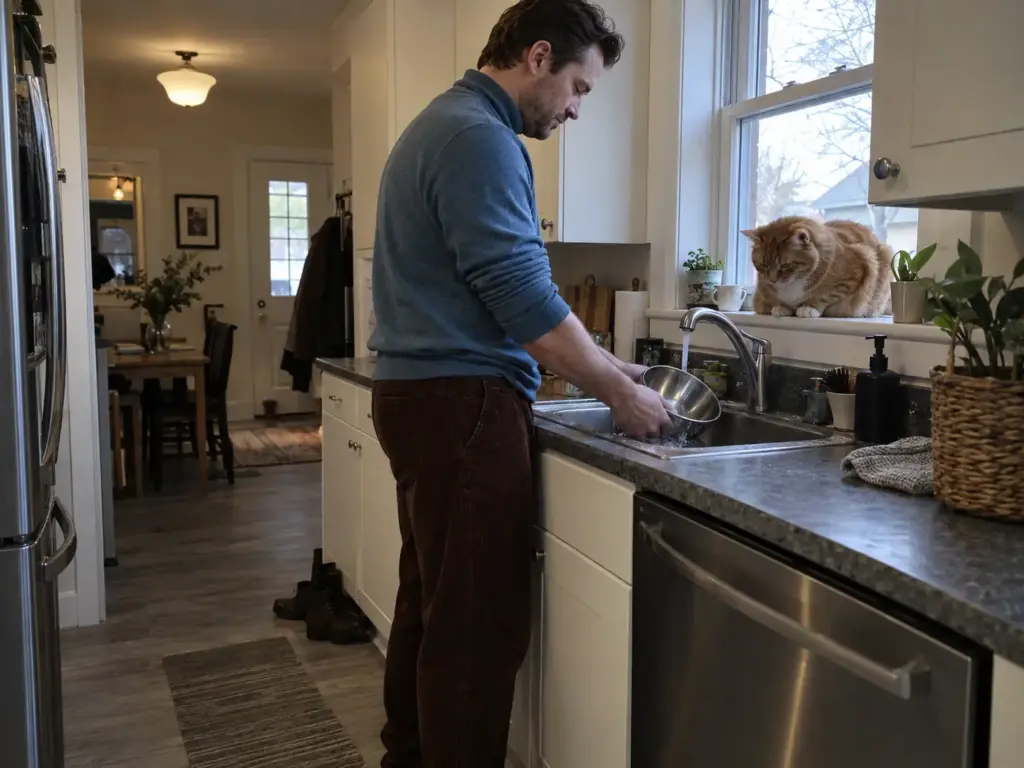
One cat means two bowls, maybe three with a water bowl in a second room. A dedicated daily cycle for that is the wasteful option, and the appliance industry gestures at a compromise without ever stating it as a rule.
Stated as a rule: wash by hand with soap and hot water on days when no load is running, and put the bowls in whenever a human-dish load is already going. You get the sanitizing cycle two or three times a week for free, and the hand-wash days cover the gaps. No extra water, no extra electricity, and no separate pet-load guilt.
Where Two or Three Cats Break the Math
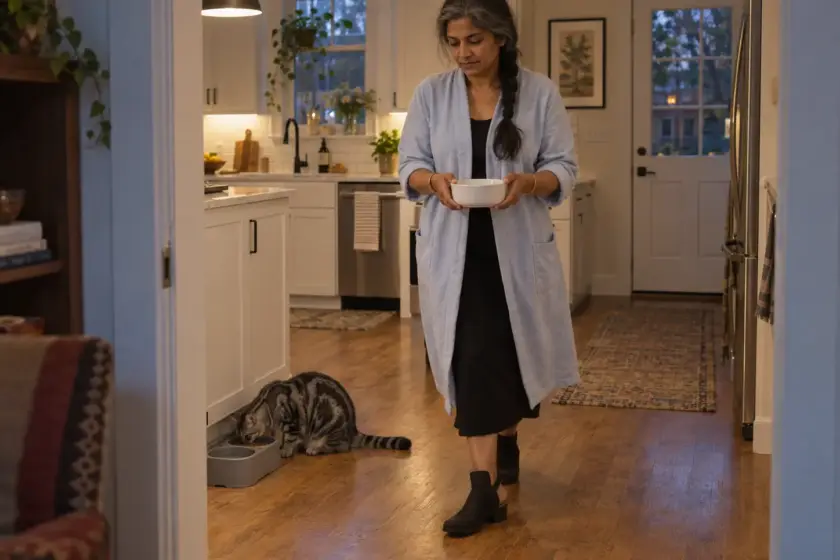
Two cats is four bowls minimum. Three cats, following the 1+1 logic that governs everything else in a multi-cat household, is closer to six.
Multiply that by a wet-food cadence of after every meal and the load-sharing rule collapses, because there is no longer room for six bowls around tonight’s dishes. At that volume the honest answer changes: either you run a genuine daily load, or you use the dedicated pet-sanitize cycle if your machine has one. The advice that works for one cat is not conservative for three, it is just wrong, and pretending otherwise is how the dishes end up stacked in the sink at midnight.
The Days You Wash by Hand
For the hand-wash days, the CDC’s method is soap and hot water, with bleach or a disinfecting wipe when something genuinely needs disinfecting. Bowls sit in its “hard items” category, next to crates and hard toys, so there is no special pet-bowl technique to learn.
Plenty of small apartments have no dishwasher at all, and the rotation that works when there’s no dishwasher in the apartment is its own problem with its own answer. The practical version people actually run is simple enough to keep: bowls go in with the evening load, and the wet-food bowl gets a rinse the moment the meal ends so nothing dries on while it waits. And if you are cleaning bowls on a schedule, a fountain puts the same film on a different cleaning clock, which is worth knowing before you add one to the kitchen.
Turn the Bowl Over Before You Buy Anything
Three things decide this. The material is the label when nothing is printed: steel stamped 18/8 or 304, plain glazed ceramic and 100% silicone go in, while painted ceramic, wood and thin plastic stay at the sink. The sanitizing cycle plus heated dry is what disinfects, and the cycle you run for everything else only cleans. And one cat does not justify its own load, so wash by hand on the quiet days and ride along with a load that was already running.
🗓️ Check back in three weeks, because this one depends on a routine holding rather than an object wearing out. Look at two specific things: whether the hand-wash days are still happening, and whether the wet-food bowl still gets rinsed right after the meal or has started waiting until evening. Those are the first two to slip, and nothing visible happens when they do, which is exactly why they slip.
Start by flipping over the bowl that is already in your kitchen. If there is an 18/8 or a 304 stamped in the steel, you just answered the whole question for free, and the dishwasher door is already open.
Amazon’s Audible — free for 30 days
Your cat won’t let you read. Let someone read to you.
Audible is Amazon’s audiobook library — thousands of titles, read out loud, on your phone. Free for a month, plus one audiobook to keep forever.
Frequently Asked Questions
01Is it okay to put cat bowls in the dishwasher?
Yes, if the bowl’s material can take it. Stainless steel, plain glazed ceramic and 100% silicone all can. The CDC says running them in the same load as your own dishes is fine, though a separate load is the more cautious version.
02What Is the Best Way to Clean Cat Bowls?
Soap and hot water covers routine cleaning, whether that happens at the sink or in the machine. To disinfect rather than rinse, use the dishwasher’s high-temperature or sanitizing setting together with heated dry. Wet-food bowls get washed after every meal, dry-food and water bowls daily.
03How Do I Know If a Cat Bowl Is Dishwasher-Safe With No Symbol on It?
There is no universal dishwasher-safe icon, so a blank bottom is not a verdict either way. Judge by material: plain glazed ceramic, 18/8 or 304 stainless and 100% silicone survive repeated hot cycles. Painted ceramic, wood and thin plastic generally do not.
04Should Cat Bowls Go on the Top or Bottom Rack?
Light bowls like ceramic go on top, heavier stainless steel on the bottom. Weight decides, not delicacy. A light bowl on the bottom rack tends to flip under the spray arm and fill with dirty water before the cycle ends.
05Why Don’t You Put a Cat’s Water Next to the Food?
Most cats drink more when the water sits away from the food bowl, which makes it a placement question rather than a cleaning one. It changes where the bowls live, not how you wash them, and it is covered in the Care guide for this cluster.



Leave a comment