Food and Water Next to Each Other? Not on the Same Tray
Don't buy a fountain yet. If food and water sit next to each other on one tray, crumbs reach the water and splash reaches the food [free fix inside].

Alfredo RamsesFounder · September 28, 2026 · 17 min read
On this page6 sections
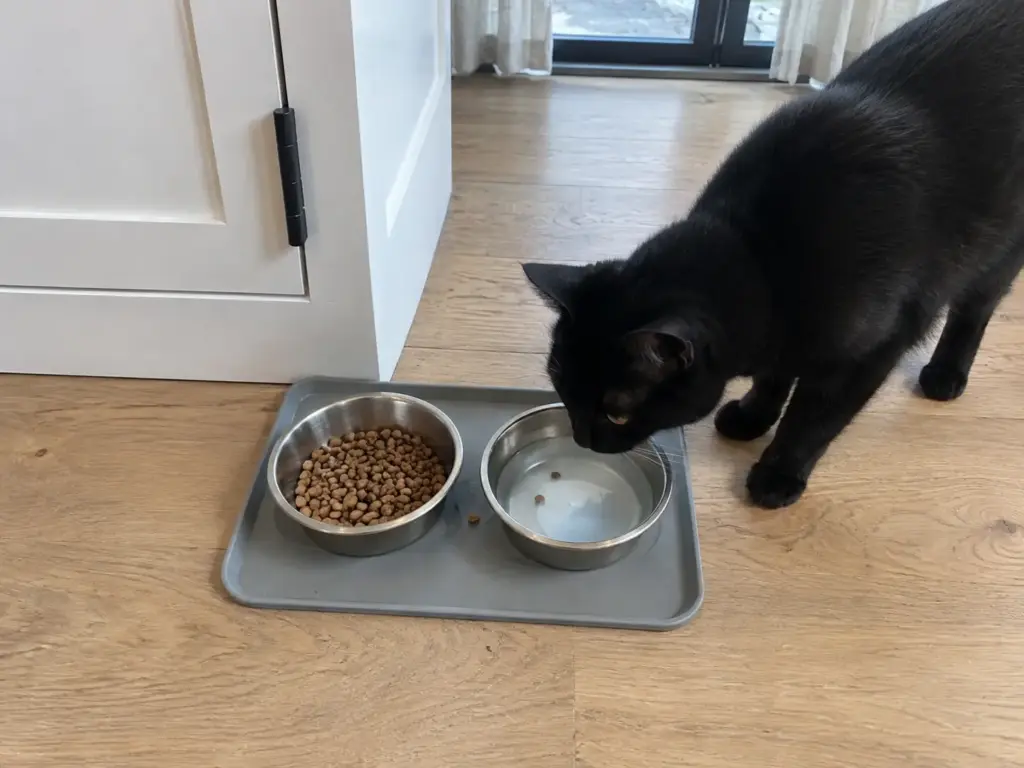
The set came with the cat: two bowls molded into one plastic base, food on the left, water on the right. He eats from one side and walks straight past the other, and he isn’t being fussy, because the water next to his dinner has his dinner in it.
The standard advice on food and water next to each other is to separate them, and it’s right, though the distance everyone quotes was never measured by anyone; what you can check tonight is what ends up inside the two bowls. Below: which setups actually count as next to each other, what travels between the bowls, what to do with the one you already own, and when to leave it alone.
Quick Answer
Keep them apart, and lose the shared surface first. A molded double feeder, a two-bowl mat or a single tray passes crumbs and grease into the water and splash into the food. Two separate bowls a few strides apart, with something solid between them, suit most cats. A cat drinking normally from side-by-side bowls isn’t an emergency.
Food and Water Next to Each Other Means Four Different Setups
“I have them a foot apart. Is that next to each other?” It’s a fair question, and the advice to separate the bowls almost never says separate them from what.
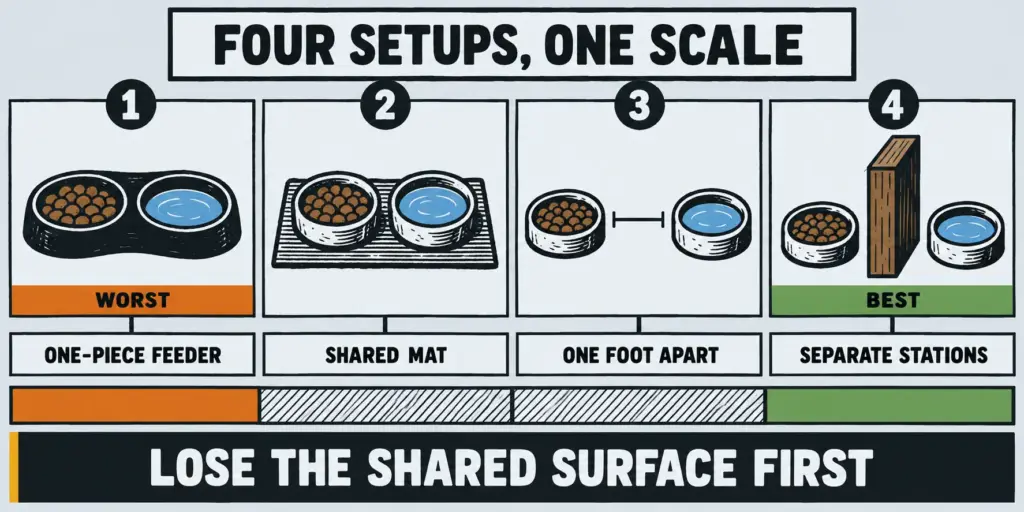
The wider guide to where cat bowls go and what quietly ruins them covers the whole floor plan. This section does one narrower job: it grades the four arrangements people actually have on the floor, worst to best.
The reason behind the advice, in one breath: a cat treats water sitting beside food as water sitting beside whatever the food used to be. That’s the prey contamination idea, a wild instinct to keep the two apart, and people who study cat behavior see the pattern consistently. Nobody has put it through a controlled trial, though, and Purina is unusually frank that there are no good studies on where the bowls should go.
So the “few feet” you’ll read everywhere is repeated, not tested, and so is the vaguer “a different corner.” The long version of why a cat walks away from the food to drink is its own read. Here, what matters is something you can see without believing any of it: the surface the two bowls share.
The one-piece double feeder
Food well on one side, water well on the other, one molded base underneath. Sold as a dual feeder or a combo feeder, it started life as a dog bowl, as Americat points out, and it’s still the default in pet aisles and the thing inside most starter kits: the set nobody chose.
Of the four, the double feeder is the worst, for three separate reasons. The bowls share a surface, so anything that leaves one lands on the rim of the other. You can’t move the water without moving the food. And you can’t wash one half without washing both.
A fourth problem lives in the rims. On a lot of these units the two wells sit so close that his whiskers brush the second rim while his face is in the first, which stacks a small irritation on top of the big one. That’s the complaint filed under whisker fatigue, and a fused double bowl is about the most reliable way to produce it.
You’ll usually know which half he has rejected before you know why. The food side gets licked down to the plastic. The water side keeps the same waterline day after day, with a faint skin of dust on top.
Try the ten-second lift. Take hold of the water bowl and pick it up. If the food bowl comes with it, or the tray under both of them tilts, the two count as next to each other however far apart they look, and sliding the unit to another spot in the kitchen won’t change that.
Two bowls sharing one mat or tray
This is the starter kit with separate bowls: two dishes sitting in the recesses of one silicone mat, or the homemade variant, a baking tray or a storage-tote lid set down as one big feeding station. It looks like an upgrade on the molded unit because the bowls lift out. On the floor it behaves almost the same.
The mat is the bridge. A feeding mat is designed to catch whatever misses the bowls and hold on to it, which is exactly what you want for the floor and exactly what you don’t want between food and water. Spilled water pools inside the raised lip, dropped kibble rolls into the pool and softens, and the next time he noses the food bowl sideways (they all do), that damp mush gets pushed up against the base of the water bowl. Verdict: a fail, though an easy one to fix, because nothing here is glued together.
Two bowls a foot apart on the same floor
The borderline case, and honestly, it works for plenty of cats. The surfaces are separate, so most of the traffic between the bowls stops: dropped food particles land near the bowl they came out of, and splash from the water lands near the water.
What may not change is how the cat reads the arrangement. A foot of bare tile with a clear sightline from one bowl to the other can still look like one station to him, and a cat who has already started drinking somewhere else is usually the one who needs more than a foot. If yours eats, drinks, and leaves both bowls looking used, this setup is fine.
Two stations with something in between
So the scale runs like this: the molded feeder and the shared mat fail on the surface alone, a foot of bare floor works for a lot of cats, and two stations with something solid between them work for nearly all of them. That fourth one is the target.
“Something in between” doesn’t mean another room. It means an object he has to walk around: the end of a run of cabinets, a doorway, the other side of the kitchen counter.
The usual correction for bowls that sit too close is more distance, so people slide the water along the tray until it’s as far from the food as the tray allows. For bowls on a shared surface, distance is the second fix. Taking the water off the surface is the first, it’s free, and it does more than the extra inches ever will.
What Travels Between the Two Bowls in a Day
You filled the water bowl this morning. By dinner there’s a dull film on the surface and a few crumbs on the bottom, and the kibble at the edge of the food bowl has gone soft. Neither is the cat’s doing. Both are the tray’s.
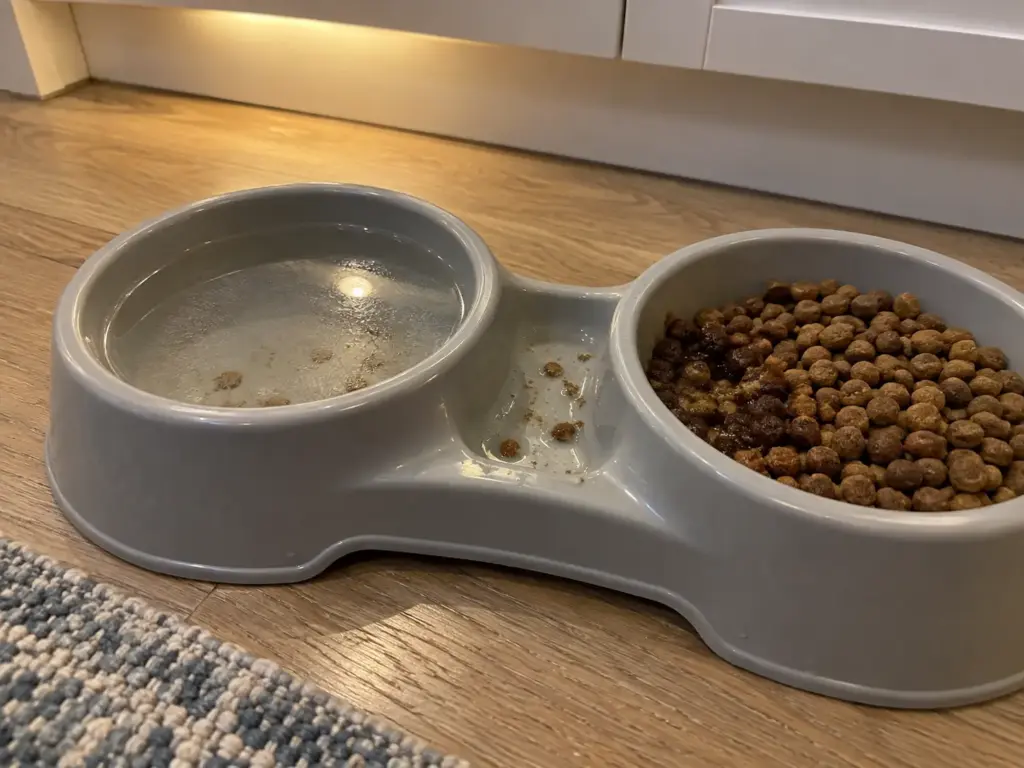
Traffic between two bowls runs in both directions, and the instinct explanation only ever talks about one of them.
What ends up in the water
The obvious traffic is dry: kibble dust shaken loose every time he noses into the food, and whole crumbs that bounce off the rim. The less obvious traffic rides on the cat.
He eats, lifts his head, and the crumbs stuck to his chin and whiskers go wherever his face goes next. When the water bowl is right there, his face goes into it. With a stride or two between the bowls, most of that falls on the floor on the way.
Wet food adds a slick of fat, and a greasy surface is what makes a cat sniff the water and walk off. That film doesn’t disappear with a quick rinse in the morning, either. Left to build, it becomes the slime that a rinse never removes, which you can feel on the inside wall of the bowl long before you can see it.
A shared base makes all of this worse than distance alone would. Crumbs that miss a bowl on bare floor dry out and get swept up. Crumbs that miss a bowl on a tray land in the well, soak in whatever water has splashed there, and wait for a paw or a push to carry them over the rim. That’s cross-contamination on a timer, and the tray sets the timer.
What ends up in the food
The other direction gets almost no attention. A cat drinks by flicking his tongue so fast that the water is pulled up in a little column and snapped off, which is efficient for him and splashy for everything in range. More drips come off his chin when he lifts his head. With the food bowl at his elbow, that water lands on the dry food at the rim, and the softened kibble at the edge is the portion that sits out longest and spoils first.
That matters more for cats than for almost any other pet, because of how cats get fed. A peer-reviewed survey of pet food bowl hygiene in BMC Veterinary Research found bacterial growth more likely when “a portion of food is left in the bowl for 6 or 12 h after feeding,” in contact with saliva. The same survey found that 43% of the cat caregivers fed ad libitum, with food left out all day, against 4% of the dog caregivers. The cat is the one with food sitting out for hours, and on a double feeder that food sits an inch from his water.
Wet-food bowls came out with higher counts than dry-food bowls in that study, which will surprise nobody who has picked up a wet-food dish at four in the afternoon. If he eats wet, the rim of the food bowl is the one to watch.
Why the shared base doubles the cleaning
The water bowl wants a fresh wash every day. The food bowl wants one after every wet meal. A molded double base can’t keep either cleaning schedule, because the whole unit goes into the sink at once, and in practice it gets washed whenever somebody gets around to washing the awkward thing, which is less often than either half needs. The well underneath holds standing water the entire time.
Cornell’s Feline Health Center notes that “Cats should have access to clean, fresh water at all times.” The word doing the work in that sentence is “clean,” and Cornell also lists dirty containers among the things that can put a cat off eating.
Separating the bowls doesn’t cut how often you wash them. It lets each one run on its own clock, so the water stops getting dirty on the food’s timetable, and the breakdown of how often each bowl actually needs washing sets out those clocks by what’s in the bowl.
The standard answer to a grimy water bowl is a better bowl: stainless steel, ceramic or glass instead of plastic. Material does help with scratches and lingering smell. But in that same BMC sample the metal bowls carried higher bacteria counts than the plastic ones, which says less about steel than about how rarely any of the bowls got washed. No material replaces the schedule.
Run a finger around the inside of the water bowl last thing at night. If it feels slick, the surface the two bowls share is feeding it, and the fix is to split them up, not to buy a stronger dish soap.
What to Do With the Setup You Already Own
You paid for the double feeder, or it came with the carrier, and throwing it out feels wasteful. Usually you don’t have to. Each setup below starts with the free version; the products are for a feeder that won’t come apart or a home that’s one bowl short.
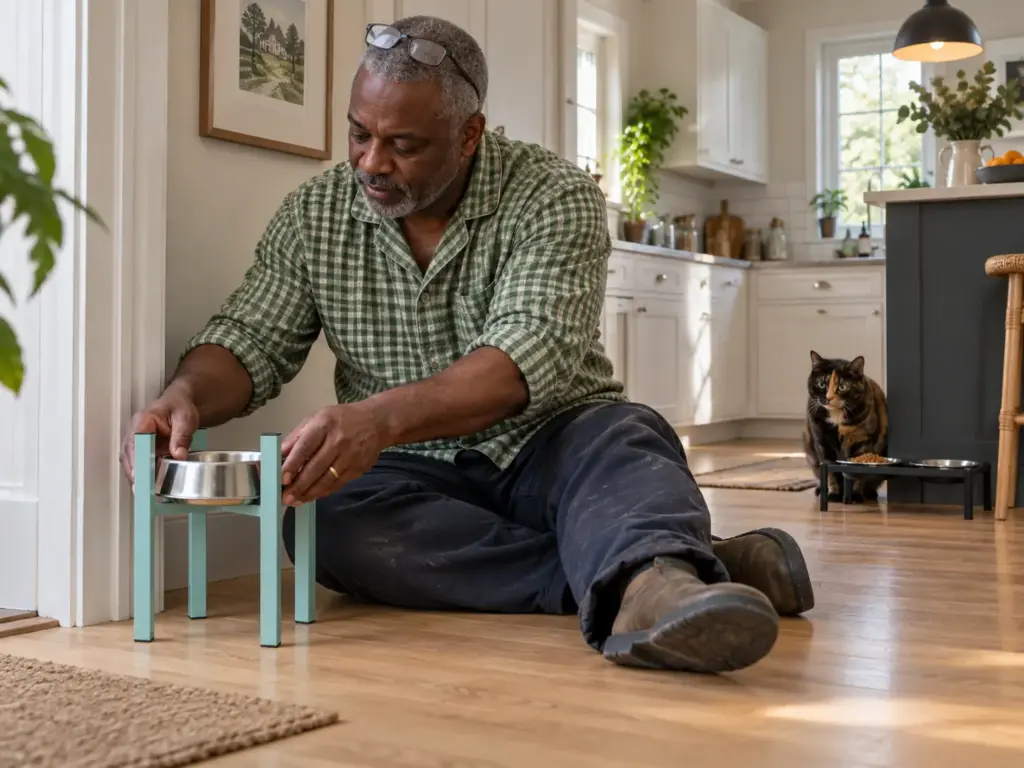
If the bowls lift out of the double feeder
Keep the frame as a food-only station: wet on one side and dry on the other, or breakfast and dinner. The water bowl goes somewhere else, on its own, on the floor. That’s the whole fix.
It changes the washing too. A lift-out bowl can go through the dishwasher by itself, while a molded base usually won’t fit the rack or isn’t labeled for it, and whether a bowl can go in the dishwasher mostly comes down to the material.
Fill the water bowl first and set it down in its new spot before you put any food out. He meets the new station on its own, with nothing from the old setup sitting next to it, and the first thing that spot means to him is water.
If it’s one molded piece
It can stay. Use the food side as the dish and leave the water side empty and dry (not topped up “just in case,” which puts you right back where you started).
The water goes into a separate bowl. Well, a separate wide, shallow bowl; a deep, narrow one swaps one complaint for another. A wide cereal bowl from your own cabinet will do to start.
For dedicated bowls, the Ceramic Cat Food Bowl Set is a four-pack of wide, shallow dishes, so one water bowl can be in the wash while a clean one goes down. The catch is ceramic itself: knock one onto tile and it chips, and a chipped bowl gets retired, not rinsed and put back.
The two-bowl mat or tray
Free version: leave the mat under the food, where it’s genuinely useful, and give the water its own spot on the bare floor or a folded towel. The fix a lot of people land on goes one step further: two single stations, the same two bowls, two different places. No new purchase.
If the bowls that came with the mat are small and deep, that’s the moment to replace them. The WROSWT Stainless Steel Cat Bowls are a pair of single bowls, 5.5 inches across and shallow, so the rim stays clear of the whiskers. For what it’s worth, the evidence on how much of whisker fatigue is real is thinner than the marketing suggests, but a shallow bowl costs nothing in trade. The catch: stainless still needs its daily wash.
The double raised stand
Keep the double bowl stand for the food, since an elevated bowl stand is a perfectly good place for a meal. The water goes on the floor, which is free and can’t tip, or on a single bowl stand of its own somewhere else. Matching the two heights is optional; he needs the water steady, not level with dinner.
Steady is the harder half, because raised water bowls tip more than food bowls do: a full bowl sloshes when he leans in, and the stand takes the push. If you want the water off the floor, the Drawinsage Adjustable Metal Raised Cat Bowl Stand is a single-bowl metal riser with an adjustable height, and it ships without a bowl, so it holds the one you already put down for water. Adjustable joints can work loose, so set a full bowl in it and press on the rim before you trust it.
When Side-by-Side Bowls Are Fine, and When They Aren’t
“My cat drinks fine from the double feeder. Do I actually have to change it?” It’s the most reasonable question anyone asks about this, and it deserves a better answer than the blanket no it usually gets.
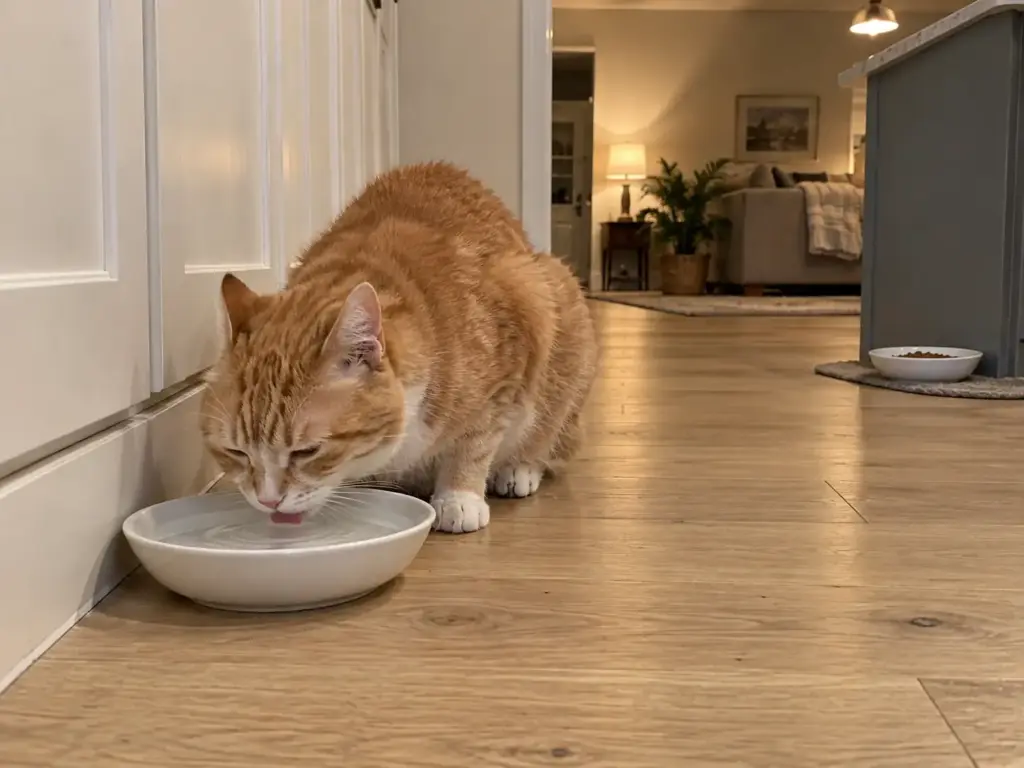
A cat already drinking normally
If all three of these are true, your setup is working:
- The water level drops every day, not every few days.
- He has no sink, shower or toilet habit.
- The water is still clean when you refill it at night.
In that case the change is low priority, not an emergency. Lose the shared tray when it’s convenient, for the cleaning reason rather than the instinct one, and don’t go measuring the kitchen for a distance nobody ever measured in the first place. What the cat needs is clean water he’s willing to drink. A number in feet is the internet’s requirement, not his.
It’s a different situation when a cat stops drinking from a bowl that looks fine. The story that turns up again and again in cat forums runs the same way every time: the cat walks past a full bowl for days, sniffs it and leaves, then drinks normally within a day of the bowl moving a few feet. That’s the cat this article is really for.
And one line on where this stops being a bowl question: a cat that stops eating or drinking altogether, rather than preferring a different arrangement, is a vet visit, not a placement problem. Everything here assumes that isn’t what you’re looking at.
The kitchen with one spot
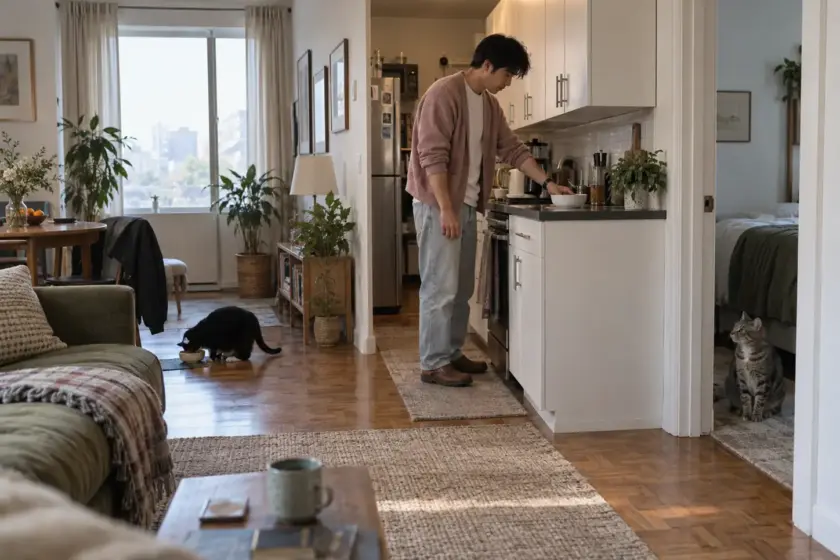
In a small apartment, the kitchen is often one counter and a strip of floor, and “a different corner” assumes a corner you don’t have. The minimum is short: two separate bowls, no shared base, and the water at the far end of whatever floor there is.
If the kitchen is L-shaped, the turn of the L is your object in between. In a galley kitchen, where the only floor is the walkway, the bowls go at its two ends; he walks the length of it to drink, and the far end is usually the nearest thing that kitchen has to a quiet low-traffic spot, where nobody kicks the water across the tile while carrying groceries in.
Keep both bowls out of the litter area as well. Distance from the litter box is a separate rule, and it’s the one people in a studio or a one-bedroom sometimes trade away to solve this one. The full rundown of where water can go with no second room belongs to the hydration piece linked earlier. The only thing to add here: dropping the tray gets you most of the way before you move anything else.
Older cats and the longer trip
Sending the water to another room is sound advice for a young cat. It stops being sound around the time he starts taking the stairs one at a time. The AAFP–AAHA 2024 feline life stage guidelines make the point that for a senior cat, resources shouldn’t be spread so far apart that getting to them turns into hard work. So for an older or stiff cat the logic reverses: a few steps with something in between beats a long trip, and a water bowl two rooms from where he naps is a water bowl he’ll visit less often.
Two cats and one water bowl
Start with whether two cats can share bowls at all, because everything above was written for a single cat, and in a multi-cat household the question changes shape. Moving the only water away from the food can hand it to whichever cat controls that part of the apartment.
The cat who holds the kitchen at dinnertime already holds the food; push the water deeper into his side of the place and he holds that too, without a single hiss. That’s resource guarding at its quietest, done by sitting in the right spot. With two cats, the fix is a second water spot, not a longer walk, and how many water bowls a multi-cat home needs has the count.
Take the Water Off the Tray First
The shared surface is the thing to lose first: the molded base, the two-bowl mat, the tray. It carries crumbs into the water and water into the food, and it puts both bowls on one washing clock that suits neither.
You probably don’t need to buy anything, least of all a water fountain. Lift the bowls out, keep the frame for food, move the mat.
A few strides with something solid between the bowls is enough for most cats, and a cat who is drinking fine is not a problem you have to solve.
Give the new arrangement three weeks. That’s long enough for him to settle on the new water spot, and long enough for you to find out whether two separate wash schedules survive a busy week. Then look at three things: the water level, how the inside of the water bowl feels at night, and whether the kibble at the rim of the food bowl is still crisp.
Tonight, lift the water bowl out of the tray and set it down past the end of the cabinets. Leave the food exactly where it is.
Amazon’s Audible — free for 30 days
Your cat won’t let you read. Let someone read to you.
Audible is Amazon’s audiobook library — thousands of titles, read out loud, on your phone. Free for a month, plus one audiobook to keep forever.
Frequently Asked Questions
01Do cats not like their food and water next to each other?
Many cats don’t, and the pattern is consistent enough to plan around, but it isn’t universal and no controlled study has measured it. The clearer problem is hygiene: bowls that share a surface pass crumbs, grease and splash between them every day.
02How far apart should food and water be for cats?
There is no tested distance, and the few feet quoted everywhere has been repeated rather than measured, so nobody can give you a real number. A few strides with something solid between the bowls works for most cats. In a tight kitchen, two separate bowls at opposite ends of the floor is the minimum.
03Can cats drink water and food together?
Yes, cats can eat and drink at the same station, and plenty of them do it every day without any trouble. What causes problems is one shared base: crumbs end up in the water, the food at the rim gets wet, and both bowls get washed on the same schedule.
04Is a double bowl feeder bad for cats?
The frame itself isn’t the problem; using one side for food and the other side for water is what goes wrong with a double feeder. If the bowls lift out, keep the frame for food and give the water its own bowl somewhere else.
05Should I put the cat’s water bowl in a different room?
Not necessarily, and usually not for an older cat, for whom a long walk to the water becomes a problem of its own. A different spot in the same room, with something solid between the bowls, does the job for most cats.


Leave a comment