Why Rinsing the Water Bowl Never Removes the Slime
Your cat reviewed the bowl days before you felt the slime. What the film is, the scrub that removes it (rinsing doesn't) & when it's a vet call.

Alfredo RamsesFounder · September 28, 2026 · 20 min read


On this page8 sections
- 1What That Slick Film on the Bowl Actually Is
- 2Whether It Can Actually Hurt Your Cat, and Where That Question Stops
- 3Your Cat Noticed It Before You Did
- 4Why the Rinse Fails, Every Single Time
- 5The Routine That Actually Clears It
- 6What the Bowl Itself Is Doing to Help or Hurt
- 7The One Change That Ends This
- 8Frequently Asked Questions
You rinsed the bowl this morning. It is six in the evening, you run a finger around the inside wall, and it is slick. Not dirty exactly, not greasy, just slippery in a way that clean porcelain never is.
That film is biofilm, and the reason your rinse did nothing to it is that water was never the tool for the job: the CDC describes this material in water systems as bacteria living inside a bacterial matrix they built themselves, and a shell does not wash off. Here is what the film is, whether it matters, why the rinse fails every time, the routine that clears it, and what your bowl itself is doing to help or hurt.
Quick Answer
The slime is biofilm: bacteria that have built a polymer shell over themselves on the bowl wall, seeded mostly by your cat’s saliva. It returns within a day or two on any wet surface, and rinsing never removes it because water does not break the shell. Friction does. Scrub daily with a dedicated brush and dish soap.
What That Slick Film on the Bowl Actually Is
The instinct is to blame yourself. The bowl felt slimy, so the bowl was dirty, so you must have skipped a day or used weak soap or let it sit too long. None of that is what happened.
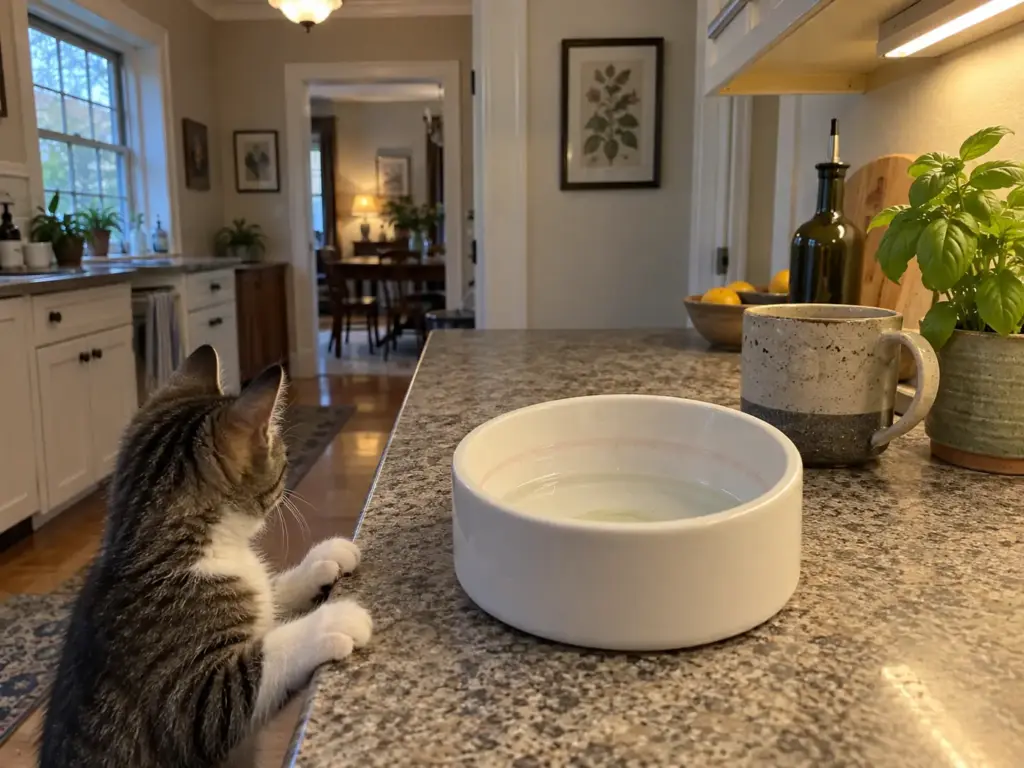
This film would appear in a spotless kitchen, on a bowl washed by a person who does nothing wrong, because it is not a housekeeping failure. It is a biological process with a schedule.
The Matrix, and Why It Is Not a Stain
Bacteria in water do not float around politely waiting to be poured out. They stick to surfaces, and once stuck they start manufacturing a glue-like layer of polymers around themselves. What you feel under your finger is that layer, with the bacteria living inside it.
The CDC’s own guidance on biofilm in water systems describes exactly this: cells embedded in a matrix of extracellularly produced polymers. The technical people call it the matrix. In plain English, it is a house, and the tenants built it themselves.
That distinction decides everything that follows in this article. A stain sits on a surface and comes off when you dissolve it. A house is attached, structural, and has to be knocked down.
You can pour a stain out of a bowl. You cannot pour out a house. And it is worth knowing early that stagnant water is not the only condition this happens in, because that myth sends people shopping for the wrong solution later on.
Where It Comes From — Your Cat’s Mouth, Mostly
Every drink is a delivery. Saliva is not one germ, it is a mixed starter culture of oral bacteria that arrives already assembled.
A peer-reviewed study of how saliva builds biofilm found the aggregates bind to a surface together rather than in a tidy sequence, then expand outward in three dimensions once they land. In that lab model, maximum surface binding was reached after 60 minutes. Not a day. An hour.
From there the clock is short. On a wet, nutrient-rich surface, biofilm establishes within roughly 24 to 48 hours. That is the whole explanation for the thing that confused you: the bowl was genuinely clean yesterday morning and it is genuinely slick tonight, and both of those things are true at once.
Clear, Green, or Pink — What the Color Is Telling You
Most of the time the film has no color at all. You find it with a finger, not an eye, and by the time it is visible as a whitish or faintly green cast on the wall it has been there a while. The green end of that range is usually Pseudomonas, which is about as common in standing water as anything gets.
The one people actually notice is the pink ring at the waterline, the thing sold online as pink slime. That is Serratia marcescens, and it is worth knowing two things about it. First, it is the same mechanism, not a different problem, just a bacterium that happens to be pigmented.
Second, and this is the useful part: it feeds on phosphorus and fatty residue, including leftover soap. The pink ring shows up most reliably in bowls that get washed but not rinsed properly, which means the people fighting it hardest are sometimes the ones feeding it. If you want the fuller picture on where the bowls sit and what quietly ruins them, that is the parent guide to this whole problem.
Whether It Can Actually Hurt Your Cat, and Where That Question Stops
This is the real reason most people are reading at eleven at night after touching a bowl. You want to know whether you have been quietly poisoning your cat for months. The honest answer is reassuring, and it is worth giving straight rather than burying under hedges.
What a Dirty Bowl Plausibly Does
A bowl is a surface your cat puts its mouth on several times a day, and biofilm is a bacterial community living on that surface. Keeping it clean is ordinary hygiene, the same logic as not drinking from a glass that has been on the nightstand since Tuesday. That is a solid, defensible reason to scrub it, and it is enough of a reason on its own.
What this article will not do is tell you that a specific film in a specific bowl caused a specific illness. Nobody writing on the internet can see your cat, and the sources that gesture at urinary infections and kidney disease are doing so in general terms that do not transfer to your kitchen. The far more common and far more observable effect is behavioral: the cat drinks less, because the bowl now smells and tastes wrong to it. That is covered properly in the next section, and it is the part you can actually do something about.
The positive version of the same point comes from an institution worth quoting. According to Cornell’s Feline Health Center, “having clean bowls with fresh water in several locations in the home will encourage cats to drink more.” Clean bowls, fresh water daily, and more than one water station. That is the lever, stated by people who study feline kidneys for a living.
Where This Stops Being a Bowl Question
A cat that is drinking noticeably less than it used to, or whose habits changed suddenly rather than gradually, is a vet visit. Not a cleaning project, not something to fix with a better brush, not something to wait out for a week to see if the new routine helps. Book the appointment.
That is the line, and this article stops at it on purpose. Everything below assumes the drinking question has either been answered by a vet or was never in doubt. If what you are really worried about is a cat that stops drinking from a bowl that looks fine, that is its own subject with its own causes, and the slime is only one of them.
Your Cat Noticed It Before You Did
Here is the sequence almost nobody writes down, and it runs backward from the way people tell the story. The complaint that arrives first is “he hasn’t been drinking as much lately.” The slimy bowl gets discovered afterward, usually by accident, usually while washing up for some unrelated reason. Everyone then treats those as two separate events that happened to coincide.
They are one event, in order. The cat reviewed the bowl, declined it, and started drinking less. You found out days later.
The Sniff, the Pause, and the Walk Away
Cats detect this film well before a human hand does. They have the nose for it and they have their face directly in the bowl, which is a considerably better sampling position than your fingertip. The approach-sniff-pause-leave at the water bowl, the one that reads as fussiness or moodiness, is a quality inspection with a result.
And this is where the framing usually goes wrong. The cat is not being picky, and he is certainly not refusing on purpose. He is describing a constraint: the water tastes like the wall of the bowl it is sitting in.
You are describing a preference, which is that the bowl looks fine to you. Between a cat’s nose and a human’s eye on the subject of what is in that water, the cat wins, every time.
Why He Is Suddenly Drinking From the Faucet
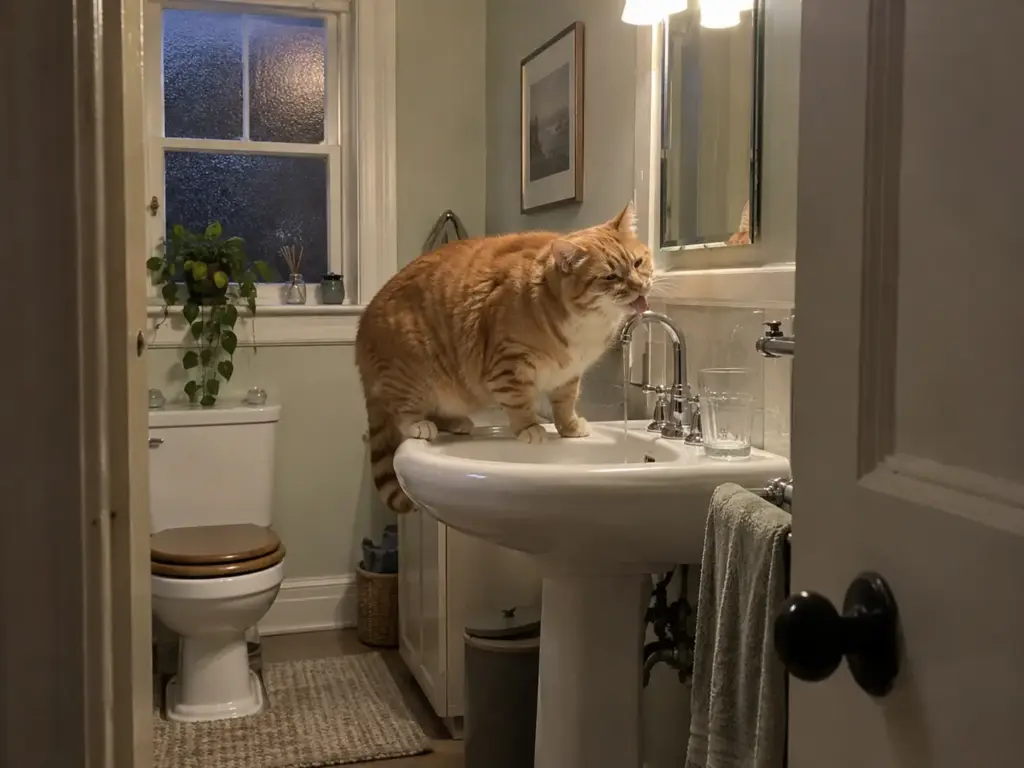
A cat that has started drinking from the bathroom faucet, the shower floor, the glass by your bed, or a plant saucer is not developing a charming quirk. He has run a comparison and found a source he prefers. Running water tastes of nothing in particular. A bowl with two days of film on the wall tastes of the film.
This matters more than it sounds. A cat has a low thirst drive to begin with, and one who finds the main water source unappealing does not usually protest about it. He just drinks less and gets on with his day, and the reduced water intake shows up as nothing at all until it shows up as something.
If the question underneath all this is really how much water a cat actually needs in a day, the intake side is worth reading separately, because the bowl is only one of the reasons that number comes up short.
Before you decide the cat is being difficult, run the two-bowl test. Put a second bowl of fresh water in the same room, in a clean vessel, and leave both down for the evening. If he goes to the new one and ignores the old one, you have your answer in a few hours and it was never about the cat.
Using the Cat as the Test
Once you see it this way, the cat becomes the most sensitive instrument in the kitchen. He is checking the water several times a day with equipment you do not have, and he reports the result by where he chooses to drink. A cat who drinks happily from a freshly washed bowl and skips the old one has just told you the bowl was the problem and the routine needs to change.
One honest boundary, so the two do not get confused. A cat who drinks eagerly from a clean bowl is a bowl story with a solvable ending. A cat whose overall drinking has dropped and stayed down, clean bowl or not, is the vet conversation from the previous section, and the brush is not the answer to it.
Why the Rinse Fails, Every Single Time
Nobody here is being lazy. Rinsing feels like cleaning. It looks like cleaning. For crumbs, for wet food residue, for the ordinary mess a bowl accumulates, it genuinely is cleaning.
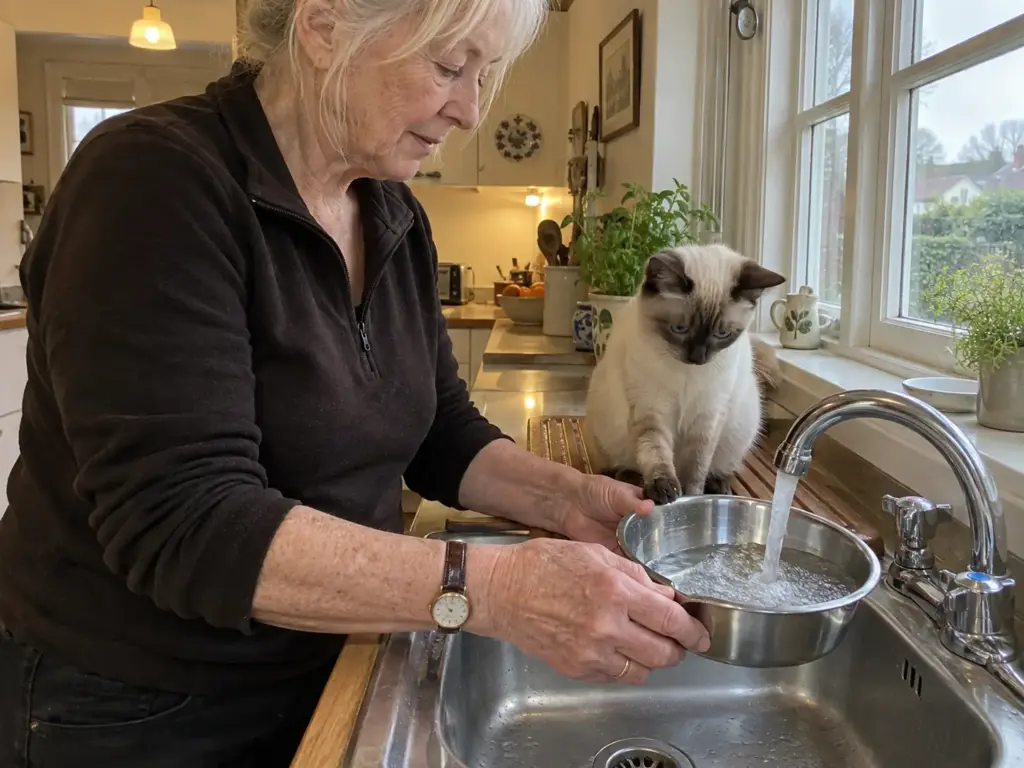
Biofilm is the one thing in your kitchen where running water accomplishes nearly nothing, and the reason is structural rather than a matter of effort.
Rinsing Versus Scrubbing, and Why Only One Works
The matrix is a physical shield, and it is a good one. The CDC’s language is worth reading twice on this point: “Research has shown that biofilm-associated organisms are more resistant to antibiotics and disinfectants than are planktonic organisms.” Planktonic means free-floating, the bacteria that have not built a house yet. The ones inside the matrix survive chemistry that kills their homeless cousins outright, and chlorine specifically is noted as less effective against them.
Sit with what that implies about your sink. If a disinfectant formulated to destroy bacteria struggles to get through this layer, tap water running over it for eight seconds was never in the contest. Water does not dissolve the matrix and water pressure from a faucet does not shear it off.
What removes it is mechanical scrubbing: a brush, a cloth, a fingernail, something physically dragging across the wall and tearing the structure apart. That is the entire difference between rinsing and cleaning in this one specific case. Not a matter of degree, a matter of whether the mechanism happens at all.
Why Soaking It Overnight Changes Nothing
The next thing people try is time. Fill the bowl with hot soapy water, leave it in the sink overnight, let the soap do the work. It comes out in the morning and it is still slick, and this is genuinely baffling until you hold the mechanism in your head.
Soaking is not scrubbing. Eight hours of soapy water sitting still against the wall of a bowl applies no friction whatsoever. You have given the matrix a long, warm bath. Contact time is not the missing ingredient here, contact pressure is, and five seconds of a brush beats a whole night of soaking by a margin that is almost funny.
The Fountain Does Not Fix This Either
The most expensive version of the mistake is buying hardware. The reasoning is intuitive: the slime grows in still water, so moving water will not grow it. A cat fountain gets recommended everywhere on exactly this logic, and they are genuinely good for other reasons, mostly that many cats drink more from them. But as an escape from biofilm, the premise is wrong.
The CDC notes that biofilms may form under stagnant as well as flowing conditions. Stagnation is an accelerant, not a requirement.
What actually happens is that people swap the container, keep the same routine, and find the film again in a few weeks in the reservoir, in the pump housing, in the filter and in the impeller seams, all of them far harder to reach with a brush than the smooth wall of a bowl ever was. You did not remove the mechanism, which is saliva plus a wet surface plus time. You just moved it somewhere with more hiding places. If you are weighing it up anyway, the honest version of whether a fountain is the right answer in a small apartment covers the noise and the maintenance clock alongside the benefits.
Whatever you scrub with belongs to the cat and to nothing else. The kitchen sponge carries a film of its own between the dinner plates and the water bowl, and it does that job well. One brush, one purpose, kept somewhere it will not get borrowed for the frying pan.
The Routine That Actually Clears It
This section is short and boring, which is the point. The people who stop seeing the film are not the ones who bought something clever. They are the ones who moved a brush next to the sink and gave the bowl five seconds of contact once a day.
The Daily Version, Which Costs Nothing
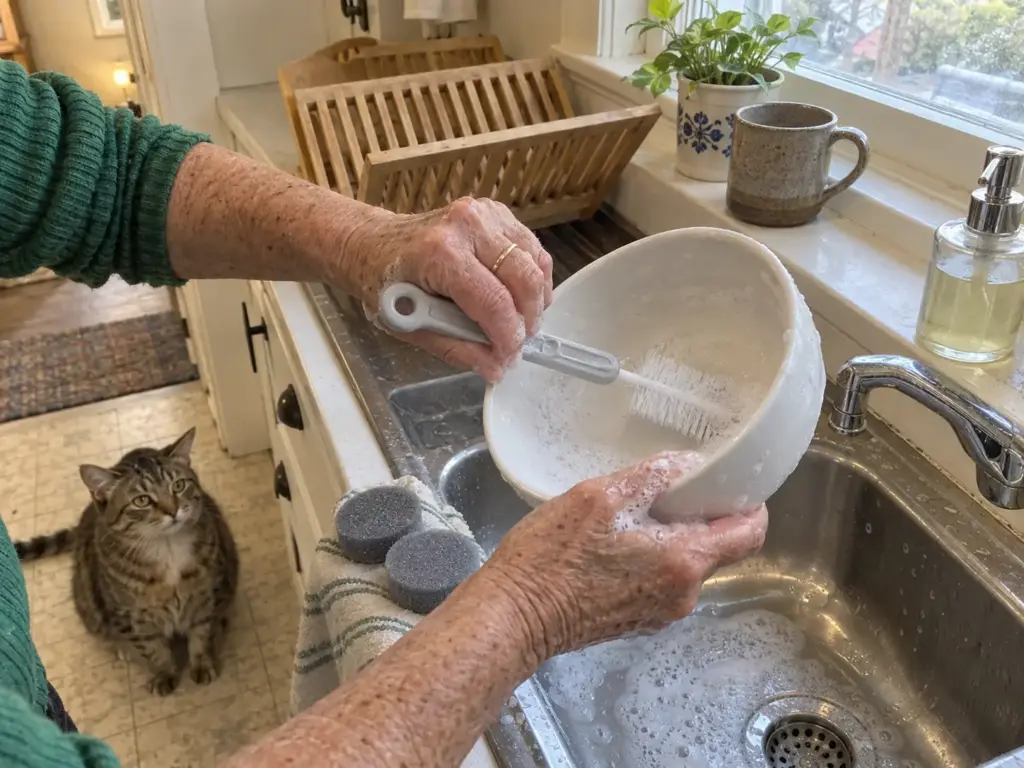
Dump the water. Scrub the inside wall with hot water and dish soap, with real contact, for a few seconds. Get the ring at the waterline and the lip under the rim, which are the two places a hurried pass always misses.
Rinse it thoroughly. Refill. Once a day.
For most single-cat homes, that is the entire article, and you can close the tab after this paragraph. No purchase, no special formula, no new bowl.
The rinse at the end is not a throwaway step, and it is where people who scrub properly still lose. Soap residue left in the bowl is food for Serratia, which is why the pink ring turns up in some carefully washed bowls and not in others. Rinse until the water runs off without any slipperiness of its own. That is it.
Two things this routine replaces, both of which get recommended online and neither of which does what people think. A daily rinse on its own is the failure this whole article is about, so a daily scrub takes its place. And a weekly deep clean as the main event is the wrong shape for the problem: the film re-establishes in a day or two, so a big Sunday session is six days late. If your water is hard and you also get chalky mineral buildup, that is a separate job — a vinegar soak handles descaling and does nothing to the biofilm, so do it occasionally and do not confuse it with the daily scrub.
The Tool That Does the Actual Work
The free version of the tool is an old toothbrush, retired from your mouth and promoted to the cat’s dishes. It is a better tool than it sounds, because the head is small enough to get into the waterline ring and under the rim where a sponge just glides past. If you own a bowl and a toothbrush, you own everything this problem requires.
If you want something built for it, the COLLBATH Cat Water Fountain Cleaning Brush Set is a multi-piece set with long handles, which matters for a deep bowl where the alternative is putting your whole hand in, and for fountain reservoirs and seams if you run one of those too. The caveat is the honest one: it does nothing the toothbrush does not, it just does it more comfortably and reaches further.
On the cleaning agent, dish soap is the recommendation and the upgrade is optional. For anyone who would rather use something made for pet dishes, the Furrtripsy Pet Bowl Cleaner Mousse is pH-balanced and fragrance-free, the second of which is the part that matters, since a scented cleaner is a good way to make a cat avoid a bowl you just cleaned.
But be clear about what it is buying you. The friction removes the film. The formula does not. A mousse used without scrubbing performs exactly as well as a rinse, which is to say not at all.
One Cat, Several Cats, and How Often to Look
One cat, once a day, is the working baseline. A multi-cat household with one shared bowl is different arithmetic: more mouths means more saliva contact per hour, more inoculation events, and a film that comes back faster.
How much faster, nobody has measured, and there is no published multiplier to hand you. Anyone giving you a number for this is guessing.
So do not run a multi-cat home on a schedule. Run it on inspection. Check daily, scrub when it needs it, and let the bowl tell you rather than the calendar. And if you also have a fountain in the house, that runs on the three separate clocks a fountain runs on, which are not the same as the bowl’s single one.
The finger test beats any schedule. Run a finger around the inside wall just under the waterline before you wash it. Slick means it is due, and that is equally true on day one and on day four. It stops you scrubbing a bowl that was fine and it catches the one you were about to skip.
What the Bowl Itself Is Doing to Help or Hurt
Two bowls, one house, same routine, and one of them goes slick faster than the other. That is not bad luck and it is not your imagination. The surface is doing half the work here, in one direction or the other, and it decides how hard the daily fight is.
Why Scratched Plastic Loses
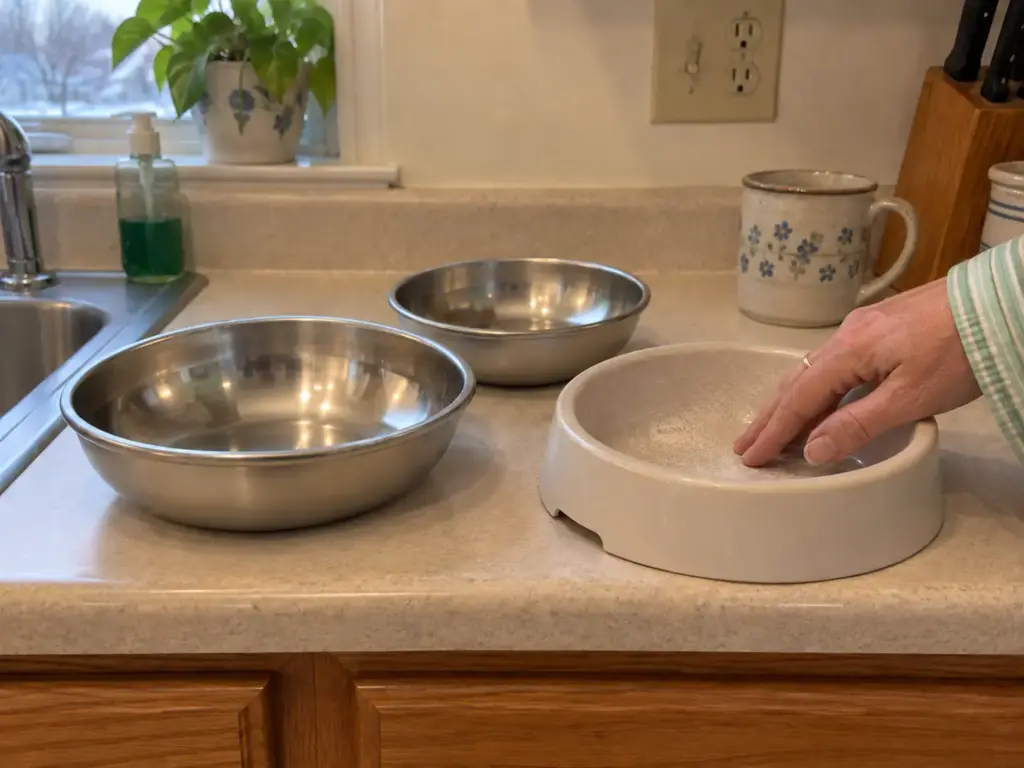
A smooth, non-porous wall gives the matrix very little to grip and, more importantly, gives your brush access to all of it. One pass and the whole surface has been touched.
A scratched plastic bowl is the opposite arrangement. Every scratch is a narrow trench, and a bristle riding across the top of it never reaches the bottom. The film inside survives the scrub intact and reseeds the bowl from shelter.
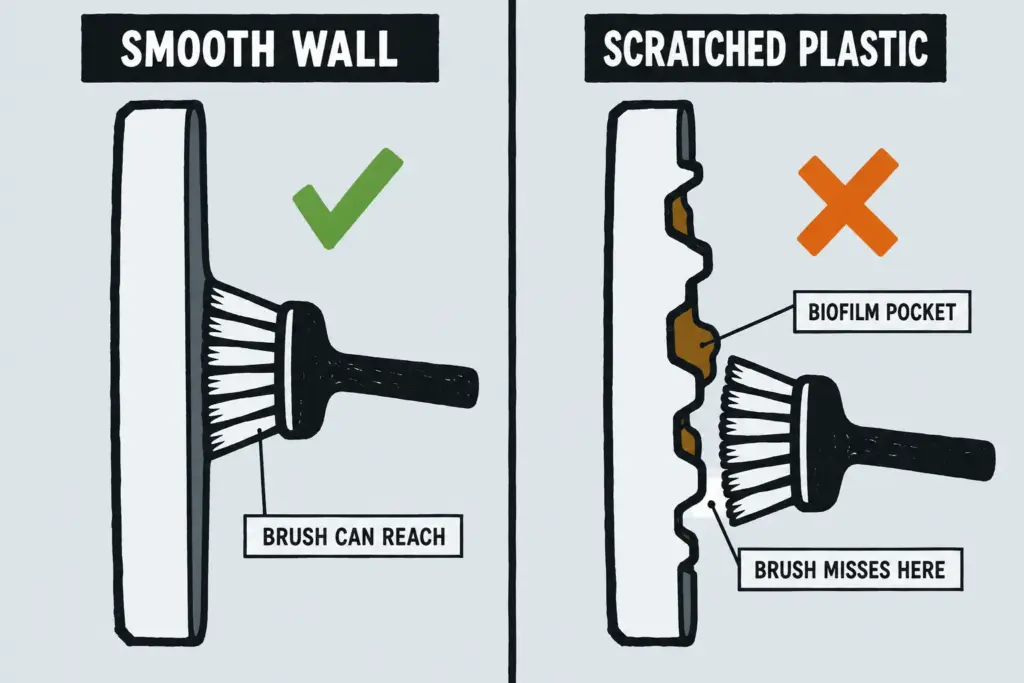
Plastic also scratches from ordinary use, which means this gets worse on a schedule of its own no matter how careful you are. A bowl that has been in service two years has a texture you cannot see and cannot fully clean. There is a second argument against plastic involving chin acne that has nothing to do with biofilm, and the two separate answers on plastic bowls keeps them apart properly.
Steel, Ceramic and Glass, and What Each Gives Up
Stainless steel is the default, and it is boring for good reasons: non-porous, scratch-resistant, genuinely dishwasher safe for the life of the bowl, and it does not develop hidden texture over time. If you have decided the old plastic bowl is the problem, the Americat Company Stainless Steel Cat Bowls come as a 2-pack in 18/8 304-grade steel, and the grade is the checkable part on a listing rather than a marketing word. The trade-off is that some cats dislike the noise of a light steel bowl sliding on a hard floor, which is a real objection and not a small one.
Ceramic works well when the glaze is intact and the bowl was fired hard enough to vitrify. That qualifier is doing more work than most listings admit: a properly high-fired ceramic, vitrified all the way through, is essentially non-porous, while a softly fired one behaves closer to unglazed pottery. The failure mode to watch for is crazing, the fine web of cracks that develops in an aging glaze and turns a smooth surface porous overnight. A Ceramic Cat Food Bowl Set of four wide, shallow food-grade bowls handles this in the practical way, since a spare means a chipped or crazed bowl gets retired instead of tolerated for another year. Ceramic’s real cost is weight and breakability, and a dropped bowl is gone.
A glass bowl is as non-porous as steel with one genuine advantage nobody mentions: you can see the film forming from the outside, days before you would have found it by hand. The Catit Style 2-Bowl Glass Diner Set gives you that in a two-bowl stand. Its limit is capacity, at 6.8 fl oz per bowl, which is fine for one cat and runs dry too fast in a house with several. If you want the full material comparison rather than this section’s summary of it, cat bowls in ceramic, steel or plastic and what fails is the room that owns that argument.
Check the Bowl You Already Own Before Buying One
Before any of that, go look at what is in your kitchen right now. Steel in good condition needs no replacement. Intact ceramic needs no replacement. Run a fingernail across the inside of an older ceramic bowl and listen for the catch that means crazing, and hold a plastic bowl at an angle under a light to see the scratch pattern you have been washing over.
Replace a bowl because it is scratched, chipped or crazed. Not because an article told you to. Most bowls that are failing at this are failing on routine, not on material, and buying a beautiful new steel bowl that gets rinsed instead of scrubbed will produce the exact same film in the exact same two days.
The One Change That Ends This
The film is biofilm, seeded by your cat’s own mouth, and it will return on any wet surface no matter what you buy. The goal is a short cycle, not a sterile bowl, and nobody has a sterile bowl.
Rinsing has never removed it and never will, because water does not break the matrix. Friction does, and it takes about five seconds a day. And the bowl you already own is probably fine unless it is scratched, chipped or crazed, so check it before you replace it.
In three weeks, run a finger inside the bowl under the waterline before you wash it. Smooth means the habit held. Slick means either the brush drifted back into a drawer or the bowl itself is the problem, and by then you will know which one you are looking at.
Tonight, move a brush to the sink and give the bowl five real seconds of contact. If the cat goes back to drinking normally this week, that cost you nothing at all.
Amazon’s Audible — free for 30 days
Your cat won’t let you read. Let someone read to you.
Audible is Amazon’s audiobook library — thousands of titles, read out loud, on your phone. Free for a month, plus one audiobook to keep forever.
Frequently Asked Questions
01What is the slime in my cat’s water bowl?
It is biofilm — bacteria that have built a protective polymer layer over themselves on the bowl wall, seeded mostly by your cat’s saliva. It forms on any wet surface within a day or two, which is why a bowl rinsed yesterday feels slick today.
02What kills biofilm in water bowls?
Friction, more than any product. The matrix shields the bacteria from disinfectants, so the step that removes it is scrubbing with a brush or cloth and dish soap, followed by a thorough rinse. Water alone, however hot, does not break it.
03Is biofilm harmful to cats?
A bowl your cat drinks from several times a day should be clean, and biofilm is a good reason to scrub it daily rather than rinse it. What this article will not do is connect it to any specific illness. If your cat is drinking noticeably less or changed habits suddenly, that is a vet visit, not a cleaning question.
04How do I get rid of biofilm in a cat water fountain?
The same mechanical principle applies, across more surfaces: the reservoir, the pump housing and the impeller all need contact from a brush, not just a rinse. Moving water does not prevent biofilm, since it forms under flowing conditions too.
05How often should I clean my cat’s water bowl?
Once a day for a single cat, with a real scrub rather than a rinse. Several cats sharing one bowl means more saliva contact per hour and a faster return, so check it more often instead of trusting a fixed schedule — a finger run inside the bowl tells you more than the calendar does.



Leave a comment