Why Cats Refuse a Litter Box in the Basement
A basement litter box fails above 60% humidity, and your dehumidifier's display lies by 5-15 points. The capacity chart + the free fix first.

Alfredo RamsesFounder · August 26, 2026 · 17 min read

On this page8 sections
- 1What the Basement Solves, and Who It Solves It For
- 2The Stairs Are Not the Problem; the Round Trip Is
- 3Cold, Dark, and the Furnace That Kicks On
- 4Damp Is a Number, Not a Feeling
- 5Out of Sight, Out of Mind: The Failure That Is Yours
- 6The Fix That Costs Nothing, and the Door That Costs a Little
- 7What to Do Next
- 8Frequently Asked Questions
The box went downstairs for a good reason.
The living room stopped smelling, the toddler stopped finding it, and the guest bedroom became a guest bedroom again. Then, four months later, there is a damp patch on the carpet near the top of the basement stairs, and it reads like a protest. It isn’t one. Your cat did the arithmetic on that round trip and decided it doesn’t pay, and what separates a litter box in the basement that keeps working from one that quietly gets abandoned is not the box at all: it’s four things about the room and one thing about your own route through the house. Below is what the cat is actually measuring, the two failures that belong to you rather than to him, and the free fix that beats every purchase in this article.
Quick Answer
Yes, a litter box can go in the basement, but never as the only box in a multi-floor home. It works if the spot is dry, lit, and away from the furnace. Most failures are not about the basement at all: the box left your daily path, so the scooping quietly stopped.
What the Basement Solves, and Who It Solves It For
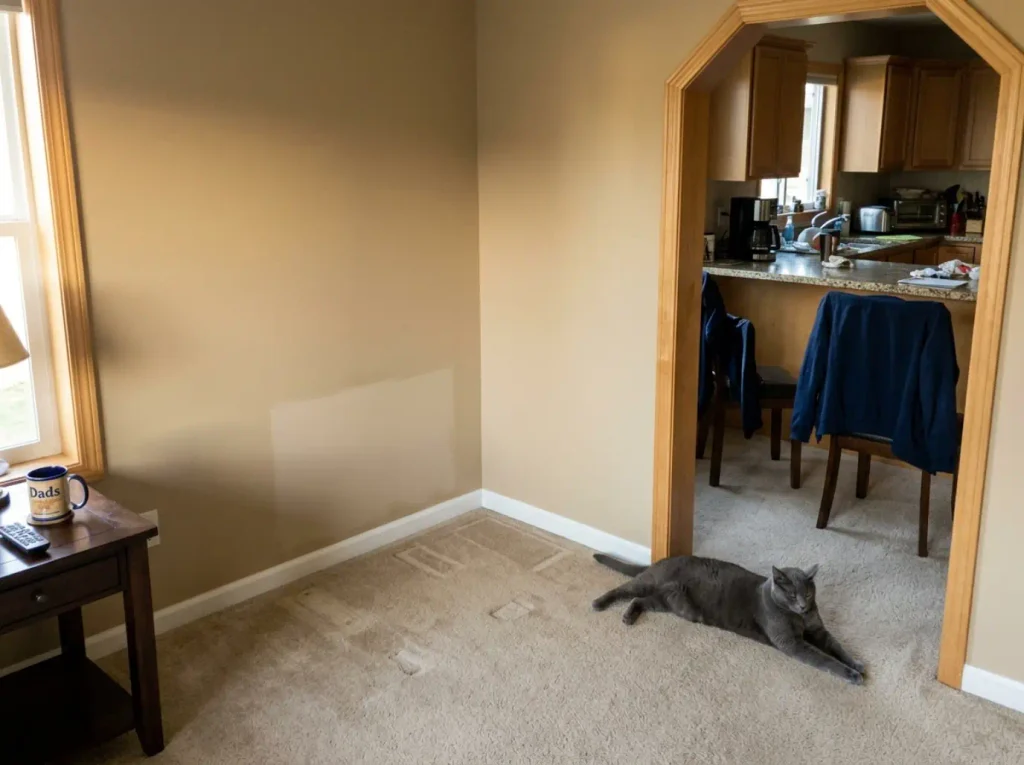
Nobody moves a litter box to the basement on a whim. It was the smell reaching the sofa. It was the toddler who kept discovering the box as an activity. It was the spare room that stopped being usable because of what was in the corner of it. Those are real problems, they had to be solved, and solving them by moving the box downstairs was a reasonable call.
It was also, every single time, a solution to your constraints.
Odor containment is yours. Keeping the box away from a toddler or a dog is yours. Both legitimate. Neither one appears anywhere on the list your cat is working from, because he is measuring an entirely different set of things: how far the trip is, what he has to cross to make it, how cold the floor is at the other end, whether he can see, and what noises happen down there without warning.
Moving the box to the basement improves none of those. It worsens most of them, which is why litter box placement in a basement follows the same placement rules that govern every other room in the house, only with the margins tighter. You can read the full framework in where to put a litter box, and the three places to never.
There’s an anecdote that circulates in litter threads with almost no variation, and it’s worth sitting with.
The owner is pleased: the box is hidden, the house smells clean, guests never see it. Months later they find out the cat had been using a laundry basket near the top of the stairs the entire time. Nothing about that house was dirty. The human problem was solved beautifully and the cat’s problem was never asked about.
So here’s the rule that decides the rest of this article, and it decides most of these cases before anything gets bought: in a multi-floor home, a basement box is a second box. It is never the only one. Everything below assumes you’re deciding whether the basement is a good place for an additional box, not whether you can move your cat’s entire bathroom into it.
Before you change anything, walk the trip yourself once, at night, with only the lights you’d actually leave on. Count the doors. Notice the temperature change at the bottom. That one walk answers most of this article for free.
The Stairs Are Not the Problem; the Round Trip Is
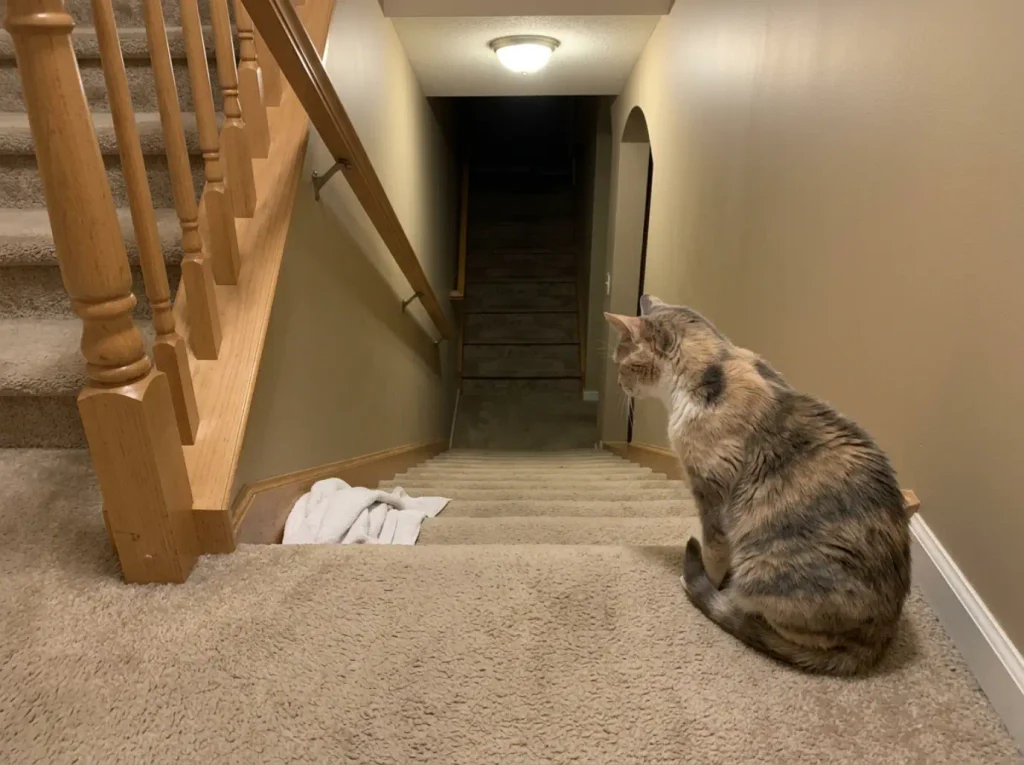
Everybody arrives at this question the same way: how many stairs is too many?
And here is the honest answer, which is also the most useful thing in this section. No source quantifies it. There is no study, no threshold, no number of steps at which cats reliably stop making the trip. Anyone who hands you one made it up. A cat doesn’t object to a staircase as an object anyway. He objects to a round trip that costs more than the alternative, and in a house there is always an alternative: the rug by the door, the pile of clean laundry, the plant pot.
What replaces the missing number is the cat making the trip. Not cats in general. Yours, and there are roughly four profiles.
A kitten is still learning the route and will lose it under pressure. Give him a box he can reach in seconds until he’s a year old, because a kitten who is halfway down the stairs when the urge arrives is not going to finish the trip.
A healthy adult with a clear route and a lit destination is the one case where the basement genuinely works, and it’s why some readers will finish this article and keep everything exactly as it is. A senior cat, or any cat with limited mobility, is where the basement stops being viable, and this is not a maybe: more than 90% of cats over 12 develop some form of arthritis. For that cat, a flight of stairs twice a day is already a negotiation before you add the cold slab at the bottom.
And an anxious cat who will not cross open ground twice, especially open ground with a dog or a washing machine on it, has effectively no route at all, regardless of how short the route is on paper.
Forum threads have a phrase for the outcome, and they use it about cats who have no medical explanation whatsoever: the trip isn’t worth it. That is not a behavior problem. It’s an access failure, and access failures are solved by shortening access, not by improving the destination. One thing does sit outside this, and it deserves a sentence rather than a paragraph: a cat who suddenly stops using a box he used yesterday is a vet visit before he is a furniture question. Everything in this article assumes that call has already been made.
The mechanism generalizes past the basement, incidentally, which is why a closed door does the same thing to a bathroom box as a flight of stairs does to a basement one. Distance and obstruction are the same currency to a cat. Both are just cost.
Cold, Dark, and the Furnace That Kicks On
Here’s how this one usually goes. The box moves downstairs, the cat stops using it a few weeks later, and everyone blames the stairs. Sometimes the stairs are fine. Sometimes the problem is that the furnace cycles on at the exact moment your cat is mid-squat, and that happened once, and once was enough.
Three things down there push a cat off a box that has nothing to do with distance: cold, darkness, and mechanical noise.
Noise is the worst of the three, and it’s worth understanding why rather than just being told. Cold is constant, so a cat can decide about it in advance. Darkness is constant too. Noise is not.
A furnace kicking on, a water heater firing, a sump pump starting up: these arrive without warning and they catch the cat in the one position from which he cannot leave quickly. He doesn’t reason about it afterward. He just files the location under unsafe, and one event is genuinely enough to lose a spot permanently.
Stand in the basement and wait for the furnace to cycle. If it startles you, standing upright and expecting it, it startles the cat. He is closer to it, lower down, and not expecting anything.
The cheapest fix in this entire article costs about as much as a bag of litter: a night-light near the box. Total darkness makes a basement box functionally unavailable after dark for a lot of cats, and every hour your household is asleep is an hour that box may as well not exist. Buy the light before you buy anything else on this page. Honestly, if you only take one action away from this article and the second box upstairs isn’t possible, take that one.
Then there’s the slab.
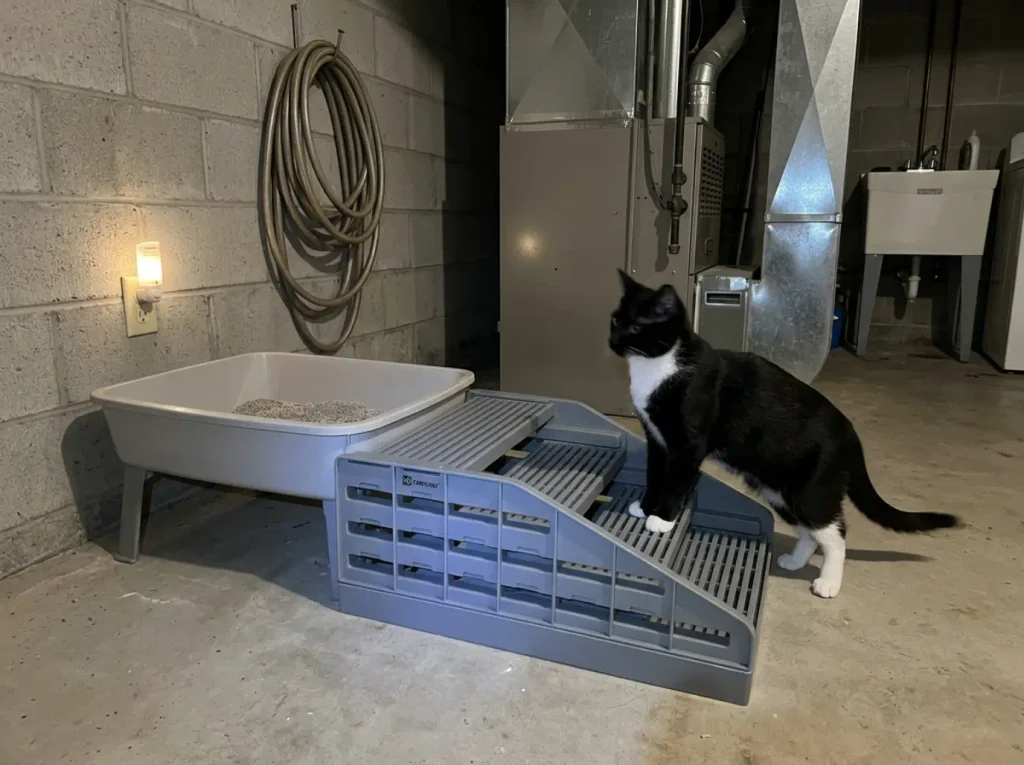
Concrete is the coldest surface in the house and it stays cold in July, which surprises people who tested the spot in August and thought it was fine. A raised platform under the box solves the temperature, and in a cold basement it is the difference between a spot the cat tolerates and one he writes off, and if the cat making the trip is a senior it can solve the second problem at the same time: the Adjustable Litter Box Step/Ramp has adjustable height, fits standard and automatic boxes, and lifts the box off the slab while giving an arthritic cat a step instead of a wall to climb. One purchase, two of this section’s problems. The caveat is that a ramp only helps a cat who is willing to be down there in the first place, so it belongs after the light, not before it. If you want the same effect for less, the Zhaoyao Litter Box Ramp has four detachable adjustable-height legs at 14 x 10 x 3.74 inches and does the mechanical part of the job.
Clearance still applies down here, too. A basement corner needs the same 24 x 20 x 18 inch clear floor around the box as the same clear floor an enclosed box needs anywhere else in the house. Spare space is not the same as usable space, and a box wedged between the water heater and a stack of storage bins fails the clearance test even though it looks like it’s floating in an empty room.
Damp Is a Number, Not a Feeling
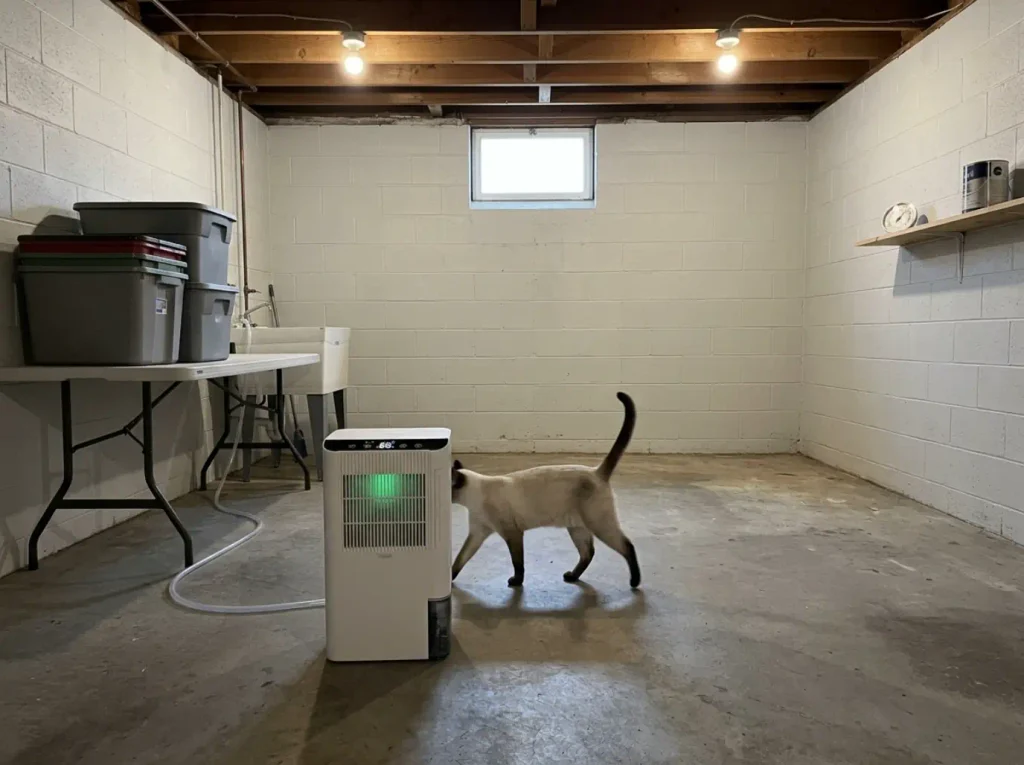
Every article about this tells you to make sure the basement isn’t damp. Not one of them says what damp means. So you go stand at the bottom of the stairs, decide it smells basically fine, and move on with a decision you have no way to check.
There is a number, and it’s a good one.
Mold spores need sustained relative humidity above roughly 55-60% for 24 to 48 hours, plus something organic to eat. Below that line they stay dormant. It isn’t a scare figure invented by dehumidifier companies either:
ASHRAE’s Indoor Air Quality Guide puts the acceptable indoor ceiling at 60% RH, and the EPA’s recommended range is 30-50%. Two separate standards organizations, arriving independently at the same place, which is why basements are considered too humid above 60% relative humidity. Your practical target for an unfinished basement is 45-50% RH in summer and 30-40% in winter.
Now the part that makes the number useless if you don’t know it.
Built-in dehumidifier displays read 5 to 15 points optimistically. A unit sitting there showing you a comfortable 50% may be in a room that’s actually at 58 to 65%, which is over the line while telling you it’s under. The fix is a separate hygrometer placed across the room from the unit, not next to it, and it’s a pocket-change purchase. That’s the buy that matters here. Not the dehumidifier. If you spend nothing else in this section, spend it on knowing the real number, because a dehumidifier bought on a bad reading is an expensive way to be wrong.
And when you do need one, size it to the room. This is the chart nobody publishes:
| Basement size | Capacity you need |
|---|---|
| Up to 500 sq ft, mildly damp | 30-pint |
| 500 to 1,000 sq ft | 40-pint |
| 1,000 to 1,500 sq ft | 50-pint |
| 1,500 to 2,500 sq ft, with active seepage | 70-pint |
Matching capacity to the room is the lever, not buying the biggest unit on the shelf. For a typical residential basement corner, the Dehumidifier 2000 Sq Ft Compact covers up to 2,000 sq ft with a 2.5L tank and a 3.3 ft drain hose, and that hose is the feature that decides whether this works long term. A tank you empty by hand is a daily chore performed in the room you already avoid, which means it gets abandoned in about three weeks. If your basement is genuinely large or genuinely wet, the hOmeLabs 50-Pint is better per pint, though it’s oversized for most corners and it’s a bigger object to have sitting next to a litter box.
I used to think the dial was the variable people got wrong. The recurring confession in basement threads says otherwise: I turned the dehumidifier down and it didn’t help. A lower dial number does not make a unit work harder, it just sets a target the unit can’t reach, and the actual problem was almost always sizing or a display telling a comfortable lie. Set it to 45 and verify with the hygrometer across the room.
What damp does to the box itself is more direct than most people expect. Plant-based and wheat litters mildew. Clay clumps go soft and stop holding together, so scooping breaks them and the fine stuff stays in the box. And the mat under the box never dries out, so a damp floor turns ordinary litter tracking into a slow, quiet mess in a room nobody visits.
This is the one place in the house where waterproof genuinely matters more than absorbent: the PetFusion ToughGrip Waterproof Cat Litter Mat in Large is premium silicone, so ambient damp sits on top of it instead of soaking into it. A fabric mat on a damp slab will never fully dry. The Catit Cat Litter Mat in Small, 15.75 x 23.5 inches, is the cheaper version if the box sits in a tight corner.
Out of Sight, Out of Mind: The Failure That Is Yours
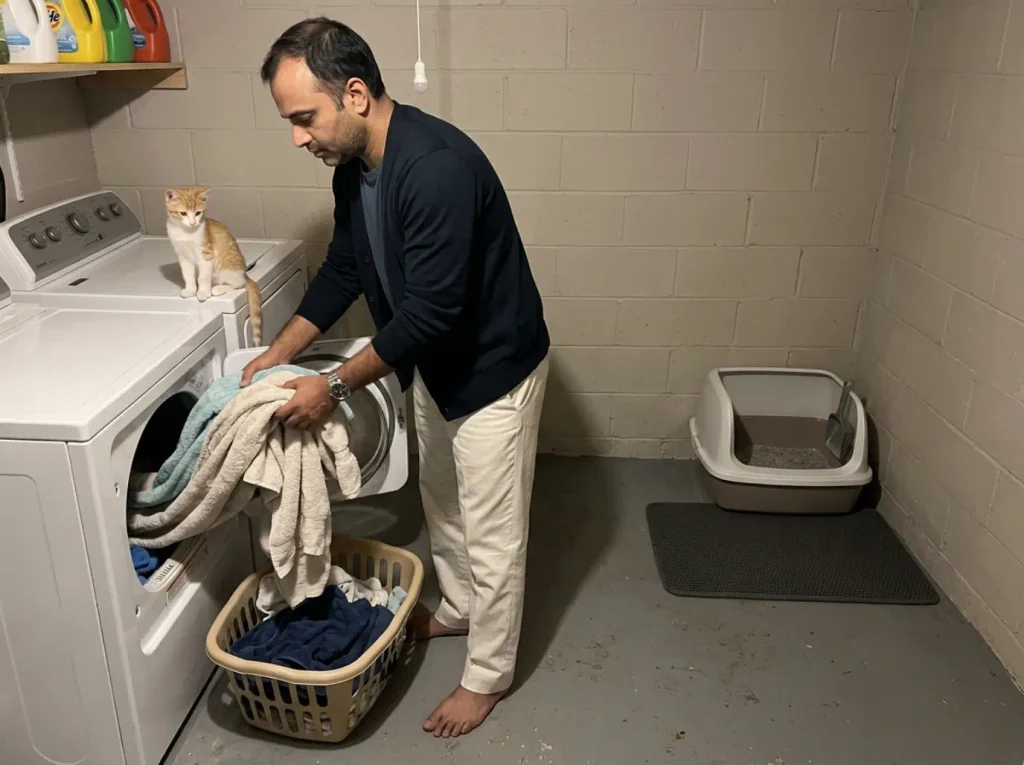
This is the section the article exists for, so I’ll put the mechanism first and the sympathy second.
Scooping is not triggered by intention.
It’s triggered by passing the box. You walk past it, you see it, you scoop it, and that loop has been running so reliably that you experience it as a decision you make. Move the box off your daily route and the trigger disappears while the intention stays exactly where it was. Which is why the owner in this situation is telling the truth when they say they scoop regularly. They mean it. They just aren’t doing it, and there’s nothing in the house that tells them so.
Because here is the second half: the box degrades in silence.
Nobody is down there to smell it.
In the living room a box that’s a day overdue announces itself before you consciously notice, and the whole system self-corrects. In the basement there’s no one in the room. By the time it’s strong enough to reach the top of the stairs, it has been unacceptable to the cat for several days, and he has already started making other arrangements. The wet patch near the stairs isn’t the beginning of the problem. It’s the notification, arriving late.
So the fix is a routine, not a product, and this is the advice competitors bury in a comment thread: tie the trip to something that already takes you downstairs. For most houses that’s the laundry room. Scoop when you start a load, every time, and the trigger is rebuilt out of something that already runs on its own schedule.
Phone reminders are the fallback and they’re a genuinely weaker one, because a reminder is a thing you dismiss with your thumb while doing something else, and laundry is a thing that physically puts you in the room. Use the reminder if you have to. Expect it to survive about a month.
If you cannot name the thing that already takes you downstairs twice a week, the basement is not a placement problem. It is the wrong room for your house, and no purchase on this page changes that.
The phrase forum users reach for is out of sight out of mind, and the thing worth noticing is that they use it about themselves.
Not about the cat. They worked this out already.
The Fix That Costs Nothing, and the Door That Costs a Little
You came here looking for a better basement box. The answer, most of the time, is a second cheap box upstairs, which is exactly why this section is last instead of first.
Don’t upgrade the basement box. Add a box on the floor your cat actually lives on. That removes the stairs from the equation instead of making the stairs nicer, and it’s the standard resolution for a multi-level access problem for the same reason it’s the cheapest one: it changes the trip rather than the destination. Use a box you already own, put it somewhere your cat already spends the afternoon, and see what happens over a week.
This is not a defeat, either. The basement box stays exactly where it is and keeps doing its job for you, containing odor away from the living room, out of reach of the toddler. It just stops being the only one. The exception is when there is no second floor to move it to, which is a different problem with a different set of answers.
The count changes as soon as there’s more than one cat. The working rule is one box per cat plus one — the 1+1 rule — and the part everyone gets wrong is that multiple litter boxes only count as multiple if they are genuinely separate. Three boxes lined up in one basement corner is not three locations — the same trap a small apartment hits from the opposite direction, with too little floor rather than too much. To the cats it reads as one, and the count changes as soon as there are two cats in ways that a single basement corner cannot absorb no matter how much floor you give it. A multi-floor house with two cats and one basement box is short by every count there is.
Then there’s access, which is a separate problem and worth checking before you spend anything at all. If the basement door gets shut, for heat, for the dog, for a draft off the stairs, then everything above is irrelevant. A cat cannot open a door. He also cannot tell you the door was shut for two hours this afternoon, which is how this failure hides for months.
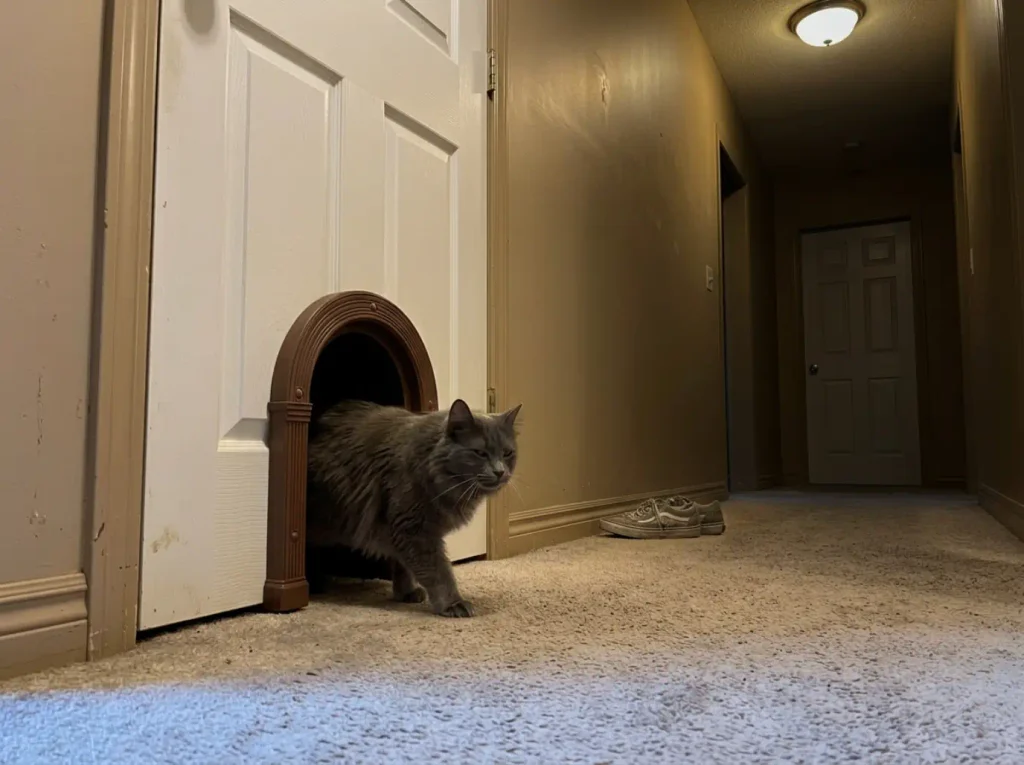
Every competing article’s fix for this is to cut a cat door into the basement door, which is fine advice if you own the house and useless if you don’t. If you rent, you’re not cutting a hole in a door that isn’t yours. A no-flap interior insert is the renter-friendly version of a pet door, and it works: the Cat Door for Interior Doors handles cats up to 25 lbs, clips into an existing hollow-core or solid interior door, and comes back out on move-out day without a conversation with the landlord.
The no-flap opening matters for a second reason that has nothing to do with the lease: a cat who is already unsure about a dark basement will not push through a swinging flap to get there. Two hesitations stacked on one trip is one too many. The honest caveat is that this is a fix for a door that genuinely gets closed. If yours stays open, you have no access problem and you should not buy one.
What to Do Next
A basement box works as a second box and fails as the only one. That distinction alone resolves most of these cases before anything gets bought, so make that call first and see what’s left.
Two of the four failures are yours rather than your cat’s. The box left your route, so the scooping stopped, and no amount of blaming the stairs fixes a trigger that isn’t firing. Tie the trip to the laundry and that half is repaired for free, today.
Put a hygrometer across the room before you put a dehumidifier in it. 60% RH is the line, 45-50% is the summer target, and the unit’s own display will tell you a comfortable lie by 5 to 15 points.
Check back in three weeks, not three months. This depends on a cat accepting a location and on you holding a new routine, and both of those declare themselves fast. Two questions at the three-week mark: is the upstairs box getting used more than the basement one, and did the basement trip survive past week two? If the second answer is no, you already know which room this box belongs in.
Move a box you already own up one floor. If the accidents stop, you just learned the answer and it cost you nothing.
Amazon’s Audible — free for 30 days
Your cat won’t let you read. Let someone read to you.
Audible is Amazon’s audiobook library — thousands of titles, read out loud, on your phone. Free for a month, plus one audiobook to keep forever.
Frequently Asked Questions
01Can a litter box be in an unfinished basement?
Yes, but it needs three things the average unfinished basement lacks: a light left on, a spot away from the furnace, and the box lifted off the concrete. Check the humidity before you commit to a corner. Above 60% RH is where damp stops being cosmetic.
02Is one litter box in the basement enough for two cats?
No. One box per cat plus one is the working count, and boxes lined up in the same basement corner read as a single location to the cats rather than as three. In a multi-floor home, at least one box belongs on the floor the cats actually live on.
03My cat used the basement box and suddenly stopped. What changed?
Check the room first: a new noise, a burnt-out bulb, a colder month, a door that started getting shut. If nothing in the room changed and the stop was sudden, that is a vet visit before it is a furniture question.
04Do I need a cat door to the basement?
Only if the door gets closed. If it stays open, you have no access problem and you should not buy one. If it does get shut, a no-flap interior door insert works without cutting anything permanently, which matters if you rent.
05Will a dehumidifier fix a basement that smells like the litter box?
It helps with the damp-basement smell, but not with the box. Ammonia coming off a box is a scooping-frequency problem, and a basement box is the easiest one in the house to under-scoop, which is usually the real answer.
Leave a comment