Best Hidden Litter Box Furniture for Small Apartments
Don't buy hidden litter box furniture off the listing size. That number is the outside (subtract 2" per side), and your cat lives on the inside.

Alfredo RamsesFounder · August 25, 2026 · 19 min read

On this page9 sections
- 1The Number on the Listing Is the Outside of the Box
- 2Measure the Cat Before You Measure the Room
- 3What Fits When the Room Is the Only Room
- 4The Free Version, and When It Actually Wins
- 5Hidden Is a Visual Word, Not a Smell Word
- 6Two Cats Do Not Fit in a Cabinet Built for One
- 7What a Rental Changes, and What It Doesn't
- 8Conclusion
- 9Frequently Asked Questions
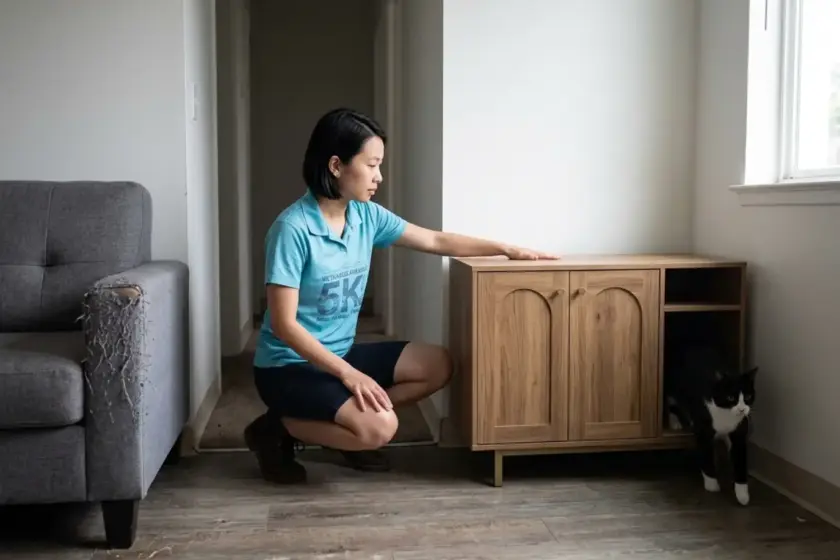
The cabinet arrived, you assembled it on the living room rug, and it looks exactly like the photo. Then the cat walks up, puts his front paws inside, and stops with his back end hanging out over the threshold. He is not protesting the decor. He is solving a geometry problem you handed him, and his answer is the correct one.
The number that failed here is not a mystery either: almost every listing gives you the outside of the cabinet, your cat lives on the inside, and nobody publishes the chain of measurements that connects the two. So here is that chain, start to finish, filtered through the one thing the buying guides skip entirely — what changes when the room holding this furniture is the only room you have.
Quick Answer
Five numbers decide whether hidden litter box furniture works in a small apartment. Everything else is finish and color.
- Measure the cat first: nose to tail base, times 1.5, is your box size
- Usable interior of at least 24″ wide, 20″ deep, 18″ tall
- Entry opening no smaller than 8″ wide by 10″ tall
- Subtract about 2 inches per side from any listed exterior size
- Over 40″ of interior width before one cabinet counts as two boxes
The Number on the Listing Is the Outside of the Box
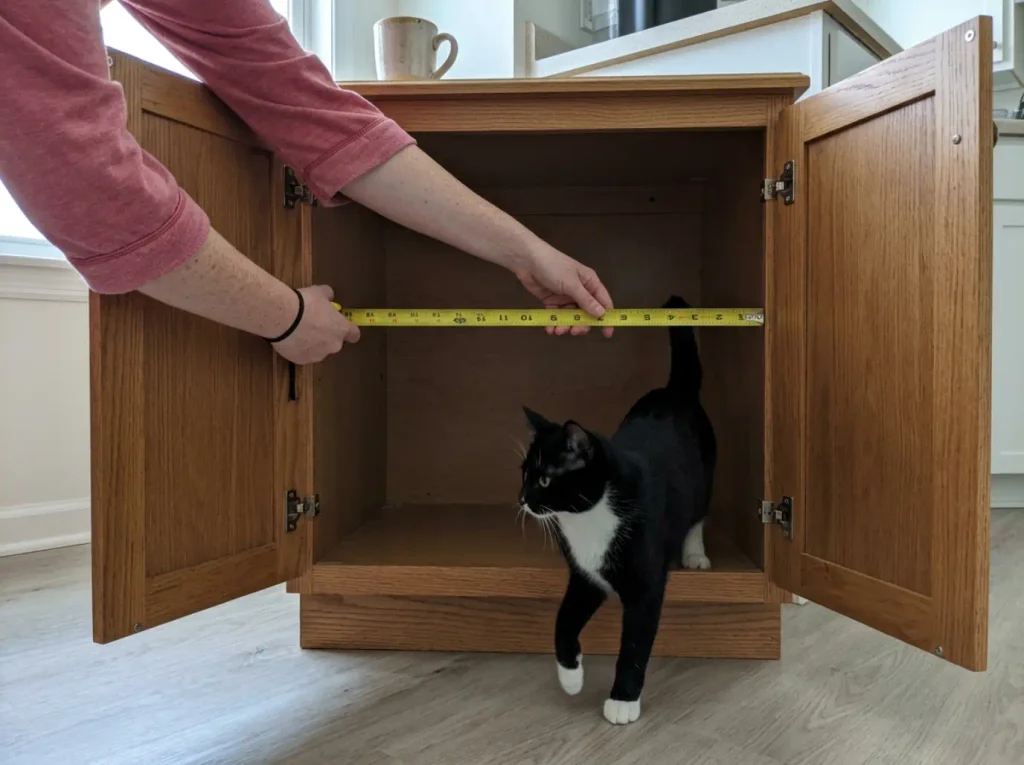
A cat litter cabinet sold as 31.5 inches wide is 31.5 inches of your wall. It is not 31.5 inches of cat.
Somewhere between those two numbers sit two side panels, a back panel, a door and the frame the door hangs on, and every one of them eats into the space the cat is actually standing in. The listing photographs the outside because the outside is what fits in your apartment, and that is a reasonable thing for a furniture seller to measure. It is just not the number you were comparing against your cat.
The correction is blunt and it works: subtract about 2 inches per side from the listed exterior dimensions and treat the result as your realistic usable interior. The Refined Feline publishes this alongside the interior clearances a cabinet actually has to hit, and it reframes every product page you are about to open. That handsome 31.5-inch cabinet is closer to 27 inches inside. The 24-inch nightstand-style piece is closer to 20, which is under the floor before the box goes in.
Before you open a single listing, write your two target numbers on your phone: the interior you need, and that same figure plus 4 inches. The second one is the exterior size you are allowed to shop for. If a seller publishes interior dimensions, use those and skip the arithmetic entirely, because a seller who publishes them usually has nothing to hide.
So what is the floor? A usable interior of 24 inches wide, 20 inches deep and 18 inches tall. Below 18 inches of height the cat has to crouch to get in, and a cat that crouches to enter is a cat doing a squat every time he needs the box. Below 20 inches of depth he cannot turn around without brushing a wall, which is the movement that matters most, because turning is what happens before covering.
Then there is the opening, and this is where good-looking furniture quietly fails. The entry needs to be at least 8 inches wide by 10 inches tall. A small decorative arch cut into a door photographs beautifully and reads to a cat as a tunnel with one exit. Cat-friendly design is a dimension before it is a style, and an enclosed litter box gets judged on that opening before anything else.
That is the single most common reason a cat refuses to walk into a piece of furniture that looks fine from every angle, and no amount of treats near the opening fixes a hole that is the wrong size.
The failure everyone makes is not a measuring failure. It is an order-of-operations failure. The cabinet gets chosen for how it looks against the wall, the box gets chosen to fit the cabinet, and the cat gets whatever is left. The chain runs the other way: cat, then box, then cabinet interior, then the piece of furniture.
Run it in that direction and you buy once. Run it backwards and you either return the cabinet or you keep it and the cat starts using the rug beside it, and the rug is a much more expensive lesson than the return shipping. This whole category is furniture that hides the box, not the smell, and it hides bad measurements just as well.
Measure the Cat Before You Measure the Room
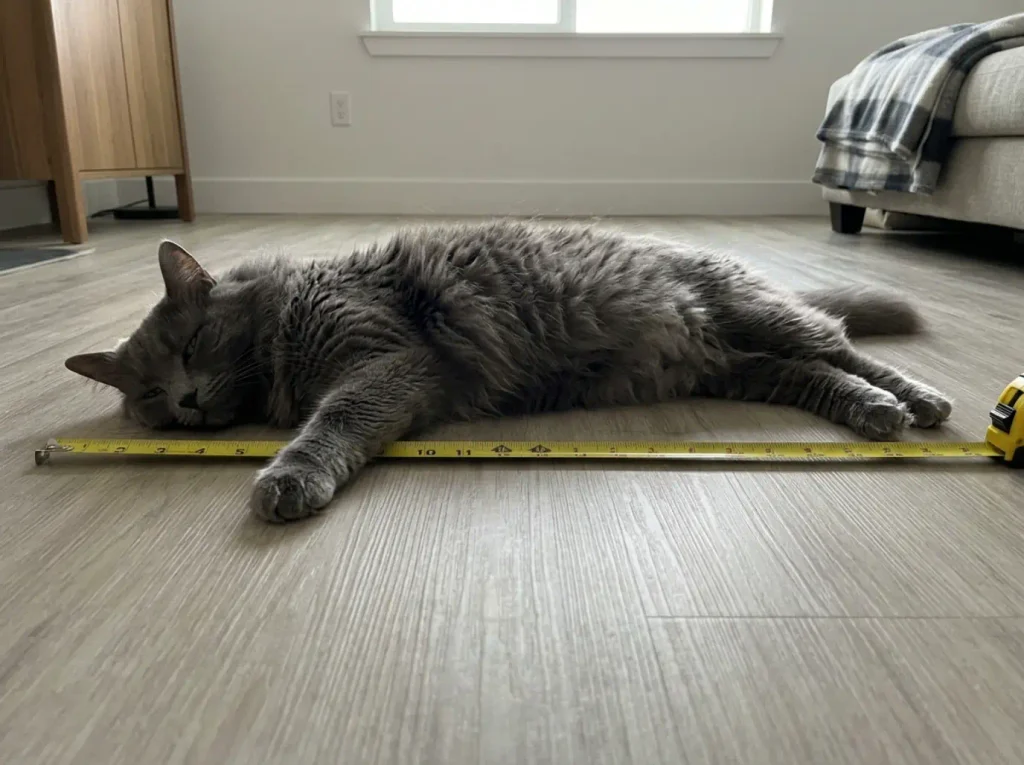
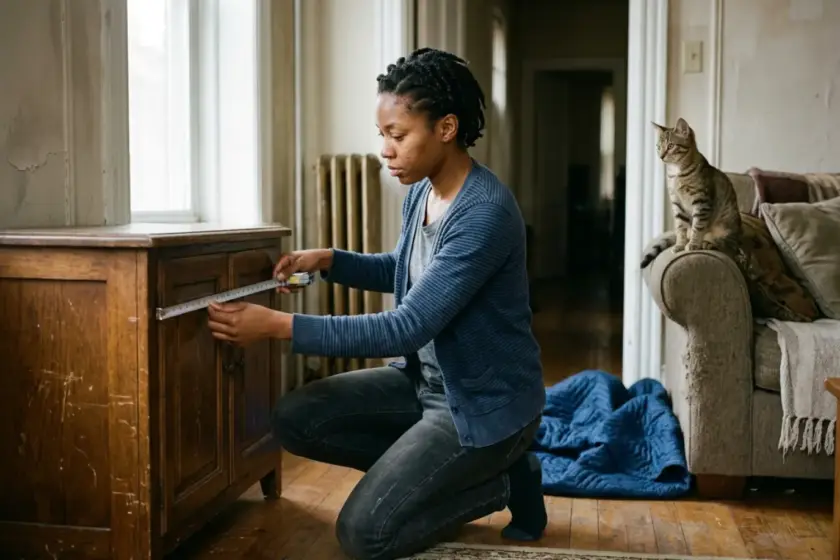
Nobody measures the cat. People look at the cat, decide he is medium, and shop on that impression. The tape measure costs nothing, takes thirty seconds, and it is the only number in this article that is genuinely yours.
Get him stretched out and measure from the tip of his nose to the base of his tail, not including the tail. Multiply that by 1.5 and you have the minimum box length he needs. A fourteen-inch cat needs a twenty-one-inch box.
That box then has to sit inside the cabinet with scoop access left over on one side, and now you know why the 24-inch interior floor exists rather than being a number someone picked for symmetry. There is more of this math in the piece on what size litter box a cat actually needs, in inches.
Three numbers, in this order, and none of them are the furniture:
- The cat: nose to tail base, stretched, tail excluded.
- The box: that figure times 1.5, as a minimum length.
- The cabinet interior: the box, plus turning room, plus a hand with a scoop in it.
Above 15 pounds the whole calculation moves. Push the interior toward 28 inches wide by 22 deep, because a large cat at full extension goes past what most furniture calls standard without ever announcing it. A big Maine Coon is the clearest case in the category: at full stretch he needs an interior that a lot of brands simply do not build, and the listing will never tell you that because the listing has no idea how big your cat is. Long hair counts too.
The animal turning inside that box is not his skeleton, it is his silhouette, and a long coat adds real inches to his turn radius.
I used to think entry height was the forgiving dimension, the one you could shave an inch off without consequence. Then you notice which cabinets generate the complaint that the cat uses it for a month and then stops. It is almost always the low-ceilinged ones, and the mechanism is boring: he was crouching the whole time and he was willing to, right up until he wasn’t.
Whether an enclosure is bad for a cat at all comes down to size rather than to the enclosure, and this is the dimension it comes down to. Height is not the forgiving number. Depth is, slightly, and only if the opening is generous.
And the cat standing there with his front paws in and his rear end out is not making a point. He is telling you the interior is short, in the only sentence available to him.
What Fits When the Room Is the Only Room
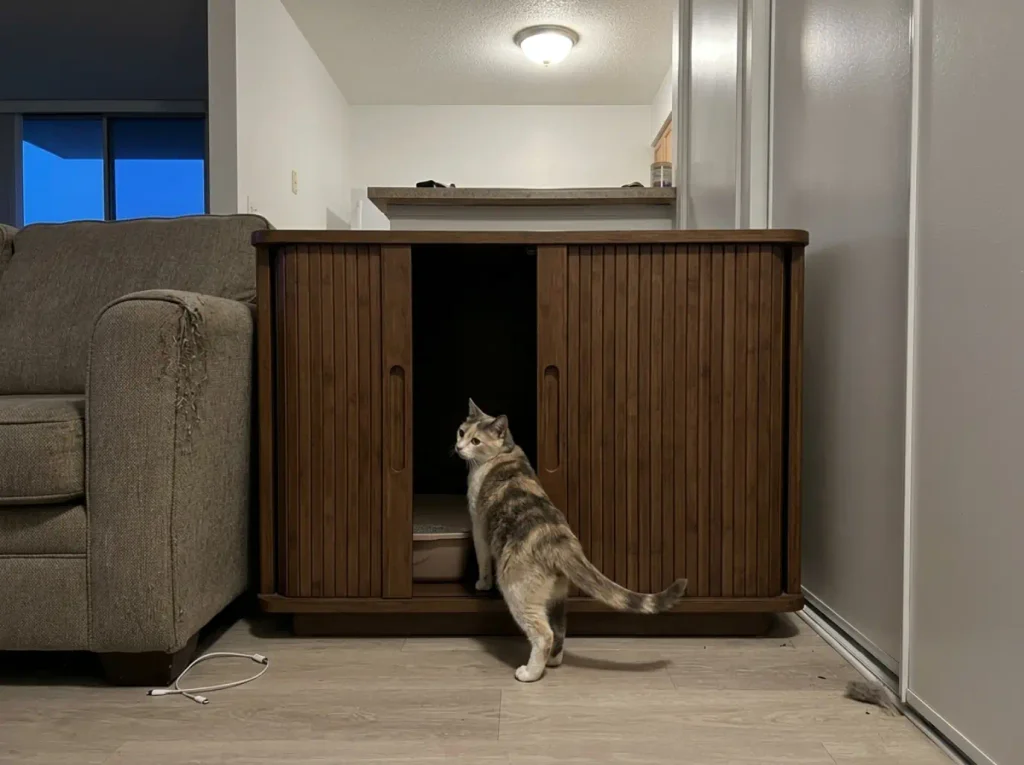
In a studio or a one-bedroom there is no laundry room, no guest bathroom, and no dead hallway to donate to this. Small space is not a style constraint here, it is the whole specification. The cabinet has to live where you live, and that single fact rules out about half of what gets recommended in general buying guides written for houses.
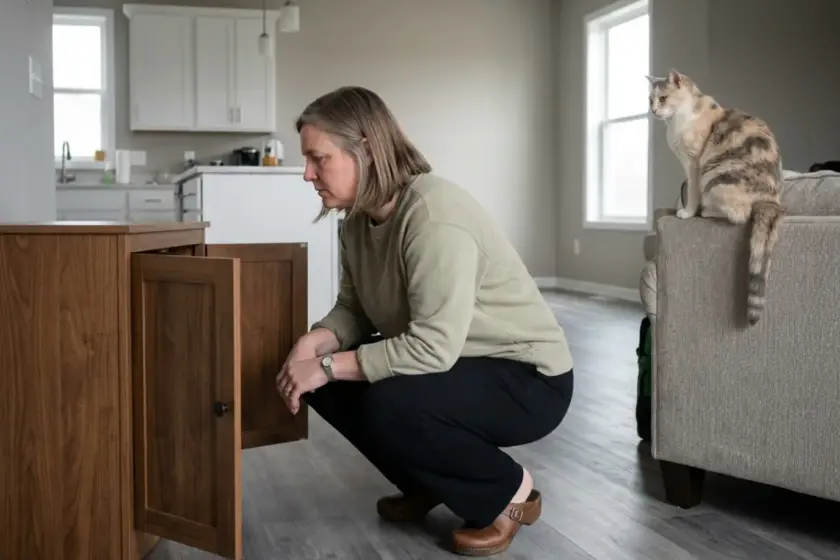
Start with the constraint nobody lists in the specs: a hinged door needs floor space to open. A 32-inch cabinet with a pair of swing doors is not a 32-inch object in your apartment. It is 32 inches of wall plus roughly 16 inches of floor in front of it that has to stay permanently clear, or you will be shuffling a chair every time you scoop. Soft-close hinges and magnetic doors are pleasant and they change none of this, because the arc is geometry and the hardware is comfort.
In a room where the walking path is already one person wide, that arc is the whole problem.
Before you buy anything at all, go look at what you already own. A low console table, an entryway bench, an old TV cabinet with the back panel already loose. Any of them with one side left open is most of a litter box cover already, and the free version deserves its own section below. Repurposing shows up across every source in this category as the first move, not the fallback.
Measure the arc the door sweeps before you measure the width of the cabinet. Tape the outline on the floor, both the footprint and the swing, and then live around that tape for a day. If you step over it once, you will step over it every day for the next two years.
When a swing arc is what is stopping you, the fix is a door that does not swing. The RAKTEN 31.5-Inch Cat Litter Box Furniture Cabinet with Tambour Sliding Door rolls its door sideways into the frame instead of out into the room, which means the only floor space it needs is the floor it is standing on. At 31.5 inches wide it lands in useful territory once you apply the 2-inch-per-side discount. The caveat, written down: it is a single-bay cabinet, so it is one litter box location and only one, and if you have two cats that is a problem the next-but-one section deals with directly.
Depth against the wall is the other tax you pay for a small room, and you pay it in smell rather than in inches. A cabinet pushed flat against a wall in a corner has air moving on two sides at best. Hold that thought, because it is the entire mechanism behind the odor section. If you want the placement logic on its own terms, there is a full piece on the layout that works when there is no spare room.
The Free Version, and When It Actually Wins
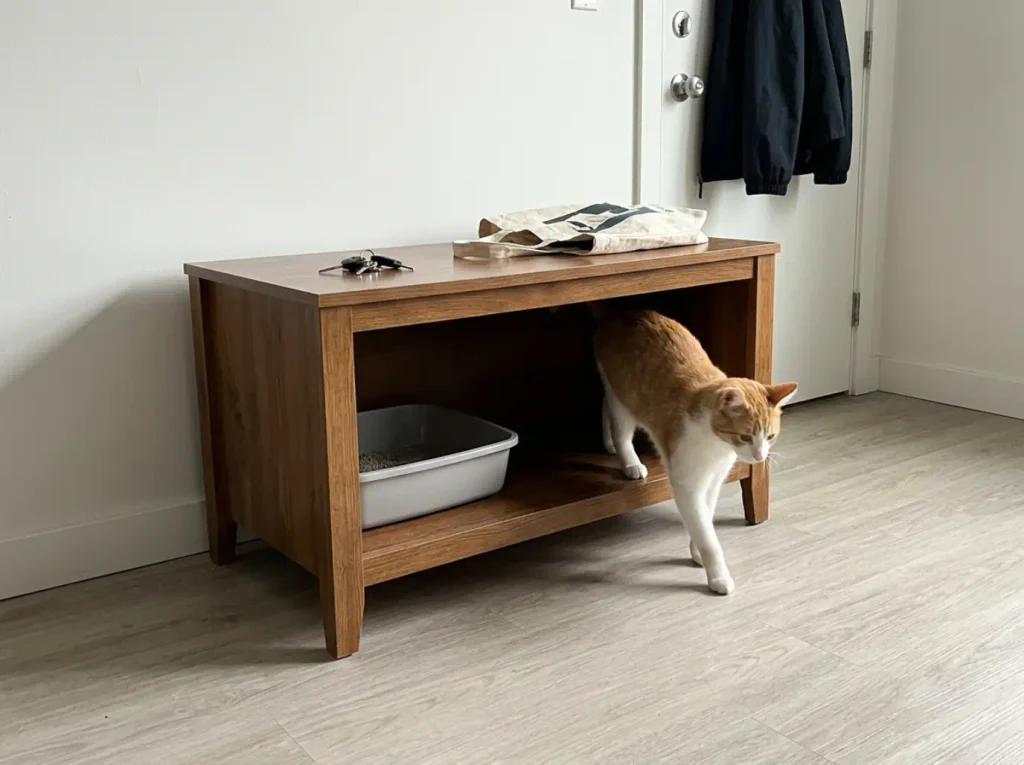
Here is the buying guide telling you not to buy yet. If there is a low console table in storage, or a bench by the door you never sit on, you already own most of a litter cabinet. The height is usually right, the footprint is already accounted for in your apartment, and the money you did not spend is the cleanest saving in this article.
What a Bought Cabinet Gives You That a Borrowed One Doesn’t
The honest list is short, and worth knowing before you commit either way. A purpose-built piece arrives with the entry already cut to a size a cat will use, an interior floor that expects moisture, and hinges rated for opening every single day rather than twice a year. Sturdy materials and easy cleaning are what the price tag is actually buying.
Those three things are genuinely hard to add to a console table, and the second one is where borrowed furniture usually gives up first: particleboard and litter dust and the occasional miss are not a long-term relationship. The two seams that decide this have their own article on waterproofing, and if you are converting something you own, read that before you cut anything.
What a bought cabinet does not automatically give you is real airflow or an interior sized to your particular cat, and it charges you for both regardless. That is the trade in one line. You are paying for finish, fit and durability. You are not paying for ventilation or clearance, and plenty of well-reviewed cabinets have neither.
The no-cut route exists too, for anyone whose lease means the furniture leaves in the same condition it arrived. Leaving one end open, or turning the piece so an existing gap becomes the entrance, works without a saw ever coming out, and if you do want to make the cuts, the builds, and the two cuts that decide them covers that ground properly.
The expensive mistake in this category is not buying a premium cabinet. It is buying a cheap one, discovering the cat will not use it, and buying a second one. Measure first and one purchase does the job.
Hidden Is a Visual Word, Not a Smell Word
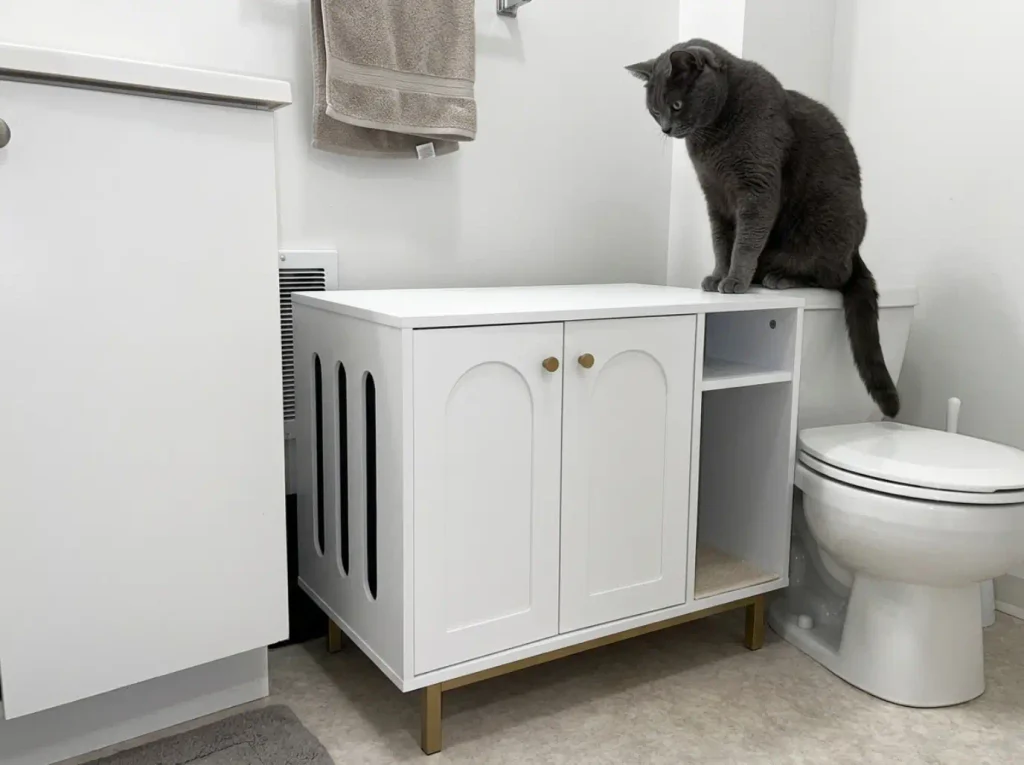
You covered the box and the apartment started smelling worse. That is not bad luck and it is not the litter. Hiding something removes it from view, and vision is the one sense this furniture addresses.
The mechanism has two parts and the second one is the part small apartments get hit by. First, an enclosure traps ammonia inside a small volume, right where the cat’s nose goes when he steps in. You solved your problem and made his worse. Second, whatever does escape is escaping into a room with far fewer cubic feet than a house has.
Odor control is a dilution problem before it is a product problem, and a studio has less air to dilute into. Same cat, same litter, same scoop schedule, noticeably stronger smell. The variable that changed was the size of the room.
There is a number for this that almost nobody publishes: ventilation openings should total roughly 20% of the enclosure’s surface area to move any meaningful air, which is the ventilation share a closed enclosure needs to move any air at all. Hold a typical cabinet up against that figure.
A pair of decorative slots in a door is maybe 2%. Sisal-covered panels with a gap top and bottom do better. A solid four-sided box with a cute arch does nothing, and it is usually the one that photographs best.
Placement does more work here than any product, and it is free. The good spots share one trait, which is air that was already moving: a bathroom corner with an exhaust fan, a laundry nook, or anywhere near the sliding balcony door. The bad spots are just as consistent: the kitchen, anywhere next to food and water, and the worst of all, a closed damp cabinet under a sink.
Before you spend anything on odor, try moving the cabinet ten feet toward the airflow you already have. That sometimes ends the conversation. If you want the design-level version of this question, which box design smells the least before you hide anything is the place to start, because a hidden bad box is still a bad box.
For a compact piece that does not cheat on the interior to get small, this is the one that holds up.
Two Cats Do Not Fit in a Cabinet Built for One
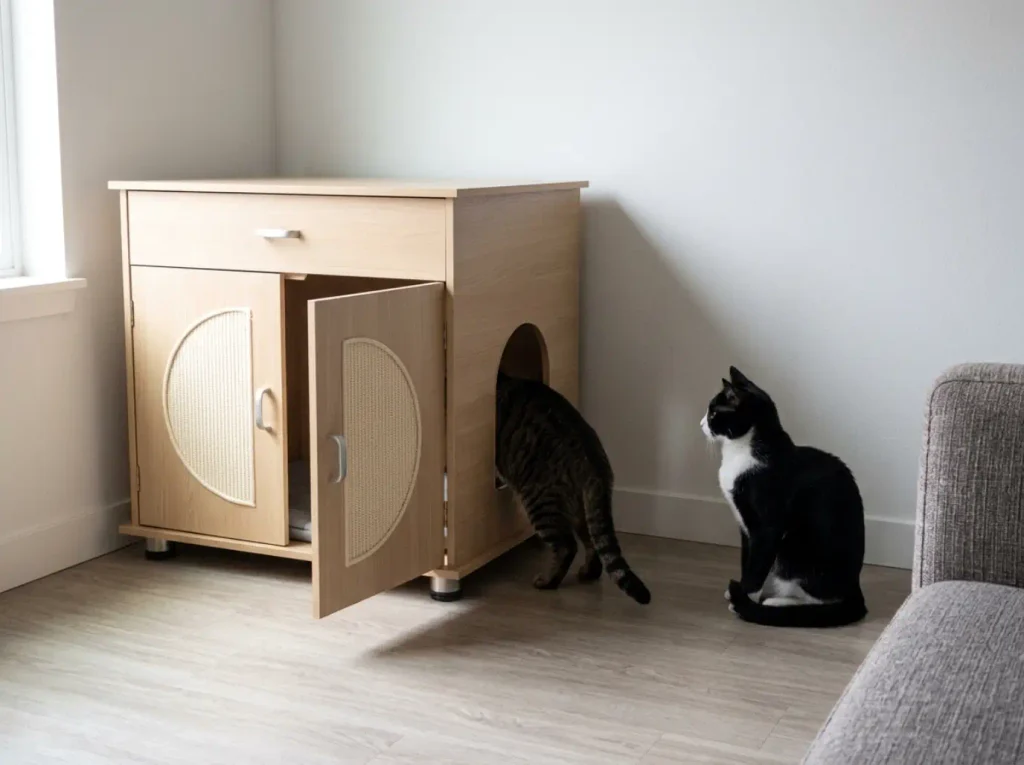
You bought the two-bay cabinet and the cats are still queuing. From where they stand those are not two boxes. That is one wide box with a divider in it, and a divider is not distance.
The threshold is more than 40 inches of interior width before a single cabinet genuinely holds two separate boxes. Under that figure the two bays sit close enough that cats read them as one shared resource, which cancels the entire reason for owning two. It is the hardest number in this whole category and the one that most “fits two cats” listings quietly fail in a multi-cat household.
A 36-inch double cabinet is not a compromise. It is one box that cost you the price of two.
Then there is the count itself. The N+1 rule says one box per cat plus one spare, so a one-cat apartment ideally runs two and a two-cat apartment runs three. Which means a piece of furniture that hides one box is rarely the complete purchase, no matter how good it is. The arithmetic on that is laid out in how many boxes two cats actually need, and it changes what you should be shopping for before you spend anything.
Now the part that runs against the obvious answer. In a small apartment the winning setup is usually not one big cabinet — it is two small ones in different rooms. A 59-inch double unit eats an entire wall of a studio and, in territory terms, still gives your cats one location.
Two compact cabinets, one in the bathroom corner and one by the balcony door, cost about the same footprint spread across the apartment and give the cats what they actually wanted: two places that are not the same place. Distance is the feature. Doors are not.
There is a second benefit too, straight out of the odor section: one shared cabinet concentrates all of it in a single point of the room.
If you do have the wall for it, the RAKTEN 59.1-Inch Double Litter Box Enclosure for 2 Cats clears the 40-inch threshold with a wide margin and its center passage separates the two bays properly rather than nominally, with four doors so you can reach either side without dismantling the room. Its caveat is the size itself, and it is a big one: nearly five feet of wall. In a genuinely small studio that is not the answer, and two compact units in separate corners will beat it. In a one-bedroom with a real living room wall to spare, it works.
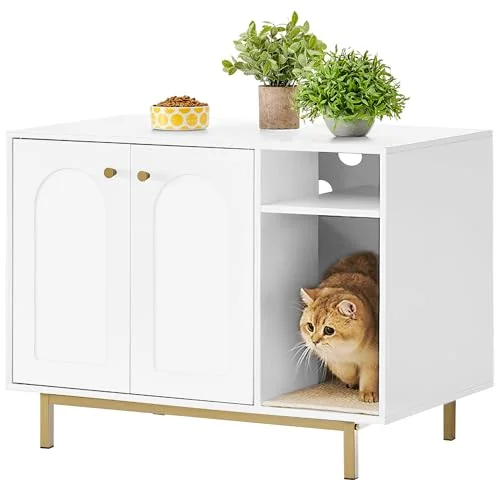
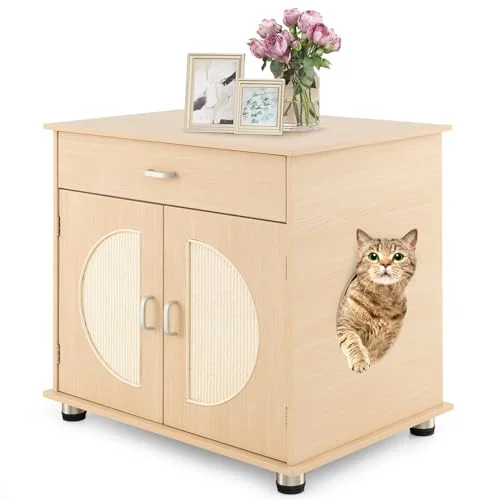
For the middle ground, right at the threshold rather than past it:
What a Rental Changes, and What It Doesn’t
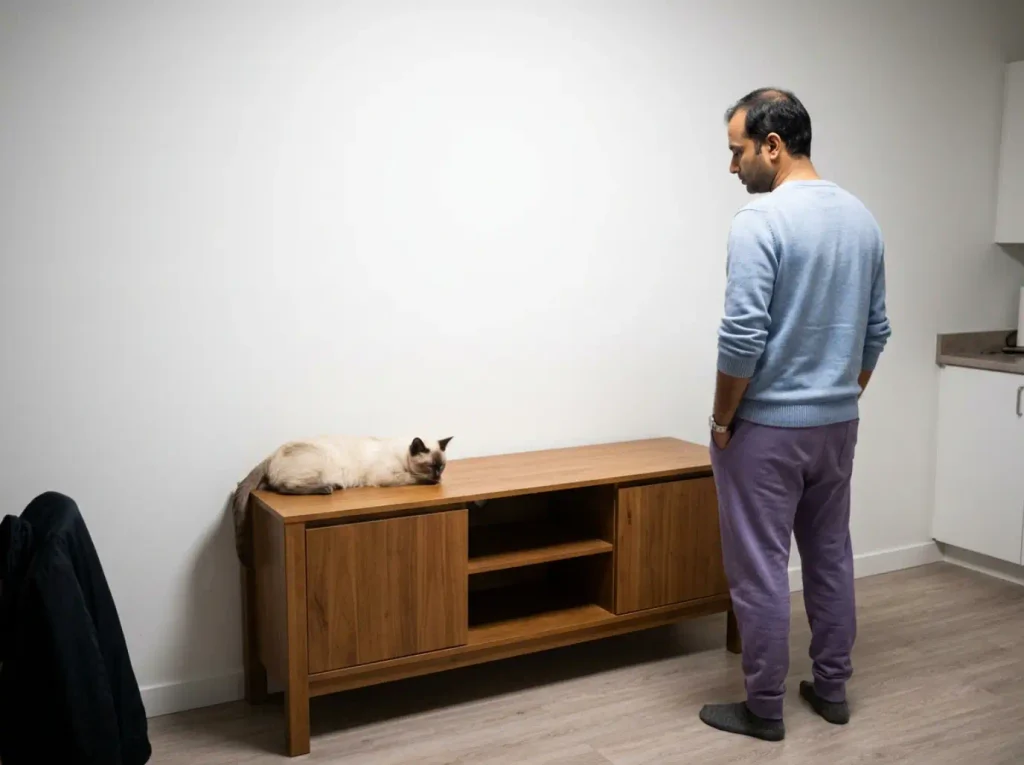
You cannot drill, the floor is not yours, and in two years all of this moves with you. Three constraints, all of them affecting which cabinet is the right buy, and not one general guide mentions any of them.
Start with tipping, because a tall cabinet in a small apartment is a tall cabinet in the room where everything happens. “I can’t drill” and “it can’t be secured” are not the same sentence, and the no-drill difference is documented: the CPSC has run its own research into anchoring without tools, covering non-destructive approaches for exactly the household that cannot put a screw into a stud. And when you can drill, use metal L-brackets rather than the plastic anchors that come in the box. Plastic goes brittle and lets go years later, which the CPSC’s Anchor It campaign has been flagging for a decade.
The wrong saving here is the tempting one: skipping the anchoring entirely because the little kit in the box inspires no confidence. It shouldn’t inspire confidence — that instinct is correct. The answer is not a better kit, though.
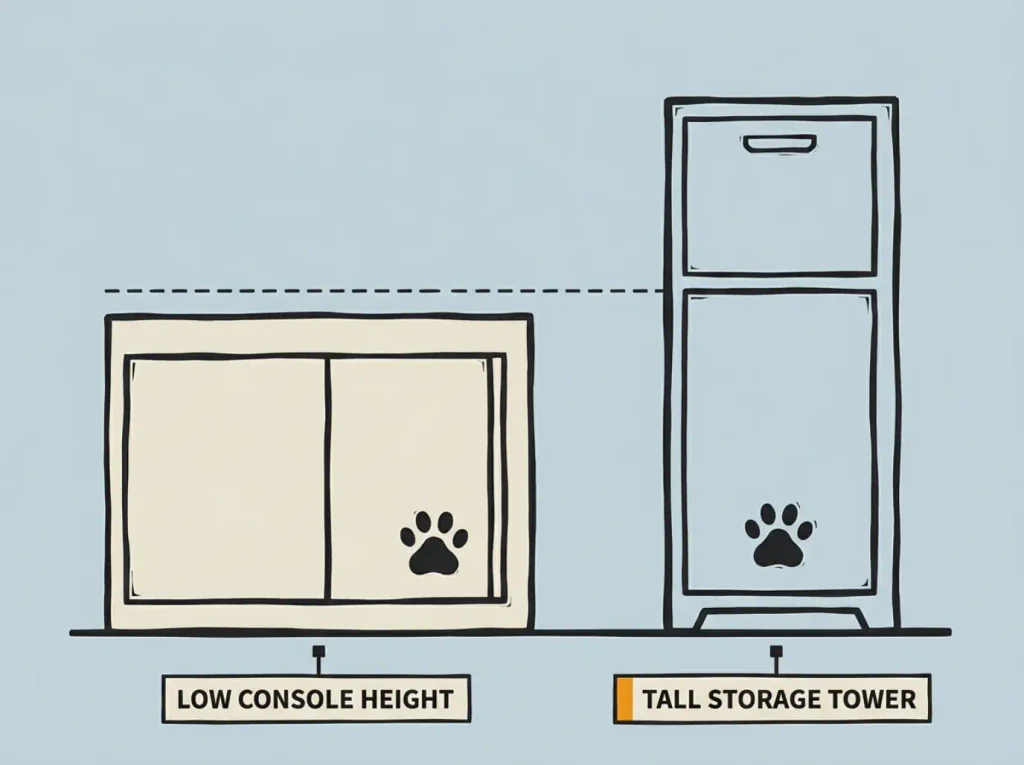
The answer is a low cabinet. This is the quiet reason low pieces are the renter-friendly choice, and it has nothing to do with looks: a bench-height or console-height enclosure has no meaningful tipping moment, so there is nothing to anchor, nothing to explain to a landlord, and no patched holes at move-out. It also moves in one trip. If you are renting and undecided between a tall storage-style unit and a low one, that is your tiebreaker.
In a rental, make low the default and let a tall piece earn the exception. Low means no anchoring, no wall holes, no landlord conversation, and one person can carry it down the stairs on moving day. The storage shelf on top of a tall unit is worth less than all of that combined.
The floor is the other landlord-owned surface in this arrangement, and it sits directly under the one appliance in your home guaranteed to leak eventually. Anything that gets past the box has a short trip to a security deposit, and the fix belongs in the same conversation as the cabinet itself rather than after it.
Two remaining picks, both with their limitations first, because in a small apartment both are conditional buys rather than recommendations.
The JanflyHome Cat Litter Box Enclosure has an interior height of 15.35 inches, which is below the 18-inch minimum this article has been insisting on for five sections. So it is not a general recommendation and it should not be read as one. It is the small-cat option: if you measured a compact adult and the geometry genuinely clears, the pull-out drawer and the tiny footprint do a real job in a tight apartment. Measure the cat first, and if the number is borderline, this is not your cabinet.
At the other end, if you already own an automatic box, standard furniture will not take it. A self-cleaning unit needs closer to 30 by 25 by 30 inches of interior, which is a different class of enclosure entirely. The Garvee Large Cat Robot 4 Enclosure Furniture is built for that, with an interior of 27.75 by 24.8 by 30.3 inches, an outlet and a five-foot cord so the cable is not running across your floor, and a shelf that keeps a dog out of it. The written caveat is the honest one: it is large, and in a studio it competes for space with the part of the apartment where you live.
Conclusion
Three things to take with you, in the order you need them.
Measure the cat before you open a single listing. Nose to tail base, times 1.5, and every other number in this purchase follows from it. Subtract 2 inches per side from whatever the listing claims. That figure was always the outside of the cabinet; your cat lives on the inside. And look at what you already own first. A low console with one side left open is most of an enclosure and costs nothing, which is the best possible outcome for an article that sells furniture.
🗓️ Check back in three weeks. Not three months — what you are measuring is whether the cat accepted the thing, and cats decide that in days. At the three-week mark look at exactly one behavior: does he walk all the way in, or does he go in with his front paws and leave his back end outside? If it is the second, the interior is too small, and no amount of air freshener or litter changing will fix a box he cannot stand up in.
Before you spend anything more, move the cabinet you have toward the balcony door or the bathroom fan and give it a few days. If the smell drops, you just saved yourself the bigger cabinet and learned something about your apartment that no product page could have told you.
Amazon’s Audible — free for 30 days
Your cat won’t let you read. Let someone read to you.
Audible is Amazon’s audiobook library — thousands of titles, read out loud, on your phone. Free for a month, plus one audiobook to keep forever.
Frequently Asked Questions
01What size should hidden litter box furniture be on the inside?
Aim for at least 24 inches wide, 20 deep and 18 tall of usable interior, with an entry opening no smaller than about 8 by 10 inches. For a cat over fifteen pounds, push the width and depth closer to 28 by 22 instead.
02Do litter box enclosures make the smell worse?
They can, and in a small apartment they usually do when the ventilation is decorative. Openings should add up to roughly a fifth of the enclosure’s surface before it moves any real air, and a pair of slots in a door is nowhere near that.
03Can one piece of furniture hold two litter boxes?
Only if the interior clears about 40 inches of width. Below that, cats read the two boxes as one shared spot, which cancels the reason for having two in the first place.
04Will hidden litter box furniture fit in a studio apartment?
A compact single-box cabinet will, especially one with a sliding or tambour door that needs no swing clearance. A wide double cabinet usually will not, and two small cabinets in different corners beat one big one on territory anyway.
05Do I need to anchor litter box furniture in a rental?
If the piece is tall, yes, and there are tool-free methods a lease allows. The simpler answer in a rental is to buy a low piece that never needed anchoring, then there is nothing to secure and nothing to patch at move-out.
Leave a comment