Can You Put a Litter Box in the Bathroom? Usually
Litter box in the bathroom? Leave 3-4 inches of clearance, keep humidity at 35-50%, and know the 12-inch spec that rules out automatic boxes.

Alfredo RamsesFounder · August 26, 2026 · 20 min read

On this page8 sections
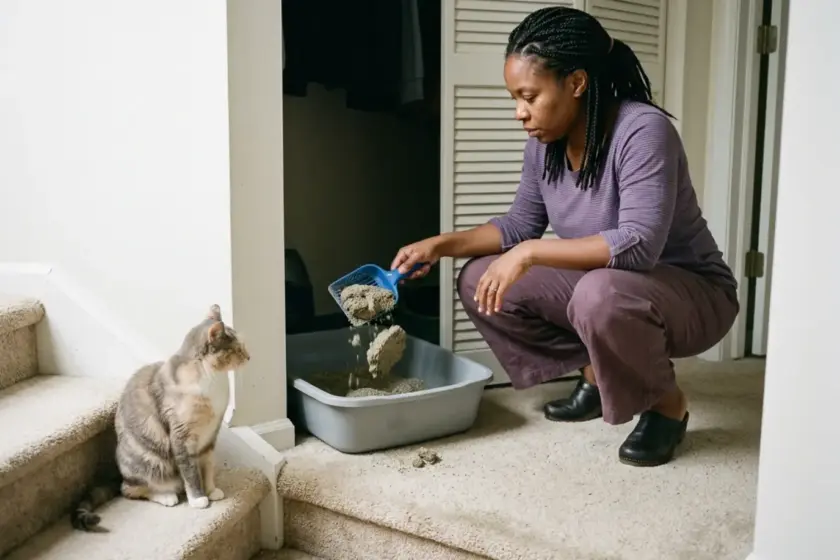
The bathroom is where most people put the litter box, and they usually put it there for the wrong reason: it is the one room where a mess would not matter. Then something goes sideways. The cat starts going on the bath mat, or the clumps turn to mush on the scoop, or the room smells at six in the evening no matter how often you clean it, and nobody can tell you whether the room was the mistake or something inside it was.
The room is almost never the mistake. A bathroom passes three of the four tests litter box placement has to pass, and the fourth one fails for reasons that have nothing to do with the cat. Here is what a bathroom actually gets right, the three specific ways a bathroom litter box collapses, and how to fit a box into the tightest bathroom in the house.
Quick Answer
Yes, a bathroom usually works: tile cleans easily, traffic is low, and the fan or window handles ventilation. The hard condition is the door, which has to stay open or have a cat-sized opening. Two things spoil it: shower humidity, and sharing the only bathroom in the house.
What a Bathroom Actually Gets Right
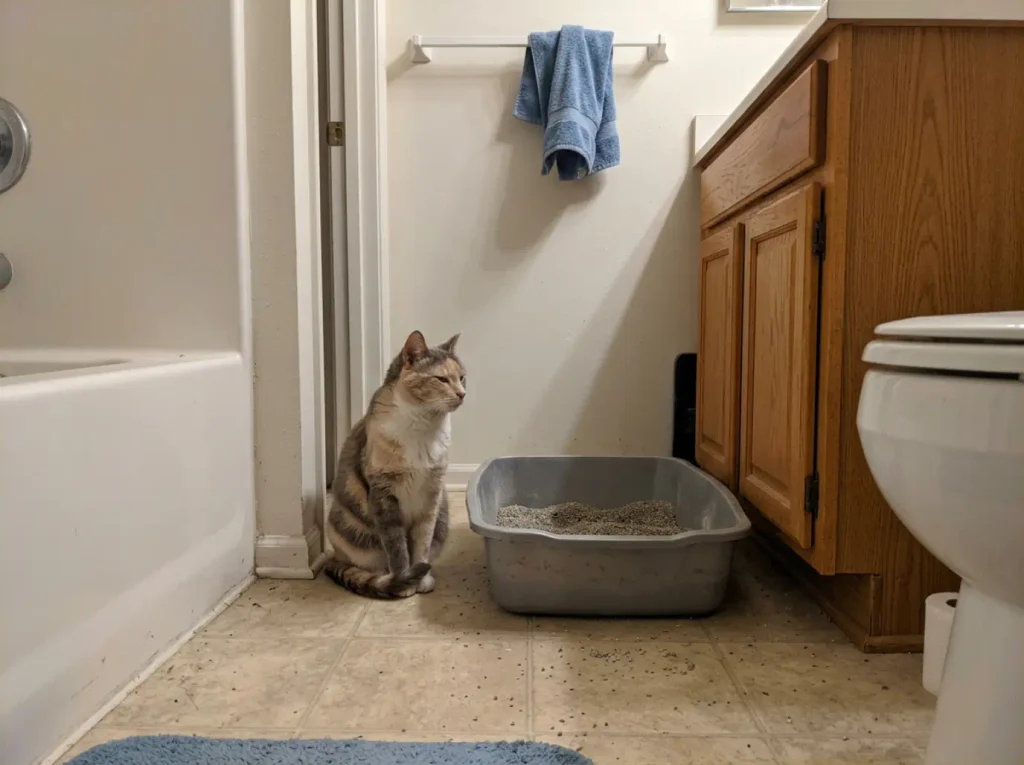
Most people land on the bathroom by default and then feel vaguely guilty about it, as if the tidy answer were somewhere else. It is worth checking the room against the general rules for where a litter box goes before you move anything, because the bathroom scores better than its reputation suggests. It just scores well for different reasons than the ones people give.
The floor comes first. Tile flooring and vinyl mean tracked litter sweeps up instead of grinding down into carpet pile, and a spill is a wipe rather than a laundry problem. That is not a small thing over the life of a box. Litter granules in a rug are permanent in the way sand at the beach house is permanent, and no vacuum has ever fully settled the argument.
Then traffic, which is the property that actually matters and the one people mistake for privacy. A cat does not need a secret room. A cat needs a room where nothing surprising happens during the hours he wants to use the box, and a bathroom is the emptiest room in most homes between midnight and six in the morning.
A low-traffic area and a private one get used interchangeably in placement advice, and they are not the same claim. A closet is private and terrible. A quiet corner of an open hallway is no kind of high-traffic area either, and it works fine.
That distinction is baked into the professional standard. The AAHA/AAFP feline guidelines ask for a quiet spot with an unblocked escape route, away from busy household traffic. A bathroom passes quiet, passes private, passes away-from-traffic. The escape route is the fourth test, and the whole rest of this article turns on it.
One more advantage nobody bothers to name: a bathroom is the one room in the house where food and water bowls are never kept. Cats do not eat where they eliminate, which is the actual reason kitchen and dining placements fail, and putting the box in a bathroom rules out the single most common placement error in the house without you having to think about it.
And a distinction from the forums that decides half of what follows: powder room versus full bath. A half-bath with no shower is the best-case version of this spot, and it is usually the guest bathroom rather than the one you use. No steam, no splash, no damp mat. If that is the room you are considering, you have the easy version of this problem and you can skim the humidity section entirely.
The Closed Door Is the Failure, Not the Room
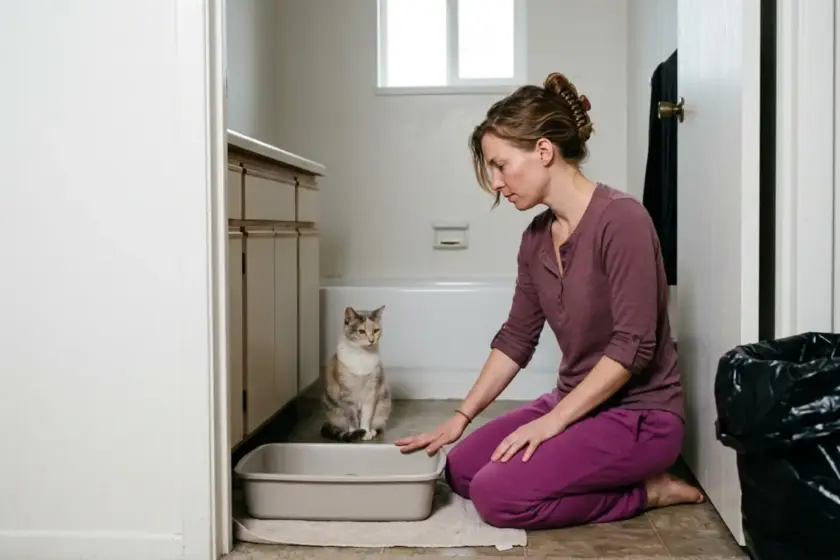
Nothing moved. The box is where it was, the litter is the same brand, the scoop schedule has not slipped. The cat stopped using it the week your sister stayed over, and nobody connected the two, because nobody thinks of a door as part of the setup.
A bathroom door is the only door in the house that people close by reflex. You close it for guests. You close it while the shower runs so the steam stays in. You close it out of pure habit because that is what bathroom doors are for.
The cat gets no warning and no vote, and a room with one exit under someone else’s control is not a private room. It is a gamble he has to take twice a day.
That is what the escape-route requirement means in practice. It is not about a cat feeling watched. It is about a cat committing to a spot where he can be shut in, or shut out, without notice.
A cat who finds the door closed twice will select a second location, and the second location is chosen by the cat and by nobody else. It is often the bath mat, because it is soft, absorbent and just outside the door he could not get through. That is what litter box avoidance looks like from the inside: he is not making a point, he is solving the problem you handed him with the only tools he has.
Fix the door before you spend a cent on anything. Say out loud, to everyone who lives there, that this door stays open. That is the entire fix in a household where the agreement holds, and it holds more often than people expect once someone actually says the words instead of assuming everyone already knows.
The conventional advice here is to buy a cat door and be done with it. In practice, most bathroom-box failures that turn up in the forums are one conversation deep, and the conversation is free.
Before buying any hardware, prop the door open for one full week and change nothing else. If the box comes back into use, the door was the whole problem and you have your answer for free. If it does not, you have ruled out the most likely cause and can move on to the litter, the size, or the smell with a clear head.
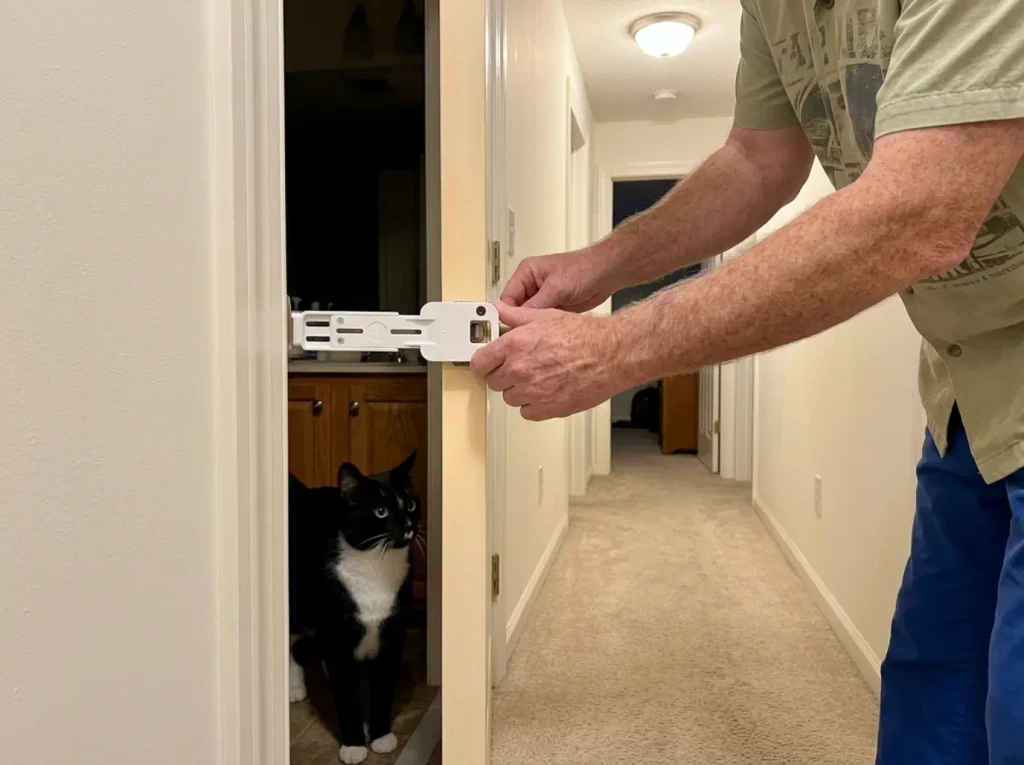
Where the agreement will not hold, there are two hardware answers and they split cleanly by whether you own the door. If you rent, a strap beats a door wedge, because a wedge slides on tile and a strap holds a gap you actually chose.
The Door Buddy Door Prop for Cats (Amazon) holds an interior door open at a fixed gap you set anywhere between two and six inches, mounts with 3M adhesive, and leaves nothing to repair on move-out. Wide enough for a cat, narrow enough to keep a toddler or a large dog out of the litter. The catch is obvious once you look at it: the door is now permanently ajar, which solves the cat’s problem by handing the human’s problem straight back.
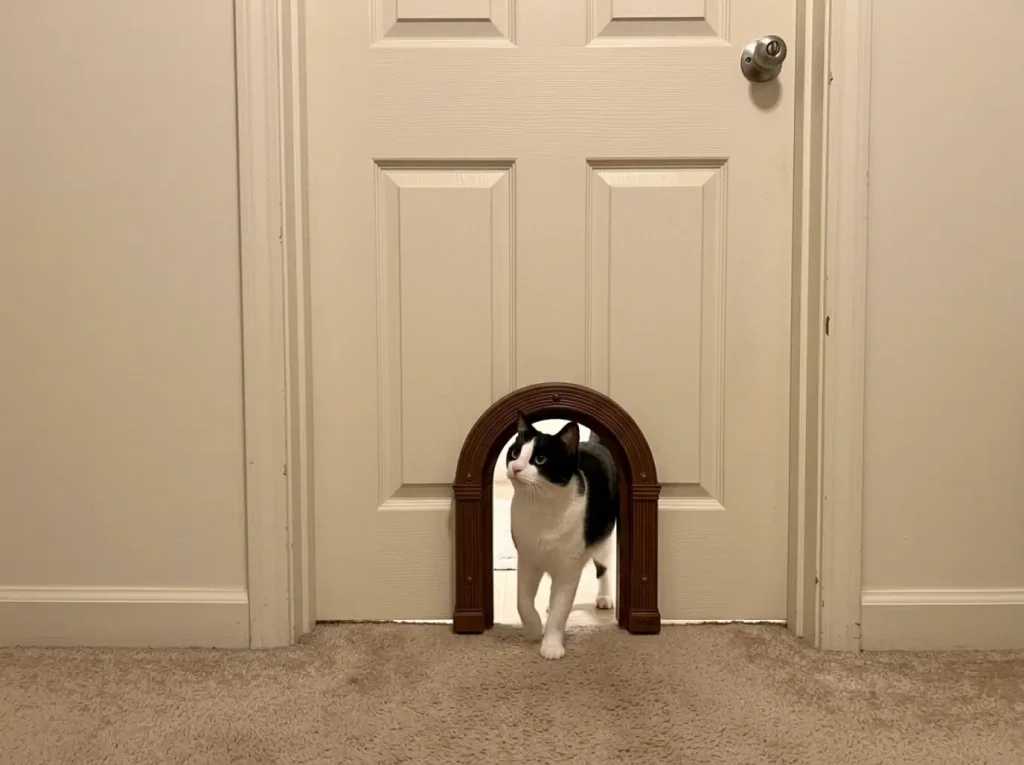
If you own the place and the door genuinely has to shut sometimes, the answer is a cutout instead of a prop. A no-flap interior cat door (Amazon) fits standard 1.25 to 1.75-inch interior doors, hollow or solid, and is rated to a 25-pound cat, which covers even a large Maine Coon with room to spare. No flap means nothing for a hesitant cat to learn and nothing to jam, which is the whole accessibility argument for it: a kitten and an arthritic fifteen-year-old both walk through the same opening.
The cost is a hole in a door, permanently, and a small rectangle of light and noise between two rooms that used to be sealed off from each other. Worth it if the alternative is a door that is never closed again.
Some readers will read all of this and decide the answer is to conceal the box instead. That works, but only if you keep the access rule intact: furniture that hides the box without shutting the cat in is a different object from a cabinet with a door on it. A hidden box behind a closed door is the same failure wearing better clothes.
What the Shower Does to the Litter
Here is the second failure, and it announces itself at the scoop. The clumps stop lifting whole. They crumble halfway up, they leave a wet layer welded to the bottom of the box, and the reasonable conclusion is that the litter got worse.
Same bag, same brand, same everything. The litter did not change. The room did.
Clumping litter works by binding moisture on contact, and it does not care where the moisture comes from. In a room that runs humid twice a day, the surface of the litter is quietly binding ambient steam between uses, so by the time the cat gets there some of its clumping capacity is already spent. What you get is a soft clump that breaks under the scoop instead of a hard one that lifts out in a piece. Nothing about that is the cat’s doing, and nothing about it shows up on the bag.
The number worth knowing: litter areas are meant to sit between 35 and 50 percent relative humidity, with cross-ventilation and full drying after any wash. A bathroom with a weak exhaust fan and a shut door runs well above that range for a good stretch after every shower. If you want the cheap version of measuring it, a hygrometer costs less than a bag of litter and it will settle the argument in a day.
Organic litters are where this gets past nuisance and into a real problem. Wood, paper, corn and walnut are plant matter, and plant matter in a room that never fully dries will grow mold. Clay and silica will not. That does not make organic litters bad, and I would still use them in a dry laundry room without hesitation. In a full bath with a struggling fan, they are the wrong material for the room.
Run the fan for ten minutes after the shower, not during. Most bathroom fans are wired to the light switch, so the fan stops the second you walk out and the room does the bulk of its drying with no air moving at all. If yours is on the light, a timer switch or the simple habit of leaving the light on for ten minutes changes the humidity in that room more than any product you can buy for it.
If you rent and the fan is weak and replacing it is not on the table, the free fix is the window and the door together. Cross-ventilation after every shower costs nothing and it is the step almost everyone skips, because it feels too simple to be the answer. Open the window two fingers, leave the door open, walk away. That is it.
The other physical problem in a bathroom is water that arrives by accident. A box parked against the tub catches shower spray over the rim. A box tucked beside the toilet catches drips and, in the failure mode that turns up in every thread about tiny bathrooms, catches a roll of toilet paper that unspools straight down into the litter. Two feet of separation from the tub and the toilet handles both, and it is usually available even in a small room once you stop treating the space beside the fixtures as the only option.
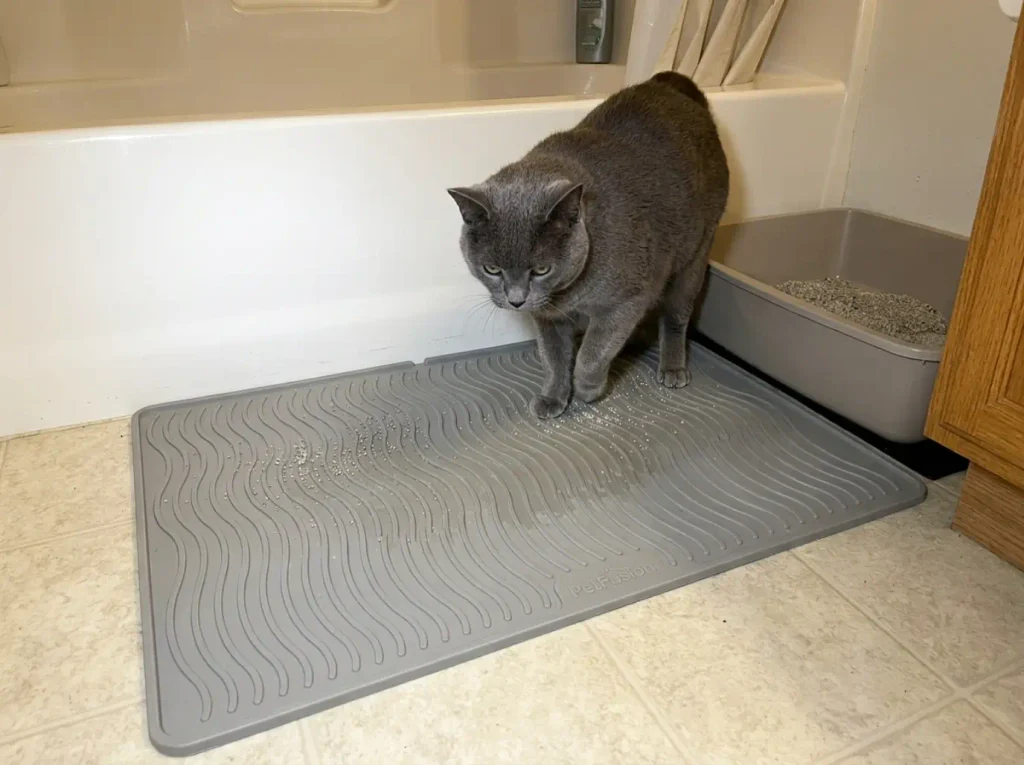
The mat matters more here than anywhere else in the house, and specifically the material. A fabric mat in a splash zone stays damp, and damp litter granules glue themselves to tile in a film that needs a scraper. A waterproof one sheds it.
The PetFusion ToughGrip Waterproof Cat Litter Mat (Amazon) in Large is silicone rather than fiber, so water sits on top of it and wipes off instead of soaking in. It is heavier than a fabric mat and it does not roll up neatly for storage, which is a fair trade in a room that gets wet twice a day. Where you put it decides how much it catches, and where the mat goes relative to the box is a shorter answer than most people expect.
Where the Box Fits When the Bathroom Is Small
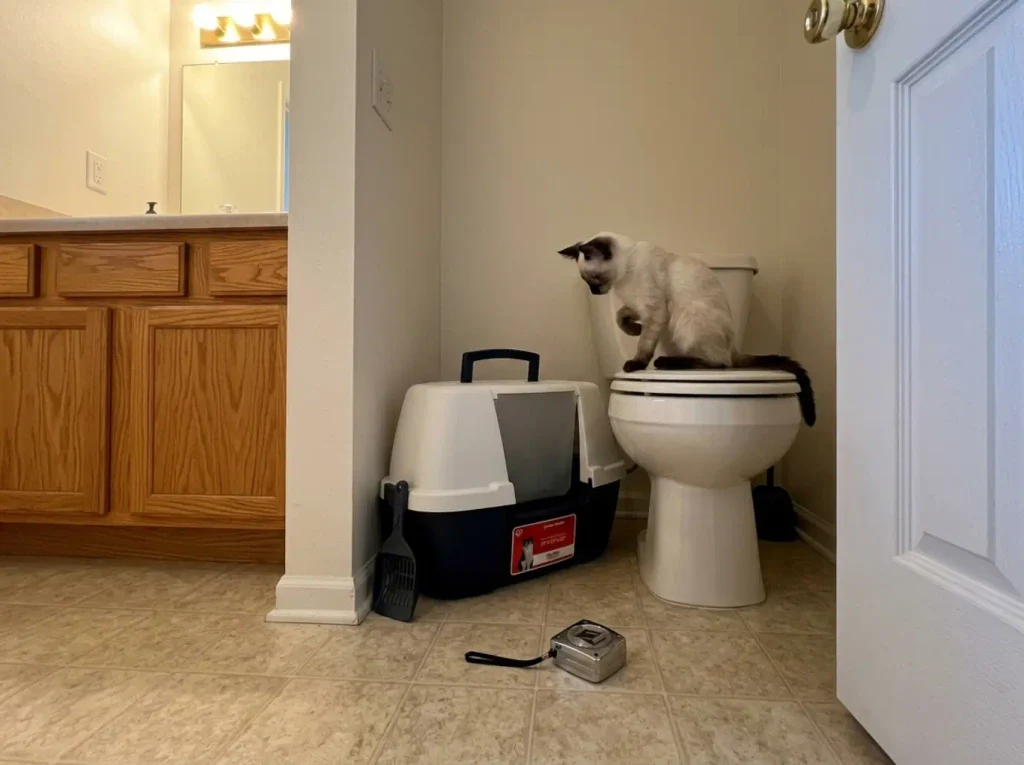
You have already looked at the floor and concluded there is no room. There usually is. It is in a corner you have been mentally filing as unusable, and the reason nobody finds it is that no placement article prints a single number.
Start with clearance. A box needs three to four inches between it and any wall or fixture. That gap is not for the cat, who does not care.
It is so you can lift the box out and clean the floor behind it without moving the toilet, and so the box does not sit welded into a corner accumulating a strip of damp litter you cannot reach. Four inches on the two open sides is the working number.
The spec that quietly kills the fanciest option: a front-loading automatic litter box needs roughly twelve inches of clearance in front of it to open its drawer for servicing. Not to run. To empty.
In a bathroom where the door swing and the toilet already own most of the floor, twelve inches of dedicated service space in front of the unit is usually what rules it out, and it appears in none of the product listings. The same arithmetic applies to any front-entry litter box with a drawer or a pull-out tray. If you are eyeing an automatic for a small bathroom, measure that first and save yourself the return.
The dead space in most bathrooms is the triangle in the corner beside the toilet, or the gap under a pedestal sink where a rectangular box will not sit square. A corner litter box turns that triangle into the entire footprint. The IRIS USA Large Corner Cat Litter Box (Amazon) is built for exactly that shape, and it buys you a full-size interior out of space that was previously holding a spare roll of paper.
The limitation is that a corner box only helps if you actually have a free corner. In a bathroom where the corners are the toilet, the tub and the door, it solves nothing.
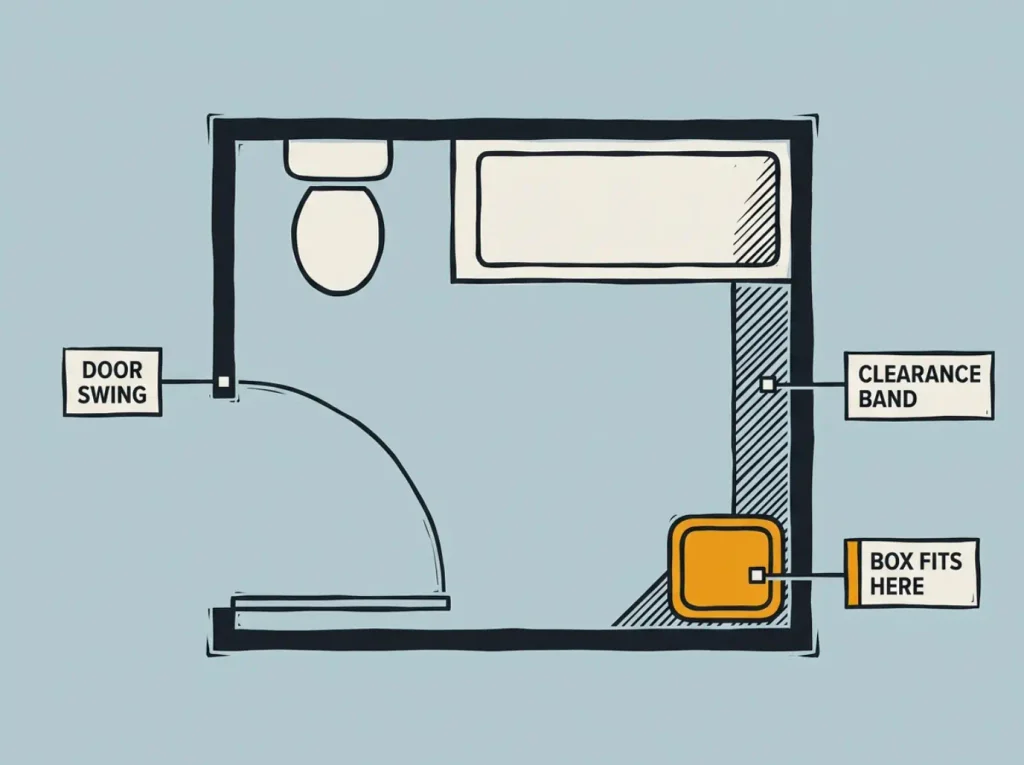
The apartment benchmark worth carrying in your head: under twenty-one inches wide and under two and a half square feet of floor is what fits in a tight bathroom without fouling the door swing. That is roughly the footprint of a large top-entry box, and it is the ceiling, not the target.
Scatter behaves differently on tile than on carpet. Carpet holds it, tile spreads it, and in a room people walk into barefoot in the dark that is a specific kind of unpleasant. A top-entry litter box contains it at the source. The Modkat Top-Entry Cat Litter Box (Amazon) measures 21 by 16 by 17 inches and the cat exits through the lid, which knocks most of the granules off his paws on the way out.
I used to recommend top-entry as the default answer for small tiled rooms. After enough threads where an older cat quietly stopped using one, I switched to recommending it only for cats who jump without thinking about it. A senior cat, or a heavy short-legged one, will pick the floor over a seventeen-inch climb and never tell you why.
One warning that undoes all of the above if you ignore it: the clearance rule is about the box, never about the cat. A small room does not license a small box. Shrinking the box to make the numbers work is precisely how a workable spot becomes a rejected one, because a cat who cannot turn around without touching a wall will stand with his front paws in and his back end over the edge, and then you have a floor problem instead of a space problem.
Settle how big the box has to be for the cat first, then go looking for the corner that holds it. Not the other way around.
And measure the door’s swing arc, not just the floor. A box that fits the corner but sits inside the arc gets nudged a half inch further every time someone walks in, and in a month it is somewhere neither of you chose.
Sharing the Only Bathroom in the House
Everyone writing about this quietly assumes you have a spare bathroom. Plenty of readers live in a one-bathroom apartment, and telling them to put the box in the bathroom and leave the door open is asking them to give up the door on the only room in the house that locks. That is not a small ask and pretending otherwise is how advice stops being useful.
So name it: the cat needs the door open and the person needs it shut sometimes. That is a genuine conflict, not a failure of commitment, and it does not dissolve because someone on the internet tells you the cat comes first.
It does have a shape, though. The cat’s claim is on availability, not on every hour of the day. A door closed for twenty minutes while someone showers is a completely different event from a door closed all evening because it is easier that way. Cats absorb the first without much complaint.
What they cannot absorb is unpredictability, where the door might be shut at four in the morning and might not, because there is no way to plan around a coin flip. If the door is shut only in short, waking-hours blocks and open the rest of the time, a one-bathroom household works.
If it is going to be shut for stretches, or shut overnight, the cutout is the answer rather than the prop. The door closes fully, the cat still gets through, and nobody is negotiating anything at eleven at night. It costs a hole in a door and it ends the argument permanently, which for a shared household is usually the better trade.
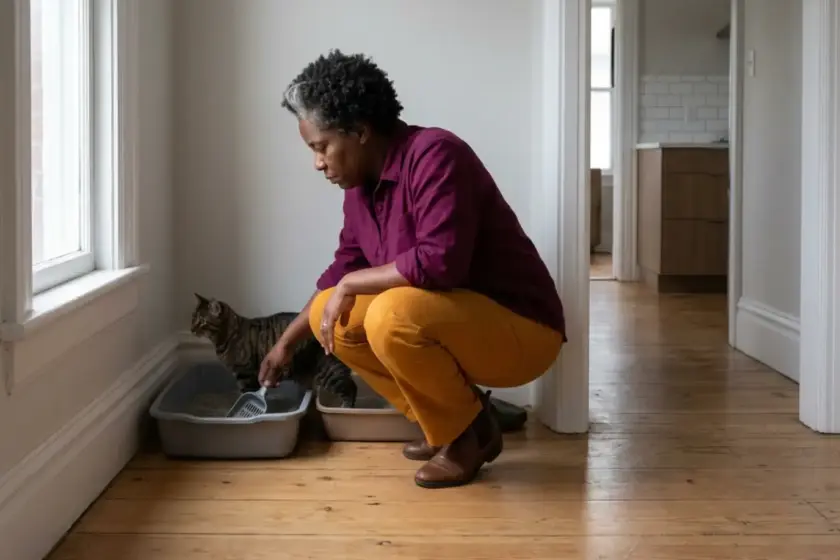
Two cats change the answer completely, and this is where the bathroom stops being able to carry the whole plan. The guidance is the one-box-per-cat-plus-one rule, usually written N+1: one box per cat plus one spare, in different locations. Two boxes side by side in one bathroom is one location, not two, and cats treat it that way.
The whole point of the rule is that a cat can reach a box without crossing paths with the other cat, and two boxes eighteen inches apart fail that on the geometry alone. In a multi-cat household that arithmetic decides the rooms before it decides the products. Work out how many boxes two cats actually need before you plan a single room around them.
Count the boxes the household needs first, then see how many the room can hold. Everyone does it backwards: they measure the bathroom, fit what fits, and discover the shortfall three months later when a cat starts going somewhere else. The count comes from the number of cats, not from the square footage.
So the honest verdict for a one-bathroom home with two cats is that the bathroom holds one box and only one. Everything in this article applies to that box. The second one lives somewhere else.
Finding it is a different problem, covered by the rest of the layout in a small apartment. If a box is already in use elsewhere and you are bringing it into the bathroom, that is a gradual relocation rather than a move: a few inches a day, not a room in one afternoon. Stacking both in the bathroom because it is the tidy answer is the version that fails, and it fails at around week three.
There is one more thing about shared bathrooms that has nothing to do with cats. A box in a shared bathroom gets scooped less than a box in a hallway. It drops out of the daily sightline of whoever is not the primary caretaker, and a chore nobody sees is a chore nobody owns. That is the actual mechanism behind boxes that go a week without being touched in an otherwise clean home.
Keeping a Bathroom Box From Smelling in a Small Room
A bathroom is the smallest room in the house and the one you send guests into alone. The same box that is unremarkable in a hallway is noticeable in there, and it is not because the bathroom is dirtier. It is arithmetic.
There is less air in the room to dilute the same amount of ammonia, and a door that closes concentrates what little there is. Your margin for a late scoop is smaller here than anywhere else in the house.
The fan is a ventilation device, not an odor control device. It moves air while it runs and does nothing at all while it does not, and since it is usually wired to the light switch, it runs for the ninety seconds somebody is in the room. Treating the fan as your odor plan means having an odor plan that is off twenty-three hours a day.
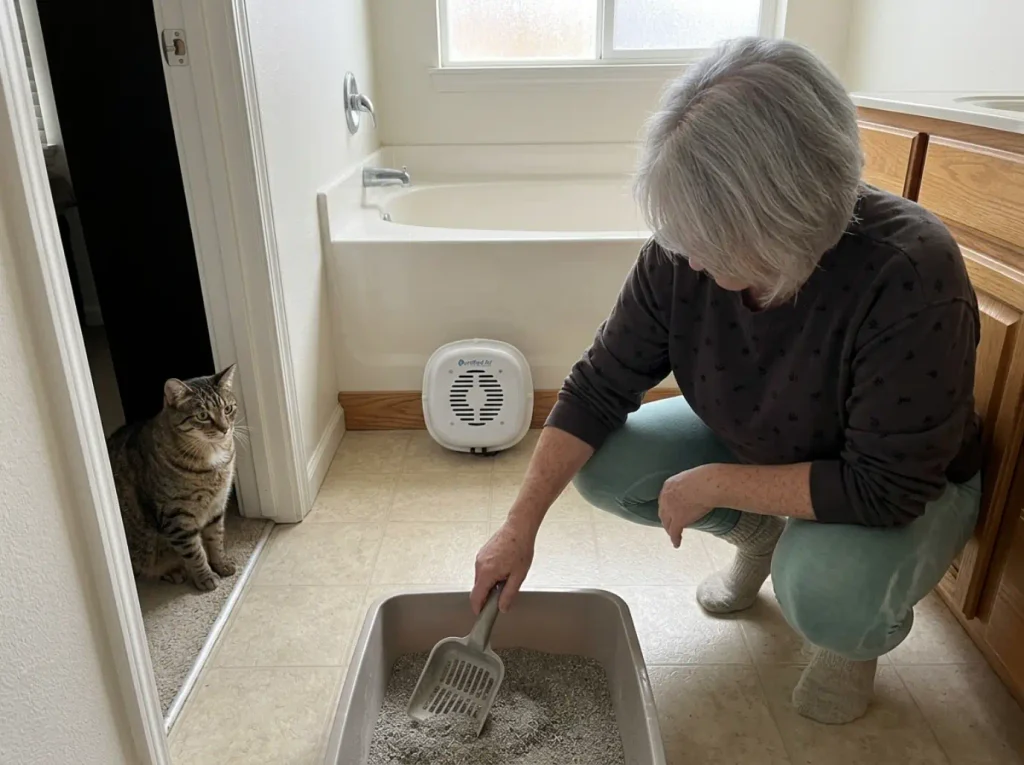
The free fix is cadence, not equipment. Scooping twice a day in a bathroom does more than any product on the market, because it removes the source before a small room has time to concentrate it. Morning and evening, thirty seconds each. Every odor product ever sold is a way of managing what is still sitting in the box, and nothing manages it as well as it not being there.
There is a cheap test for whether it is working, and it is the only honest one available: you cannot smell your own home. Walk out for two hours and notice what hits you when you open the front door. That is what a guest gets, and it is free.
Where the fan cannot be relied on, a passive unit beside the box picks up the slack because it needs nobody to remember anything. The Purrified Air Litter Box Air Purifier (Amazon) runs on activated carbon and zeolite and sits beside or behind the box, working whether or not anyone flipped a switch. The limitation is the same one every carbon product has: the media saturates, and a unit nobody has serviced in six months is a decoration. Put the replacement on the same reminder as the smoke alarm batteries and it stays honest.
Two things make it worse, and both get recommended constantly. Covering the box traps the smell where the cat’s nose is instead of where yours is, which solves your problem by giving him a worse one, and covered boxes in humid rooms hold the damp in as well.
A scented product adds a second smell to a room that already has too little air to handle the first. What belongs near the box for smell, and what makes it worse goes further into that, but the short version is that in a bathroom, addition is almost always the wrong direction. Take things out.
The Verdict
The bathroom is usually a good spot, and the room is almost never what went wrong. The door is, or the humidity is, or the footprint is, and all three have fixes that do not involve moving the box anywhere.
Settle the door before you spend anything. A household agreement costs nothing and fixes the most common failure outright. The strap and the cutout are what you buy when the agreement will not hold, and the choice between them comes down to whether you own the door.
If it is the only bathroom in the house and there are two cats, the bathroom holds one box and one only. Plan the second somewhere else rather than stacking them, because two boxes in one room is one location and the cats will treat it that way whatever you intended.
Check back in three weeks. Not three months, because nothing here wears out on that scale, but a household routine slips by the third week and that is when a new arrangement quietly reverts. Three weeks in, look at two things: is the door still being left open, and is the scoop still happening twice a day. If both held, it held.
Start by propping the door open for a week and changing nothing else. If the box comes back into use, the room was never the problem and you have spent nothing finding that out.
Amazon’s Audible — free for 30 days
Your cat won’t let you read. Let someone read to you.
Audible is Amazon’s audiobook library — thousands of titles, read out loud, on your phone. Free for a month, plus one audiobook to keep forever.
Frequently Asked Questions
01Is it okay to put a litter box in the bathroom?
Usually, yes. A bathroom gives you hard flooring, low traffic and ventilation, which are three of the four things a litter box location needs. The fourth is an escape route, so the door has to stay open or carry a cat-sized opening.
02Where should you never put a litter box?
Next to food and water bowls, in any room the cat can be shut out of, and anywhere the only route in passes something he avoids: a noisy appliance, a dog bed, a doorway with heavy foot traffic. Height counts too. A spot a senior cat has to climb to reach gets abandoned quietly.
03Is the bathroom the most sanitary place for a litter box?
It is the easiest to clean, which is not the same thing. Tile and vinyl wipe down and do not hold odor the way carpet does, but a bathroom’s smaller air volume concentrates smell faster. You get easier cleanup in exchange for a tighter scooping schedule.
04Can I hide a litter box in the bathroom?
You can, and the two spots that work are the dead corner beside the toilet and the gap under a pedestal sink. Both need three to four inches of clearance so you can still lift the box out. What fails is hiding it behind a door that then gets closed.
05Does bathroom humidity ruin cat litter?
It works against clumping litter, which binds ambient moisture as readily as it binds urine, so clumps crumble on the scoop instead of lifting whole. Organic litters made of wood, paper or corn can mold in a room that never dries out. A half-bath with no shower has neither problem.
Leave a comment