Best Litter Scoops That Don’t Bend or Clog
Don't replace a clogged litter scoop — soak it first. Slot width, not the brand or the review score, decides whether yours works with your litter.

Alfredo RamsesFounder · August 26, 2026 · 20 min read

On this page9 sections
- 1Why the Scoop That Came With the Box Fails First
- 2Slot Width Is Decided by Your Litter, Not by the Scoop
- 3Metal or Plastic, and When Plastic Is the Right Answer
- 4Bowl Depth, and Why Two Cats Change the Answer
- 5Handle Length, and the Joint That Comes Loose
- 6Storage, and the Part Everyone Gets Wrong
- 7What to Buy, by What You Actually Have at Home
- 8Conclusion
- 9Frequently Asked Questions
You bought a litter box, it came with a scoop, and you have been using that scoop ever since without ever once deciding to. It flexes when it hits a wet clump and drops half of it back in. Fine litter pours through the slots you needed it to hold, and coarse litter jams the ones you didn’t. The best litter scoop for your house is almost never the one that arrived free in the same box, and the reason is mechanical rather than mysterious: that scoop was built to a price point, not to clear a box.
Here is what actually breaks and when, how slot width is decided by your litter rather than by the scoop, and which designs hold up in a house with more than one cat.
Quick Answer
Pick the scoop by what you pour into the box, not by a review score.
- Fine clumping clay: narrow slots, around a tenth of an inch.
- Pellet, corn, walnut, paper or tofu: wide slots, two to four tenths.
- Two or more cats: solid metal, deep-shovel bowl, one per box.
- Can’t kneel: fixed long handle, not a telescoping one.
Why the Scoop That Came With the Box Fails First
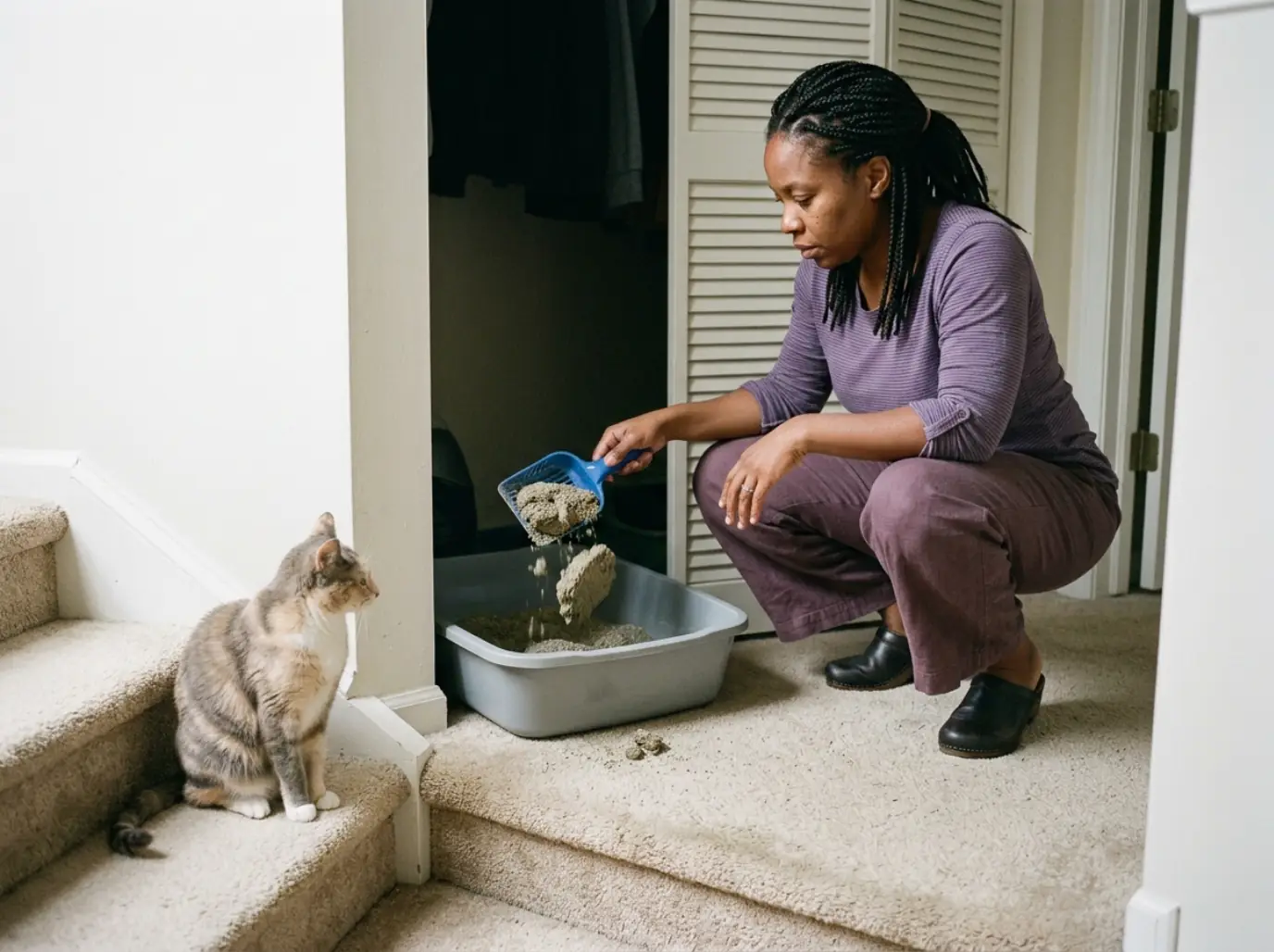
Everyone who has ever cleaned a box knows the feeling of a scoop flexing mid-lift. You get the clump clear of the litter, the plastic bows under the weight, and the whole thing tips back into the tray at the last second. Almost nobody frames that as a design failure. They assume they scooped badly, adjust their grip, and do it again tomorrow, next to a box whose whole setup is settled long before the tool ever comes into it, which is why where the box sits in the first place is the question underneath this one.
The flex is the failure. Thin injection-molded polypropylene has almost no stiffness across its width, and a loaded scoop of saturated clumping clay is heavier than it looks. The scoop does not need to snap to fail you.
It only needs to bend far enough that the clump rolls back over the lip before it clears the rim, which happens at a deflection you can barely see. That’s the whole mechanism.
Cracking is a separate mode and it arrives later. It starts at the stress point where the handle meets the bowl, which is exactly where a molded plastic scoop is thinnest, and it usually shows as a hairline before it shows as a break. Bundled and thin-wall plastic scoops tend to give out somewhere between two and six months of daily use.
A solid metal scoop runs two years and up, with plenty of owners reporting five and six. That gap is the argument worth making, and it is not about what a scoop costs on the day you buy it. It is about how many of them you buy in the same period.
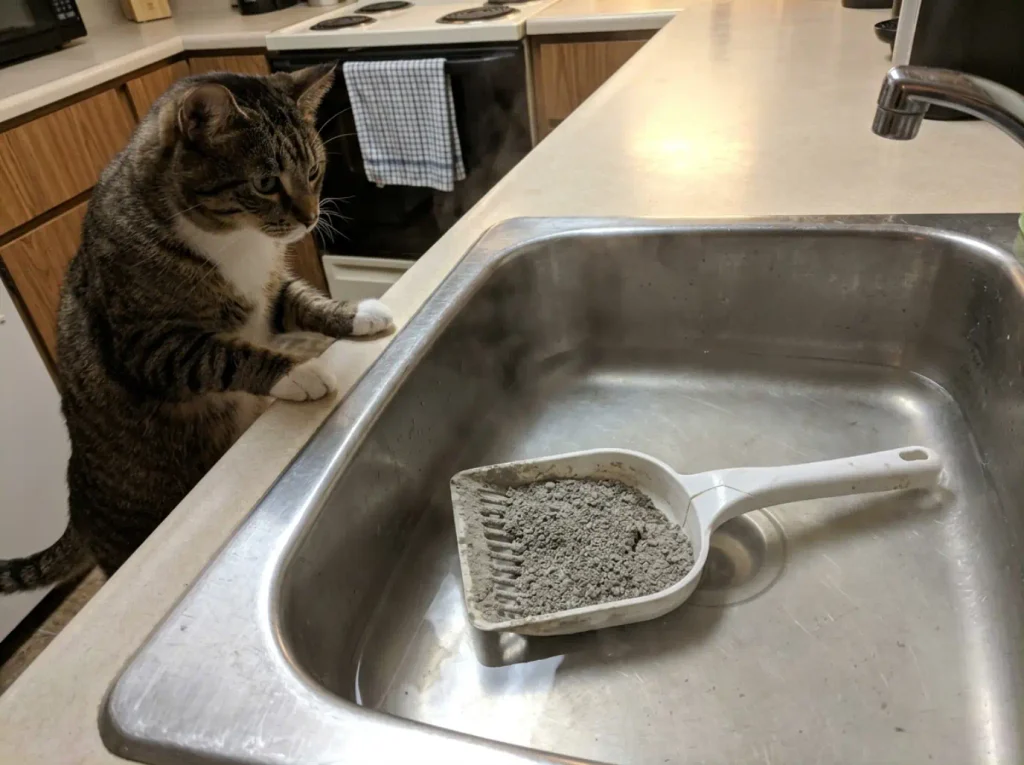
Clogging is the third mode and the most misdiagnosed by a wide margin. Wet litter packs into narrow slots, dries there, and turns a sifter into a solid paddle. From that point on, every pass lifts clean litter along with the clump, the box empties faster than it should, and it feels like the scoop got worse when nothing about the scoop changed at all. The recurring version of this in litter threads is people scraping their slots clear with a second tool, every single day, without ever registering that a daily unclogging ritual is a symptom rather than a chore.
So before you buy anything, work out which of the three you actually have. A worn scoop and a packed scoop look identical from arm’s length, and only one of them needs replacing.
Soak a clogged scoop in hot water for twenty minutes and let it dry completely before you decide it is worn out. Half the scoops people describe as broken in forum threads are packed solid, not damaged, and they come back working.
Slot Width Is Decided by Your Litter, Not by the Scoop
Someone buys the scoop that won a roundup, uses it for a week, and reports that it performs badly. The scoop was never the controlling variable. What they pour into the box was, and no ranked list of the best cat litter scoop leads with that. Every scoop that sifts is a litter sifter first and a shovel second, and the tine spacing across that head is the specification that decides whether it works in your house.
Fine-grain clumping clay wants narrow slots, in the region of a tenth of an inch. Go wider and the clean litter takes too long to fall back through, so you stand there shaking the scoop over the box while fine dust rides out on top of the clump and ends up in the trash. Narrow slots let the clay sift fast and hold the clump together while it drains.
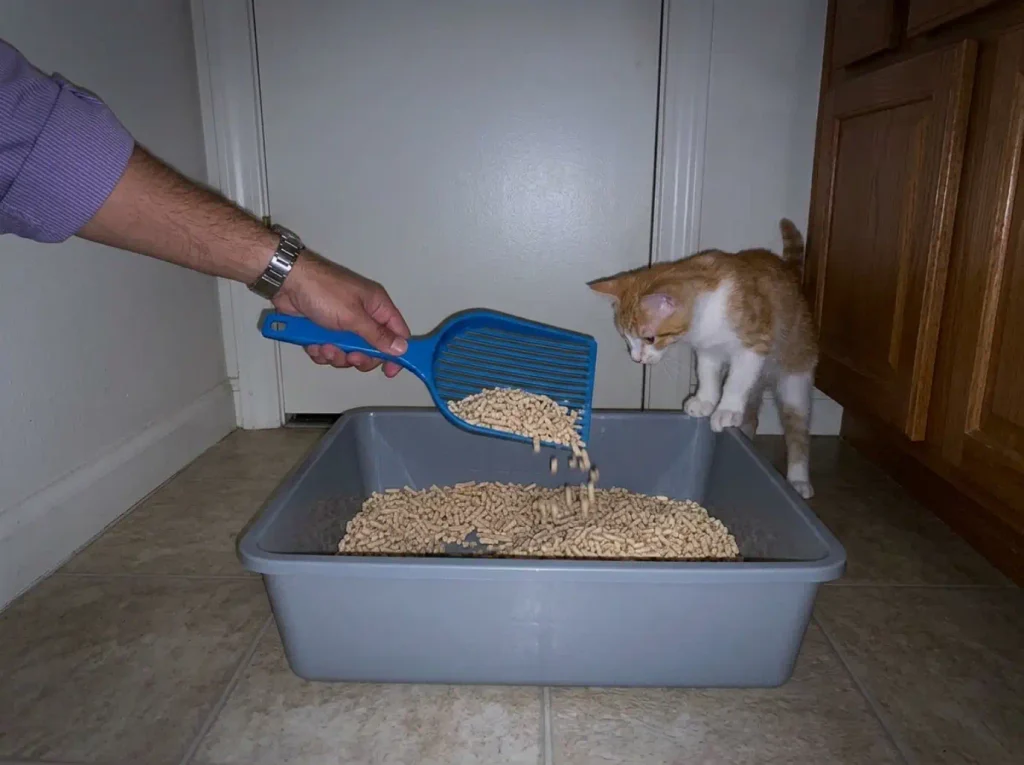
Pellet litters and the rest of the non-clumping litter family, meaning corn litter, walnut, paper and tofu, want the opposite: roughly two to four tenths of an inch. A pellet is larger than the gap a clay scoop is built for, so a narrow-slot scoop meeting pellet litter stops being a sifter on the first pass. It becomes a paddle. Nothing falls through, you lift the entire contents of that corner, and the box drains itself in a week.
That is the whole decision, and it gets published as a spec line under a product photo instead of as the first question anyone asks. Slot width sits in the bullet list next to weight and handle length, as though the three were comparable. Two of them are preferences. This one is a compatibility check.
The two-zone scoops exist because manufacturers know this. Narrow slots at the tip, wider toward the back, one head for both litter families. It works well enough, and it is worth being honest about what it is: a hedge for a household that has not settled on a litter yet, rather than an answer for one that has. If you know what is going in the box and it isn’t changing, a scoop built for that litter beats a scoop built for both.
And the most common version of “my scoop stopped working” is not a scoop that stopped working at all. It is a household that changed litter and kept the tool.
Somebody moves to a low-dust clay, or to walnut, or to the litter you switched to for the smell, and the scoop that was fine for two years is suddenly clogging on every pass. Nothing broke. The specification just quietly stopped matching.
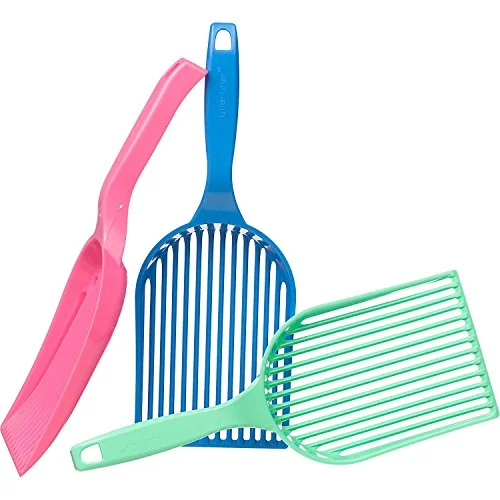
There is also a design that sidesteps the whole argument by refusing to sift.
Metal or Plastic, and When Plastic Is the Right Answer
Every roundup in this category ends up at the same place: buy metal. Most people reading them own plastic, and their plastic scoop has been fine for years. Both of those things are true at once, and the interesting part is the specific point where they stop being true.
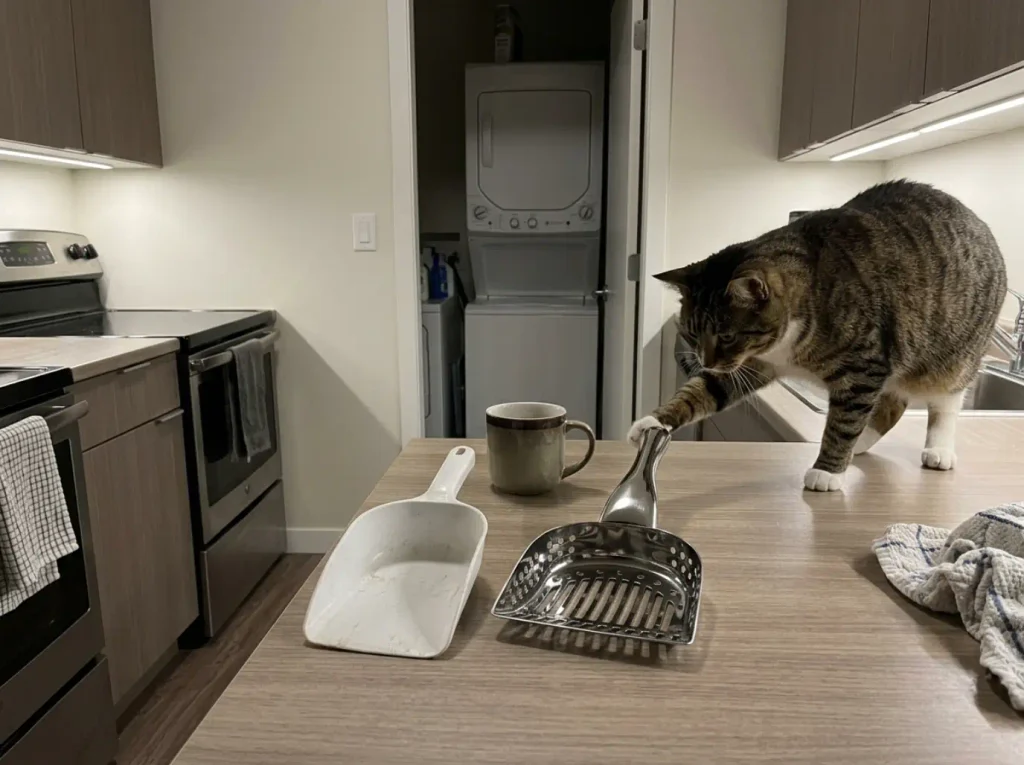
The case for aluminum and for a stainless steel scoop is short and it is a good one. Both are effectively rust proof in a household that keeps them dry. Metal does not flex under a loaded bowl, does not crack at the handle joint, and does not scratch into grooves that hold residue. Three failure modes removed by material alone.
But a thick-walled plastic scoop with a smooth-edged bowl will handle fine clumping clay in a single-cat box more or less indefinitely. Plastic does not fail on principle. It fails on scale and on wet weight, which means it fails in the houses that lift more per pass and more passes per day. If you have one cat, one box, and clay litter, a decent plastic scoop is the honest recommendation.
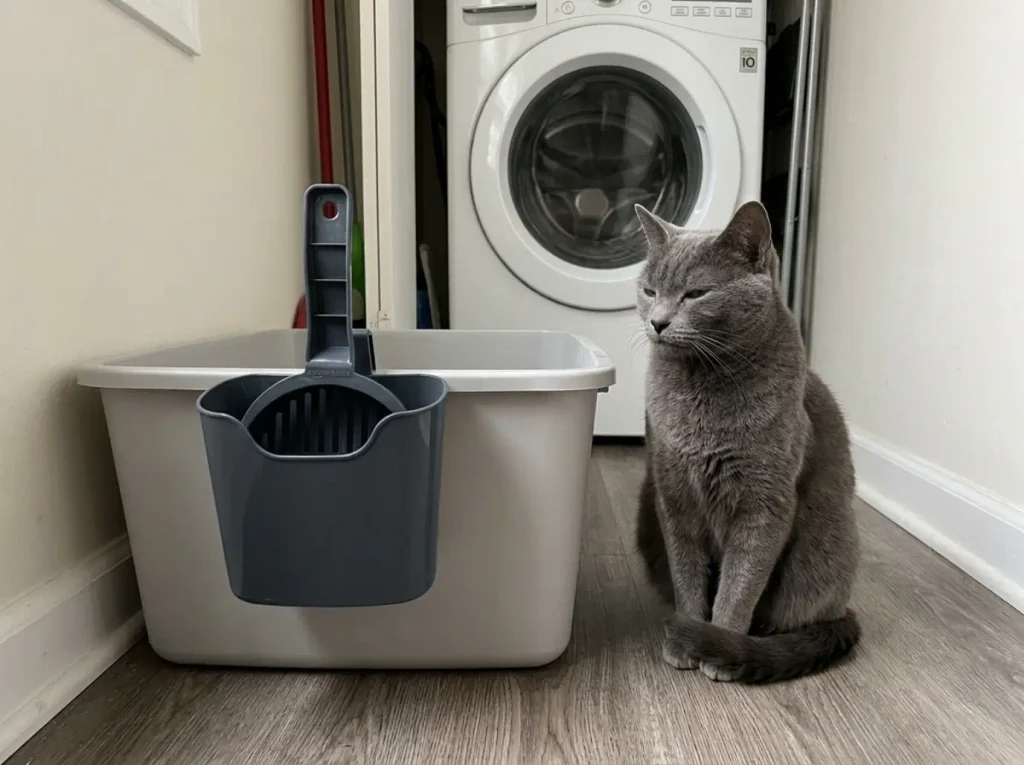
The Amazon Basics Durable Cat Litter Scoop with Holder is the version worth naming: polypropylene, a smooth scraping edge that behaves like a non-stick coating without being one, and a holder that hangs it on the side of the box so it isn’t living on the floor. Its ceiling is where you’d expect. Two or three cats and daily wet clay, and you will find the flex point inside a year.
Where plastic genuinely loses is scratching, and this is the failure that decides it rather than the one people argue about. A plastic bowl accumulates fine scratches from litter and from the edge of the box, and those grooves hold residue that rinsing does not reach. The scoop looks clean. It is not clean.
That is the reason a litter area can smell faintly of ammonia when the box itself was emptied yesterday. Non-porous surfaces do not do this, which is the same surface logic that decides a box rather than a separate argument about scoops.
There is one trade-off nobody names. A solid metal scoop is heavier, and if you run three boxes twice a day that is six lifts of a heavier tool, every day, for years. For most people it is nothing. For someone with wrist or grip trouble, the lighter scoop that gets used is a better scoop than the heavy one that doesn’t.
For what it’s worth, the scoop still named most often in durability threads is the DuraScoop, sold for two decades with tens of thousands of ratings behind it. Its listing is not currently buyable. Reputation and availability are not the same thing.
| Material | What it survives | Where it fails | Best for |
|---|---|---|---|
| Thin bundled plastic | Light, dry litter and occasional use | Flexes under wet clumps in 2-6 months | Nothing. It is a placeholder. |
| Thick-wall plastic | Daily clay in a single-cat box, for years | Scratches into residue-holding grooves | One cat, clumping clay, tight budget |
| Aluminum | Two-plus years of daily wet clumps, no flex | Nothing indoors; lighter than steel | Most households, most litters |
| Stainless steel | Everything aluminum does, plus corrosion | Heaviest of the four in the hand | Buy-once readers, outdoor or damp storage |
Bowl Depth, and Why Two Cats Change the Answer
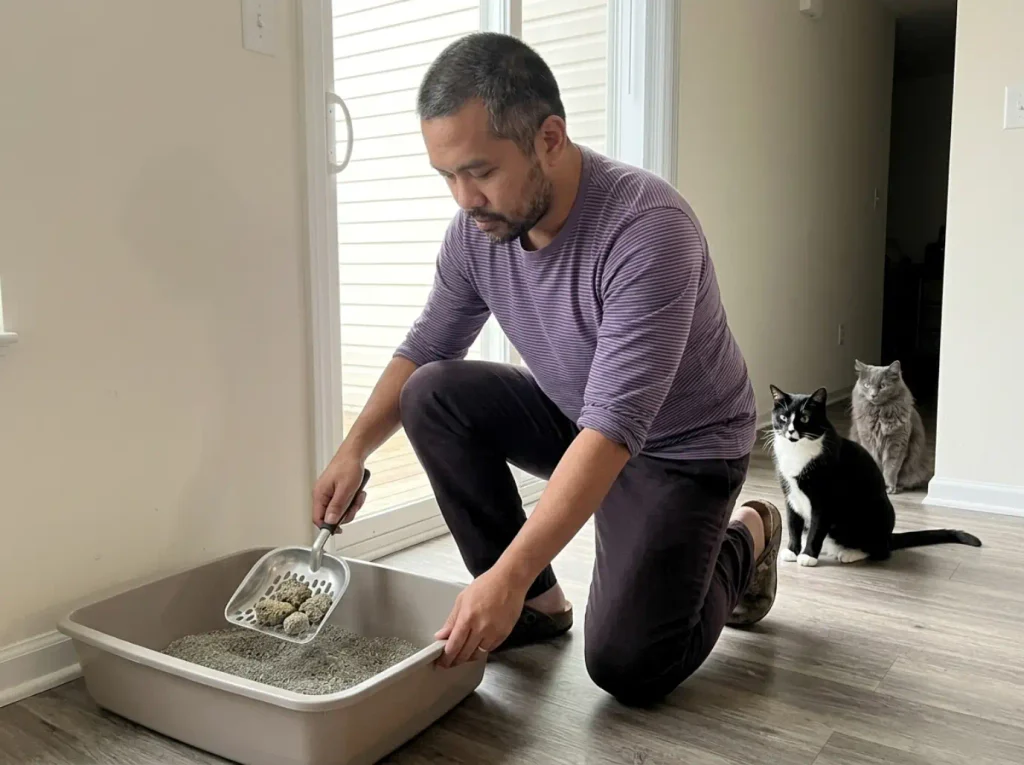
Two cats do not automatically mean twice the work. They mean twice the work if you are lifting the same shallow scoop twice as often, which is what happens by default because nobody rethinks the tool when the second cat arrives.
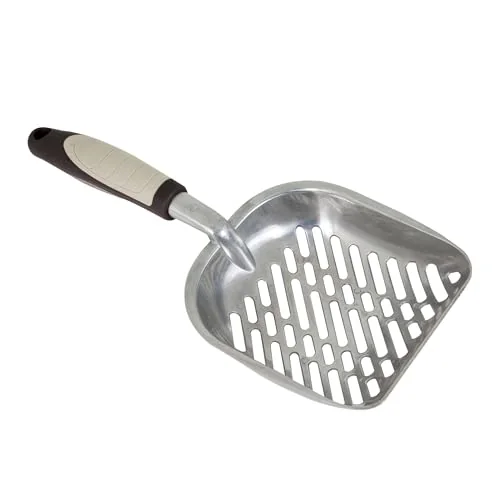
A shallow flat scoop lifts one clump cleanly. That is what it is for, and in a single-cat box it is enough. A deep shovel scoop lifts several at once, and that difference is the entire gap between clearing one box and clearing three.
Deep-shovel bowls run around two inches from rim to base, and the depth is not about capacity in the way a bigger bag is about capacity. It is about the angle.
Two inches of wall is what stops clumps rolling back over the lip when you tilt the bowl to drain the clean litter, which is the exact moment a shallow scoop gives half of its load back.
Here is the part that compounds. The 1+1 rule puts a two-cat household at three boxes for two cats, so in a multi-cat household a single scooping pass is three boxes, not one. In a single-cat household it stays one, and that is the whole reason the answer splits here. Depth multiplies across those three.
Slot width doesn’t: a correct slot width is correct once and stays correct whether you have one box or five. Depth is the spec that scales with the household, and it is the one every roundup treats as a stray con line about the scoop being too large.
Which is the honest limitation. A deep bowl is clumsier inside a small covered box, where the hood limits how far you can angle it and you end up scooping at a wrist angle the tool was not shaped for. If all your boxes are hooded and compact, a mid-depth bowl will annoy you less than the deepest one you can find.
The arc in multi-cat threads is remarkably consistent: somebody buys a second identical scoop so the second box has its own, then a third, and at no point does anyone suggest that one better-shaped scoop per box would have been the actual answer. Buying more of a tool that was wrong once is how a small mismatch becomes a daily one.
If the depth argument lands but you also want to stop kneeling at every box, there is a version that does both.
Handle Length, and the Joint That Comes Loose
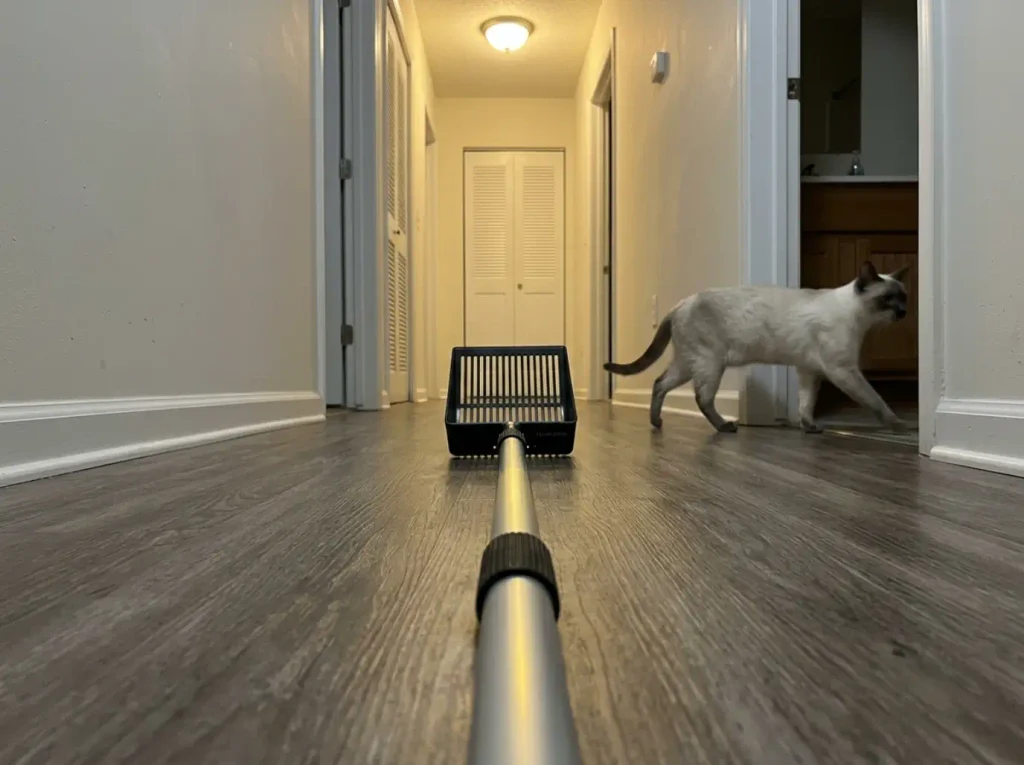
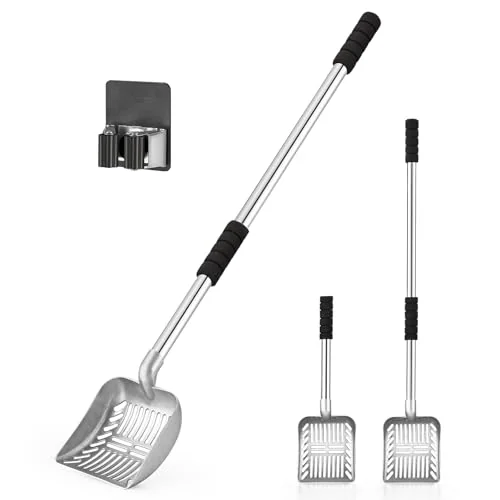
Long-handled scoops sell on one promise, and it is a good promise: you stop kneeling on a floor covered in tracked litter twice a day. The ones that fail do not fail at the bowl. They fail at the joint, mid-scoop, with both your hands committed and a loaded bowl over an open box, which is meaningfully worse than kneeling.
Two different products get sold under the same phrase. A fixed long handle is one piece, or two pieces that thread together once and stay there. An adjustable or telescoping handle extends and locks, usually with a twist collar or a threaded sleeve. They look like the same category on a listing page.
They fail in completely different ways, because only one of them has a moving part.
The handle grip is the part nobody weighs and everybody feels. A rubber grip stays put in a wet hand; a foam handle is kinder on the fingers and degrades faster, going tacky after a year of damp. Bare metal does neither and lasts forever. None of that decides a purchase on its own, but it is what you notice on the fortieth pass.
The twist-lock joint is the weak point and the mechanism is easy to picture. Scooping is not a straight lift. You push sideways into packed litter, you rock the bowl to drain it, and every one of those motions puts torque across the joint in the direction that unscrews it.
It does not loosen over years of fair wear. It loosens over a week of normal use, and then one morning the handle rotates in your hand and comes away. That specific complaint appears again and again in long-handle reviews, described in almost identical words by people who have never met.
A fixed-length handle has nothing to loosen. If the reason you want length is a bad back, an awkward corner, or a box you cannot get in front of, fixed beats adjustable on reliability and it is not close. Buy the length you need and stop there.
Adjustable earns its place in one situation, and it is a real one: several boxes at genuinely different heights, or a box inside a cabinet where a fixed handle won’t clear the opening on the way in. If that is your house, the TOYPOPOR adjustable scoop runs from 21 to 39.5 inches and covers the range. Buy it knowing the joint is the part that will need attention, because that is a maintenance item rather than a defect, and knowing it in advance is the difference between a habit and a bad morning.
If you buy an adjustable scoop, set it once to the length you actually use and re-tighten the collar before the first pass of the week. The joint loosens with torque, not with time, so it goes on the routine you already have rather than on a calendar.
Storage, and the Part Everyone Gets Wrong
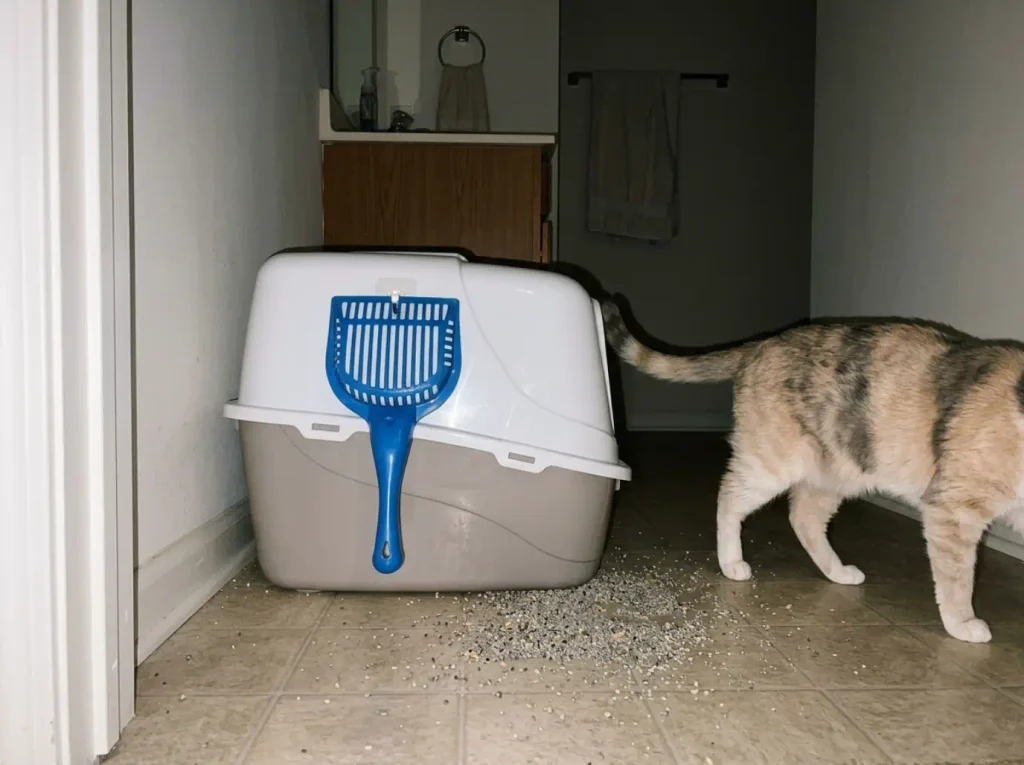
A clean scoop sitting on the floor next to the box is not a clean scoop. You already know this. You have been stepping around it for months anyway, because there was never an obvious alternative and the floor was right there.
The mechanism is straightforward and slightly grim. A scoop resting on the floor rests in whatever litter tracking has put there, picks up damp fines on the bowl and the handle, and carries them straight back into the box on the next pass. Whatever ended up on the floor gets a return ticket. If that floor litter is itself the problem, the litter that ends up on the floor around it is a separate fix worth making, but the scoop half is solved by getting the tool off the ground.
Hung beats standing, for the same reason. A scoop clipped to the box rim touches nothing but air. A scoop holder that sits on the floor beside the box has simply moved the problem into a container. A wall-mount holder or a purpose-made litter caddy works well and needs drilling, which rules them out of most rentals before the conversation starts.
The version that costs nothing is an adhesive hook on the outside of the box, or on the wall behind it, at whatever height gets the bowl clear of the floor. Alternatively, store the scoop inside a small lidded bin next to the litter, which also contains the smell of the residue you cannot see. Neither of those needs a landlord’s permission, a drill, or a purchase, which makes both of them the renter-friendly answer in a small apartment where the box and the litter share one corner.
There is a related argument for a spare. One scoop traveling between boxes carries damp litter dust from box to box, which is a hygiene issue in exactly the households that can least afford one. A cheap second scoop per box solves it more thoroughly than any deodorizer, and something like the Van Ness Pureness Regular Litter Scoop is the shape of the answer, high-impact plastic and nothing clever about it. Its stock comes and goes, so if it isn’t showing as available, any thick-walled plastic scoop does the same job.
Rinsing schedule follows from material. A metal scoop rinses and dries in seconds and needs it maybe weekly. A plastic one, under daily scooping, needs it more often, and specifically it needs drying rather than just rinsing, because those scratched grooves from the material section are where damp residue sits.
Store the scoop bowl-up, not bowl-down. Bowl-down traps damp litter dust against whatever it is resting on and keeps it from drying, which is where the faint smell you cannot locate usually lives.
One boundary before we go back to the tool. A cat who suddenly stops using a box you have been scooping the same way for months is telling you something a vet should hear about first. That is not a storage problem and it is not a scoop problem, and no change to either one is the right response to it. Everything in this article assumes a cat who is using the box.
What to Buy, by What You Actually Have at Home
Six sections in, you want the answer for your house rather than a ranked list of nine scoops. Find your row.
- One cat, fine clumping clay, plastic box. The narrow-slot scoop you already own is probably fine once it has been soaked and dried. Free, and it works often enough to try before anything else.
- Two or more cats, clumping clay. Solid metal, deep-shovel bowl, and one per box rather than one that travels between them. This is also the household where how often you’re lifting it matters as much as what you are lifting it with.
- Pellet, corn, walnut, paper or tofu litter. Wide slots, and it is not negotiable. A narrow-slot metal scoop performs worse here than a cheap wide-slot plastic one, because the material never gets a chance to matter.
- Can’t kneel, or the box is inside furniture. Fixed long handle first. Adjustable only if the box heights genuinely differ or the cabinet opening demands it.
- Covered or compact boxes only. Mid-depth bowl, not the deepest one available. The hood decides your angle whether you like it or not.
Then there is the upgrade that isn’t one. Stainless steel over aluminum buys corrosion resistance, and corrosion resistance is a property you will not use in an apartment where the scoop lives dry and indoors. The RSVP International Endurance stainless scoop is a genuinely lovely object, 11.25 inches long with a 6.5-inch handle, and it will outlive the apartment.
It is a nicer thing to own than an aluminum scoop. It is not a better tool for the job, and anyone telling you otherwise is ranking by material instead of by outcome. Stock on it runs thin, which is its own argument for not building a plan around it.
I used to point people straight at the most durable metal scoop in whatever thread was current, on the theory that buying once was the end of the question. After enough posts describing a metal scoop that clogged solid on the owner’s new pellet litter, I stopped. Material is the second decision. Slot width is the first, and getting the order wrong is how someone ends up with an expensive paddle.
Conclusion
Clean the scoop you own before you buy one. A packed scoop and a worn scoop look identical in the hand, and only one of them needs replacing, which makes the twenty-minute soak the cheapest diagnostic in this entire topic.
Match slot width to your litter rather than to a review score. That one decision resolves more scoop complaints than material ever will, and it is the reason a scoop that was perfect for two years can turn useless the week you change what goes in the box.
If you run more than one box, buy depth and buy one per box. The traveling scoop is the hygiene problem nobody writes about, and depth is the only spec that scales with the number of cats you have.
Three weeks from now, look at the scoop, not the box. If the edge is flexing under a loaded lift or the slots have packed again on the same litter, the tool is what changed, not the cat.
Soak the scoop you own tonight. If it comes back working, you just saved the purchase entirely.
Amazon’s Audible — free for 30 days
Your cat won’t let you read. Let someone read to you.
Audible is Amazon’s audiobook library — thousands of titles, read out loud, on your phone. Free for a month, plus one audiobook to keep forever.
Frequently Asked Questions
01How long should a litter scoop last?
A solid metal scoop should run two years or more of daily use, and plenty last far longer. Thin plastic ones, including the kind bundled with a new litter box, typically start flexing or cracking between two and six months. If yours is failing sooner, check whether it is packed with dried litter rather than worn out.
02Are metal litter scoops actually better than plastic?
For multi-cat boxes and wet clumping clay, yes. Metal does not flex under load and does not scratch into residue-holding grooves. For one cat and fine clay, a thick-walled plastic scoop is genuinely fine for years. The failure that decides it is scratching, not material snobbery.
03What size slots do I need for pellet litter?
Wide ones, roughly two to four tenths of an inch. Narrow-slot scoops built for fine clumping clay turn into solid paddles the moment they meet pellet, corn or walnut litter, because nothing falls back through. If you switched litter and your scoop stopped working, this is almost always why.
04Should each litter box have its own scoop?
If you have more than one box, yes. One scoop traveling between boxes carries damp litter dust from one to the next, and that is the smell people cannot locate. A cheap second scoop fixes it more completely than any deodorizer, and it costs less than one.
05Why does my litter scoop keep clogging?
Almost always a slot-width mismatch with your litter, or wet litter that dried in the slots and never came out. Soak it in hot water and dry it fully first. If it clogs again within a week on the same litter, the slot width is wrong for what you are using.


Leave a comment