How Often to Deep Clean a Litter Box, and How to Do It
Full change every other week, soap-and-dry scrub every 3-4 weeks, and 2-3 days if you run non-clumping. Plus the 4 signs the box is done.

Alfredo RamsesFounder · August 26, 2026 · 20 min read

On this page8 sections
- 1What a Deep Clean Actually Is, and What It Is Not
- 2How Often, by Litter Type and Cat Count
- 3The Wash Itself, Step by Step
- 4Deep Cleaning in an Apartment With No Hose and No Yard
- 5When the Smell Comes Back in 48 Hours, the Box Is the Problem
- 6Keeping the Cadence When Life Gets in the Way
- 7The Two Clocks, and the One That Isn't a Clock
- 8Frequently Asked Questions
The box was washed on Sunday. By Tuesday evening the room smells again, and the first thing most people do is add the wash to the calendar more often. That is almost never the fix.
Veterinarians land in a fairly tight window on how often to deep clean a litter box, roughly every three to four weeks, and the number nobody publishes is the one that matters more: the box itself has a replace-by date, and past it no schedule will save you. Below is the two-tier cadence, the wash that actually works in an apartment with no hose and no yard, and the signal that means stop washing and start shopping.
Quick Answer
Deep clean a litter box with soap and a full dry every three to four weeks. Between those, dump and rinse all the litter every other week with clumping litter, or every two to three days with non-clumping. If odor returns within 48 hours of a real wash, the box is the problem, not the schedule.
What a Deep Clean Actually Is, and What It Is Not
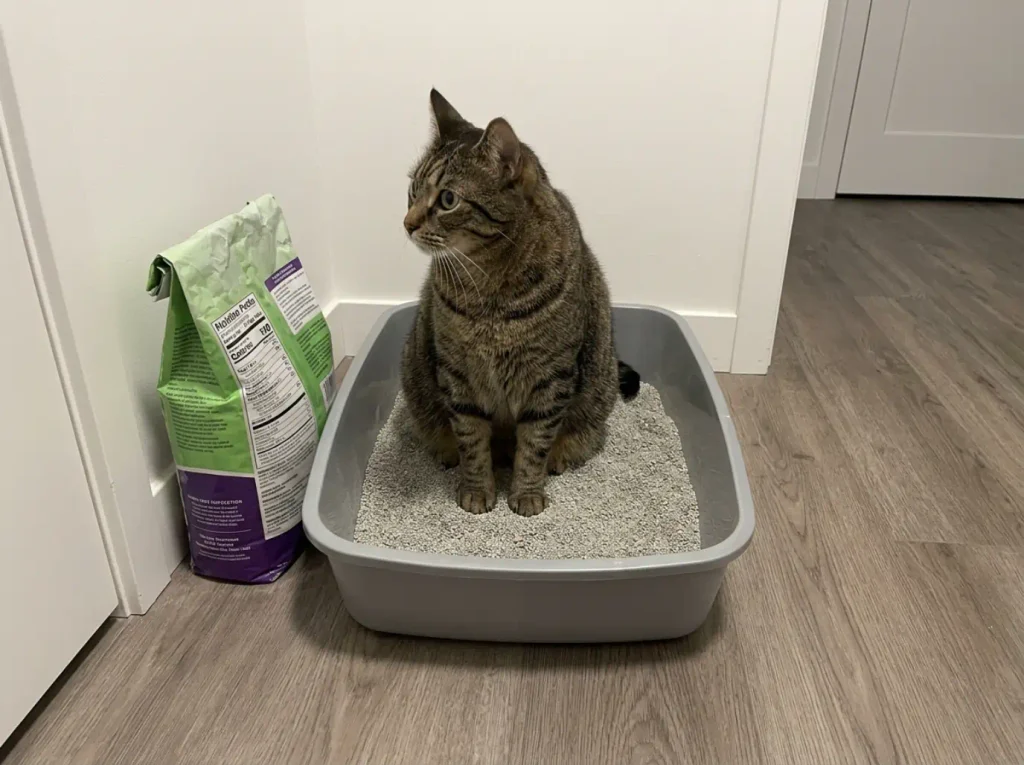
Someone can clean a litter box every single week for two years and never once deep clean it. That is not laziness. Nobody told them these were two different jobs, because almost nothing written about litter box maintenance separates them, and maintenance is the half of the job that decides whether where the box sits in the first place was a good decision or a slow-motion odor problem. Getting the location right buys you nothing if the tray underneath has not been emptied since spring.
There are three actions here, and they escalate:
- Scoop. Daily. Solids and clumps out, litter topped up to depth, box stays where it is. Nothing is dumped and nothing gets wet. That one has its own clock, and the daily scoop has its own schedule, per cat per day.
- Full change. Every grain of litter leaves the box, the tray gets rinsed with hot water, and fresh litter goes back in at depth. No soap. Takes five minutes.
- Deep clean. Everything empties, the tray is washed with mild unscented dish soap, scrubbed into the corners, rinsed, and then dried completely before refilling. Twenty minutes, most of which is drying.
The clearest version of the split comes from International Cat Care, whose guidance separates the two actions in a single sentence: the tray is scooped out at least twice a day and completely cleaned out and washed every two to four weeks on clumping litter, weekly on non-clumping. Two actions. Two clocks. Most of the articles ranking for this question name both and then use the words interchangeably three paragraphs later.
Here is the physical tell that settles it. A full change ends with a wet box. A deep clean ends with a dry one. That sounds like a technicality until you refill over damp plastic and find out what happens next: the first batch of clumps bonds to the floor of the tray and comes up in pieces two weeks later, which is exactly the crust you will be scraping at the next wash.
The drying is not the boring part at the end. It is the part that decides how hard the next one is.
And the most common failure in litter threads is not skipping the wash. It is never dumping the litter at all. Scoop, top up, scoop, top up, for weeks, until the bottom inch of the box has been sitting there since a season ago, soaked and packed and completely invisible under three inches of clean-looking litter.
The person doing it is not neglecting anything. They are doing the visible job perfectly.
Depth is what makes the gap between washes survivable. Two to three inches for non-clumping, two to four for clumping. Go shallower and urine reaches bare plastic on day one, which means every wash is starting from a stain instead of a surface.
How Often, by Litter Type and Cat Count
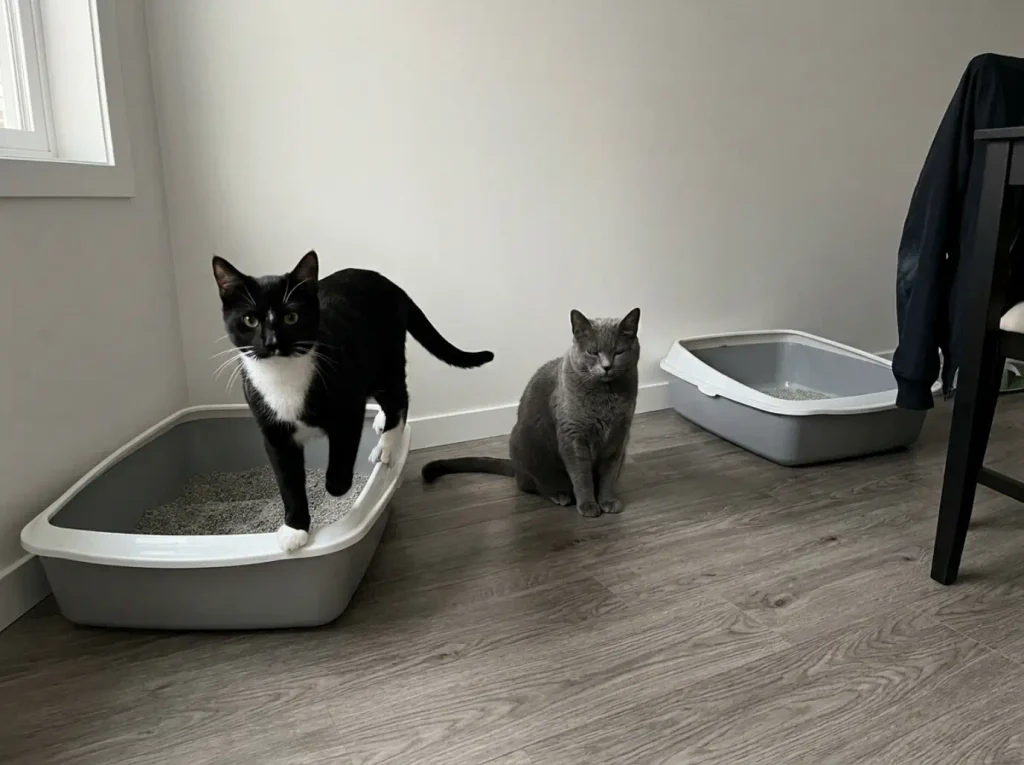
Every competing article says multi-cat households need to clean more often and then stops, as if the reader could derive the number from enthusiasm. Two variables move the interval, and one of them moves it much further than people expect.
Clumping Litter, One Cat
One cat on clumping litter is the easiest version of this and it is still not “monthly.” Scoop daily, do a full change and rinse every other week, and give it the soap-and-dry deep clean every three to four weeks. That is the baseline, and Ohio State’s Indoor Pet Initiative states the floor version of it plainly: the box gets scooped daily and washed weekly with mild dish detergent.
The reason the interval stretches that far is that clumping litter is doing removal work for you. Every clump you lift out is urine leaving the box permanently, so what stays behind is mostly clean substrate. Which only holds if the litter is deep enough to form a clump that lifts whole, and the two to four inches that keep urine off the plastic is not a suggestion. At two inches the clumps hit the floor of the tray and break when you scoop, and the half that breaks off stays in the box until the next full change.
Non-Clumping Litter, and Why the Number Drops by Four
This is the part that surprises people, and it is why which litter you run changes the interval more than how many cats you have. With non-clumping litter, urine is never removed between full changes. It absorbs into the substrate and stays there. The entire tray is the absorbent, and the only way to take urine out of the box is to take the whole box of litter out.
So the full dump moves from every other week to every two to three days, and ten days is the outer edge for a single cat, not a target. That is a four to five times shorter interval for the identical box, the identical cat and the identical apartment.
That is the one case where a weekly rhythm is too slow rather than too keen. A litter box liner is the usual workaround here, and it buys less than people hope: clay clumps tear it within days and the urine reaches the tray anyway. The deep clean stays roughly monthly, but it arrives harder, because a tray that has been holding saturated litter needs the corners worked rather than wiped.
Two Cats, Three Cats, and What the Box Count Does to the Math
With more than one cat the scooping moves to two or three times a day, full changes tighten to every one to two weeks on clumping and every four to five days on non-clumping, and the monthly deep clean stays monthly while becoming the thing you cannot skip. Here is the whole thing in one place:
| Setup | Full change (dump + rinse) | Deep clean (soap + dry) |
|---|---|---|
| Clumping, one cat | Every other week | Every 3 to 4 weeks |
| Non-clumping, one cat | Every 2 to 3 days, 10 days at the outside | Every 3 to 4 weeks, harder each time |
| Clumping, two or more cats | Every 1 to 2 weeks | Monthly, and not skippable |
| Non-clumping, two or more cats | Every 4 to 5 days | Monthly, plus a mid-month rinse |
What holds those numbers together is the box count, not the cat count. One box per cat plus one is usually sold as a hygiene rule. It is closer to a load-balancing rule: three cats sharing one tray is a volume problem, and you cannot wash your way out of a volume problem.
The stories that keep surfacing in litter threads follow the same script, two cats on one box and the smell back the same evening as the clean, and the person telling it always assumes they cleaned it wrong. They didn’t. They did arithmetic on a box that was already losing.
Count boxes, not cats. Every one of these intervals is per tray, so adding the plus-one box does not add work, it spreads the same volume of urine across more surface and quietly buys back days on both cadences. Two cats and three boxes is a lighter cleaning week than two cats and two boxes.
The Wash Itself, Step by Step
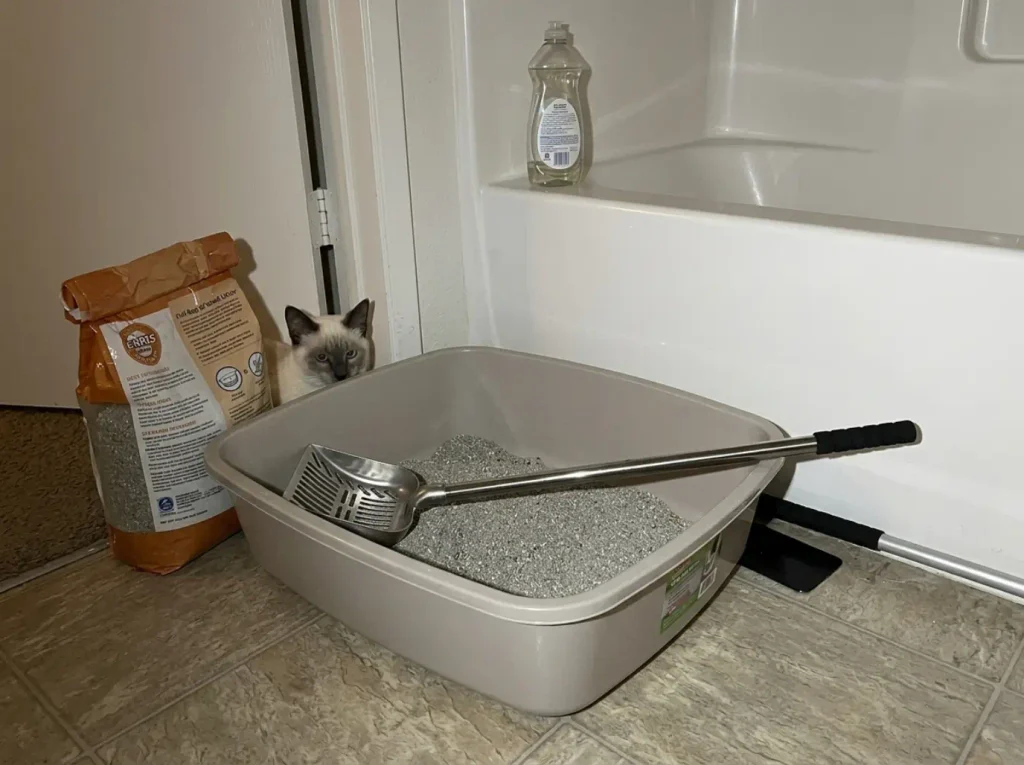
The order matters more than the products, and there are exactly two things that must never touch the tray.
Empty It Completely First, and Why the Scoop Matters Here
Dump everything. Not most of it, all of it, including the packed layer at the bottom that has stopped looking like litter. Then scrape the residue out dry, over the trash, before any water touches the box. Wet litter is heavier, stickier and harder to remove than dry litter, so every second you spend scraping before the tap runs is a minute you don’t spend scrubbing after.
Getting that last layer out is easier with a scoop that lifts rather than crumbles. The Yangbaga Metal Cat Litter Scoop has a detachable long handle and metal slots wide enough to keep clumps whole on the way up, which is the difference between the bottom layer leaving the box and the bottom layer breaking into powder that settles back down. The handle length is the reason it is worth having for this specific job, since it keeps your hand out of the tray while you work the corners. The trade-off is that a metal scoop is loud against a plastic tray and it will not fit a narrow hooded box’s opening without the handle coming off first.
Soap, Water, and the Two Cleaners That Make the Box Worse
Hot water soak, mild unscented dish soap, scrub every corner with a brush or sponge that never touches anything else in the house, rinse. That is the recipe. It has been the recipe for decades, and Cornell’s Feline Health Center is explicit about the other half of it: avoid cleaning products containing ammonia or vinegar, because they smell like urine and can be irritating.
There are two reasons for that, and everyone gives the first one. Bleach and ammonia meeting in a tray produce chloramine gas, which is a real risk in a small bathroom with the door shut. The second reason is the one nobody gives, and it is the one that explains the cat: ammonia smells like another cat’s urine to a cat. Since ammonia starts building about thirty minutes after the pee, it is the exact scent signature of an occupied territory.
Wash a box with an ammonia cleaner and you have not made it clean. You have signed someone else’s name on it, and a cat who reads that signature may decline the box entirely, spotless and gleaming as it is.
I used to treat the no-bleach rule as generic pet-safety boilerplate, the kind of line every article copies from the one above it. What changed my mind was how often box-refusal threads end with someone mentioning, almost in passing, that they had recently switched cleaners. The box was cleaner than it had ever been. That was the problem.
For clumps welded to the tray, the free fix beats the scraping. Baking soda across the base, white vinegar poured over it, fifteen to twenty minutes, then rinse. The fizz lifts the bond for you. Do that before you scrub, not after you have already spent ten minutes attacking a corner with a butter knife.
Drying, Which Is the Step Everyone Cuts Short
Towel it, then leave it. A box that feels dry to the hand is usually still damp in the corner seams, and that is where the next batch of litter starts bonding. If the tray goes back into service in five minutes because the cat is waiting, you have done a full change with extra steps, not a deep clean.
Dry the box in direct sun on a balcony or on a windowsill if you have one. UV finishes what the towel starts, gets into the seams a cloth cannot reach, and costs nothing. Twenty minutes of sun beats an hour of air-drying in a windowless bathroom, which is where most boxes go to stay damp.
Deep Cleaning in an Apartment With No Hose and No Yard
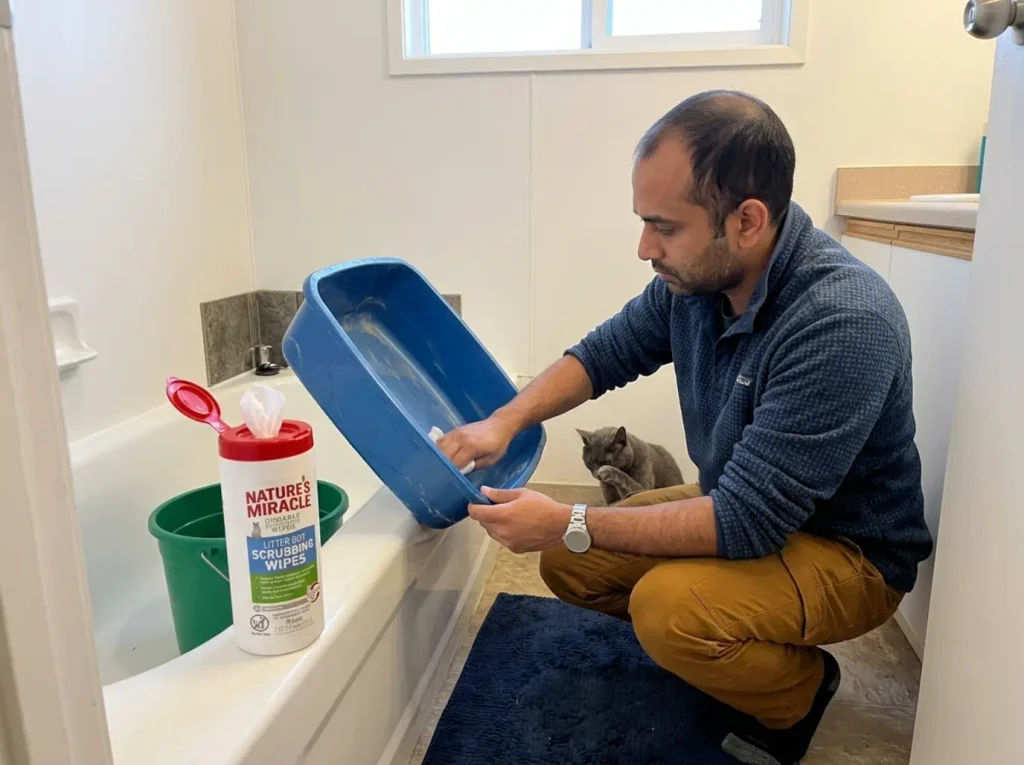
Read the published procedures closely and you will notice they all assume the same house: a yard, an outdoor tap, a hose, a driveway to leave the box drying on. Almost nobody who searches this question has any of those things. In a one-bathroom apartment the wash happens in the tub you shower in, and where the box fits when there is no spare room is already a solved compromise before the cleaning question even arrives. That mismatch is the actual reason people skip the deep clean, not laziness and not the twenty minutes.
The Bathtub Method, and How to Not Resent It Afterward
The order is what makes this tolerable rather than grim.
Scrape everything out dry over the trash first. Never rinse litter down a drain, and this is not a fussy warning: clumping litter is bentonite clay, it sets in a trap the way it sets in the box, and the plumber’s bill for that is a genuinely bad afternoon.
Once the tray is empty and dry-scraped, it goes in the tub. Fill a bucket for manual rinsing rather than trying to aim a showerhead into a low tray, because the bucket gives you control over where the water goes and the showerhead gives you a wet bathroom. Wash, rinse with the bucket, lift the box out, then rinse the tub itself down with hot water before anything else happens in there.
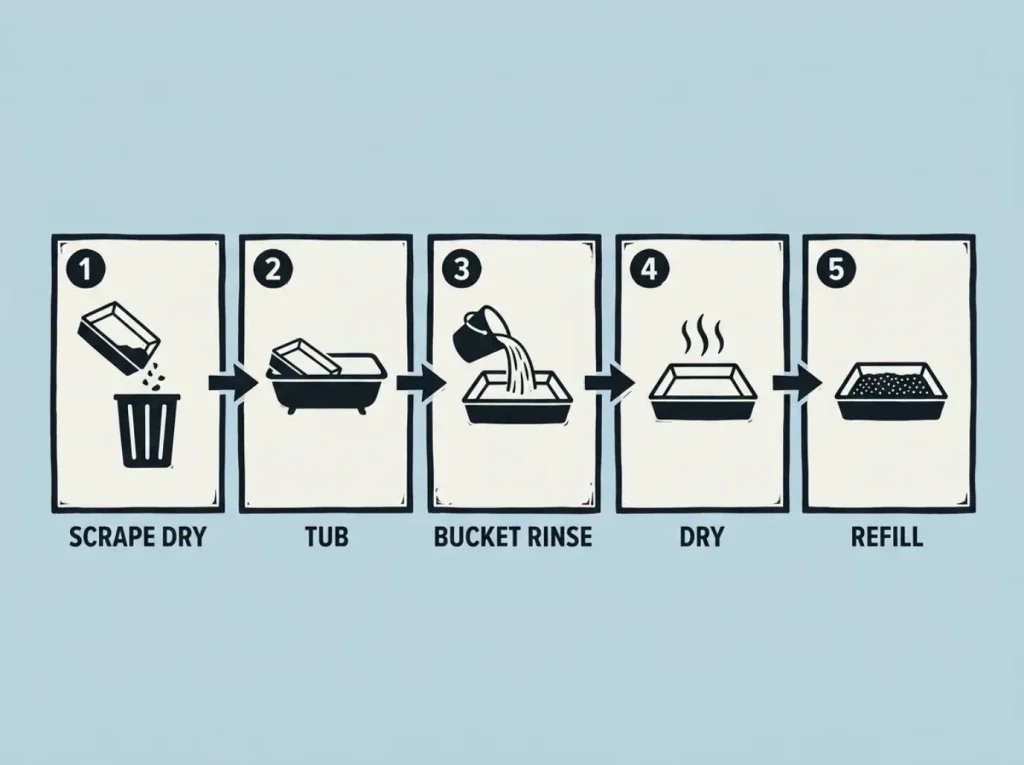
The kitchen sink is the worse option, not the convenient one. Food surfaces and litter residue do not belong within reach of each other, and a sink is too shallow to rinse a full-size tray without splashing the counter you make sandwiches on. Use the tub. If the box already lives in the bathroom, you have the shortest carry in the building and one less room to drip through, which is a small consolation but a real one.
The renter fix that shows up in apartment threads over and over is a bucket, and specifically a bucket that has been designated the litter box bucket and lives under the sink doing nothing else. It sounds trivial. It removes the hesitation of “which bucket did I use,” and people who do it report they stopped putting the wash off, which is the entire game.
The Between-Washes Touch-Up When a Full Wash Is Not Happening Today
Some weeks the tub is not available, or you are not available, and the honest answer is that a full soap wash is not happening. There is a middle tier for that, and it is walls and rim only. Wipe down the vertical surfaces where urine has sprayed and dried, which is where a surprising share of the room’s smell actually lives, and leave the deep clean where it belongs on the calendar.
An old sponge you were going to throw out does this fine, and that is the free version. If you would rather not keep a dedicated wet sponge around, Nature’s Miracle Cat Litter Box Scrubbing Wipes come thirty to a pack with an enzymatic formula, which matters because enzymes break the residue down rather than smearing it thinner. Thirty wipes at one weekly touch-up covers roughly seven months. The limitation is worth stating plainly: a wipe cannot get into the corner seams and it does nothing for the floor of the tray under the litter, so it buys you an honest week and never a month.
When the Smell Comes Back in 48 Hours, the Box Is the Problem
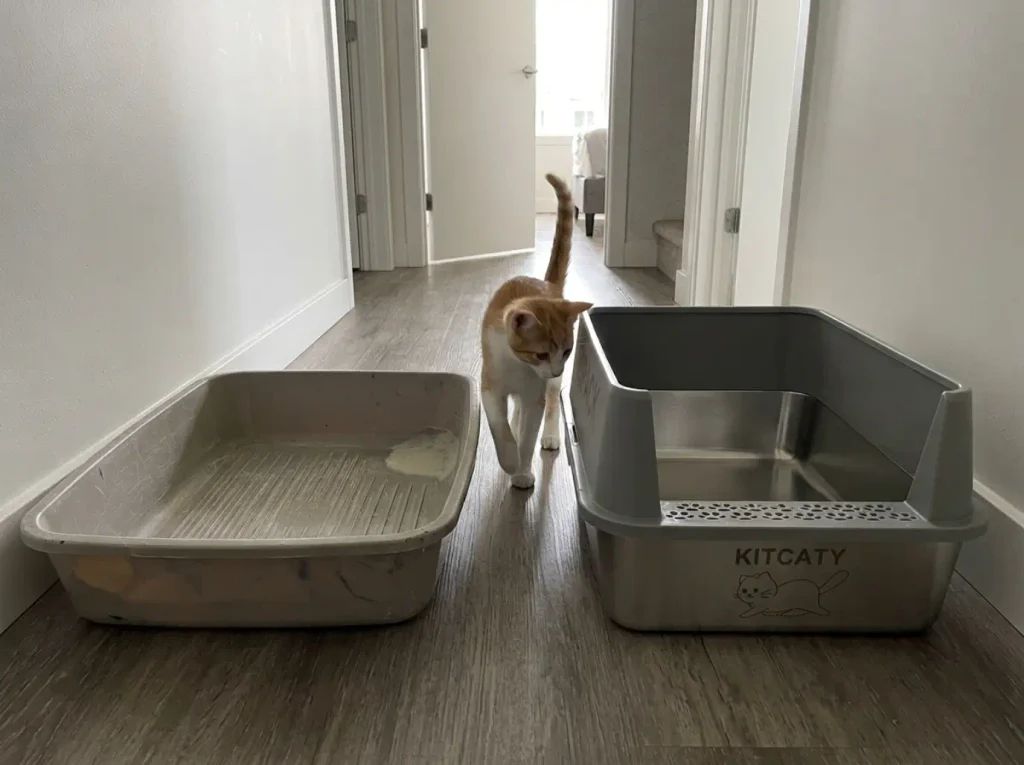
This is the section that matters most, and it is the one every competing article leaves out.
The Rebound Test, and What 24 to 48 Hours Tells You
Do a genuine deep clean. Soap, corners, full dry, fresh litter at depth. Then start counting. A freshly cleaned box is not supposed to be odorless forever, and how long a box is supposed to smell after a clean is the baseline you are measuring against, but if the room smells again within 24 to 48 hours, stop adjusting the schedule.
Washing more often cannot fix a surface problem. You will just be washing a contaminated box more frequently, and you will conclude you are bad at cleaning.
That is the rebound test. It costs nothing, it takes two days, and it tells you which of two completely different problems you have.
What Scratched Plastic Actually Does
Plastic does not stay smooth. Litter granules are abrasive, claws are abrasive, and a metal scoop dragged across the floor of the tray twice a day for two years is doing exactly what it sounds like.
The result is thousands of micro-scratches, and those grooves hold urine residue and bacteria below the level any sponge reaches. Soap works on surfaces. It does not work on a surface with texture finer than the sponge.
Once that has happened, the box itself is the odor source, and every clean starts from a contaminated baseline.
This is where the human and the cat see two different objects. The human sees a box that looks clean, because it is clean where light lands, and concludes the cat is being difficult about it. The cat is standing in front of two years of accumulated scratches with a nose that reads them the way you would read a label. He is not objecting to a clean box. He is telling you it isn’t one, and on the evidence available to him he is right.
The Four Replace-By Signs
The check takes about thirty seconds standing over the tray. Four signals put a plastic litter box on the box replacement list.
Replace it when you see visible scratches, cracks or grooves in the plastic. Replace it when there are stains that no longer wash out. Replace it when odor lingers immediately after a deep clean. And replace it when a cat starts avoiding a box that is objectively clean, because litter box avoidance on a tray you just scrubbed is the tray talking, not the cat.
Plastic gets roughly a year. That is a rule of thumb rather than an expiry date, and a lightly used box in a single-cat home stretches past it while a shared box in a three-cat apartment will not make it.
Run a fingernail slowly across the floor of the empty tray, in the spot the cat stands most. If you can feel the grooves catching, so can the smell, and no wash is reaching the bottom of them. It is the fastest diagnostic in this article and it costs nothing.
Before buying anything, run that test on the box you already own. A good half of the people reading this will find their schedule was fine all along and their tray is four years old, which is a much cheaper discovery than a new cleaning routine that was never going to work.
If the grooves are there, more washing is not the answer and a new plastic tray only restarts the same clock. Steel is the material fix: it does not micro-scratch the way plastic does and it does not absorb, so the annual replacement clock stops, and whether metal boxes really do smell less has a more precise answer than most people expect. The 2-Pack Stainless Steel Litter Box with Lid runs 23.8 by 16 by 12 inches per tray, which also clears the length a full-grown cat needs to turn around without touching a wall, something most trays sold as large do not. Two caveats, honestly: steel is cold, loud when scratched at, and a few cats want a week to accept the sound, and buying a two-pack when you needed one tray only makes sense if you were going to run the plus-one anyway.
🚑 One line that belongs here and then stops. A cat that suddenly stops using a box he used yesterday can be telling you about something medical rather than something plastic. That is a vet visit, today, before it is a cleaning question, and everything above assumes the vet has already cleared him.
Keeping the Cadence When Life Gets in the Way
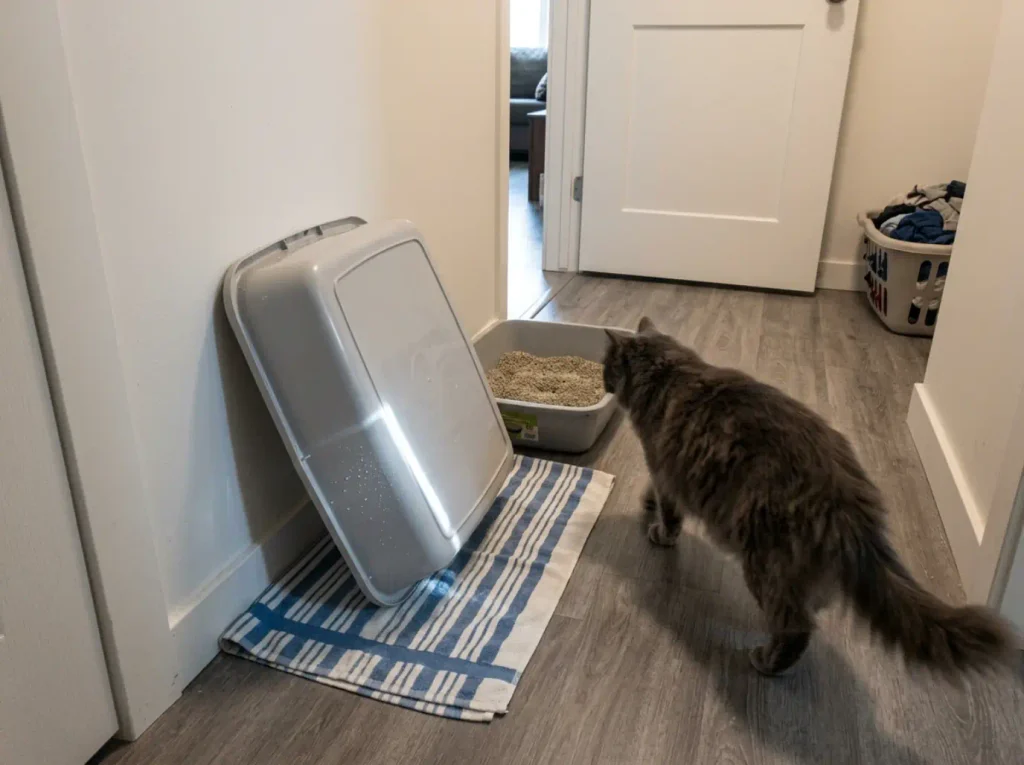
Two-tier schedules do not fail in week one. They fail in week three, which is where every household routine goes to die, and they fail for a reason that has nothing to do with motivation.
Stop tying the deep clean to a date. A calendar reminder that says “wash the litter box” on the 15th gets dismissed on the 15th, because a notification asking for twenty minutes always loses to whatever you were already doing. Anchor it to something that already happens: the day the litter bag runs out, rent day, the first laundry load of the month. An event you are already standing up for carries a second task much better than a reminder does.
And if you arrived here owning a Litter-Robot or similar, note that an automatic box does not remove this job, it moves it, because the rake handles solids and the drawer, the rake and the base still need the monthly wash.
The weekly full change survives better than the monthly wash for one boring reason: it is short. So protect the monthly by keeping it small in your head. It is twenty minutes and most of that is the box drying without you. People who mentally file it as an afternoon project do it once.
The single best structural fix is two trays in rotation. The wet one dries on its own schedule while the dry one is in service, which removes the drying step from the critical path entirely, and nothing has to be finished before the cat needs it. That is also the strongest argument for the plus-one rule that has nothing to do with the cats and everything to do with you.
At week three, check three things: whether the litter is still going in at the right litter depth, whether the corners are still getting scrubbed or only the open floor of the tray, and whether anyone in the house has quietly gone back to topping up instead of dumping. Those slip first, in that order.
And routines break at the drying step before they break anywhere else. The box gets washed, gets refilled damp because waiting is annoying, the clumps weld to the bottom again, and by the following month the wash is twice as hard as it was, which is when people decide deep cleaning does not work. It worked. The towel didn’t.
If the smell survives a cadence you are genuinely keeping, the rest of what keeps a room from smelling is the next thing to look at.
If you own two trays, the second one is not a spare. It is what makes the wash cadence survivable, because the washed box can take as long as it needs to dry while the cat has somewhere to go the whole time. Rotate them and the drying step stops being the reason you postponed.
The Two Clocks, and the One That Isn’t a Clock
Scooping, changing and deep cleaning are three jobs on three different clocks, and the one most people skip entirely is the middle one. Dumping the litter is what decides whether the wash is a twenty-minute job or an hour of scraping welded clumps out of a corner.
Clumping litter and one cat buys you a monthly scrub and an every-other-week change. Non-clumping, or a second cat, and the whole schedule tightens, with the litter type moving the number considerably further than the cat count does.
And if the smell is back two days after a real deep clean, the schedule was never the variable. Check the tray for grooves before you check the calendar.
Three weeks from now, look at two things and only two: whether the litter is still going in at full depth, and whether the corners are still getting scrubbed. Those are the first to slide, and they slide quietly.
Start by running the fingernail test on the box you already own. If the floor of the tray is smooth, your schedule is the only thing that ever needed changing, and that is free.
Amazon’s Audible — free for 30 days
Your cat won’t let you read. Let someone read to you.
Audible is Amazon’s audiobook library — thousands of titles, read out loud, on your phone. Free for a month, plus one audiobook to keep forever.
Frequently Asked Questions
01How often should you clean a litter box with one cat?
Scoop daily, do a full litter change and rinse every other week with clumping litter, and give it a soap-and-dry deep clean every three to four weeks. Non-clumping litter tightens the full change to every two or three days, because urine never leaves the tray between changes.
02Can you use bleach to clean a litter box?
No. Bleach and ammonia produce a toxic gas if they meet in the tray, and even used alone, harsh scented cleaners leave a smell a cat reads as another cat’s marking. Mild unscented dish soap and hot water is the whole recipe.
03How often should you replace a litter box?
Roughly once a year for plastic, and sooner if the tray has visible grooves, stains that no longer wash out, or odor returning within a day or two of a real deep clean. Stainless steel does not micro-scratch the same way, so it does not carry that annual clock.
04Do you need to deep clean an automatic litter box too?
Yes, on about the same monthly cadence. The rake handles solids, but the waste drawer, the rake itself and the base still accumulate residue that only a wash removes. The machine moves the job rather than deleting it.
05How often should you clean a litter box with two cats?
Scoop two or three times a day and move the full litter change to every one or two weeks with clumping litter, or every four to five days with non-clumping. The monthly deep clean stays monthly, but skipping it shows up much faster with two cats than with one.

Leave a comment