How Many Litter Boxes for Two Cats? Three, Usually
How many litter boxes for two cats: three, and where each one goes. Plus what to do when a third genuinely won't fit in your apartment.

Alfredo RamsesFounder · August 25, 2026 · 16 min read

On this page7 sections
- 1Three Boxes for Two Cats, and Where the Number Comes From
- 2Why Two Cats Will Not Share One Box, Even When They Like Each Other
- 3Three Boxes in One Bathroom Count as One
- 4When Three Boxes Will Not Physically Fit
- 5The One Case Where Two Boxes Is Genuinely Enough
- 6What to Do Tonight
- 7Frequently Asked Questions
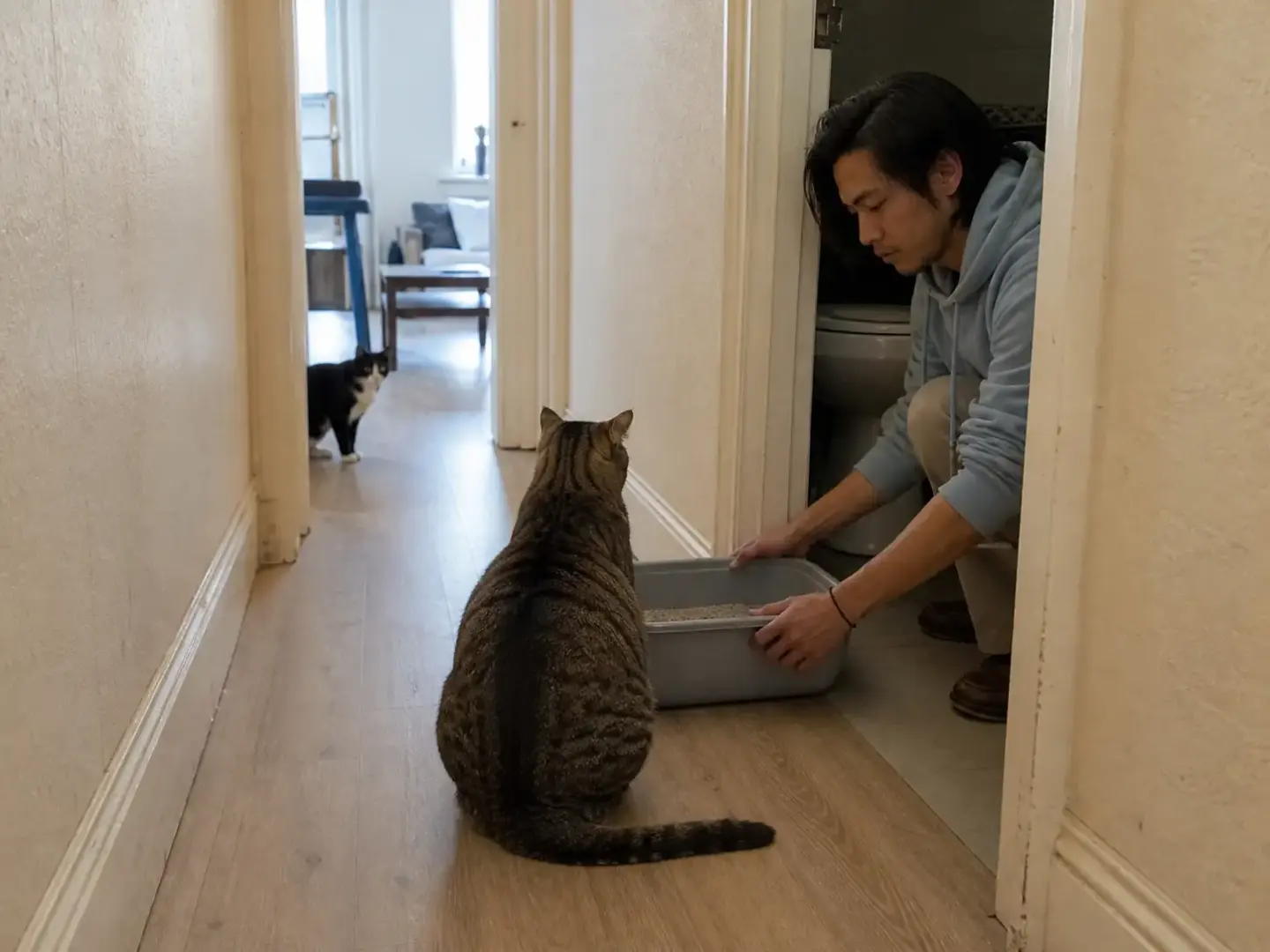
One box worked for two cats for a year, and then one Tuesday somebody went on the bath mat instead. He is not protesting and he is not confused about where the box is. He is reporting a queue you never noticed, because the queue is silent and it happens at three in the morning.
The number itself is not folk wisdom either: the veterinary groups that publish on this, from the AAHA and AAFP guidelines to Cornell’s Feline Health Center, all land on the same arithmetic, and they land there for a reason that has nothing to do with hygiene. Below is the number, why two cats will not share the way you assume they do, why three boxes in one bathroom still count as one, what to do when three genuinely will not fit in your apartment, and the single case where two is honestly enough.
Quick Answer
Two cats need three litter boxes: one per cat, plus one. The spare is not a luxury, it is what stops either cat from controlling the only option. Three works only if each box is large enough and they sit in genuinely separate places. A bonded pair can run on two, right up until one of them is sick, stressed, or guarding.
Three Boxes for Two Cats, and Where the Number Comes From
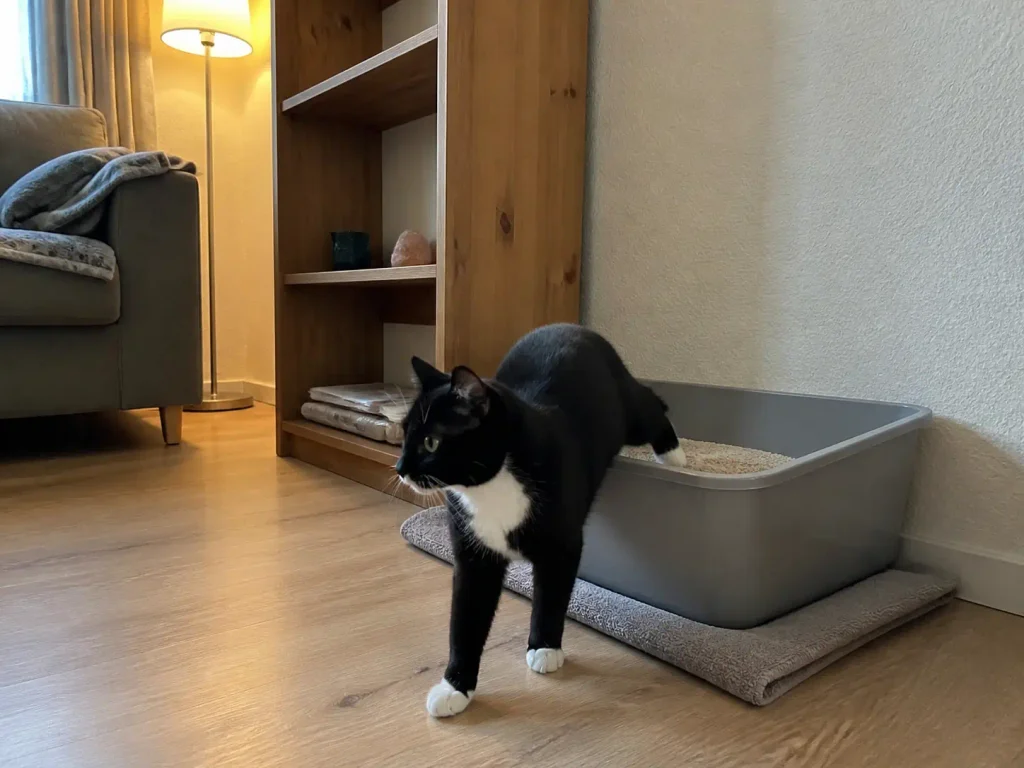
Two cats, three boxes. One box per cat plus one spare, which is the rule usually written as n+1. That is the whole answer to the question, and it takes one line, which is roughly how much attention it usually gets before everyone moves on to placement advice.
The part almost nobody explains is why the extra box exists, and without that explanation the rule reads like something invented by people who sell litter boxes. It is not a spare in the hygiene sense, the way a spare roll of paper towels is a spare. It is the box that exists so that no single box can be owned.
Cats do not treat a litter box as plumbing. They treat it as a resource with a location, and resources with locations get claimed. Two boxes for two cats means that on any given evening, one cat can be standing between the other cat and both of them, and the arithmetic collapses to zero available options for whoever is lower in the hierarchy that week.
That framing is not a stylistic choice. The AAFP and ISFM house-soiling guidelines treat litter boxes as key territorial resources in a multi-cat home, which is precisely why the recommendation is a count with a distribution attached rather than a single tray kept scrupulously clean. Adding boxes reduces competition. Cleaning one box harder does not.
And here is the thing that makes the rule feel broken to so many people who followed it: the rule has four parts, not one. Count is the first. Distribution across the home is the second. Size, at roughly one and a half times the cat’s nose-to-tail-base length, is the third. Daily scooping is the fourth.
Most readers only ever get told part one, so they buy the third box, put it next to the other two, and conclude that the whole thing was nonsense. It was not nonsense. It was three quarters missing. If you want the sizing method itself, sides, entry height and interior dimensions, that lives in our guide to how to choose a litter box by size, sides and entry, because this article deliberately does not re-teach it.
The most repeated confession in multi-cat threads is exactly this shape: bought the second box, put it right beside the first one, nothing changed, went back to assuming the cat was being difficult. He was not. You gave him one location with two trays in it, and he counts locations.
If you are adding a box today, add it in a different room from the one you already have, not a bigger box in the same corner. The count only starts paying off once the boxes are in separate places.
Why Two Cats Will Not Share One Box, Even When They Like Each Other
Your two cats groom each other and sleep stacked in the same chair, so the idea that they need separate bathrooms sounds like an upsell. It is a fair objection and it is the single most common reason people stop at two boxes. It is also based on a category error, because affection and box-sharing are not measuring the same thing.
A litter box is a place where a cat is briefly committed. He is in a confined space, his balance is occupied, his back is turned to at least one direction, and he cannot leave quickly.
That vulnerability is why the box is a territorial resource and not a shared appliance. Two cats can adore each other and still both prefer not to be the one caught mid-squat when the other one walks in. Friendliness does not change the geometry of that moment.
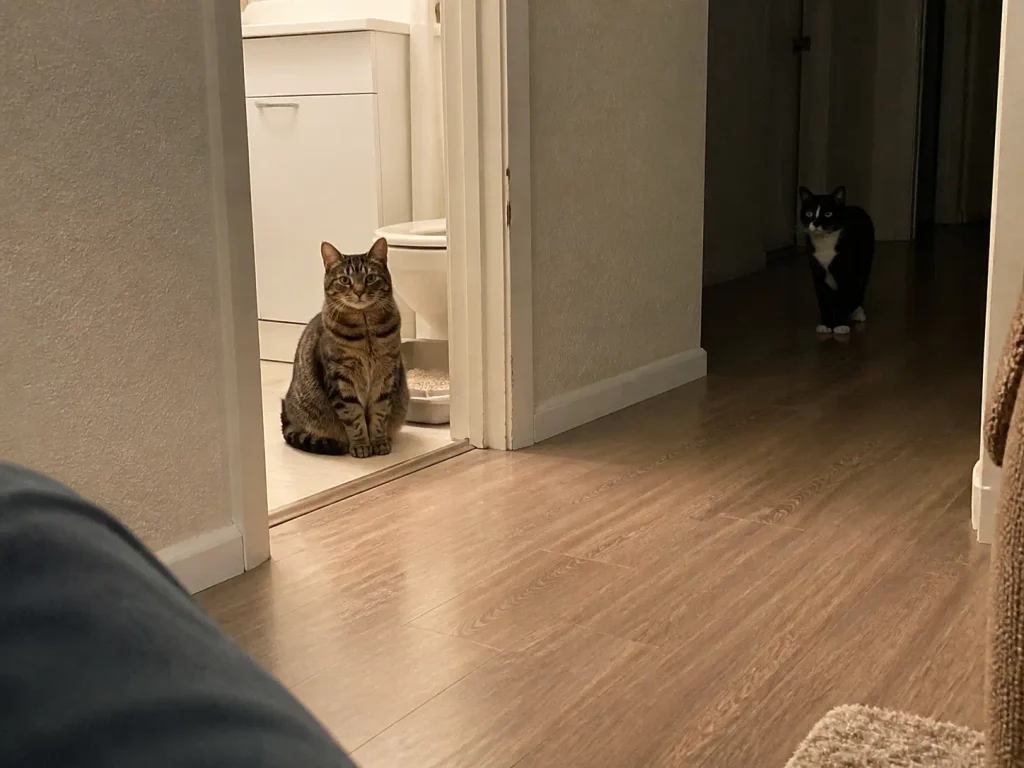
Guarding is the mechanism, and guarding almost never looks like a fight. This is what makes it so easy to miss for months. It looks like one cat sitting in the doorway, apparently doing nothing, while the other one is in the box.
It looks like a long unblinking stare from across the room. It looks like the exit sprint, the cat who leaves the box at speed for no visible reason.
Communities have a name for this that says it better than the behavioral literature does: the silent standoff. Nobody hisses, nobody swats, and the owner watching it happen reads it as the cats hanging out near each other.
- One cat sits in the doorway or hall while the other is in the box. No contact, no noise. Watch whether the sitting is timed to the digging, because that is the tell.
- A long stare from across the room. A cat who is genuinely relaxed near the box does not track the box.
- The exit sprint. Leaving the box at a run means the exit is being anticipated as a problem, not that the cat is playful.
- One cat only ever goes at night. This is the one owners almost never catch, because it happens at three in the morning specifically so that it will not be observed.
Scent does the rest of the work. A box carrying another cat’s deposits does not read to a cat as dirty, which is the assumption baked into the phrase “but I scoop it every day.” It reads as occupied.
That distinction matters, because the person who scoops twice daily and still has a cat going next to the box concludes that cleaning is not the variable and gives up on the whole line of thinking. Cleaning genuinely is a variable, and ammonia starts building about thirty minutes after the pee, so daily scooping earns its place. It is just not the variable in play here. If your presenting problem is smell rather than misses, the counting question is one of five things behind odor that comes back a day after you clean, and box count is on that list for exactly this reason.
There is a cost attached to getting this wrong, and it is heavier than a laundry problem. Inappropriate elimination is the leading behavioral reason cats get surrendered to shelters, per Salman’s 2000 study of relinquishment. The path there is not dramatic. It is a cat quietly avoiding a contested box for a few weeks, an owner who never sees the guarding because there was nothing loud to see, and a habit that has moved to the rug by the time anyone connects the two.
Three Boxes in One Bathroom Count as One
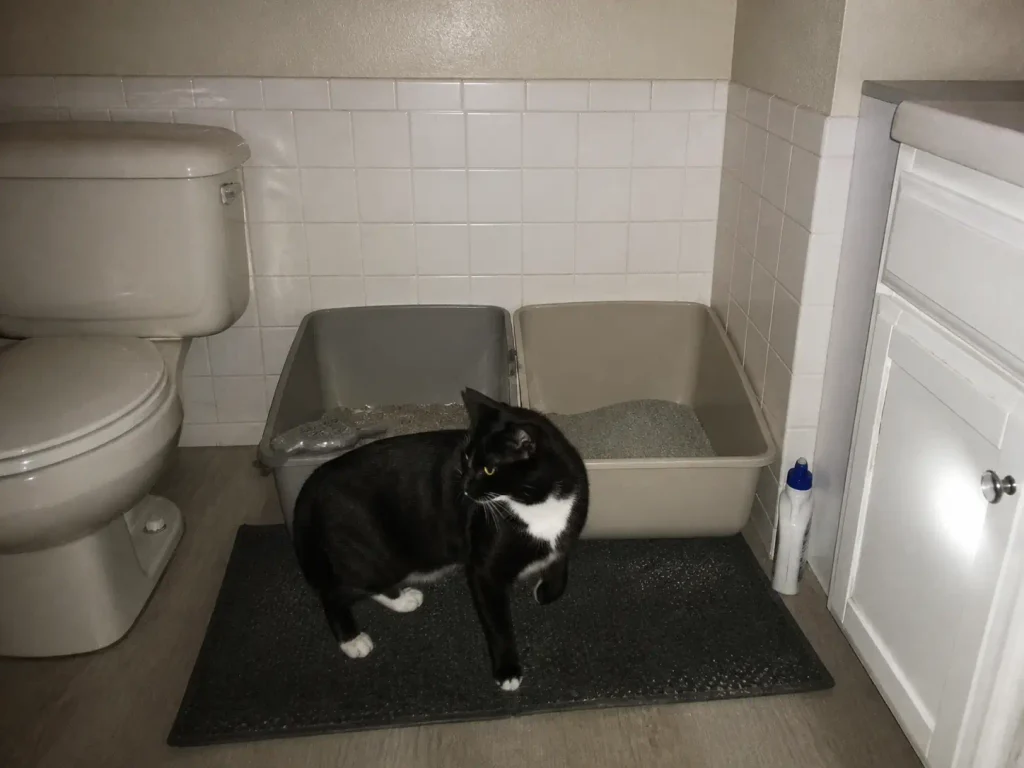
You did the thing. You bought two more boxes, lined them up along the bathroom wall, and six weeks later somebody is still going on the bath mat. This is the most expensive way the rule fails, because it costs money and effort and produces exactly the same result as doing nothing.
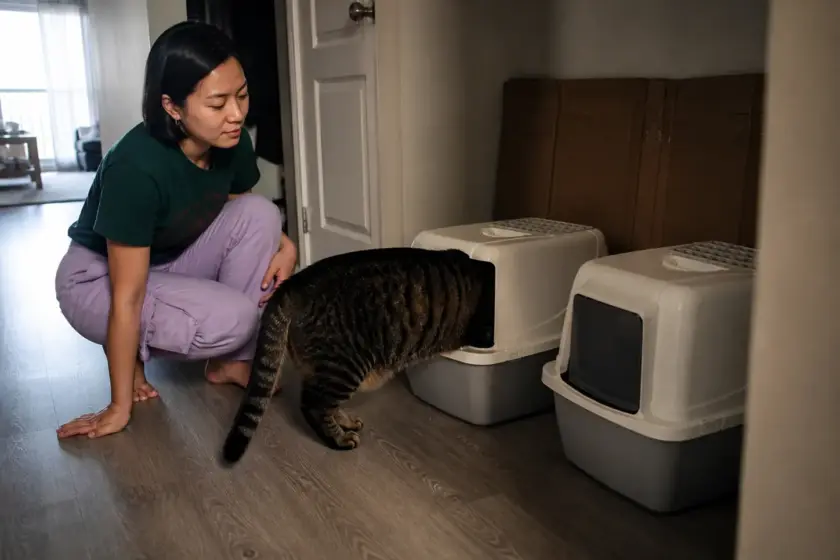
A cat evaluating three boxes side by side along one wall does not see three options. He sees one big box with three doors, in one location, reachable by one route.
One cat sitting at the end of that row controls all three of them without touching anything. The rule was never about how many trays exist. It was about how many places a cat can go where the other cat is not.
So distribution is the part of the rule that does the actual labor. Boxes in genuinely separate places, ideally on opposite sides of the home, and on each floor if you have more than one.
Away from the feeding station, because a cat does not want to eat where he eliminates any more than you do. Away from the washing machine, and away from any other high-traffic area where someone walks past at unpredictable times, because a busy spot is survivable and an unpredictable one is not. And never in a spot with only one way out, which rules out most narrow closets and the dead end behind a door. A cat who can be cornered in a box has already started planning an alternative.
Then there is the apartment problem, stated honestly rather than dodged. If you have one bathroom and forty-something square meters, the advice to spread three boxes across three rooms is describing a home you do not live in. Most articles reach this point and stop, or suggest you find more space, which is not advice, it is a description of your problem read back to you. The next section is the actual answer.
What keeps working in small apartments, judging by the fixes people report back as successful, is almost never a bigger or better bathroom setup. It is one box moved somewhere nobody had classified as a litter box location. Which is a lower bar than it sounds.
Stand where your quieter cat sleeps and look toward the box. If the only route there passes the other cat’s favorite chair, that box is further away than the floor plan says it is.
When Three Boxes Will Not Physically Fit
You are not being lazy. You live in a studio, or a one-bathroom rental, and the only remaining place for a third box is the middle of the room where you eat. That is a real constraint, and the honest answer starts with the free options, because a surprising number of them work.
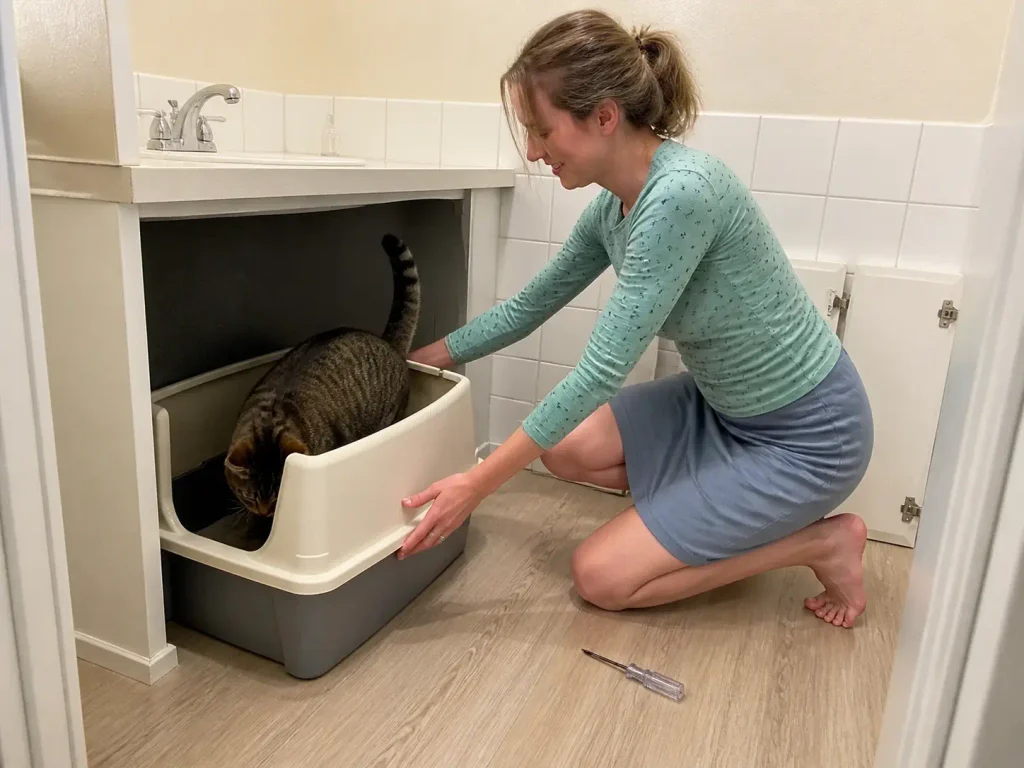
Take the doors off the bathroom vanity and look at the gap underneath. In a lot of rentals that gap is a genuine second location, and it is about as renter-friendly as a fix gets: it costs a screwdriver, and the doors go back on when you move out.
A four-leg end table or nightstand is another one, and it is better than it looks: a box tucked under a table with open sides gives multiple entry and exit routes, which is the exact quality a cat is checking for. The far corner of a closet with the door left open works if the door genuinely stays open. And in a studio where you have room for two boxes and no more, put them at opposite ends of the space rather than together, so that at minimum the two you have are two locations instead of one.
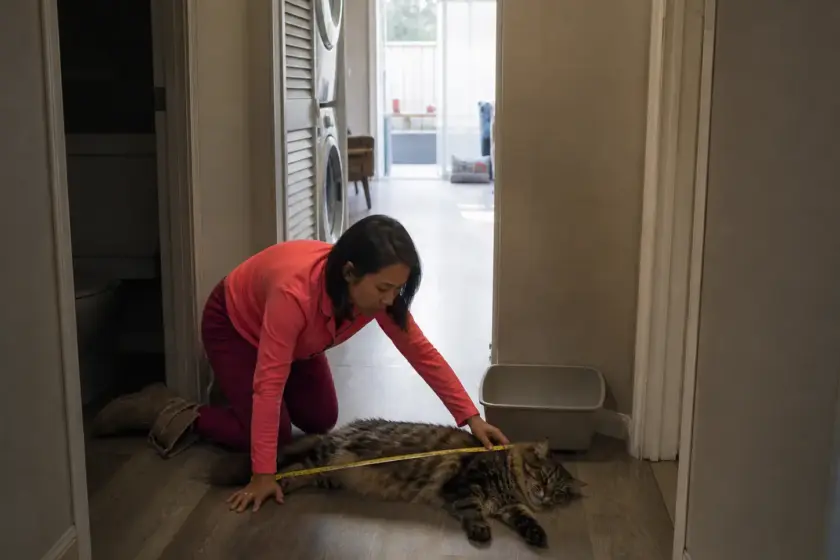
When count is capped, size becomes the lever you have left. This is where most of the SERP goes quiet, and it is the part that changes outcomes. A cat needs a box roughly one and a half times its length from nose to the base of the tail, and the box marked “large” on the shelf routinely is not.
That target is not a preference detail either: in a controlled comparison, cats chose the larger box over the smaller one at a meaningful margin, roughly 34 inches long against 22. Size measurably changes whether a box gets used, and it is the one variable you can still fix in an apartment where you cannot add a third location. Our full treatment of what size litter box a cat needs, in inches has the measuring method; the number you need here is the multiplier.
For a cat of ordinary size, that target is easy to hit without buying anything specialized. The Amazon Basics Large Cat Litter Box is a plain open-top pan with high sides, and it clears the bar for most average adults at a budget-friendly level. Its limitation is the honest one for any open pan: high sides help with scatter but nothing stops a determined digger from throwing litter over the top.
Big cats are where the math gets uncomfortable. A large Maine Coon at full stretch is well past what a standard “large” pan covers, and the AAHA sizing spec quietly eliminates most commercial pans for cats over ten pounds.
If that describes your cat, the number you actually need is closer to what the XXXL Stainless Steel Litter Box gives you at 28 by 20.5 by 16.5 inches. The catch is footprint. Twenty-eight inches is a lot of floor in a small apartment, and the lid it ships with reduces the usable interior, which is worth thinking through if the box is going somewhere tight. If you are weighing that trade, covered versus uncovered, by the numbers covers what a lid does to effective space.
If the constraint is money rather than floor space, the fastest route from one box to three is buying two at once. A 2-pack of stainless high-sided boxes at 23.8 by 16 by 12 inches each gets you both remaining boxes in one purchase and clears the sizing bar for an average adult cat at the same time.
Stainless is also the material that stops absorbing odor over time, though only grade 304 actually delivers on that. Two matched boxes make the “which one is he actually using” test easier to read later, since you are not comparing a nice box against a fifteen-year-old pan. Just do not let matching tempt you into putting them side by side. That is how a two-box purchase becomes a one-location purchase.
I used to think a self-cleaning box was mostly beside the point in a two-cat home. Enough threads later where the presenting complaint is specifically “they both want whichever box was just scooped,” I stopped dismissing it, with one boundary. A Litter-Robot 4 resets itself after each use, so the always-clean box stops being a scarce resource, and that is a real variable in a home where one cat is fussy about a used box.
What it is not is a replacement for a second location, and Whisker does not claim otherwise in its own multi-cat guidance. It solves cleanliness. Territory is untouched. If your cats are avoiding each other, an automatic box in the same corner as the manual one is still one corner.
That is the trade, plainly: if you can reach three locations, do that first. If you cannot, make the two you have properly large and put them as far apart as the apartment allows.
Before buying anything, take the doors off the bathroom vanity and look at the gap underneath. In a lot of rentals that is the third location, and it costs a screwdriver.
The One Case Where Two Boxes Is Genuinely Enough
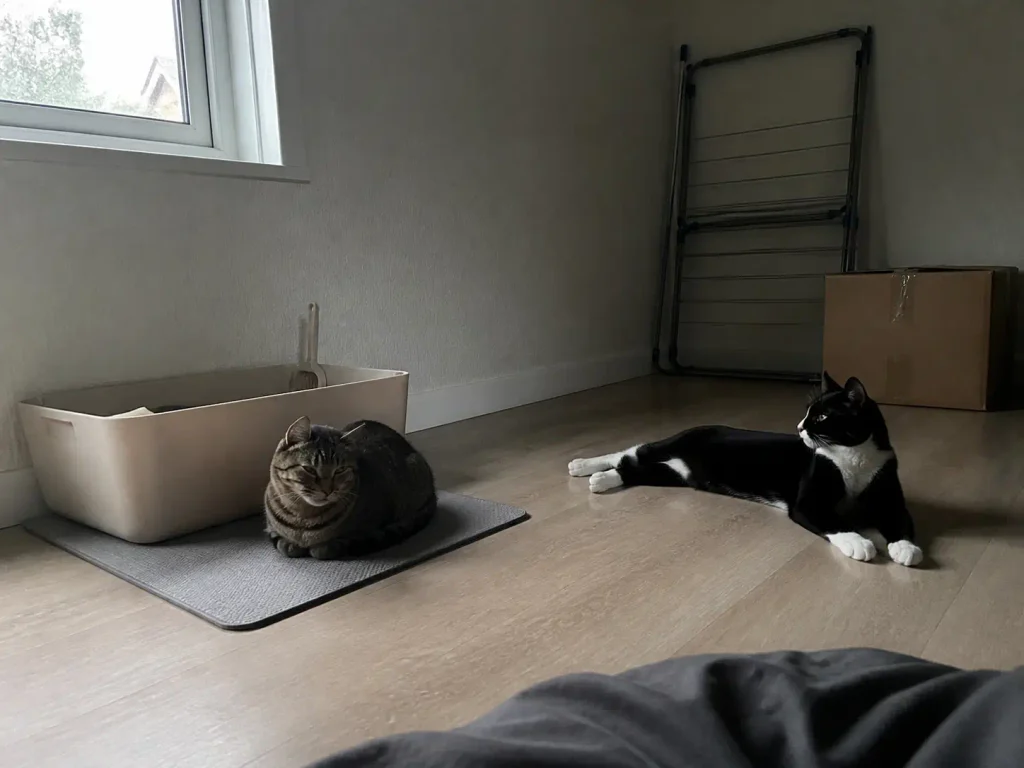
If you have two bonded cats and two boxes that have worked for years, every article you have read has told you that you are doing it wrong. You are not necessarily doing it wrong. The exception is real, and almost nobody publishes it because a conditional rule is harder to write than an absolute one.
Genuinely bonded cats, littermates or a pair that groom each other, sleep touching, and share everything else without negotiation, often run on two boxes indefinitely. Not because the territorial mechanism switched off, but because these two have already settled the territory question between themselves and the box is not a contested resource in that particular household. Vets who write about this conditionally rather than absolutely say the same thing: two often works if the cats are bonded and you are paying attention.
The conditions are what make it work, and they are stricter than the three-box version, not looser. Both boxes generously sized, because with only two options you have no margin for a box being marginal. Both in separate places, because two boxes in the bathroom is still one location no matter how much the cats like each other. And scooped daily rather than most days, with a full deep clean of both boxes when you change the litter out, since “most days” plus two boxes plus two cats is a thinner buffer than it sounds.
Then there is the part nobody publishes, which is what breaks it. Illness in either cat. A stressor in the home, which means a move, a new person, a new animal, or building work next door. One cat starting to guard, which as established you may not see for weeks.
Or you traveling for a long weekend and the scooping falling behind while nobody is there to notice a change.
What makes this genuinely difficult is that the setup does not degrade gradually. It works, it works, it works, and then within a few days of the stressor arriving one cat has stopped using a box entirely. The two-box arrangement was never stable. It was untested, which is not the same thing.
So here is the honest test, and it takes a week. It is working if both cats use both boxes. Not equally, and not with any particular frequency, just that both boxes get used by both animals at some point. If each cat has quietly become a one-box cat, what you have is not a bonded pair sharing a system. It is a territory that has been divided, and a division that has held for two years can still fail in the week either cat gets sick.
And one line on the thing this article cannot help with: if either cat has already started going outside the box, straining, or going noticeably more often, that is a vet visit before it is a furniture question. Everything above assumes both cats are healthy.
For one week, note which box each cat uses. Not how often, just which one. If the answers never cross over, you have two cats with one box each and no spare.
What to Do Tonight
Three boxes for two cats, and the third one exists so that no box can be owned by one cat. That is the count, and the count is the easy part.
Distribution beats count every time. Three boxes in one room is one location, and a cat counts locations, not trays. If you only change one thing after reading this, change where a box is rather than how many you own.
And if three genuinely will not fit, make the two you have properly large and properly far apart, then watch whether both cats use both. That is the whole diagnostic, and it costs nothing.
Give it three weeks and check three things: whether both cats are using more than one box, whether the doorway sitting has stopped, and whether anyone is still going next to the box rather than in it. Three weeks is the right window because a cat accepts or rejects a new arrangement in days, and a new scooping routine is what slips by the third week.
Tonight, move one of the boxes you already own to the other side of the apartment. If the guarding stops, you just answered the question for free.
Amazon’s Audible — free for 30 days
Your cat won’t let you read. Let someone read to you.
Audible is Amazon’s audiobook library — thousands of titles, read out loud, on your phone. Free for a month, plus one audiobook to keep forever.
Frequently Asked Questions
01How many litter boxes for 3 cats?
Four boxes, using the same one-per-cat-plus-one arithmetic. The distribution rule matters more as the number climbs, because four boxes spread across only two rooms is functionally two locations for three cats.
02Where should I put litter boxes for two cats?
In genuinely separate places, on different sides of the home and on each floor if you have more than one. Keep them away from the feeding station and out of spots with only one way in, so neither cat can be cornered.
03How many litter boxes for 2 bonded cats?
Three is still the recommendation, but a genuinely bonded pair often does fine on two if both boxes are large, separated and scooped daily. Check that both cats use both boxes. If each has settled on one, you have no spare.
04Should I have two litter boxes for one cat?
Yes, and it runs on the same logic. The spare covers the box that is dirty, the box blocked by a running washing machine, and the box in a room whose door happened to get closed while you were out.
05How many litter boxes for 1 cat?
Two. One cat plus one, the same arithmetic as every other count on this page. A single cat with a single box has no fallback the day that box is unusable for any reason.
Leave a comment